







Abstract
Objective:
Burnout among correctional nurses is a growing concern, with 50% to 62% reporting symptoms and intent to leave their positions. This occupational phenomenon, marked by emotional, physical, and mental exhaustion, stems from chronic workplace stress and is exacerbated in correctional environments due to overcrowding, perceived threats of violence, and limited autonomy. This study aimed to assess environmental contributors to burnout among nurses located in a southeastern U.S. county correctional facility.
Methods:
Using a cross-sectional design and the Maslach Burnout Inventory paired with the Areas of Work life Survey, the study evaluated six domains of workplace stressors.
Results:
Of 22 eligible participants, 45% completed the survey. Contrary to prior findings, nurses reported feeling safe and having adequate time to complete tasks. However, low scores in workplace relationships, recognition, and fairness suggest systemic issues. These findings highlight the need for leadership training, improved reward systems, and policy reforms to foster healthier work environments.
Conclusion:
Addressing organizational culture is critical to improving nurse well-being, retention, and patient outcomes. This study contributes to the limited literature on correctional nurse burnout and underscores the importance of targeted interventions to reduce stress and enhance job satisfaction in secure care settings.
Introduction
It is estimated that between 50% and 62% of nurses working in correctional facilities report symptoms of burnout and intent to leave (Forman-Dolan et al., 2022; Health Resources and Services Administration [HRS], 2024). Burnout is a state of emotional, physical, and mental exhaustion caused by prolonged and excessive stress (Maslach & Leiter, 2022). Of those correctional nurses reporting symptoms of burnout, 45% to 50% of them also suffer with depression symptoms due to the challenging and potentially dangerous nature of the work. Based on the inherent risks and associated increased stressors within the correctional environment, the incidence of burnout is greater as compared to community facilities and has significant negative impact on nurse well-being and the quality of patient care delivered (Cornelius, 2021; Forman-Dolan et al., 2022; Guardiano et al., 2022; Keller et al., 2023, 2024). Studies have shown that nurses who report burnout have a 57% increase in workplace absenteeism and are more likely to report medication and patient care errors (Aiken et al., 2023; HRS, 2024). Overall quality of care metrics for facilities with high rates of nurse burnout have decreased by 23%, with nosocomial infection rates increasing by 30% (Aiken et al., 2023; Forman-Dolan et al., 2022; HRS, 2024; Shah et al., 2021). There is extensive literature to define burnout among professional nurses, particularly for those who work in highly stressful environments. The COVID-19 pandemic exacerbated the prevalence and severity of burnout for the profession of nursing, bringing a heightened focus and awareness to the causes of burnout and the long-term impact on health care.
According to the World Health Organization (WHO, 2025), occupational burnout is a syndrome resulting from chronic workplace stress. Burnout is a job-induced phenomenon rooted in the work environment. Working in a restricted correctional environment refers to a secure, highly regulated setting where individuals are confined under legal authority and subject to strict controls on movement, communication, and daily activities. These environments are designed to maintain safety, enforce discipline, and support rehabilitation, often through structured routines, surveillance, and limited access to external resources or freedoms. These secure, tightly controlled environments produce additional workplace stressors related to the physical and psychological stressors from overcrowded inmate populations, perceived or actual, threats of violence that are not commonly experienced by nurses working in community-based and/or acute care facilities (Forman-Dolan et al., 2022). Burnout is often manifested in increased staff turnover and high absenteeism rates due to stress. It is also associated with high levels of stress and low levels of job satisfaction. If not addressed, burnout leads to mental anguish, diminished care quality, and operational inefficiency (Aiken et al., 2023; Forman-Dolan et al., 2022; HRS, 2024; Maslach & Leiter, 2022; Shah et al., 2021). While efforts are being made to address burnout and well-being at the individual level, little research evidence is available to guide organizational efforts to reduce or remove work-related cultural factors contributing to nurse burnout. Therefore, this project was designed to assess environmental factors contributing to burnout among nurses working in a correctional care facility. Findings from this project will inform interventions to address cultural and organizational factors propagating burnout among correctional nurses.
Method
Research Design
This project utilized a quantitative, cross-sectional research design.
Sample and Setting
A convenience sample was recruited from an accredited, secure county correctional facility in the southeastern United States to explore workplace factors associated with burnout among nursing staff working in a correctional facility. The setting capacity is 540 beds and a current population of 695 inmates across both minimum- and maximum-security levels. The sample included all nursing staff: nurse practitioners (NPs), registered nurses (RNs), licensed practical nurses (LPNs), patient care technicians (PCTs), and unit clerks (UCs), who were assigned to the medical unit. Non-nursing personnel were not included in the survey. There were no contracted employees at the facility.
Instrument
The study design and survey instrument were framed by the seminal work of Maslach and Jackson (1981), defining the phenomenon of burnout. The Maslach Burnout Inventory (MBI), an empirically validated instrument for assessing the three domains of occupational burnout, has become the gold standard for identifying individuals at risk of burnout since its debut over 35 years ago. The Areas of Work life Survey (AWS), a companion survey to MBI, is a concise 28-item 1 to 5 Likert-type-style questionnaire. The survey rates participant engagement, (1) “strongly disagree,” (2) “disagree,” (3) “neutral,” (4) “agree,” and (5) “strongly agree” across six components of the work environment that may exacerbate burnout. AWS, with established reliability and validity by American Psychological Association (APA) PsychNet Database across diverse occupational settings compliments the MBI (Leiter & Maslach, n.d.). Where the MBI identifies individuals at risk of burnout the AWS identifies individual engagement to identify environmental factors contributing to burnout. Together the combined survey provides a comprehensive framework for understanding both the individual experience and the systemic conditions propagating burnout. The AWS component of the combined survey tool supported the aim of this project by identifying organizational drivers of burnout across six domains: workload, control, reward, community, fairness, and values, evaluating work demands, autonomy, recognition, workplace relationships, perceived equity, and value alignment to pinpoint systemic stressors. One item was reverse scored: “I feel like my work demands spill into my personal life and/or cause physical stress” for congruence with other item interpretations. Following Institutional Review Board Approval (24-05-7639), the AWS was made accessible to nursing staff through a secure, anonymized Qualtrics-generated QR code.
Procedures
Potential study participants were introduced to the project during their departmental meeting on June 20, 2024, and subsequently recruited via informational flyers posted on the medical unit and in the staff restrooms in the weeks of June 23 and July 7, with surveys closing July 12, 2024. Flyers contained information for the informed consent describing the purpose and aims of the survey and a QR Code to allow potential participants access to the informed consent. All health care providers and staff who were >18 years of age and currently employed on the medical unit at the county jail were eligible to participate.
Data Analysis
Descriptive statistics such as mean and standard error of the mean were used to perform item analysis of organizational drivers of burnout questions. Bar graphs with error bars were used for data visualization of response summaries. All item-total correlations were 0.20 or higher, a minimum psychometric standard indicating quality of the survey items and adequate item discrimination (See Figure 1). Each item adequately discriminated between individuals with higher and lower levels of engagement within the six domains identified within the instrument. Data analysis was performed using Statistical Package for the Social Sciences (SPSS Version 29).
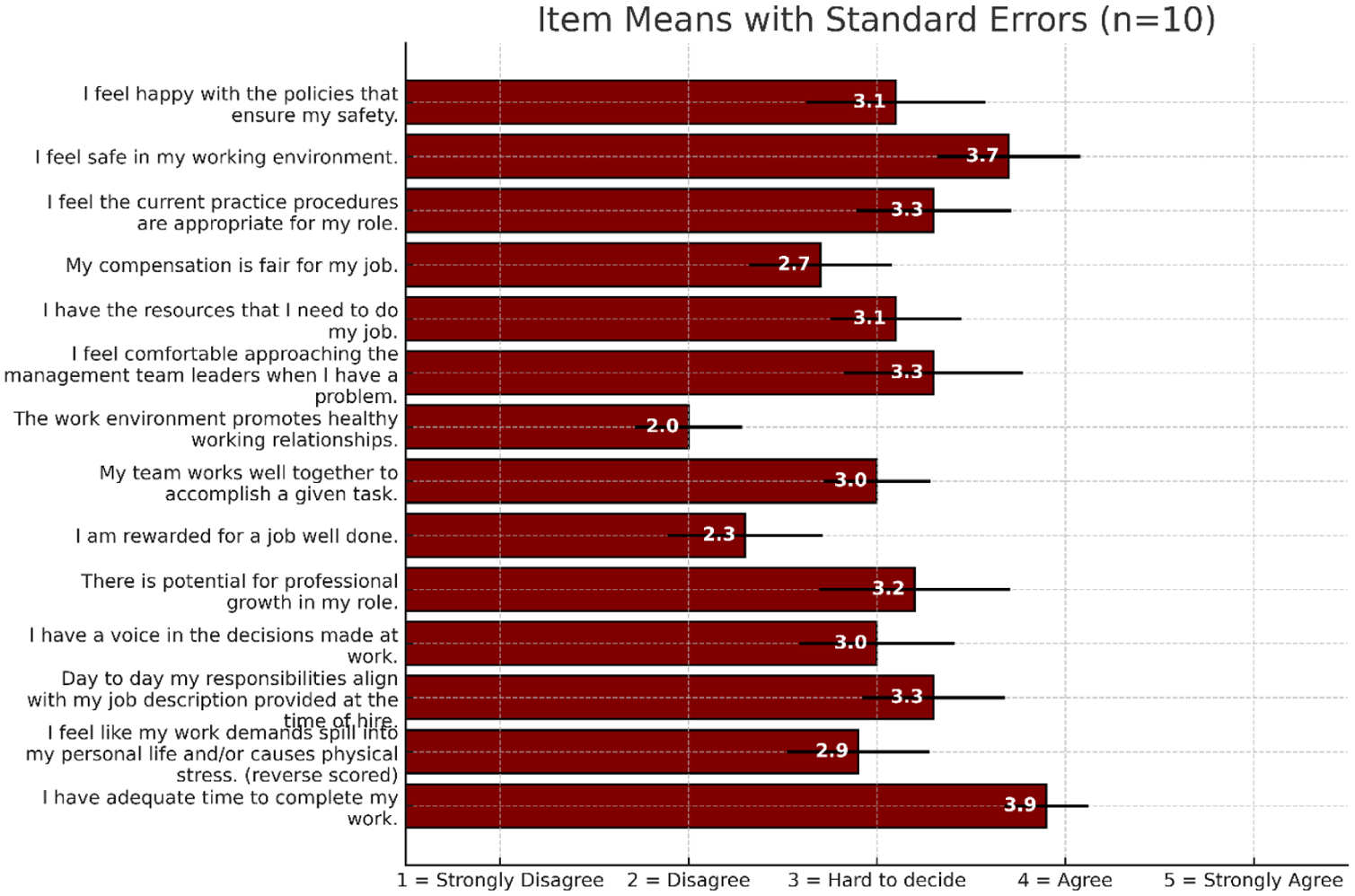
Item Means with Standard Errors (N = 10).
Results
The response rate was robust, with 45% of eligible individuals (10 out of 22) completing the survey. Of the initial 16 responses, one was identified as a survey preview and excluded from analysis. Among the remaining 15 responses, four either declined to provide consent or had missing consent information. Of the remaining 11 participants, one respondent completed only the consent form without providing any additional data, resulting in a final analytic sample of 10 participants. The sample included 10 female participants, comprised of five White and five Black individuals. There were five LPNs, three RNs, one PCT, and one clerical staff member. Seven participants held an Associate’s degree as their highest level of education. All had been employed in the jail’s medical unit for 2 years or less, with five reporting less than 1 year of tenure. Participant ages ranged from 24 to 53 years, with four individuals between 44 and 53 years and six between 24 and 43 years. The frequent turnover exhibited by the nursing staff is reflective of the burnout experienced by the staff in the facility. We were tasked with examining causative factors (Aiken et al., 2023; Forman-Dolan et al., 2022; Shah et al., 2021).
Regarding workload, participants most agreed with “I have adequate time to complete my work” (M = 3.9), with “I feel safe in my working environment” as the second most agreed with statement (M = 3.7). Least agreed with items included “The work environment promotes healthy working relationships” (M = 2.0), “I am rewarded for a job well done” (M = 2.3), and “My compensation is fair for my job” (see Figure 1).
Discussion
The overarching purpose of this survey assessment was to identify workplace factors that may contribute to burnout among nurses working in a correctional facility. Surprisingly, this sample of correctional nurses felt safe in their working environment and agreed that they had adequate time to complete their work. This finding contradicts that of previous studies in which increased workloads and fear for safety were identified as environmental factors that affect stress and burnout in nurses across correctional settings (Keller et al., 2024; Keller et al., 2023). An integrative review of 11 studies with nurses working across correctional settings revealed themes of fear related to workplace violence and bullying, interpersonal conflict, and high work demands with increasing workloads (Keller et al., 2023). The strong presence of and collaboration with correctional officers during patient interactions may have contributed to the contradiction in findings from previously published studies (Keller et al., 2024; Keller et al., 2023).
Consistent with the few studies on burnout with correctional nurses, our study sample least agreed with the statement that the work environment promoted healthy working relationships. This finding aligns with that of a recent study in which correctional nurses reported a hostile work environment (bullying and unprofessional behaviors from their supervisors and coworkers) that correlated with poor job satisfaction and burnout (Simpson et al., 2025). Unfortunately, correctional nurses in this study may be at risk for poor job satisfaction and/or burnout given the minimal endorsement of fair compensation and recognition for their work.
Strengths and Limitations
There are two strengths of this study. First, this study contributes to the limited body of literature on burnout among nurses working in correctional settings. Second, this study included a validated and reliable instrument to explore environmental factors associated with burnout in this population. This study is not without limitations. There is a potential for selection bias with convenience sampling, but this study was an exploratory and quick, cost-effective way to gain some insight into burnout among correctional nurses. Given that some participants did not respond to the survey, there is a chance of response bias, which warrants larger studies to fully explore burnout across correctional settings. Limited resources and time constraints resulted in a small sample for this study. Future research should expand to include multiple sites for greater scope, size, and generalizability. While the quantitative methods provided broad knowledge of environmental factors associated with burnout in this sample, additional qualitative data would provide in-depth information regarding the nurses’ perceptions of unhealthy working relationships and whether lack of recognition and rewards further contributes to feeling devalued and burnout. In regard to workplace safety, it is critical to further explore whether correctional nurses agree that they feel safe with their peers, supervisors, and inmate population.
Implications for Mental Health Research and Policy
It is critical to explore organizational factors associated with burnout among correctional nurses, given the unique workforce issues they face and high rates of burnout and poor retention. Studies are needed to improve burnout assessments and consistently evaluate well-being among correctional nurses. This sample of correctional nurses least agreed that the work environment promoted healthy working relationships, and there is minimal research focused on leadership training as a strategy to create healthy work environments and combat stress and burnout. Research studies should explore the impact of organizational leadership models within correctional facilities on nurse well-being and improvements that are likely to yield better outcomes for staff nurses, inmates, and the organization at large. The American Association of Critical Care Nurses (AACN), based on the Healthy Work Environment Survey (HWE), recommends strengthening communication skills and lines of interpersonal and team communication, building collaborative teams, and promoting the development of strong, authentic leadership skills to strengthen workplace relationships (AACN, 2025; Padilla, 2025). Furthermore, it is important to examine the implementation and impact of reward systems within correctional settings on nurses’ well-being, job satisfaction, inmate outcomes, retention, and burnout (Padilla, 2025).
The AACN website offers a plethora of ideas and interventions to address challenges in the workplace environment. The HWE toolkit provides a HWE Assessment Tool [HWEAT] that can be used to assess the current environment, identifying current strengths and opportunities for growth. The gaps identified in the assessment will guide you in determining the specific interventions most impactful for your work environment (AACN, 2025). For example, engage employees in developing a compact for mutual respect, standards of communication, and conflict resolution. Enlist key stakeholders to support the consistent implementation of the agreed-upon behavioral standards. Provide interactive gaming activities to promote and enhance communication, collaboration, and team building. Enhance leadership skills through mentoring and coaching. Explore different ways to provide meaningful recognition to staff on the unit and a personal level.
Conclusion
Occupational and environmental stress negatively affects the overall health and well-being of nurses working in correctional settings. Nurse burnout among correctional nurses and its influence on individual, patient, and organizational outcomes is understudied. It is well documented that correctional nurses often lack a working environment that promotes healthy relationships and supports their overall well-being. Fair compensation and rewards for job performance are organizational factors that should be further explored to address stress and burnout among correctio-nal nurses. Future studies are warranted to investigate organizational leadership models to create healthy and safe working environments that support the overall well-being of nurses working in correctional settings. Such approaches are essential for shaping organizational policies that effectively address burnout and stress among correctional nurses and ultimately strengthen the quality and safety of patient care.
Footnotes
Acknowledgements
The authors thank Daijah Beavers-Henley, Director of Nursing, and Loyd Baker, Chief Deputy and Commander Tuscaloosa County Jail.
Author Contributions
All authors contributed to the conception or design of the study or to the acquisition, analysis, or interpretation of the data. All authors drafted the manuscript, or critically revised the manuscript, and gave final approval of the version that was submitted for publication. All authors agree to be accountable for all aspects of the work, ensuring integrity and accuracy.
Data Availability
The datasets generated during and/or analyzed during the current study are available from the corresponding author on reasonable request.
Declaration of Conflicting Interests
The authors declared no potential conflicts of interest with respect to the research, authorship, and/or publication of this article.
Funding
The authors received no financial support for the research, authorship, and/or publication of this article.
Ethical Approval
The University of Alabama Ethics Review Committee at The University of Alabama in Tuscaloosa approved the study and our interviews (approval: protocol number 24-05-7639) on May 29, 2024. Respondents gave written consent for review and signature before starting interviews.
