







Abstract
Implications for Knowledge Translation
Nurses’ preoperative guidance, either verbally or through a playful comic book, immediately increased parents’ and children's knowledge about the anesthetic-surgical procedure. Preparing the child should begin after scheduling the surgery, and nurses should use a child-centered care approach. Using educational materials to improve health literacy requires more investigation and conducting multicenter studies in high-, middle-, and low-income countries.
The nursing process of perioperative care aims to assess the needs of users who undergo anesthetic-surgical procedures, help patients and their family members understand the proposed treatment, prepare them for the event, and minimize risks associated with the use of the materials and equipment required to perform these procedures (Castellanos & Jouclas, 1990). Accordingly, the nursing process of perioperative care includes five phases: preoperative evaluation, health-care planning, assistance implementation, postoperative evaluation, and assistance reformulation (Brazilian Association of Surgical Center Nurses, Anesthetic Recovery and Material and Sterilization Center (SOBECC), 2017; Castellanos & Jouclas, 1990).
The objectives of the nursing preoperative evaluation are to ensure health-care continuity between the inpatient and out-patient units and the operating room (OR); adapt the OR in accordance with patient needs; provide clarification and guidance regarding surgery, anesthesia, and the OR routine; improve interaction and communication; and alleviate anxiety in patients and their family members (Castellanos & Jouclas, 1990; SOBECC, 2017). Given that parents do not accompany their children into the OR, the preoperative evaluation by the nurse also aims to prepare and reassure child patients and their family members before surgery (Castellanos & Jouclas, 1990; SOBECC, 2017).
The hospitalization process affects all aspects of patient life. With regard to children, it involves new experiences, exposure to an unfamiliar environment filled with different kinds of people, and a drastic change in routine. The hospital environment can induce fear, anxiety, and stress, and can affect children's biopsychosocial development. Thus, it is important to prepare children for all types of medical procedures, including surgery (Alves et al., 2019; Broering & Crepald, 2011). Preoperative preparation can empower them with a sense of control over the uncertainty of the impending situation. It is essential to provide children with information about their surgery to promote self-care, help them understand the objectives of the procedure, and answer any questions that they may have (Broering & Crepald, 2011).
In the case of pediatric patients, it is common for professionals to speak only to parents or guardians to provide information about their child's health condition. This can further damage child perceptions of the hospitalization process. The respective child should be included in the communication process to uphold their autonomy and ensure their involvement in the treatment process (Kohlsdorf & Costa Junior, 2013). In addition, it is essential to provide child-centered health care in accordance with the appropriate guidelines for the respective age group and the capacity for children`s understanding.
Playful strategies facilitate communication and relaxation and consequently can promote child development. Indeed, they can mitigate negative experiences and confer benefits during hospitalization and/or anesthetic-surgical procedures (Alves et al., 2019; Garcia et al., 2011; Marinelo & Jardim, 2013). Some studies have found that games and educational materials can be used to reduce the anxiety, fear, anguish, sadness, pain, and stress caused by such experiences and enhance cooperation during medical procedures (Alves et al., 2019; Garcia et al., 2011; Marinelo & Jardim, 2013).
During such times, family members also undergo changes in their lives and may feel anxious and insecure. Therefore, they should also be included in the health-care process. Specifically, they should be provided with pertinent information to address their physical and emotional needs. Playful activities facilitate the inclusion of parents and guardians in the health-care process and the provision of humanized assistance because they enhance interpersonal relationships (Garcia et al., 2011; Marinelo & Jardim, 2013).
Playful strategies rely on supportive resources such as educational materials to promote learning experiences, improve communication among health-care professionals, and enhance interventions provided to patients and family members (Paiva & Vargas, 2017; Paiva et al., 2017). Such tools (the most common of which are printed materials) should be prepared in a language that is appropriate for the target audience and should be attractive and easy to understand (Paiva & Vargas, 2017; Paiva et al., 2017). They play an important role in the teaching-learning process, enhance knowledge, facilitate the acquisition of the pertinent attitudes and skills, and promote autonomy by reinforcing the oral information provided by health professionals (Cumino et al., 2013; Paiva & Vargas, 2017; Paiva et al., 2017; Sena et al., 2020).
Such resources are also significant contributors to health literacy. They improve patients with the ability to acquire, process, understand, and use health information to make judgments and health decisions (Maragno & Luiz, 2016; Nutbeam, 2008; Santos & Bastos, 2017). Child health literacy refers to a child's ability to use information provided in an age-appropriate and developmentally appropriate manner. Thus, effective educational materials (e.g., when their use facilitates behavior change and enhances understanding) can improve health literacy and decision making among patients (Santos & Bastos, 2017).
In a study conducted in the United Kingdom, the participating children demonstrated a low level of health literacy regarding hospital procedures. This was attributable to barriers that hindered their ability to access, understand, and use information, and was strongly influenced by the adults around them (Bray et al., 2019). Other studies have shown that inadequate or limited health literacy is associated with poor knowledge, ineffective communication, poor use of health services, greater difficulties in understanding and applying health information, and exposure to negative consequences (Chen et al., 2018; Maragno & Luiz, 2016).
Recently, a group of researchers developed a comic book that serves as a simple tool to help children and parents understand surgical treatments (Vasques et al., 2020). Its content and face validity have been established among health-care professionals and samples of parents and children, respectively; nevertheless, it is important to investigate whether this tool enhances knowledge among children and their parents (Vasques et al., 2020).
The current study is justified because (a) preoperative evaluation by nurses is beneficial to patients, and (b) surgery and the separation of children from family members during surgery is an unpleasant experience for children, families, and health professionals. However, there are no printed educational materials that are appropriate for pediatric surgery patients in Brazil.
Methods
Study Design and Setting
This quasi-experimental control before-and-after study was conducted in the surgical ward of the State Hospital of Botucatu (Hospital Estadual de Botucatu, HEB) and the pediatric ward of the Clinical Hospital of the Botucatu Medical School (Hospital das Clínicas da Faculdade de Medicina de Botucatu, HCFMB), São Paulo, Brazil, between February 2020 and January 2021.
Participants and Inclusion Criteria
Inclusion criteria were: children aged 6 to 14 years, American Society of Anesthesiologists physical status classification I (healthy patient) or II (patient with a mild systemic disease), scheduled to undergo their first surgical procedures estimated to last for up to two hours, and has parents 18 years of age or older, literate, and able to communicate verbally. Exclusion criteria were neuro-psychomotor deficits, psychoactive drug use, hearing and/or visual impairments, prior surgical intervention, sedative preanesthetic medication use, expected hospital stay longer than seven days (including the preoperative and postoperative period), and admission to the intensive care unit.
Study Procedure and Instruments
Sampling Method
The patients were recruited after their elective surgery was scheduled. Their electronic medical records were searched to determine their eligibility. Subsequently, a simple participant allocation procedure was used to determine the control and intervention groups.
Data Collection Instruments
Sociodemographic characteristics and variables related to the surgery were assessed via a questionnaire, and the primary outcome was increased child and parent knowledge. The instrument used to evaluate knowledge was developed by the researchers, and covered important aspects of the surgical procedure. In accordance with established developmental patterns for school children 6 to 10 years old and prepubescent children/adolescents (11–14-year-olds; Hockenberry & Wilson, 2014), we developed two different instruments for the child participants. A third instrument, explicitly designed for adults, was created to evaluate parents’ knowledge. Possible scores ranged from 0 to 10. See Supplemental File 3 for the questionnaire for schoolchildren 6 to 10 years old.
Comic Book
The educational material was constructed and validated in the previous study (Vasques et al., 2020). The comic book story includes a mother, an older brother (13 years old) who has had two surgeries, a younger brother (8 years old) who has surgery scheduled, and a pet. Characters involved in the preoperative period, such as the nurse, surgeon, and anesthesiologist, are presented, explaining their responsibilities during the surgery. In the comic book, the older brother encourages the younger brother before his surgery. The story encourages the child to trust the surgical team and makes the child aware that they will be without their parents in the OR). It covers the following sequence of events and experiences: preoperative period (pediatric ward, fasting, bath, medications), surgical intervention (surgical team, OR, surgical equipment, post-anesthesia recovery room), and postoperative period (dressing, rest, pain). It also presents pastime activities. At the end of the book, the child has had surgery reassures the children about their surgery. This book is available in Portuguese (Vasques et al., 2020) and English versions (www.enfermagemeduca). See Supplemental Files 1 and 2 for the comic book in both languages.
Data Collection Procedure
Using the following three steps, data were collected on the day of hospitalization (i.e., one day before the surgery) in the HCFMB pediatric ward and moments before the procedure in the HEB surgical ward.
First, a questionnaire that assessed the sociodemographic characteristics of the children and family members was administered. Next, a test of knowledge about the surgery, which was designed using respondent-appropriate language (school-age children or prepubescent children/adolescents’ questionnaire and parents’ questionnaire) was administered. For the school-age children (6–10 years old), the instrument was playful in nature and contained five questions and scores 0 to 10. See Supplemental File.
For prepubescent children/adolescents (11–14 years old), was used a questionnaire that consisted of 10 questions written in simplified language, with three response options: a correct answer, a wrong answer, and an “I don’t know” or “I’m not sure” response.
For parents was used a questionnaire that consisted of 10 questions written with language appropriate for adults, with three response options: a correct answer, a wrong answer, and an “I don’t know” or “I’m not sure” response, addressing the aspects that the researchers considered to be important.
Information about the anesthetic-surgical procedure was provided orally, and written support materials were not used.
During the preoperative evaluation, oral information was provided with the aid of the comic book. The parents and children were provided with a copy of this book so that they could read the book again if needed.
The test of knowledge that was used in the first step was administered to the children or prepubescent children/adolescents and their parents again.
Data Analysis
An intentional non-probabilistic sample of all children and parents who met the inclusion criteria was recruited. For each group, descriptive statistics were computed to examine quantitative (means and standard deviations) and categorical (frequencies and percentages) variables. The Student’s t-test was used to compare group means. The Chi-squared test was used to examine group differences in the categorical variables. Pre- and post-intervention comparisons were undertaken using repeated measures analysis of variance (total scores) and the Tukey multiple-comparisons test. Temporal changes in parent responses were examined using the chi-squared trend test. The significance level was set as 5% across all analyses and p < .05 was considered suggestive. Statistical Analysis System for Windows version 9.4 was used to conduct all analyses.
Ethical Considerations
This study was approved by the local Institutional Review Board and complied with resolution No. 466/12, which establishes the guidelines and regulatory rules for research involving humans in Brazil. All parents provided written informed consent, and they signed for the children after being assured of the confidentiality of their information. Written informed consent was obtained from children aged 7 years and older, using language suitable for their understanding. All participation was voluntary; participants could withdraw from the study at any time without giving a reason.
Results
Of the 45 participating children, 23 were assigned to the control group, and 22 were assigned to the intervention group. The groups were homogeneous (Table 1). The parent and guardian groups were also homogeneous (Table 2).
Descriptive Statistics for the Characteristics of the Children.
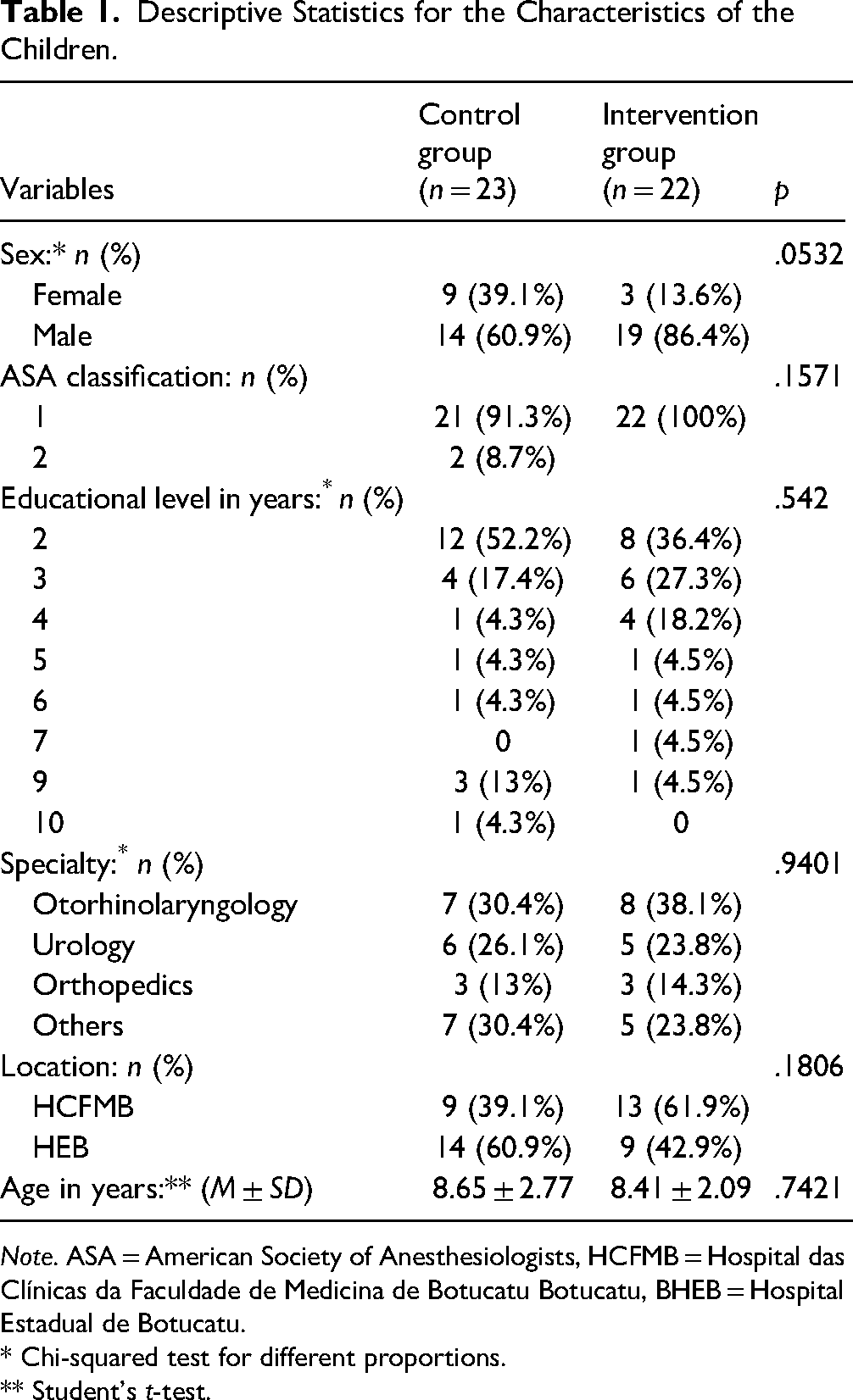
Note. ASA = American Society of Anesthesiologists, HCFMB = Hospital das Clínicas da Faculdade de Medicina de Botucatu Botucatu, BHEB = Hospital Estadual de Botucatu.
* Chi-squared test for different proportions.
** Student’s t-test.
Descriptive Statistics for the Characteristics of the Parents.
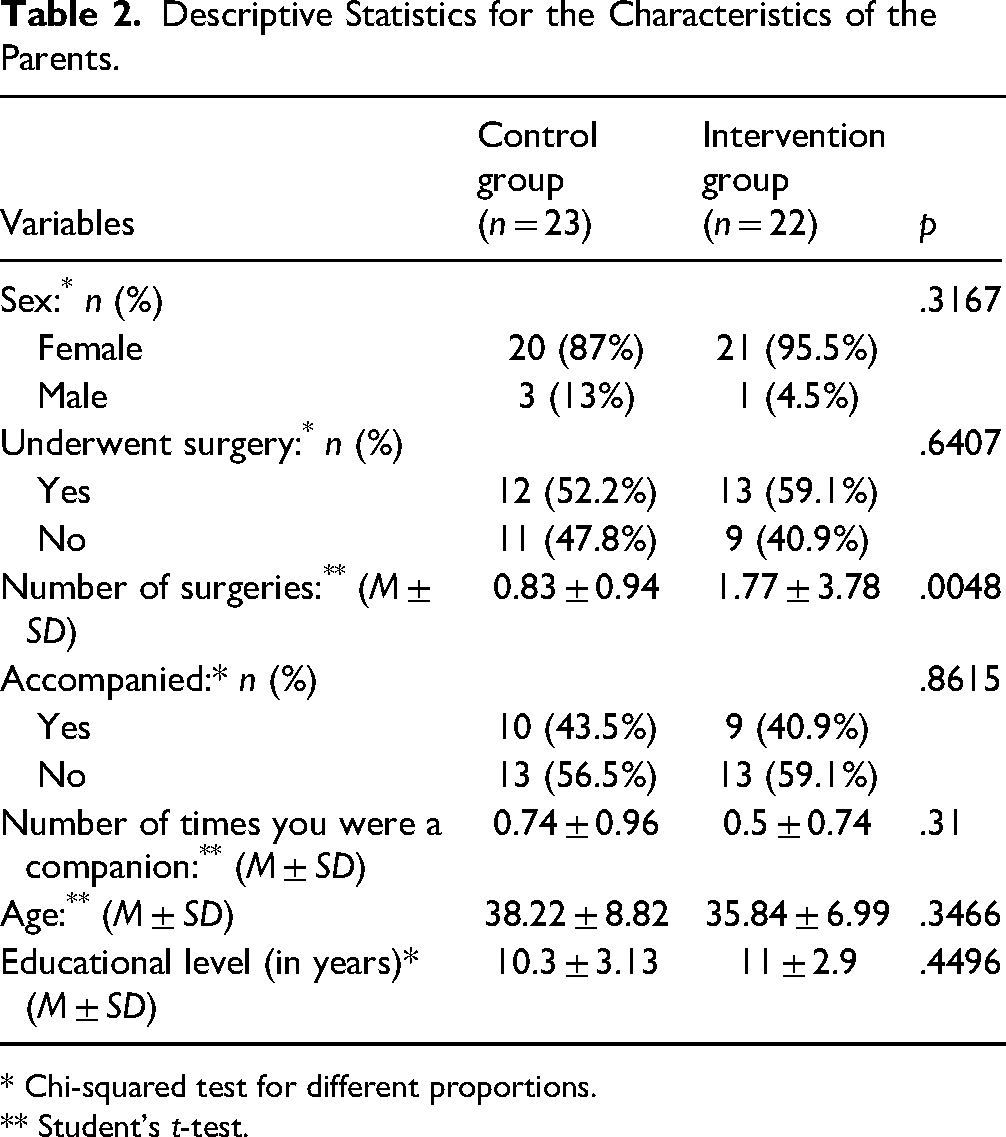
* Chi-squared test for different proportions.
** Student’s t-test.
Table 3 indicates that the average number of correct answers from both groups of children during the pre-intervention period was similar. After the intervention, the intervention and control groups significantly increased the average number of correct answers. However, there was no statistical difference between the groups during the post-intervention period, indicating that both educational strategies were effective.
Comparisons of the Pre-Intervention and Post-Intervention Scores of the Intervention and Control Group Participants.
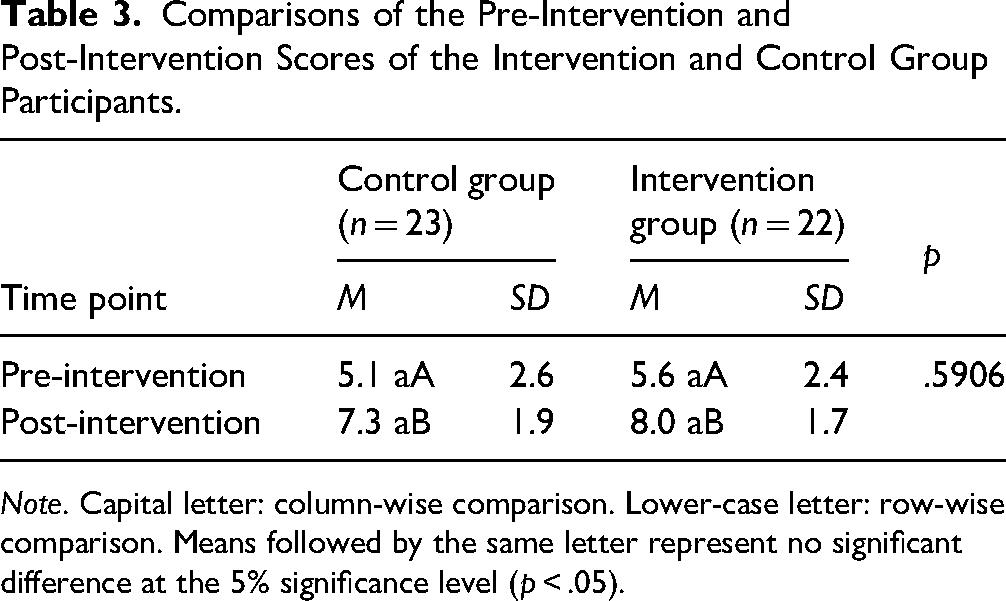
Note. Capital letter: column-wise comparison. Lower-case letter: row-wise comparison. Means followed by the same letter represent no significant difference at the 5% significance level (p < .05).
Comparisons of the pre-intervention and post-intervention scores obtained by the parents revealed that both the groups obtained lower pre-intervention mean scores. Thus, there was a significant difference between pre-intervention and post-intervention scores in both the groups (column-wise comparisons, represented by different capital) (Table 4).
Comparison of the Parents’ Final Scores in Groups and Moments.
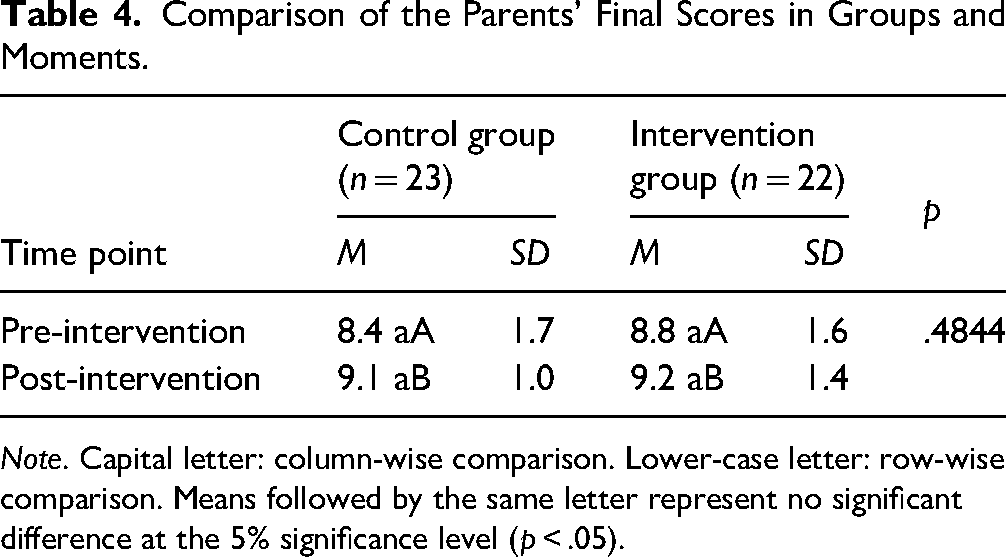
Note. Capital letter: column-wise comparison. Lower-case letter: row-wise comparison. Means followed by the same letter represent no significant difference at the 5% significance level (p < .05).
Discussion
This quasi-experimental study examined the effectiveness of a preoperative nursing intervention (oral information with and without a comic book) in improving knowledge among children aged 6 to 14 years and their parents. There was a statistically significant group difference in their pre-intervention and post-intervention scores. This finding is consistent with past observations and lends support to the contention that educational materials increase knowledge levels among children scheduled for surgery (Macindo et al., 2015). The findings also underscore the effectiveness of child-focused oral information that is provided using appropriate language.
Thus, providing information (with or without supporting educational materials) is extremely important because it increases child health literacy. Indeed, a better understanding of the various aspects of one's health condition empowers children, creates more realistic and appropriate expectations regarding their situation, and motivates them to be more active and cooperative during the treatment process (Bray et al., 2019; Santos & Bastos, 2017).
The same trend was observed among the parents. There was a statistically significant difference between the pre-intervention and post-intervention scores obtained by the control and intervention group participants. In other words, oral information in short-term provision resulted in an immediate increase in knowledge, irrespective of whether a supporting comic book was used. This finding is consistent with the results of past studies. Specifically, in a past study, there was no significant difference in the effects of oral-only information provision and oral information provision with supporting educational materials in the short term. However, in long-term analyses, the intervention group participants, who had received supporting educational materials, obtained higher scores than the control group participants (Ünver et al., 2020).
Researches conducted in Rome (Piredda et al., 2016), France (Landier et al., 2018), China (Chen et al., 2020), Finland (Johansson et al., 2010), the United Kingdom, and the United States (Humphris & Field, 2003) have found that educational materials help individuals integrate and memorize information and increase knowledge among adults. Further, it has been found that communicating with surgical patients through informal conversations has beneficial effects and is a part of the role that nurses play as educators (Dos Santos et al., 2011). Thus, health-care professionals should use playful educational strategies to enable adequate communication, show empathy and sensitivity to the individual characteristics of each person under their care, and provide comprehensive and humanized assistance.
It is important to adapt communication and educational materials based on the characteristics of the target audience (whether in terms of language or the type of resources to be used; e.g., print vs. digital). It is important to improve access to information and help patients understand the pertinent information in the clearest way possible. This can improve their knowledge and health literacy (Paiva & Vargas, 2017; Paiva et al., 2017; Santos & Bastos, 2017).
Adequate health literacy can empower individuals to understand their health status and make suitable decisions (Nutbeam, 2008; Santos & Bastos, 2017). This can improve communication between professionals, children, and their family members and result in the creation of a favorable environment in which relationships can be nurtured and alleviation of apprehension and suffering in patients and their family members through information provision and clarification (Garcia et al., 2011; Maragno & Luiz, 2016; Sampaio & Margareth, 2015). It is important to highlight that the child is the protagonist of his or her health narrative. Therefore, the child should be included in the health-care process. However, this does not diminish the importance of providing a space to discuss the needs of family members (who may also be fragile), including them in the health-care process and acknowledging their essential role in this process given that they have a strong influence on their child's condition (Corrêa et al., 2015; Pinto et al., 2010; Sampaio & Margareth, 2015).
In this study, the pediatric surgery patients and their parents possessed prior knowledge about the surgery (even if only minimal). They acquired this knowledge from the information provided by other health-care professionals when the surgery was scheduled. The present findings underscore the relevance of the preoperative nursing evaluation, which served to reinforce patient understanding of information about the scheduled procedure (represented by the higher number of correctly answered questions). Most wrong answers pertained to information about the usefulness of the identification bracelet, anesthetic procedure, professionals involved in the process, purpose of the surgery, and hospital facilities that the patient would access. These findings underscore the need to further address these topics during information provision.
In such contexts, information provision to increase child and parent knowledge is the primary form of assistance. Nurses are responsible for ensuring that the procedure guidelines are accurately understood during the preoperative evaluation, minimizing anxiety, promoting well-being, and maximizing the success of the anesthetic-surgical procedure though the provision of continuous and individualized humanized assistance (Garcia et al., 2011; Marinelo & Jardim, 2013; Oliveira & Mendonça, 2014; Sampaio & Margareth, 2015; Santos et al., 2011; Souza et al., 2010).
The preoperative nursing evaluation, which is a part of the first stage of the nursing process, facilitates the execution of all subsequent steps. Nurses are responsible for providing information about the procedure, listening to surgical patients, understanding their needs, preparing them physically and emotionally, and contributing to the preparation of comprehensive care plans (Oliveira & Mendonça, 2014; Santos et al., 2011; Souza et al., 2010). During this period, information provision (whether through informal conversations or using educational materials) increases knowledge. It is extremely important to respect individual differences and adapt information and language based on their prior knowledge and sociocultural background to increase the effectiveness of the information provided to them (Santos et al., 2011).
Limitations of Study
This study has some limitations, which should be acknowledged. First, the questionnaires were developed by the current researchers and have not been validated). Second, because of the ongoing SARS-CoV-2 pandemic, fewer elective surgeries were performed at this site, and data collection was disrupted from March to April 2020 and in January 2021. Third, both the hospitals shared the same management, surgical team, and anesthesiologists; although the protocols were remarkably similar, the nursing teams were not the same, and there were differences in their physical structure.
Recommendations for Further Research
Educational intervention with both an educational comic book and oral information versus oral information alone had similar results in children and their parent's knowledge about the surgery. This may be because the participants in both groups were already well prepared, and/or the quality of the non-comic book instruction was that good or attractive. We recommended that preparing the child should begin after scheduling the surgery. In addition, interactive educational content, such as virtual reality, interactive toys and games, and mobile health can be more enjoyable for children, and this intervention should be investigated.
Conclusions
The preoperative nursing intervention resulted in an immediate increase in knowledge about the anesthetic-surgical procedure among both parents and children, irrespective of the information provision method that was used. This underscores the importance of the role that nurses play during the preoperative evaluation, using appropriate language that is centered on the child and his or her family, and providing comprehensive and humanized care. The nursing consultation during the preoperative period significantly increased knowledge among patients and their parents. Thus, it is necessary to use audience-appropriate language in such interventions. Irrespective of the resources used to provide guidance, nurses play an extremely important role in the educational process (primary form of assistance). Specifically, they provide the pertinent information and empower pediatric patients and their family members during the treatment process. The process of preparing the child should begin as soon as possible after scheduling the surgery.
Supplemental Material
sj-pdf-1-cng-10.1177_10784535251319439 - Supplemental material for Effectiveness of a Perioperative Pediatric Nursing Intervention with a Brazilian Educational Comic Book: A Quasi-Experimental Study
Supplemental material, sj-pdf-1-cng-10.1177_10784535251319439 for Effectiveness of a Perioperative Pediatric Nursing Intervention with a Brazilian Educational Comic Book: A Quasi-Experimental Study by Vanessa Natsumi Mizobata, Tatiane Roberta Fernandes Teixeira, Patrícia Aparecida Francelino Crepalde and Michelle Cristine De Oliveira Minharro, Marla Andréia Garcia de Avila in Creative Nursing
Supplemental Material
sj-pdf-2-cng-10.1177_10784535251319439 - Supplemental material for Effectiveness of a Perioperative Pediatric Nursing Intervention with a Brazilian Educational Comic Book: A Quasi-Experimental Study
Supplemental material, sj-pdf-2-cng-10.1177_10784535251319439 for Effectiveness of a Perioperative Pediatric Nursing Intervention with a Brazilian Educational Comic Book: A Quasi-Experimental Study by Vanessa Natsumi Mizobata, Tatiane Roberta Fernandes Teixeira, Patrícia Aparecida Francelino Crepalde and Michelle Cristine De Oliveira Minharro, Marla Andréia Garcia de Avila in Creative Nursing
Supplemental Material
sj-pdf-3-cng-10.1177_10784535251319439 - Supplemental material for Effectiveness of a Perioperative Pediatric Nursing Intervention with a Brazilian Educational Comic Book: A Quasi-Experimental Study
Supplemental material, sj-pdf-3-cng-10.1177_10784535251319439 for Effectiveness of a Perioperative Pediatric Nursing Intervention with a Brazilian Educational Comic Book: A Quasi-Experimental Study by Vanessa Natsumi Mizobata, Tatiane Roberta Fernandes Teixeira, Patrícia Aparecida Francelino Crepalde and Michelle Cristine De Oliveira Minharro, Marla Andréia Garcia de Avila in Creative Nursing
Footnotes
Declaration of Conflicting Interests
The authors declared no potential conflicts of interest with respect to the research, authorship, and/or publication of this article.
Funding
The authors disclosed receipt of the following financial support for the research, authorship, and/or publication of this article: V. N. M. was funded by Fundação de Amparo à Pesquisa do Estado de São Paulo (FAPESP) (grant number 19/26094-8).

Supplemental material
Supplemental material for this article is available online.
Author Biographies
References
Supplementary Material
Please find the following supplemental material available below.
For Open Access articles published under a Creative Commons License, all supplemental material carries the same license as the article it is associated with.
For non-Open Access articles published, all supplemental material carries a non-exclusive license, and permission requests for re-use of supplemental material or any part of supplemental material shall be sent directly to the copyright owner as specified in the copyright notice associated with the article.
