







Abstract
This paper introduces the Societal Health & Nursing Framework as a sociologically informed approach that expands nursing's focus from individual patients and families to the broader societal conditions influencing health and illness. Grounded in sociology, public health ethics, social determinants of health, intersectionality, and socioecological models, the framework offers nurses a shared language and structure to address upstream drivers of health inequities. Nursing practice is increasingly shaped by social, political, and economic forces that extend beyond individual clinical encounters. Although the International Council of Nurses Code of Ethics affirms nurses’ responsibility to promote human rights, health equity, and social justice, these ethical commitments are not consistently translated into everyday practice or education. By situating health within cultural and structural contexts, the Societal Health & Nursing Framework provides a unified vocabulary and conceptual foundation to promote holistic, culturally responsive care and strengthens nursing's role in advocacy, policy engagement, and global citizenship. Integrating this framework into nursing education and practice reinforces nursing's social mandate to advance health equity and societal well-being.
Implications for Practice, Education, Research, or Policy
The Societal Health and Nursing Framework bridges the gap between ethical principles and practical implementation in nursing. By explicitly naming societal nursing, the framework clarifies nurses’ systems-level roles and reinforces commitments to intersectional, equity-focused care. The framework integrates into existing nursing courses to strengthen structural awareness, cultural sensitivity, and advocacy skills without adding curricular burden. Emphasizing international perspectives positions the framework as globally relevant rather than country-specific, responsive to diverse health system contexts and population health needs. The framework supports the development of measurable indicators for evaluating structural competency and the impact of nursing interventions on health equity outcomes.
This paper introduces “Societal Health & Nursing” as a comprehensive framework that equips nurses to understand and address the societal influences shaping health at individual, family, community, and global levels. The International Council of Nurses (ICN) Code of Ethics (2021) emphasizes nurses’ moral responsibility to promote human rights and advocate for health equity. While the practical application of these principles in nursing practice and education is progressing, the principles themselves may not be fully understood. We propose Societal Health & Nursing as a valuable framework, offering a shared vocabulary, conceptual structure, and knowledge base to guide nurses in assessing, planning, implementing, and evaluating change that advances a healthier and more equitable global society.
Background
The origins of the study of societal health were pioneered by nurses such as Florence Nightingale, Mary Seacole, and Lillian Wald. We now recognize that they were battling the root causes of illness and have been associated with early public health movements (Wilson et al., 2023). This early advocacy evolved globally through milestones like the 1978 World Health Organization's (WHO) Declaration of Alma-Ata, which formally identified health as a fundamental human right requiring action across all social and economic sectors (WHO, 1978). Ultimately, their work laid the foundation for health-care professionals during the early 2000s when these concepts were further expanded by ethicists such as Nussbaum (2003), Powers and Faden (2006), and Fleck (2009), among many others. As conceived by these ethicists, social justice encompassed attention to barriers to health that are beyond the control of the individual patient. They argue that individuals cannot achieve well-being without necessary social conditions in their lives, such as human rights (e.g., the right to vote, physical and social freedoms, right to work, right to social protection, right to medical treatments, and right to education) and material resources (e.g., safe housing, economic security, and an adequate standard of living). Powers and Faden (2006) discuss the essential dimensions of health necessary for well-being and society's obligations toward individuals’ well-being. For individuals to attain a healthy life and lifespan, laws and policies must support equity, inclusion, and equal opportunity. Without consideration of the context in which people live, health as defined by the WHO is not attainable; “Health is a state of complete physical, mental and social well-being and not merely the absence of disease or infirmity” (WHO, 1948, p. 1). This view highlights that health is not an individual but a societal concern. Nurses need to lead education, research, practice, and improve policies for better global health outcomes (ICN, 2025).
Philosophical Approach
Philosophically, societal health nursing aligns with public health nursing and community nursing, as it focuses on promoting health by addressing underlying societal issues that contribute to health disparities. Nurses are at the vanguard of daily ethical decisions based on their physical closeness, the nature of the intimate care they offer, and the relational position they hold in the lives of those in their care (Monroe, 2019). Slemon et al. (2025) found that concepts of social justice and equity were often blended into nursing literature, with dominant interpretations framing social justice as distributive justice and fairness. The re-conceptualization of social justice helps to clarify and support nurses engaging with social justice through theory and practice; this should act as a guiding principle for nursing. It recognizes and remediates inequities at the individual and structural levels toward a state of equity (Slemon et al., 2025).
The ICN Code of Ethics (2021) serves as a foundational guide, affirming nurses’ moral responsibility to protect human rights, advocating for equity, and recognizing health care as a fundamental human right. This approach includes both episodic care, which addresses immediate or acute health needs, and societal care, which addresses the structural, social, and environmental conditions that determine whether individuals can achieve well-being across their lifespan. Together, these forms of care support a vision of caring for the whole person, acknowledging that individual health episodes are inseparable from the larger societal systems that shape health opportunities.
Despite these aspirational principles, translating them into practical strategies within nursing education and clinical practice remains a significant challenge. An example from the United States is the implementation of the Healthy People 2030 goals that provide a framework for monitoring progress toward the national goal of enabling all individuals in the United States to achieve their full potential for health and well-being across the lifespan (Pronk et al., 2021). Similarly, there is a nation-wide health promotion initiative in Japan called “Health Japan 21,” which aims to “achieve an increase in a healthy life expectancy and reduction in health disparities” (Wada, 2024, p. 69). Although national initiatives such as Healthy People 2030 and Health Japan 21 provide important benchmarks for population health, a comprehensive Societal Health & Nursing framework must be applicable across diverse health system structures, including universal, mixed, and resource-constrained contexts (Frenk & Moon, 2013). In many regions, health inequities are shaped by broader political and economic conditions that influence the distribution of opportunities and resources, requiring nursing engagement that is locally responsive and globally informed. From a global perspective, the United Nations (UN) has established 17 Sustainable Development Goals (SDGs) that urge no poverty, no hunger, clean water and sanitation, reduced inequalities, and “ensur[ing] healthy lives and promot[ing] well-being for all at all ages” (UN, 2015). Advancing planetary health calls for humans to be cognizant of the impact they make; an example is global warming: human actions have forever changed planetary health (Solheim et al., 2024). By adopting a holistic approach, nurses can contribute to the achievement of the U.S. Healthy People 2030 goals, Health Japan 21, and the UN's SDGs, and collaborate across borders to enhance global health (Solheim et al., 2024).
The Societal Health & Nursing Framework
Societal health considers population health thinking, which extends beyond our own social norms and networks toward being part of a community: a regional, national, continental, and global citizen. Societal health needs are multifaceted, as societal health status is impacted by social determinants of health, all of which are nonmedical factors, and are the most significant causative factors of health status (Centers for Disease Control and Prevention, 2025; Murray et al., 2020). Also, individuals, families, and communities have a unique set of experiences across their lifespan. These unique experiences are intersections that shape life and health.
Integrating a socioecological model and intersectionality framework with social determinants of health supports the evidence that the causes of health status occur at multiple levels in the ecosystem and interact with each other over the lifespan of individuals, families, and communities (Schoon & Krumwiede, 2022; Schoon & Porta, 2023). The use of an intersectionality approach suggests social justice by analyzing interacting factors such as social inequality, power, relationality, and social context (Agenor, 2020). A socioecological framework addresses the social determinants of health and facilitates the ethical practice of nursing to work toward safe and equitable health care (Schoon & Krumwiede, 2022; Schoon & Porta, 2023).
The Societal Health & Nursing Framework is grounded in principles of social justice and collective responsibility, recognizing that health inequities arise from the unequal distribution of power, resources, and opportunities and from the conditions in which people are born, grow, live, work, and age (WHO, 2026). This perspective extends the ethical commitments of nursing beyond individual care toward active engagement with the structural, political, and economic forces that shape health opportunities across contexts.
While individual patient advocacy remains central to nursing practice, the Societal Health & Nursing Framework extends this commitment to structural advocacy. Structural advocacy involves addressing the systemic conditions, such as housing instability, labor precarity, environmental risk, and discriminatory institutional practices that produce and sustain health inequities across populations (Laari, 2026). Health disparities are not only the result of individual risk factors but are embedded in broader social and economic structures that systematically constrain agency and produce differential vulnerability (Diderichsen et al., 2019). Addressing the social gradients in health therefore requires sustained upstream action that targets the structural drivers of inequity (Marmot, 2020). Through collaboration with intersectoral partners and community stakeholders, nurses contribute to interventions that promote sustainable and systemic change, reinforcing the ethical responsibility of nursing to advance health equity.
The Societal Health & Nursing Framework emerges as a crucial framework that bridges the gap between ethical principles and practical implementation in nursing. Societal health nursing promotes a holistic, ethical, culturally responsive approach and strengthens nursing's role in advocacy, policy engagement, and global citizenship. The framework emphasizes nursing's ethical accountability and systems actions, how nurses translate societal forces into care, advocacy, and policy engagement across micro–meso–macro levels. Beyond advocating for existing public health policies, the Societal Health & Nursing Framework calls for meaningful engagement in policy transformation processes. Health inequities are shaped not only by social conditions, but also by the distribution of power, money, and resources across societies (WHO, 2026). To fully address these inequities, it is essential to bridge the gap between social determinants, the conditions in which people live, and the political determinants that create those conditions (Dawes, 2020). Viewing health through the lens of political determinants underscores how governance structures, institutional priorities, and policy decisions ultimately allocate resources and influence population health outcomes (Dawes, 2020). In this expanded role, nurses move beyond policy implementation to actively participate in shaping reforms that address structural drivers of inequity and promote health equity across diverse political and social contexts.
The Societal Health & Nursing Framework reinforces nursing's social mandate to advance health equity globally (ICN, 2021; Kim, 2023; Marmot, 2020; Schoon & Krumwiede, 2022; Schoon & Porta, 2023; Solheim et al., 2024; UN, 2015; WHO, 2026). Figure 1 illustrates a conceptual model for the Societal Health & Nursing Framework, emphasizing the integration of ethical principles with practical implementation to improve health equity and well-being.
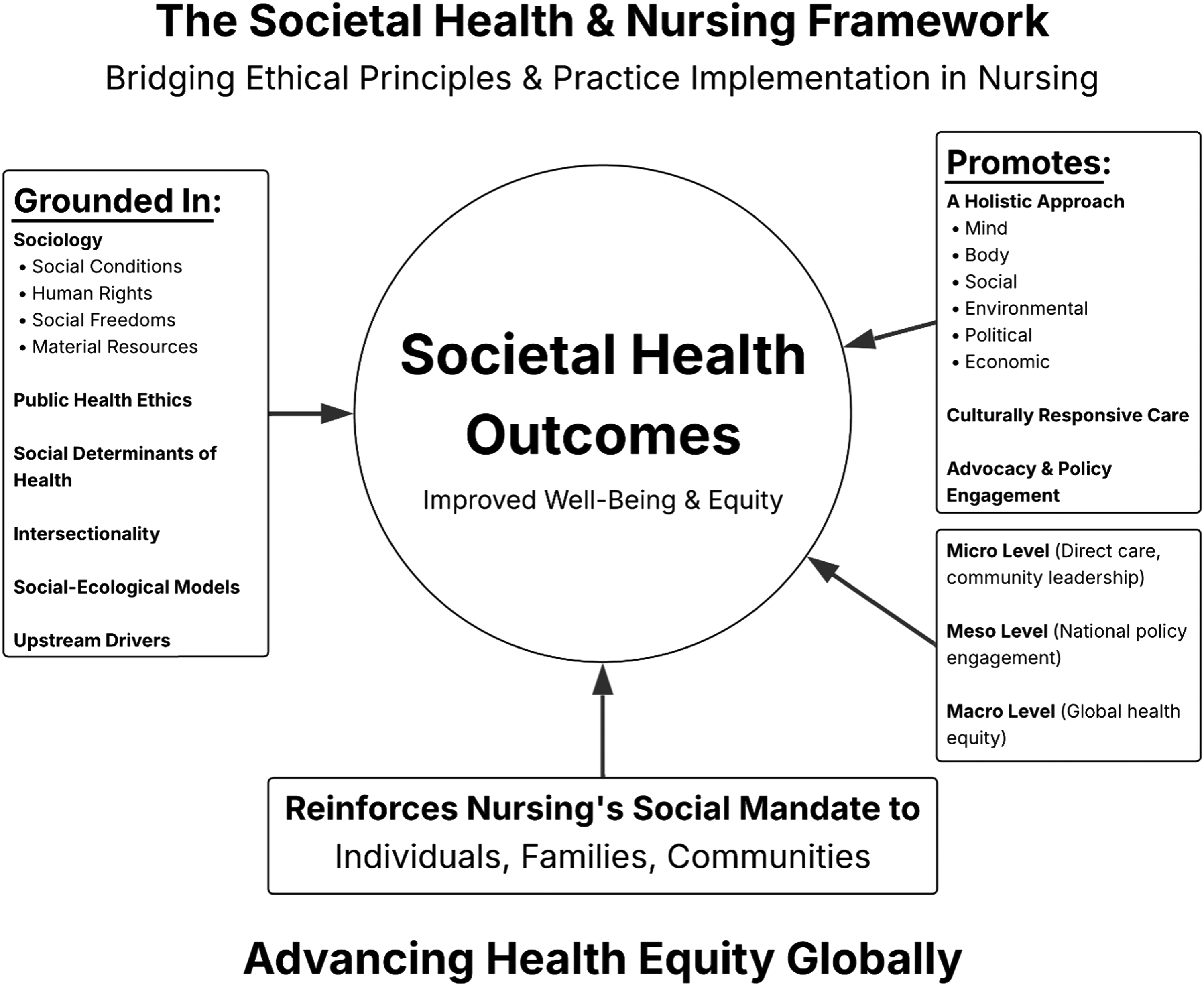
Conceptual Model of the Societal Health & Nursing Framework.
The roles and responsibilities of nurses engaged in societal health practice are interconnected and extended across individual, community, and structural levels of care. Central to this role is the engagement of nurses in policy processes through advocacy, implementation, program adaptation, and context-sensitive leadership across diverse governance structures. In hierarchical health systems, nursing leadership often manifests through organization of services, workforce management, and/or the translation of national policy into local practice. Advocacy for policy processes addresses social, economic, and environmental determinants of health, alongside the ongoing monitoring of population health trends to evaluate the impact of community-based interventions.
Generally, health outcomes are measured by indicators such as global birth rates, life expectancy, mortality rates, morbidity rates, chronic and infectious disease rates, perception of well-being and quality of life, and functional ability. A comparative analysis of health status indicators results in designations of health equity (Chin et al., 2018) or health inequality (Keilman, 2024) with the understanding that equity shapes societal health (Lewis et al., 2023). Sample outcomes from efforts to improve societal health are increased average lifespan; increased equity in lifespan across groups and communities; increased safe, low-income housing; decreased medical and public health treatment-related disparities; increased access to and completion of early childhood education; increased educational attainment across groups; equity in wages across groups; and a decreased income gap between the wealthy and all others in society (WHO, 2026).
Therefore, measures of societal health outcomes expand to include gross domestic product per capita, political stability (quality of public services and policies, levels of corruption, electoral integrity, international relationships, and media freedom), health system strength (measured by the extent of universal health-care coverage), and equity of access to care (WHO, 2023). Ensuring that environmental, economic, political, structural, research, and technological conditions support fair access to health resources ultimately leads to improved health outcomes and stronger, more resilient communities (Lewis et al., 2023).
Societal Nursing and Disaster Resilience
The Societal Health & Nursing Framework is useful in a disaster nursing context both for understanding the needs of affected populations and for proactively promoting disaster resilience locally and globally. From the perspective of nurses living in Japan, where people routinely experience natural disasters (e.g., major earthquakes and typhoons), one of the societal issues to be understood in this framework could be the protection of people's health during disasters. The Societal Health & Nursing Framework is useful for understanding the needs of and providing care for people affected by disasters as well as for proactively promoting disaster resilience of the community. The concept of disaster nursing has been established (Nakajima & Kanbara, 2022), and studies to identify the roles and skills of nurses have been conducted internationally (Marutani et al., 2021; Su et al., 2022). The perspective of societal health and nursing may provide new insight into the scope of disaster nursing practice, research, and education.
Societal Nursing in a Universal Health-Care System
While the Societal Health & Nursing Framework provides a conceptual guide, its principles are increasingly being codified into professional mandates globally. Spain, a high-income country with a highly decentralized, universal public health-care system, serves as an exemplar. Facing intense demographic shifts such as rapid aging, high rates of chronicity, and severe rural depopulation, the nursing profession in Spain has formally recognized that individual clinical care is insufficient to achieve health equity.
Recently, the Spanish General Council of Nursing (CGE) enacted a thoroughly updated Código Ético y Deontológico de la Enfermera Española (Code of Ethics and Deontology of the Spanish Nurse). Crucially, Chapter 5 of this code, titled “The Nurse and Global Health,” transforms societal advocacy from an aspirational goal into a deontological obligation. Article 107 explicitly mandates that nurses participate in the formulation of public health policies to promote equity and structural change, Article 104 urges leadership in community health and the promotion of health assets, and Article 100 dictates professional responsibility toward environmental sustainability and planetary health (Consejo General de Colegios Oficiales de Enfermería de España [CGE], 2026).
Through the established specialty of Enfermería Familiar y Comunitaria (Family and Community Nursing), Spanish nurses map community health assets and navigate the intersectionality of rurality, aging, and socioeconomic status. The Spanish context illustrates how the Societal Health & Nursing Framework can be legally and ethically anchored within a national health-care apparatus, equipping nurses with the mandate to move beyond bedside interventions and actively reshape the political and social determinants of health.
Societal Nursing Within a Low- to Middle-Income Country
Vietnam offers a salient illustration of how societal dimensions of nursing are enacted within a low- to middle-income country undergoing rapid socioeconomic and demographic transition. Nurses constitute the largest segment of the health-care workforce and practice across primary care, hospital services, community health, and public health programs. Nursing work in Vietnam is deeply embedded in both clinical care and broader social contexts.
In Vietnam, these structural conditions take shape within a health system transformed by sustained economic growth, accelerated population aging, and a rising burden of noncommunicable diseases (GBD 2019 Diseases and Injuries Collaborators, 2020; World Bank, 2021). National reforms aimed at expanding universal health coverage have reshaped access to care and institutional responsibilities (World Bank, 2021, 2025). Their work unfolds at the intersection of policy mandates, resource constraints, and lived community realities.
Across these settings, nursing practice is characterized less by formal legislative advocacy and more by sustained relational engagement. Nurses contribute to health education, prevention, chronic disease management, and care coordination within primary and community structures. Daily practice frequently includes assisting individuals and families in navigating health insurance systems, securing access to local services, and coordinating across the sectors of care, activities that position nurses as intermediaries between national policy frameworks and everyday experience. In this sense, structural inequities are encountered and negotiated in routine encounters.
The professionalization of nursing in Vietnam reflects expanding recognition of system-level contributions (Nguyen et al., 2022). At the same time, practice remains shaped by hierarchical governance arrangements, interprofessional boundaries, and resource allocation processes that define the scope of action (Nguyen et al., 2022; World Bank, 2021). Nursing agencies therefore operate within institutional conditions that simultaneously enable participation and constrain authority. What may appear as routine clinical labor is embedded within the broader patterns of poverty, rural–urban disparity, demographic transition, and chronic disease burden (GBD 2019 Diseases and Injuries Collaborators, 2020; World Bank, 2021).
Overall, the Vietnamese context underscores the flexibility and global relevance of the Societal Health & Nursing Framework. It affirms nursing as a socially embedded practice operating across the micro-, meso-, and macro-levels of care and supports a more inclusive understanding of nursing's role in advancing societal health across diverse global settings. It reinforces nursing as a socially embedded, multilevel practice that operates from bedside to the community health system. This example strengthens the argument that societal nursing must be defined flexibly to fit diverse sociopolitical and economic environments, with the understanding that it must align with resource variability, value informal and relational forms of advocacy, and recognize non-Western pathways to achieving societal health goals.
Nursing Application of the Societal Health & Nursing Framework
Despite being the largest health professional group globally, nurses encounter obstacles in translating ethical principles into tangible actions. We acknowledge the slow progress in advancing these principles and identify the need for a comprehensive approach that aligns with nursing practice and education. In resource-constrained educational settings, the Societal Health & Nursing Framework may be most effectively introduced as an integrative lens within existing courses, rather than as an additional curricular requirement. This paper advocates for increased emphasis on educating and empowering nurses to apply Societal Health & Nursing principles, thereby fostering positive change on a global scale.
Societal Health & Nursing provides a conceptual framework through which nurses can develop a deeper understanding of inequity, moral and cultural sensitivity, and social injustice (Kim, 2023). These dimensions are not universally or easily understood, particularly among individuals socialized in contexts where inequity is normalized. Moreover, the adoption of global standards related to moral and cultural sensitivity may be challenging in settings where deeply embedded cultural practices and long-standing traditions shape social norms and power structures (Abdi et al., 2025; Curtis et al., 2019). Research shows that health professionals who had not previously worked with socially marginalized patients lacked the knowledge, skills, and confidence to provide care that includes patients’ mental health and social concerns (Molina-Mula et al., 2018), and they often feel overwhelmed by the complexity of the care required (Hosseinzadegan et al., 2021). Consequently, these patients are frequently met with stigmatization and a condescending attitude from health professionals (Molina-Mula et al., 2018), which may lead to inadequate care (Antonsen et al., 2025). Societal nursing practice is often characterized by patient care and conversations, consultation of patients and health professionals, and coordinating interprofessional and intersectoral with a perspective that goes beyond the reasons for hospitalizations (Antonsen et al., 2025). Nurses applying a societal health framework recognize that intersectionality consists of “multiple systems of oppression, racism, classism, sexism, heterosexism, cissexism, and ableism in particular, simultaneously reinforce and constitute one another to maintain existing stratification hierarchies across categories” (Robinson, 2016, p. 478). Nurses operating within this framework must address structural inequities associated with place of residence, including disparities between rural, remote, and urban communities. Low health literacy, especially prevalent in developing countries, along with systemic practices that unjustly influence access to health-care services, contributes substantially to persistent health inequalities. Collectively, these challenges, from the stigmatization of marginalized groups to geographic access barriers, underscore why a single-axis view of illness is inadequate. An intersectional, societally informed approach is therefore essential to recognize how these overlapping systems of disadvantage dictate health outcomes.
The Societal Health & Nursing Framework equips nurses with the tools to address global health challenges. By embracing the framework, nurses can assess individuals, families, and communities, plan strategies, and implement and evaluate change effectively, aligning with the principles outlined in the ICN Code of Ethics (2021) and the UN’s SDGs (2015).
Future Implications
The Societal Health & Nursing Framework offers an opportunity to align nursing's ethical commitments with structural action. To influence practice, the framework must move from a conceptual framework to intentional integration across education, research, leadership, and policy engagement. The 2025 redefinition of nursing by the ICN affirms that nursing requires advocacy, influence over policy, health promotion, and the advancement of equity at the individual and societal levels. The Societal Health & Nursing Framework provides a structure through which this expanded definition can be enacted. It does not replace person- or family-centered care; rather, it situates these practices within the broader political, economic, and environmental conditions that shape health opportunities across the lifespan.
If nursing remains focused primarily on the patient viewpoint at the micro- and meso-levels, the broader societal mandate embedded within the profession risks remaining underdeveloped. The purpose of this framework is not to shift attention away from individuals, but to ensure that nursing action extends to the structural and international forces that influence population health overall. In an increasingly interconnected global society, nursing's ideological anchor lies not only in relational care, but also in advancing healthy populations through ethically grounded systems-level engagement, such as policy development. This work builds upon, rather than replaces, existing nursing philosophy and ethical commitments.
Education
Educationally, the framework can be embedded within existing courses, particularly community health, ethics, leadership, and global health, through case analysis, socioecological assessment tools, and policy-engagement assignments. Clarifying societal nursing competencies, such as structural awareness, systems thinking, and advocacy literacy, may support measurable outcomes while allowing adaptation across diverse global contexts (Laari, 2026). Emphasizing international perspectives ensures that this model is not country-specific, but responsive to the realities of global health and necessary for strengthening healthy populations globally.
Research
A coordinated research agenda is needed to examine how integration of societal health principles influences structural competency, professional identity, and policy engagement among nurses and nursing students. Cross-national collaboration will be essential to ensure cultural responsiveness and to reflect the varied ways societal nursing is enacted within different governance systems. Such inquiry can help clarify how nursing actions, rooted philosophically in social justice and human rights, translate into measurable improvements in health equity.
Practice
In practice, nurses already translate policy into care environments and navigate the tensions between ethical ideals and structural realities. Naming these activities as societal nursing strengthens professional identity and reinforces nursing's collective social mandate. At a time when ethical interpretations within the profession may appear increasingly fragmented, this framework offers a unifying structure grounded in nursing's long-standing philosophical foundations.
The question is not whether nursing has a societal role—it always has. The invitation now is to make that role explicit, measurable, and intentional at a broader, international level. By participating in dialogue, creative curricular innovation, and systems-level reflection, the profession can continue to evolve in ways that respect both its relational roots and its responsibility to advance equitable and sustainable health for all.
Conclusion
Societal health nursing plays a crucial role in improving the health and well-being of communities by focusing on the broader social, economic, and environmental factors that influence health outcomes within communities. By working to improve the health of entire communities, states, and nations, nurses applying a societal health lens contribute to creating healthier, more resilient societies (National Academies of Sciences, Engineering, and Medicine, 2021). The Societal Health & Nursing Framework elevates nursing's influence through the social mandate to advance health equity and societal well-being. Through this integrated approach, nurses across all practice settings address upstream drivers of health inequities while supporting individuals and families within the broader contexts that shape health and well-being. Adopting this framework strengthens the capacity of nursing to translate ethical commitments into action across practice, education, research, and policy. By engaging with structural determinants of health, nurses are positioned not only as caregivers but as key actors in advancing equitable systems and societal transformation. Integrating Societal Health & Nursing principles is therefore essential to maintaining the profession's social accountability in an increasingly complex global health landscape.
Footnotes
ORCID iDs

Funding
The authors disclosed receipt of the following financial support for the research, authorship, and/or publication of this article: Funding was received through the Taylor Institute, Minnesota State University, Mankato, USA.
Declaration of Conflicting Interests
The authors declared the following potential conflicts of interest with respect to the research, authorship, and/or publication of this article: Dennis Demedts and Hans-Peter de Ruiter are members of the Editorial Board of Creative Nursing. The remaining authors declared no conflicts of interest.
Data Accessibility Statement
The authors acknowledge the data availability policy.