







Abstract
The present study investigates the recidivism rates of a sample of 351 male adolescents who sexually offended, and were assessed at an outpatient psychiatric clinic in Montreal, Canada, between 1992 and 2002. The mean age of the participants was 15.8 years (SD = 1.8). Data on adolescent and adult recidivism were collected in Summer 2005 from official criminality sources in Canada. Over an 8-year follow-up period, 45% (n = 158) of the participants were charged with a new criminal offense, 30% (n = 104) were charged with a violent offense, and 10% (n = 36) were charged with a sexual offense. Cox regression results suggest that overall, violent, and sexual recidivism can be predicted by a variety of developmental, social, and criminological factors. Paternal abandonment, childhood sexual victimization, association with significantly younger children, and having victimized a stranger were associated with a higher risk of sexual recidivism. Previous delinquency, attention deficit disorder, and childhood sexual victimization were found to increase the risk for both violent and overall recidivism. Also, the use of violence during a sex crime and victimizing a stranger were associated with violent recidivism, and school delay and association with delinquent peers were predictive of overall recidivism. The results confirm that a significant proportion of adolescents who have sexually offended pursue a criminal activity beyond adolescence, although few specialize in sexual offending.
Several studies of recidivism have made it clear that adolescents who have sexually offended commit a wide variety of offenses. Despite methodological differences related to sample selection (e.g., assessment and treatment), recidivism criteria (e.g., self-reported recidivism, new charge, new conviction), and length of follow-up (1-14 years), results clearly indicate that adolescents who have sexually aggressed have higher recidivism rates for nonsexual offenses than for sexual ones (Caldwell, 2002, 2007; Gretton, McBride, Hare, O’Shaughnessy, & Kumba, 2001; Hagan & Gust-Brey, 1999; Hagan, Gust-Brey, Cho, & Dow, 2001; Långström, 2002; Långström & Grann, 2000; Nisbet, Wilson, & Smallbone, 2004; Parks & Bard, 2006; Rasmussen, 1999; Vandiver, 2006; Waite et al., 2005; Worling, 2001; Worling & Curwen, 2000). In general, the overall recidivism rate varies from 30% to 72%, compared with a sexual recidivism rate of 0% to 30%. These results have led some researchers to conclude that although a significant proportion of adolescents who have sexually offended do persist in criminal activity, few specialize in sexual offending (Vandiver, 2006; Veneziano & Veneziano, 2002). In his 2010 meta-analysis of 63 studies and 11,219 adolescents who have sexually offended, Caldwell confirmed this conclusion. With an average follow-up period of 5 years, the mean overall and sexual recidivism rates were 43% and 7%, respectively.
McCann and Lussier (2008) conducted a meta-analysis of 18 studies of the risk factors for sexual recidivism among a total of 3,189 adolescents who had sexually offended and who had been followed for a mean of approximately 5 years. They found that half the sample (53%) had reoffended during the follow-up period and that the new offences were predominantly nonsexual. The mean sexual recidivism rate was 12% and ranged from 2% to 30%. In light of the quantity and heterogeneity of the risk factors identified, the authors emphasized the difficulty of drawing firm conclusions concerning the prediction of sexual recidivism. Despite the low effect size, however, they identified predictors of sexual recidivism, including variables related to criminal history (prior sexual and nonsexual offenses), victim characteristics (stranger victim, child or adult victim, male victim), sexual deviance, and antisociality.
In a narrative review of the published literature on juvenile sex offender recidivism, Worling and Långström (2003, 2006) distinguished between risk factors they classified as empirically supported, promising, and possible. Empirically supported risk factors were defined as factors that have been statistically linked to sexual reoffending in at least two independent empirical investigations, have received support from clinical guidelines and checklists, and whose association with sexual offending had not been contradicted in the literature. Deviant sexual interests, prior criminal sanctions for sexual offending, sexual offending against a stranger victim, sexual offending against more than one victim, social isolation, and uncompleted offense-specific treatment were all categorized as empirically supported risk factors. Promising factors were defined as factors that were included in published risk assessments for juvenile who have offended sexually and supported by a single published study on juvenile sexual offender recidivism. The authors placed problematic parent–adolescent relationships and attitudes supportive of sexual offending in this category. Finally, “possible risk factors” were factors that had been considered to be related to sexual recidivism by some authors but for which empirical support is currently lacking. Many of these possible risk factors (impulsivity; antisocial interpersonal orientation; high-stress family environment; interpersonal aggression; negative peer associations; use of threats, violence, or weapons in sexual offenses; and environment supporting reoffending) were also associated with violent and overall recidivism among adolescents who have sexually offended and adolescent offenders in general (Worling & Långström, 2006).
In a meta-analysis of risk factors for criminal recidivism in juveniles, Cottle, Lee, and Heilbrun (2001) found that criminal history, family problems, ineffective use of leisure time, delinquent peers, conduct problems, and nonsevere pathology, such as stress or anxiety, were risk factors for the persistence of antisocial behavior. Unfortunately, the power of these risk factors to predict sexual, violent, and overall recidivism among juvenile sexual aggressors has rarely been empirically tested. In this connection, McCann and Lussier (2008) argue that the choice of variables used for the prediction of recidivism among adolescents who have sexually offended should take into account current knowledge concerning the factors associated with the persistence of offending behavior among juvenile offenders in general. High rates of nonsexual recidivism among juvenile sexual aggressors suggest that some risk factors for the persistence of antisocial behaviors may also predict sexual and nonsexual recidivism among these aggressors.
Aims of the Study
To date, there has been little consensus on the predictors of recidivism among adolescents who have sexually offended. Recidivism rates indicate that sexual recidivism is relatively rare, which makes the prediction of the phenomenon difficult (McCann & Lussier, 2008; Smith & Monastersky, 1986). Furthermore, the heterogeneous results reported may be due in part to significant methodological differences. Drawing on developmental theory, Vandiver (2006) has stated that it is imperative to clearly distinguish between adolescents who have sexually offended and who pursue their criminal activity (both sexual and nonsexual) beyond adolescence on the one hand, and those who desist, on the other. Consequently, it is important to study potential risk factors for both sexual and overall recidivism among adolescents who have sexually offended. The goals of this study were therefore to estimate the recidivism rate of a relatively large sample of adolescents who have sexually offended and to identify the predictors of sexual, violent, and overall recidivism among these adolescents.
Method
Participants
Our sample was composed of 351 adolescents who have sexually offended, and who had been assessed at the Centre de psychiatrie légale de Montréal between 1992 and 2002. This outpatient psychiatric clinic, affiliated with the Philippe-Pinel Institute, offers a specialized assessment and treatment program for adolescents who have sexually offended. For the purposes of this research, recruitment was limited to male participants who were between 11 and 18 years of age, had committed at least one hands-on sexual offense, and exhibited no signs of moderate or severe intellectual disability. The mean age of the participants at the time of assessment was 15.8 years (SD = 1.8 years). Almost all (95.2%) had been born in Canada, with 5 participants (1.4%) born in Africa and 8 (2.3%) born in Central America. Information on the origin of 3 participants was missing.
During initial assessment, it was estimated that 208 adolescents in the sample had committed sexual assaults solely against children (victims younger than 12 and aggressor at least 3 years older) and that 85 adolescents had assaulted solely peers or adults (same age group or an adult, i.e., a person older than 17). The remaining participants either could have been classified in more than one way (mixed assaults, n = 27) or exhibited an offense profile that did not correspond to the aforementioned categories (n = 31; e.g., an adolescent of 11 years who had abused a victim of 10 years). The age of the victim of the index sexual offense (the most recent offense at the time of assessment) varied from 6 months to 41 years, with a mean of 9.2 years (n = 346, SD = 5.6 years). Victims were female in 66.6% of cases. Participants victimized a sibling (brother, sister, half-brother, half-sister, sibling from a blended family) in 38.9% of cases, and a friend or cousin in 33.1% of cases. The sexual offense had been committed against a victim where the aggressor had been babysitting in 9.8% of cases, a young person in the aggressor’s foster family or home in 10.7% of cases, and a stranger victim in only 4.9% of cases.
Materials and Procedure
Data collection proceeded in two stages. In the first stage, retrospective data were collected from the archives of the Centre de psychiatrie légale de Montréal. Psychiatric reports produced during the initial assessment of the adolescent as well as all reports already on file (psychological assessment, summary report of social services, presentencing report, police report, victim statements, etc.) were examined. Information on approximately 100 variables related to the participants’ individual, familial, social, and offending characteristics was captured using a coding scheme specifically developed for adolescents who have sexually abused. The principal author and two research assistants conducted the first phase of data collection. Interrater reliability of the two primary raters (principal author and one of the two research assistants) was assessed for 20 participants for all collected variables. The mean coefficient of interrater reliability (weighted kappa) was .95 (range = 0.71-1.00), indicating almost perfect agreement. The coding of the third rater was overseen by the two principal raters.
Measurement of Recidivism
The second stage of data collection gathered information on recidivism from official sources in Canada. Data on adolescent recidivism were collected from the archives of the youth courts who refer offenders to the Centre de psychiatrie légale de Montréal, namely the Montréal, Montérégie and Laurentides youth courts. Information on adult recidivism was collected from the three following sources: the RCMP’s Fingerprint Service (Canadian national files), the DACCOR files of the Quebec criminal court (Quebec provincial files), and the files of the Montreal municipal court (municipal files). The information collected concerned the nature of the recidivists’ charges (sexual, violent, or nonsexual nonviolent offense), the number of offenses, the characteristics of the victims of sexual offenses, and legal sanctions.
For the purposes of this study, recidivism was defined as the laying of any new charge (excluding violations of parole or of other conditions) subsequent to initial assessment and during the follow-up period. Measuring recidivism in terms of charges rather than convictions avoids the negative effects of plea bargaining (Caldwell, 2007). In keeping with the practice of other researchers (Firestone et al., 1999; Gretton et al., 2001; Proulx et al., 1997; Rice, Quinsey, & Harris, 1991; Worling, 2001), three types of recidivism were retained for the purposes of analysis: (a) overall recidivism, defined as the laying of at least one criminal charge during the follow-up period; (b) violent recidivism, defined as the laying of a charge for an offense against persons, including offenses of a sexual nature; (c) sexual recidivism, defined as the laying of a charge for a hands-on or hands-off sexual offense. The mean follow-up period was 96.8 months and ranged from 21 months to 162 months (SD = 33.3 months).
Statistical Analyses
To identify risk factors for recidivism (a new charge subsequent to initial assessment), survival analyses were conducted. This type of analysis is particularly relevant because it allows estimation of the probability that an event (new offense) occurs during specific time intervals. Survival analysis takes into account both the time elapsed until the recidivism (if any) and the presence of censured data, that is, participants who did not experience the event by the end of the follow-up period (nonrecidivists; Tabachnick & Fidell, 2001).
As the risk period of each participant differed, Cox regression analysis was conducted. For each type of recidivism, univariate Cox regression analyses were conducted on 35 nominal variables either identified as risk factors for recidivism in previous studies of adolescent sex offenders or associated with recidivism in studies of delinquency. Some variables which have been identified as important risks factor for adult sexual offenders were also selected for exploratory analyses. For example, the variable “association with younger children” was selected because current studies of adult sexual offenders have considered emotional congruence with children to be an empirically supported risk factor for sexual recidivism (Mann, Hanson, & Thornton, 2010; Wilson, 1999). Finally, some variables (e.g., borderline traits and placement) were included because exploratory correlationnal analyses indicated a statistical association between them and recidivism. All selected variables were related to the participants’ personal, familial, educational, social, and offending characteristics. Only variables exhibiting a statistical significance of .25 or less in univariate Cox regression analyses were retained for multivariate Cox regression models (Hosmer & Lemeshow, 1999). (See Appendix A for the definition of the variables and Appendix B for the results of the Cox regression univariate analyses.)
Cox regression analyses allow estimation, in terms of hazard ratios (HRs), of the strength of the effect of the covariates on the event to be measured (new offense). The HR is a comparative measure of survival experience over the entire time period (Hosmer & Lemeshow, 1999). The adjusted HR is the HR controlled for the other covariates of the model. To create distinct predictive models for each type of recidivism, three separate analyses were conducted, using a backward solution with Wald criteria for the removal of variables from the model. In our study, recidivism (overall, violent, or sexual) was the event to be measured and was coded as 1, and nonrecidivism was coded 0. Consequently, a positive HR indicates that participants who possess the characteristic have higher rates of recidivism, compared with those who do not possess the characteristic. The number of months between initial assessment and recidivism (or between initial assessment and the end of the follow-up period for nonrecidivist participants) was entered as the dependent variable. The area under the curve (AUC) of the received operating characteristics (ROC) was also calculated for the three survival models (sexual, violent, and overall recidivism) within two different time frames (2 years and 4 years). The AUC is a useful metric for describing the ability of prediction models to discriminate between recidivists and nonrecidivists. In the current study, prediction scores were the hazard rates estimated by the Cox regression. These scores were tested against the observed recidivism rates at 2 years and 4 years (fixed follow-up). Note that AUCs are based on rank order of scores of recidivists and nonrecidivists and, as such, are invariant to the recidivism base rates and to transformation of the predictor variables. In the context of evaluating prediction models, the AUC may vary between .50, which corresponds to random prediction, and 1.0, which corresponds to perfect prediction (Hosmer & Lemeshow, 1999). According to these authors, discrimination power may be categorized as “outstanding” (AUC ≥ 0.90), “excellent” (AUC = 0.80-0.89), or “acceptable” (AUC = 0.70-0.79).
Results
Recidivism
At the end of the follow-up period (June 1, 2005), the mean age of the participants was 23.9 years (range: 15-32, SD = 3.5 years). Only 13 participants (3.7%) were not of legal age (18 years) at this date. The mean follow-up period was 96.8 months and ranged from 21 months to 162 months (SD = 33.3 months). In total, 10.3% of the participants (n = 36) had been charged with at least one new sexual offense and 29.6% (n = 104) had been charged with a new violent offense (including sexual offenses); overall, 45% (n = 158) had been charged with a new offense. Recidivism rates for sexual, violent, and overall offending as a function of time are presented in Figure 1. The variables associated with an increased likelihood of sexual, violent, and overall recidivism are presented in Table 1.
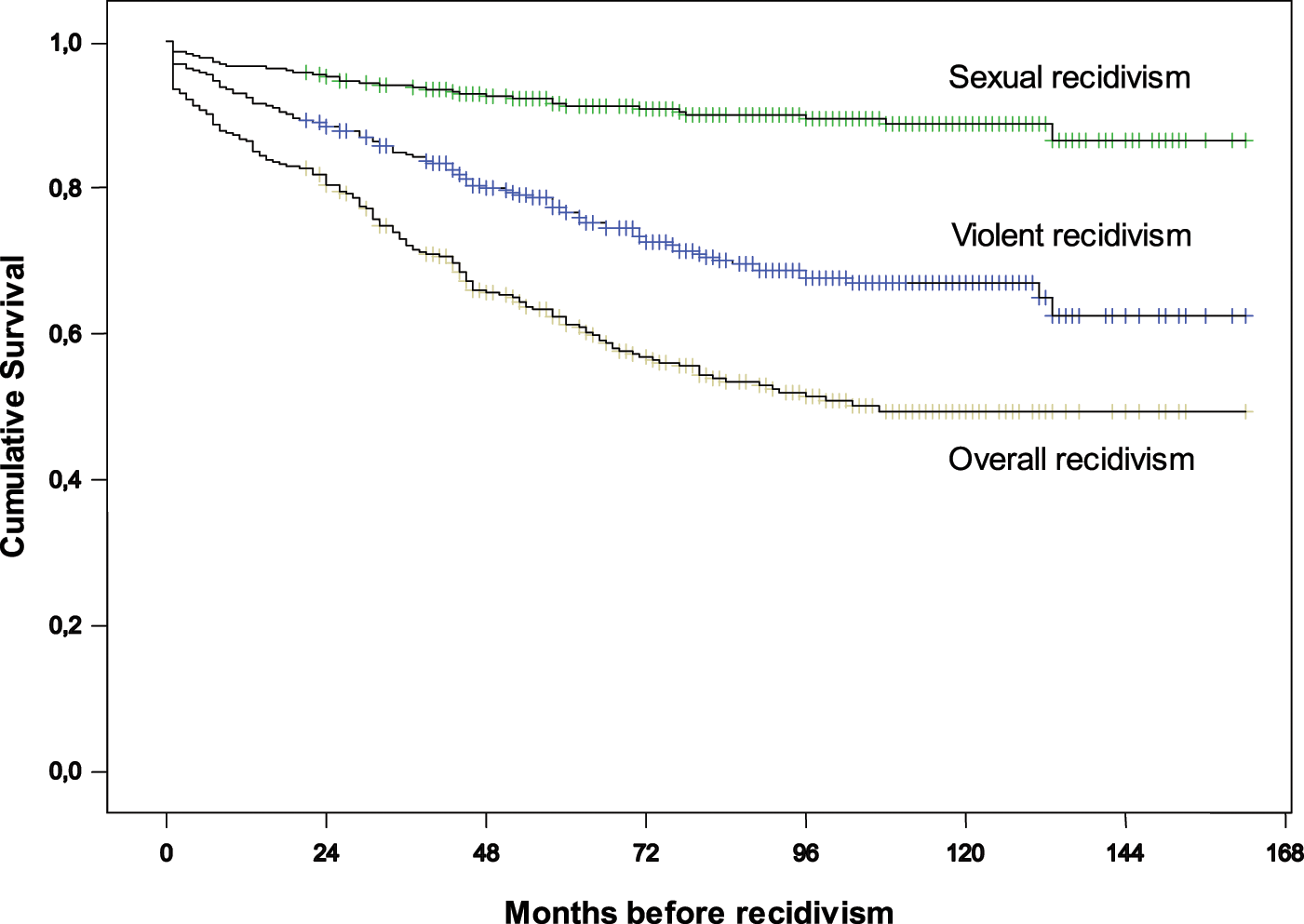
Kaplan-Meier survival curve estimates regarding sexual, violent, and overall recidivism
Cox Regression Model for Sexual, Violent, and Overall Recidivism
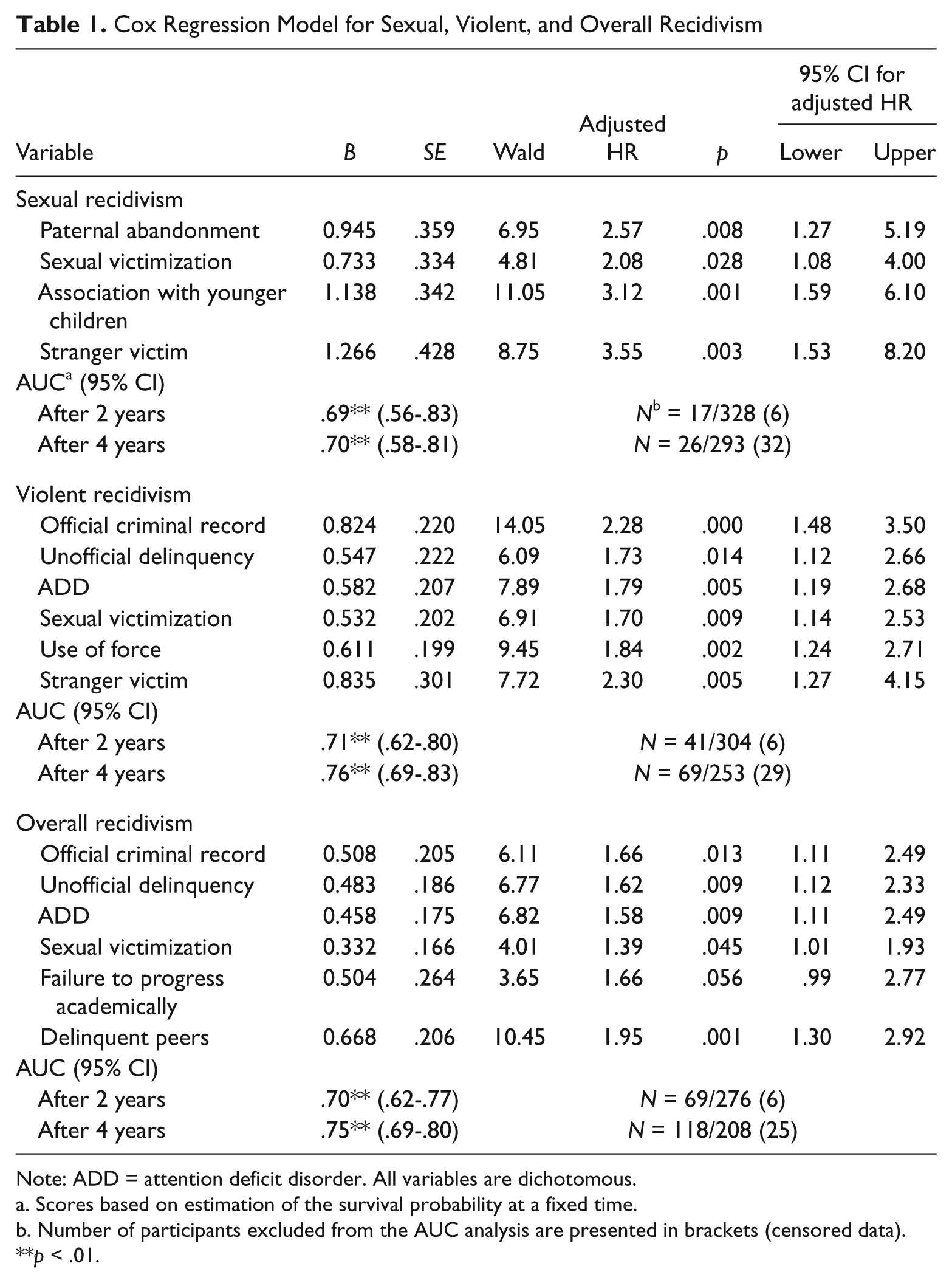
Note: ADD = attention deficit disorder. All variables are dichotomous.
Scores based on estimation of the survival probability at a fixed time.
Number of participants excluded from the AUC analysis are presented in brackets (censored data).
p < .01.
Survival Analyses
Sexual recidivism
Thirty-six participants were charged with at least one new sexual crime during the follow-up period. The analytical model of survival for sexual recidivism, which was significant χ2(4, N = 351) = 40.07, p < .01, comprises four variables. The sexual recidivism rate of adolescent sexual aggressors who experienced long-term paternal absence and hands-on childhood sexual victimization was higher than that of other participants throughout the study period. Also, the sexual recidivism rate of participants who associated with significantly younger children was higher than that of other participants. Finally, the rate of sexual recidivism was significantly higher among aggressors who had selected a stranger victim (for either the index offense or previous offenses). The fit of the model, measured by the risk index’s AUC was .69 (95% CI = .56-.83) after 2 years of follow-up and .70 (95% CI = .58-.81) after 4 years, indicating that the model demonstrated a moderate ability to discriminate between recidivists and nonrecidivists.
Violent recidivism
Sexual and nonsexual violent recidivism were observed among 104 participants during the follow-up period. The Cox regression model of violent recidivism was significant χ2(6, N = 351) = 70.03, p < .01 and included six variables. An increased rate of violent recidivism during the follow-up period was significantly associated with an official or unofficial history of delinquency, a diagnosis of attention deficit disorder (ADD), a history of hands-on childhood sexual victimization, the use of force during a sexual assault and the selection of a stranger victim for a sexual assault. The risk index’s AUC for 2 years of follow-up after initial assessment was .71 (95% CI = .62-.80) and improved to .76 (95% CI = .69-.83) after 4 years of follow-up.
Overall recidivism
A new criminal charge was laid against 158 participants during the follow-up period. The final multivariate model of overall recidivism was significant χ2(6, N = 351) = 76.26, p < .01 and comprised six variables. The presence of an official or unofficial history of delinquency increased the rate of recidivism during the follow-up period. In addition, the rate of recidivism was higher among participants diagnosed with an ADD and participants who had been sexually assaulted at a young age. Failure to progress academically was also moderately associated with an increased rate of overall recidivism during the follow-up period. Finally, participants who had been involved with delinquent peers had higher rate of recidivism than did those who did not associate with such peers. The fit of the regression model is very similar to that of the violent recidivism model after 2 years (AUC = .70) and 4 years (AUC = .75) of follow-up.
Descriptive statistics for the variables included in the multivariate models of sexual, violent, and overall recidivism are presented in Table 2. As the table indicates, the majority (66.7%) of sexual recidivists had experienced long-term paternal absence, and half the participants who had been charged with a new sexual offense had themselves been victims of childhood sexual abuse. Almost two thirds of sexual recidivists (61.1%) had associated with children significantly younger than themselves at the time of initial assessment, compared with 30.5% of nonrecidivists. In addition, violent and overall recidivists were much more likely than nonrecidivists to possess an official or unofficial history of criminal activity. Finally, almost all the overall recidivists had experienced failure to progress academically.
Prevalence of Variables Significantly Associated With Sexual, Violent, and Overall Recidivism
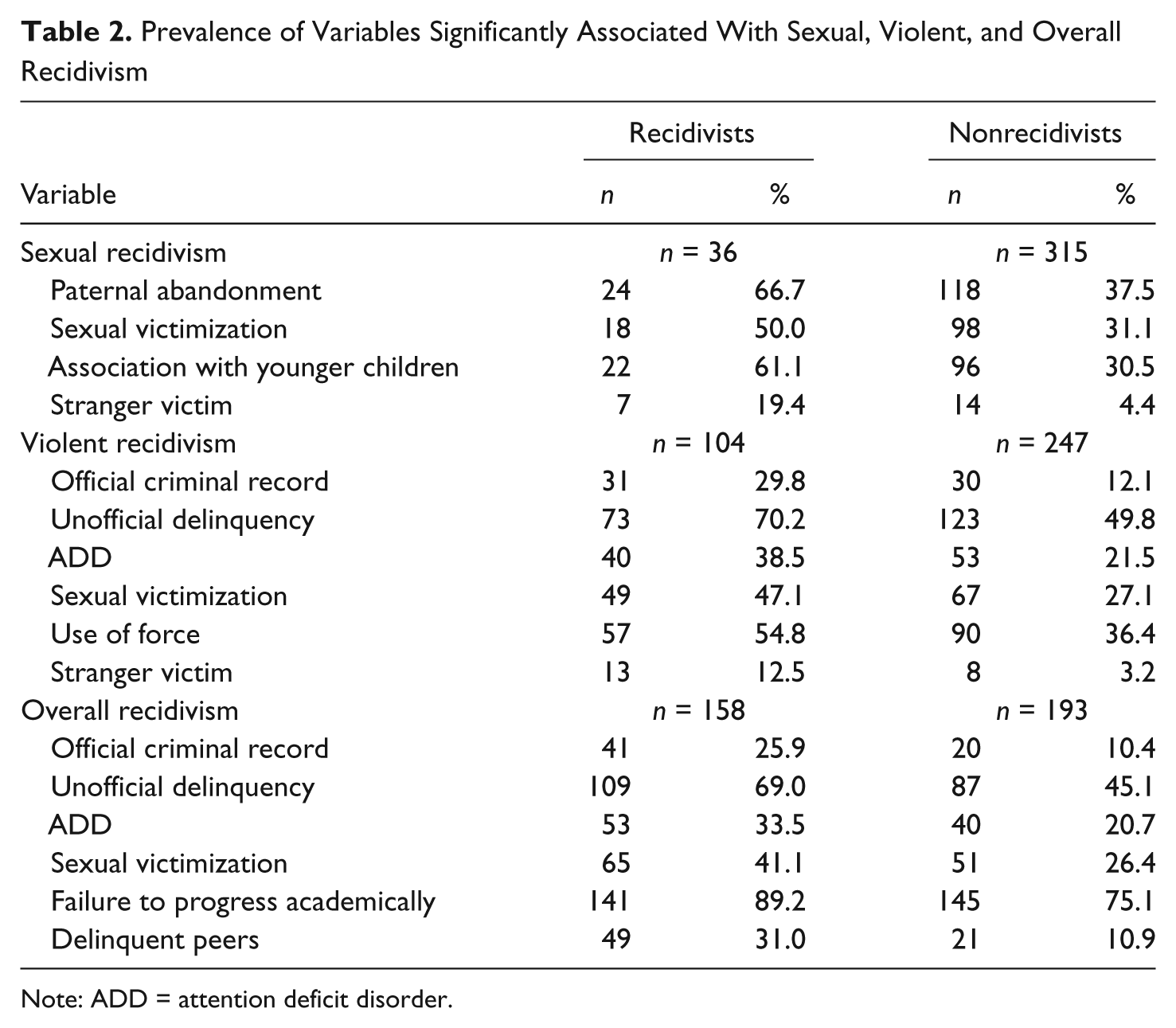
Note: ADD = attention deficit disorder.
Discussion
The results of our study confirm that a significant proportion of adolescents who have sexually offended persist in criminal pursuits beyond adolescence but that few of them specialize in sexual crimes. Although almost half (45%) of our sample faced at least one charge for a new offense during the follow-up period, only 10% had been charged with a new sexual offense. These rates are comparable to those reported by other studies, including those with significant methodological differences, especially with regard to sampling and to follow-up periods. Our study also demonstrates the rapidity with which recidivism occurs during the follow-up period. Almost half the recidivists had been charged with a new offense in the first 2 years of the follow-up period, and this proportion increased to 75% after 4 years of follow-up. These results have important implications, especially for the case management of adolescents who have sexually offended. Our results indicate that the years immediately following initial assessment constitute a high-risk period for recidivism among adolescents who have sexually offended. Consequently, special attention should be paid to the adolescents during this period.
The results of survival analyses suggest that a combination of developmental, social, and criminological factors contribute to the persistence of criminality among adolescents who have sexually offended. However, our survival models also indicate that the specific risk factors at play differ in the three types of recidivism.
Specific Risk Factors for Sexual Recidivism
Two risk factors were exclusively associated with the risk of sexual recidivism: paternal abandonment and association with significantly younger children. Long-term paternal absence appears to play a particularly important role in the persistence of sexual criminality beyond adolescence. To our knowledge, few authors have studied the impact of this phenomenon on adolescents who have sexually offended, although Worling and Curwen (2000) have reported a significant relationship between feelings of parental rejection and sexual recidivism. In a literature review of the effect of paternal absence on development in adolescents, East, Jackson, and O’Brien (2006) concluded that the absence of a father significantly contributes to the emergence of certain problems, including identity problems, low educational success rate, maladaptive and dangerous behaviors (e.g., consumption of drugs, early sexual relationships) as well as difficulties developing intimacy.
Smallbone (2005) states that attachment plays a central role in the explanation of repeated sexual assaults by adolescents. An unstable or disorganized parent–child relationship is thought to favor the development of childhood antisocial behaviors (e.g., a generally aggressive and hostile relational mode) which persist into adolescence. According to Smallbone (2005), other factors associated with insecure attachment—such as low empathy, poor emotional self-control, and mistrust—may facilitate the generalization of adolescent antisocial behaviors, including patterns of sexual behaviors. When difficulties of adolescents are compounded by the intense sexual impulses of puberty, aggression may become an inappropriate outlet for sexual gratification (Cortoni & Marshall, 2001).
Relational difficulties may perhaps explain why the majority of adolescent sexual recidivists in this study associated with younger children, with whom they probably felt more at ease than they did with their peers or with adults. It is possible that our participants sought to satisfy their relational and intimacy needs in sexual activities in which they did not feel rejected—for example, with children (Katz, 1990).
In addition, association with younger children may have increased the opportunities for recidivism among the adolescents in this study, placing them in a high-risk situation. Epps (1997) suggested that adolescents with unsupervised access to potential victims are at a higher risk of sexual recidivism. In light of this, it is reasonable to suppose that the opportunities for sexual crimes—and by extension, the risk of sexual recidivism—are reduced by the external controls usually implemented by legal authorities following the discovery of a sexual offense (prohibition from associating with children or the victim) and by the avoidance strategies used by some adolescents (e.g., avoidance of being alone with a child). Findings from Hanson and Harris’s (1998) study of adult sexual offenders indicated that sexual recidivists were more likely than nonrecidivists to place themselves in situations that procured them access to potential victims. In adolescent, but not adult, offenders, access to victims is partially related to parental choices and decisions which are not under the offender’s control (e.g., letting adolescents babysit or spend prolonged periods playing alone with younger children). Finally, even though sexual offenses against strangers were rare among the offenders in this sample, the selection of a previously unknown victim was associated with an increased rate of sexual and violent recidivism. The association between stranger victim and sexual recidivism has also been reported among adolescent sexual aggressors (Långström, 2002; Smith & Monastersky, 1986) and adult (Hanson & Bussière, 1998) sexual aggressors. Sexual offenses involving an unknown victim require more effort by adolescents and, quite often, recourse to some form of coercion. The choice of a stranger victim may reflect the presence of a powerful motivational factor, such as deviant sexual interests arising in adolescence or low self-control of sexual or aggressive impulses (Långström, 2002).
Risk Factors for Violent and Overall Recidivism
Three factors appear to be strongly associated with both violent and overall recidivism: the existence of an official criminal record, an unofficial history of delinquency, and a diagnosis of ADD. All three of these may be understood as indices of impulsivity or low self-control. Given the high prevalence of official and unofficial histories of criminal activity in our recidivists, it may be that sexual aggression is a manifestation of a general pattern of antisociality (Lussier, 2005; McCann & Lussier, 2008; Veneziano & Veneziano, 2002). Gottfredson and Hirschi (1990) state that individuals with low self-control have little ability to resist temptation and are likely to adopt offending behavior when the opportunity arises, and that this trait is stable over time. Furthermore, adolescents with poor self-control tend to avoid situations of social control (supervision, discipline), and consequently tend to associate with peers who resemble them and who, like them, are likely to offend. These young people also tend to experience school difficulties (behavioral and learning difficulties), leading to failure to progress academically, and school dropout in favor of less constraining environments. Results of our model of overall recidivism partially confirm this hypothesis: the presence of these factors (impulsivity, history of antisocial behavior, failure to progress academically, and association with delinquent peers) contributed to the increase in overall recidivism in our participants.
Other researchers have reported a relationship between educational problems, association with delinquent peers, and pursuit of a delinquent pathway. Among delinquent adolescents in general, absence of academic motivation (Loeber, Stouthamer-Loeber, VanKammen, & Farrington, 1991), learning difficulties (Moffitt, 1993), and association with delinquent peers (Lipsey & Derzon, 1998) have been identified as risk factors for the persistence and escalation of offending. Ayers et al. (1999) explained that educational difficulties weaken the attachment to educational institutions, which facilitates the development of offending as an alternative source of reward and gratification. When the quality of the social link to school deteriorates, the adolescent becomes more vulnerable to antisocial influences of delinquent peers, who may in turn become agents of socialization. In fact, association with delinquent peers gives adolescents the opportunity to learn criminal techniques and to familiarize themselves with antisocial values (Sutherland & Cressey, 1978). In addition, the level of supervision and monitoring by parents also affects the opportunity to offend.
Sexual Victimization as a Common Risk Factor
Childhood sexual victimization was the only risk factor in our study associated with an increase in the risk of sexual, violent, and overall recidivism. In all, half of the sexual recidivists in this study had been victims of hands-on sexual abuse, compared with slightly less than one third of nonrecidivists. The prevalence of sexual victimization is much higher among recidivists than among nonrecidivists. A few authors have reported the presence of a relationship between childhood sexual victimization and sexual (Kenny, Keogh, & Seidler, 2001; Richardson, Kelly, Bhate, & Graham, 1997), nonsexual (Worling & Curwen, 2000), and overall (Kahn & Chambers, 1991) recidivism. In fact, it appears that adolescents who have sexually offended and who were sexually victimized in childhood present more problems related to conduct, including offending behavior than do adolescents who were not victimized (Hawkes, Jenkins, & Vizard, 1997; Widom & Ames, 1994). Smallbone (2005) indicated that the trauma associated with sexual victimization can affect the emotional development of the child, particularly by causing attachment disorders, and that this may lead to the development of an antisocial relational pattern.
It is recognized in the scientific literature that severely traumatic experiences affect children’s cognitive and psycho-physiological development and increase the probability of children developing a variety of problems, including sexual problems (Veneziano, Veneziano, & LeGrand, 2000). This being so, sexual aggression may be part of a more general phenomenon of deviant conduct. Finally, Lafortune (2002) suggests that sexual trauma experienced during childhood may play a triggering role in the development of a sexual offending pattern, through a process involving other factors, including early paternal abandonment, lack of supervision and support, cohabitation with younger and more vulnerable children, and consumption of pornographic materials. The results of our survival model of sexual recidivism largely confirm this hypothesis, as participants who presented multiple risk factors (e.g., paternal abandonment, sexual victimization, and association with younger children) exhibited higher risks of sexual recidivism. In this small subgroup of adolescent sexual recidivists with significant vulnerabilities, sexual offending appears to be a specific and complex issue that cannot necessarily be explained by a general pattern of antisocial conduct.
Limitations of the Study
This study does have some limitations. First, the recidivism rates are probably underestimates, as they are based on official Canadian data on criminality. Limitations of the criminal databases used in this study may have biased our estimates of recidivism rates. Although information from the Canadian and Quebec adult criminal systems is merged into central files that facilitate the search for criminal records, databases for the adolescent penal justice system (YCJA or YOA 1 ) and the municipal justice system for adults are not centralized. As a result, some recidivism in a municipality other than those included in this study will have been undetected. Second, as the sample used for multivariate analyses was small, the findings reported here should be replicated before being generalized to other populations. Third, results of AUC analyses only represented the fit of Cox regression models. These results must be interpreted with caution, as our model’s fit was calculated using the same sample used for the regression analyses. Further investigations should be carried out in new samples, to validate the model’s ability to predict recidivism. Finally, our sample was composed of adolescents who had sexually offended and were referred to the Centre de psychiatrie légale de Montréal for psychiatric assessment and possible therapy. The decision to refer an adolescent to this specialized outpatient clinic is often the result of multiple consultations with other organizations, or is a consequence of legal sanctions. It is possible that participants referred to this clinic had a sexual problem of higher intensity than the overall population of adolescents who have sexually offended.
Conclusion
The results of our study confirm that a minority of adolescents who have sexually offended persist in sexual criminal activity. These results contradict the stereotypical views that sexual offenders cannot be treated and that adolescent sexual offenders are future adult sexual offenders. In fact, our results support the fact that the transition from adolescent to adult sexual aggression is the exception rather than the rule, confirming the results of Nisbelet al. (2004). These findings must be taken into consideration by legal, penal, and therapeutic authorities, especially as the labeling of an adolescent as a sexual aggressor may contribute to social isolation and therefore influence their development (Parks & Bard, 2006).
In addition, results of our study suggest that a high proportion of adolescent recidivists engage in nonsexual criminality beyond adolescence. A majority of these adolescents present the same risk factors as nonsexual offenders, and only a small proportion—sexual recidivists—present distinctive risk factors and different needs in terms of legal and therapeutic management. These results not only confirm previous authors’ suggestion that treatment should target specific risk factors for sexual recidivism but also suggest that well-established risk factors for nonsexual recidivism should not be neglected (Barbaree, Marshall, & Hudson, 1993; David & Leitenberg, 1987).
Treatment programs implemented for these adolescents must, obviously, pursue not only objectives specific to sexual abuse but also those related to the prevention of offending behavior in general (Butler & Seto, 2002; Rasmussen, 1999). As sexual aggression appears to be part of the overall criminal activity of some adolescents, therapeutic management of this subgroup of sexual aggressors should take into account the possibility of an antisocial predisposition, and target not only risk factors associated with sexual offending but also those related with offending in general. The risk factors identified in this study may be useful treatment targets, although further studies in different samples of adolescents who have sexually offended are necessary to verify the generalizability of our results.
In conclusion, the results of our study emphasize the importance of early intervention for children and adolescents in difficulty, as it has been demonstrated that several risk factors associated with the pursuit of an offending pathway arise during childhood. In particular, it has been established that the basis for the development of prosocial and antisocial behaviors are established in the first 5 years of life (Loeber & Farrington, 1998). Early intervention among young people exhibiting certain risk factors identified in this study and documented in the literature (e.g., sexual victimization at a young age, paternal absence, educational and relational difficulties, impulsivity, and delinquency) may prove useful in favoring desistence of offending in adolescents who have committed their first sexual abuse.
Footnotes
Appendix
Crude Hazards Ratios (HR), Two-Tailed p Values and 95% Confidence Intervals for 3 Types of Recidivism
| Sexual recidivism | Violent recidivism | Overall recidivism | ||||||||||
|---|---|---|---|---|---|---|---|---|---|---|---|---|
| 95% CI | 95% CI | 95% CI | ||||||||||
| Study variables | HR | p | Lower | Upper | HR | p | Lower | Upper | HR | p | Lower | Upper |
| LPJ record | 1.99 | .044 | 1.02 | 3.89 | 2.04 | .000 | 1.37 | 3.02 | 1.69 | .001 | 1.23 | 2.31 |
| Official criminal record | 1.15 | .727 | 0.507 | 2.64 | 2.60 | .000 | 1.70 | 3.96 | 2.58 | .000 | 1.80 | 3.70 |
| Unofficial history of delinquency | 2.14 | .041 | 1.03 | 4.44 | 2.14 | .000 | 1.40 | 3.26 | 2.24 | .000 | 1.60 | 3.15 |
| Unofficial history of sexual assault | 0.863 | .727 | 0.378 | 1.97 | 1.36 | .165 | 0.880 | 2.11 | 1.20 | .330 | 0.831 | 1.73 |
| First sexual offense before 12 years b | 0.967 | .922 | 0.494 | 1.89 | 0.820 | .333 | 0.549 | 1.22 | 0.836 | .276 | 0.605 | 1.15 |
| First offense before 12 years | 1.32 | .404 | 0.685 | 2.55 | 1.15 | .466 | 0.785 | 1.69 | 1.14 | .403 | 0.836 | 1.56 |
| Attention deficit disorder | 2.35 | .011 | 1.22 | 4.55 | 1.95 | .001 | 1.31 | 2.89 | 1.53 | .012 | 1.10 | 2.13 |
| Conduct disorder | 1.49 | .243 | 0.763 | 2.91 | 1.40 | .096 | 0.941 | 2.10 | 1.57 | .007 | 1.13 | 2.17 |
| Borderline traits | 1.69 | .126 | 0.863 | 3.31 | 1.40 | .084 | 0.955 | 2.07 | 1.18 | .278 | 0.870 | 1.62 |
| Antisocial traits | 1.15 | .794 | 0.406 | 3.24 | 1.87 | .024 | 1.08 | 3.25 | 2.49 | .000 | 1.62 | 3.83 |
| Low IQ | 2.88 | .003 | 1.44 | 5.78 | 1.61 | .047 | 1.00 | 2.58 | 1.42 | .082 | 0.956 | 2.11 |
| Learning disabilities | 1.76 | .142 | 0.828 | 3.74 | 1.43 | .095 | 0.939 | 2.17 | 1.54 | .013 | 1.09 | 2.18 |
| Failure to progress academically | 1.39 | .490 | 0.542 | 3.58 | 2.08 | .021 | 1.11 | 3.90 | 2.22 | .002 | 1.34 | 3.68 |
| School dropout | 0.853 | .764 | 0.301 | 2.41 | 1.48 | .138 | 0.881 | 2.49 | 1.49 | .071 | 0.967 | 2.30 |
| Placement | 3.00 | .023 | 1.16 | 7.72 | 1.73 | .018 | 1.09 | 2.73 | 1.93 | .001 | 1.33 | 2.80 |
| Long-term paternal abandonment | 3.05 | .002 | 1.52 | 6.11 | 1.81 | .002 | 1.23 | 2.67 | 1.23 | .180 | 0.905 | 1.69 |
| Aggressive manifestations | 2.10 | .035 | 1.05 | 4.21 | 2.01 | .001 | 1.35 | 3.00 | 1.54 | .007 | 1.12 | 2.11 |
| Parental neglect | 1.54 | .217 | 0.773 | 3.09 | 1.56 | .029 | 1.04 | 2.34 | 1.51 | .012 | 1.09 | 2.10 |
| Physical victimization | 2.18 | .022 | 1.11 | 4.27 | 1.72 | .005 | 1.17 | 2.54 | 1.57 | .004 | 1.15 | 2.15 |
| Psychological victimization | 2.15 | .022 | 1.11 | 4.13 | 1.41 | .085 | 0.953 | 2.10 | 1.27 | .148 | 0.919 | 1.75 |
| Sexual victimization | 2.16 | .020 | 1.12 | 4.16 | 2.11 | .000 | 1.43 | 2.10 | 1.68 | .001 | 1.22 | 2.30 |
| Deviant sexual behavior | 1.74 | .097 | 0.905 | 3.35 | 1.02 | .912 | 0.683 | 1.53 | 1.12 | .472 | 0.814 | 1.55 |
| Association with younger children | 3.10 | .001 | 1.59 | 6.07 | 1.02 | .905 | 0.686 | 1.53 | 1.03 | .857 | 0.744 | 1.42 |
| Social isolation | 1.91 | .074 | 0.940 | 3.88 | 0.870 | .478 | 0.592 | 1.27 | 0.791 | .142 | 0.579 | 1.08 |
| Delinquent peers | 1.80 | .102 | 0.889 | 3.68 | 2.38 | .000 | 1.58 | 3.59 | 2.89 | .000 | 2.05 | 4.06 |
| Use of force during a sexual offense | 2.25 | .017 | 1.15 | 4.41 | 1.88 | .001 | 1.28 | 2.77 | 1.26 | .143 | 0.924 | 1.72 |
| Stranger victim | 4.47 | .000 | 1.95 | 10.2 | 2.98 | .000 | 1.66 | 5.35 | 2.29 | .002 | 1.34 | 3.90 |
| Multiple victims c | 1.14 | .238 | 0.766 | 2.92 | 1.39 | .097 | 0.942 | 2.05 | 1.34 | .065 | 0.982 | 1.84 |
| At least one male victim | 1.08 | .805 | 0.562 | 2.10 | 1.04 | .810 | 0.712 | 1.54 | 1.19 | .274 | 0.871 | 1.62 |
| Multiple male victims | 1.23 | .548 | 0.618 | 2.47 | 1.01 | .948 | 0.666 | 1.54 | 1.17 | .349 | 0.840 | 1.63 |
| At least one female victim | 0.898 | .781 | 0.422 | 1.91 | 0.853 | .476 | 0.550 | 1.32 | 0.779 | .162 | 0.548 | 1.10 |
| Multiple female victims | 1.26 | .477 | 0.659 | 2.43 | 1.30 | .179 | 0.886 | 1.91 | 1.14 | .396 | 0.837 | 1.56 |
| Deviant sexual fantasies | 1.67 | .139 | 0.846 | 3.29 | 0.850 | .407 | 0.578 | 1.24 | 0.862 | .351 | 0.631 | 1.17 |
| Anger | 2.06 | .032 | 1.06 | 4.00 | 1.78 | .004 | 1.19 | 2.66 | 1.24 | .220 | 0.879 | 1.74 |
| Cognitive distortions | 0.989 | .975 | 0.514 | 1.90 | 0.836 | .366 | 0.567 | 1.23 | 0.841 | .283 | 0.614 | 1.15 |

Note. All variables are dichotomous (yes/no). Only variables exhibiting a statistical significance (p value) of .25 or less were retained for Cox regression multivariate models.
As this variable was very highly correlated with the “placement” variable (r = .552), only the latter was used in the multivariate Cox regression analyses.
A problem of multicollinearity was noted between this variable and the “First general offense <12 years” variable. Neither of those two variables was tested in the multivariate Cox regression models, given their lack of statistical significance.
A problem of multicollinearity was noted between this variable and the “multiple male victims” and “multiple female victims.” The latter variable was excluded of the multivariate analyses given is lack of statistical significance. The two others variables were therefore tested separately in the Cox regression models before being excluded due to their lack of statistical significance.
Acknowledgements
The authors would like to thank the two anonymous reviewers for their helpful comments on an earlier draft of this article.
The author(s) declared no potential conflicts of interest with respect to the research, authorship, and/or publication of this article.
The author(s) disclosed receipt of the following financial support for the research, authorship, and/or publication of this article: This study was support by a grant from Social Science and Humanities Research Council of Canada awarded to Jean Proulx.