







Abstract
This research focuses on structural covariates of sex crimes in rural communities (using urban and urbanizing communities as comparison groups), with particular analysis on exploring how the magnitude and direction of such covariates differ with respect to type of sex crime. Using 2000 sex crime data from the National Incident-Based Reporting System (NIBRS) for the population of reporting U.S. cities, negative binomial and logistic regression procedures were used to explore the relationship between resource disadvantage, local investment, and economic inequality and sex crime subtypes. For sex crimes that occurred almost exclusively in the home, urban and urbanizing community rates were largely influenced by resource disadvantage and local investment, while these measures did not reach significance for explaining rural rates. Conversely, local investment was a significant predictor of sex crimes that occurred outside the home in rural communities. This research indicates that a structural analysis of sexual victimization (widely absent from the scientific literature) does yield significant findings and that disaggregation of crime into subtypes allows for a more detailed differentiation between urban and rural communities.
Introduction
During the mid-1990s in the United States, the phenomenon of sex crimes and the offenders that commit them garnered extensive attention from politicians, courts, families, treatment providers, and the media. Over the past 20 years, the extensive legislative history (federal and state) pertaining to the identification, prevention, and containment of sex offenders, aimed primarily at protecting the safety of children, has resulted in the only type of crime for which convicted perpetrators are mandated to register their name, address, date of birth, fingerprints, and photographs on a public website. Along with the explosion in legislation, the theoretical and causal explanations for sex crimes also were catapulted to the forefront of conversation, especially concerning treatment and civil commitment of sex offenders. This research was, and continues to be, largely dominated by discussions of micro-level, individual theory from biological, cognitive, behavioral, personality, and evolutionary canons.
Conspicuously absent from this conversation (see Stinson, Sales, & Becker, 2008) is the contribution of macro-level theory (i.e., theory that attempts to explain sociological processes’ relationship to crime rates, as opposed to individual criminal offender pathologies) in deriving explanations of sex crimes. Although no explicit reason has been identified as to why this might be, what little research has been done with respect to a structural analysis of sex crimes has illustrated that such analyses may be theoretically and scientifically valuable in explaining and predicting these types of crimes. For example, a study conducted by Marcum, Higgins, and Ricketts (2010) showed that routine activities theory served as an appropriate framework in deriving a theoretical-based understanding for the online sexual victimization of adolescents. Likewise, research by Tewksbury, Mustaine, and Covington (2010) showed that social disorganization theory was a moderately useful explanation for sexual offenses against adults in an urban county. Although empirical work is beginning to address the macro-level criminological forces associated with sex crimes, the literature continues to be marked by a lack of research on inter-community variation in sex crimes, particularly work that addresses sex crimes in rural communities.
Yet there are compelling rationales that warrant an investigation of sex crimes in small town America. An examination of recent data trends has indicated that, while raw counts of sexual victimizations are higher in urban communities compared with rural ones, the opposite holds true for rates of such victimization, with many enclaves of rural America reporting higher rates of forcible rape, sexual assault, and sexual abuse than their urban counterparts (Lewis, 2008; Pemberton, 2000). Consider next that convicted sex offenders, due to the nature of residency restrictions that have resulted during the height of prevention legislation, are strictly bounded to where they can live and sustain employment. Such residency restrictions have forced numerous registrants to relocate to rural communities, where prospects for treatment, social ties, and gainful employment are drastically diminished (Human Rights Watch, 2007). Ironically, the very laws that seek to protect children and promote public safety may, in fact, exacerbate the very problem they seek to redress in rural communities. As convicted offenders are forced into areas with lower employment opportunities, fewer or no social ties, and limited access to treatment, the likelihood of sexually recidivating increases (Mann, Hanson, & Thornton, 2010). Finally, national longitudinal crime trends reveal a peculiar pattern of sex crimes in rural America. The United States celebrated a massive crime drop during the 1990s, with all forms of violent crime (including forcible rape) plummeting to the lowest levels the country had experienced in over 30 years. However, this crime drop was largely an urban phenomenon. While the entire nation experienced an impressive 45% reduction in forcible rape from 1991 to 2001, there was actually a 3.6% increase in these rates in rural communities, specifically. Furthermore, this increase occurred in spite of decreases in other types of violent offending in rural communities, including homicide, robbery, and assault. This figure, though admittedly small, does provoke an important question: What is it about rural communities that has contributed to the pervasiveness of sex crimes?
Although research has shown that structural factors such as isolation (Boggs, 1971; Carter, 1982), high levels of poverty (Weisheit, Falcone, & Wells, 2006; Weisheit & Wells, 2005), and the differing uses of formal and informal social control are particularly illustrative of the rural landscape, such structural antecedents have rarely been analyzed with respect to the study of sex crimes in rural communities. Provided that empirical work has explored such structural factors as they pertain to other forms of violent rural victimization (see generally Kaylen & Pridemore, 2011; Lee, 2008; Lee & Thomas, 2010; Osgood & Chambers, 2000; Weisheit & Wells, 2005), in addition to the belief that absolute difference in crime rates between rural and urban communities has been declining over time (Weisheit & Donnermeyer, 2000), it seems logical to not dismiss a structural analysis of rural sexual victimization. The first goal of this study, therefore, is to provide a macro-level analysis of rural sexual victimization.
In addition, this study also attempts to advance the empirical literature by application of the aforementioned analyses to disaggregated subtypes of sex crimes. Lessons from past research have indicated that certain subtypes of a particular type of violent crime may demonstrate variance in their theoretical underpinnings. For instance, Williams and Flewelling (1988) found that indicators of resource deprivation and social disintegration tend to have significant effects across subtypes of homicide, although the magnitude of the effects varies among these subtypes. As well, indicators of violent cultural orientation were confined to homicides resulting from inter-personal conflicts. Later research by Lee and Bartkowski (2004) showed that traditional measures of social disorganization (specifically, concentrated disadvantage and divorce rate) were significant to explaining the prevalence of acquaintance juvenile homicide, but not family- and stranger-juvenile homicide in rural counties. Conversely, these measures were significant to explaining all types of juvenile homicide in urban counties. Although disaggregation of crime rates into finer subtype components has become a hot topic in the macro-criminological literature, no studies to date have investigated the empirical benefits from studying sex crimes in this fashion.
In response to these lacunae, this study attempts to address the role of macro-criminological theory, specifically social disorganization theory, to the study of disaggregated sex crime rates. Furthermore, this study evaluates cross-community variation, as well as within-community variation, in these disaggregated rates by focusing on remotely rural towns and communities, as well as larger urban cities.
Literature Review
Prevalence of Sex Crimes in Rural America
Though national survey data suggest low rates of sexual assault in rural communities, Lewis (2008) drew attention to weaknesses in national surveys, in that they may skew rural sex crime rates due to the propensity of those living in rural areas to distrust “outsiders” and other agencies. Ruback (1993) also noted that rural sexual assaults occur almost exclusively between non-strangers (i.e., close acquaintances and relatives), leading to increased deterrence of victim reporting. Moving beyond the national level, the question of prevalence rates has been examined at smaller units of analyses.
Ruback and Ménard (2001) reported significantly higher rates of sexual assault in rural counties compared with urban counties, concluding that a major factor in reporting a sexual attack was having experienced a stranger assault. Urban counties, in this study, had a significantly higher rate of stranger sexual assaults. Lewis’s (2008) analyses of sexual assault data in Mississippi indicated that rural sexual assault rates were often higher than urban rates, with the most rural county in the state, Kemper County, having the second highest rate of sexual assaults in the state. The state of Alaska represents, possibly, the most extreme case of sex crime prevalence, in that it has the highest rate of forcible rape in the nation (Pemberton, 2000). Interestingly, the city of Anchorage’s (which houses half the state’s population) forcible rape rate in 1999 was 62.8 crimes per 100,000 residents. However, the state rate for that year was 83.5 crimes per 100,000 residents, pointing to the fact that rural areas figure prominently into the high state rate. When examining urban/rural differences in sexual assaults and abuse (which are not part of data reflected in the UCR), Alaska’s rural detachments were found to have experienced the highest rates of sexual assault, with rates spanning between 215 and 959 crimes per 100,000 residents in 2000.
Although differences across states are not directly comparable due to any number of confounding variables (e.g., law enforcement efforts, social support services, etc.), the point remains that the nation’s sexual violence epidemic is not only exclusive to its inner city slums and dangerous urban neighborhoods, but also extends to the most remote pockets of rural America. Therefore, it is imperative that structural community elements be scrutinized toward a theoretical understanding of rural sex crimes.
Theoretical Framework
For almost 70 years, social disorganization theory has been a dominant theoretical framework through which geographic variation of violent crime has been analyzed and explained. Shaw and McKay’s (1942) social disorganization theory identified three structural characteristics of neighborhoods that regulate the behavior of its members: concentrated economic disadvantage, ethnic diversity/heterogeneity, and residential mobility. In disadvantaged areas, these three elements interfere with a community’s ability to exert informal social control over behavior (Bursik, 1988). While economic disadvantage reflects poverty in the neighborhood, ethnic heterogeneity and residential mobility reflect the hindrance of communication among community members, thereby impeding the growth of social relationships that foster informal social control. Shaw and McKay found that delinquency was most likely to occur in neighborhoods that were disorganized and unable to deter crime due to poor resources, social/cultural barriers between residents, and a general unfamiliarity among residents.
Extending Social Disorganization to Sex Crimes
Researchers, policy analysts, and lawmakers have invested significant time and resources into understanding sexual offenders and the crimes they commit. Until lately, micro-causes of sexual offending have dominated the literature, including theories related to cognitive distortions (Marshall, Laws, & Barbaree, 1990; Mihailides, Devilly, & Ward, 2004; Ward, 2000), attachment deficits (Hudson & Ward, 1997; Marshall, Hudson, & Hodkinson, 1993), and aggression (Kanin & Parcell, 1977; Koss, Gidycz, & Wisnieski, 1987). In the past decade, macro-criminological research has emerged that traces community deficits and their relationship to sex crimes. Peterson, Krivo, and Harris (2000) found that neighborhood factors such as economic deprivation, residential stability, and economic heterogeneity were all related to rape in a medium-sized metropolitan area. In addition, Mustaine, Tewksbury, and Stengel (2006) found that registered sex offenders generally cluster in socially disorganized neighborhoods. These studies were notably confined to the study of sex crimes occurring in larger, urbanized areas.
Given that past research has illustrated differing directions and magnitudes of certain community indicators as crime covariates between rural and urban communities, this suggests that traditional empirical structural covariates of sexual offending must take urban−rural differences into account. To date, only three studies have advanced a macro-criminological explanation of sexual offenses in rural communities. First, Osgood and Chambers (2000) determined that the themes of social disorganization generalized well to rural communities when studying multiple forms of youth violence, finding that residential instability, family disruption, and poverty were significantly associated with juvenile arrest for forcible rape. Interestingly, the relationships of structural characteristics to the rate of murder and robbery arrests (which are considered fairly reliably recorded crimes) were nearly identical to those for forcible rape. Researchers concluded that social disorganization theory as applied in this context “had everything to do with general principles of social relations and nothing to do with urban versus rural structure” (p. 85). Bouffard and Muftić’s (2006) analysis of 221 upper Midwestern non-metropolitan counties concluded that unemployment and population density were significant predictors of forcible rape. Finally, a recent study published by Rennison, DeKeseredy, and Dragiewicz (2012) reported that divorced/separated women in rural communities experience intimate rape and sexual assault at a rate of 3 times higher than their urban counterparts. As well, rural separated women are raped/sexually assaulted at a rate of 1.6 times higher than similarly situated suburban women. This finding may imply that family disruption in rural communities (as typically operationalized by percent female-headed households) has a greater impact on sexual victimization as reported by Osgood and Chambers (2000), but not by Bouffard and Muftić (2006).
Disaggregation of Sex Crimes
Although the small number of studies examining the relationship between structural community characteristics and sex crimes may in itself account for the inconsistent findings and failure to replicate, a subtler mechanism may be at play. The disparity in the aforementioned research findings may be an artifact of specific type of sex crime under investigation. Research by Williams and Flewelling (1988), Flewelling and Williams (1999), and Pridemore (2002) has demonstrated that aggregation bias (i.e., assuming what holds true for an aggregate group of elements also remains true for each individual element in that group) may contribute to inconsistent findings among homicide studies, and that disaggregation techniques are needed to explore whether ecological factors may vary among subtypes of homicide. In coalescing previous rural sex crime studies’ outcomes of interest, forcible rape is commonly the only outcome used in analysis (Bouffard & Muftić, 2006; Osgood & Chambers, 2000), while other studies have used forcible rape and sexual assault as the dependent outcome (Rennison et al., 2012). Indeed, criminal justice statistics have demonstrated that sexual offending occurs for many different reasons and across many different contexts. As such, it is questionable as to whether the same structural factors characterize and predict these variant types.
While prior research has examined differences in familial, acquaintance, and stranger rape (see generally Hickman & Muehlenhard, 1997; Koss, Dinero, Seibel, & Cox, 1988; Seifert, Lambe, Anders, Pueschel, & Heinemann, 2009), this research exclusively focuses on differences between situational characteristics and victim/offender demographics, with no research on how higher order structural forces may be driving these differences. As mentioned earlier, past homicide research (see Lee & Bartkowski, 2004; Williams & Flewelling, 1988) has detected differences among structural covariates of family, acquaintance, and stranger homicides. In addition, research by Miles-Doan (1998) found that urban neighborhoods with high concentration poverty-stricken residents, unemployed males, and female heads of households with young children had dramatically higher rates of assaultive violence (including forcible rape and sexual assault) between intimate partners/spouses than middle class or affluent neighborhoods. In addition, while the effects of residential mobility and structural density were not significantly related to assaultive violence between intimates/spouses, these constructs were negatively associated with assaultive violence occurring in incidents involving family, friends, and acquaintances. Crimes of child sexual abuse, however, have been positively linked to indices of family turmoil and instability in clinical samples (see Seghorn, Prentky, & Boucher, 1987). This indicates that while disaggregating crime according to victim/offender relationship is important to disentangling differences among crime subtypes, it is also important to take individual offender and victim characteristics into account.
Even further, location of crime incidents is perhaps the most important element to disaggregation of crime events, given the implications that social disorganization theory may have to explaining events occurring in differing geographic locations. Deslauriers-Varin and Beauregard (2010) investigated target selection in a sample of 72 serial sex offenders using a latent class analysis of behavioral variables, victims’ routine activities, and geographic situational characteristics. This analysis resulted in a typology of offenders who target victims: (a) within the home, (b) in outdoor settings (e.g., while jogging, commuting, prostituting, at a park, etc.), and (c) in social settings (e.g., at a bar, concert, pool, shopping mall, etc.). While the aforementioned studies are strong in their disaggregation techniques, the samples in these studies generally only included crimes committed by incarcerated offenders and for which the offenders were charged and convicted. Therefore, the results of these studies might only reflect offenders who were not able to avoid detection and were thus apprehended by the police. To date, no study has been conducted that examines disaggregated sex crimes in the combined domains of victim/offender relationship, victim/offender characteristics, and geographic location, while taking into account a larger scale sample of crimes that are not solely confined to offenders apprehended by authorities.
This current dearth in the literature forms the basis for three primary research questions. The first question addresses the applicability of social disorganization to sex crimes, in general. The second question focuses on convergence/divergence in structural covariates of sex crimes between urban and rural communities. The third question examines how structural covariates may converge/diverge across different types of sex crimes. To summarize,
Method
The current study utilizes U.S. cities and towns as the unit of analysis. To the author’s knowledge, this study is the first to use this unit of analysis in rural sociological research. Processes of rural violence customarily have been explored at the county level (Lee, 2008; Lee & Thomas, 2010; Osgood & Chambers, 2000; Petee & Kowalski, 1993; Weisheit & Wells, 2005). Although some defense of this method is offered (e.g., rural counties have strong internal economic and governmental structure), counties appear to be utilized largely as a matter of convenience. Most counties have several distinct communities within them. In other words, it is not uncommon for counties to contain urbanized clusters, as well as small farming communities. To this end, cities and towns were selected as the unit of analysis given the level of abstraction at which social disorganization processes are cast.
In generating the sample, Census definitions guided the construction of the unit of analysis with respect to defining “urban” and “rural.” The Census 2000 classified “urban” as all territory, population, and housing units located within urbanized areas (urban areas with a population more than 50,000) or urbanized clusters (urban areas with a population under 50,000). The Census Bureau’s classification of “rural,” conversely, consists of territory, population, and households outside of urbanized areas and urbanized clusters. This schema allows for the possibility of a city housing rural and urban populations. For example, a city with a total population of 1,200 may consist of 935 individuals (77.9%) located in urbanized clusters and the remaining 265 (22.1%) housed in rural geographic areas. For analytic purposes, separate models were run for exclusively rural communities (defined as communities with 100% of the population housed in rural areas), exclusively urban communities (defined as communities with 100% of the population housed in urban areas or clusters), and urbanizing communities (communities with urban and rural households). The final database consisted of 1,647 cities and towns, covering 20 U.S. states, 1 which represents the entire population of available city-level sex crime data from National Incident-Based Reporting Systems (NIBRS) for the year 2000.
Dependent Variable
The dependent variables for this analysis consist of sex crime data derived from a national population of sex crime victimizations from the Victim segment of NIBRS 2000. NIBRS is unique in that it collects victim and offender information, as well as many situational elements surrounding the commission of a crime, more than any existing program (Chilton & Jarvis, 1999). This study focuses on those crimes for which a conviction would result in mandatory registration with the state’s sex offender registry. 2 Within the victim segment of NIBRS, these offenses include forcible rape, forcible sodomy, sexual assault with an object, forcible fondling, incest, statutory rape, and kidnapping/abduction. This is not an exhaustive catalog of offenses, as production/distribution/possession of child pornography, as well as compelling child prostitution, are excluded. Each criminal event within the file segment was then coded dichotomously (1 = sex crime, 0 = not a sex crime). The next stage involved the construction of sex crime subtypes using a principal components factor analysis using the following clustering variables: victim/offender relationship, victim/offender race dyad, victim/offender sex dyad, victim/offender age difference, location of the criminal event, weapon use, and concomitant offender alcohol/drug usage. The varimax rotation resulted in 22 factors.
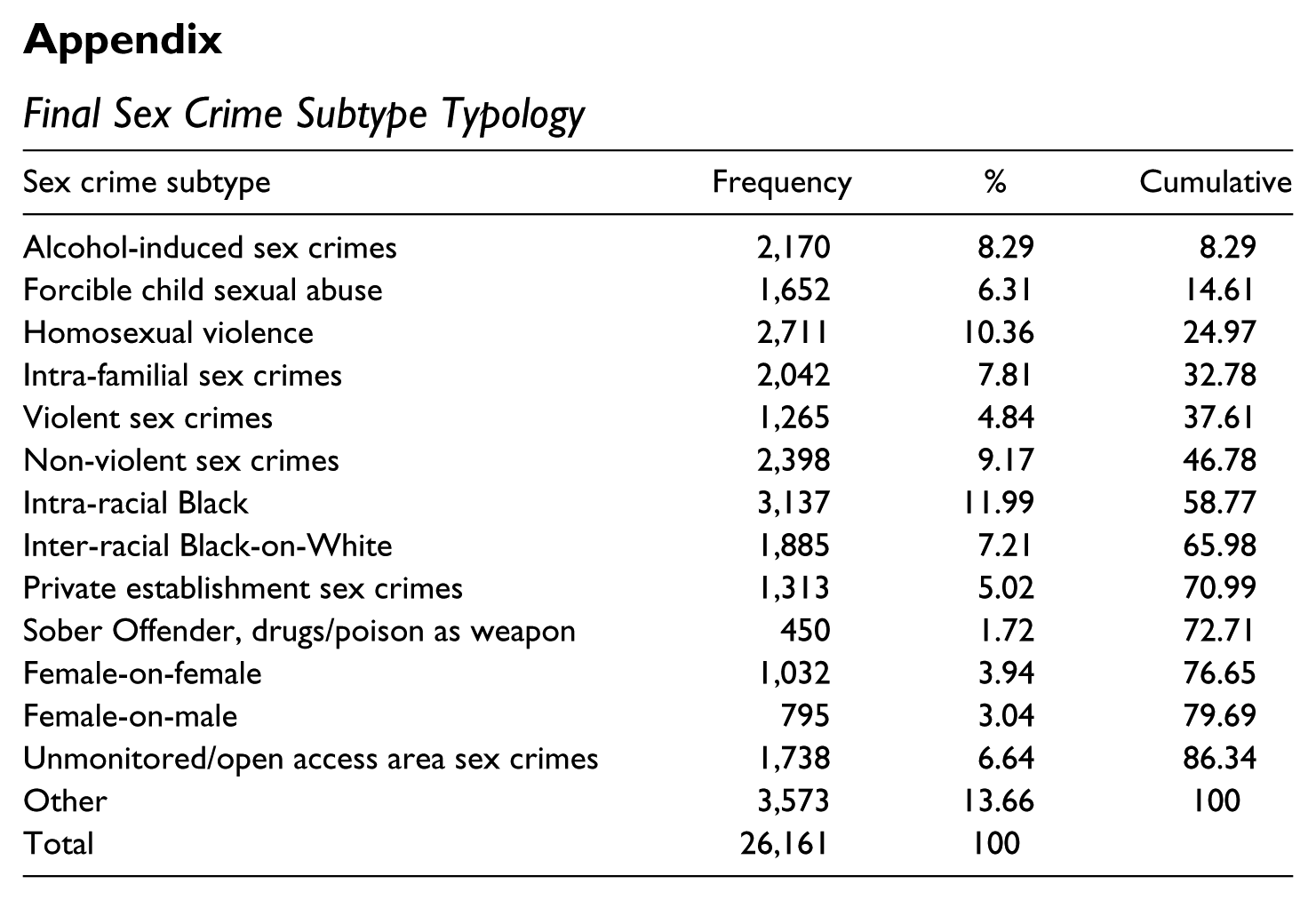
After examining the rotated solution, I identified loadings for each factor that were greater than |.4|. Six factors were determined to not be meaningful, as they loaded highly on a “missing” or “other” clustering variable. These predicted factor scores were dropped and corresponding observations were subsequently placed into one of the 16 remaining factors based on that observation’s highest score among valid factors. Finally, for determining inclusion of observations in each factor, I examined the maximum factor scores. 3 Observations with maximum factor scores greater than |1| were included in the factor, and those less than |1| were reassigned to an “other” category. The final data reduction resulted in 14 sex crime subtypes (see the appendix).
I focused my analysis on sex crime subtypes that are potentially theoretically linked to social disorganization theory. Private establishment sex crimes and sex crimes occurring in unmonitored/open access locations were obvious choices due to the likely influence disorganization has on violent crime occurring in such locations. Given the high volume of sex crimes that occur in the home, I also selected sex crime subtypes that had a higher level “within-home” ordering. Given that prior research has established structural variation with respect to explaining familial, acquaintance, and stranger violent victimization (Williams & Flewelling, 1988; Lee & Bartkowski, 2004; Flewelling & Williams, 1999), it is reasonable to assume that a within-home versus outside-the-home approach would yield similar variation. In examining descriptive statistics for each within-home subtype, I found that alcohol-induced sex crimes, child sexual abuse, intra-familial sex crimes, and violent sex crimes occurred almost exclusively within the home. The forthcoming analyses present the results of a general aggregated sex crime model, followed by six subtype models: alcohol-induced sex crimes, child sexual abuse, inter-familial sex crimes, violent sex crimes, private establishment sex crimes, unmonitored/open access area sex crimes.
Primary Explanatory Variables
Six indicators reflecting social disorganized communities were derived, at the city level, from the 2000 Census utilizing GeoLytics software. Ethnic heterogeneity was represented by a racial diversity index (known as the Herfindahl index) of six racial/ethnic categories (White, Black, Asian, Hispanic, Native American, and “Other”) that is represented by the following equation:

where S represents the proportion of the population of racial group i out of N races. This summation is then subtracted from 1 so that values of 0 represent total homogeneity and increasing values represent increasing heterogeneity.
Residential stability was calibrated using the proportion of residents within the community who had not moved from another dwelling in the previous 5 years (Osgood & Chambers, 2000; Sampson, 1985). Home ownership was indexed by total number of housing units occupied by owners, expressed as a proportion of all housing units in the community. I defined poverty in terms of simple poverty—that is, the proportion of persons living below the poverty line. Family disruption was indexed by the number of single female-headed households with one or more children under the age of 18, expressed as a proportion of all households with children (Lee, 2008; Lee & Thomas, 2010; Warner & Pierce, 1993). I calculated the low educational attainment rate for each community by scaling the total number of persons over age 25 without a high school degree or GED by the total number of persons in the community above 25. I also calculated the unemployment rate by scaling the total number of adults (above the age of 18) that were unemployed by the total population in the labor market.
Preliminary analysis of the correlational structure of these measures raises some concerns, particularly with regard to relatively strong correlation among low educational attainment, unemployment, and poverty. Given the likely problem of multi-collinearity in the forthcoming regression models, a data-reduction technique is necessary to summarize like-measures into composite indices. Therefore, a Varimax-rotated principle component factor analysis was run to detect underlying data structures. Two summary indices were apparent from the entered variables: resource disadvantage (combining poverty, family disruption, unemployment, and high school drop-out rate) and local community investment (combining home ownership and residential stability). These two uncorrelated factors were retained to reduce issues of multi-collinearity, preserve statistical power, and reduce the possibility of spurious variation in effects in the forthcoming regression models (see generally, Anderson, Burnham, Gould, & Cherry, 2001). Furthermore, these indices have shown theoretical promise in predicting rural violent victimization (see generally, Lee & Thomas, 2010).
An element often missing in this research tradition focuses on the role of economic inequality within communities. It has been proposed that economic heterogeneity may be more pronounced in rural communities, because they encompass a wide range of social classes and incomes (Osgood & Chambers, 2000). However, the effect of this inequality is still largely unknown. To this end, I accounted for inequality using the Gini coefficient. As Pedersen (2004) argued, the Gini coefficient contains the desirable property of capturing relative deprivation when measured on populations where such comparisons are appropriate. The Gini coefficient is defined as

where xi signifies the household income for 1999 as reported by the 2000 Census, µ represents the mean income value, and n represents the total number of households, indexed by i. Due to the nature of Census data representing income level data as bins (e.g., “US$0-US$9,999,” “US$10,000-US$14,999,” etc.), I followed the procedure used by Hipp (2007) to take this data format into account. Using an adapted version 4 of the Pareto-linear procedure (Nielsen & Alderson, 1997), I generated Gini coefficient values for all cities.
Control Variables
In addition to key theoretical variables, I also controlled for a variety of other possible confounding factors. Prior research indicates that community vacancy rates are an indicator of physical community disorder (Skogan, 1990). Therefore, I calculated community vacancy rates using the total number of empty housing units (less empty homes identified as summer rentals) and scaling by the total number of housing units in the community. Finally, owing to the diverse representation of states from across all regions of the United States (specifically, that states may differ considerably in their sex offender statutes, likelihood of victimization reporting, and law enforcement response), it is important to control for variability across states and assess only within state relationships. To this end, each model estimated the fixed effects of states by including dummy variables for all states (less one to serve as the reference category). For rural models, however, inclusion of all state dummy variables resulted in a significant reduction of cases that were included in the regression models. This was due to the high proportion of states that experienced zero sex crimes within their rural populations. An omnibus F test revealed that state dummy variables were not jointly significant to explaining any of the predicted sex crime subtype outcomes. 5 Thus, I included a measure of logged population at risk as well as a dummy variable measure of South (vs. non-South) in the rural subtype models.
Analysis Plan
My primary hypothesis is that cities with lower resource disadvantage and higher community investment will have, on average, lower volumes of sexual crimes. I expect this to be particularly evident for sex crime subtypes that occur outside the home (namely, unmonitored/open access locations and private business/retail offices). For urban and urbanizing communities, negative binomial regression was used to predict the total sex crime count, with the population at risk specified as the exposure variable in the regression equation. Reported sex crime victimizations are generally rare events that occur over a small population, generating extreme heteroskedasticity unsuited to ordinary least squares (OLS) regression models. Poisson-based regression models of offense counts to analyze per capita offense rates are built on the assumption that the underlying data can take the form of nonnegative integer counts of events (Osgood, 2000). Negative binomial regression combines the Poisson distribution of count events with a gamma distribution of the unexplained variation in the underlying true mean of event counts, λi. The negative binomial model is defined as
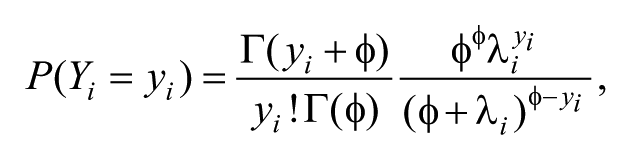
where Γ represents the continuous gamma function and ϕ is the reciprocal of the residual variance of underlying mean counts.
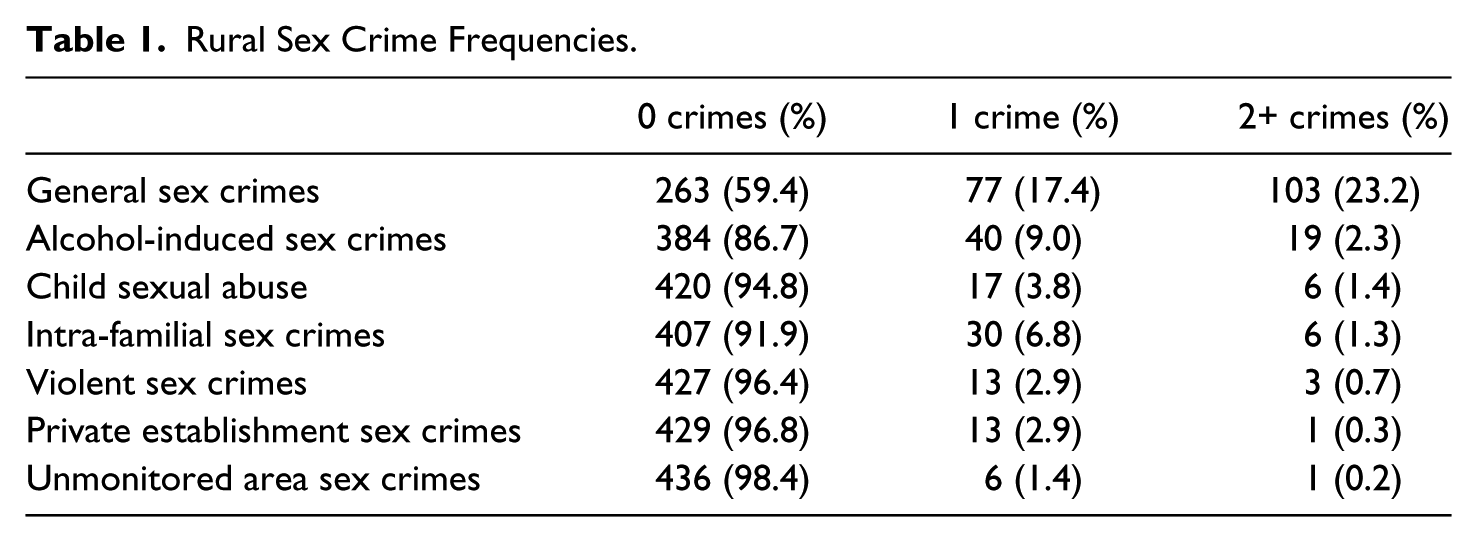
Negative binomial models, however, were not well suited to rural community analysis. When examining sex crime subtypes, rural communities were particularly marked by very low counts of sex crime events (range = zero-five). When event counts are very small, a large sample of aggregate units is needed to secure adequate statistical power. The sample size of rural communities (n = 443) was not sufficient to achieving this threshold. Therefore, I transformed the outcome variable for rural communities into a binary outcome (sex crime occurred in community: yes/no) and used binary logistic regression for rural community models. As illustrated in Table 1, a binary outcome is fairly appropriate given the distribution of events for each of the crime subtypes (i.e., only 0.2% to 2.3% communities experienced two or more of a particular type of sex crime event). A negative binomial model was used when analyzing aggregated sex crimes in rural communities, provided the proportion of cities that reported two or more sexual victimizations that year (23.2%) warranted the outcome variable to be analyzed as a count outcome, rather than a dichotomous outcome.
Rural Sex Crime Frequencies.
Analysis and Results
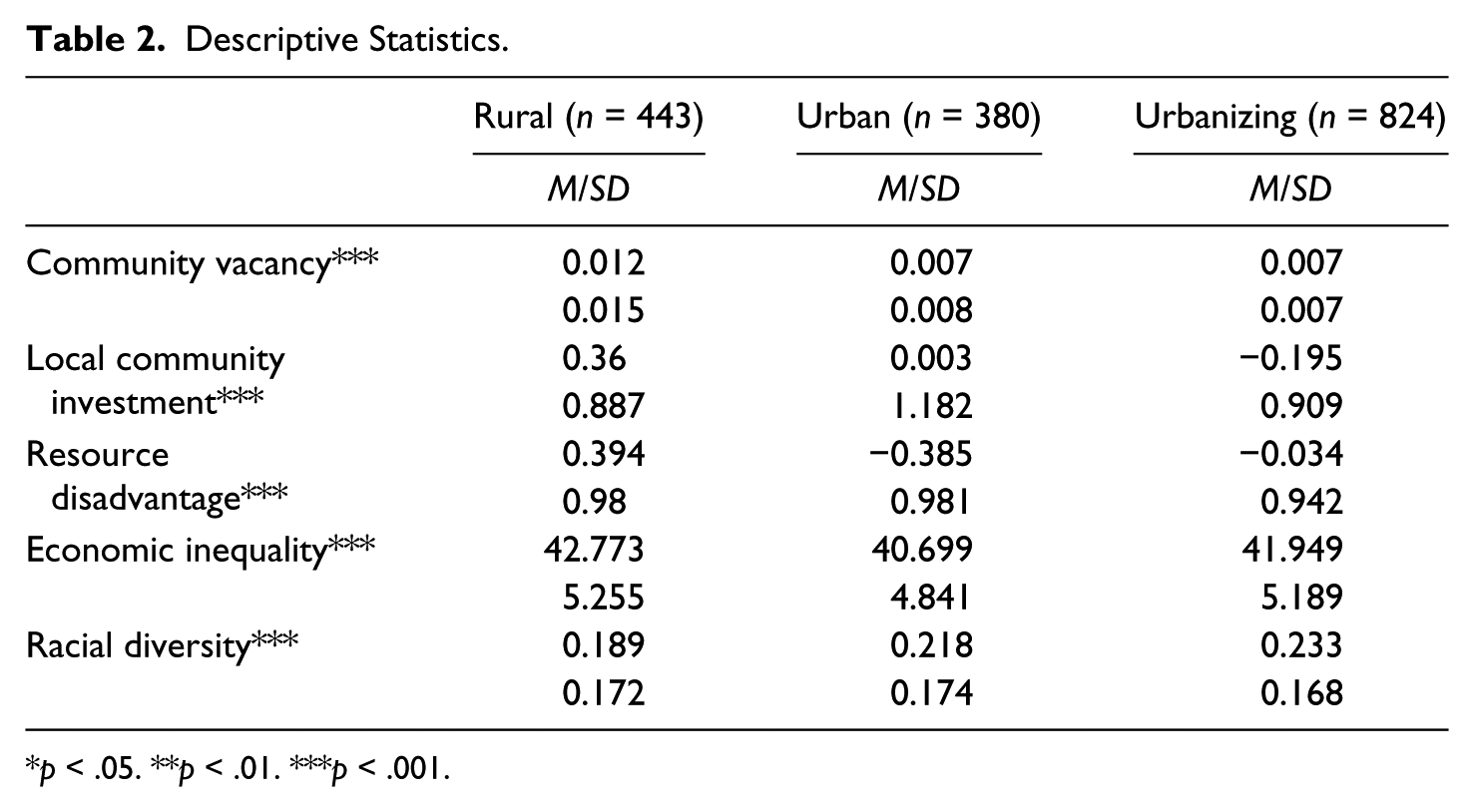
The key variables of interest are described in Table 2. Significant differences among the three community types were detected using one-way ANOVA, and pairwise differences were analyzed using a Bonferroni post hoc adjustment. All three communities demonstrated significant differences from each other with respect to resource disadvantage, F(2, 1644) = 68.10, p < .001, local community investment, F(2, 1644) = 46.86, p < .001, and economic inequality, F(2, 1644) = 16.86, p < .001. In the rural sample of communities, the mean levels of resource disadvantage, economic inequality, and community vacancy rate were significantly higher than those levels in urban and urbanizing communities. As far as these measures are concerned, it is reasonable to conclude that rural communities are more disorganized/disadvantaged compared with urban and urbanizing counterparts. However, levels of racial diversity were significantly lower in rural communities than in urban and urbanizing communities, p < .001. Finally, the level of local community investment is significantly higher in rural communities than in the urban or urbanizing counterparts, p < .001. Taken together, it is reasonable to conclude that rural communities in this sample are more structurally disadvantaged than their urban/urbanizing counterparts, yet still maintain higher levels of community investment and lower levels of racial diversity.
Descriptive Statistics.
p < .05. **p < .01. ***p < .001.
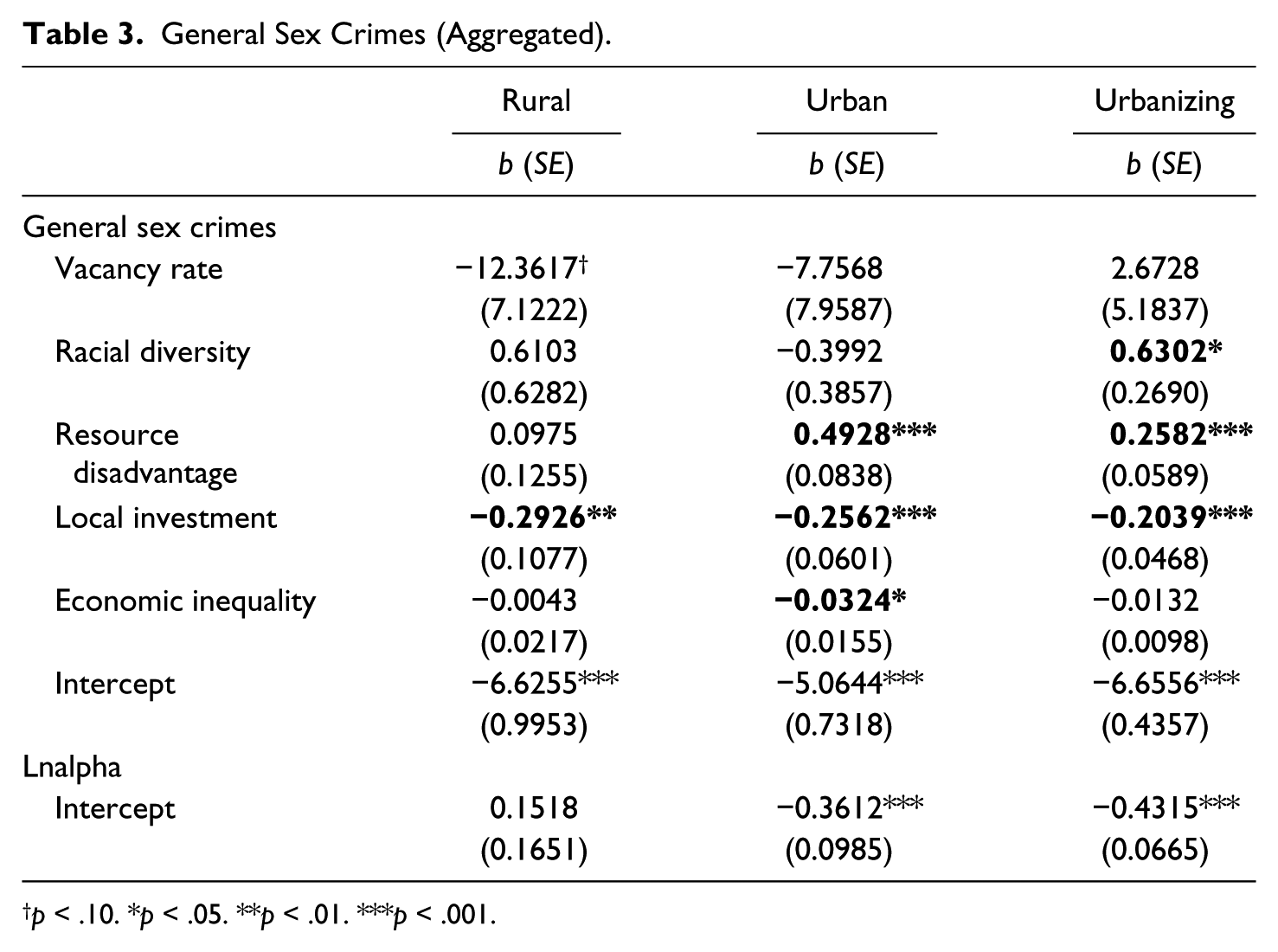
Tables 3 through 9 display the results from the application of explanatory variables to the outcomes of interest. As mentioned briefly earlier, the general sex crime model (which models the relationship between social disorganization measures and the aggregated total of sex crimes) uses negative binomial regression techniques for rural, urban, and urbanizing communities; therefore, coefficients are directly comparable across these models (see Table 3). The results of this initial model show that local investment was a significant predictor of sexual crimes in all community types (p < .01) in that lower level of local community investment was associated with increases in the rate of aggregated sex crimes. Resource disadvantage, however, was only significant in explaining variation in sex crimes in urban and urbanizing communities. Economic inequality was a significant covariate in urban communities alone (p < .05), but behaved in a counter-intuitive manner (i.e., decreases in economic inequality were significantly associated with increases in aggregate sex crimes). The following sections describe the results of the modeled relationships between covariates of interest and individual sex crime subtypes.
General Sex Crimes (Aggregated).
p < .10. *p < .05. **p < .01. ***p < .001.
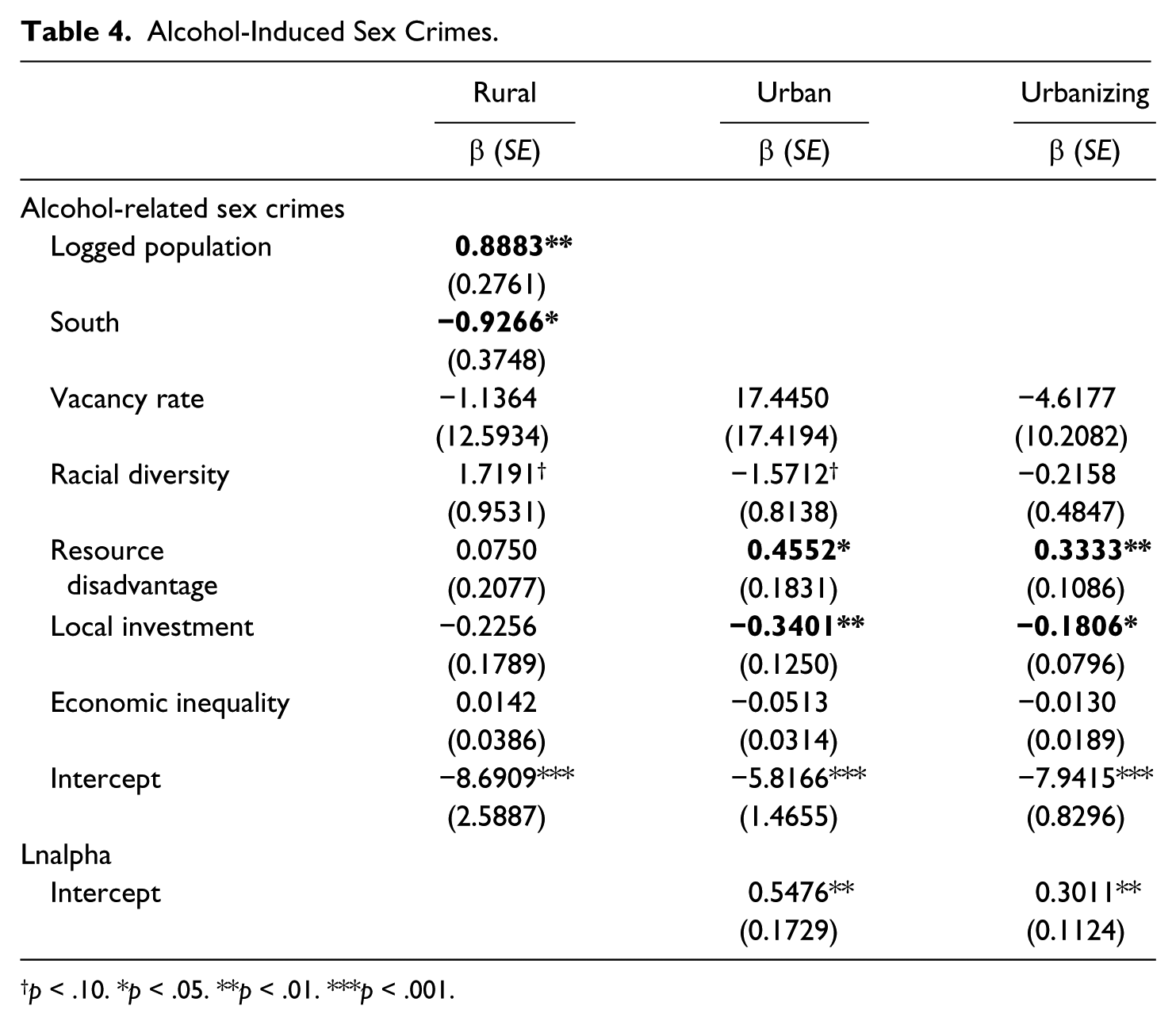
Alcohol-Induced Sex Crimes.
p < .10. *p < .05. **p < .01. ***p < .001.
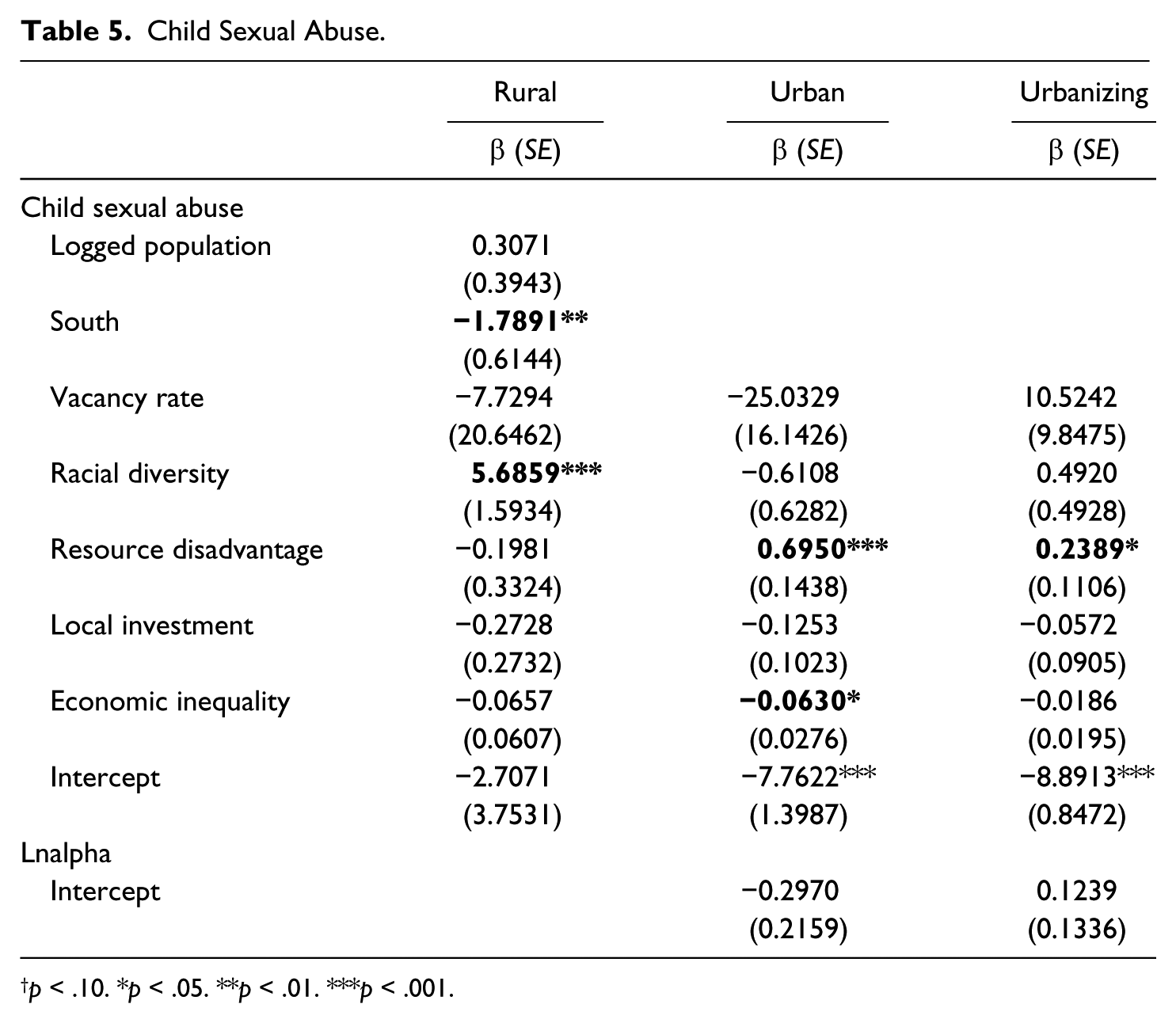
Child Sexual Abuse.
p < .10. *p < .05. **p < .01. ***p < .001.
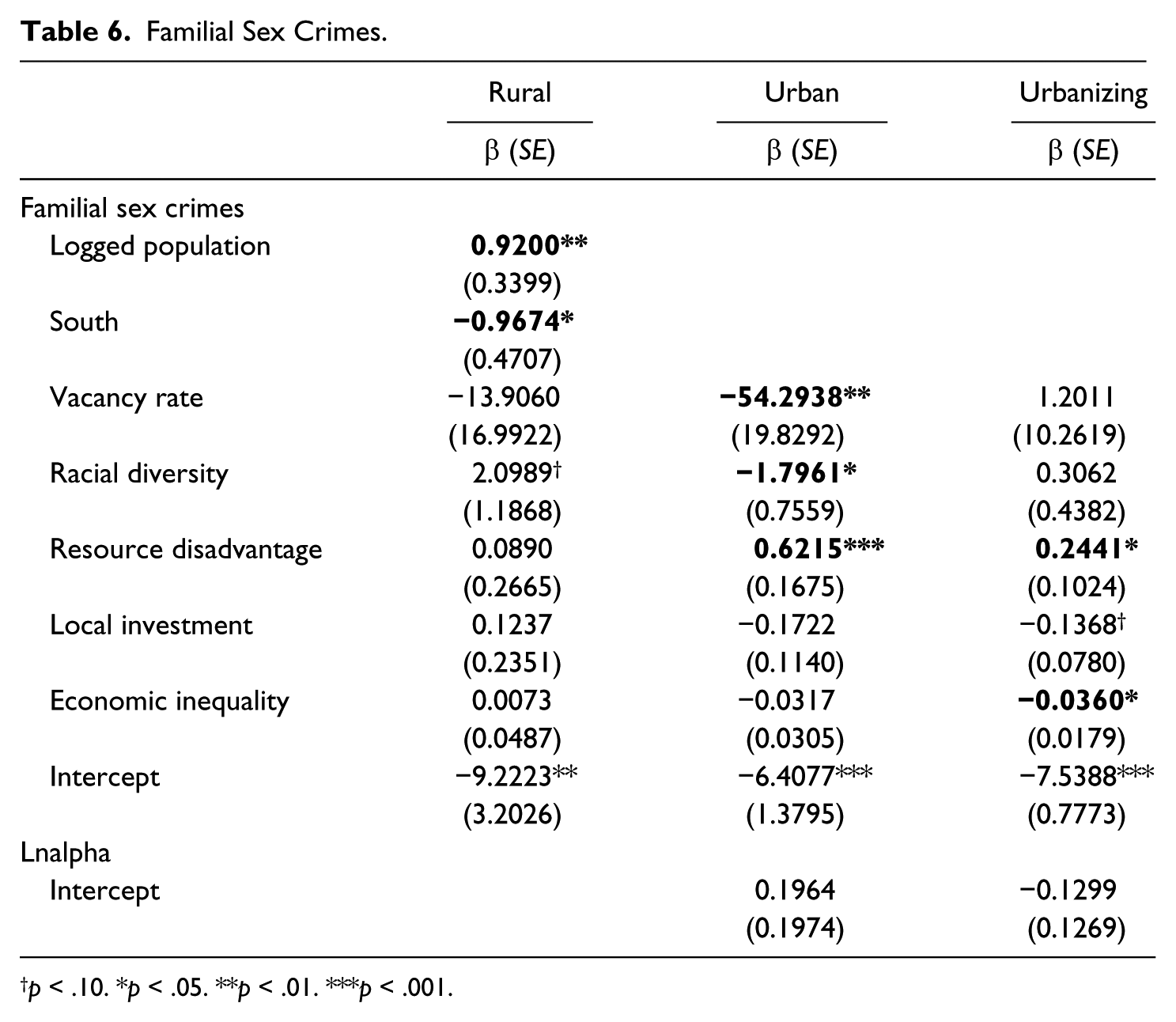
Familial Sex Crimes.
p < .10. *p < .05. **p < .01. ***p < .001.
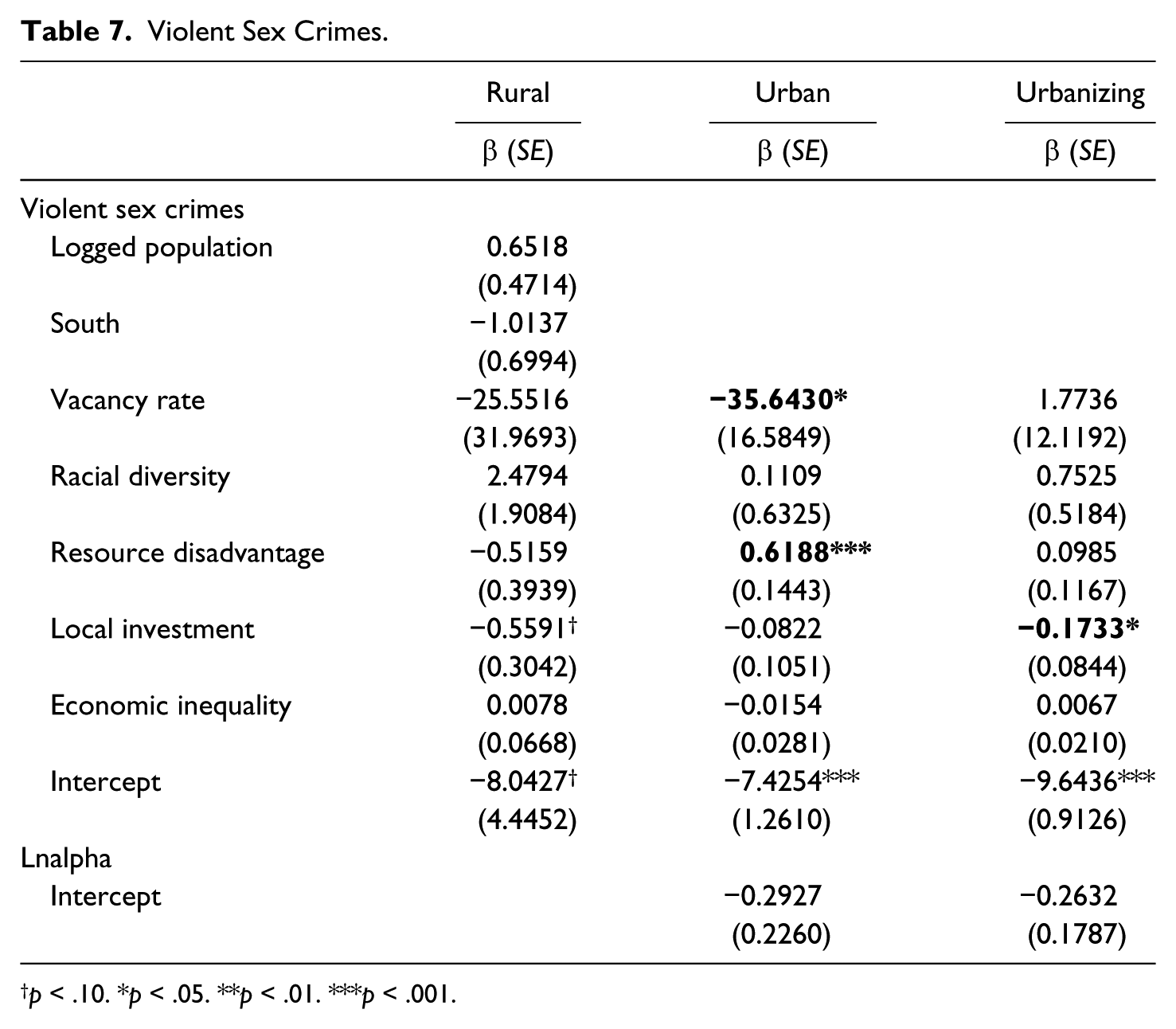
Violent Sex Crimes.
p < .10. *p < .05. **p < .01. ***p < .001.
Private Establishment Sex Crimes.
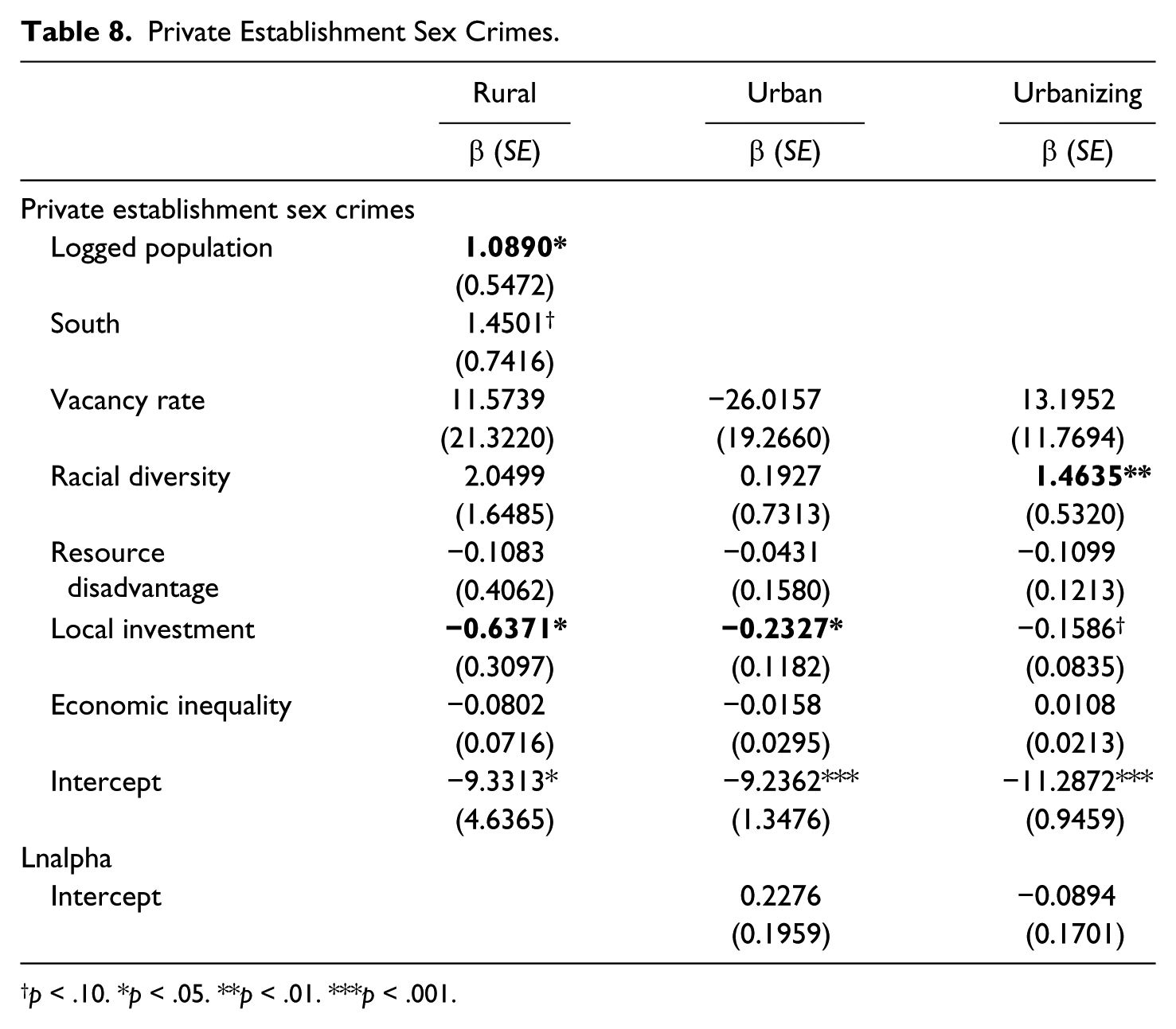
p < .10. *p < .05. **p < .01. ***p < .001.
Unmonitored/Open Access Sex Crimes.
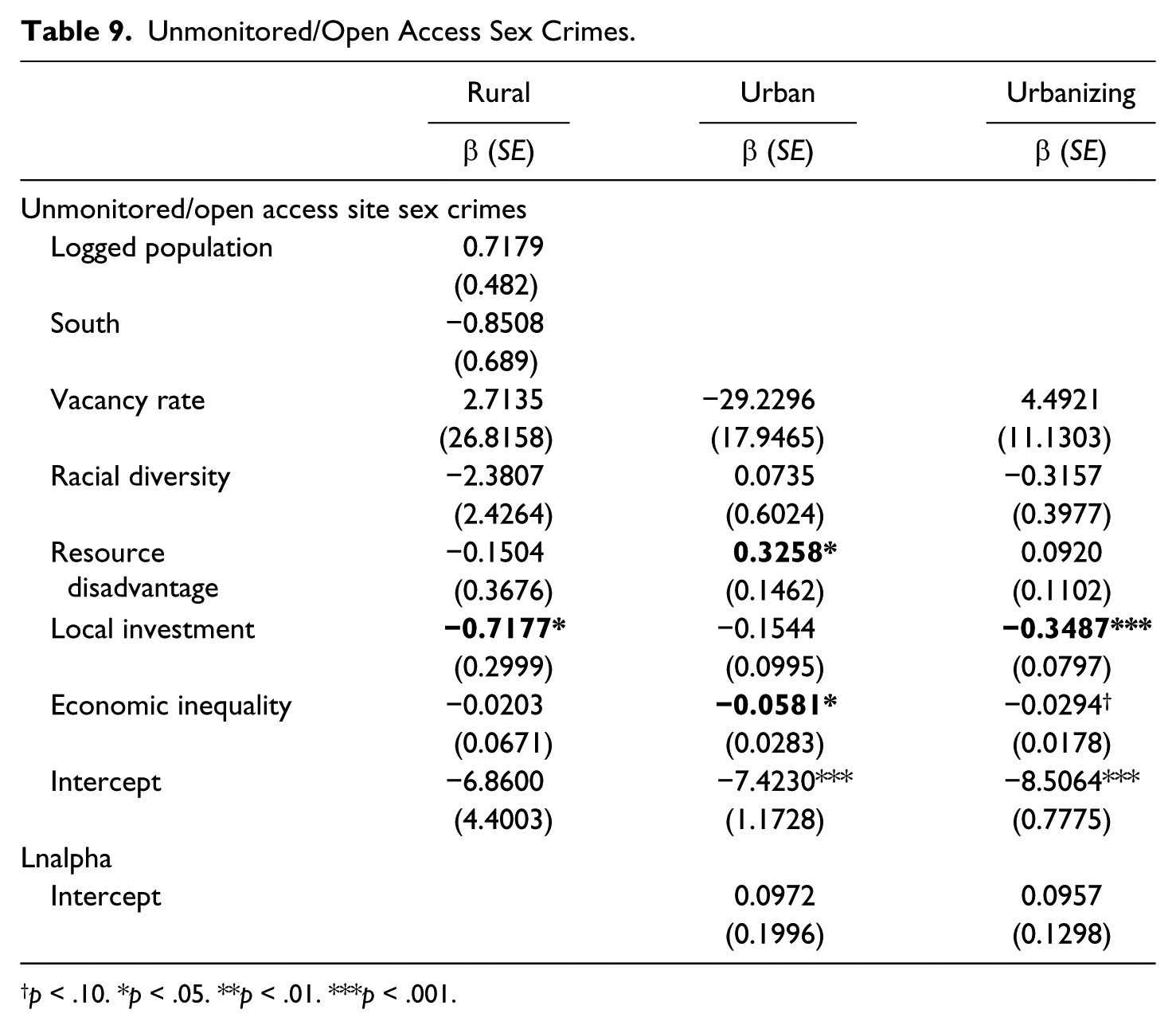
p < .10. *p < .05. **p < .01. ***p < .001.
Alcohol-Related Sex Crimes
Sex crimes that were committed while the offender was intoxicated had very different structural covariates for those reported in rural areas from those reported in urban and urbanizing areas (see Table 4). The effects of resource disadvantage and local investment were not significantly related to this specific type of reported victimization in rural communities; however, these effects did successfully explain alcohol-related sex crimes in urban and urbanizing communities (p < .05). For these community types, resource disadvantage and local community investment demonstrated positive and negative relationships with alcohol-induced sex crimes, respectively. Of additional interest, the role of racial diversity showed nearly significant effects in rural and urban communities, but not in urbanizing communities. However, these effects were opposite in direction; whereas increased racial diversity significantly predicted increased alcohol-related sex crimes in rural communities, increased diversity in urban communities accounted for decreases in this crime type.
Child Sexual Abuse
Crimes of child sexual abuse (which consisted primarily of crimes of forcible fondling, incest, and statutory rape) were also explained by different structural mechanisms between rural and urban areas (see Table 5). Higher levels of resource disadvantage in urban and urbanizing areas were associated with higher reported child sexual abuse victimizations, while higher levels of economic inequality were significantly associated with higher victimizations in urban areas only. In rural communities, racial heterogeneity played a role in explaining this type of victimization, with increased heterogeneity being linked to increased crimes. Local community investment did not appear to play a significant role in any of the explanatory models.
Intra-Familial Sex Crimes
Intra-familial sex crimes (including spousal rape and incest) demonstrated a degree of variability across the three model types (see Table 6). For instance, in urban and urbanizing communities, increased levels of resource disadvantage again explained a significant portion of the variance in this type of sexual victimization (positive relationship), but not in rural communities. There were also a number of counter-intuitive findings that warrant further investigation. For example, community vacancy rates, as well as the degree of racial heterogeneity, were significant predictors of intra-familial sex crimes in urban communities; however, the coefficients were in the opposite expected direction. In other words, increased vacancy rates and increased racial heterogeneity were significantly associated with decreases in this type of offending. As well, increased economic inequality was significantly associated with decreased victimizations in urbanizing communities.
Violent Sexual Assaults
Violent sexual assaults (which included any type of sex crime enumerated by NIBRS combined with multiple weapon use, including knives, guns, and personal weapons) were also explained by differing mechanisms (see Table 7). In urban communities, resource disadvantage was a significant positive predictor of this type of victimization, while local investment played a more important role in urbanizing and, to a degree, rural communities, with lower levels of this construct explaining increased offending. As with intra-familial sex crimes, the community vacancy rates were significantly associated with this type of victimization, but this finding was counter-intuitive (i.e., increased levels of vacancy were associated with decreased victimizations).
Private Establishment Victimization
Sex crimes that occurred in private establishments (including private offices, bars, gas stations, retailers, grocery stores, and other private businesses) were markedly different from the preceding four subtypes with respect to explanatory structural mechanisms (see Table 8). While resource disadvantage was not significantly associated with reported victimization of this specific sex crime, decreased levels of local community investment were associated with increased levels of victimization in rural and urban communities. Racial diversity also was an important predictor of sex crimes that occurred in private establishments, but only those in urbanizing communities, with increased levels of heterogeneity being associated with increased offending in private establishments.
Unmonitored/Open Access Victimization
Sex crimes falling under this category occurred in locations that were likely unmonitored and accessible 24 hr per day (e.g., construction sites, parking structures, fields/woods, parks, etc.). This victimization subtype behaved markedly different from all preceding models (see Table 9). First, resource disadvantage and economic inequality were significant predictors of this type of sex crime only in urban communities. Whereas resource disadvantage behaved intuitively with respect to this sex crime subtype (signified by a positive relationship), the effect of economic inequality behaved in a counter-intuitive manner, with higher levels of inequality resulting in decreased levels of victimization. The role of local community investment was a significant predictor in rural communities and urbanizing communities, with lower levels of investment explaining higher levels of victimizations.
Discussion and Conclusion
This analysis was crafted in effort to address the possible intersection of several significant voids in the research on inter-community variations in sex crimes. First, although some evidence has suggested that macro-level forces may contribute to sexual offending in general, few empirical studies have examined these in detail; most of the theoretical underpinnings of sexual victimization have been confined to micro-level theories, specific to sexual offenders. Second, although a small number of empirical studies have focused specifically on the subject of rural sexual victimization, no study to date provides an adequate empirical test on the specific types of rural sexual victimization (taking into account situational factors and inter-personal characteristics). Finally, the author is not aware of any study to date that examines inter-community variation in the structural antecedents of sexual victimization (i.e., prior empirical work has examined either urban communities or rural communities, but not both). The theoretical implications of the current study not only shed light on inter-community variation in sexual victimization, but also more broadly contribute to the knowledge base of theories on sexual offending, in general.
In general, the results suggest that social disorganization of communities is a powerful determinant of sex crimes. In examining the model for the aggregate summation of all sex crime offenses, resource disadvantage was significant in explaining urban and urbanizing community sex crime rates; local investment was significant to explaining all community-type sex crime rates, and economic inequality was significant to explaining urban sex crime rates. As well, the results suggest differing within-community characteristics are associated with different types of sex crimes. For instance, in rural communities, local investment was significantly related to private establishment sex crimes and unmonitored/open access sex crimes, but not significantly related to any other subtypes. Likewise, in urban communities, resource disadvantage was significantly related to all subtypes, except private establishment sex crimes. The differences between rural and urban communities were particularly marked, in that resource disadvantage was a major predictor of sex crimes (aggregate and subtypes) in urban and urbanizing communities, but was not predictive of any dependent outcome in rural communities. These findings indicate that the canons of social disorganization theory, originally derived to explain violent street crime in the urban metropolis, have an informative element in explicating a more macro-theoretical understanding of sexual crimes, specifically. Furthermore, these findings illustrate different mechanisms and social landscapes at work in urban areas versus rural ones. While the role of resource disadvantage (poverty, family disruption, low educational attainment, unemployment) had a strong influence on general sex crimes (aggregated measure) in urban and urbanizing communities, this element was not critical to the explanation of sex crimes in rural communities. This is interesting, given that earlier research has demonstrated that resource disadvantage had a positive relationship with general violent crime in rural communities (Barnett & Mencken, 2002). The finding that local community investment being an important indicator of general sex crimes does dovetail nicely with the prior work of Osgood and Chambers (2000), who found that residential stability was an important indicator of forcible rape among juvenile offenders. Economic inequality only demonstrated significant negative influence on general sex crimes in urban communities. This contradicts the conclusions of Peterson et al. (2000), who found that economic deprivation had a significant positive effect on rates of forcible rape in urban communities. However, given the primary use of forcible rape alone as a measure of sex crimes, it is still unknown how a measure of economic deprivation would behave in predicting other types of sex crimes (particularly non-violent ones). Even though rural communities had, overall, a greater level of economic inequality than in urban and urbanizing areas in this study, no significant effects were detected for rural communities.
When turning to the subtype models, I find that resource disadvantage does indeed continue to exert an influence on specific types of sex crimes in urban (and, to an extent, urbanizing) areas, but this influence was diminished when analyzing those crimes occurring in private establishments, as well as unmonitored/open access locations. In fact, when analyzing these latter two subtypes, it appears that social disorganization mechanisms are stronger for rural communities. In rural communities, there is a stronger effect of local community investment on private establishment sex crimes, as well as sex crimes occurring in unmonitored/open access locations. In general, it appears that sex crimes that occurred almost exclusively within the home or primary residence (i.e., alcohol-induced, adult-on-child sexual abuse, intra-familial, and violent sex crimes) were subject to social disorganization mechanism influences in urban and urbanizing areas, but not in rural areas. Conversely, those sex crimes that occurred outside the home or primary residence were subject to more social disorganization influence when reported in rural areas, and lesser in urban and urbanizing areas.
One explanation for this may lie in the fact that rural homes and families may be more “guarded” against out-of-house influences (such as widespread poverty, unemployment, and general disorder) due to their ability to seek refuge from other informal means. Recent research has supported the notion that the informal social control acts as an important mediator between rural disadvantage and violent crime. Research by Moore, Probst, Tompkins, Cuffe, and Martin (2007) concluded that rural children, though more likely to live in abject poverty and grow up in unemployed households compared with their urban counterparts, were less likely to live in homes wrought with high parenting stress and violent expressions of disagreement, as well as less likely in neighborhoods with low levels of trust. The present study, illustrating that resource disadvantage and (to an extent) economic inequality are related to “within-home” sexual victimization in urban communities but not in rural ones, suggests that some higher order mechanisms may diminish the effect of these social constructs in rural communities. One possibility is noted by Lee and Bartkowski (2004), who conclude that the presence of civically engaged religious adherents serves as a protective measure against juvenile family homicides in rural communities. This effect, however, was not found for acquaintance or stranger homicides in rural communities, nor was it found for juvenile homicides of any type in urban communities. It is possible that a similar dynamic may be at play with respect to sexual victimizations in rural communities. This is further evidenced when examining “outside-home” sexual victimizations in rural communities, where lower levels of local community investment are explanatory of sexual victimizations occurring in private establishments as well as unmonitored/open access locations. 6
Given that “mainstream” criminology, specifically social disorganization theory, has been largely absent in the literature on sexual offending, this study provides a new lens with which to examine these crimes. It is worth noting, however, that the theoretical contribution of this study should not to be viewed as “in competition” with specialized theories of sexual offending, but rather, potentially in conversation with these theories. The Integrated Theory of Sexual Offending (ITSO), for instance, is one theory that may complement the findings of the current study. This theory, proposed by Ward and Beech (2006), posits that sexual offending occurs as a consequence of three simultaneously interacting factors: (a) biological factors, influenced by genetic inheritance, and brain development; (b) ecological niche factors, specifically social cultural roles of the offender; and (c) neuropsychological factors, including motivation, perception, memory and action selection and control. Ecological niche factors are said to reflect a set of “potentially adverse social and cultural circumstances, personal circumstances, and physical environments confronting each person as he or she develops throughout their life” (p. 52). Consideration of these proximal factors can be instrumental to explaining how sexual offending emerges from networks of relationships between individuals and their habitats. Though Ward and Beech do not specifically implicate rural/urban differences in this framework, the results of the current study do demonstrate a relationship between adverse social environments (abject poverty, lack of real jobs, social isolation, lack of community commitment) and sexual victimization.
Implications
Many of the problems faced by rural communities in responding to sexual violence (from a reporting and a treatment vantage point) may stem from deleterious structural elements unique to those communities. Rural communities are, by and large, characterized by geographic isolation, low population density, high density of acquaintanceship, and limited accessibility of services. One major finding in the preceding analysis was that low levels of local community investment were associated with higher rates of rural sex crimes (aggregate rates, as well as rates of private establishment and unmonitored/open access sex crimes). Though this construct was also significant to explaining urban sex crime rates, as well, it is highly likely that different explanatory mechanisms are at work. Sturney (1989), for example, found that women in mining communities often face barriers to disclosure of rape due to portions of such communities being dislocated and relatively transient. It is plausible to hypothesize that barriers to disclosure may serve as a mechanism that allows sexual violence to thrive in these areas. As well, some rural communities that are organized as tourist industries with a lot of mobility may also impact the rate of sexual violence incidents that occur. Rural coastal areas, for instance, with strong tourism industries are noted for high levels of sexual assault, particularly on weekends (Neame & Heenan, 2004). Effective policy and treatment initiatives, therefore, must give full consideration to these unique rural issues. Lewis (2008) recommended that this movement must begin with recognition of the unique challenges faced by rural victims and advocates (and, I would argue, the rural community itself) by working to promote culturally sensitive training of sexual assault advocates and rural police officers. Though it continues to be of paramount importance to understand micro-level issues of victims and offenders with respect to treatment and prevention, the community context of sexual victimization must be a part of this conversation, as a certain symbiosis between micro-level and macro-level forces may be at work.
Future Directions
There are many possibilities for augmenting the knowledge base on rural sexual victimization. This can be accomplished, in part, by extending the current study in several ways. First, it would be of extreme utility to increase the sample of cities to ensure generalizability of results. Although the current analysis includes 1,647 cities representing 20 U.S. states, these cities were selected for pragmatic reasons, rather than scientific ones. These cities represent the total available data from NIBRS for the year 2000. With a larger and more geographically representative sample of cities, one could derive more confident estimates of variation in city-level crime rates across states. As well, it is unclear whether these results would generalize at the international level. Recent work by Bruinsma, Pauwels, Weerman, and Bernasco (2013) found that social disorganization models did not fit crime data well in a Western-European city. It is unlikely that an exact replication of this study would yield similar results across different countries, given the varying degrees of social and political organization, as well as varying rates of reported sex crimes (the majority of EU countries, for example, have considerably lower rates of reported forcible rape than the United States).
Second, it would be useful to expand the range of structural variables used in the analysis. For instance, it would be interesting to examine the effect of housing unit crowding on sexual victimization, especially provided the vast number of sex crimes that occur within the home. As well, it was also be advantageous to focus on measures that capture the positive dimensions of community social structures that serve to enhance social organization, rather than undermine it. The present study largely used measures that reflect corrosive community features, rather than measures that illustrate institutional integration and social control (with the exception of local investment). As mentioned earlier, it would be interesting to weave the religious adherent hypothesis (Lee & Bartkowski, 2004) into the present analysis to gauge potential protective effects that buffer disadvantaged rural homes from “within-home” sexual victimization. In addition, there is value in exploring the civic community perspective in the present analysis, which explores the interwoven relations between social, political, economic, religious, and other realms (Lee, 2008; Lee & Thomas, 2010). Given that past research has used these measures almost solely at the county level unit of analysis, it would be interesting to examine how these social forces behave at the city level. Such an expansion on the analytic methods may also shed light on why the current study illuminated a number of counter-intuitive findings, specifically with respect to how community vacancy and racial heterogeneity behaved in a number of the models. It is possible that there are interaction effects and/or mediating effects of these constructs that may demonstrate more plausible linkages to macro-criminological theory.
Third, it has been well established that sex crimes are among the least reported of violent/personal crimes to law enforcement. Formal reporting of sexual victimizations is often remarkably low. To illustrate, only 16% of sexually victimized participants in the National Women’s Study–Revised (NWS-R) revealed that they reported this victimization to formal authorities (Wolitzky-Taylor et al., 2011). Therefore, utilizing NIBRS sex crime data is problematic, in that it only represents those sexual victimizations reported to law enforcement. However, NIBRS does have the unique advantage of capturing sexual victimizations of children under the age of 12, which usually accounts for approximately one third of sexual assaults annually (Snyder, 2000). This indicates that victimization surveys, such as the National Crime Victimization Survey (NCVS), is missing more than a third of all sexual assaults that occur in the United States each year. As well, NIBRS is the only existing dataset that allows for the large-scale disaggregation of sex crime events, as it contains more victim/offender information, as well as situational characteristics, than any other national criminal database.
Footnotes
Appendix
Final Sex Crime Subtype Typology
| Sex crime subtype | Frequency | % | Cumulative |
|---|---|---|---|
| Alcohol-induced sex crimes | 2,170 | 8.29 | 8.29 |
| Forcible child sexual abuse | 1,652 | 6.31 | 14.61 |
| Homosexual violence | 2,711 | 10.36 | 24.97 |
| Intra-familial sex crimes | 2,042 | 7.81 | 32.78 |
| Violent sex crimes | 1,265 | 4.84 | 37.61 |
| Non-violent sex crimes | 2,398 | 9.17 | 46.78 |
| Intra-racial Black | 3,137 | 11.99 | 58.77 |
| Inter-racial Black-on-White | 1,885 | 7.21 | 65.98 |
| Private establishment sex crimes | 1,313 | 5.02 | 70.99 |
| Sober Offender, drugs/poison as weapon | 450 | 1.72 | 72.71 |
| Female-on-female | 1,032 | 3.94 | 76.65 |
| Female-on-male | 795 | 3.04 | 79.69 |
| Unmonitored/open access area sex crimes | 1,738 | 6.64 | 86.34 |
| Other | 3,573 | 13.66 | 100 |
| Total | 26,161 | 100 |
Acknowledgements
I would like to express my gratitude to John R. Hipp for his excellent advisement and support on this project. As well, I wish to thank Carroll Seron, Donna Vandiver, and Valerie Jenness for providing extensive and helpful comments on earlier drafts of this article. Finally, I am grateful for the efforts of two anonymous reviewers, whose thoughtful suggestions were particularly helpful in revising this manuscript.
Declaration of Conflicting Interests
The author declared no potential conflicts of interest with respect to the research, authorship, and/or publication of this article.
Funding
The author received no financial support for the research, authorship, and/or publication of this article.