







Abstract
In this article, I describe the motivation-facilitation model of sexual offending, which identifies the traits of paraphilia, high sex drive, and intense mating effort as primary motivations for sexual offenses, as well as trait (e.g., antisocial personality) and state (e.g., intoxication) factors that can facilitate acting on these motivations when opportunities exist. Originally developed to explain contact sexual offending against children, the motivation-facilitation model was subsequently extended as an explanation for child pornography offending and for online solicitations of young adolescents. Here, I argue it has the potential to be expanded to explain other forms of sexual offending, including sexual assaults of adults and noncontact offenses involving exhibitionism or voyeurism. In this review, I critically examine the evidence for and against the model, discuss its limitations, and identify critical gaps for future research.
Keywords
Introduction
Understanding the factors underlying sexual offending could lead to more effective prevention, assessment, and intervention. Advances over the past 20 years in our understanding of factors associated with persistence of sexual offending—that is, factors associated with sexual recidivism among identified sex offenders—have improved our ability to make decisions based on recidivism risk and has guided treatment and supervision planning. This work has shown that risk factors can be broadly assigned to one of three dimensions (Hanson & Bussière, 1998; Hanson & Morton-Bourgon, 2005): (a) Atypical sexuality, which encompasses paraphilias such as pedophilia, biastophilia, sexual sadism, and exhibitionism; and hypersexuality as reflected in excessive sexual preoccupation and/or high sex drive. (b) Antisociality, which encompasses individual differences associated with antisocial and criminal behavior, including antisocial personality traits; offense-supportive attitudes, beliefs, and values; lifestyle instability; and a lack of prosocial, structured activities such as work. (c) Interpersonal deficits, which encompasses problems with social skills, difficulties maintaining stable and positive relationships, and feelings of loneliness.
Our understanding of the factors associated with onset of sexual offending, however, is less developed. What distinguishes those who commit a sexual offense for the first time from those who never commit sexual offenses? Onset and persistence factors are not necessarily the same; for example, there is evidence that childhood sexual abuse is associated with the onset of sexual offending, but it is not a significant predictor of sexual recidivism (Hanson & Bussière, 1998; Jespersen, Lalumière, & Seto, 2009; Seto & Lalumière, 2010; Widom & Massey, 2015). The gap between knowledge of onset and persistence factors reflects, at least in part, how it is easier to follow samples of sex offenders assessed in clinical or forensic settings, and then identify factors associated with the likelihood they sexually reoffend, than it is to identify and follow large community groups of at-risk individuals (preferably cohorts) to see who commits a sexual offense in the first place. Thus, existing models to explain onset of sexual offending have relied on cross-sectional comparisons—comparisons of sex offenders with other offenders or with nonoffending individuals—and extrapolation from the persistence literature on recidivism risk factors. A full review of these explanatory models is not possible here, but readers are referred to several books for critical reviews (Lalumière, Harris, Quinsey, & Rice, 2005; Seto, 2008, 2013; Stinson, Sales, & Becker, 2008; Ward, Polaschek, & Beech, 2006). Here, I describe and critically examine the motivation-facilitation model (MFM) of sexual offending.
MFM
The MFM of sexual offending (see Figure 1) is strongly influenced by Finkelhor’s (1984) preconditions model and by the general theory of crime proposed by Gottfredson and Hirschi (1990). Briefly, Finkelhor’s (1984) model identified three factors reflecting motivations to sexually offend against children—sexual arousal to children (pedophilia), having more affinity for children than for adults (emotional congruence with children), and feeling unable to meet one’s emotional and sexual needs in adult relationships (blockage). A fourth factor represented the overcoming of inhibitions to committing sexual offenses. The general theory of crime suggests that individuals who are low in self-control will commit crimes if opportunities exist (Gottfredson & Hirschi, 1990). Opportunity, in turn, depends on access to a potential victim or target, which is influenced by situational factors including the presence of obstacles. For example, the desire to take property will result in theft if the person is low in self-control and has an opportunity to take something of value. That opportunity does not exist if the valuable property is locked away and the person is not able to open or break the lock.
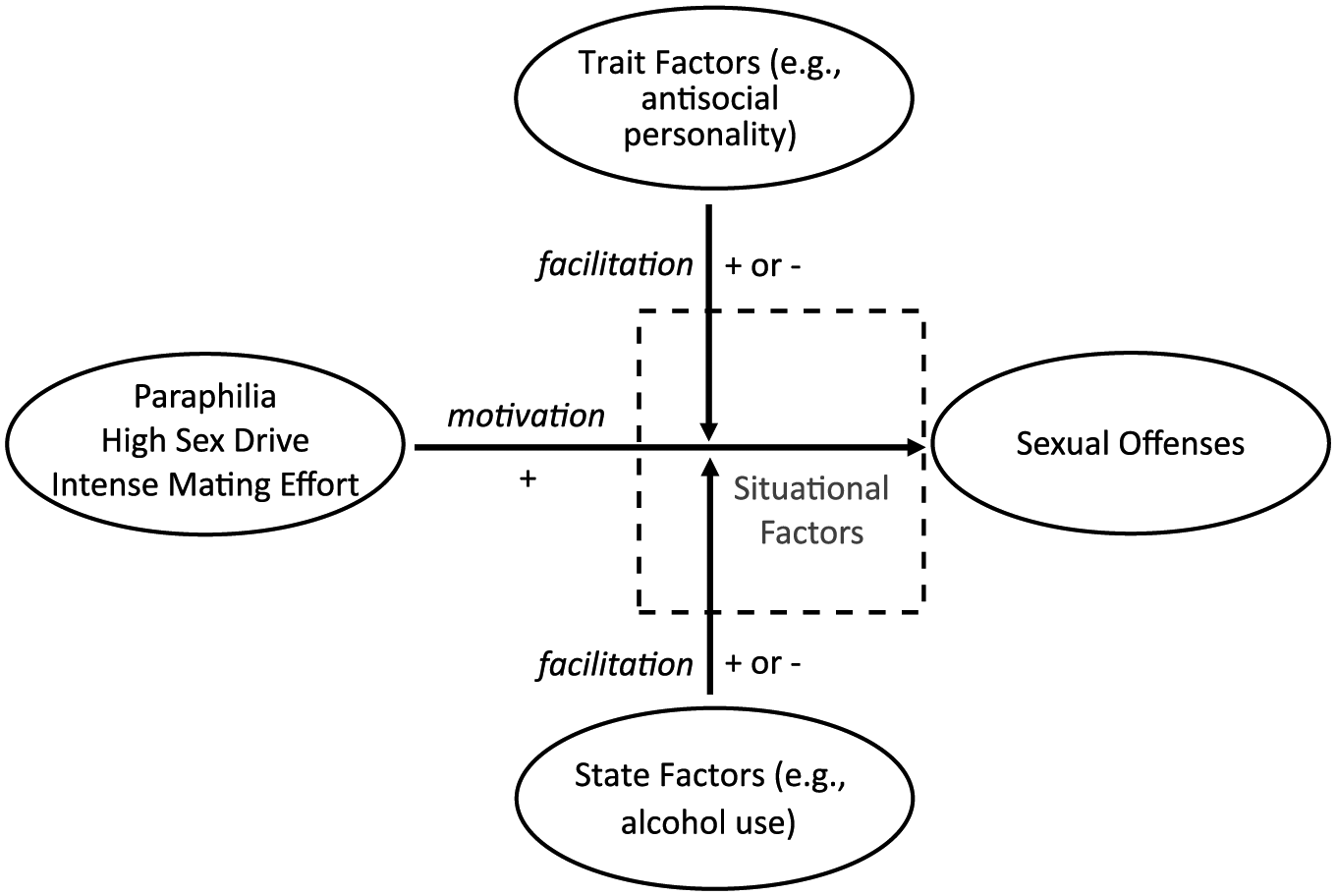
Updated motivation-facilitation model of sexual offending.
The general theory of crime is agnostic about the nature of individual motivations to commit crime, but implies that these motivations are human universals, for example, committing theft because one wants the stolen object, or committing assault because one wants to hurt the target. The MFM differs from the preconditions model and the general theory of crime by explicitly specifying primary sexual motivations and by explicitly delineating trait and state facilitation factors. Next, I explain what is meant by motivation and facilitation in the MFM.
Motivation
Consistent with dictionary definitions and with a consensus definition from Kleinginna and Kleinginna’s (1981) review, I also define motivation here as a psychological process that energizes and directs behavior; for example, a desire for sex is a motivation to engage in sexual behavior. Motivation for sex can influence perceptions, intentions, and other psychological phenomena, but is distinct from these other phenomena. Motivations to sexually offend can vary from offender to offender and offense to offense, but the MFM emphasizes three primary sexual motivations: (a) paraphilias, (b) high sex drive, and (c) intense mating effort.
Paraphilias
Paraphilias were the first type of sexual motivation considered in the MFM. Paraphilias are defined as an intense, recurrent, and unusual sexual interest in atypical sexual activities or objects (American Psychiatric Association [APA], 2013). Paraphilias are uncommon, socially sanctioned, and may reflect departures of evolved mechanisms from functioning as designed, to the extent that they interfere with reproductively relevant behavior and inclusive fitness. In line with this definition, I have estimated the prevalence of pedophilia (prepubescent children) is 1% of the general male population (Seto, 2017); pedophilia is highly stigmatized (Jahnke, Schmidt, Geradt, & Hoyer, 2015); and there is rapidly growing evidence that pedophilia is associated with indices of neurodevelopmental disorder—as indicated by white matter differences, difference in neuropsychological functioning, and a higher prevalence of prenatal perturbation indicators such as nonright-handedness and minor physical anomalies—that represents a failure in the psychological mechanisms underlying the detection of youthfulness in potential sexual partners (see Seto, 2017). Altogether, this evidence suggests that pedophilia precedes the onset of sexual offending, rather than representing an acquired response set after sexual offending has taken place (Seto, 2012, 2017).
The focus in the original description of the MFM was on the role that pedophilia played, and how pedophilia appeared to be related to neurodevelopmental perturbations and sexual abuse history. Since the first full description of the MFM in Seto (2008), the model has been expanded to include hebephilia (a paraphilic interest in pubescent children), other paraphilias (e.g., biastophilia: interest in nonconsenting sex), and to include nonparaphilic sexual motivations (high sex drive and intense mating effort) as well.
Some paraphilias are very important motivations for sexual offending, particularly pedophilia or hebephilia (associated with sexual offenses against prepubescent and pubescent children, respectively); biastophilia (associated with acts of sexual coercion, usually against peers or adults); and nonconsensual sexual sadism (associated with gratuitous violence or even the death of victims), exhibitionism (associated with indecent exposure), and voyeurism (associated with invasion-of-privacy offenses). Other paraphilias exist but are not explicitly named in either of the major international diagnostic systems (APA, 2013; World Health Organization, 2016). Many of these named paraphilias are criminalized, in the sense that they are illegal if acted upon with others. For example, sexual contacts with children are illegal, sexual assault and rape are illegal, and exhibitionism or voyeurism is illegal when committed against an unsuspecting person. Other paraphilias are not illegal unless they involve nonconsent, for example, there are sexual sadists in search of consenting partners with corresponding masochistic sexual interests.
The relationship between paraphilias and sexual offending is not one-to-one. Not all individuals with paraphilia have acted upon their sexual interests and many sexual offenders are not paraphilic. For example, some individuals with pedophilia have not committed any known sexual offenses involving children, and many sex offenders with child victims would not meet the diagnostic criteria for pedophilia (Cantor & McPhail, 2016; Seto, 2008, 2013). Seto (2008) estimated that approximately 50% to 60% of sex offenders against children are pedophilic. But there are other motivations, and whether someone acts on their sexual attraction to prepubescent children is affected by the influence of facilitation and situational factors.
Nonetheless, there is good evidence that paraphilias help explain sexual offenses. Studies consistently find that male sex offenders differ from other male offenders or nonoffending males in the likelihood they self-report paraphilic sexual thoughts, fantasies, or urges, though many will also deny their paraphilic interests (see Lalumière et al., 2005; Seto, 2008; Seto & Lalumière, 2010). Phallometric studies find that sex offenders with child victims show relatively more genital response to stimuli depicting children (stories about sex with children, pictures of children) than to stimuli depicting adults (stories about sex with adults, pictures of adults) when compared with other sex offenders, other offenders, or nonoffending males (see Seto, 2008, 2013).
Similarly, men who have sexually assaulted women respond relatively more to stories of rape than to depictions of mutually consenting sex, compared to other men (see Lalumière et al., 2005). This sexual response to rape appears to be related to cues of nonconsent rather than violence, and thus we have argued for a distinction between biastophilia and sexual sadism (Harris, Lalumière, Seto, Rice, & Chaplin, 2012; Seto, Lalumière, Harris, & Chivers, 2012). Surprisingly few studies have been conducted on other paraphilias, but those that have been reported still show this general pattern, for example, with exhibitionists (Marshall, Payne, Barbaree, & Eccles, 1991). Moreover, there is good evidence that paraphilia indicators predict sexual recidivism among identified sex offenders (Hanson & Bussière, 1998; Hanson & Morton-Bourgon, 2005). This includes admissions of paraphilic sexual interests, phallometrically assessed sexual arousal to children or to sexual violence, number of sexual victims, and the age and gender of child victims.
However, these correlations may not reflect causal effects; causality requires covariation, but also temporal precedence and ruling out alternative explanations for covariation. One could also argue that the causality is in the opposite direction, that sexual offending conditions sexual response to cues associated with offending. For example, pairing sexual arousal and gratification to children could increase subsequent sexual thoughts, fantasies, urges, or sexual arousal to children (though learning is not supported as an explanation for pedophilia; see Seto, 2008). One could also argue that both paraphilia and sexual offending could be explained by a third variable, for example, Kafka’s (1997) suggestion that some paraphilic interest and behavior may instead be explained by high sex drive (see Dawson, Bannerman, & Lalumière, 2016, and next section). Later, I discuss the kinds of research that could help elucidate causality.
High sex drive
Distinct from how sexual desires are oriented—toward children or adults, toward consenting sex versus nonconsenting sex, and so forth (see Seto, 2017)—is the strength of that sexual desire, or sex drive. Sex drive is itself explained by many factors, including age, hormones, relationship status, and physical health (e.g., DeLamater & Sill, 2005). Individuals vary in sex drive, with some of those in the very high range having problems such as excessive sexual preoccupation and very high frequency engagement in behavior such as masturbation, viewing pornography, or soliciting sexual partners, despite negative effects on health, finances, or relationships (e.g., pornography use leading to trouble at work or taking up so much time it impairs romantic relationships). Determining whether someone is high in sex drive requires knowledge of population norms. For example, by definition, fewer than 5% of people will be above the 95th percentile on indicators such as frequency of sexual thoughts or fantasies, frequency of masturbation, extent of pornography viewing, or number of sexual partners. Whether someone has a clinical problem depends on an assessment of their subjective distress or impairment, such as financial or relationship difficulties (Kafka, 2010, 2013). Different overlapping terms have been used to describe chronic high sex drive associated with distress or impairment, including hypersexuality, sexual addiction, and sexual compulsivity (Kafka, 2010; Winters, Christoff, & Gorzalka, 2010).
The focus of high sex drive is usually conventional sexual behavior, but high sex drive can become a motivation for sexual offending if the person’s desire for sex overcomes any inhibitions they have about coercing someone into sex or having sex with someone who cannot legally consent (e.g., as a result of young age). Overall, there is less research on the role of high sex drive in sexual offending than the role of paraphilias. Kingston and Bradford (2013) examined self-reported total sexual outlets—number of orgasms per week—as a blunt indicator of high sex drive; 12% of their sample of 586 adult male sex offenders met a clinical cutoff of greater than seven orgasms per week that was suggested by Kafka (2010, 2013) as indicative of hypersexuality. Total sexual outlets significantly predicted long-term sexual recidivism in this sample of sex offenders.
Klein, Schmidt, Turner, and Briken (2015) examined data from a population-representative online survey of over 8,000 German men, asked questions about sex drive, orgasms per week, sexual fantasies about children, past criminal behavior, and sexual offending involving children, either sexual contacts with children or use of child pornography. As predicted by the MFM, both forms of sexual offenses were significantly associated with self-reported sexual fantasies about children. High sex drive was also associated with child pornography use, suggesting that some men may engage in child pornography use as part of a broader pattern of illegal or taboo pornography use (e.g., Seto, Reeves, & Jung, 2010).
Intense mating effort
Mating effort is a concept adopted from evolutionary biology, and refers to the effort (time, energy, resources) invested in acquiring new mates rather than investing in a current mate and one’s offspring with that mate (which is described as parental effort). By definition, effort put toward new mates cannot be allocated toward one’s current mate or offspring, so there is an inherent trade-off between mating effort and parental effort. Mating effort varies across individuals and, like sex drive, is sensitive to age and environmental factors. Mating effort is distinct from high sex drive because the focus is on novel sexual partners and it may not involve excessive sexual preoccupation. To illustrate the distinction, high sex drive could be satisfied by very frequent sexual activity with a long-term, committed sexual partner, whereas intense mating effort could not be satisfied in this way, by definition. Conversely, intense mating effort could be satisfied by occasional sexual experiences with novel partners in someone with a lower sex drive. High sex drive and intense mating effort could co-occur, such that someone is highly preoccupied by sexual desire AND by partner novelty.
There are large individual differences in male mating effort, which is related but not synonymous with the concept of sociosexuality, defined as a willingness to engage in sex outside of a committed relationship (Simpson & Gangestad, 1991). Lalumière et al. (2005) hypothesized that men who are high in mating effort are more likely to be sexually coercive, partly as a result of greater opportunities to offend, for example, by having more encounters with potential sexual partners, which therefore increases the likelihood that sexual coercion can occur; and partly as a result of the mating effort itself, for example, men who are high in mating effort may make more persistent or aggressive attempts to overcome partner reluctance or even refusal. Indeed, survey research with community samples of men has repeatedly found that those who admit engaging in sexual coercion also report a greater preference for multiple sexual partners, compared with those with no sexual coercion experience (Lalumière & Quinsey, 1997; Malamuth, 1998). One of the few longitudinal studies completed with community men showed that those who scored higher in mating effort were more likely to be sexually coercive in the future, establishing covariation and temporal precedence (Malamuth, Linz, Heavey, Barnes, & Acker, 1995; see also Abbey & McAuslan, 2004). An important gap for the literature is that mating effort is seldom studied in clinical or forensic contexts. A notable exception is conceptual and empirical work by Lalumière and Quinsey (1996), who described how paraphilia, antisocial traits, and mating effort all could play a role in explaining sexual offending against peers or adults.
Facilitation
Being motivated to sexually offend as a result of paraphilia, high sex drive, or intense mating effort is not sufficient in the MFM because—in line with the general theory of crime—someone who is high in self-control would be able to resist these motivations. In other words, even very strong motivations to sexually offend can be countered by sufficiently strong inhibitions. Self-control can vary both as a trait (across individuals) and as a state (within individuals); for example, within individuals, self-control might vary with mood, exposure to stressors, and other dynamic factors such as intoxication. Facilitation factors are defined as those factors that overcome any trait or state inhibitions against acting upon motivations (see Figure 1). In the following sections, I discuss self-regulation problems and hostile masculinity as two examples of trait facilitation factors, and negative affect and alcohol use as two examples of state facilitation factors.
Self-regulation problems
Poor self-regulation encompasses several related psychological concepts, including impulsivity, short-sightedness, and recklessness. Neuropsychological studies suggest both adolescent and adult sex offenders have executive function deficits (see Joyal, Beaulieu-Plante, & de Chanterac, 2014). Unlike sexual self-regulation deficits, which are manifested in terms of problems regulating sexual thoughts, fantasies, urges, arousal or behavior, general self-regulation problems appear in multiple domains. For example, someone with general self-regulation problems is likely to have difficulties sustaining education or employment, may move or change plans frequently, and have problems with anger and aggression, substance use, or other impulse control problems. Self-regulation is important in understanding who is likely to sexually offend again, as both general and sexual self-regulation deficits are dynamic risk factors (Hanson, Harris, Scott, & Helmus, 2007).
Hostile masculinity
Hostile masculinity is a construct encompassing the tendency to endorse misogynistic attitudes and beliefs, be suspicious/hostile toward women, and to see women as adversaries in a “battle of the sexes” (Malamuth, 1986). Men who are high in hostile masculinity are also very likely to endorse patriarchal ideas and to be anti-feminist in their ideology. Although the focus of research on hostile masculinity has been through assessments of attitudes about women, one could also argue that hostile masculinity would include attitudes that are permissive about sex with children and supportive of sexual entitlement and the idea that children and women are subservient to men.
Malamuth and colleagues have described how hostile masculinity is important in explaining sexual offending by community men against women in the confluence model of sexual aggression (e.g., Malamuth, Heavey, & Linz, 1993). Malamuth et al. (1995) found evidence for two major pathways in male-against-female sexual aggression: the first pathway involved endorsement of hostile, suspicious, and other negative attitudes and beliefs about women, and the second pathway involved high levels of sexual promiscuity and interest in casual, uncommitted sex, which are both clearly related to the concept of mating effort. Both paths independently contributed to a greater risk of sexual aggression, as did the interaction (confluence) of these two pathways (see also Hermann, Nunes, & Maimone, 2018, as further evidence of the role of antisocial cognitions in male-against-female sexual aggression).
State facilitation factors
State facilitation factors differ from their trait counterparts because they can dynamically change over time or circumstances; examples include high levels of sexual arousal, intoxication, or changes in affect. The following list of state facilitators is not exhaustive, instead I focus on two that are better studied or commonly cited in clinical or research literatures on sexual offending.
Negative affect
Explanations of sexual offending have frequently cited negative affect as a relevant factor, wherein at-risk men who experience negative affect (e.g., anger or stress following work or relationship conflict, depressed mood) may seek out sex as a way to cope (Cortoni & Marshall, 2001).Sexual recidivists are more likely to report a decrease in mood or increase in anger prior to committing the new offense (Hanson & Harris, 2000).
We recently conducted an experimental mood induction study with 48 nonoffending men that raises the possibility that positive affect could also have a facilitation effect (Lalumière, Fairweather, Harris, Suschinsky, & Seto, 2017). In this study, we pre-exposed men to negative, neutral, or positive mood conditions by having them listen to corresponding music and then recording their sexual responses to stimuli depicting cues of nonconsent or violence (a version of the stimulus set used by Harris et al., 2012, and by Seto et al., 2012). Compared to stories describing mutually consenting sex, sexual arousal was inhibited by listening to stories with cues of nonconsent or violence; however, this inhibition was reduced by either negative or positive mood, rather than negative mood only, as predicted by current explanations of sexual offending.
Alcohol use
Although substances other than alcohol can have disinhibiting effects on behavior, alcohol is legally available to adults and plays a bigger role in sexual offending than other drugs (e.g., Abracen, Looman, & Anderson, 2000). Convicted sex offenders are more likely to be intoxicated while committing their index offense than other types of offenders, such as those who commit robbery, theft or drug offenses (Felson & Staff, 2010). Peugh and Belenko (2001) reported that two thirds of sex offenders were intoxicated when they committed their offenses, with a higher rate for those who victimized adults compared with those who victimized children. In the community, there is good evidence of an association between alcohol use and sexual aggression (see Abbey, Zawacki, Buck, Clinton, & McAuslan, 2004).
Alcohol can have direct physiological effects on the brain as well as indirect effects through expectancies about alcohol’s effect on behavior. Indeed, experimental research on the effect of alcohol on sexual arousal or sexual behavior suggests that expectancies can play a bigger role than actual alcohol consumption; the belief that alcohol has been consumed can lead to larger effects on behavior than actual consumption (for reviews, see Crowe & George, 1989; Seto & Barbaree, 1995). Testa (2002) noted that men who misuse alcohol are more likely to be in social situations like parties or bars and these social contexts themselves are associated with opportunity to offend as a result of more interactions with others, alcohol expectancies, and increased vulnerability to sexual assault among women who are themselves intoxicated.
Situational Factors
Even if motivation and facilitation factors are present, sexual offenses cannot take place without opportunities to act. There is a person–environment interaction, in that individuals who are strongly motivated to commit sexual offenses are more likely to seek out or create opportunities to offend. We can conceive of situational factors as state facilitation factors that exist outside the person and that interact with personal facilitation factors, for example, someone who uses alcohol in social settings will also come into more contact with potentially vulnerable victims. Criminological research informed by rational choice theory and routine activities theory (Clarke & Felson, 1993) suggests that situational factors such as access to a vulnerable victim, presence of a potential guardian, location, and time are all relevant (see Wortley & Smallbone, 2006). In this way, the MFM integrates these general theories of crime with specific sexual motivations to explain sexual offending.
Vulnerable Victims
There is a reluctance in the sexual offending literature to look closely at adult victim characteristics, perhaps out of concern that this might be seen as victim blaming or shifting of the responsibility from the perpetrator. There seems to be less resistance to looking at child vulnerabilities, perhaps because children are less likely to be viewed as culpable agents. In either case, I consider the identification of potential victim vulnerabilities to be important in terms of developing better prevention strategies. Vulnerable child victim characteristics include father absence or living in a blended family, because children are relatively at greater risk from step-father figures than from genetic fathers 1 ; lower income households or other family stressors; and loneliness, social isolation, or rejection by peers (Finkelhor, 1980; Finkelhor, Ormrod, Turner, & Hamby, 2005; Holmes & Slap, 1998; Snyder, 2000). Vulnerable adult victim characteristics include being female, having a history of childhood or adolescent sexual abuse, and being under the influence of alcohol or drugs (Barnes, Noll, Putnam, & Trickett, 2009; Senn et al., 2015; Testa, Livingston, Vanzile-Tamsen, & Frone, 2003). These vulnerabilities represent both historical or trait factors (e.g., being female) and state factors (e.g., being under the influence of alcohol or drugs).
Presence of Guardians
This situational factor does not refer to the presence of guardians in the formal or legal sense, but in the sense of a responsible person who could intervene if a sexual offense is taking place (Leclerc, Smallbone, & Wortley, 2015). Within the family home, this could be a parent or (formal) guardian, an older sibling, or a coresiding adult; outside the family home, guardians could include other relatives, teachers or other professionals, older friends, and bystanders. The nature and number of potential guardians will change with the potential victim’s age and circumstances. Leclerc et al. (2015) found that the nearby presence of a guardian was associated with a shorter duration of child sexual abuse incidents and a lower likelihood of penetrative acts.
Time and Place
Sexual offenses are not randomly or uniformly distributed across time or space. Certain times and certain places are associated with greater risk. For example, McKillop, Brown, Wortley, and Smallbone (2015) found that sexual offenses against children were more likely to occur in the afternoon or early evening than at other times, and usually in the residence of the child or perpetrator, if they lived separately. This reflects the impact of routine activities, where children are less vulnerable to sexual offenses while at school, surrounded by other adults and children. Similarly, adult victims are more vulnerable at different times and places, for example, in the evenings, at their own residence or the perpetrator’s residence, or after gathering at parties or bars.
Much more work is needed to elucidate the kinds of situational factors that are most germane, and the way these situational factors interact with individual perpetrator (and potential victim) factors. Many sexual offense prevention strategies—walk home services, bystander interventions, supervision rules banning unsupervised contact with minors, and relapse prevention strategies—are predicated on the importance of situational factors in sexual offending. Individual differences in risk are targeted by perpetrator-focused interventions, such as treatment for at-risk persons or identified offenders, and in supervision models, such as the Circles of Support and Accountability, containment, or multi-agency protection plans (Beier et al., 2009; English, Jones, & Patrick, 2003; Hanson, Bourgon, Helmus, & Hodgson, 2009; Scott et al., 2006).
Conclusion
Strengths
The MFM incorporates evidence from community studies of self-identified sexually aggressive men, as well as clinical and forensic studies of identified sex offenders (e.g., Lalumière et al., 2005; Malamuth et al., 1995). The most distinctive feature about sex offenders is the prevalence of paraphilias, as other offenders usually score higher on antisociality (though some sex offenders can be quite high in antisociality, and sex offenders still score higher than nonoffending men, on average, after excluding criminal history variables). The MFM also connects to research on situational risk factors and work to identify psychologically meaningful risk factors (Mann, Hanson, & Thornton, 2010).
I suggested earlier that the MFM could be applied to other types of offenses, such as noncontact sexual offenses involving exhibitionism or voyeurism. Child pornography offending is a compelling test for the MFM because child pornography offenders are likely to have pedophilic sexual interests, yet many have not had any known sexual contact with children. The difference seems to involve facilitation, because child pornography offenders are lower on antisociality indicators such as psychopathy or criminal history than contact offenders (Babchishin, Hanson, & VanZuylen, 2015). Moreover, child pornography offenders who do have more antisociality (e.g., more prior criminal justice involvement) are more likely to sexually reoffend than those who are low in antisociality, whether by committing another child pornography offense or a contact sexual offense (Seto & Eke, 2015). This suggests that many child pornography offenders are individuals who are motivated to engage in sexual behavior involving children because they have pedophilic or hebephilic sexual interests, but they are high in self-control or low in facilitation factors and thus are unlikely to commit contact sexual offenses involving children. Their self-control is not sufficient, however, to inhibit acting on their pedophilic or hebephilic motivations by committing child pornography offenses. Consistent with rational choice and routine activity theories, child pornography offenders have more access to Internet technologies, but less access to children than contact offenders (Babchishin et al., 2015).
Weaknesses or Gaps
In the current description of the MFM, all motivations are sexual in nature, contrary to ideas that anger, revenge, desire for power or control, or other nonsexual motivations play key roles in sexual offending against adults (Pullman, Stephens, & Seto, 2016; Seto, 2008, 2013). This is an assumption that requires further empirical evaluation. Typologies developed to describe the heterogeneity of offenders against adults distinguish between sexual and nonsexual motivations (e.g., Barbaree, Seto, Serin, Amos, & Preston, 1994). For sexual offending against children, there has long been a distinction between sexual and ostensibly nonsexual motivations. Groth, Hobson, and Gary (1982) suggested there was a difference between those who were motivated by a sexual attraction to children (fixated) in contrast to an emotional affinity for children and/or distance from adults (regressed). Similarly, Finkelhor (1984) suggested some offenders are primarily motivated by a sexual attraction to children, whereas others are primarily motivated by their emotional congruence with children. I have described emotional congruence or affinity with children as ostensibly nonsexual because newer conceptualizations suggest that desire for erotic activity and desire for closeness or intimacy are facets of sexual desire (e.g., Chadwick, Burke, Goldey, Bell, & van Anders, 2017; van Anders, Goldey, & Kuo, 2011).
Consistent with feminist conceptualizations of male sexual violence toward women, and with early typological work on rape and rapists, hostile masculinity may represent a motivation rather than facilitation factor, or could both motivate and facilitate acting on other motivations (Brownmiller, 1975; Groth, 1979; but see Lalumière et al., 2005, and Palmer, 1988). For example, endorsement of rape myths and other offense-supportive beliefs about women and sex can be viewed as aspects of hostile masculinity. These attitudes and beliefs could both motivate (e.g., believing that women who wear revealing clothing are “asking for sex,” increasing sexual desire) and facilitate (e.g., believing that women are subordinate to men and should therefore acquiesce to men’s sexual demands) sexual offending. One way to test whether hostile masculinity can be a motivation for sexual offending, particularly offenses against women, is to see whether it is associated with sexual offending in the absence of paraphilia, high sex drive, or intense mating effort. In other words, would someone who is high only in hostile masculinity be at greater risk of committing sexual offenses, in conjunction with other facilitation factors such as negative affect and alcohol use?
A related and important question is whether ostensibly nonsexual motivations are essentially sexual in nature. For example, emotional congruence with children may reflect a romanticized sexual attraction to children, rather than a focus simply on sexual gratification. As another hypothetical example, a man who is viewed as motivated by a nonsexual desire for power and control over an unwilling woman may in fact be expressing nonconsensual sexual sadism or biastophilia, wherein having that power and control over a woman is sexually arousing. Another possibility that can be explored in further research is that nonsexual and sexual motivations are intertwined in complex ways; for example, a more distal, nonsexual, and misogynistic motivation to have power and control over women may be associated with a more proximal, sexual, and still misogynistic motivation to engage in coercive sex.
Another question for the MFM is how to address offenders who victimize both children and adults. Such individuals are less likely to be have pedophilia (given some sexual offenses targeting adults) but they might be more likely to be have biastophilia or sexual sadism (where this activity paraphilia trumps age or gender preferences), high sex drive, or antisociality. I recently discussed in a different paper how sexual attractions to gender, age, and sexual activities might be co-organized (Seto, 2017). Another gap or limitation is whether the MFM can explain incest offending. Individuals who commit offenses against related children are unlikely to have pedophilia or hebephilia, and do not show evidence of high sex drive or intense mating effort, on average (Seto, Babchishin, Pullman, & McPhail, 2015). So what then motivates their sexual offenses against related victims?
The focus of the MFM is individual differences associated with risk to sexually offend, reflecting the clinical and forensic focus of the original model development. The MFM focuses on the (potential) perpetrator’s psychology, but sexual offending involves both a perpetrator and a victim. It is increasingly clear that we also need to consider protective factors, situational factors, and systemic or structural factors, integrating psychological and criminological theories and findings. Protective factors are less understood than risk factors, but they might include intelligence, social support, and positive community ties (e.g., as a result of work, religious observance, volunteerism). The MFM also does not explicitly incorporate victim characteristics, vulnerabilities, or resistance. Although the model can address offending against children and against adults, there are important differences. For example, sexual offenses against genetically related adults are rare, or rarely reported to authorities, whereas sexual offenses against genetically related children are a major subset of sexual crimes against children.
Finally, a major limitation of the MFM, and of other proposed models to explain sexual offending, is that causal inferences are temptingly made from correlational evidence. These causal inferences need to be tested. We need research to demonstrate that the onset of putative motivations precedes the onset of sexual offending, preferably from longitudinal follow-up as well as retrospective recall studies. And we need both multivariate and experimental work to rule out alternative explanations. For example, laboratory studies conducted in the 1980s showed that experimental manipulations to induce anger at a female conference or to activate alcohol expectancies could increase sexual arousal to depictions of nonconsenting sex, suggesting anger and alcohol use are states that could facilitate sexual response to the sexual cues in those depictions (Barbaree, Marshall, Yates, & Lightfoot, 1983; Yates, Barbaree, & Marshall, 1984). Could similar experimental manipulations facilitate sexual arousal to depictions of children? Such studies have not been conducted yet. Social priming paradigms might also be able to temporarily manipulate sex drive and mating effort to see whether they have the expected effects on laboratory analogs such as genital response or performance on implicit cognition tasks such as the implicit association task (e.g., Gray, Brown, MacCulloch, Smith, & Snowden, 2005).
Future Directions
The identification of gaps and weaknesses in the MFM points to a variety of different directions for further research, to test the model, fill in the gaps, and possibly modify it. Focusing on the model as it applies to sexual offenses involving children, we need research exploring whether the model explains the onset and/or persistence of sexual offending among self-identified perpetrators, that is, using anonymous surveys with community samples. Online survey technologies assuring confidentiality could shed light on whether the MFM is best suited for clinical or forensic populations.
Most research on the sexual motivations for sexual offending against children has focused on pedophilia. However, hebephilia is a relevant and distinct sexual interest in pubescent children, and is likely to also play a major role in sexual offending against children (Stephens, 2015). Indeed, I have suggested that the prevalence of hebephilia should be higher than for pedophilia, because the latter represents a greater departure from the species-typical sexual interest in sexually mature young adults (Seto, 2017). The MFM would predict a strong association between paraphilic motivations and sexual recidivism in terms of victim characteristics and the nature of the offending. Follow-up studies typically look at how paraphilia indicators can predict sexual recidivism, but we would expect a correspondence where evidence of pedophilia specifically predicts future offending involving children (child pornography or sexual contacts with children). Such studies would probably require aggregation of multiple studies with detailed follow-up information (beyond criminal records indicating new charges) to detect these effects.
For sexual offending against adults, there is still a great deal of debate about the importance of paraphilic motivations, though the existing evidence would suggest these motivations play a role that is comparable to that of pedophilia for sexual offending against children (cf. Lalumière et al., 2005; Seto, 2008). A coercive paraphilic disorder was not, however, included in the Diagnostic and Statistical Manual of Mental Disorders (5th ed.; DSM-5; APA, 2013), whereas sexual sadism was specifically listed. An important question is whether the distinctive sexual arousal patterns shown by rapists, as a group, compared with nonrapists, is explained better as biastophilia (nonconsent) or nonconsensual sexual sadism (violence/suffering). Arousal to nonconsent is different from arousal to violence/suffering because nonconsent does not require cues of pain, injury or suffering, and there are self-identified sexual sadists who prefer consenting interactions. Our research suggests that rapists are more influenced by nonconsent cues than by violence/injury cues, whereas the reverse pattern is observed among self-identified sexual sadists living in the community (Harris et al., 2012; Seto et al., 2012). There is much less controversy about the role of paraphilias such as exhibitionism and offenses involving indecent exposure or voyeurism and offenses involving invasion of privacy, but we still need follow-up research to determine whether having these paraphilias does indeed predict the same kinds of sexual offenses if recidivism occurs. Much more work is needed to understand the role of paraphilias in sexual offenses against adolescents and adults.
There is surprisingly little work on the role that high sex drive plays in sexual offending. There is some empirical support for the use of sex drive reducing medications for some pedophilic sex offenders who have demonstrated an inability to control their sexual urges, though methodologically stronger evaluation studies are clearly needed (Rice & Harris, 2011). The rationale for this medical intervention does not require high sex drive, however, as even reducing normal sex drive could be associated with a reduction of sexual behavior toward children. A similar logic has been applied to the use of sex drive reducing medications for offenders motivated by sexual sadism directed at nonconsenting persons (Thibaut et al., 2010).
Impersonal sex, which is related to intense mating effort, is an important dimension in Malamuth’s (1998) confluence model and seems to play an important role in explaining sexual aggression toward women in studies involving community samples. But what about criminal justice samples? The focus has been on paraphilias and, to a lesser extent, high sex drive, but it would be very interesting to ask questions about and collect information regarding the proportion of lifetime number of sexual partners (already used as an indicator of high sex drive) who were casual, short-term, and relatively impersonal. I noted earlier that many individuals who have sexually offended against children do not have pedophilia or hebephilia; many of these nonpedophilic offenders might instead be characterized by high sex drive or intense mating effort.
From the MFM, I would predict that a typology of sexual offending based on a clear assessment of primary motivation(s) could lead to better predictions of treatment needs and sexual recidivism outcomes than one based on other aspects of personal history such as maltreatment history, mental health, or criminal history, including sexual offending history. Beyond the expected correspondence between paraphilias and sexual offending behavior and victims, I would expect that individuals who are primarily motivated by high sex drive will target adolescents and adults corresponding to their gender sexual orientation, including individuals who are already known to them. I expect individuals who are primarily motivated by intense mating effort will target peers who they have never been sexual involved with before, particularly in school, friendship, and work contexts.
We do not yet have strong tests of the MFM with adolescent offenders. There is limited work on pedophilia or other sexual motivations, with some evidence that a small minority of male adolescents, particularly among those who offend against boys, show relatively greater sexual arousal to children than to peers or adults (see Seto, 2008). I am not aware of any studies of biastophilia or excessive sexual preoccupation in adolescent sex offenders. Similarly, the research literature on female offenders is growing, but we know much less about women who offend, either against children or adults. In addition, most research on offending involving adults has focused on cases where men perpetrate against women. We have an extensive literature on men who offend against boys, but very little evidence about men who offend against other men.
Although the MFM has strong intuitive appeal as an explanation of noncontact sexual offending involving exhibitionistic or voyeuristic activity, there is very little empirical research on these forms of sexual offending, irrespective of tests of the MFM. Policy and practice has mostly focused on contact sexual offending, though there has also been a second line of research on online sexual offending over the past decade (see Seto, 2013). Also, though community samples have been studied, more work needs to be done, for example, examining different theoretical frameworks in community studies that focus more on social and situational factors (e.g., alcohol use and expectancies, sexual scripts.)
Longitudinal studies of general or at-risk cohorts of children and young adolescents are required to demonstrate whether the MFM can explain the onset of sexual offending, as opposed to the persistence of sexual offending. These studies are expensive, difficult, and time-consuming, but essential if we are to correctly explain the origins of sexual offending. In addition, the field is in dire need of more experimental manipulations of motivation or facilitation via sexual arousal, mood induction, and social/cognitive manipulations of risk-taking behavior. This is a surprising gap in the literature because early sexual offending studies did experimentally examine the impact of factors such as pre-exposure to mainstream pornography, anger induction, and alcohol expectancies on sexual arousal to non-normative stimuli (e.g., descriptions of rape). Research drawing on these paradigms is needed to understand the impact of these factors, and their potential interactions with sexual motivations and trait facilitation factors with sex offenders against children and other forms of sexual offending. Finally, as is true of so much social science research, most of what we know about sexual offending comes from developed, English-speaking countries. There is a critical need for work from other countries so the cross-cultural applications of the MFM can be explored.
A developmental perspective is needed because there is good evidence that the factors discussed in the MFM change over time. We do not expect age-related changes in paraphilia per se, though the intensity of paraphilic sexual thoughts, fantasies or urges may decline over time in conjunction with an overall decline in sex drive. Mating effort is life-course dependent, changing with age and with life circumstances. It is usually highest among young men, which may help explain why young men are more likely to engage in sexual aggression than older men (see Lalumière et al., 2005). I would also expect age-related changes in the intensity and expression of facilitation factors, including self-regulation problems, hostile masculinity, negative affect, and alcohol use (e.g., Hare, 2003; Hare, McPherson, & Forth, 1988).
Final Comments
The MFM has similarities to other models or theories proposed to explain sexual offending, but it is distinctive in its emphasis on primary sexual motivations, distinction between trait and state facilitation factors, and potential versatility across types of sexual offending. Considering the criteria for judging whether a model or theory is scientifically useful, this article argues that the MFM has promise: It helps unify different facts and theories about sexual offending, is internally consistent, is parsimonious, and generates testable ideas for future research.
Footnotes
Declaration of Conflicting Interests
The author(s) declared the following potential conflicts of interest with respect to the research, authorship, and/or publication of this article: Review of this manuscript was handled by guest editors Drs. Kevin Nunes and Chantal Hermann.
Funding
The author(s) received no financial support for the research, authorship, and/or publication of this article.