







Abstract
According to recent analyses, Bumby’s RAPE scale of rape-supportive cognitions about women and sexual assault comprises two factors. Excusing rape serves to reduce abusers’ culpability for their offending, and ascribing blame to victims, while justifying rape is associated with a sense of sexual entitlement. The distinct effects of these factors on rape judgments have not yet been investigated. We examined whether these belief clusters differentially explained judgments of perpetrator innocence after priming cues related to each of them. We used a cross-sectional design (N = 217) to test our hypotheses. As predicted, we found that excusing rape cognitions contributed to exaggerated innocence judgments when the victim paid the bill on a first date (potentially indicative of romantic or sexual interest). However, contrary to expectations, there was no evidence that participants justified rape when the perpetrator paid the bill. Implications for conceptualizing the functions of rape-supportive cognitions are discussed.
Rape-supportive cognitions, broadly defined as incorrect or maladaptive attitudes about women and/or sexual relationships, have been implicated as key drivers of coercive sexual behavior (Gannon, 2009; Malamuth, 1981, 1986; Marshall & Barbaree, 1990; Ward & Beech, 2006; Ward & Siegert, 2002). In recent times, however, there have been increasing levels of social discussion about the role of such attitudes in the general community, particularly in relation to claims that particular aspects of our society can be deemed “rape cultures.” This notion assumes that there are large swathes of the population who endorse myths about rape, rapists, women, and the victims of rape offenders (Burt, 1980; Suarez & Gadalla, 2010) and that these beliefs lead to low conviction rates for rape offenses (Burt & Albin, 1981; Hammond, Berry, & Rodriguez, 2011; Temkin, Gray, & Barrett, 2018).
A range of theoretical and conceptual models have outlined the various ways in which rape-supportive cognitions may be expressed. In an early work, Scully and Marolla (1984) interviewed a large sample of convicted rapists and identified cognitions which clustered into five themes: women as seductresses, women mean yes when they say no, most women eventually relax and enjoy it, nice girls don’t get raped, and guilty of a minor wrongdoing. These models are typically based on the idea of implicit theories, which operate as mental schemas about the world, and the relationships between people within it. Ward (2000) theorized the specific implicit theories that guide these interactions in sexual offenders. In rapists, Polaschek and Ward (2002) proposed the following implicit theories by examining standardized questionnaire measures of rape-supportive cognitions: women are unknowable/dangerous, women as sex objects, entitlement, the male sex drive is uncontrollable, and dangerous world. Polaschek and Gannon (2004) subsequently analyzed interviews with rapists and found empirical support for each of these in their transcripts.
Explicit (i.e., self-report) measures of rape-supportive cognitions support the idea that these beliefs are multidimensional in nature (for a review, see Maruna & Mann, 2006). The Illinois Rape Myth Acceptance (IRMA) scale (Payne, Lonsway, & Fitzgerald, 1999), for example, is a 45-item measure comprising seven themes: she asked for it, it wasn’t really rape, he didn’t mean to, she wanted it, she lied, rape is a trivial event, and rape is a deviant event. Similarly, Feild’s (1978) Attitudes Toward Rape (ATR) scale was found to comprise eight underlying factors/themes: woman’s responsibility in rape prevention, sex as a motivator for rape, severe punishment for rape, victim precipitation for rape, normality of rapists, power as a motivator for rape, favorable perception of women after rape, and resistance as a woman’s role during rape. Despite this, the three most commonly used measures of rape-supportive cognitions are typically used in a manner that suggests unidimensionality. Burt’s (1980) Rape Myth Acceptance (RMA) scale comprises 19 items (e.g., “In the majority of rapes, the victim is promiscuous or has a bad reputation”). Items from the RMA scale have been adapted by a range of researchers and subsequently summed or averaged to produce a single composite score for RMA (e.g., Fox & Potocki, 2016; Hammond et al., 2011; Vonderhaar & Carmody, 2015).
Bumby’s (1996) RAPE scale is a 36-item questionnaire (e.g., “If a woman gets drunk at a party, it is really her own fault if someone takes advantage of her sexually”), which has been used to measure rape-supportive cognition in convicted samples of rapists and nonconvicted community samples. Until recently, the unidimensional use of the RAPE scale was generally unchallenged within the literature. However, Hermann, Babchishin, Nunes, Leth-Steensen, and Cortoni (2012) undertook to examine the underlying factor structure of the RAPE scale, finding it to underpinned by two distinct factors. The first—excusing rape—comprised items that appeared to shift blame away from rape perpetrators and placed responsibility onto their victims (e.g., “The reason a lot of women say ‘no’ to sex is because they don’t want to seem loose”). The second factor—justifying rape—comprised items that minimized the negative effects or wrongfulness of rape (e.g., “I believe that if a woman lets a man kiss her and touch her sexually, she should be willing to go all the way”).
These two RAPE scale factors were found to be differentially related to static (Static-99; Hanson & Thornton, 2000) and dynamic (Stable-2000; Hanson, Harris, Scott, & Helmus, 2007) risk of sexual offending. For example, excusing rape cognitions was unrelated to either of these risk assessment instruments. Similarly, justifying rape cognitions was unrelated to static risk but strongly associated with dynamic risk. These different correlation trends support the distinctiveness of the two factors, both theoretically and from the perspective of their practical implications.
Despite this established knowledge, Hermann et al.’s (2012) two-factor structure of the RAPE scale has not been explored in relation to its ability to explain judgments of rape in noncustodial or nonoffending samples. As such, we sought to build upon Hermann et al.’s (2012) work by extending it into the social domain by examining judgments of rape scenarios (rather than investigating the links between rape-supportive cognition and risk of rape perpetration). This is of particular importance given some established work examining the potential effects of rape-supportive cognitions in these contexts. Our focus on the RAPE scale is driven by this new factor analysis of the measure, as well as its widespread use within this area of research, and its apparent resistance to socially desirable responding (Hermann et al., 2012).
In nonoffending populations, rape-supportive cognitions have been associated with future sexual aggression (Thompson, Koss, Kingree, Goree, & Rice, 2011). More relevant to the present study, rape-supportive cognitions have also been implicated in leniency being shown toward the perpetrators of sexual aggressions. The endorsement of rape myths (e.g., that victims are responsible if they have consumed alcohol, or attractive women cannot be assaulted, or are in some way responsible for their victimization) is associated with higher levels of victim blame and lesser perceptions of perpetrator responsibility (Gerger, Kley, Bohner, & Siebler, 2007; Suarez & Gadalla, 2010; Süssenbach, 2016; Temkin & Krahé, 2008). Not only has this effect been observed in explicit (self-report) judgments, but the acceptance of such rape myths has also been found to lead to more severe judgments of cases that concur to the “real rape” stereotype at the implicit level (Süssenbach, Albrecht, & Bohner, 2017). Furthermore, two papers by Süssenbach and colleagues have reported how participants high on RMA (a) selectively attend to information that focuses on a rape victim (vs. a defendant), (b) pay more attention (using eye-tracking methods) to victims than defendants, and (c) attend to “real rape” cues in an image of an alleged crime scene quicker and with greater ease than cues not associated with this stereotype (Süssenbach, Bohner, & Eyssel, 2012; Süssenbach, Eyssel, Rees, & Bohner, 2017).
The present study set out to examine whether Hermann et al.’s (2012) two-factor RAPE scale structure could account for differences about specific date rape scenarios. We used a psychometrically guided online experimental design by assigning male and female participants to one of two date rape vignettes, with one key manipulation differentiating these—Who paid the bill? In line with the two-factor view of the RAPE scale, we predicted that participants who endorse “excusing rape” cognitions to a greater degree will suggest that a rapist is less guilty in a date rape scenario if the female victim paid for the bill. This is because participants who endorse these beliefs may infer her paying as an expression of sexual or romantic interest in her date. In contrast, we predicted that participants who endorse “justifying rape” cognitions to a greater degree will suggest that a rapist is less guilty if the male perpetrator paid for the bill. This is because participants who endorse these beliefs may view the perpetrator as being entitled to sexual recompense following his gesture of paying on their date.
Method
Design
To examine the effects of participants’ sex, age, and rape-supportive cognitions in judgments of a date rape scenario, this study adopted a pseudo-experimental method and a between-subjects design. To the participants, it took the form of an anonymous online survey using the Qualtrics system, which sought to understand “views of sexual relations on a first date.”
Two vignettes were used to gather judgments of date rape. In the first, the male paid for the bill on the date (the “Perpetrator Paid” condition), while in the second, the female paid for the bill (the “Victim Paid” condition). We ran two linear multiple regression analyses for each scenario. In each of these, the first four assessed variables (sex, age, excusing rape cognitions, and justifying rape cognitions) were entered as predictors, with judgments of the vignettes as the criterion. The first model was directed toward explaining the variance in judgments made at the explicit level using a self-report method. The second model was directed toward explaining judgments made at the implicit level using an implicit-association test (IAT).
Participants
We sought to recruit a large sample of young people (inclusion criteria were that participants should be aged between 18 and 35 years to reflect the ecological context of the scenarios used in the study, with a good command of written English). Two of the authors used their positions as undergraduate researchers to recruit age-appropriate participants through their personal and social networks. Advertisements were placed on various social networking sites, such as their personal Facebook and Twitter feeds, and U.K. pages of the microblogging website, Reddit. Volunteers were also sought through direct approach on the campus of a large city-center university, where researchers used laptops to recruit participants in quiet public areas (e.g., cafés and private work spaces). Recruitment was also supplemented using an institutional research participation scheme, whereby undergraduate psychology students were able to take part in research projects in exchange for partial course credit (n = 16; all other participants received no incentives).
A total of 256 people started the online survey, although three of them were removed for being over the age of 35 years. Of the 253 eligible participants, 19 were removed from the sample for not fully completing the RAPE scale, and five participants were removed as they failed to complete the scenario judgment questions. These were both taken as an indication of study withdrawal, as per the instructions included on the first page of the study survey. Finally, 12 participants were excluded for failing the survey’s attention checks (see “Materials” section). This left a total of 217 participants (51% female; Mage = 29.94 years; SD = 3.93) in the sample for inclusion in the analyses. All participants were naïve to the aims of the study prior to taking part.
Measures
Demographic questions
To protect the anonymity of participants, only key demographic information (sex and age) was requested from participants.
Bumby’s RAPE scale
We used Bumby’s (1996) RAPE scale as a measure of participants’ rape-supportive cognitions about women and sex. As already described, the RAPE scale comprises 36 items designed to tap into attitudes and cognitions that serve to excuse, rationalize, justify, or minimize the effects of rape. Each item is posed as a statement, for which participants provide their level of agreement on using a 4-point scale anchored from strongly disagree to strongly agree. We calculated average scores (range = 1-4; high scores indicate greater levels of rape-supportive cognitions) for the RAPE scale in the present study.
Date rape scenarios
Two parallel versions of a date rape scenario were written for the purposes of this study. These scenarios depicted a first date between two people (Adam and Gemma) who met on the smartphone dating app Tinder. They went out to dinner and ended the night back in Gemma’s apartment, where a coercive sexual interaction took place. Both scenarios were identical with the exception of who paid for the dinner bill. The exact wording was as follows (manipulated wording is presented in square brackets “[. . .]”): Adam and Gemma met on the popular dating app Tinder, and felt there was a spark between them. After spending about a week chatting within the app, they arrange to meet up for a date so that they could get to know each other better in person. Both Adam and Gemma were excited about the date, and dressed to impress. Adam wore a shirt and jacket, while Gemma bought a new dress specifically for the date. They mutually decided to go for a meal at a local upmarket restaurant, which was known for serving high quality food in a romantic setting. The conversation was flowing on the date, and they were getting on well. They both ordered an expensive meal. Adam had a steak, while Gemma ordered a lobster. After three courses and a bottle of wine between them, they decide to settle to bill and leave. Adam [Gemma] paid for the meal, which came to just under £150. Gemma was walking home, and so to make sure she got there safely, Adam went with her. On the walk back, they discussed how much they both enjoyed the date, and that they should do it again soon. Just before arriving at Gemma’s house, it began to rain, so they both decided it would be a good idea for Adam to go inside until it stops. Whilst they wait for the rain to stop, Gemma made drinks for them to warm up. They talked some more about their shared interests, and seemed to be getting on well. During the conversation, Adam touched Gemma’s thigh. She giggled, and moved his hand away. After some more chatting, Adam started to move closer to Gemma, but she retracted to the edge of the sofa they were sharing. In one silence, Adam tried to kiss Gemma. In order to not look rude, she returned the kiss, thinking that this would signal the end of the date and Adam would leave. However, Adam then began to progress the interaction, and indicated that he wanted to have sex with Gemma. Gemma expressed that she did not want to have sex on the first date. Adam continued to kiss Gemma, and she got tired of telling him she didn’t want to go further. Eventually they had sex there on the sofa. After finishing, Adam finished his drink, kissed Gemma on the forehead, and went home, as the rain had stopped. Before leaving, he said that he hoped to see her for another date.
Three free-text response questions were used as an attention check. These questions asked participants to confirm three pivotal details: (a) Where did Adam and Gemma meet? 1 (b) Who paid for the bill? and (c) How much did the bill come to? Participants were retained in the study if they provided the correct answer to Question 2 (our key manipulated detail) and at least one of the other questions.
Explicit scenario judgments
Consistent with Süssenbach, Albrecht, & Bohner (2017), we used four questions to gather information about participants’ explicit (self-reported) judgments of the date rape scenarios. We asked, “How responsible is Adam for what happened?” “How responsible is Gemma for what happened?” “Is Adam guilty of rape?” and “If he was convicted, how severe a sentence should Adam receive?” Each question was rated using an 11-point scale anchored from 0 (not at all responsible/absolutely no/lightest possible punishment) to 10 (completely responsible/absolutely yes/harshest possible punishment). We reverse-coded Questions 1, 3, and 4, such that high scores indicated judgments of innocence. All items were highly and significantly correlated (rs ≥ .40, ps < .001). As such, we averaged participants’ responses across all four items to compute a single “explicit innocence judgment” score (possible range = 0-10; α = .83).
Implicit scenario judgments
In addition to self-reported judgments, we also assessed implicit judgments of the date rape scenarios using an IAT run from within the survey software using iatgen (Carpenter et al., 2018). This software uses HTML code to embed an IAT into an online survey built using Qualtrics. Iatgen runs the IAT procedure (and data cleaning/scoring) in accordance with Greenwald, Nosek, and Banaji’s (2003) guidelines. The IAT contains stimuli related to both targets (here, “Adam” and “Gemma”) and evaluations (here, “innocent” and “guilty”). Stimuli in the present study were words that correspond to our targets and evaluations (see Table 1 for full word lists). The aim of an IAT is to examine how quickly participants can classify a target with a given evaluation when they share response keys (here, the “E” and “I” keyboard keys). During the IAT, stimuli are presented in the center of the screen, one at a time, and classified by participants as quickly and accurately as possible using the appropriate response keys.
Implicit-Association Test Stimuli.
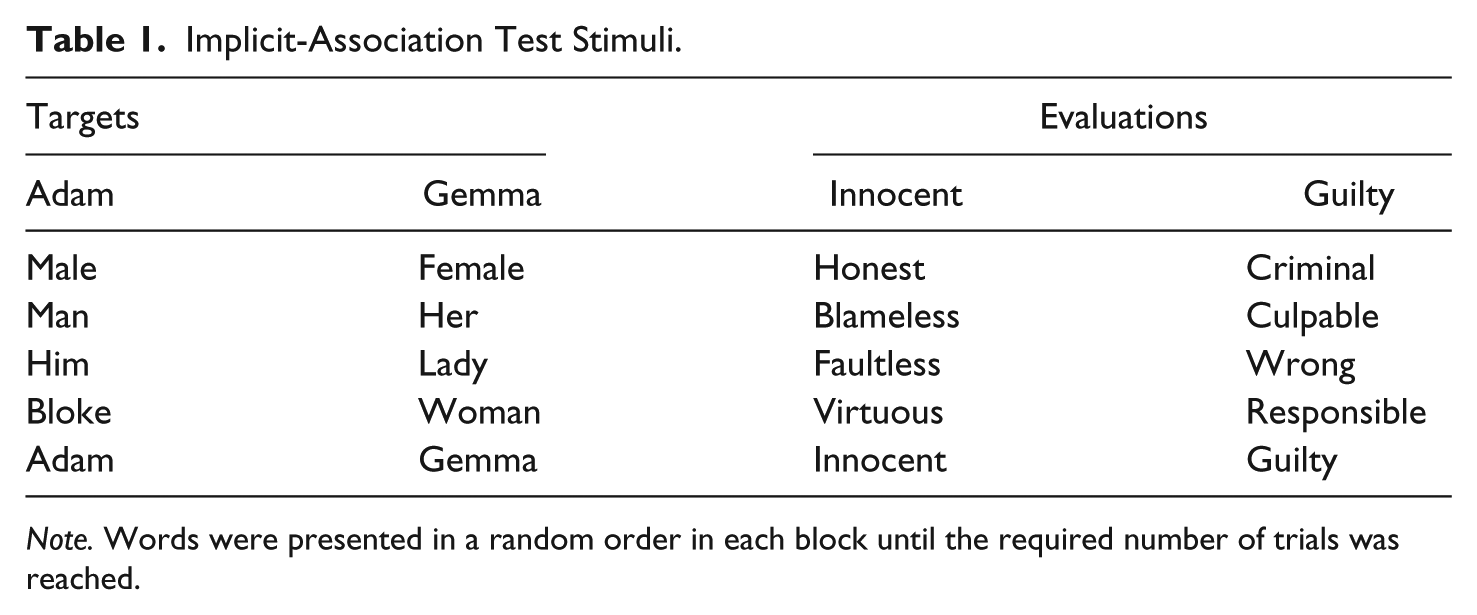
Note. Words were presented in a random order in each block until the required number of trials was reached.
In the present study, the IAT was made up of seven blocks. The first two blocks allow participants to practice classifying targets (Block 1; 20 trials) and evaluations (Block 2; 20 trials) in isolation. These blocks familiarize participants to the stimuli to be used later in the task. Next come two combined blocks, one of which is a practice (Block 3; 20 trials) and one in which data contribute to the scoring of the IAT (Block 4; 40 trials). In these combined blocks, evaluation categories are linked with target categories (e.g., “Adam OR Innocent” and “Gemma OR Guilty”), with each pair sharing a response key. After this, the evaluation categories switch sides. Following a practice of this new position in isolation (Block 5; 20 trials), Blocks 6 and 7 follow the same format as Blocks 3 and 4, with the evaluation terms being paired with the other targets.
Participants were instructed to respond as quickly and accurately as possible for each stimulus word. Errors were met with a red cross, with participants having to correct their response before moving on to the next stimulus. The order of target/evaluation pairings (and the initial left/right position of the target names) was counterbalanced between participants.
Procedure
After being recruited via the methods described previously, participants clicked a URL link to the online survey containing the project questions. They first read an information sheet detailing the general aims of the project (“investigating judgments of sexual relations on a first date”) and were required to give affirmative consent to participate by selecting a box and accepting the inclusion criteria. Next, participants provided their demographic information, before completing the RAPE scale. After this, participants were randomly allocated to one of the date rape scenarios. The button required to move on to the next page of the survey was disabled for 60 s to further control the levels of attention paid to these stories. Participants then answered the attention check questions, before providing their judgments of the scenario they read. The order of the explicit and implicit judgment tasks was counterbalanced between participants.
All participants received a comprehensive debrief (along with information about rape support services) upon completion. This procedure was approved by an institutional ethical review committee prior to data collection.
Results
Bumby’s RAPE Scale Factors
Given that no attempts to replicate Hermann et al.’s (2012) two-factor structure of the RAPE scale have previously been made, we sought to interrogate this model using a confirmatory factor analysis before undertaking our planned analyses. 2 We conducted this analysis in Amos for SPSS, using Hermann et al.’s (2012) 36-item structure as the default model. This model was a poor fit to the data provided by our sample, χ2(463) = 1,806.84, p < .001, comparative fit index (CFI) = .65, root mean square error approximation (RMSEA) = .10.
Following from this poor fit, we ran a principal components analysis (PCA) on our RAPE scale data. The sample size here equates to approximately seven observations per scale item, exceeding Costello and Osborne’s (2005) recommended minimum of five observations. The scree plot suggested two to three components should be retained in the model. Looking for the most parsimonious model, and in line with Hermann et al. (2012), we ran the PCA with an instruction to extract two components using an oblique (promax) rotation. The two extracted components explained 38.19% of the variance in RAPE scale scores. Item loadings for each of the two components are presented in Table 2.
Item Loadings for the RAPE Scale in the Present Sample.
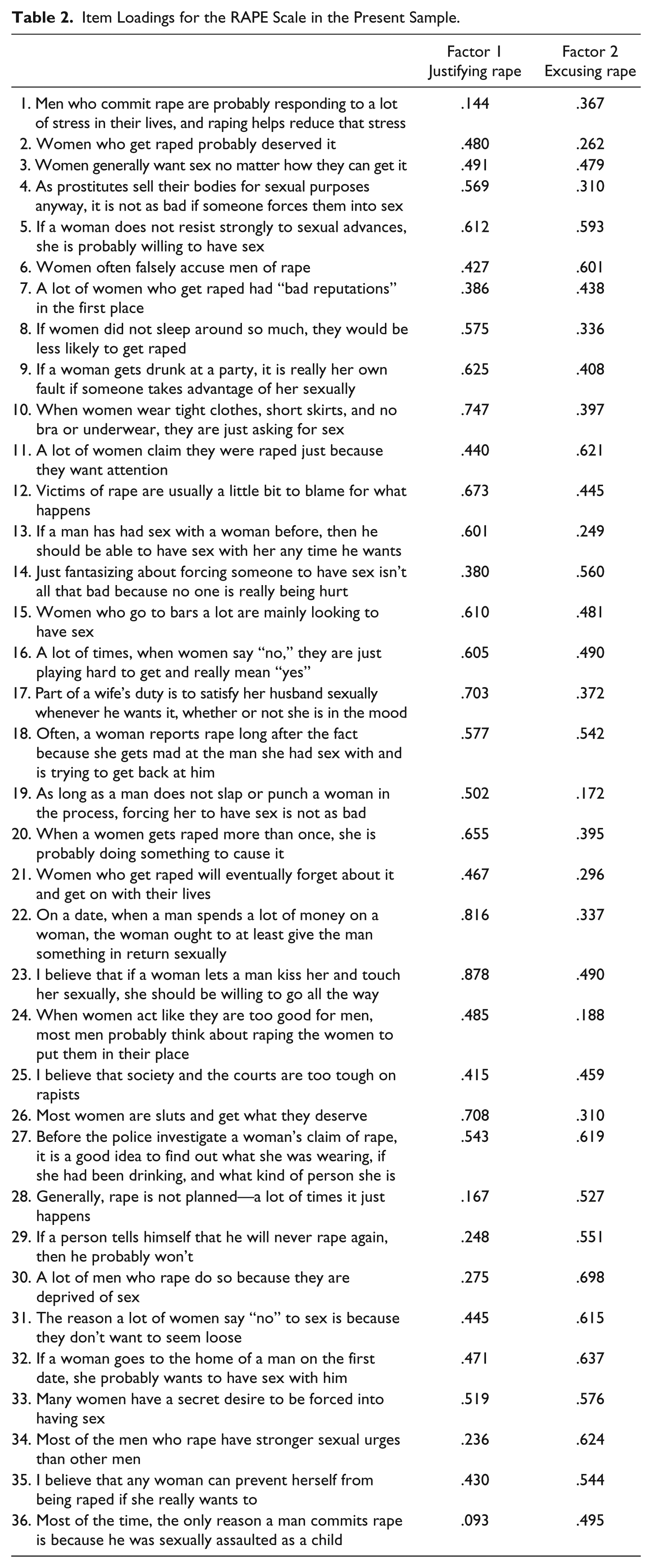
There was substantial overlap between the loadings onto each factor when comparing the models produced by Hermann et al.’s (2012) data and our own (Table 3). In the present study, we used the item loadings produced by our own analysis, as this was the model we could be most confident in. Given the substantial item overlap between our model and that reported by Hermann et al. (2012), we retained the labels “excusing rape” (15 items; α = .85) and “justifying rape” (17 items; α = .90) for these components.
Discrepancies Between Items Loading Onto Components in Hermann, Babchishin, Nunes, Leth-Steensen, and Cortoni (2012) Compared With the Present Sample.
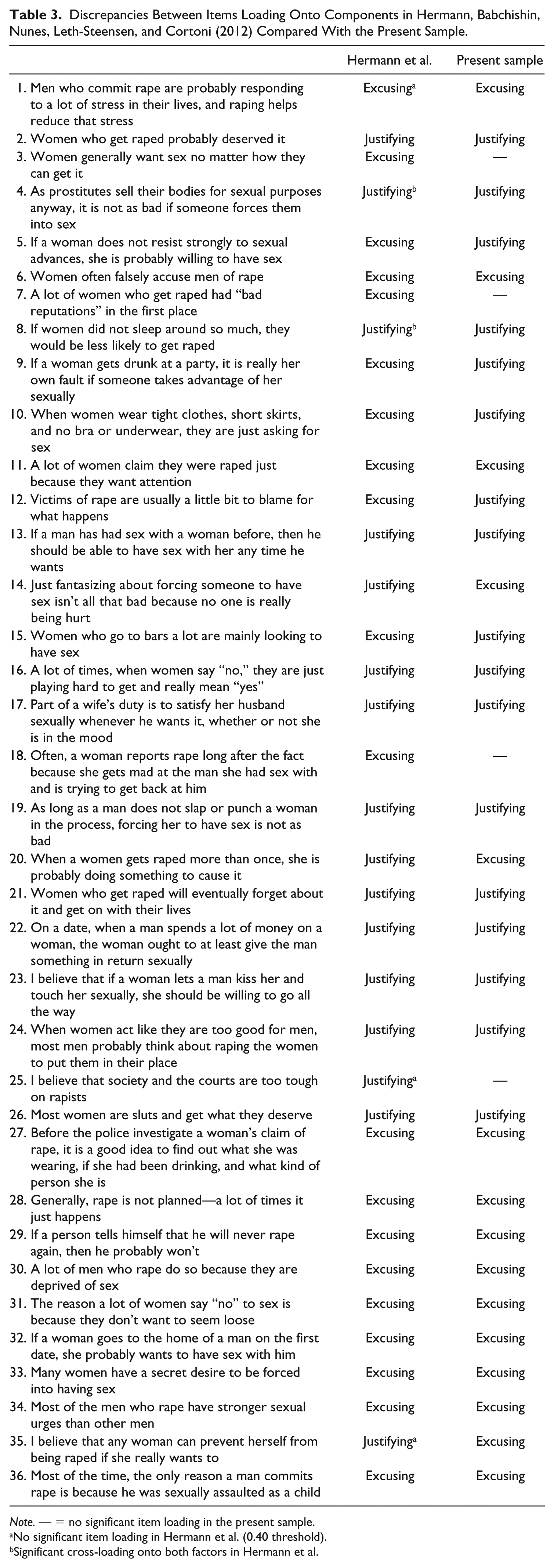
Note. — = no significant item loading in the present sample.
No significant item loading in Hermann et al. (0.40 threshold).
Significant cross-loading onto both factors in Hermann et al.
Baseline RAPE Scale Scores
Before conducting our main analyses, we sought to establish whether there were any differences between the two vignette conditions in relation to their endorsement of either factor on the RAPE scale. We entered both excusing rape and justifying rape cognitions as dependent variables into a 2 (Participant Sex: Male vs. Female) × 2 (Vignette: Perpetrator Paid vs. Victim Paid) multivariate analysis of variance (MANOVA). Descriptive statistics are presented in Table 4.
Baseline RAPE Scale Factor Scores, by Vignette and Participant Sex.
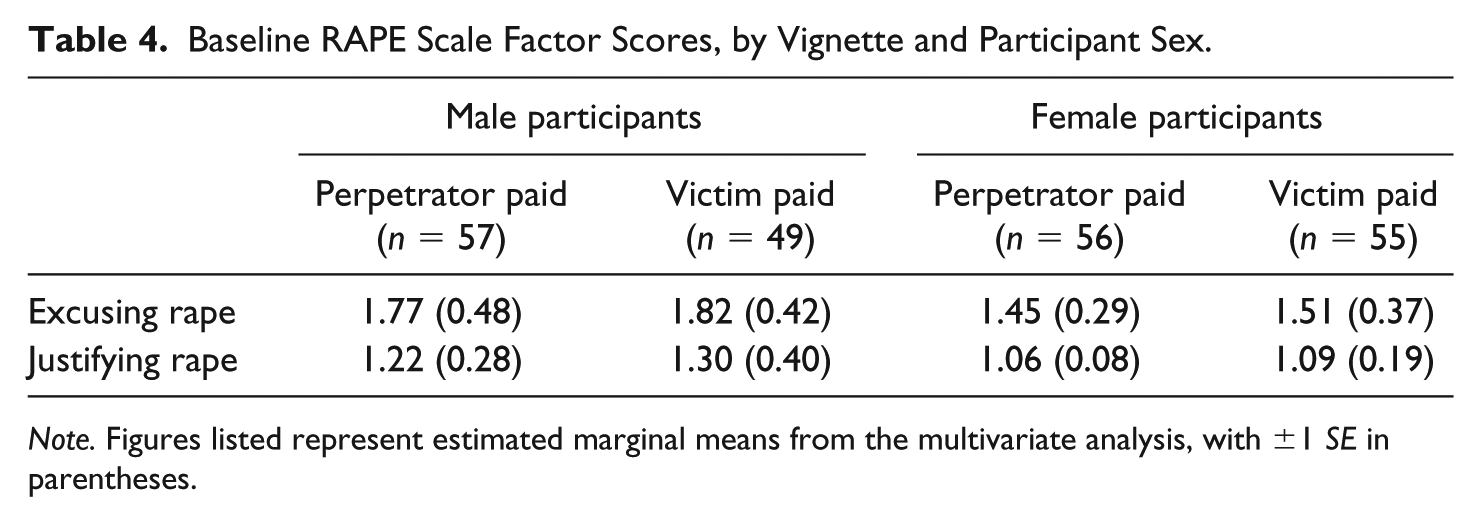
Note. Figures listed represent estimated marginal means from the multivariate analysis, with ±1 SE in parentheses.
There was a significant multivariate effect for Participant Sex, Wilks’s λ = 0.85, F(2, 212) = 19.11, p < .001,
In relation to Vignette group, there was no multivariate effect, Wilks’s λ = 0.99, F(2, 212) = 1.12, p = .327,
What these results indicate is that male participants scored higher in relation to both types of rape-supportive cognition compared with females. However, levels of these cognitions (both specific to each participant sex group, and when collapsing all participants together) did not differ at baseline between each Vignette group.
Explicit Judgments of Date Rape Scenarios
The first of our regression analyses pertained to explicit judgments of the two rape scenarios used in this study. To begin, we conducted correlational analyses between both types of rape-supportive cognitions and participants’ self-reported judgments of each vignette. For both vignettes, there were strong positive correlations between both RAPE scale factors (although these correlations fell just short of indicating collinearity) and moderate positive correlations between both types of rape-supportive cognition and judgments of the perpetrator’s innocence (Table 5). We further established that the mean explicit innocence judgments for the “Perpetrator Paid” scenario (M = 3.15, SD = 2.26) and “Victim Paid” scenario (M = 3.27, SD = 2.09) were not significantly different, t(215) = 0.41, p = .684, d = 0.06.
Zero-Order Correlations Between Excusing Rape and Justifying Rape Cognitions and Perpetrator Innocence judgments, by Vignette.
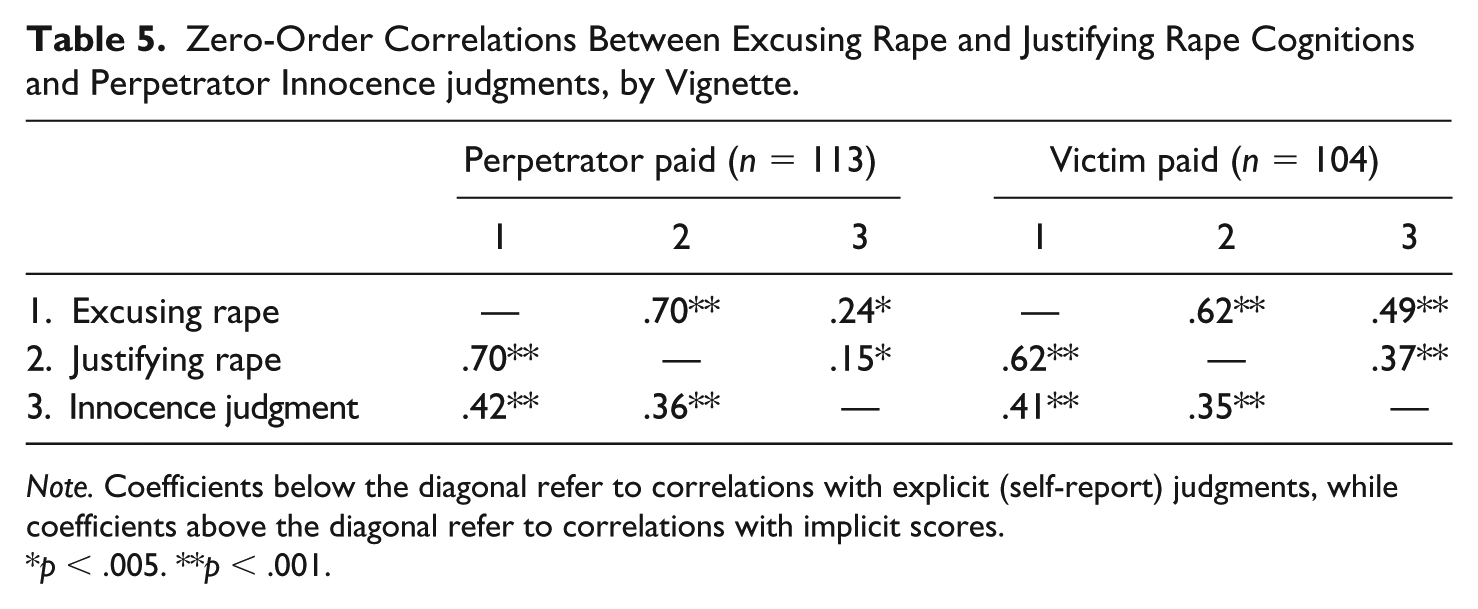
Note. Coefficients below the diagonal refer to correlations with explicit (self-report) judgments, while coefficients above the diagonal refer to correlations with implicit scores.
p < .005. **p < .001.
These correlations indicate that linear multiple regression was an acceptable method for analysis. As such, we entered excusing rape and justifying rape cognitions as predictors with participant sex and age in a regression model for each vignette, with explicit innocence judgments as the dependent variable. We included sex and age owing to the observed differences in rape-supportive cognition levels between the sexes (Table 4) and recent commentaries about the #MeToo and Title XI college rape response movements, which are typically being driven by younger millennials and iGen-aged students on university campuses. 3 Both models explained a significant proportion of the variance in explicit innocence judgments—Perpetrator Paid: adjusted R2 = .228, F(4, 106) = 9.11, p < .001; Victim Paid: adjusted R2 = .196, F(4, 98) = 7.20, p < .001. Coefficients within each regression model are presented in Table 6.
Regression Coefficients Explaining Innocence Judgments of the Perpetrator, by Vignette.
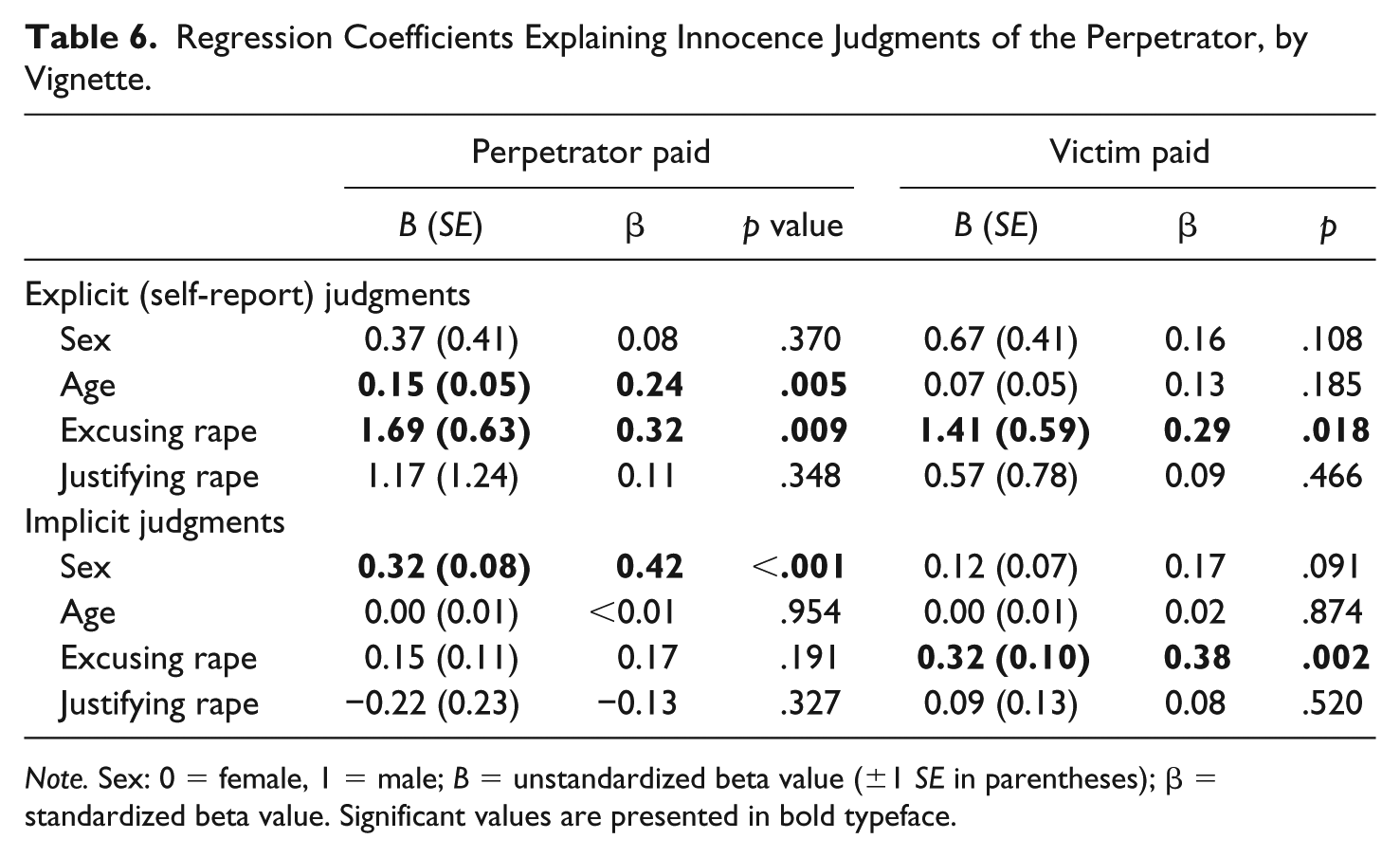
Note. Sex: 0 = female, 1 = male; B = unstandardized beta value (±1 SE in parentheses); β = standardized beta value. Significant values are presented in bold typeface.
Examining the coefficients, it appears that age, β = 0.24, t(106) = 2.86, p = .005, and excusing rape cognitions, β = 0.32, t(106) = 2.67, p = .009, were the only significant predictors of innocence judgments when the perpetrator paid for the bill, with older age and greater levels of excusing cognitions explaining higher levels of perceived innocence. When the victim paid for the bill on the date, higher levels of the excusing rape cognitions significantly explained greater levels of perceived innocence, β = 0.29, t(99) = 2.41, p = .018. These data are only partially supportive of our hypotheses. That is, justifying rape cognitions did not have any effect in increasing innocence judgments when the perpetrator paid for the bill. However, when the victim paid for the bill (potentially indicative of sexual interest in the perpetrator in the lead-up to the rape), innocence judgments were positively associated with increased levels of excusing rape cognitions.
Implicit Judgments of Date Rape Scenarios
As observed by Süssenbach, Albrecht, & Bohner (2017), rape-supportive cognition (operationalized as RMA) was associated with higher perceived innocence at the implicit level when a rape scenario was framed in a manner consistent with the “real rape” stereotype. We sought to examine whether the subtle priming of different cues related to specific clusters of rape-supportive cognition could contribute to increased innocence judgments at the implicit level.
IAT scoring
Using the iatgen applet (Carpenter et al., 2018), we computed standardized D scores for each participant according to their response latencies as they completed the IAT. A score of 0 on this scoring procedure indicated no difference between implicit judgments of guilt or innocence. Positive scores indicated implicit judgments of innocence, while negative scores indicated an increased propensity to see the perpetrator as guilty at an implicit level. The applet provides a score of “NA” for participants who should be removed from analyses on the basis of indiscriminate responding (i.e., they responded too quickly on a significant proportion of trials or made a large number of errors). A total of 10 participants (4.61% of the sample) were dropped from subsequent analyses for this reason (revised N = 207).
After computing these D scores, we conducted a series of one-sample t tests to determine the validity of the IAT in the present study. The mean D score for the sample as a whole was −0.43 (SD = 0.37), which was significantly different from zero, t(206) = −16.58, p < .001, d = −1.15. This indicates that, across the sample, the implicit scores were oriented in the direction of seeing the perpetrator as guilty, providing evidence of the validity of this method for establishing innocence judgments. The size of this effect was consistent in both scenario conditions—Perpetrator Paid: M = −0.47 (SD = 0.38), t(104) = −12.60, p < .001, d = −1.23; Victim Paid: M = −0.39 (SD = 0.36), t(101) = −10.89, p < .001, d = −1.08. The difference in the average levels of implicit innocence judgments was not statistically different when comparing the two scenario conditions, t(205) = 1.61, p = .109, d = 0.22.
Correlational and regression analyses
As with the explicit judgment analyses, we first examined the extent to which each type of rape-supportive cognition was associated with participants’ IAT scores. As with the self-report data previously reported, both types of cognition were significantly and positively associated with innocence judgments at the implicit level, particularly within the Victim Paid condition (Table 5).
We next repeated the same linear multiple regression analyses as were run in relation to the explicit judgments previously reported. Again, the collection of participant sex, age, excusing rape cognitions, and justifying rape cognitions accounted for a significant proportion of the variance in implicit innocence judgments of both vignettes—Perpetrator Paid: adjusted R2 = .176, F(4, 98) = 6.44, p < .001; Victim Paid: adjusted R2 = .237, F(4, 96) = 8.77, p < .001. Regression coefficients for both models are presented in Table 6.
When the perpetrator paid for the bill on the date, he was seen as significantly more innocent at the implicit level by male participants than female participants, β = 0.42, t(108) = 4.30, p < .001. No other variables uniquely explained variance in implicit judgments of this scenario. However, when the victim paid for the bill, increased endorsement of excusing rape cognitions was significantly associated with greater implicit innocence judgments, β = 0.38, t(99) = 3.23, p = .002. These results are consistent with the explicit innocence judgments, in that rape-supportive cognitions had no effect on judgments when the perpetrator paid for the bill, but excusing rape cognitions explained an increased propensity to view the perpetrator as innocent when the victim paid for the bill. These findings are again partially supportive of our hypotheses.
Discussion
In this study, we sought to examine the divergent explanatory effects of excusing rape and justifying rape cognitions on two different date rape scenarios. Consistent with the definitions advanced by Hermann et al.’s (2012) factor analysis of Bumby’s RAPE scale, we hypothesized that excusing rape cognitions (but not justifying rape cognitions) would contribute to higher innocence judgments when the victim paid for the bill, given that this could be inferred as a signal of sexual interest by those high on this type of cognition. In contrast, we hypothesized that justifying rape cognitions (but not excusing rape cognitions) would explain higher innocence judgments when the perpetrator paid the bill, as this could indicate the victim being in the debt of the perpetrator to those high on this type of cognition.
We found no support for our first hypothesis. When the perpetrator paid for the bill, there was no evidence in our data that endorsing justifying rape cognitions enhanced perceptions of their innocence at either level of analysis. Instead, explicit judgments were influenced by age, with older participants seeing the perpetrator as more innocent. This finding may be reflective of younger participants holding a more egalitarian view of courtship and the division of responsibility to pay on dates (Lever, Frederick, & Hertz, 2015). At the implicit level, enhanced innocence judgments when the perpetrator paid the bill was explained by participants’ sex (specifically, being male). This conforms to established findings suggesting that men are more likely to find rapists less culpable (and to assign greater levels of blame to female victims) than women (Black & Gold, 2008; Grubb & Harrower, 2008; Pinciotti & Orcutt, 2017), but extends this existing body of work into the implicit domain.
However, our data did support our second prediction. That is at both the explicit (self-report) and implicit (IAT) levels, higher levels of excusing rape cognitions explained enhanced perceptions of the perpetrator’s innocence when the victim paid the bill. However, justifying rape cognitions was unrelated to judgments of this scenario. These findings support the two-factor structure of the RAPE scale that was reported by Hermann et al. (2012) and demonstrates how excusing rape and justifying rape cognitions are not only distinct from a conceptual standpoint but also have unique empirical effects on judgments of rape scenarios.
Active Versus Passive Functions of Rape-Supportive Cognitions
The lack of concordance between our data and the predictions we made on the basis of prior theorizing—specifically in relation to justifying rape cognitions—raise some interesting questions about the nature and function of specific rape-supportive cognitions. The endorsement of such beliefs (particularly with regard to rape myth acceptance) has been associated with lenient judgments of rape perpetrators (and exaggerated levels of victim blame) for several decades (Blumenthal, Gudjonsson, & Burns, 1999; Bohner, Pina, Viki, & Siebler, 2010; Burt, 1980; Grubb & Turner, 2012). However, Hermann et al.’s (2012) factor analysis and subsequent explanation of the underlying structure of the RAPE scale allowed for a more nuanced examination of the effects of rape-supportive cognition than has previously been possible.
In this study, we found significant explanatory effects for excusing rape being associated with leniency when a victim demonstrated a behavior that could be linked to some degree of romantic interest in the perpetrator (i.e., paying the bill on a date). This effect is consistent with Hermann et al.’s (2012) description of excusing rape cognitions. That is, this collection of thoughts is said to reflect a tendency to ascribe complicity in the rape onto the victim (e.g., “When women wear tight clothes, short skirts, and no bra or underwear, they are just asking for sex,” or more relevant to our investigation, “If a woman goes home with a man on a first date, she probably wants to have sex with him”). As these cognitions are intricately related to the mitigation of rapists’ responsibility (and are thus directly related to levels of culpability and guilt), we might expect these opinions to explain judgments of others’ sexually coercive behavior. That is, excusing rape cognitions (or a lack of them) might lead people to attempt to explain the behaviors of others in criminal procedures. Justifying rape cognitions, in contrast, may be more related to personal actions than in the judgments of those behaviors of others. That is, we are responsible for justifying our own actions, but not those of other people. This may help us to explain why there was no significant effect (or even a slight trend) for justifying rape cognitions to affect judgments in the present study.
If we are to accept this interpretation, we might expect justifying rape cognitions to explain judgments of rape if the participants were to be cast in the position of the perpetrator. This dichotomy of rape-supportive cognitions based upon the distinction between excusing the behavior of others and justifying the behavior of oneself points toward a motivated view of such beliefs. That is, the extent to which these beliefs have an effect on judgments may depend upon the extent to which the perceiver has something to lose on the basis of the rape that has been committed. This was an argument also advanced by Szumski, Bartels, Beech, and Fisher (2018) who, drawing on Kunda (1990), argued that people may use rape-supportive cognitions to rationalize judgments in a situational manner. Bartels (2016) set out how this happens in light of immediate emotional states. For example, experiencing rejection from a potential sexual partner could lead to negative affect, and as a remedy to this, an individual may use such beliefs (or “temporary belief states”; Frijda, Mesquita, Sonnemans, & van Goozen, 1991) to rationalize or justify sexual coercion.
More specific to the present study, the explicit agreement with statements such as “A lot of times, when women say ‘no,’ they are just playing hard to get and really mean ‘yes’” or “I believe that any woman can prevent herself from being raped if she really wants to” (items loading onto the justifying rape factor of the RAPE scale; Hermann et al., 2012) is unlikely to be widespread within the general population as a result of societal negativity toward sexual offenders (for a review, see Harper, Hogue, & Bartels, 2017). As observed by Richards and McCartan (2018), people are generally hesitant to explicitly endorse propositions that may condone or justify the behaviors of sexually coercive individuals. However, due to this societal negativity, the motivation to engage in justification might be more heightened if/when one’s own behavior is in question. That is, justification takes the form of an active process to negate cognitive dissonance associated with a conflict between one’s own behavior and that which is expected as a social norm.
In contrast, agreeing with items such as “If a woman does not resist strongly to sexual advances, she is probably willing to have sex” and “Most of the men who rape have stronger sexual urges than other men” (items loading onto the excusing rape factor of the RAPE scale; Hermann et al., 2012) is a broad proposition that invites nuanced responses (rather than blanket rejections) to avoid generalization. As such, agreeing with these propositions may not actually reflect specific beliefs about women and sexual relations, but rather a lack of willingness to completely reject these ideas across the board. With this in mind, the endorsement of excusing rape cognitions might take the form of more passive evaluations of the situational factors which may be present in many rape cases.
Support for this distinction between active (justifying) and passive (excusing) rape-supportive cognition comes from Hermann et al.’s (2012) initial factor analysis of the RAPE scale. They reported that excusing rape cognitions were not significantly related to dynamic risk of sexual offending (Stable-2000 scores). However, justifying rape cognitions was strongly associated with such risk scores. While this active–passive dichotomy makes conceptual sense, further empirical work is necessary to explore these ideas in more depth.
Limitations and Future Directions
In this study, we used a combination of self-report and indirect measures to examine judgments of the innocence of an apparent rape perpetrator in our vignettes. However, we only used a self-report measure of rape-supportive cognitions. The reason behind this was to use a validated scale that has been found to have the two distinct clusters of rape-supportive cognition embedded within it. However, as suggested above, there may be concerns over the validity of data collected using such self-report measures of these cognitions in this domain (although the RAPE scale has been reported to be uncorrelated to measures of social desirability; Hermann et al., 2012). As such, examining rape-supportive beliefs at the implicit level using indirect measures may be a fruitful avenue in future research. Szumski et al. (2018) also made this observation, and we support their argument that emerging dynamic measures of implicit cognition (e.g., computer mouse-tracking; Freeman & Ambady, 2010) could provide novel insights into rape-supportive cognition—particularly subtle rape justification—in a manner that is, by design, free from social desirability biases. This method was recently employed by Smith, Treat, Farmer, and McMurray (2018) who found that undergraduate males’ mouse trajectories indicated a greater tendency to ascribe sexual interest to female models dressed provocatively than conservatively.
In our discussion of the data here, we have advanced an argument in relation to an active–passive dichotomy of rape-supportive cognition. This argument requires more detailed empirical attention. Some studies that could be run to examine this distinction may involve shifting the perspective of participants. That is, in line with the active role of rape justification, it may be the case that placing participants in the position of a rape perpetrator (or portraying the perpetrator as a member of a valued ingroup) may increase the extent to which this cluster of beliefs contributes to lenient judgments. Not only might this have implications for explaining rape perpetration but may also provide psychological insights in relation to why institutional abuse is explained away or covered up in many settings (Edwards, Turchik, Dardis, Reynolds, & Gidycz, 2011; Harper & Perkins, 2018; Sabina & Ho, 2014).
It may also be interesting to examine whether other scenario details might trigger the enactment of specific rape-supportive cognitions. For example, we found no effects of justifying rape cognitions on judgments when the perpetrator paid for the bill. This was contrary to expectations. However, if we were to embed other cues related to justifying rape, such as an expectation from the victim for the perpetrator to pay (or, more explicitly, the victim’s refusal to pay the bill), we might prime justifying rape cognitions in a more direct way. This is due to the items making up the justifying rape factor being in relation to both male sexual entitlement and hostility toward women (e.g., “When women act like they are too good for men, most men probably think about raping the women to put them in their place”). Furthermore, we did not directly assess whether paying the bill was actually viewed as an indicator of perceived sexual interest. Future studies should explicitly examine this manipulation in a direct way.
A key limitation of our work is a lack of ability to replicate Hermann et al.’s (2012) precise two-factor structure to the RAPE scale. While our sample’s data did support a two-factor solution, the items loaded differently in our sample compared with that used by Hermann et al. (2012). This difference may be reflective of the difference in sampling between our two studies. That is, Hermann et al. (2012) used a sample of men convicted of sexual offenses. In contrast, our sample comprised nonoffending male and female community members. Future research might look to examine whether the dimensionality of rape-supportive cognitions using larger samples and investigate the consistency of this dimensionality across offending and nonoffending samples.
Away from conceptual advances of our research, it is also necessary to acknowledge some of the inherent limitations in our work. We made use of a limited age sample (18-35 years) to reflect the ecological characteristics of our scenarios. That is, the fact that our protagonists met on a smartphone dating app led us to want to control for age in our sample, given that 83% of Tinder users are below the age of 35 years (McGrath, 2015). Future research might make use of a broader range of scenarios and examine the effects of excusing and justifying rape cognitions across the lifespan, such as to have clearer links to crucial criminal justice contexts (e.g., jury decision making). Our data may also be subject to some of the contextual factors embedded within the vignettes. That is, some of the variance in judgments may be explained by participants’ views about online dating or dating apps in general.
For ethical reasons, we turned off IP address tracking for the online survey to increase participants’ anonymity and encourage honest responding. However, this means that we cannot be sure about the precise locations of where our survey was completed or the national homogeneity of our sample, while we have strong reasons to believe that the vast majority of our sample were based in the United Kingdom (owing to the location of the research team and data collection methods employed). However, the use of online fora may have led to a small proportion of the sample coming from other countries. This could be an issue given the different legal definitions of rape in different jurisdictions. Future research might balance the need to maintain participant anonymity with tighter control over jurisdiction-specific definitions of rape. One way to do this may be to utilize multi-lab data collection initiatives, such as the Psychological Science Accelerator (Chartier, McCarthy, & Urry, 2018), which enables research teams from across the world to collaborate on single projects to bring small samples together into large-scale multisite international studies.
Conclusion
The present study sought to examine the empirical validity of Hermann et al.’s (2012) two-factor structure of Bumby’s (1996) RAPE scale of rape-supportive cognitions. Consistent with this conceptualization, we found that greater excusing rape cognitions explained exaggerated innocence judgments when the victim paid for the bill on a first date which subsequently ended in a rape. However, we found no evidence that rape was justified when the perpetrator paid for the bill. These findings suggest that excusing and justifying rape cognitions do represent empirically distinct clusters of rape-supportive cognitions about women and sex. The practical effects of this distinction, coupled with a theoretical exploration of how and under what conditions they are activated, should be the topic of future research to reduce the effects of such beliefs in the perpetration and judgment of rape cases.
Footnotes
Acknowledgements
The authors would like to thank Dr. Ross Bartels for his helpful comments on an earlier draft of this article.
Declaration of Conflicting Interests
The author(s) declared no potential conflicts of interest with respect to the research, authorship, and/or publication of this article.
Funding
The author(s) received no financial support for the research, authorship, and/or publication of this article.
