







Abstract
Objective
Prior research has rarely focused on sexual motives (e.g., motives for having sex) when studying sexual violence perpetration prevention. The current study examined the role of sexual motives alongside other risk factors like alcohol expectancies in predicting sexual violence.
Method
We analyzed data from 205 male college students; 36% reported sexual perpetration of some type. Participants completed a series of questionnaires in a randomized order, including: measures of prior sexual perpetration, sexual motives, rape myth acceptance, alcohol expectancies, and a measure of social desirability. Data were analyzed using a series of T-tests and logistic regressions.
Results
With one exception (coping motives), all sexual motives (intimacy, enhancement, self-affirmation, peer approval, and partner approval) were endorsed at higher levels by individuals who perpetrated sexual violence than those who did not (p < .05, Cohen’s d = .25–.56). The partner approval motive significantly predicted sexual violence perpetration on its own. The enhancement motive, both independently and in interaction with alcohol expectancies for aggression, predicted sexual violence perpetration. Two other motives, intimacy and self-affirmation, were only significant in interaction with alcohol expectancies for aggression.
Conclusion
All sexual motives were endorsed more frequently by those who perpetrated sexual violence than those who did not. Sexual motives had a complex interaction with alcohol expectancies in predicting sexual violence perpetration. The results suggest that intervention programs should emphasize healthy, consensual sexual relationships that do not involve alcohol.
Introduction
Rape victimization affects approximately one in five college women (Muehlenhard et al., 2017) and one in six college men (Anderson et al., 2018). Sexual violence perpetration rates among college men are similarly prevalent at 29.3% (Anderson et al., 2021a). In order to combat this widespread public health issue, it is important to prevent perpetration. Sexual violence is defined as sexual activity when consent is not obtained or not given freely, consistent with the Centers for Disease Control and Prevention (Breiding et al., 2015). Thus, perpetration refers to the behavior of those who initiated these nonconsensual sexual behaviors, and victimization refers to the experience of one’s consent being violated. One of the key elements in understanding how to prevent sexual violence, is understanding the “why” of those who perpetrate. The goal of this study is to understand how sexual motives may be related to sexual violence perpetration using the Confluence Model of Perpetration.
Theoretical Models of Sexual Perpetration
Evolutionary and feminist theories offer different explanations of the etiology of sexual violence perpetration. The evolutionary theory approaches sexual violence as the inherent urge of human beings, particularly men, to seek reproduction by any means (Archer & Vaughan, 2001; Malamuth et al., 1995). It also postulates that the motive behind sexual violence is sex itself. In contrast, feminist theory sets forth that sexual violence is a direct result of the patriarchy. Sexual violence reflects the imbalance of power in society between the genders (Johnson & Johnson, 2021). According to the feminist perspective (Brownmiller, 1975), the purpose of rape is to exercise patriarchal power, and that the way for a male to accomplish this is to force sex on a woman. Hostile masculinity, a personality profile characterizing men who desire to dominate women and have a distrustful orientation toward women, is common among sexually aggressive men (Malamuth & Thornhill, 1994).
The Confluence Model (Malamuth, 1996) provides a theoretical framework that incorporates impersonal sex, similar to the evolutionary theory, and hostile masculinity, as found in the feminist theory, as the two primary determinants of sexual violence perpetration (Logan Greene et al., 2011). Impersonal sex was initially d as uninhibited attitudes toward sex, especially casual sex, frequent masturbation, and pornography use (Malamuth, 1996). According to the Confluence Model, impersonal sex is dissociated from affection and bonding commonly found in long-term relationships. Hostile masculinity and impersonal sex independently do not necessarily lead to sexual aggression unless they are combined in the same individual (Archer & Vaughan, 2001; Malamuth, 1996). Thus, an impersonal sexual orientation alone may not be problematic; however, when combined with a selfish lack of concern for partners, or hostile attitudes towards women, pro-violence attitudes, et cetera, the risk for sexual perpetration is elevated (Malamuth et al., 2021). Indeed, risk factors are interactive such that the degree of perpetration for those classified as high risk is nearly seven times higher than for those who are low risk (Malamuth et al., 2021).
Malamuth et al. (1995) noted that impersonal sex signifies a lack of concern for the partner’s well-being during the sexual encounter and reflects a developmental history of abusive or troubled home environment and antisocial adolescent behavior (Malamuth et al., 2021). The impersonal orientation to sex discourages the individual from seeking to understand and prioritize their partner’s sexual gratification or emotions. This conceptualization of impersonal sex as a risk factor for perpetration is also consistent with other theoretical models of adolescent risk behaviors – such as the Theory of Triadic Influence and Theory of Planned Behavior (see Thompson et al., 2015 for an application). Historically, the impersonal sex pathway in the confluence model has been operationalized in research as the number of partners or willingness to have casual sex. However, impersonal sex, like many psychological constructs, may be contextual. For example, a person may only be interested in group sex if a loving partner is present; thus, if only considering number of partners, this person’s score would be inflated in a manner that is not equivalent to someone who avoids relationships but not casual sex. Thus, further investigation of the impersonal sex pathway and alternative operationalizations is important to comprehensively understand this risk factor.
Theoretical Models of Sexual Motives
Sexual motives, or the reasons a person is motivated to have sex in a given situation, may be fruitful for better understanding and particularly contextualizing the impersonal sex risk pathway. Several theoretical models attempt to explain sexual motivations. Research on sexual motivations has largely been silo-ed from sexual perpetration research in college or community samples.
Psychodynamic trauma-mastery theory suggests that some sexual motives may arise from traumatic experiences, and the post-trauma need to re-enact the trauma to disprove traumagenic beliefs (Fimiani et al., 2020). Thus, motives such as intimacy or coping may be associated with perpetration when the originating trauma was sexual in nature. The behavioral conditioning (or incentive) model suggests that sex is a very reinforcing experience and that sexual motives which lead to orgasm will be reinforced (e.g., conditioned) and more likely to recur (Toates, 2009). This could apply to any variety of motives depending on a person’s history. Sexual script theory integrates behavioral conditioning with cultural ideas about sexuality and suggests that sexual behavior (including motives) is a result of cultural norms combined with conditioned beliefs (McCormick, 2010). Thus, motives consistent with stereotypes and gender-specific role norms would be more likely. Finally, schema theory suggests that sexual motives would arise from internal, stable, global cognitive representations about sexuality and that any sexual desire or sexual experience would be interpreted via this cognitive schema. For example, individuals experiencing sexual dysfunction may interpret these experiences as proof of their unlovable-ness (Nobre & Pinto-Gouveia, 2009). Thus, motives could be very particular to a person and their experiences. These models sometimes have very different predictions for the associations between sexual perpetration and specific sexual motives, as summarized in Figure 1. Summary of Theoretical Models and Sexual Motives.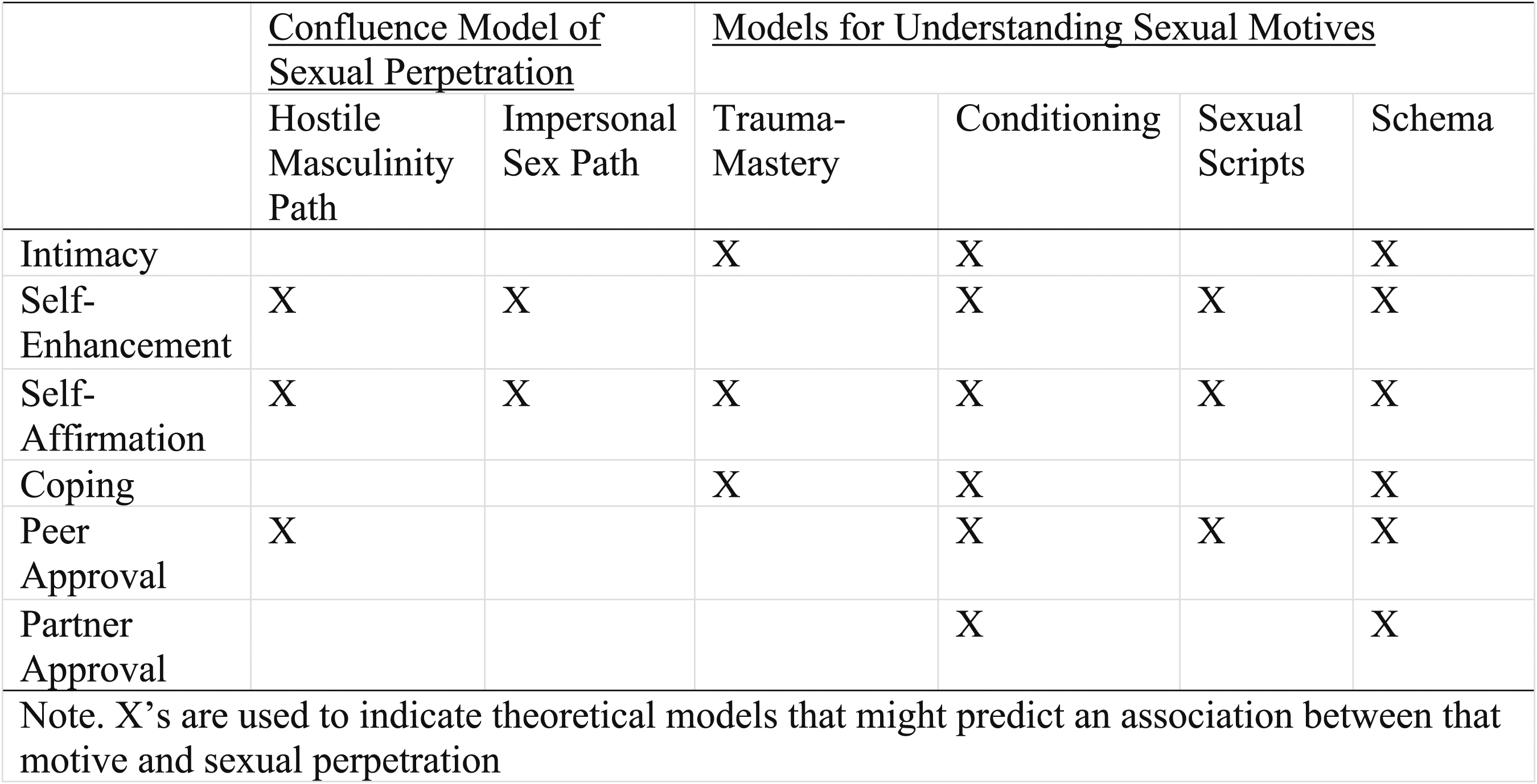
Prior Research on Sexual Motives and Sexual Perpetration
In contrast to other aspects of sexuality such as pornography use or number of partners, sexual motives have been understudied in relation to sexual perpetration. For example, in a recent systematic review O’Connor et al. (2021) identified six studies that examined sexuality-related predictors of sexual perpetration in college students. None of these studies included sexual motives; rather number of sexual partners was the most common construct. Yet, studies examining sexual motives specifically suggest this may be a useful construct. For example, Davis et al. (2021) found that both sexual arousal and power dominance served as motivations for sexual perpetration. Further, altering sexual motives can also a component of effective cognitive-behavioral treatment for sexual offending (Yates, 2004; Tyler et al., 2021). Individuals who sexually offend tend to have cognitive distortions about sexuality and justify their behavior, they also tend to have poor relationships lacking in intimacy and use sex to cope (Yates, 2004). Thus, motives for sex that include coping and lack of intimacy are empirically justified targets for sexual offending treatment but have largely been ignored in understanding prevention of sexual perpetration in college or community men. By better understanding the “sexual” aspect of “sexual violence,” we may improve our understanding of the fundamentals of this crime and identify new avenues for prevention.
When considering the sexual motives identified empirically in the healthy sexuality literature, people’s sexual motivations may be broadly classified as motivated by positive emotions—pursuing positive or pleasurable outcomes; or avoiding negative emotions such as rejection by one’s partner (Cooper et al., 1998). Sex can also fulfill social and emotional rewards, such as feeling valued or promoting a sense of well-being (Hill & Preston, 1996). Sexual motives can also differ by gender. While all genders endorse all motives, there is a difference in the frequency of their endorsement. For example, men are more likely to be interested in sex for pleasure and physical release, whereas women were more likely to endorse having sex to be valued by their partner (Hill & Preston, 1996), consistent with gender differences in the perpetration of sexual violence and gender role socialization (Krahé et al., 2015).
Further, better understanding of the healthy or unhealthy aspects of sexuality may inform upstream prevention efforts such as comprehensive sexuality education. This is particularly important when considering that some traditional sexual perpetration interventions may actually cause iatrogenic effects – increasing pro-violence attitudes (Malamuth et al., 2018). One reason these interventions may be so unsuccessful is a mismatch between participants’ and intervention values—traditional interventions often target anti-woman and pro-violence attitudes, the hostile masculinity pathway of the confluence model. A shift to focus on the impersonal sex pathway may be more fruitful – but only if interventions are aligned with participants’ interests and/or values. If interventions are sex-negative (have a negative attitude toward any sexual behavior other than procreational) or even sex shaming, participants are unlikely to engage in the intervention or benefit from it.
Alcohol as a Risk Factor for Sexual Perpetration
While the specific relationship between alcohol and sexual violence is highly variable and can range from a lack of inhibition to a direct tactic, or the presence of a third variable, the association between alcohol and sexual violence is consistent (Abbey, 2011). For example, nearly 45% of those who participated in a hook-up that became nonconsensual indicated that they had engaged in binge drinking (four or more standard drinks) prior to the assault (Littleton et al., 2009). Further, desire for impersonal or less inhibited sex is a powerful motivation to drink (Abbey et al., 1999; Messman-Moore et al., 2013). Thus, studying impersonal sex without studying alcohol may be misguided. Alcohol expectancies or the perceived effects and consequences of alcohol consumption, have a powerful impact on behavior (Labbe & Maisto, 2011) and on sexual violence in particular (Abbey et al., 1999). A common expectancy among college students is strong sexual drive (Abbey et al., 1999). Individuals engaging in impersonal sex have a disproportionate focus on themselves and their sexual encounters rather than a focus on their partners. This unbalanced lens can be amplified by alcohol (Abbey, 2011; Abbey et al., 2011). Testa and Cleveland (2017), using longitudinal data, show how the effects of alcohol on perpetration is mediated through other variables – suggesting that alcohol consumption alone is not problematic. In this study, alcohol expectancies are examined.
Rape Myths
Rape myths are sexual scripts that are formed and shaped by an individual’s own perceptions and beliefs surrounding one’s sexual behavior as well as cultural sexual scripts (Ryan, 2011). Specifically, rape myths are false beliefs about rape that encourage the perpetration of sexual violence and shift responsibility away from the instigators to the victim. Individuals who perpetrate sexual assault have historically been found to have a greater acceptance of rape myths (Loh et al., 2007; Trottier et al., 2021), consistent with the hostile masculinity pathway of the Confluence Model. Rape myths could also be influential in the formation of sexual motives. The day-to-day presence of rape myths in a culture can influence how individuals think of their sexuality. In other words, rape culture (Johnson & Johnson, 2021) can influence even so-called “normal” sexuality (Chapleau and Oswald, 2010).
The Current Study
This exploratory study aimed to examine the role of sexual motives in the perpetration of sexual violence. Many previous studies have attempted to understand the cause of sexual violence by framing its motivations as related to power and control consistent with the feminist understanding of rape. While this vein of thought adds critically important perspectives, it may be dangerous in over-pathologizing the behavior and ignoring empirically supported models of perpetration that suggest impersonal sex and related constructs like sexual motives are also causative. No prior work has examined sexual motives as potential indicators of impersonal sex. We predicted differences between those with and without perpetration histories in endorsing different sexual motivations (H1). Specifically, we hypothesized that individuals with perpetration histories would endorse self-enhancement, self-affirmation, and peer approval motives at higher levels than those without perpetration histories, given the similarity of these motives to an impersonal sex orientation. Secondly, we tested rape myth acceptance and alcohol expectancies as two variables that represent well-established risk factors for perpetration that are likely to interact with and influence sexual motives. The second hypothesis was that sexual motives would predict sexual violence perpetration beyond accounting for individuals’ rape myth acceptance and alcohol expectancy levels in a hierarchical logistic regression (H2). This is based on the theory that sexual desires are a more proximal risk factor of perpetration than rape myth acceptance; in other words, sexual motives are present at the incident as reflected in an individual’s emotions and thoughts in a way rape myths may or may not be.
Methods
Procedures
This study applied a secondary data analysis using data collected for a study on framing effects in sexual violence prevalence rates (Authors) in which the same study was advertised in four slightly different ways. Additional questionnaires on treatment utilization, fear of crime, alcohol consumption, and exposure to interventions were administered and analyzed in the original study but are not reported here. Because there were no experimental condition-related differences in perpetration reports, data were collapsed across conditions for this study. Participants completed all study questionnaires in a randomized order. Data were collected anonymously via Qualtrics. The Institutional Review Board approved the study at the same large, public Midwestern University the data was collected at.
Participants
For the original study, 792 students were recruited from a large, public Midwestern University in the Great Lakes region. Participants received course credit for participating in Psychology courses and could choose which studies to participate in from a large variety. Data were collected in spring 2018. Since the current study focused on male behavior, only men were retained.
This study sample comprised 205 college men aged 18 years or older. Their mean age was 20.35 (SD = 2.03). Participants were mainly heterosexual (83.4%) and Caucasian (80.6%); 11.6% identified as African American, 4.3% identified as Asian American, 8.2% as other, 1% as Native American, and 6.3% were Hispanic. The sample was representative of the university in being more women than men in the original sample and mostly white students (the university reports 16% minority students). Approximately 21% of the men were Psychology majors. The average number of years of college completed was 1.91(SD 1.58).
Measures
The Sexual Experiences Survey—Short Form Perpetration
A version of the Sexual Experiences Survey – Short Form Perpetration (SES-SFP; Koss et al., 2007) was used to assess sexual violence perpetration histories. This questionnaire was modified to be consistent with the tactic-first version used by Abbey et al., (2011). The items start with a description of a coercive tactic (i.e., taking advantage of someone when drunk) followed by a sub-item that describe a sexual act (i.e., oral or anal sex). For example, “Since the age of 14, have you ever shown your displeasure by making someone of the opposite sex feel guilty, swearing, sulking, or getting angry in order to make them have anal sex with you?”. We selected the tactic-first versions of the SES 1 , as it has demonstrated higher prevalence rates yet equivalent psychometric properties to the original SES-SFP (Abbey et al., 2021; Anderson et al., 2021b; Anderson, Silver, et al., 2021). Tactic-first SES-SFP scores are 80% reliable over 2 weeks and correlated with common risk factors for perpetration including rape myth acceptance (Abbey et al., 2021; Anderson et al., 2021b; Anderson, Silver, et al., 2021). This version was expanded to include additional items measuring substance use incapacitation and verbal coercion from items on the SES-Long Form (Koss et al., 2007). There were 70 items (10 tactics X 7 sexual behaviors) administered regardless of on the frequency response scale of 0, 1, 2–5, 6–9, 10+ times.
The Revised Conflict Tactic Scales- Sexual Coercion Subscales
The Revised Conflict Tactic Scales (CTS2-SC; Straus et al., 1996) consists of 14 paired items (one for victimization, one for perpetration) that assess tactics used to perpetrate against an intimate partner. The 14 items on this second perpetration questionnaire were included given prior research suggesting that it may identify more cases of sexual perpetration than the SES-SFP alone (Anderson et al., 2018). Indeed, in this sample the tactic-first SES-SFP identified 43 cases of sexual perpetration while the CTS2-SC identified 63 cases and the measures agreed on 32 cases. CTS2-SC scores are correlated with SES-SFP scores (Anderson et al., 2017). There is limited evidence of test-retest reliability of the CTS2-SC (Vega & O’Leary, 2007) but it is often recommended as a measure of intimate partner sexual violence (Bagwell-Gray et al., 2015).
Sexual Motivations Scale (SMS)
The Sexual Motivations Scale (Cooper et al., 1998) incorporates both positive and negative reinforcement influences on sexual behavior. Six subscales of sexual motivation are contained in 29 items: enhancement (“I have sex because it feels good”), intimacy (“I have sex to feel emotionally close to my partner”), self-affirmation (“I have sex to reassure myself that I am attractive”), coping (“I have sex to help me deal with disappointments in my life”), peer approval (“I have sex just because all of my friends are having sex”), and partner approval (“I have sex because I don’t want my partner to be angry with me”) motives. Internal consistency for the SMS subscales were in the excellent range with α = .944 to .970, (Jardin et al., 2016). All responses are ranked on a scale from 1 (Not at all important) to 7 (Extremely important), with a higher score indicating a stronger endorsement of the particular motive. Evidence of validity in community youth was demonstrated by testing the factor structure of the questionnaire which was invariant across gender and race and subscale scores were varied in predicted ways for those in and outside intimate relationships (Cooper et al., 1998).
Rape Myth Acceptance
The Illinois Rape Myth Acceptance (IRMA) consists of 45 items that assess the degree to which participants endorse societal beliefs promoting stereotypes about rape such as “Many women secretly desire to be raped” (Payne, et al., 1999). The responses are ranked on a scale of 1–7 with 1 signifying “Not at all agree” to 7 “Very much agree”. Higher scores indicate greater rape myth acceptance. Validity was demonstrated by correlations between IRMA scores, gender stereotypes, attitudes towards violence (Payne et al., 1999). The IRMA can be scored via subscales as well as one total score; in this study we used the total score, α = .926 in this sample.
Alcohol Expectancies
The self-related alcohol expectancies subscale (19 items) of the Alcohol Expectancies Regarding Sex, Aggression, and Sexual Vulnerability Questionnaire (Abbey et al., 1999) was used to measure people’s beliefs about alcohol and its effects on their own behaviors, thoughts and feelings. Items were measured on a five-point scale from 1 indicating “Not at all” to 5 indicating “Very much,” to represent the subscales of aggression, affect, sex drive, and risk for victimization. For example, “after drinking I become hostile,” or “women are short-tempered”. Validity was indicated by positive correlations with sexual self-esteem and trait aggression with moderate test-retest correlations, r = .65 (Abbey et al., 1999). Internal consistency in this sample was good across subscales, α = .865–.949.
Social Desirability
Positively biased self-reports and impression management were measured by administering the Balanced Inventory of Desirable Responding (BIDR; Paulhus, 1991). All items on the questionnaire are rated on a 7-point scale from 1–7 ranging from “not true” to “very true.” The BIDR uses 40 items to assess the two dimensions of socially desirable responding including items such as “I always declare everything at customs” (self-positive bias) and “I never swear” (impression management). The items can be cumulated for one score or viewed as two separate subscales. Prior evidence of validity has been demonstrated by correlations with the Marlowe-Crowne Social Desirability Scale and reliability demonstrated by strong test-retest correlations (r ≈ .67). Internal consistency in this sample was α = .838.
Data Analytic Plan and Data Cleaning
In order to evaluate the first hypothesis, that college men with sexual perpetration histories will have different motivations for sex, a series of t-tests were performed in SPSS using a new variable combining all those who indicated perpetration on the SES-SFP (N = 43) as well as the CTS2 subscale (N = 63). To test Hypothesis 2, that sexual motives can predict rape perpetration while accounting for rape myth acceptance and alcohol expectancies, we ran two logistic regressions predicting any sexual violence perpetration. In both logistic regressions, step one comprised alcohol expectancy variables and rape myth acceptance, as these variables are less proximal risk factors to committing sexual violence (Abbey, 2011; Loh et al., 2007). Step two comprised the sexual motives subscales to investigate if, after accounting for the aforementioned variables, sexual motives would increase an individual’s likelihood of perpetrating sexual violence. In the second model, step three was comprised of the alcohol expectancy and sexual motives interaction variables, consistent with the latest research on the Confluence Model and other theories of risk behavior. The authors take responsibility for the integrity of the data, the accuracy of the data analyses, and have made every effort to avoid inflating statistically significant results.
Considered at the questionnaire level, data was missing for five participants or less. Thus, we did not undertake any imputation. When participants completed some items but not all on a latent variable questionnaire, total scores were prorated if participants completed at least 75% of the questionnaire items. For behavioral variables (e.g., perpetration), because the modal value of any item was 0, participants were included if at least one item was completed, and missing items were considered the modal value. Multicollinearity diagnostics were computed, and VIF values ranged between 1.11 to 3.25, which is considered in the moderate and acceptable range.
Power Analysis
Given that Hypothesis 1 was exploratory, there were no prior studies from which to estimate effect sizes directly. However, research on related constructs, such as impersonal sex (e.g., sociosexuality) suggests that the relationship between sexual motives and sexual perpetration would likely be in the range of r ≈ .2–.30 (Mouilso & Calhoun, 2012; Wright et al., 2021). According to a priori power analyses conducted in G*Power, this would suggest a minimum of 30 participants with a perpetration history to determine differences in sexual motives between those with and without sexual perpetration histories using a one-tailed test at alpha level .05, Power = .80, and an allocation ratio of perpetration to non-perpetration of .25–.33. Next, we computed zero-order correlations between sexual motives, alcohol expectancies and sexual perpetration to estimate power for linear regression analysis using the assumption of R2 deviation from zero. With significant correlations ranging from r = .163–.241 and up to 15 predictors (to account for interaction variables), this suggests a total sample size of 147 would achieve Power = .801 at alpha level .05. With a sample size of 205 participants; this analysis suggested our study is adequately powered.
Results
Socially Desirable Responding
Socially desirable responding was analyzed by computing two correlations: one between sexual violence perpetration and the SMS subscales and another to examine the relationship between the SMS subscales responses while controlling for BIDR scores. The consistency between both sets of partial correlations indicates that the relationship between the variables was true and not influenced by socially desirable responding. For example, the correlation value between any sexual perpetration and self-enhancement motives was r = .252, while controlling for BIDR scores the value was r = .227; this represented the largest change in scores which ranged from deltas of .025 to .019. Thus, social desirability scores were not further analyzed nor controlled for to simplify the interpretation.
Hypothesis 1
Sexual Motive Endorsement t Tests.
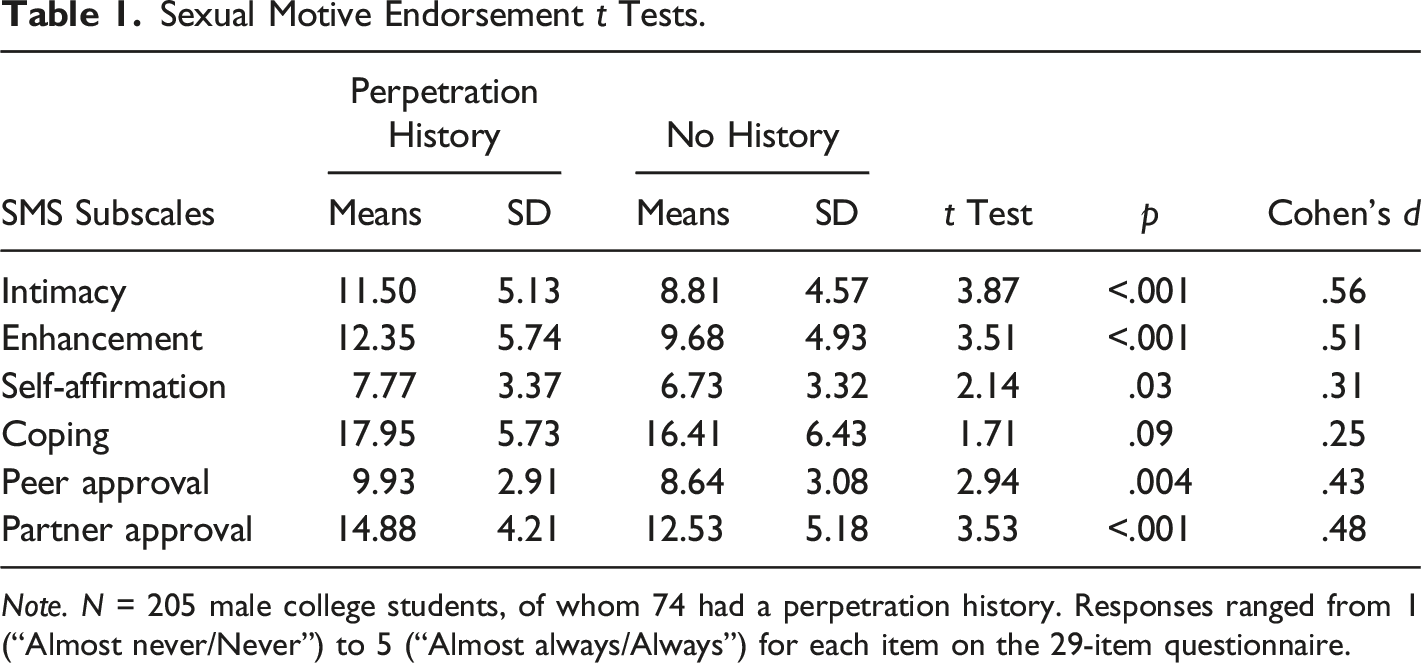
Note. N = 205 male college students, of whom 74 had a perpetration history. Responses ranged from 1 (“Almost never/Never”) to 5 (“Almost always/Always”) for each item on the 29-item questionnaire.
Hypothesis 2
Logistic Regression Predicting Sexual Violence Perpetration a , No Interaction.
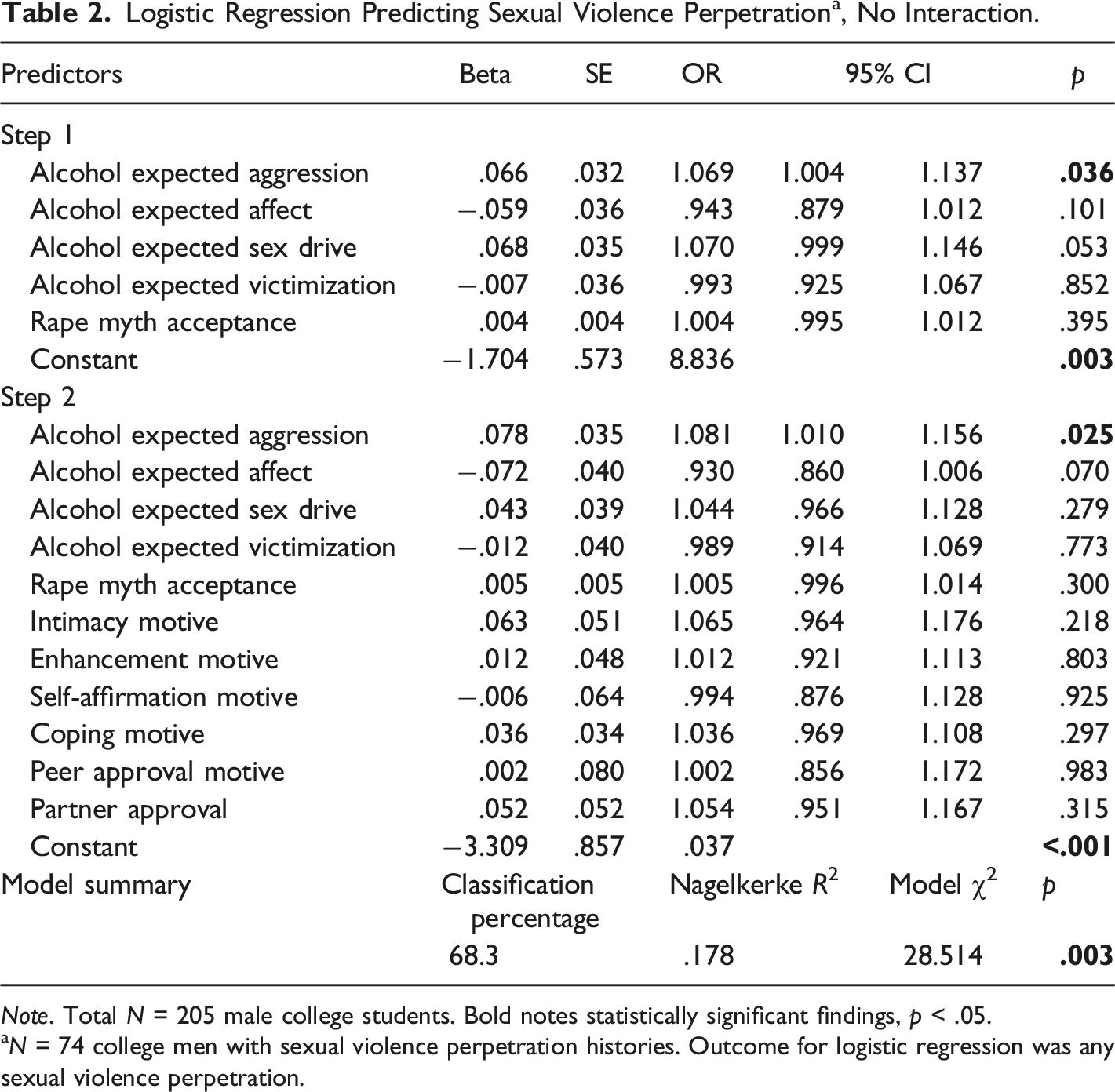
Note. Total N = 205 male college students. Bold notes statistically significant findings, p < .05.
aN = 74 college men with sexual violence perpetration histories. Outcome for logistic regression was any sexual violence perpetration.
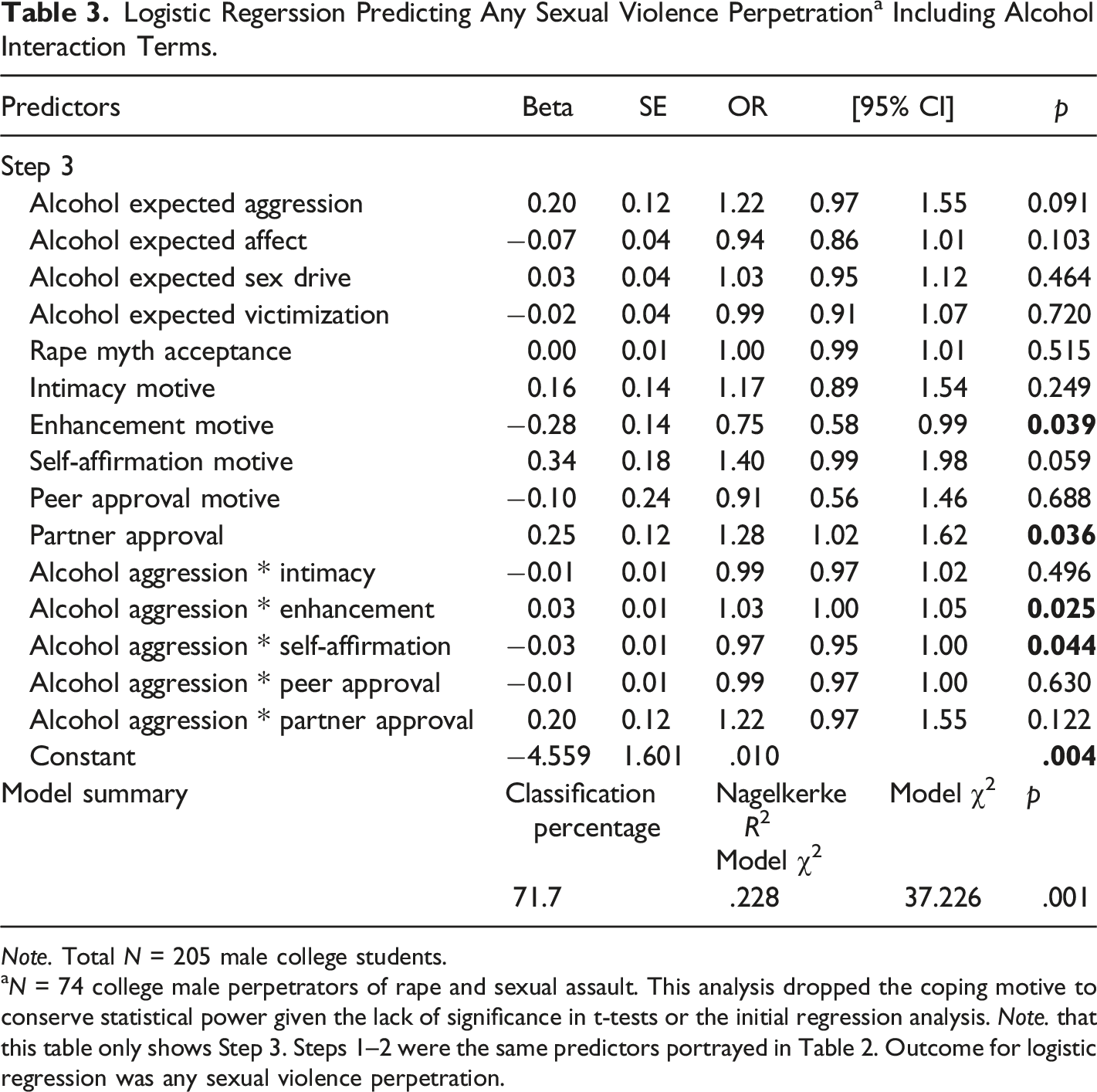
Logistic Regerssion Predicting Any Sexual Violence Perpetration a Including Alcohol Interaction Terms.
Note. Total N = 205 male college students.
aN = 74 college male perpetrators of rape and sexual assault. This analysis dropped the coping motive to conserve statistical power given the lack of significance in t-tests or the initial regression analysis. Note. that this table only shows Step 3. Steps 1–2 were the same predictors portrayed in Table 2. Outcome for logistic regression was any sexual violence perpetration.
While the alcohol expected aggression was no longer significant in and of itself, in interaction with the enhancement motive it significantly predicted an increase in sexual violence perpetration (p = .039). The enhancement motive on its own reduced the odds of sexual violence perpetration by 25% (p = .039) for every one unit increase. In contrast, the partner approval motive increased the odds of sexual violence perpetration by 28%. Alcohol expected aggression in interaction with self-affirmation, reduced the likelihood of sexual violence perpetration and in interaction with self-enhancement, increased likelihood of perpetration. However, these two significant interaction variables added a much smaller increase to the odds of any sexual violence perpetration (approximately 3% increase for every one unit, respectively).
In sum, college men with a history of perpetration endorsed all motives more frequently than men without this history. Considering the prediction of sexual perpetration, two sexual motives were significant predictors on their own (self-enhancement −, partner approval +), and two motives predicted perpetration when in interaction with alcohol expected aggression (self-enhancement +, self-affirmation −). Yet, although effects were significant, the direction of the influence of sexual motives on sexual perpetration was complex, sometimes increasing risk (+) and sometimes decreasing risk (−).
Discussion
This study aimed to examine the role of sexual motives as predictors in the perpetration of violence while including other relevant factors from the Confluence Model. We found that college men with histories of sexual perpetration endorsed all sexual motives at higher rates than men without. We also found that two sexual motives were sufficient in and of themselves in predicting sexual violence perpetration, but when considered as interaction terms with alcohol expectancies, there were additional effects.
Differences in the Endorsement of Sexual Motives
There were significant differences between individuals with and without perpetration histories in the endorsement of every sexual motive, which was somewhat surprising given that even motives like intimacy were statistically different. Further, in regression analyses, the partner approval motive being associated with increased risk for perpetration was somewhat surprising. However, considering that many men who perpetrate do so within intimate relationships (Black et al., 2011) are often unaware of their perpetration because they perceive their behavior as normal; this finding may be consistent with these distorted perceptions.
This difference between college men with and without perpetration histories could also be explained potentially by men who have perpetrated having more sexual encounters and more partners than men who do not perpetrate (Davis et al., 2018). Both early work on the Confluence Model (Malamuth et al., 1995) and recent data from those who perpetrate emphasize that among those who perpetrate, not all sexual encounters will be coercive (Testa and Cleveland, 2017). The higher endorsement of all motives by individuals with perpetration histories likely reflects the heterogeneity of sexual perpetration behaviors, the heterogeneity of the men who perpetrate (Brennan et al., 2019), and the heterogeneity of sexual encounters among those who perpetrate. This also supports the idea that focusing on the non-attitudinal path of the Confluence Model may highlight important targets for intervention.
Predictors of Sexual Violence Perpetration
The findings partially support Hypothesis 2, suggesting some sexual motives (self-enhancement, partner approval) are significant predictors even when accounting for other risk factors in the Confluence Model. Alcohol-expected aggression significantly interacted with self-enhancement and self-affirmation motives to predict sexual perpetration. However, the nature of these relationships was complicated, with self-enhancement sometimes being associated with a decrease risk for perpetration (as an individual predictor) and sometimes associated with increased risk (when in interaction with alcohol-expected aggression). Similarly, self-affirmation when in interaction with alcohol expectancies for aggression, decreased risk for perpetration but approached significance in increasing risk for perpetration when considered individually. This is consistent with Wright et al. (2021), which also found somewhat conflicting findings regarding how impersonal sex interacted with other variables.
In Cooper and colleagues’ (1998) study, the self-affirmation motive was positively associated with a need for sex, sensation-seeking, and neuroticism. Notably, the self-affirmation subscale does not relate to a partner’s emotions or pleasure. It is possible that the interaction of self-affirmation with alcohol may reduce the likelihood of sexual violence because a man would want to “reassure myself of my desirability” (item 10) so much that they are actually seeking consent. Alternatively, this could be an artifact of the limitation of not measuring the data at the event level.
In contrast to self-affirmation, the enhancement motive predicted an increase in sexual violence perpetration, but only in interaction with alcohol-expected aggression. As Cooper et al. (1998) explain, the enhancement motive (“I have sex because it feels good”) is focused on the self. This motive in interaction with alcohol-expected aggression could become abrasive and result in sexual violence perpetration. This indicates that promoting a healthy attitude about sexual pleasure without dependence on alcohol can potentially reduce sexual violence. While Cooper et al. (1998) found that enhancement motives predicted risky and indiscriminate behaviors, such as non-condom use, one-night stands, purchasing sex, and sex with people who are drug users or have HIV. Their explanation that sexual pleasure outweighs the risk of sexual contact, might hold for nonconsensual sexual behavior, especially when another risk factor, such as alcohol is present. These complicated interactive relationships reflect the complexity of the effects of alcohol on perpetration (Testa & Cleveland, 2017; Abbey, 2017; George & Davis, 2017). Alternatively, this finding could again reflect a methodological artifact of cross-sectional and not event-level data.
Implications and Future Research
The impersonal sex risk pathway has been largely neglected in sexual violence interventions, especially in conjunction with alcohol-related constructs. Understanding why sexual violence occurs is instrumental to preventing rape. As previous research by Cooper et al. (1998) and Sanderson and Cantor (1995) suggest, interventions aimed at reducing sexual violence may be most effective if they can be tailored to different sexual motivations. Prevention and education programs can have a crucial role in creating conversations and dialogue about how to have pleasurable, healthy, consensual experiences and relationships. One example of an effective relationship health program is Coaching Boys into Men, a program that has been empirically demonstrated to reduce relationship abuse and sexual violence among youth athletes (Miller et al., 2020). Future research should investigate the key mechanisms of Coaching Boys into Men and how programs like this could be adapted for college audiences.
Further, as Stidham and colleagues (2016) have pointed out, sex education in the United States continues to rely on abstinence-only until marriage policy. Willis et al. (2019) also found that current sexual education curriculum in the United States does not necessarily address consent. This may leave individuals, particularly college men, unequipped with the various skills needed to navigate sexual situations involving consent (Muehlenhard et al., 2017), especially in situations complicated by alcohol. Sociocultural, political, and systemic constraints are interfering with implementing a truly modern, egalitarian, evidence-based model of comprehensive sex education at different developmental stages and community settings. Discussing motivation for sex other than procreation is not a common element in adolescent sex education programs and could be a pathway to perpetration prevention.
Limitations
As a secondary data analysis, this study was limited to the constructs and methodology of the primary data collection. An additional limitation was that participants were asked about sexual motives generally, not about specific incidents or events. Thus, it was impossible to determine which motives applied to consensual events and which to nonconsensual ones. Additionally, participants were not asked directly about the frequency of their sexual encounters or the number of partners they had to include traditional operationalizations of impersonal sex. As previously mentioned, event-specific data would have been particularly important in understanding the partner approval and self-affirmation motives.
A more diverse sample could also be valuable to represent the larger population outside of the setting of higher education. It is also documented that sexual violence disproportionately affects Indigenous communities and LBTQIA + communities at much higher rates (McCauley et al., 2019). Cooper et al. (1998) found significant differences in sexual motivation among Black and White respondents, so there may be racial differences in motivations. However, the findings and in particular as they relate to alcohol-expected sexual perpetration are still applicable to college and university settings that are mostly White. The vast majority of studies on sexual assault have focused on college students (Abbey et al., 2011). The confluence model, for example, was developed and validated in samples of college students (Malamuth et al., 1995).
Conclusion
In this study, we took a unique look at the impersonal sex pathway of the Confluence Model by examining sexual motives and the interaction of sexual motives with alcohol expectancies. The findings suggest that more factors are significant in predicting sexual violence perpetration than just power and dominance motives dominant in some theories. Specifically, college men with histories of sexual violence perpetration endorsed all sexual motives at higher levels than those without perpetration histories, even positive emotion-related motives, indicating that sexual motivations may play a role in sexual violence. Additionally, alcohol expectancies proved again to be significantly involved in predicting sexual violence by itself and in interaction with some sexual motivations. While power and dominance are part of the explanation, it is also important to acknowledge that sexual violence has a sexual nature, at least in some cases or for some who perpetrate.
Footnotes
Author Note
Thank you to the participants who shared their information with us.
Declaration of Conflicting Interests
The author(s) declared no potential conflicts of interest with respect to the research, authorship, and/or publication of this article.
Funding
The author(s) disclosed receipt of the following financial support for the research, authorship, and/or publication of this article: RaeAnn Anderson’s time was supported by a grant from the FundingNational Institute on Alcohol Abuse & Alcoholism, (1K01AA026643). The content is solely the responsibility of the authors and does not necessarily represent the official views of the National Institutes of Health.
Disclosures
Dr. Anderson's funding supported her time writing the manuscript and did not influence data collection or interpretation. Our team has no financial interest to disclose.
