







Abstract
Given that students are enthusiastic about social media or even have expertise in some social media tools, the author decided to design a class project in her Writing for Careers (Business Communication) class that integrates social media in terms of content and project management. This article intends to describe such a class project design as well as the working process; reflect on such a practice by reviewing students’ feedback, examining the final products, and assessing the learning outcomes; and finally provide suggestions on how to improve this project.
If living in the digital age teaches us anything, it is that we are all in this together. Perhaps more so than ever.
Social media has transformed our lives in many ways at the individual, business, and societal levels. Managing or administering social media tools has become a new skill set that employers are seeking in potential candidates. Young’s (2009) assertion that “colleges today are supposed to give graduates the ‘immediate skills’ they need to launch their professional careers, and they now need more digital communication skills and need to understand why they are needed” (p. 9) is supported by Greenwald (2010).
It is not exaggerating to say that almost all our students are using social media in one way or another for various reasons, mostly to stay connected with their friends and/or family. Since they are enthusiastic about social media or even have expertise in some social media tools, I decided to design a class project in my Writing for Careers (Business Communication) class that integrates social media. This article describes the project design as well as the working process and reflects on this practice by reviewing students’ feedback, examining the final products, and assessing the learning outcomes. In concluding, the article provides suggestions for improvement.
Project Rationale
A number of business communication educators advocate that we should teach students how to master digital communication skills to meet professional expectations (Bovée & Thill, 2010; D’Angelo, 2010; Greenwald, 2010; Young, 2009). In particular, they point out that as businesses are increasingly using social media, these media should be included in the business communication course. One big change in the latest edition of Business Communication Today (Bovée & Thill, 2010) is the addition of Business Communication 2.0 sections.
A job posting by the National Archives in Washington, D.C., in January 2011 garnered my attention. The employer was looking for an individual who writes very well and enjoys working with YouTube, Facebook, Twitter, and so on. At that time I was still contemplating the final project design for my Writing for Careers class. It occurred to me that students could form teams of two or three members to work on an unsolicited external business proposal to a local business or organization to persuade the business or organization to consider using social media tools in promoting itself or marketing its products and services.
Project Overview and Project Management
Introducing the Project
Students were excited when they first learned that their final class project would be related to social media. Besides, they would be working with a real client. A few students looked puzzled, as if they were questioning the relevance of this project to a business communication class. Later, they admitted that despite being active users of social media themselves, they might not know how these tools are used in the workplace. I assigned or suggested different books, articles, websites, movies, or TV shows—for example, Get Connected: The Social Networking Toolkit for Business, the Oscar-winning movie The Social Network, CNBC’s The Facebook Obsession, Barack Obama’s Social Media Lessons for Business. I also posted a few articles (D’Angelo, 2010; Greenwald, 2010; Jones & DeGrow, 2011) on the class Blackboard site as external reading materials on social media use and business and business communication pedagogy and a few pages from Business Communication Today on social media use.
To convince students that this would be a viable project if taken seriously, I gave real-life examples of how social media tools have been used by governments, nonprofit organizations, businesses, and universities. We discussed how President Obama used social media during his campaign and won the election and how his office is using social media to reach out to the public. Then we visited the university home page as well as the home page of 10 famous universities to look for Facebook, Twitter, and YouTube icons. Later, a guest speaker, who is in charge of university e-marketing in the public relations office, visited our class so that students could learn how and why the university is using social media.
Jones and DeGrow (2011) point out how big businesses are beginning to use social media as a channels to advertise. It is more interesting for students to know how small businesses are using social media to reduce cost in a troubling economic era. A social media expert, invited by the local county Chamber of Commerce to lead a workshop on how to market business via social media, also visited our class to discuss the ins and outs of effectively using social media.
Preparing the Internal Proposal
The final project had several interrelated aspects: an internal proposal to me; two progress reports; the final deliverable, a business proposal; an oral presentation; and a reflection memo. The goal of the internal proposal was threefold: Students should identify a local business or organization to work with, explain to me why they wanted to work with this particular business or organization, and detail how they would work on this project.
After students chose their group members, they exchanged contact information and schedules. Each group was required to come up with a group name and design its own group logo. While everyone in the class had a Facebook account, this was not true of other media. Most had heard of Twitter or LinkedIn, but few had accounts. So we used a few minutes to register on each and created user profiles. To facilitate their understanding of Twitter, I explained what special languages Twitter users often use and what they mean when they appear in a tweet. In particular, I showed them when and how to use #hashtags, @mentions,
Later, we spent time in class searching online for a real client in the area, preferably a local business or a nonprofit organization that has a website but is not currently using any social media tools. Once students identified an organization or business, they had to contact the organization/business to verify that it is not using social media tools.
To successfully complete the internal proposal, they had to demonstrate that they had identified a communication problem in the business or organization and devised a strategy to solve it. As communication consultants, they had to learn as much as they could about this organization. They were also asked to provide client information and a plan of how to assist in enhancing marketing, public relations, and communications.
However, the initial excitement vanished after they met with the potential client. Two groups emailed me and explained what happened: Some local businesses and organizations were not ready to adopt social media to communicate with their customers or patrons. One student said that she could even write an analytical report to explain why local small businesses are so reluctant. Some groups decided to find a different business or organization to work with, while some chose to stick with the original selection, since the clients would not receive the final plans. As a result, we had projects on two local restaurants, a chapter of an international honor society, a church, a child development center, a student publication, a nonprofit on eco education and preservation, and a martial arts training center.
Conducting Research
Students were required to include at least four sources, including both primary and secondary research, in their final proposal. With the help of a reference librarian, students had a research guide page (Buchanan, 2011) to access journal articles and publications on social media and business (see Figure 1).
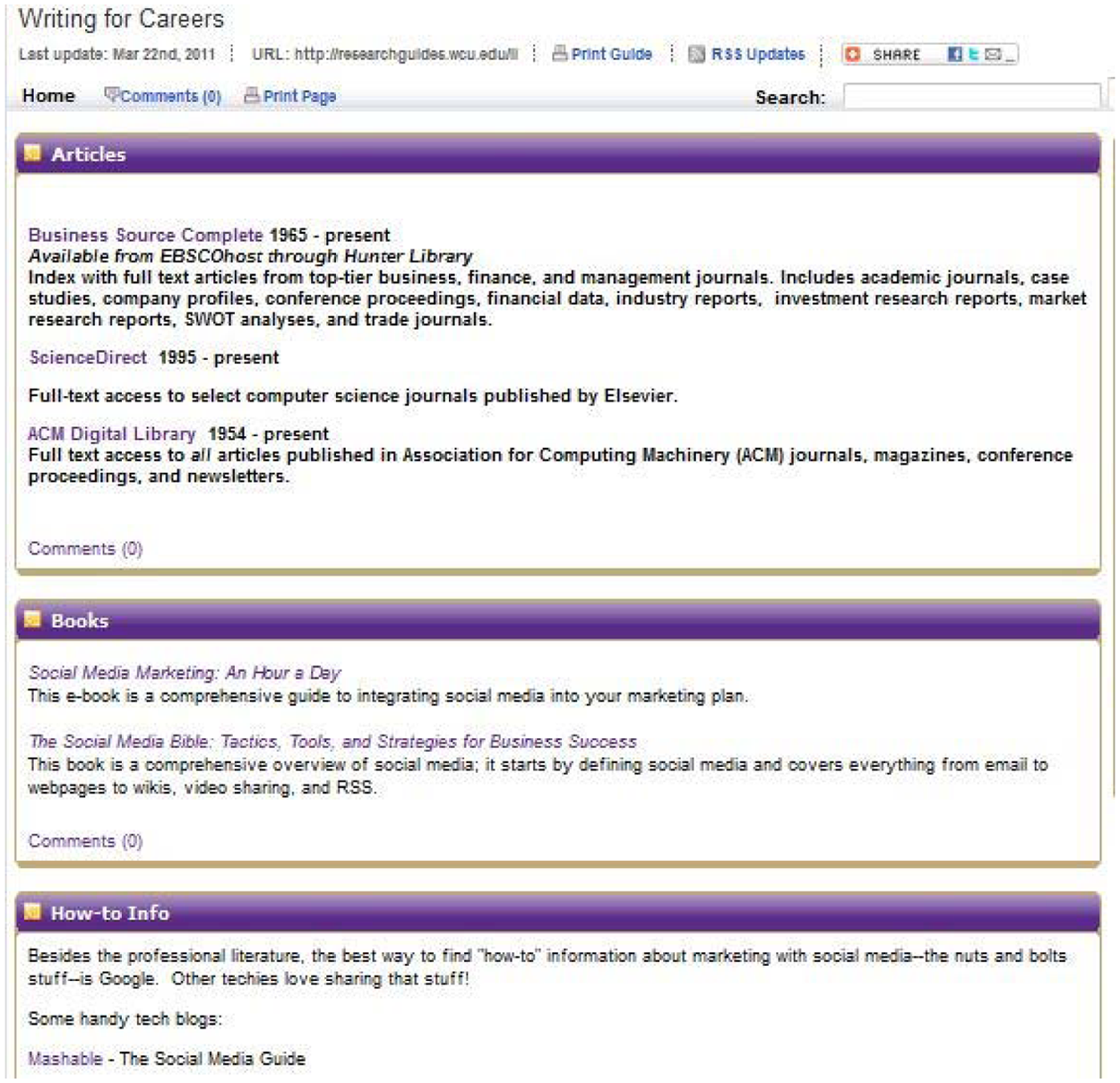
Screen capture of research guide for writing for careers
As social media increase the opportunity for illegal and unethical communication, we also discussed in class the ethics of social media marketing. Knowing that some clients are cautious in their use of the public domain in general and social media in particular, I asked students to search for articles that discuss how to minimize fears about online disclosures, how to monitor their online reputation, and how to use these social media to their advantage.
For primary research, I asked them to search for a business or organization similar to their client’s so that they could study how that business or organization had been using social media. They were also required to send a letter (email) of inquiry to solicit comments and suggestions. They would cite these comments in their proposal as a proof for their claim.
Managing the Project
Although the ultimate goal of this project was not to teach them how to use social media tools, as soon as I assigned the project, it became a secondary outcome. Students used Facebook and Twitter to stay in touch with each other. They developed friendships on Facebook, and they shared articles they found from the database and tweeted the article links to their followers, including group members.
After I approved the internal proposals, I gave them workshop, conference, and peer review hours to work on their proposals. They also had to submit individual progress reports at the midpoint of the project. Individual progress reports instead of a group progress report were preferred because they helped check how effectively they were working as a group. Any discrepancy in the progress reports by different group members might signal a group problem. These problems could relate to group dynamics, claiming credit for what he or she did not do, overstating individual contributions to the project, or failed collaboration or communication. In each case, I knew when to intervene before it was too late. I held conferences with each group after I received their progress reports, and, based on the problems documented on their progress report, I suggested possibilities to solve their specific problems. When I saw a common theme, I would address the whole class.
Reflecting on Their Performance
A reflection memo was the last assignment for this project. Students were required to assess their own performance and the performance of their group members without assigning a letter grade. Their reflection was designed to show what they had learned, their motivation, their project management, and whether and how they would use any skills they developed in the process of completing this project.
One student commented on her motivation:
With this project, I was able to research the experiences of other businesses using social networking, and by doing so I could form my own opinions of the tools to write a report. Instead of only writing down facts and figures that did not mean much to me or my client personally, I was able to add a personal touch, which made the project much more interesting.
Quite a few discussed the effects of this project:
It made me step out of my comfort zone, which is a trait we need to acquire as we are approaching graduation. Businesses who use social media are more attractive to me now than before and influence where I buy stuff. I felt like it had more of a purpose than an academic paper and I was learning about social media marketing, which could help me with future endeavors. This project gave me meaningful experience that could be very helpful in a business career or other careers. I have learned that social media marketing is a very successful and cost-effective means to businesses’ marketing goals.
Discussion and Conclusion
Throughout this project, we discussed how to use several social media tools. However, the goal of the project was not just for them to learn what tools exist and how to use each one. Instead, social media were integrated into the whole project in terms of the content of the project as well as students communicating among themselves and reaching more audiences. Students were challenged to communicate not only their mastery of digital communication skills, especially social media skills, but also their understanding of the potential for using these skills in professional settings to a target audience. In addition, they had to demonstrate their rhetorical skills in persuading their audience in considering or adopting social media.
This example of client-based, student-centered learning empowered students and increased student autonomy. The few students who disliked social media or were very reluctant to get onto social media had an opportunity to learn something new. Those who were familiar with some social media tools learned new aspects and features. This project gave students the opportunity to practice and utilize a variety of skills: critical thinking, problem solving, audience analysis, persuasion, and document design. The process-based teaching enhanced their understanding and application of what they learned in class and also made it possible to customize the teaching.
Nevertheless, there was no way that we could avoid the scenario that some students could not comprehend the goal of this project even after repeated instructor explanations. Their overconfidence and overestimation of their own social media skills also hindered their completion of this project satisfactorily. Instead of figuring out what the business or organization needs to communicate constantly and effectively with their customers, these students insisted on getting my opinion or the client had to tell them what to do. They spent time in creating a profile page instead of justifying why they had selected that particular social media tool. If they knew, based on their research, that their client had limited technology exposure, they were supposed to provide instructions to their clients as to how to use social media. But they failed to do so. If the current website of their client prevented them from successfully launching the social media page, they should have recommended that the client fix the foundation (the home page) to more clearly disseminate information and involve the customers/users.
I also hoped that their proposals would have included recommendations that the clients adopt social media as a marketing channel beyond creating a Facebook page. The client should actively participate in social media by closely observing and interacting with customers to fully exploit the potential that social media offer. During the project, I did spend some time teaching social media tools, especially the ones students lacked familiarity with, but above all social media were integrated into the final project, which constitutes a large portion of the final grade.
Overall, it was quite a learning experience, both for my students and for me. As one student commented,
Social media skills will definitely be used in my future jobs. Having the ability to attract, sell, or promote is found in every job. It takes a little creativity and uniqueness to stand out for a job and the same principle applies to marketing.
In this sense, we accomplished the learning outcomes for this course. Finally, I suggested how they could market the skills they gained from working on this project—for example, showcasing them in their hard copy resumes, in their portfolios, and even in their new online resumes which are their LinkedIn profiles.
Footnotes
The author(s) declared no potential conflicts of interest with respect to the research, authorship, and/or publication of this article.
The author(s) received no financial support for the research, authorship, and/or publication of this article.