






Abstract
Wilderness medicine elective rotations for graduate medical students are gaining popularity. The number of electives continues to grow, each with varying curriculum, format, and means of assessment. Previous curriculum guidelines attempted to standardize the knowledge-based competency for medical students in this field. Concurrently, medical education has evolved, emphasizing learner-centric and outcome-based observable competencies. Competencies based on individual qualities have since been complemented by practice-specific activities called entrustable professional activities (EPAs), which may consist of smaller observable practice activities (OPAs). This has allowed educators to use a holistic approach to determine that an individual can be fully entrusted to carry out an unsupervised activity. We surveyed current graduate-level wilderness medicine elective directors to determine expert panel recommendations for the EPAs of wilderness medicine for graduate medical students. The aim was to create EPAs and OPAs that experts deem fundamental for a wilderness medicine elective rotation and align them under the framework of entrustable practice in medical education. By mapping wilderness medicine EPAs and OPAs to competencies, we can better measure developmental progression and degree of entrustment in graduate wilderness medicine electives.
Keywords
Introduction
Wilderness medicine electives for medical students have been available domestically and internationally for decades and continue to be a popular, worthwhile opportunity for student participants.1,2 The number of electives available has been increasing steadily. 3 In the United States, these medical electives are offered by individual medical schools, private wilderness medicine companies, and national professional organizations including the Wilderness Medical Society (WMS). With the diversity in electives, the curriculum, format, and means of assessment can vary significantly between electives, including combinations of lecture-based didactics and skill sessions.2,4,5 An educational assessment is only sometimes included and, when implemented, is often a combination of observer feedback and pre- and postcourse testing.2,4 In 2014, Lareau et al 3 developed consensus-driven guidelines for medical student electives to provide standardization of wilderness medicine educational content. The aim was not only to enhance the student experience but also to assist rotation directors with curriculum design. Since this publication, there has been continued refinement in medical education, incorporating competency- and activity-based means of professional development.
Traditional evaluation methods, such as those used by the Association of American Medical Colleges (AAMC), relied on 6 core competencies developed by a collaboration of the Accreditation Council for Graduate Medical Education (ACGME) and the American Board of Medical Specialties. 6 These are patient care, medical knowledge, interpersonal and communication skills, professionalism, practice-based learning and improvement, and systems-based practice.6–8 These 6 core competencies are broad domains that are qualities of an individual and have been criticized for being abstract, making objective evaluation difficult. A limitation of this approach is that qualities and characteristics do not address whether an individual can be entrusted to perform professional work activities. 9 The 2014 medical student elective curriculum guidelines aligned competencies with wilderness medicine topics but did not address which wilderness medicine profession-specific activities would impart presumptive trust. 7
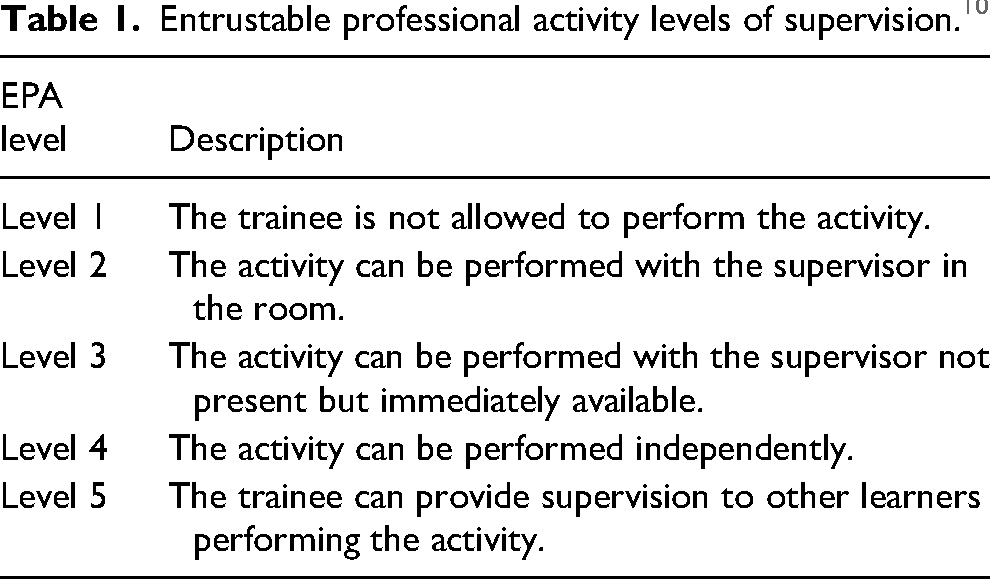
Medical education has transitioned toward the incorporation of entrustable professional activities (EPAs) and observable practice activities (OPAs). EPAs are tasks or responsibilities that trainees are entrusted to perform unsupervised once they have achieved proficiency. They represent units of work, whereas competencies represent individual abilities. This has moved markers of educational progression from the more theoretical, quality-based means of assessment to observable units of professional work. 9 EPAs typically require competency, including knowledge, skills, and attitudes, across multiple domains and typically occur through a graduated progression of supervision summarized in Table 1. 10 Because EPAs can become numerous, comprehensive collections of EPAs can be confusing or unwieldy depending on the scope of the profession or curriculum. To help mitigate this, OPAs have been described, which are smaller units of observable practice within EPAs. In essence, each EPA can be composed of multiple OPAs.11,12
Entrustable professional activity levels of supervision. 10
To help facilitate the transition to this new evaluation system, we created a guideline of potential EPAs and OPAs for medical student electives. The resulting list is not exhaustive or mandatory but may serve as a resource for curriculum developers, student evaluators, and those interested in developing wilderness medicine electives, particularly those that are introductory.
Methods
The WMS Student and Resident Education Committee solicited volunteers to serve on a task force to transform curriculum guidelines into a competency-based evaluation format. Six educators with a background in wilderness medical student education from across the United States volunteered. All members had extensive experience with wilderness education and curriculum design using EPAs. Employing guidelines from the International Association for Health Professions Education, the task force created a series of core and optional EPAs and OPAs. 13
The guidelines were created using a modified Glaser's state-of-the-art approach in an iterative fashion. 14 Initially, the task force referenced existing curriculum guidelines of student electives, resident electives, residency tracks, and fellowship programs.3,15–17 The group created an initial draft of a curriculum based on this review.
To create the initial draft, potential EPAs were generated using a course framework from the 2023 wilderness medicine resident elective curriculum guidelines by Mikros et al. 15 These resident guidelines were chosen because their educational framework included high level themes that served well as EPAs. The frameworks from fellowship and residency track guidelines were less relevant because they covered much longer timeframes and were felt to include too much material for an introductory elective.16,17 The 2014 student guidelines by Lareau et al 3 did not follow a framework that was easily adaptable to EPAs.
To ensure that all material was at a level appropriate for medical students, the OPAs were created by directly referencing the topics from the 2014 medical student elective guidelines and developing OPAs from those recommended topics. 3 The OPAs were then assigned to the appropriate EPA based on relevant content. Finally, using these OPAs as a reference, the EPAs were edited to ensure that they were also at an appropriate level.
After these initial guidelines were created, the task force identified a group of 8 experts in wilderness medicine education, who were determined by consensus. This group of experts did not include any of the authors of this paper. The initial draft of the guidelines was shared with this group, and a Google Form was used to solicit feedback on the proposed guidelines. Basic demographic information about the electives led by the experts also was collected. This included location, organizational affiliation, types of students taught, and how long the electives had been running. Three experts responded to the survey. This feedback was incorporated into a second iteration of the proposed guidelines.
The updated curriculum guidelines were shared with course directors for a second iteration of feedback. A list of all current wilderness medicine electives was created by searching the WMS, American College of Emergency Physician (ACEP), and Society for Academic Emergency Medicine (SAEM) websites, and emails were sent to each of these course directors. The curriculum guidelines also were shared with wilderness medicine fellowship directors from the WMS program list and were emailed to the ACEP Wilderness Medicine Section and the SAEM Wilderness Medicine Interest Group. They also were posted to the WMS General Discussion Board on Mobilize. Course directors, fellowship directors, and those with a vested interest from the email lists and message boards were asked to provide feedback using the same Google Form, which now included the updated curriculum guidelines. The same demographic information was collected on this form. Multiple requests were sent to each group. It is unknown exactly how many people received the survey because it was posted to multiple listservs and message boards. Four additional responses were received during this second survey. Demographic information was compared to ensure that no responses in the second wave were from the experts who completed the first wave.
With each iteration of feedback, there were minimal changes. Recommendations received focused primarily on grammar and clarity and were incorporated after discussion within the task force. No OPAs or EPAs were advised to be added or removed. The EPAs and OPAs were mapped to the ACGME Core Competencies, the AAMC Physician Competency Reference Set, and the AAMC Core Entrustable Professional Activities for Entering Residency.7,11,18
Results
Over the course of 16 months, the task force created curriculum guidelines that included 4 EPAs that all graduates of a student wilderness medicine rotation should be able to perform. The group also created a fifth category of optional OPAs that course directors might wish to incorporate. The entirety of the guidelines, including EPAs, OPAs, and their mapping to relevant competencies, is found in the online Appendix.
The first EPA, “Collaborate as a member and leader of an interprofessional team in an austere setting,” focuses on leadership, communication, and teamwork skills necessary to care for patients in an austere setting. To complete this activity successfully, students should be able to locate, rescue, and provide care for 1 or more lost and/or injured individuals as a participant in an incident command system (ICS) and effectively communicate with team members. Example OPAs include managing a mass-casualty scenario, rescuing a stranded team member or patient, and effectively documenting a wilderness medicine encounter. Participating in an ICS was included, although establishing an ICS was felt to be beyond the scope of a student course.
The second EPA, “Survive independently in an austere setting,” ensures that learners have the appropriate skills to care for themselves in an austere setting. Students should be able to plan their excursions and care for themselves to not become another patient in a wilderness scenario. Basic survival skills were included, although the activity does not include extended solo survival because it was felt to be outside the scope of a student course. Example OPAs include dressing appropriately for the wilderness and safely obtaining and treating water.
The third EPA, “Manage common illnesses and injuries in an austere setting,” focuses on the common complaints, injuries, and pathologies that students would see during the practice of wilderness medicine. Learners should be familiar with common ailments seen in the wilderness, be able to prevent them when possible, and be able to treat them when not. This includes preventing and planning for exacerbations of underlying chronic conditions. Example OPAs include creating appropriate first aid kits, extricating patients from wilderness settings, and managing gastrointestinal illness in an austere setting.
The fourth EPA, “Manage specific pathophysiologic conditions unique to austere settings in prehospital, hospital, and outpatient environments,” ensures that learners are prepared for these unique pathologies classically associated with austere environments. It encompasses typical austere injuries such as exposure, submersion, and envenomation. This includes how to manage these conditions in both austere and resource-rich settings. Example OPAs include managing a patient struck by lightning and managing a patient with a dive injury.
The final EPA contains optional material, including common profession-specific activities encountered in the practice of wilderness medicine covered in some courses that were not felt to be mandatory. The optional material is not meant to be comprehensive or exhaustive but to provide ideas for additional educational content for course directors. Example OPAs include identifying and treating the spectrum of altitude illness and rescuing a team member or patient stranded in swiftly moving water.
Discussion
Given their typically short duration, medical student electives in wilderness medicine are typically introductory-level courses. A broad range of topics is often covered, although with little depth. Many also vary significantly in curriculum and format, necessitating evaluations that can accurately reflect this diversity. Furthermore, many student rotation evaluations have lacked standardization and may not communicate competency or a learner's presumptive trust.
Many medical schools and residency programs are moving primarily toward competency-based education. This paper provides the first published guidelines for competency-based evaluation tools for wilderness medicine electives. These guidelines serve as a reference for evaluating successful completion of a medical student wilderness medicine elective. By design, course instructors will need to develop their own curriculum and evaluation tools to ensure that learners are meeting these EPAs. As such, these guidelines serve as a resource for curriculum design. Educators can use these guidelines, in addition to previously published educational literature in wilderness medicine, to create new courses or to transition existing curricula to a competency-based model.3,15–17
This study has several limitations. First, the survey was distributed solely to individuals affiliated with the WMS, ACEP, and SAEM, potentially excluding elective directors not associated with these organizations. In addition, directors and programs outside the United States were not included. Given that 2 of the 3 organizations focus primarily on emergency medicine, elective directors from other specialties may hold alternative perspectives on core EPAs and OPAs. Therefore, the suggestions provided may exhibit bias toward emergency medicine.
Second, the response rate to our survey was low. Only 3 of 8 identified experts responded, and only 4 additional responses were received in the second round. This low response rate may limit the generalizability of the proposed guidelines.
Third, although we aimed to ensure a broad scope for each EPA and OPA to encompass a wide range of elective material, it is acknowledged that they are not exhaustive. We recognize that certain niche topics may not be adequately covered by these suggestions. However, we believe that this paper may serve as a foundation for developing more focused EPAs and OPAs tailored to these specialized areas.
Lastly, this study does not specify the proficiency level students are expected to achieve for each activity. This intentional omission allows flexibility for evaluators to account for variations in student backgrounds, such as differing years in medical school, and variations in the depth of material covered. Consequently, evaluators are encouraged to adapt these guidelines to suit the specific requirements of their elective programs.
Conclusions
Wilderness medicine electives offer unique opportunities for students to develop skills to improve their abilities as future physicians. The use of EPAs and OPAs to develop curricula and evaluate students may improve accessibility of these elective opportunities by mapping them to competencies accepted by ACGME, AAMC PCRS, and AAMC CEPAER.
Supplemental Material
sj-docx-1-wem-10.1177_10806032251318582 - Supplemental material for Curriculum Guidelines for Wilderness Medicine Medical Student Electives: 2025 Update
Supplemental material, sj-docx-1-wem-10.1177_10806032251318582 for Curriculum Guidelines for Wilderness Medicine Medical Student Electives: 2025 Update by Walker B. Plash, Daniel F. Leiva, Kevin D. Watkins, Justin M. Gardner, Geoffrey Comp and Stephanie A. Lareau in Wilderness & Environmental Medicine
Footnotes
Acknowledgments
We thank the members of the Wilderness Medical Society's Student and Resident Education Committee as well as those who provided feedback on the development of this material.
Author Contributions
Conceptualization, data curation, formal analysis, investigation, methodology, project administration, validation, writing original draft, review & editing (WBP); conceptualization, data curation, formal analysis, investigation, methodology, visualization, writing original draft, review & editing (DFL); conceptualization, data curation, formal analysis, investigation, methodology, validation, writing original draft, review & editing (KDW); conceptualization, data curation, formal analysis, investigation, methodology, visualization, writing original draft, review & editing (JMG); conceptualization, formal analysis, writing original draft, reviewing & editing (GC); conceptualization, methodology, supervision, validation, writing original draft, review & editing (SAL).
Consent to Participate
Respondents gave written consent to participate by checking a box verifying consent before the survey would be available to complete.
Ethical Considerations
This study was approved by the Institutional Review Board of the University of South Alabama on April 23, 2024 (Ref. 24-129). Information obtained was recorded in such a manner that the identity of human subjects cannot be readily ascertained, directly or through identifiers linked to the subjects.
ORCID iDs

References
Supplementary Material
Please find the following supplemental material available below.
For Open Access articles published under a Creative Commons License, all supplemental material carries the same license as the article it is associated with.
For non-Open Access articles published, all supplemental material carries a non-exclusive license, and permission requests for re-use of supplemental material or any part of supplemental material shall be sent directly to the copyright owner as specified in the copyright notice associated with the article.
