







Abstract
Off-grid low-tech living is increasingly proposed for arid environments, yet longitudinal field data documenting health, nutrition, and rest–activity organization under real-world conditions remain scarce. Our objective was to describe physiologic, nutritional, psychological, and rest-activity trajectories during 120 d of low-tech off-grid desert living. This was a prospective observational case study of 2 participants (female, 29 y old; male, 39 y old) conducted in Baja California (January–April 2023). Pre-, mid-, and post-mission assessments included bioimpedance body composition, incremental cycle ergometry with gas exchange (VO2 max and ventilatory thresholds), and laboratory panels (eg, hematology, iron status, vitamins, trace elements, and renal and hepatic indices). Mental health was assessed using the State-Trait Anxiety Inventory, the Positive and Negative Affect Schedule, and daily mood ratings. Continuous wrist actigraphy quantified sleep-wake timing and nonparametric rest-activity metrics. Analyses were descriptive and within participant. Body mass decreased by ∼2 kg in both participants, primarily through reduced fat mass with preserved lean indices. VO2 max increased over time without evidence of physiologic compromise. No biochemical marker of micronutrient deficiency was identified. Although locally produced foods contributed ∼1% of total energy intake, they provided substantial micronutrient density. Ferritin levels remained within reference intervals despite transient mid-mission fluctuation in the female participant. Rest-activity rhythms remained robust across 120 d, with seasonal adjustment of sleep timing and modest sleep reduction. Anxiety did not increase, and affect balance remained positive. In this descriptive field case, prolonged low-tech off-grid desert living was compatible with maintenance of physical and psychological health. These findings provide ecologically grounded observations relevant to human functioning in resource-limited environments.
Keywords
Introduction
Climate change, increasing resource scarcity, and growing environmental constraints are driving renewed interest in autonomous living systems capable of sustaining human health under extreme conditions. Desert environments—characterized by high thermal load, aridity, intense solar radiation, and limited access to fresh water—represent a particularly demanding setting in which to examine human physiologic, psychological, and behavioral functioning. Although laboratory experiments and controlled analogue studies have yielded valuable insights into isolated stressors such as heat exposure or confinement, they often fail to capture the complexity, interdependence, and unpredictability inherent to prolonged real-world autonomous living.
Low-tech autonomous systems prioritize simplicity, robustness, repairability, and low energy demand, relying on local resources and circular material flows rather than centralized infrastructure. Within such systems, water production, food cultivation, energy generation, waste recycling, and daily human activity are tightly interdependent. Minor perturbations—whether meteorologic fluctuations, technical failures, or temporary resource imbalances—can propagate across subsystems and directly affect workload, stress exposure, and daily organization. Despite increasing societal and scientific interest in low-tech approaches as potential responses to future climate scenarios, empirical data documenting human adaptation during long-duration low-tech autonomous living remain scarce.
This study documents a 120-d off-grid living mission conducted in the Baja California desert (Mexico) within a low-tech habitat of ∼60 m2 integrating ∼25 interconnected systems dedicated to water capture and storage, agroecological food production and preservation, sanitation, passive ventilation and shading, and renewable or human-powered energy generation. The mission was conceived, designed, and operated by 2 participants, who constituted the sole operational crew and jointly managed all technical, logistical, agricultural, and organizational tasks. Their relationship was both professional and personal, a configuration intrinsic to the mission and relevant for interpreting behavioral, psychological, and social dynamics during prolonged autonomous living and relative isolation.
Although the project had a strong engineering and technological dimension, the objective of this study was not to evaluate the technical performance of low-tech devices. Rather, the aim was to document how 2 individuals adapted physiologically, psychologically, nutritionally, and behaviorally to long-duration autonomous living within a fragile and interdependent system constrained by heat exposure, limited water availability, energy scarcity, and environmental variability. The mission itself was not designed as an experimental protocol, and this report provides observational data collected without experimental manipulation.
In arid climates, heat exposure is known to impair human performance, work capacity, and sleep. Experimental and field studies have shown that elevated thermal load degrades nocturnal sleep continuity and alters sleep architecture,1–3 whereas sustained heat stress constrains physical work output and necessitates adaptive work-rest strategies. 4 Beyond thermal stress alone, research conducted in isolated and confined environments—such as Antarctic stations and spaceflight analogues—has highlighted marked interindividual variability in sleep duration, circadian timing, physical activity, and mood, emphasizing the importance of longitudinal monitoring under ecologically valid conditions.5,6
From a physiologic needs perspective, adult daily energy requirements are commonly framed by recommendations from the Food and Agriculture Organization of the United Nations/World Health Organization/United Nations University, 7 whereas daily water intake is typically estimated at ∼2.0 to 2.5 L·d−1 under temperate conditions, with higher requirements under heat stress and increased workload. 8 Occupational heat risk is frequently screened using the wet bulb globe temperature (WBGT) index, as defined by the International Organization for Standardization (ISO 7243), to guide work-rest scheduling and heat-exposure management. 9 Health is further understood as a multidimensional construct encompassing physical, mental, and social well-being, according to the World Health Organization definition. 10
To capture these multiple dimensions of human functioning in this ecological context, a multimodal observational approach was adopted. Body composition and aerobic fitness were assessed before and after the mission to document integrative physiologic responses to sustained physical and environmental demands. Blood biomarkers were analyzed to evaluate nutritional sufficiency in the context of a fully low-tech food system relying largely on locally produced resources. Rest-activity organization was monitored continuously using wrist actigraphy to describe behavioral rhythms and sleep-wake timing under desert constraints. Psychological questionnaires and daily mood ratings were included to explore trajectories of anxiety, affect, and perceived stress across the mission.
This work is presented as a descriptive, exploratory field case study. It does not aim to provide inferential evidence or causal conclusions but rather to document human responses within a real-world low-tech autonomous ecosystem. By prioritizing ecological validity and transparency regarding methodologic limitations, this study sought to generate hypotheses and inform future controlled investigations into human functioning under extreme and resource-constrained environments.
Methods
Study Design and Participants
This study was designed as a prospective, observational, descriptive field case report involving 2 participants (N=2). The low-tech autonomous mission preexisted independently of the scientific investigation and involved no experimental intervention, behavioral manipulation, or randomization. The objective was to document physiologic, psychological, nutritional, and behavioral trajectories under real-world off-grid living conditions.
The participants were 1 female, Caroline (born 1993; height 172 cm; body mass 64 kg pre-mission to 62 kg post-mission), and 1 male, Corentin (born 1983; height 175 cm; body mass 68 kg pre-mission to 66 kg post-mission). Both obtained medical clearance prior to the mission and had prior experience with autonomous low-tech living and physically demanding field conditions. Together they constituted the sole operational crew and were responsible for all technical, logistical, agricultural, and organizational tasks throughout the 120-d deployment.
Living Structure and Habitat Organization
The autonomous living environment consisted of a semi-open, naturally ventilated canvas-based structure serving as the central living and operational space throughout the mission. The habitat was not a sealed ecological system but a permeable shelter providing shade, wind protection, and partial thermal buffering while allowing continuous interaction with the surrounding desert environment.
The structure integrated sleeping, cooking, food storage, and daily living areas as well as shaded zones dedicated to agroecological production systems, including hydroponic cultivation of leafy vegetables, spirulina production units, insect farming (eg, black soldier fly larvae and crickets), dry toilets, and a closed-loop sanitation system incorporating graywater treatment and reuse. Renewable and human-powered energy systems also were integrated into daily operations.
Participants were free to move outside the habitat at all times and did so daily to perform essential outdoor tasks such as maintenance of solar panels and water desalination systems near the shoreline, agricultural work, system repairs, and material transport. The surrounding outdoor space therefore constituted an integral component of the living and operational environment. This configuration differs fundamentally from historical fully enclosed biosphere experiments, combining sheltered living with continuous exposure to external climatic conditions. Representative photographs of the habitat and systems are provided in Figure 1.

Overview of the low-tech habitat and living environment during the desert biosphere mission.
Setting and Mission Timeline
Pre- and post-mission physiologic assessments were conducted in France at the University Hospital of Caen (Department of Sports Medicine) under standardized medical conditions. Pre-mission body composition and cardiorespiratory fitness testing (VO2 max) were performed on September 8, 2022. Blood biomarkers were collected shortly before mission onset (December 27, 2022), at mid-mission (March 1, 2023), and near mission completion (April 28, 2023). Post-mission body composition and VO2 max reassessments were conducted on July 27, 2023.
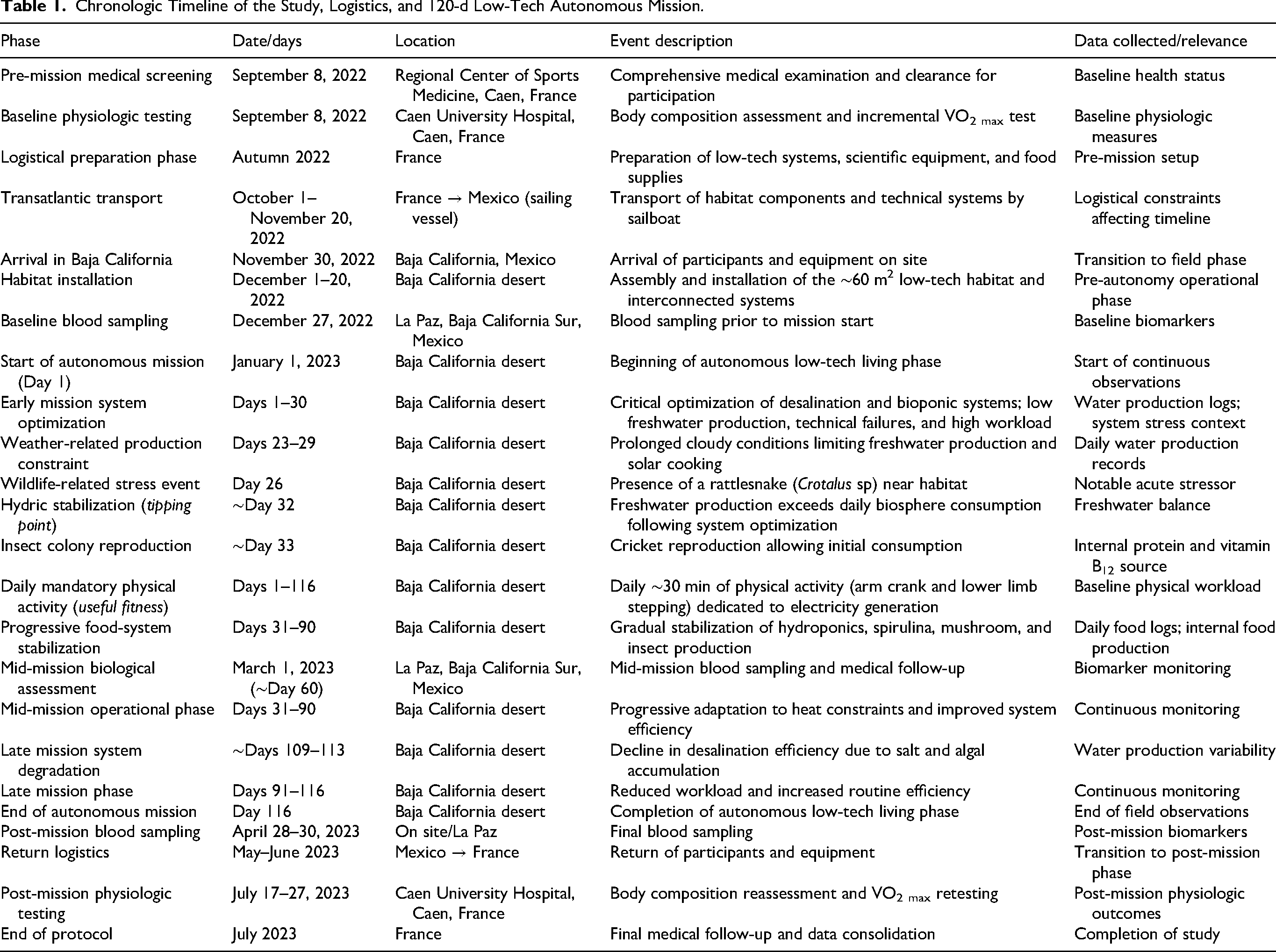
The temporal spacing between assessments reflects logistical constraints related to transoceanic transport and mission installation and is acknowledged as a methodologic limitation. A detailed chronologic timeline of assessments, logistical phases, and major contextual events is provided in Table 1.
Chronologic Timeline of the Study, Logistics, and 120-d Low-Tech Autonomous Mission.
Environmental Conditions
Direct in situ meteorologic monitoring was not available during the mission. Environmental exposure therefore was contextualized using daily mean ambient temperature, relative humidity, wind speed at 2 m, and surface solar radiation reconstructed from the NASA POWER database at the exact geographic coordinates of the habitat (24.476115°N, −110.699334°W) for the period January 1 to April 30, 2023. These reconstructed values represent regional ambient conditions and do not capture microclimatic exposure within the shaded and ventilated habitat.
In addition, local ephemerides (ie, daily sunrise and sunset times) were calculated for the same coordinates and period to provide contextual reference for seasonal changes in photoperiod and sleep-wake timing.
Physiologic Measurements
Body composition was assessed using a multifrequency bioelectrical impedance analyzer (seca mBCA 525, Seca GmbH, Hamburg, Germany) in the supine position, with standardized electrode placement and calibration procedures, during pre- and post-mission assessments at the Regional Center of Sports Medicine. In addition, body mass and body composition were monitored longitudinally during the mission using a portable consumer-grade bioimpedance scale (TANITA BC-545N, Tanita Corp, Tokyo, Japan).
Self-measurements were performed every 5 d under standardized conditions whenever possible (ie, morning, fasting state, and prior to daily work activities). These field-based measurements were used descriptively to characterize within-participant trends over time and were not intended for absolute quantification or clinical diagnoses.
Cardiorespiratory fitness was evaluated using an incremental cycle ergometer test to volitional exhaustion, with continuous breath-by-breath gas exchange, electrocardiography, blood pressure, and peripheral oxygen saturation monitoring. Maximal oxygen uptake (VO2 max) and ventilatory thresholds were determined in accordance with American College of Sports Medicine guidelines.
Blood biomarkers were analyzed to assess nutritional sufficiency and physiologic status, including hematologic parameters, iron status, vitamin B12, folate, vitamin D, electrolytes, and renal and hepatic function markers.
Nutritional Monitoring
Participants completed a daily food intake log throughout the mission, recording all consumed foods with detailed quantities (weight in grams whenever possible, volume, and number of portions). These records were used to reconstruct daily energy intake, macronutrient distribution, and selected micronutrient intake. Daily food quantities were equally distributed between the 2 participants throughout the mission, resulting in identical planned caloric and nutrient allocations per person. Energy calculations were performed using nutritional values corresponding to foods as consumed (after preparation and cooking), rather than dry or raw reference values, to ensure accurate estimation of daily intake. When necessary, adjustments were made to account for preparation-related changes in water content. The food system relied on a combination of locally produced resources (eg, leafy vegetables, mushrooms, insects, and spirulina) and presupplied stored staples introduced at the start of the mission (eg, maize, rice, black beans, chickpeas, and oils).
Nutrient intake estimations were performed using the USDA FoodData Central database, selecting food items corresponding to foods as consumed (prepared or fresh form as applicable). Daily gram quantities recorded in food logs were matched to database reference values to estimate macro- and micronutrient intakes. These estimates reflect database-derived nutritional composition rather than laboratory assays of consumed foods. Aggregated nutritional data are presented in the “Results section,” and full datasets are available on request.
Activity Organization and Qualitative Workload Documentation
Although no electronic task-tracking or energy-expenditure monitoring system was implemented, participants maintained daily written logbooks documenting the organization of activities and operational constraints. These logs described daily tasks related to water production, agricultural work, system maintenance and repair, material transport, planning, and habitat management.
Although these records did not provide quantitative workload metrics or objective estimates of energy expenditure, they offered a continuous qualitative account of task distribution, workload organization across the day, and major operational events. These data were used exclusively to contextualize physiologic, psychological, and rest-activity trajectories, particularly in relation to perceived stress, affective variability, and daily scheduling under environmental constraints.
The absence of quantified workload and direct energy-expenditure measurements is acknowledged as a methodologic limitation and precludes formal inferences regarding dose-response relationships between physical workload and physiologic outcomes.
Psychological Measures
Anxiety was assessed using the State-Trait Anxiety Inventory, Form Y, 11 including both state and trait components, administered before the mission, twice during the mission (Weeks 6 and 13), and after mission completion.
Affective balance was evaluated using the French version of the Positive and Negative Affect Schedule (PANAS), 12 at ∼4-wk intervals. In addition, participants completed daily mood ratings using a 0 to 10 visual analogue scale assessing pleasure, arousal, and motivation. Standardized questionnaires were administered less frequently to limit participant burden, whereas daily ratings captured short-term variability. Analyses focused on within-participant trajectories.
Sleep and Rest-Activity Patterns
Rest-activity rhythms were monitored continuously using wrist-worn actigraphy (CamNtech MotionWatch 8, CamNtech Ltd, Cambridgeshire, UK) with a 15-s epoch throughout the 120-d mission. Nonparametric circadian rhythm analysis metrics—including interdaily stability, intradaily variability, and relative amplitude—were derived following established nonparametric procedures. In addition to standard sleep-wake variables (ie, sleep onset, final wake time, total sleep time, and sleep efficiency), monthly averages (January–April) and pre-mission baseline values (Week 1) were examined to characterize longitudinal trajectory across the protocol.
Sleep timing was additionally referenced to local ephemerides (ie, daily sunrise and sunset times calculated at the exact habitat coordinates) to contextualize seasonal variation in photoperiod and rest-activity organization. In the absence of individual light exposure measurements and core body temperature recordings, actigraphy-derived indices were interpreted as markers of behavioral rest-activity organization rather than endogenous circadian phase.
Data Analysis
Given the descriptive nature of the study and the small sample size, analyses focused on within-participant comparisons (pre- vs post-mission and early vs late mission phases). Emphasis was placed on magnitude, clinical relevance, and temporal coherence rather than inferential statistics. For longitudinal analyses, the 120-d protocol was divided into 8 equal temporal segments (octiles), with the first and last segments corresponding approximately to the first and last 15 d of the mission. For actigraphy analyses, monthly averages (January–April) and pre-mission week (Week 1) were additionally examined to characterize longitudinal trajectory.
Ethics and Regulatory Framework
The study was conducted in accordance with French and European regulations governing noninterventional observational research. Under French legislation (Loi Jardé, Décret No. 2016-1537), Institutional Review Board or Comité de Protection des Personnes approval is required only when investigators introduce an intervention, modify participants’ behavior or care, impose experimental exposure, or randomize conditions. None of these criteria applied in this study. The mission was conceived and implemented independently of the research team, and all data collection was observational and noninvasive. The study was conducted under the General Data Protection Regulation framework and registered as a noninterventional observational study (MR-004) under institutional data protection officer supervision.
Both participants provided written informed consent authorizing participation, longitudinal health monitoring, and publication of identifiable data, including names and images, consistent with CARE guidelines for case reports.
Results
Environmental Context During the Mission
Daily environmental conditions during the mission are summarized in Figure 2. Reconstructed meteorologic data from the NASA POWER database at the exact geographic coordinates of the habitat (24.476115°N, −110.699334°W) were used to characterize daily mean ambient temperature at 2 m, relative humidity at 2 m, wind speed at 2 m, and surface solar radiation from January 1 to April 30, 2023.
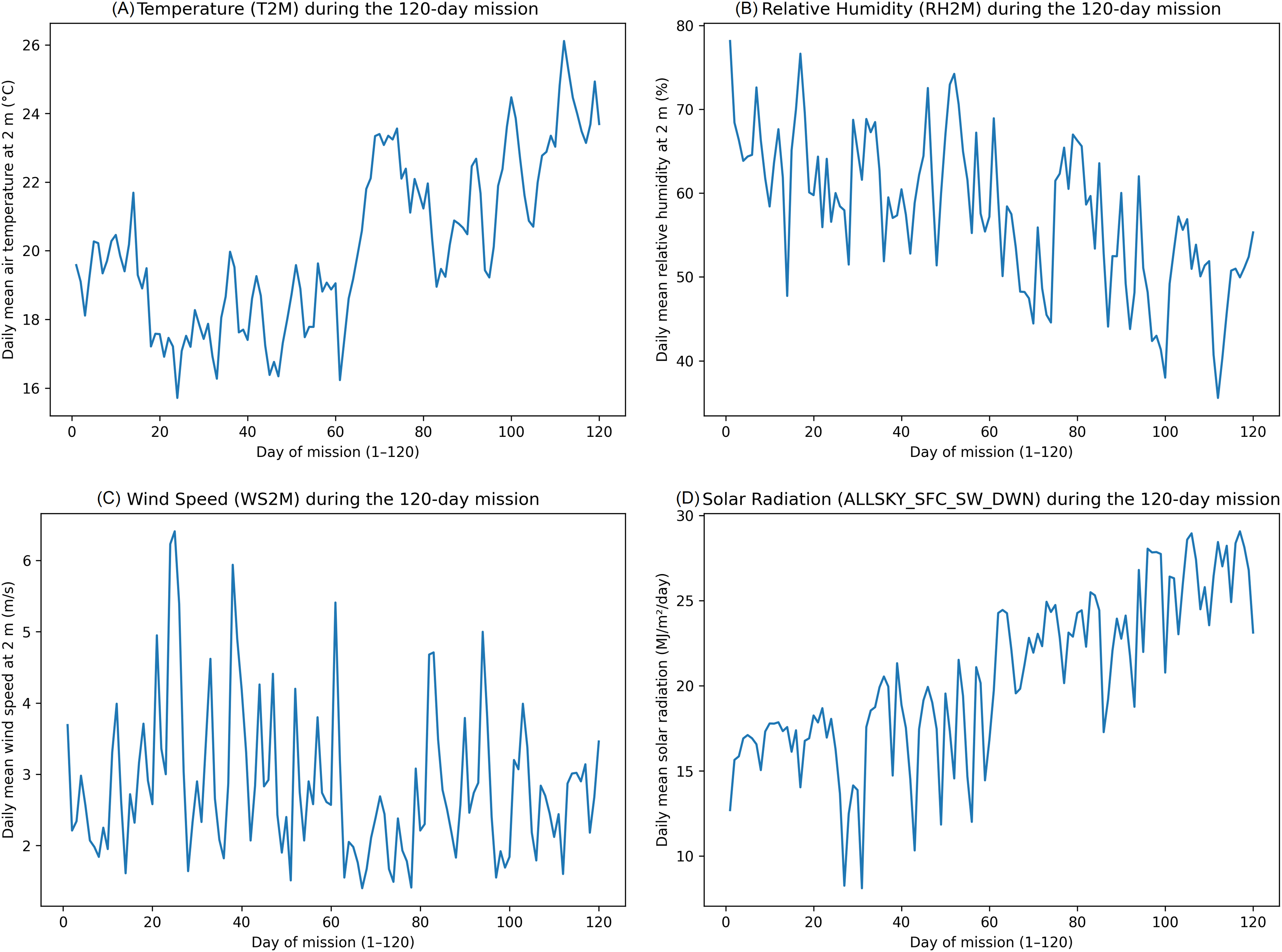
Environmental conditions during the 120-d low-tech autonomous living mission (January 1–April 30, 2023). Daily mean meteorologic parameters reconstructed at the exact location of the habitat (24.476115°N, −110.699334°W, Baja California, Mexico) using the NASA POWER database. A, Ambient air temperature at 2 m (T2 M, °C). B, Relative humidity at 2 m (RH2 M, %). C, Wind speed at 2 m (WS2 M, m·s−1). D, Surface solar radiation (ALLSKY_SFC_SW_DWN, W·m−2). Together these panels illustrate the progressive seasonal increase in thermal load, aridity, and solar exposure experienced by the participants over the 120-d desert mission. Data source: NASA POWER Project, NASA Langley Research Center.
Across the mission period, a clear seasonal progression was observed. Daily mean ambient temperature increased progressively from winter to late spring, reflecting the transition toward hotter desert conditions. This warming occurred in the context of persistently low relative humidity and high, increasing solar radiation. Wind speed showed moderate day-to-day variability without a marked long-term trend.
These reconstructed regional data illustrate the seasonal environmental context within which the mission took place, characterized by progressively warmer and more solar-exposed desert conditions. They provide background context for interpreting physiologic, behavioral, and rest-activity trajectories but do not represent direct measurements of microclimatic exposure within the habitat.
Water Availability and Freshwater Balance
Daily freshwater production and use within the biosphere system are presented in Figure 3. Fresh water was produced continuously through a solar desalination system and allocated primarily to the hydroponic and associated agroecological subsystems in addition to domestic needs (ie, cooking and hygiene) for both participants. Across the 120 d of monitoring, mean daily freshwater production was 23.2±12.1 L·d−1 (range 0–41.4 L·d−1). Estimated total daily biosphere demand averaged 12.2±11.3 L·d−1 (range −0.5–94.6 L·d−1). The resulting mean daily balance was positive (+11.0±13.9 L·d−1), indicating that desalination capacity exceeded average system demand over the observation period.
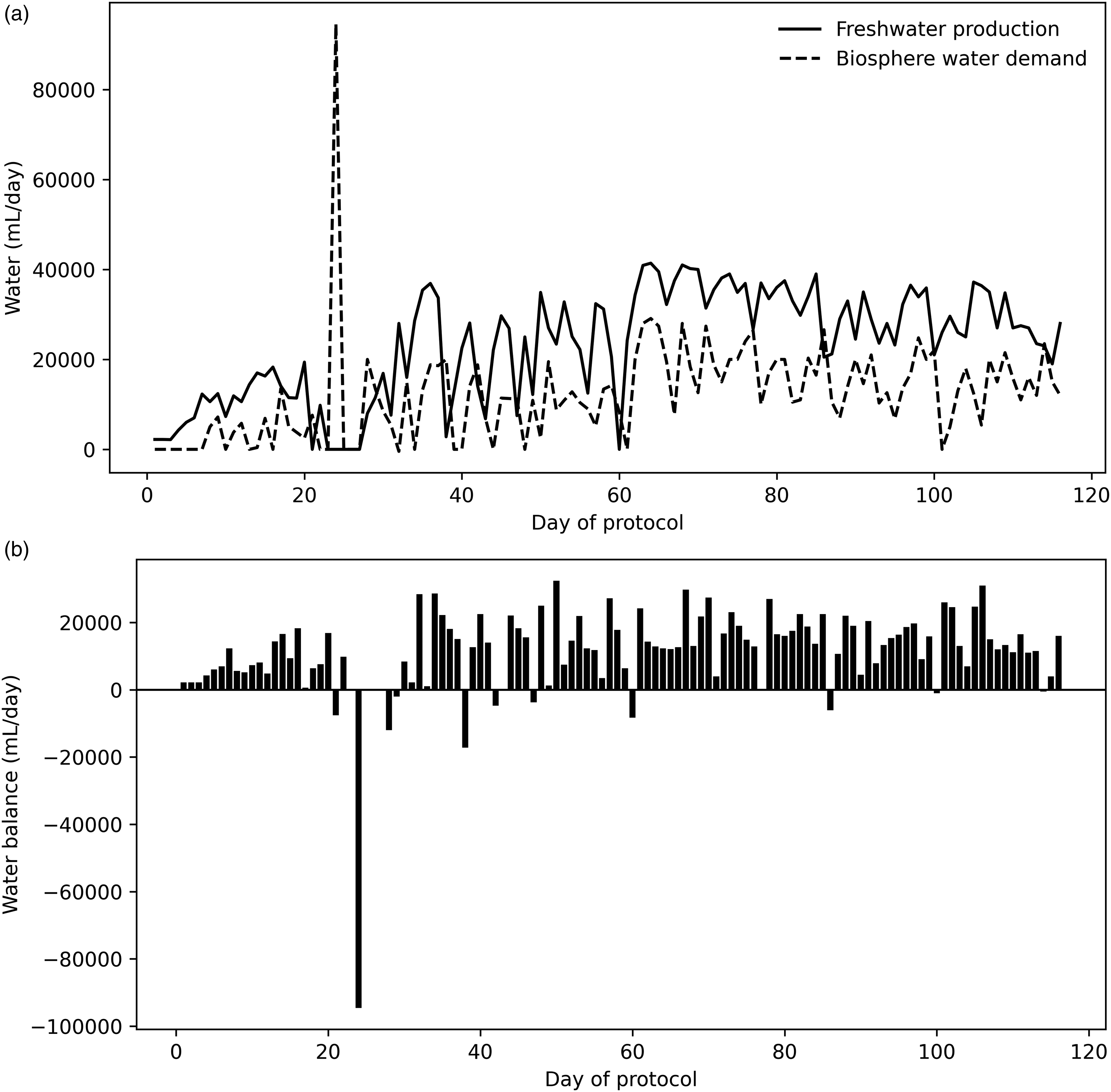
Freshwater production, demand, and balance during the 120-d biosphere protocol. A, Daily freshwater production provided by the solar desalination system (solid line) and daily freshwater demand of the biosphere hydroponic system (dashed line), expressed in milliliters per day. B, Daily freshwater balance calculated as freshwater production minus biosphere water demand. Positive values indicate surplus production, whereas negative values indicate periods of water deficit.
Daily freshwater production exhibited marked variability, reflecting meteorologic conditions and operational constraints, whereas overall system demand remained comparatively stable except for isolated operational events. The highest recorded daily demand (94.6 L) corresponded to a single incident involving accidental drainage of the spirulina basin requiring immediate replenishment to preserve culture viability.
When expressed per participant, mean daily use of fresh water corresponded to ∼6.1 L·d−1 per person. Although short-term imbalances occurred, operational logs did not indicate prolonged disruption of water-dependent subsystems, and availability of fresh water was maintained within a range compatible with continued daily living and food-production activities throughout the mission.
Food-Production System and Daily Energy Intake
Across the 120-d mission, mean daily energy intake per participant was 2797±651 kcal·d−1 (range 604–3818 kcal·d−1), with caloric intake predominantly derived from presupplied staple foods including maize, rice, black beans, chickpeas, and vegetable oils (Figure 4). Locally produced foods—leafy vegetables, oyster mushrooms, crickets, and fresh spirulina—contributed a mean of 32.8 kcal·d−1 per participant, corresponding to ∼1% of total daily energy intake.
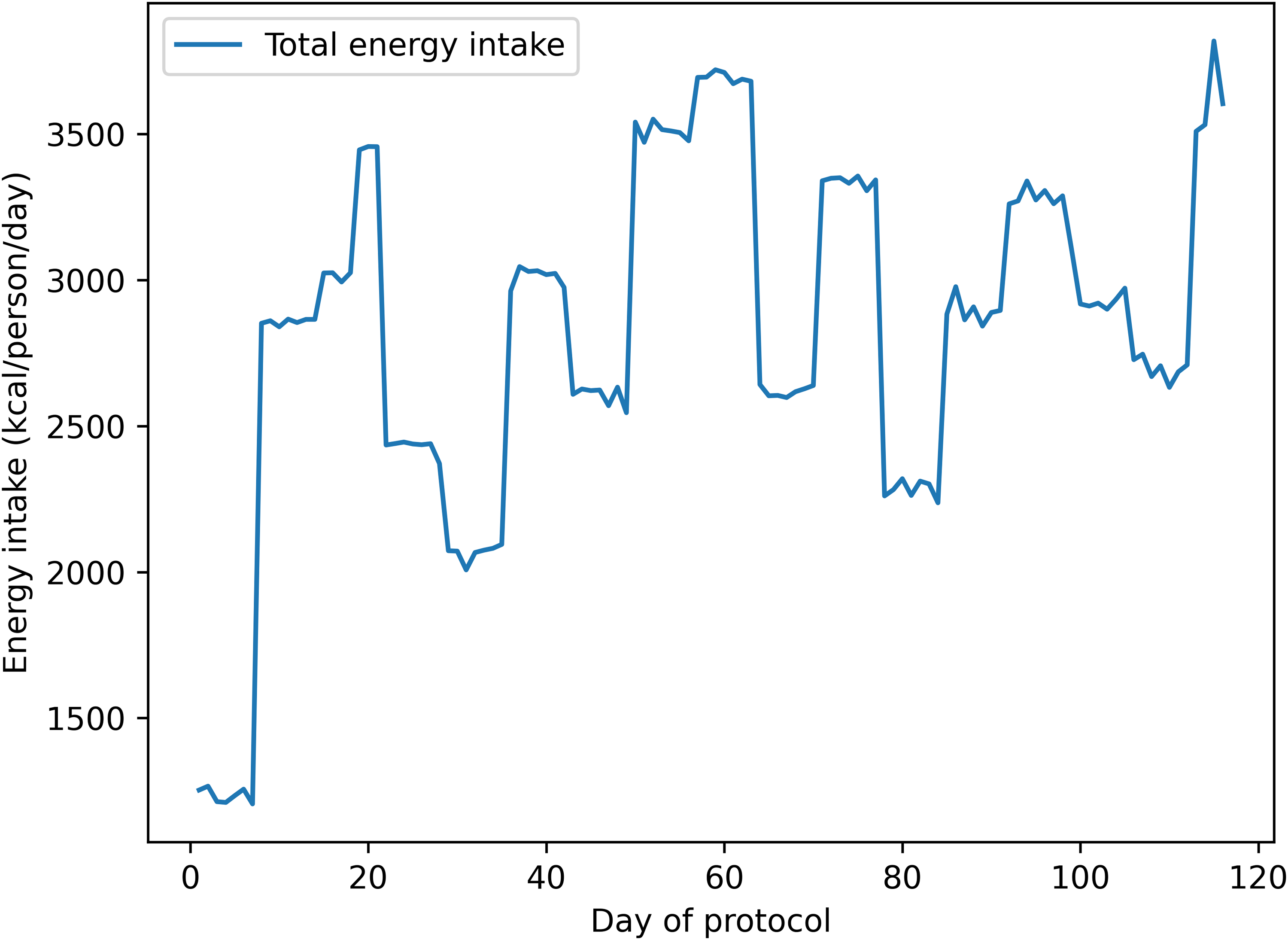
Daily total energy intake (kcal·d−1 per person) across the 120-d mission. Values represent total caloric intake per participant, combining externally supplied staple foods (eg, maize, rice, black beans, chickpeas, and vegetable oils) and in situ biosphere production (eg, leafy vegetables, oyster mushrooms, fresh spirulina, and crickets). In situ production was included in total intake but represented ∼1% of overall energy contribution across the mission.
Mean daily intake across 120 d of recorded production was 35.9 g of leafy vegetables, 9.7 g of oyster mushrooms, 1.3 g of crickets, and 64.2 g of fresh spirulina per participant. Although their caloric contribution was limited, nutrient composition estimates based on USDA FoodData Central indicate that in situ production provided a nonnegligible proportion of several micronutrients.
In situ production provided ∼3.0 mg·d−1 of iron (∼27% of European Food Safety Authority Population Reference Intake [PRI] for adult men; ∼19% for premenopausal women), ∼170 µg·d−1 Retinol Activity Equivalents of vitamin A (∼23–26% of PRI), ∼79 µg Dietary Folate Equivalents of folate (∼24% of PRI), and ∼0.46 mg·d–1 of copper (∼29–36% of Adequate Intake [AI]). Vitamin K intake was high (∼175 µg·d–1; ∼250% of adult AI), driven primarily by leafy vegetables. Contributions were smaller for zinc (∼0.61 mg·d–1; ∼6-8% of PRI, depending on phytate assumptions), vitamin E (∼8–10% of AI), vitamin B6 (∼8–9% of PRI), vitamin B12 (∼3% of AI), and vitamin D (<1% of AI). Protein intake from locally produced sources reached ∼8 g·d−1 (∼13–16% of daily adult requirements).
Thus, although energy provision relied primarily on stored staple foods, in situ production disproportionately contributed to micronutrient density, particularly for vitamin K, vitamin A, folate, iron, and copper.
Blood Biomarkers and Nutritional Sufficiency
Biochemical analyses confirmed overall micronutrient sufficiency throughout the mission (Table 2).
Pre-, Mid- and Post-Mission Blood Biomarkers in 2 Participants During a 120-d Off-Grid Desert Biosphere Experiment.
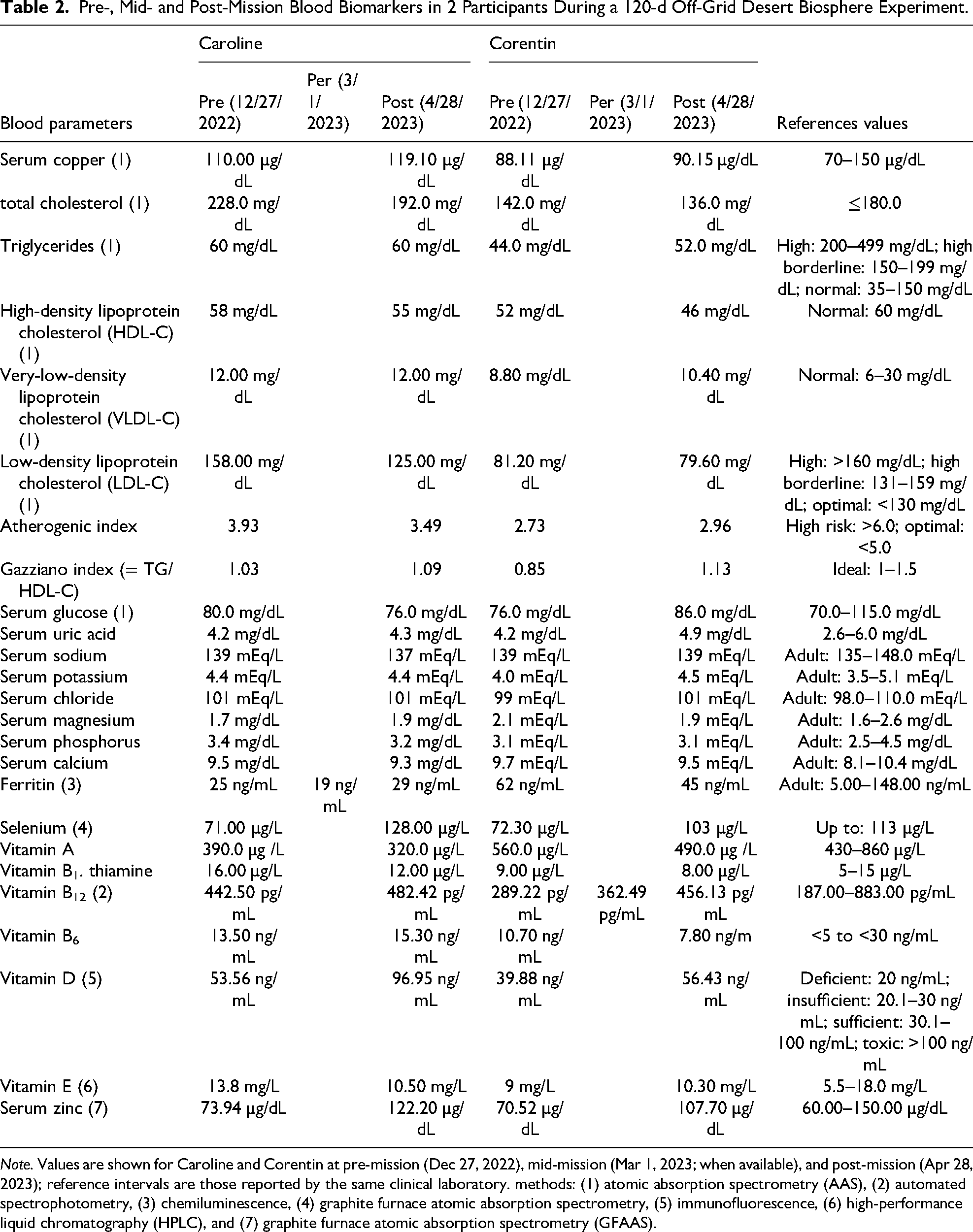
Note. Values are shown for Caroline and Corentin at pre-mission (Dec 27, 2022), mid-mission (Mar 1, 2023; when available), and post-mission (Apr 28, 2023); reference intervals are those reported by the same clinical laboratory. methods: (1) atomic absorption spectrometry (AAS), (2) automated spectrophotometry, (3) chemiluminescence, (4) graphite furnace atomic absorption spectrometry, (5) immunofluorescence, (6) high-performance liquid chromatography (HPLC), and (7) graphite furnace atomic absorption spectrometry (GFAAS).
For Caroline (29 y old), ferritin decreased from 25 ng·mL–1 pre-mission to 19 ng·mL–1 mid-mission before increasing to 29 ng·mL–1 post-mission, remaining within laboratory reference intervals at all time points. Vitamin B12 remained stable within normal range (442 → 488 pg·mL–1). Vitamins A, B1 (thiamine), B6, and E; copper; zinc; selenium; and electrolytes remained within laboratory reference ranges throughout the mission. Vitamin D increased from 53 ng·mL–1 pre-mission to 96.9 ng·mL–1 post-mission, consistent with sustained desert sunlight exposure. Lipid profile improved, and fasting glucose remained within normal limits.
For Corentin (39 y olf), ferritin remained within reference intervals (62 → 45 ng·mL–1). Vitamin B12 increased from 289 to 456 pg·mL–1 while remaining within normal range. Concentrations of vitamins A, B1, B6, and E; copper; zinc; selenium; and electrolytes remained within laboratory reference intervals across assessments. Vitamin D status was sufficient throughout the mission (39 → 56 ng·mL–1). Lipid profile remained favorable, and fasting glucose remained normal.
Overall, no biochemical marker of micronutrient deficiency or protein-energy undernutrition was identified in either participant during the 120-d deployment.
Body Composition and Physical Activity Context
Actimetry, daily logs, and field journals indicated a highly structured organization of physical activity throughout the mission. Actimetric data consistently showed a pronounced morning activity peak corresponding to mandatory operational tasks. In particular, both participants performed ∼30 min of daily physical activity dedicated to electricity generation, consisting of ∼10 min of upper-limb arm-crank ergometry and ∼20 min of rowing exercise primarily engaging the lower limbs and trunk. This routine, referred to as useful fitness, was performed every morning throughout the mission and constituted a nonnegotiable baseline workload.
Beyond this standardized routine, daily activities included recurrent physically demanding tasks related to freshwater production, bioponic agriculture, spirulina cultivation, insect and mushroom farming, habitat maintenance, and material handling. Field journals highlighted progressive optimization of task organization over time, with redistribution of workload across the day during periods of high thermal stress while maintaining consistent morning activity.
Over the mission period, both participants experienced a reduction of ∼2 kg in body mass, primarily attributable to decreased fat mass (Caroline 27.8 → 24.1%; Corentin 13.4 → 11.7%), whereas lean mass indices remained stable.
Maximal oxygen uptake (VO2 max), expressed relative to body mass (mL·kg−1·min−1), increased from 52.9 to 66.0 in Corentin and from 28.3 to 34.0 in Caroline. When expressed in absolute terms (L·min−1), VO2 max increased from 3.60 to 4.36 L·min−1 in Corentin and from 1.81 to 2.11 L·min−1 in Caroline, indicating that the observed increases were not solely attributable to reductions in body mass.
Ventilatory thresholds occurred at higher absolute workloads during post-mission testing compared with pre-mission assessment. Resting and exercise electrocardiograms remained within normal limits at both time points.
Given the observational design and absence of a control condition, these changes cannot be attributed to a specific causal factor. The observed increases in cardiorespiratory fitness occurred in the context of sustained daily physical workload and reduced fat mass but should be interpreted descriptively.
Sleep-Wake and Circadian Organization
Subjective sleep quality was rated as high in both participants (Caroline 9/10; Corentin 8/10), with low to moderate daytime sleepiness and fatigue reported across the mission. Both participants exhibited a morning-oriented chronotype at baseline.
Actigraphy confirmed a strictly diurnal organization, with no nocturnal work episodes recorded. Activity profiles displayed a bimodal pattern, with pronounced early-morning peaks (∼0600), particularly in Corentin. These peaks corresponded to operational tasks performed during cooler hours. Across the mission, daily peak activity timing advanced progressively, consistent with redistribution of workload toward earlier hours as ambient temperatures increased.
Absolute clock times of wake and sleep onset remained relatively stable throughout the mission. Caroline's mean bedtime was ∼2037, and Corentin's was 2035. Mean wake time was ∼0600 in Caroline and 0409 in Corentin. Differences between weekdays and weekends were negligible, indicating stable weekly scheduling.
Between January 1 and April 30, 2023 (24.48°N; Coordinated Universal Time−0700), sunrise advanced by 78 min and photoperiod increased by 144 min. When referenced to local ephemerides, a progressive seasonal shift was observed. Caroline's mean ΔWake (wake time − sunrise) shifted from −1 h 43 min in January to −0 h 25 min in April, whereas Corentin's mean ΔWake shifted from −1 h 57 min to −0 h 44 min. Relative to sunset, Caroline's ΔBed (sleep onset − sunset) decreased from +2 h 39 min to +0 h 33 min, and Corentin's ΔBed shifted from +3 h 14 min to +1 h 07 min. Thus, although clock times were stable, sleep-wake timing occurred progressively closer to the solar light-dark cycle.
Total sleep time averaged 8 h 16 min for Caroline and 7 h 00 min for Corentin. Across the mission, total sleep time decreased from early to late phases (−1 h 25 for Caroline; −1 h 40 for Corentin). Sleep efficiency remained generally high but showed a gradual decline across months.
Nonparametric circadian rhythm analysis metrics are presented in Table 3. Relative amplitude remained high throughout the mission in both participants (all values >0.90), indicating preserved day-night contrast. Interdaily stability decreased progressively, particularly for Corentin, whereas intradaily variability increased during mid-mission months before partially declining toward mission end.
Nonparametric Circadian Rhythm Analysis (NPCRA) Metrics Across the Mission. Relative Amplitude (RA), Interdaily Stability (IS), and Intradaily Variability (IV) for Each Participant at pre-Mission Baseline (W1) and for Each Mission Month (January–April 2023).
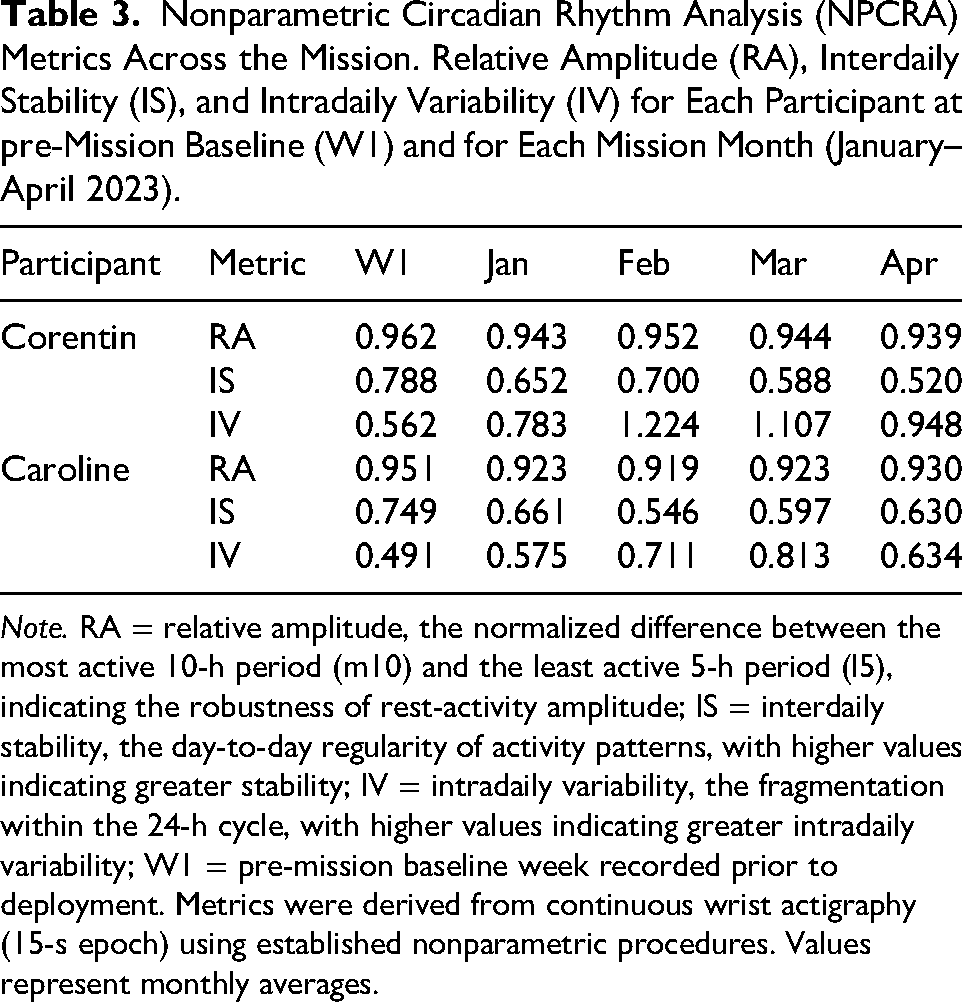
Note. RA = relative amplitude, the normalized difference between the most active 10-h period (m10) and the least active 5-h period (l5), indicating the robustness of rest-activity amplitude; IS = interdaily stability, the day-to-day regularity of activity patterns, with higher values indicating greater stability; IV = intradaily variability, the fragmentation within the 24-h cycle, with higher values indicating greater intradaily variability; W1 = pre-mission baseline week recorded prior to deployment. Metrics were derived from continuous wrist actigraphy (15-s epoch) using established nonparametric procedures. Values represent monthly averages.
In the absence of individual light exposure and core body temperature measurements, endogenous circadian phase cannot be inferred. Observed changes are therefore interpreted as behavioral organization relative to seasonal environmental constraints rather than intrinsic circadian phase shifts.
Mental Health, Affect, and Perceived Stress
Anxiety trajectories differed between participants but remained below clinical thresholds. Caroline showed elevated baseline trait anxiety with fluctuations during the mission and a clear reduction toward late mission and post-mission. Corentin showed a progressive decline in trait anxiety across the mission, with only a modest mid-mission inflection in state anxiety (Figure 5).
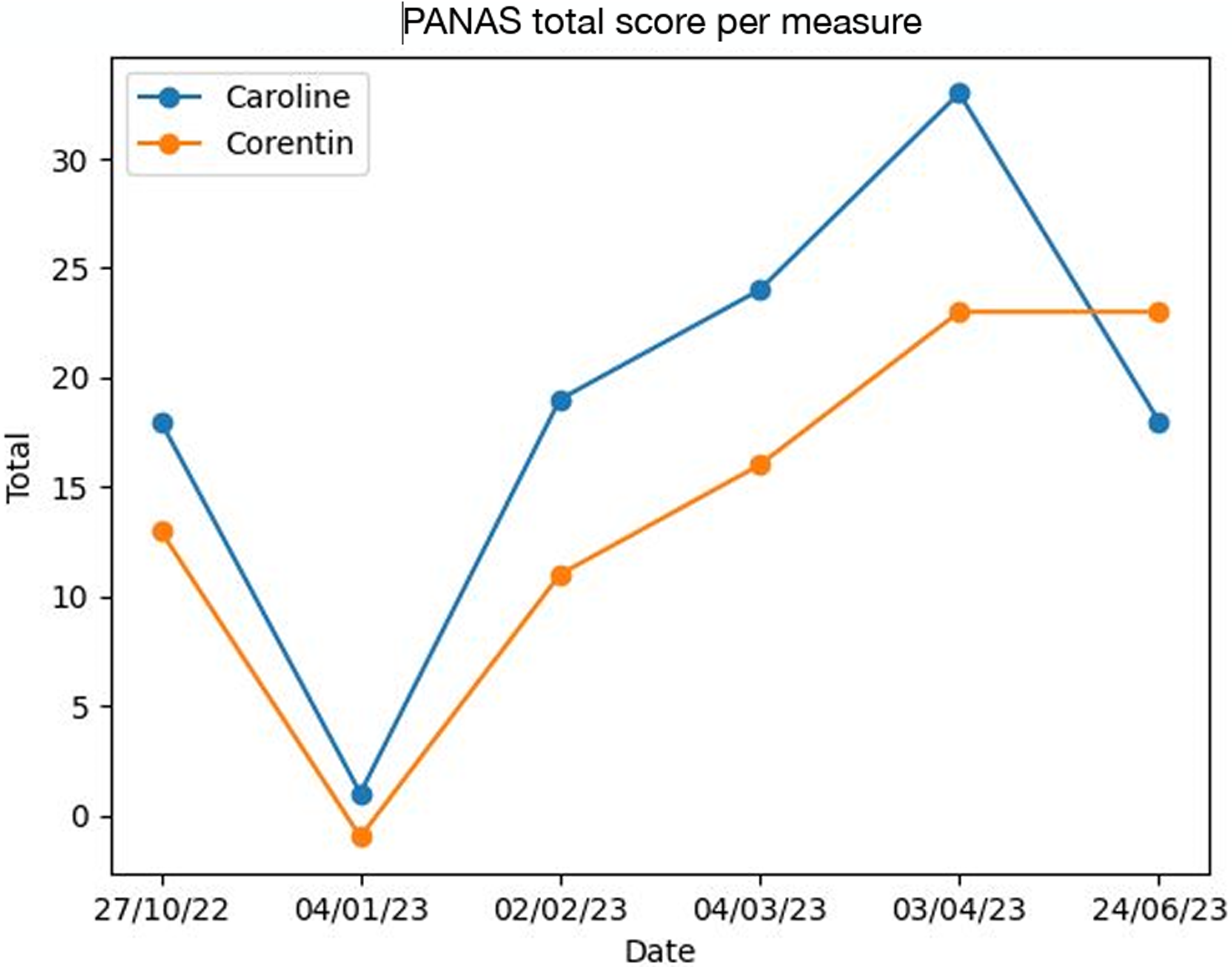
Change in Positive and Negative Affect Schedule (PANAS) over time.
PANAS scores indicated an overall positive affective balance. An initial dip at mission onset was followed by a progressive improvement during desert deployment. Item-level heatmaps showed a shift from less favorable affective profiles early in the mission toward lower negative affect and stable to moderate positive affect by late mission. Post-mission, Corentin maintained a positive plateau, whereas Caroline returned toward pre-mission levels.
Daily mood ratings showed relative stability in pleasure and arousal, whereas motivation followed an inverted-U-shaped trajectory: low pre-mission, higher during the mission, and reduced post-mission once the expedition objective was achieved. Variability was lower in Corentin and higher in Caroline, with the greatest fluctuations occurring during transition phases.
Discussion and Conclusion
This longitudinal field case study documented the physiologic, behavioral, nutritional, and temporal organization of 2 individuals living for 120 d in an off-grid low-tech desert habitat. The findings suggest that prolonged habitation under strong environmental constraint can be compatible with maintenance of physical and psychological health, provided that daily organization, workload structuring, and resource management remain functionally stable.
Hybrid Autonomy and Ecological Constraint
Importantly, this mission did not represent strict nutritional autonomy but rather a hybrid model combining exogenous staple provisioning with internal ecological subsystems. The biosphere therefore should not be interpreted as a fully closed system but as an integrative ecological exposure in which water, energy, food preparation, and daily workload were tightly constrained by environmental conditions.
Freshwater production from solar desalination showed substantial day-to-day variability, reaching ∼40 L·d−1 on the most productive days (mean 23.2±12.1 L·d−1; range 0–41.4 L·d−1 across 120 d recorded; Figure 3). When expressed per participant, mean daily use of fresh water corresponded to ∼6.1 L·d−1 per person, including cooking, hygiene, and hydroponic/agroecological subsystems. This low per-capita requirement reflects strong reliance on internal water recirculation. Water used for plant cultivation was continuously recirculated through root systems, contributing to nutrient uptake and biofiltration processes (phytoepuration).
Spirulina cultivation contributed to nutrient recycling, including nitrogen recovery from urine-derived inputs. Organic waste streams were processed through black soldier fly larvae systems, enabling biodegradation of organic residues. These larvae were subsequently used as feed for crickets, which entered the human food chain as a protein source. Thus, the ecological architecture of the system integrated water recycling, waste bioconversion, and food production within a tightly coupled metabolic loop.
Micronutrient Density Within a Hybrid Ecological System
Although locally produced foods contributed only ∼1% of total daily caloric intake, their micronutrient density was disproportionately high relative to energy contribution. Estimated in situ production provided roughly one quarter of adult iron and vitamin A requirements, nearly one quarter of folate needs, more than double the adequate intake for vitamin K, and approximately one third of copper requirements. Contributions to zinc, vitamin B6, vitamin E, and vitamin B12 were more modest, whereas vitamin D contribution from food sources was negligible.
These intake estimations were coherent with biochemical findings (Table 2). Across the 120-d mission, no laboratory marker indicated micronutrient deficiency or protein-energy undernutrition. Ferritin concentrations remained within reference intervals in both participants despite a transient mid-mission decrease in Caroline. Zinc, copper, selenium, and fat-soluble vitamin concentrations remained within physiologic ranges, and vitamin D levels increased in both participants, consistent with sustained ultraviolet exposure rather than dietary intake.
This pattern suggests that low-volume, high-density ecological production may play a stabilizing role in hybrid food systems operating under resource constraints. Even when caloric contribution is minimal, hydroponic leafy vegetables, algal cultivation, and insect-based subsystems can meaningfully contribute to micronutrient sufficiency while simultaneously supporting water recirculation and organic waste bioconversion. The nutritional role of these systems therefore extends beyond caloric autonomy and must be interpreted within a broader metabolic and ecological framework.
Importantly, these findings do not imply that in situ production alone would be sufficient to meet full nutritional requirements in the absence of external inputs. Rather, they demonstrate that hybrid systems integrating modest ecological production with stored staple foods can maintain biochemical stability over several months in a desert environment.
Figure 4 illustrates marked day-to-day variability in total caloric intake. This variability was not attributable to food scarcity per se but to operational constraints inherent to the low-tech context. Cooking depended exclusively on solar ovens, rendering preparation of staple foods directly dependent on daily insolation. During periods of reduced solar radiation, preparation of legumes and grains requiring prolonged cooking was limited, contributing to fluctuations in recorded daily energy intake. This structural coupling between solar energy availability and dietary intake represents a distinctive feature of off-grid systems.
Physiologic Resilience Under Constrained Conditions
Body mass decreased modestly (∼2 kg), primarily through fat mass reduction, whereas lean mass indices were preserved. VO2 max increased in both relative and absolute terms, but given the observational design and absence of training control, these changes cannot be causally attributed to the mission itself. Rather, they are compatible with sustained daily physical workload embedded within essential operational tasks.
Temporal Organization, Heat Mitigation, and Sleep Sufficiency
Although direct WBGT measurements were not available within the habitat, reconstructed environmental data indicated progressive seasonal warming. Redistribution of workload toward early morning hours is consistent with established heat-mitigation principles used in occupational and expedition medicine, where work-rest cycles are adjusted according to thermal stress indices such as WBGT. The observed temporal front loading of activity likely reduced peak heat exposure during midday periods.
Sleep-wake organization remained robust across the mission. Relative amplitude of rest-activity rhythms remained high (>0.90), and no evidence of circadian disorganization was observed. At 24°N latitude, sunrise advanced by 78 min and photoperiod increased by 144 min across the mission. Sleep timing occurred progressively closer to sunrise and sunset, reflecting behavioral scheduling within a moderately changing light-dark environment.
Total sleep time declined across the mission (−1 h 25 for Caroline; −1 h 40 for Corentin), coinciding with seasonal photoperiod extension and earlier workload scheduling. Despite this reduction, mean total sleep time remained within ranges commonly considered compatible with adult sleep recommendations, and subjective sleep quality remained high. No compensatory weekend rebound pattern was observed, and daytime functioning appeared preserved.
In the absence of individual light exposure and core body temperature measurements, endogenous circadian phase cannot be inferred; observed changes are therefore interpreted as behavioral organization relative to environmental constraints rather than intrinsic circadian phase shifts.
Psychological Stability
Prolonged off-grid living did not result in sustained anxiety escalation or affective deterioration. PANAS trajectories showed an initial reduction in positive affect during early mission weeks, followed by progressive recovery and stabilization. Overall affect balance remained positive throughout deployment. Motivation increased during the active mission phase and declined after mission completion, consistent with goal-directed engagement rather than chronic stress activation.
Implications for Wilderness and Environmental Medicine
These findings suggest that hybrid ecological systems integrating hydroponics, algal cultivation, and insect bioconversion may contribute to water conservation, waste recycling, and micronutrient support in arid or resource-limited settings. Structured temporal organization and early-day workload scheduling may mitigate thermal exposure. Such approaches may inform the design of prolonged medical outposts in desert regions, post-disaster deployments, refugee camp infrastructures, or humanitarian missions where water scarcity, waste management, and nutritional sufficiency represent critical constraints.
Limitations
The small sample size (N=2) and observational design preclude generalization. Environmental exposure was reconstructed from regional data and does not capture microclimatic variability within the habitat. Future studies integrating direct microclimatic measurements, light exposure, and core body temperature monitoring would refine interpretation.
Dual-Role Transparency
Two coauthors (CdC and CP) also served as study participants. To mitigate role-related bias, primary endpoints were objective and procedures were prespecified; data processing and statistical analyses were performed by investigators not involved in the field mission. All authors had full access to the data and approved the final manuscript.
Footnotes
Acknowledgments
We thank Corentin de Chatelperron (founder of the Desert Biosphere project) and Caroline Pultz for project administration, investigation, and field logistics during the 120-d mission.
Author Contribution(s)
Financial/Material Support
The Desert Biosphere mission was funded by the Brittany Region (Région Bretagne France), the City of Boulogne-Billancourt (France), the EXPLORE Foundation, ARTE, the Schneider Electric Foundation, and the Charles Léopold Mayer Foundation.
Declaration of Conflicting Interests
The authors declared no potential conflicts of interest with respect to the research, authorship, and/or publication of this article.
Data Availability
Deidentified data and analysis files are available from the corresponding author on reasonable request.
