The effects of nonlinear hysteretic damping on the post-critical behaviour of the visco-elastic Beck’s beam are discussed in this paper. The model consists of an inextensible and shear-undeformable cantilever beam, internally and externally damped, loaded at the free end by a follower force. Equations are derived in finite kinematics by taking as the configuration variable the rotation of the cross-section, instead of the usual deflection v of the beam axis, thus making the description of the contact internal actions simpler. The linear stability analysis is carried out and results of the literature are re-obtained. Then, a multiple-scale approach is developed in order to evaluate the nature, super- or subcritical, and the amplitude of the limit-cycle, occurring close to the Hopf critical load. The effects of the nonlinear damping on the amplitude of the limit-cycle are finally discussed for different linear damping coefficients.
One of the most fascinating paradoxes in mechanics is the ‘ Ziegler paradox’, or the ‘ destabilizing effect of damping’ [1–15], which occurs in linear stability analysis of non-conservative systems. According to this amazing phenomenon, when a small and positive-definite damping is added to a (discrete or continuous) linear circulatory system (i.e. a Hamiltonian system loaded by non-conservative positional forces, e.g. follower or friction forces), the critical load decreases undergoing a finite jump. The visco-elastic Beck’ s beam, that is, a cantilever beam, internally and externally damped, loaded at the tip by a follower force, represents a continuous mechanical prototype of such a paradox (see e.g. [1, 3, 5, 7, 13, 15]).
Several contributions in the literature have been devoted to discussing and, possibly, explaining the destabilization phenomenon. To this end, Bottema [16, 17] investigated the paradox from a geometrical perspective, by proving the existence of a singular surface in the space of damping and load parameters, called the ‘Whitney’s umbrella surface’ [18]. Seyranian and Kirillov furnished a justification of the paradox for discrete and continuous systems (see e.g. [13, 19]), grounding their analysis on a perturbation of the critical eigenvalues of the circulatory system. An ad hoc perturbation algorithm was developed by the authors of the present paper in [15, 20], where an unknown, marginally stable, subcritical undamped system was taken as starting point for the asymptotic expansion, instead of the known critical circulatory system.
However, all the previous papers concern linear systems, while very few contributions deal with the effect of the paradox in the nonlinear regime, notwithstanding that a large number of researchers have been attracted by this topic. Some relevant contributions can be found, for example in [21–29], with reference to discrete [21–23] or continuous [24–29] systems, respectively. The post-critical scenario of general discrete systems, in the presence of linear damping, is studied in [21] by applying the normal form theory; there, an example concerning Ziegler’s column is discussed. The stability of the trivial equilibrium position of Ziegler’s column, endowed with nonlinear hysteretic and cubic damping, is discussed in [22] via the second method of Lyapunov. The nonlinear dynamics of Ziegler’s column, linearly damped, is studied in [23] via a perturbation algorithm based on the multiple-scale method. The post-critical planar behaviour of the externally and linearly damped Beck’s beam, subjected to a distributed periodic lateral excitation and to a support excitation, is analysed in [24] by an asymptotic procedure, still based on the multiple-scale method. The nonlinear flexural–flexural oscillations of a non-conservative column, under the action of two independent loads, externally and linearly damped, are investigated in [25] by the multiple-scale method. A one-dimensional continuous cantilevered planar beam, equipped with a lumped visco-elastic device and loaded by a follower force, is analysed in [26–28]. In particular, the linear stability analysis is addressed in [26], where the existence of a rich bifurcation scenario, revealing divergence, Hopf, and double-zero bifurcations, is shown; moreover, a multiple-scale analysis, aimed at preliminarily investigating the double-zero bifurcation, is developed. An in-depth numerical and parametric investigation, grounded on asymptotic analysis, is carried out in [27, 28] on the same system, and several new results, including Hopf-divergence and both resonant and non-resonant double Hopf bifurcations, are presented. Finally, a multiple-scale-based algorithm is developed in [29], to analyse the effects of the linear damping on the double-zero bifurcation occurring in a visco-elastic Beck’s beam, loaded, in addition, by a dead axial force.
All the above-mentioned works concerning continuous systems were focused on several particular aspects of the nonlinear behaviour of the visco-elastic Beck’s beam, by leaving open some important questions, namely: (1) how does the linear damping affect the dynamics close to a (simple) Hopf bifurcation? More precisely, is the limit-cycle supercritical or subcritical? How large is its amplitude? (2) If the system is endowed with a suitable nonlinear damping, can this latter qualitatively and quantitatively modify the post-critical scenario?
This paper is a first attempt to give an answer to the previous questions. The analysis is carried out for a nonlinear visco-elastic Beck’s beam, endowed with a nonlinear hysteretic internal damping of Van der Pol type. Differently from what is usually done in the literature, where the deflection v is taken as the kinematic descriptor (here referred to as the v-formulation, see e.g. [1, 3, 24–29]), in the present paper the rotation of the cross-section is adopted as the kinematic variable (and, therefore, the procedure is called the -formulation). This choice makes the description of the contact internal actions simpler, although inertial actions require cumbersome expressions (the opposite occurs in the v-formulation). The equation of motion is found to be of integro-differential type. It is attacked by the multiple-scale method in the so-called direct form (see e.g. [26–30]), that is, avoiding any a priori discretization. Qualitative and quantitative information on the nonlinear mechanical behaviour is thus obtained.
The paper is organized as follows. In Section 2, the nonlinear model of the visco-elastic Beck’s beam is derived. In Section 3, the linearized problem is addressed and results of the literature concerning linear stability are re-obtained by the -formulation. In Section 4 the nonlinear problem is tackled using the multiple-scale method and numerical results are presented. Section 5 contains the main conclusions and two appendices furnish details.
2. Model
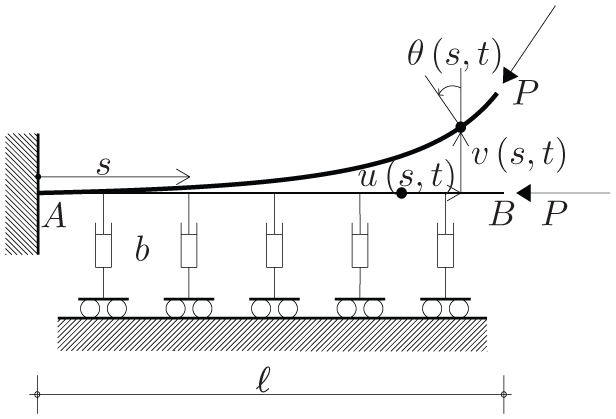
We consider the visco-elastic Beck’s beam represented in Figure 1. It is a planar beam, of length flexural stiffness EI, mass per unit length m, fixed at the end A, and loaded at the tip B by a follower force of intensity P. The material behaviour of the beam obeys the Kelvin–Voigt–Van-der-Pol rheological model (i.e. the beam is elastic and internally damped), where the elastic modulus is E, the linear viscous coefficient is and the nonlinear viscous coefficient is ; moreover, the beam lies on a purely viscous linear soil of constant b (simulating the external damping). The beam is assumed to be inextensible and shear-undeformable. When , the system reduces to the classical Beck’s beam [1, 3].
Visco-elastic Beck’s beam.
2.1. Kinematics
The beam is formulated as a one-dimensional polar continuum, lying in the plane spanned by the unit vectors , , of normal . The rotation of axis , undergone by the point P at the abscissa s and time t, makes the local three-orthogonal reference basis , attached to P, match the local current basis . Due to unshearability, is tangent to the centreline.
The curvature of the beam
is introduced as a measure of strain, where the dash denotes differentiation with respect to s. By enforcing inextensibility, it follows that
where , are scalar fields describing longitudinal and transverse displacements of the beam axis, respectively. Displacements must fulfil the boundary conditions at the clamp:
By integrating equations (2) with the boundary conditions (3a,b), are rewritten as (integral) functions of , namely:
2.2. Equilibrium
The vector form of the balance equations reads [31]
where the inextensibility condition has been accounted for and where is the force–stress vector, is the couple-stress vector, and and are external loads and couples per unit length, respectively. By representing the stress vectors in the basis, it follows that
where is the bending moment and , are extrinsic components of {\bf{t}}, having the meaning of Lagrangian multipliers [31].
The representation of the loads in the basis is
Throughout the article, it is assumed that no external distributed couples are applied to the beam, that is, .
The mechanical boundary conditions at the free end B are
Integration of the first two equations (8) under the boundary conditions (9a,b) supplies
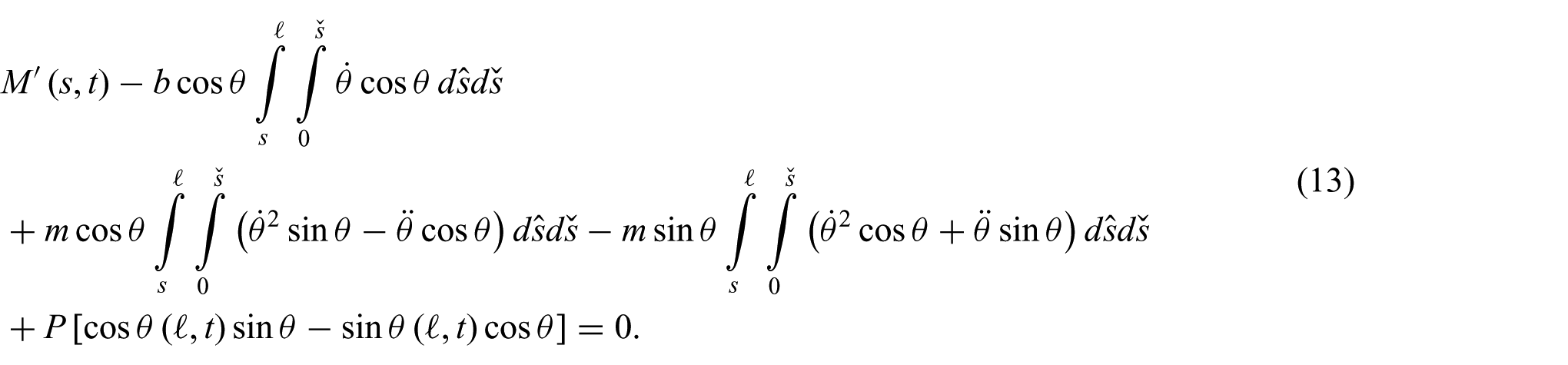
Finally, by making use of equations (10), the moment balance equation (8c) is written as
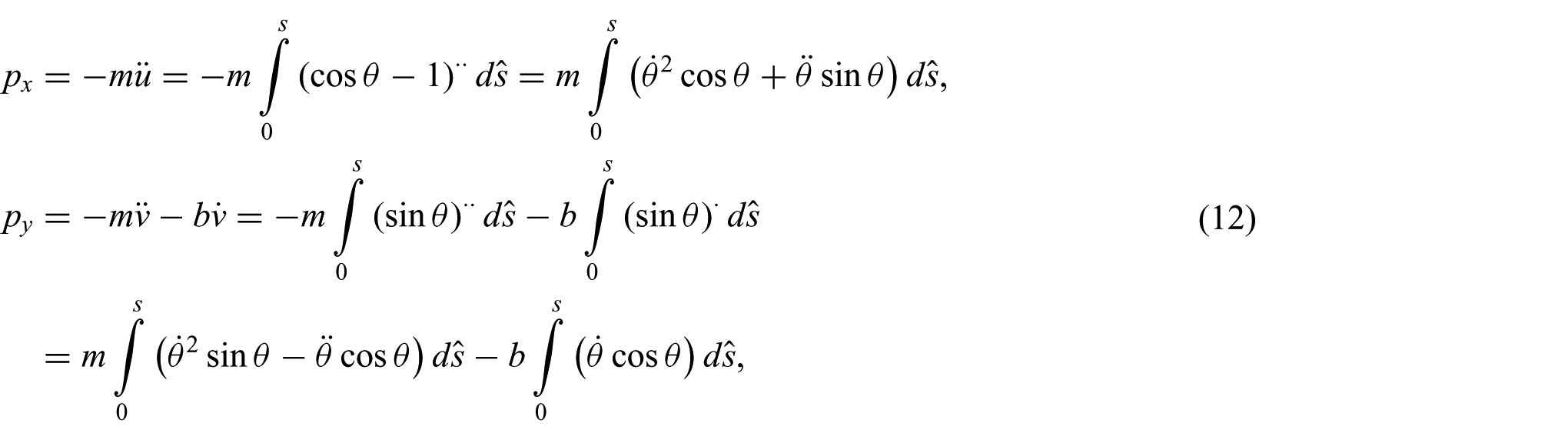
As regards the external loads, these are of inertial and (external) damping nature. They read:
where the dot denotes differentiation with respect to t and in which use of equations (4) has been made. Therefore, the moment balance equation (11) reads:
2.3. Constitutive law
The material behaviour of the beam is here taken as described by the linear visco-elastic Kelvin–Voigt model, coupled with a nonlinear hysteretic dashpot, ruled by a Van-der-Pol-like law (see e.g. [22, 32]). Therefore, the constitutive behaviour of the beam is governed by
This equation must be complemented with the two, not yet used, boundary conditions (3c), (9c):
To put the problem into non-dimensional form, the following quantities are introduced:
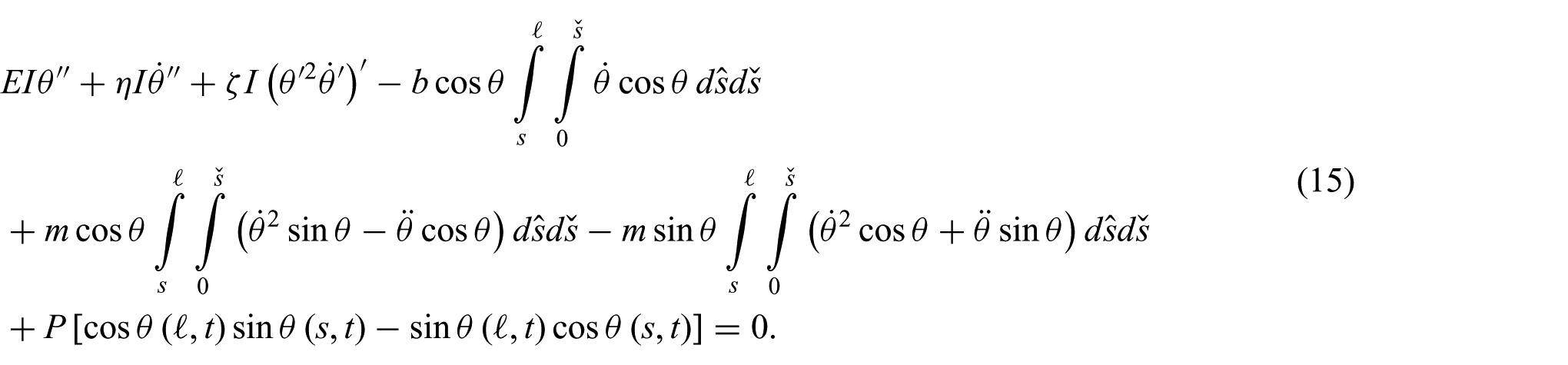
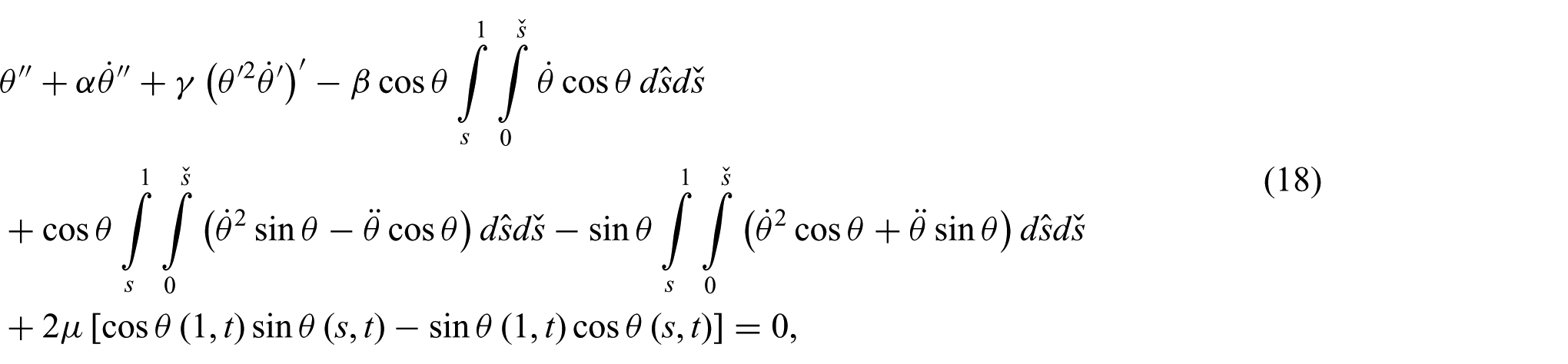
where , are the internal and external linear damping, respectively, is the nonlinear hysteretic damping and is the load parameter. The balance equations are then rewritten as (tilde removed)
and the boundary conditions are rewritten as
3. Linear stability analysis
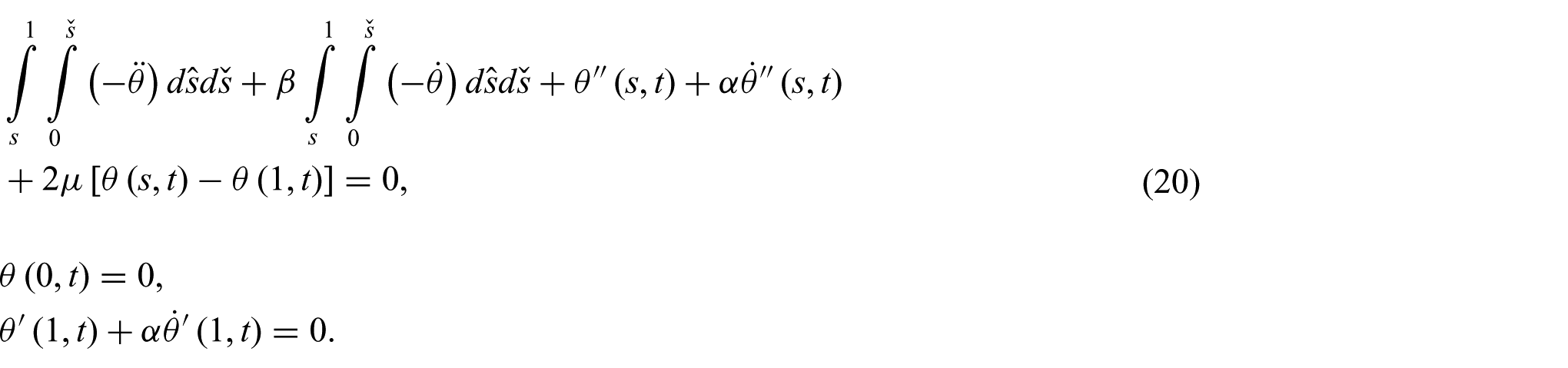
Bifurcation analysis calls for evaluation of the eigenvalues and (right) eigenvectors of the linear counterpart of equations (18), (19), which reads:
Since the problem is not self-adjoint, due to the presence of the follower force, the (left) eigenvectors of the adjoint problem must also be determined (see e.g. [26–29]). Details on the evaluation of right and left eigenvectors are given in Appendix A.
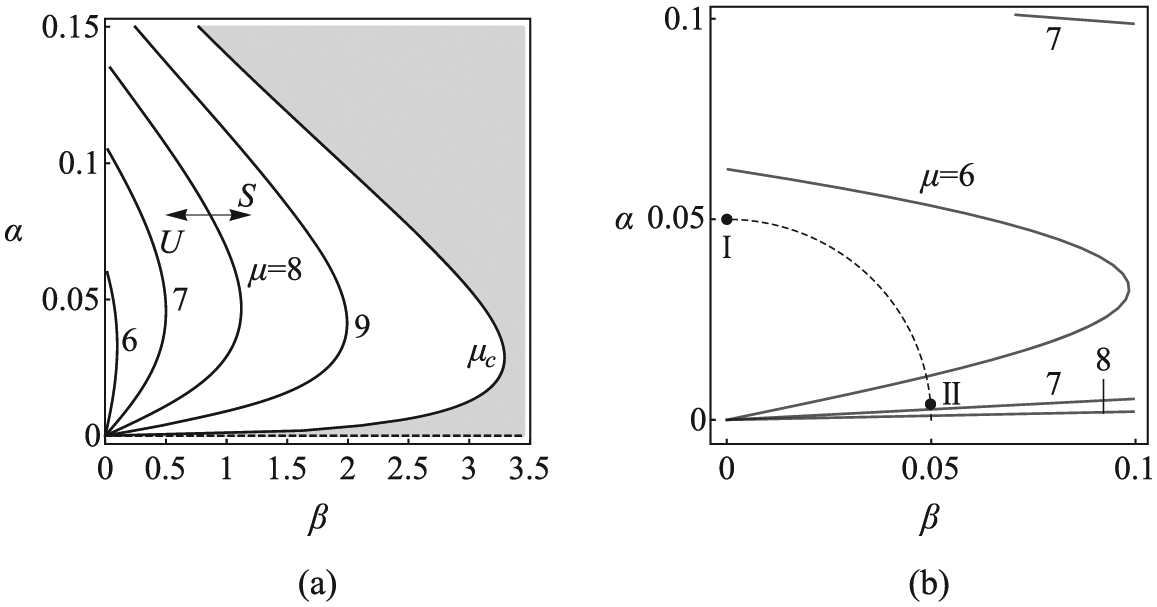
The linear stability analysis carried out using the -formulation gives the same results, of course, as the v-formulation, well known in the literature (see e.g. [13, 15]). They are briefly summarized here. There exists a critical surface in the -parameter space, which separates the stable states of the beam from the unstable ones. Figure 2(a) shows the contour lines of this surface, obtained by numerically solving the exact characteristic equation and determining the locus at which a couple of complex eigenvalues crosses the imaginary axis. The points belonging to the surface represent bifurcation states: for a given contour line, systems which are on its left side are unstable (region marked with U in Figure 2(a)), while those on its right side (region marked with S in Figure 2(a)) are stable. In Figure 2(b) a close-up of the damping plane close to the origin, which will be useful later, is displayed.
Linear stability diagram for the visco-elastic Beck’s beam: (a) -isolines: S is a stable region, U is an unstable region; (b) close-up of the damping plane close to the origin and case studies I and II.
It is important to remark that the points of the surface belonging to the -axis represent a family of marginally stable undamped systems (); for this family, a so-called ‘circulatory’ or ‘reversible’ Hopf bifurcation (see e.g. [12, 13, 15, 20, 33]) takes place at the singular point (the index c having the meaning ‘circulatory’). It is apparent that, when a vanishingly small damping is added to the family of undamped systems, a finite lowering of the critical load, from to (the index d having the meaning ‘damped’), occurs; therefore, damping is detrimental in (almost) the whole -plane. In particular, ranges from a minimum value , below which the beam is stable for any combination of the damping coefficients, and [15]. As an exception to the destabilization rule, (i.e. no internal damping) represents an optimal direction (dashed line in the figure) in the damping parameter plane, for which . It is concluded that the detrimental effect on the stability of Beck’s beam is produced by the internal damping (as already found in [3]). Finally, the region filled in with grey in Figure 2(a) represents the stabilizing region, that is, the region of the damping parameter plane in which (a sufficiently large) linear damping has a stabilizing effect on the visco-elastic Beck’s beam.
4. Nonlinear analysis
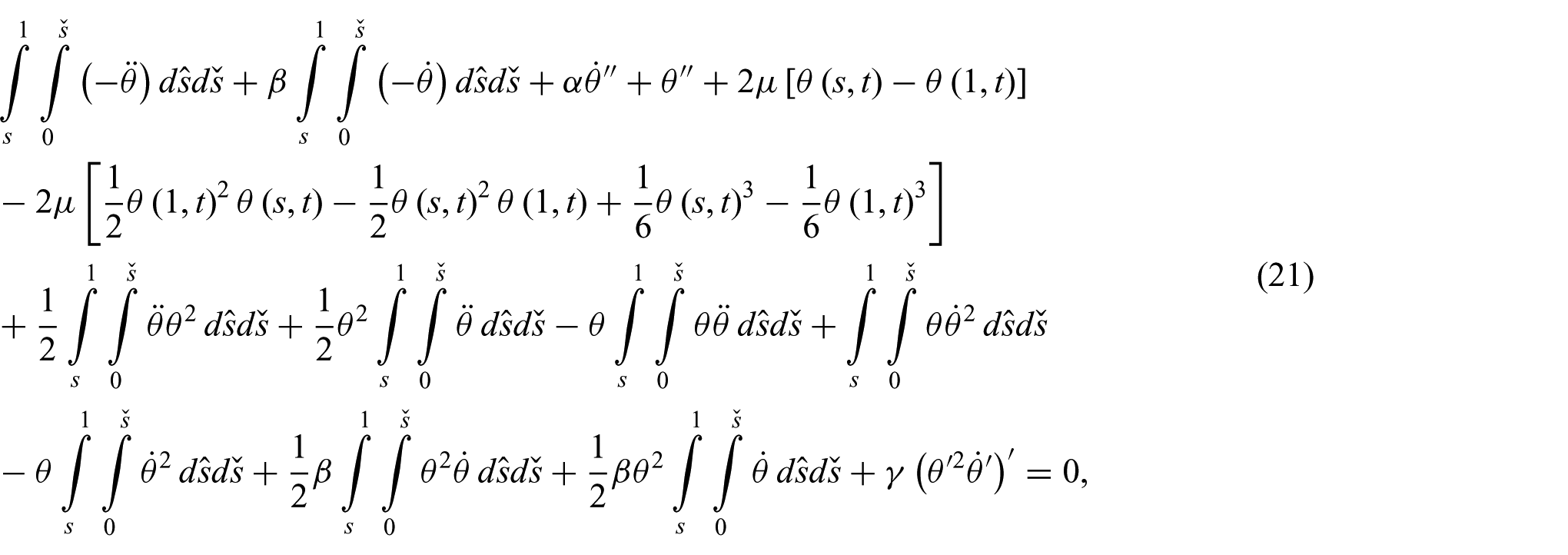
The multiple-scale method [34] is here applied to derive the bifurcation equations in the so-called direct form, that is, by dealing with the integro-partial differential equations and boundary conditions. To this end, the equations (18), (19) are Taylor-expanded up to cubic terms as
and
4.1. Bifurcation equations
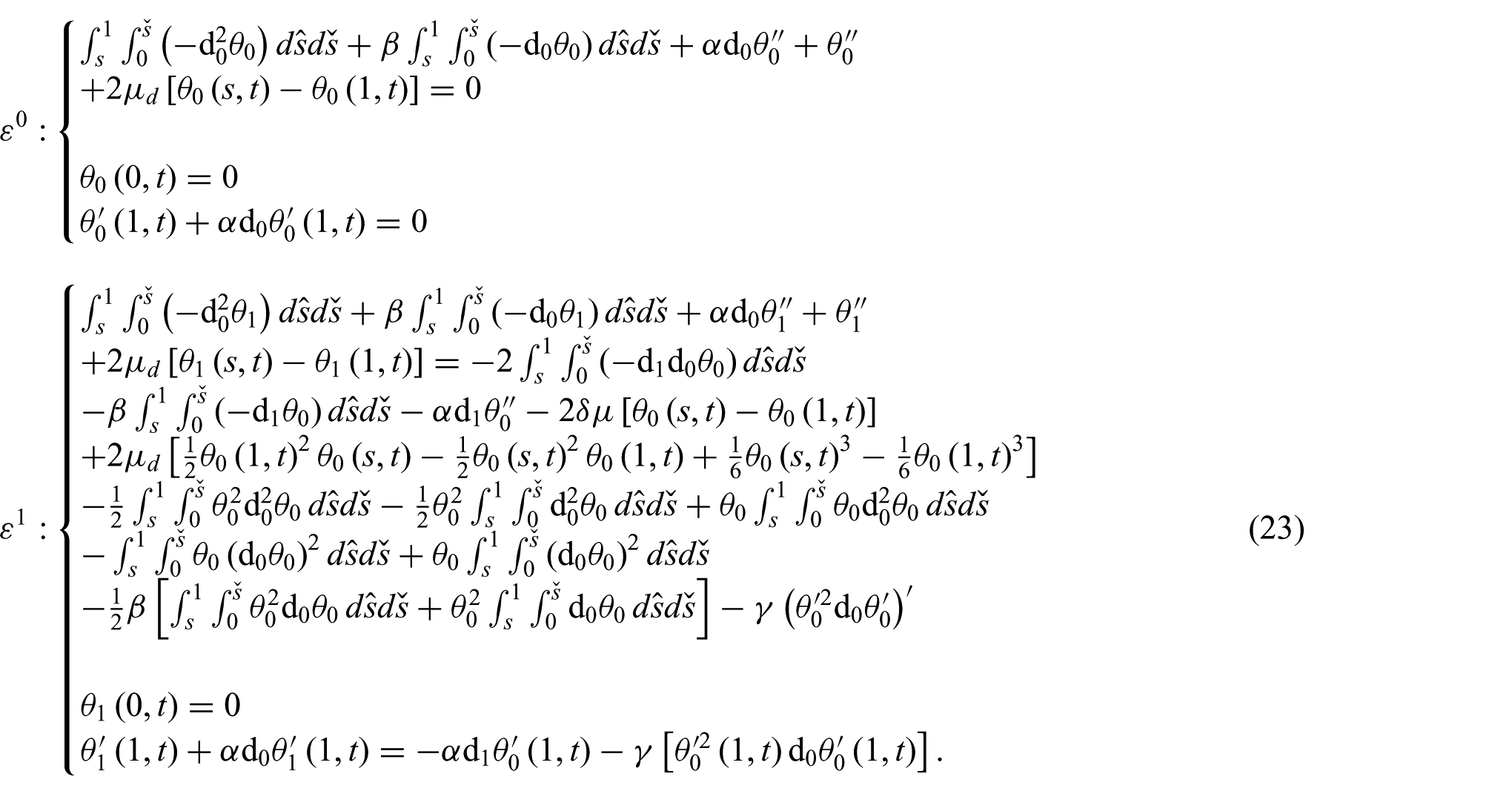
A critically loaded and damped system, undergoing a simple Hopf bifurcation at , is taken as starting point for the asymptotic analysis. First, the rescaling and is performed, where is a perturbation parameter (to be reabsorbed at the end of the procedure) and is the increment of load measured from the bifurcation. Then, several independent time scales are introduced, namely , so that , . Finally, the unknown is expanded in integer series of , namely . By substituting in equations (21), (22) and collecting terms with the same power of , the following perturbation equations (tilde removed) are obtained:
Equations (23) have to be solved in cascade. The solution of the -order problem reads (remember equations (20)):
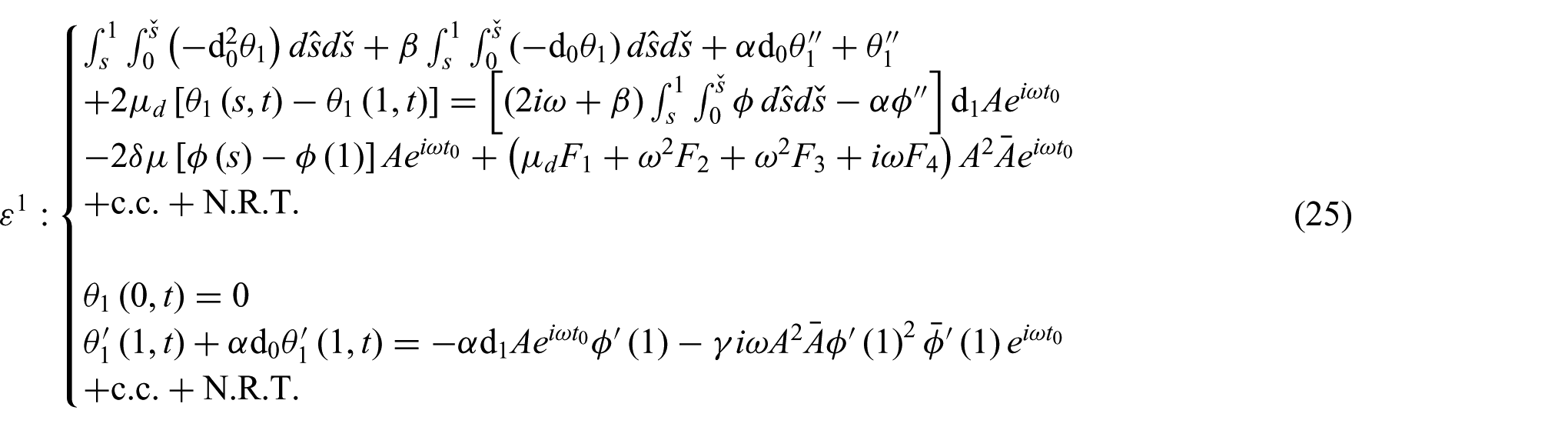
where denotes complex conjugate, is the unknown (complex) amplitude and is the eigenpair of the right eigenvalue problem (see equation (34) in Appendix A), candidate to become unstable (the first mode, in the successive numerical analysis). By substituting equation (24) into the -order problem, this latter reads:
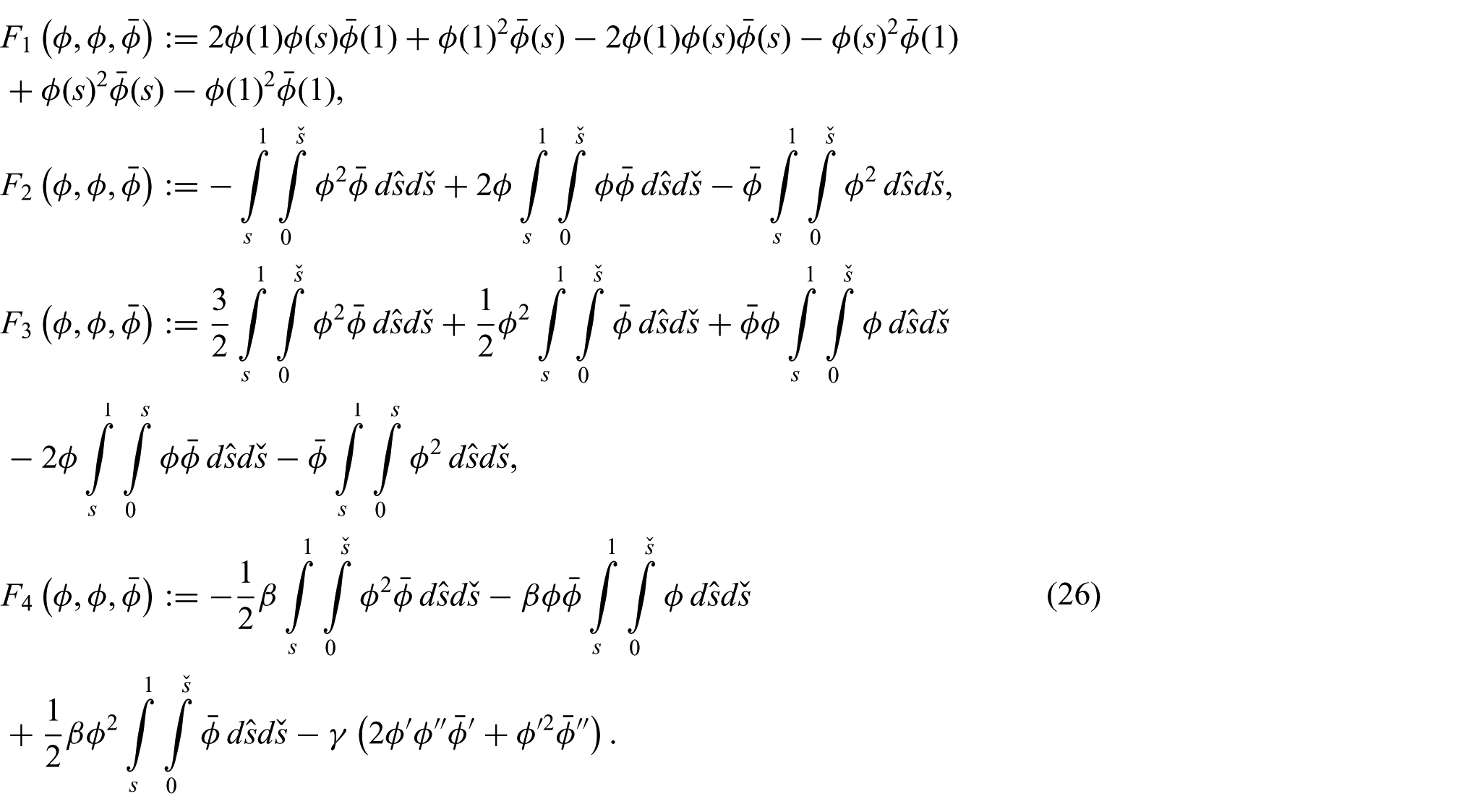
in which denotes non-resonant terms; moreover, the following trilinear functions with respect to their arguments, namely , , have been introduced:
Equation (25) is a non-homogeneous problem in the unknown . In order for it to be solvable, a compatibility (or solvability) condition must be invoked (see equation (45) in Appendix A). By solving this latter with respect to the time derivative of the amplitude, the (complex) bifurcation equation follows (also called amplitude modulation equation (AME) in the framework of nonlinear dynamics):
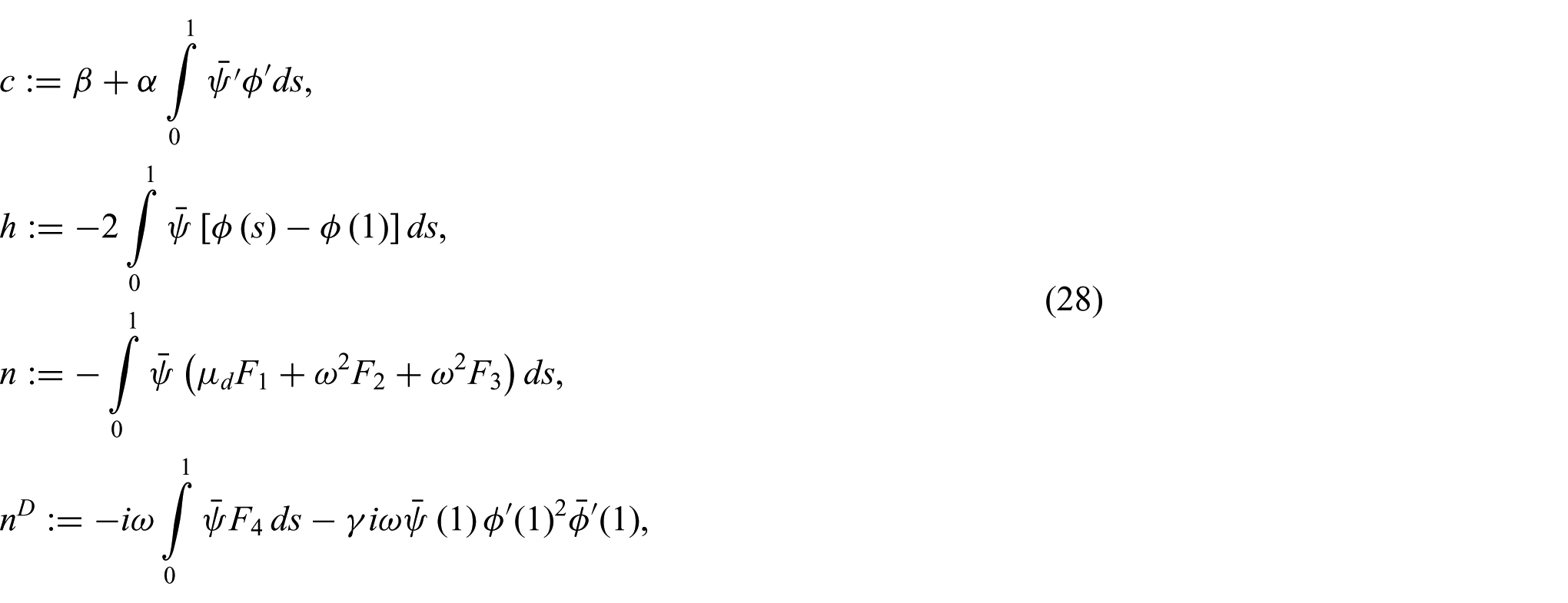
Here, the coefficients listed below have been introduced:
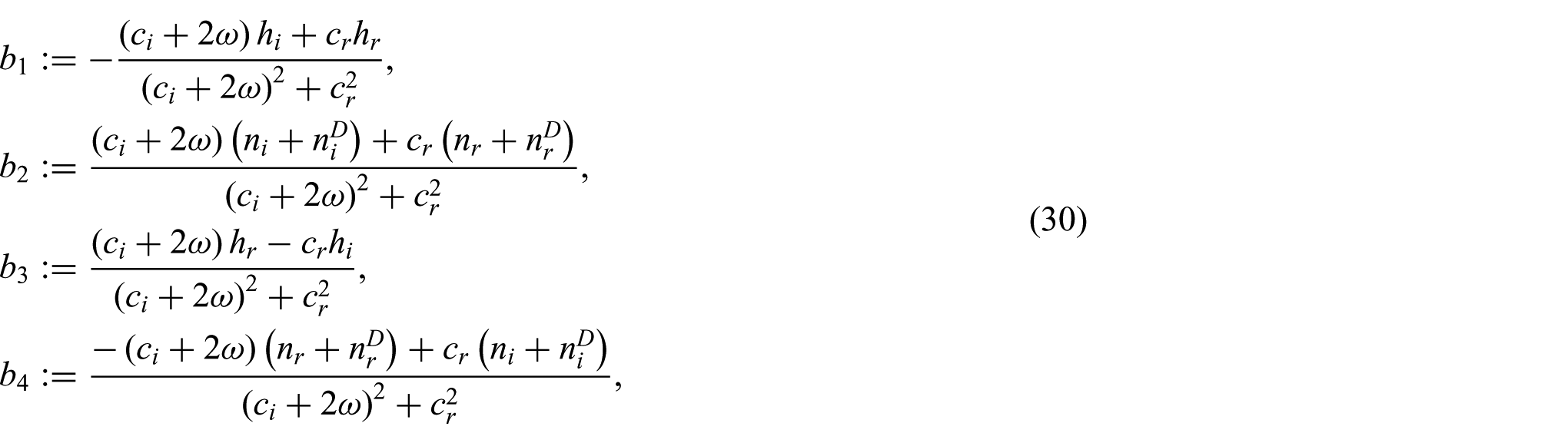
and the normalization condition has been used. Among the coefficients (28), n takes into account elastic and inertial nonlinear contributions and for the damping. Finally, by reabsorbing the -parameter, coming back to the true time and quantities, and separating real and imaginary parts, equation (27) is rewritten as
where is the modulus of A and is the argument (i.e. ), referred to as the (real) amplitude and phase, respectively. Moreover, the following coefficients have been introduced:
in which , , , , , , , .
Steady solutions of equation (29), namely and , corresponding to periodic motions for the original system, are given by
where is the frequency correction and .
4.2. Qualitative analysis
The amplitude–load relationship (31a), although is in closed form, does not allow us to gain qualitative information in a simple way, since the coefficients , depend on the parameter in a complicated manner, through of equations (30a,b) and (28). However, to make the problem simpler, use can be made of the fact that linear damping is small. Accordingly, the (complex) eigenvectors , which appear in definitions (28) can be more conveniently expressed via an eigenvalue sensitivity analysis of the undamped () circulatory system, loaded at the same extent . The relevant analysis (see Appendix B for the details) furnishes , , , where is an undamped frequency, , are the associated (real) right and left eigenvectors (here subscript u denotes undamped), and , are small (real) corrections; consistently, . By introducing these quantities in equation (31a), we obtain
where has been defined in equation (55e) of Appendix B; it depends only on the nonlinear damping parameter , that is, . Moreover, the following definitions have been introduced:
where the real quantities , , , and have been defined in equations (55) and (57) of Appendix B. It has been checked numerically, in the range of the considered parameters, that and .
The following important conclusions are drawn.
When the nonlinear hysteretic damping is zero, then ; therefore, follows from equation (32), in other words, a large-amplitude limit-cycle occurs; moreover, it is supercritical (and consequently stable).
When the nonlinear hysteretic damping is different from zero, since and of order one, the amplitude of the steady solution is , in other words, a small-amplitude limit-cycle manifests itself; it is supercritical (stable) if and subcritical (unstable) if .
4.3. Numerical results
Numerical results are discussed here, with the aim of highlighting crucial aspects of the nonlinear behaviour of the visco-elastic Beck’s beam. Two slightly linearly damped beams are chosen, which are labelled with a dot and a mark, I and II, respectively, in Figure 2(b). The damping coefficients have been taken on a circle of radius 0.05 in the damping parameter plane (denoted by a dashed line in Figure 2(b)), by varying the angle between the damping direction and the -axis, namely rad in case I (-axis) and rad in case II. It is important to remark that, in both the case studies, the first two eigenvalues of the beam are well separated, so that a simple Hopf bifurcation manifests itself. The analysis along a direction close to the optimal one, that is, when and is small, where the first two eigenvalues are close to each other (thus entailing interaction), will be not analyzed here.
By summarizing, the two case studies are as follows.
Case study I: , , for which : here, the linear damping possesses a strong destabilizing effect, since it reduces the critical load by about 42%.
Case study II: , , for which ; here the linear damping is less destabilizing, since it reduces the critical load by about 34%.
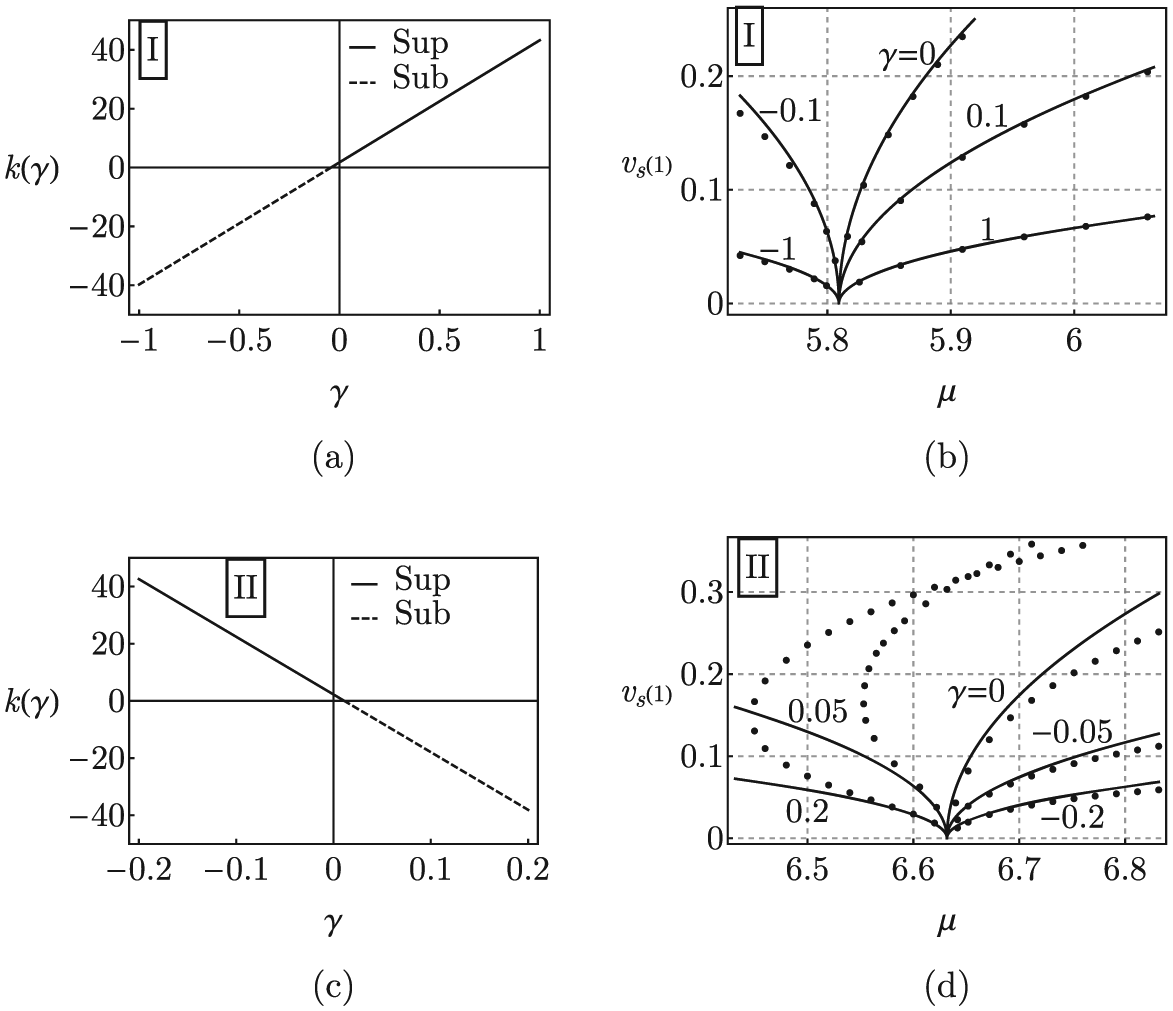
The bifurcation diagrams, obtained through the asymptotic solution equation (31), are displayed in Figure 3(a) and (c) for the case studies I and II, respectively. In particular, the coefficient is plotted versus the nonlinear hysteretic damping parameter : due to the linear dependence of k on , the plot of is a straight line external to the origin. Therefore, there exists a critical value of , in case I and in case II, for which . This critical value separates subcritical () from supercritical () bifurcations. In case I, when , the bifurcation is supercritical (denoted with a continuous line and ‘Sup’ in the subfigures); when it is subcritical (denoted with a dashed line and ‘Sub’ in the subfigures). In case study II, the behaviour is reversed, in other words, larger nonlinear damping triggers subcritical bifurcation, and smaller nonlinear damping triggers supercritical bifurcations.
Bifurcation diagrams for the two case studies: (a), (c) qualitative representation of the limit-cycle in the -plane for the case studies I and II, respectively; (b), (d) stationary solution in terms of the tip displacement, vs when , for the case studies I and II, respectively. and continuous lines indicate supercritical bifurcation; and dashed lines indicate subcritical bifurcation.
The previous results can also be recognized in the bifurcation diagrams , where is the amplitude of the deflection at the tip of the beam. Plots in Figure 3(b) and (d) show these bifurcation diagrams for different values of , for the case studies I and II, respectively. The asymptotic results (continuous lines in the two subfigures) have been compared with (benchmark) numerical solutions (black dots in the subfigures), obtained via numerical integrations of discretized equations of motion. These have been obtained via the Galerkin method, in which the first four modal eigenfunctions of the undamped cantilever have been used. It is seen that, when , that is, no hysteretic damping is present, the beam responds in both the cases with a supercritical and large-amplitude limit-cycle, according to the qualitative discussion of the previous section. When , that is, hysteretic damping of an appropriate sign and magnitude is introduced in the beam, the amplitude of the limit-cycle is smaller.
In case study I, when , supercritical limit-cycles occur, whose amplitudes, for a given , decrease if the nonlinear damping increases; when (values of were limited here, so the combined linear and nonlinear internal damping will keep a dissipative character), the beam responds with subcritical limit-cycles, whose amplitudes decrease if increases. A good quantitative accordance of the asymptotic results in case I with the benchmark Galerkin-type solutions has been found.
In case study II, when , subcritical limit-cycles occur, whose amplitudes, for a given , decrease when the nonlinear damping increases; when , supercritical limit-cycles manifest themselves and their amplitudes, for a given load exceeding the critical value , decrease when increases. In this case a good quantitative accordance of the asymptotic results with the numerical solution is found only when : indeed, differently from what happens in case study I when , the beam responds with subcritical limit-cycles which, after a turning point, become supercritical (see the Galerkin solution points in Figure 3(d)), in other words, a so-called ‘hard loss of stability’ bifurcation (see e.g. [35, 36]) occurs. It is apparent that for example when and are considered in case II, the beam manifests a supercritical limit-cycle, whose amplitude is greater than that occurring when , in other words nonlinear hysteretic damping has a detrimental effect on the post-critical behaviour of the beam. Finally, it should be remarked that the hard loss of stability cannot be caught by the first-order asymptotic analysis developed here, so a second-order analysis has to be applied.
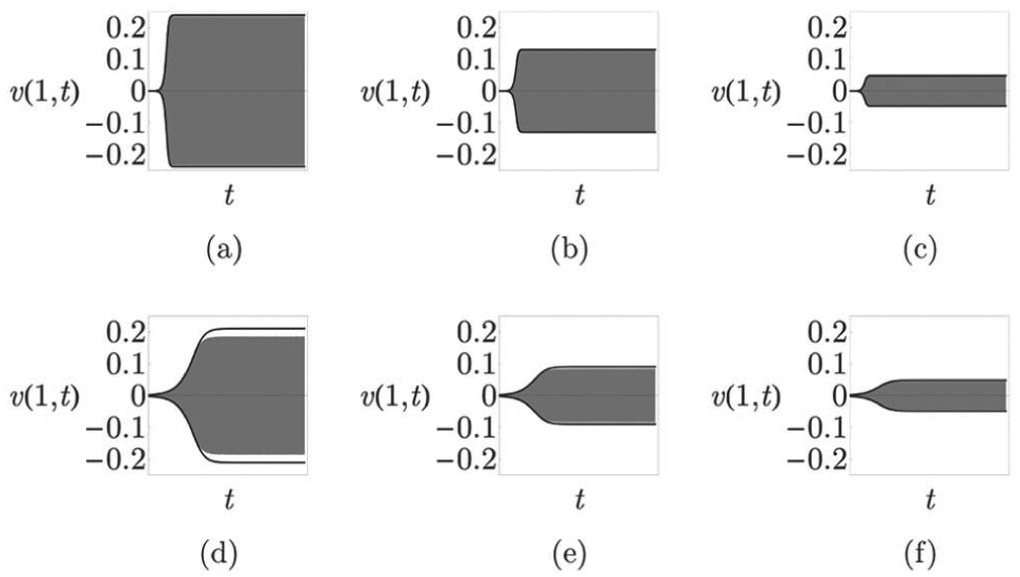
In conclusion, Figure 4 shows a good qualitative and quantitative agreement between the time-histories of the deflection at the tip , obtained via the benchmark Galerkin-type solution (grey curves in the subfigures) and numerical integrations of the bifurcation equations (29) (black curves in the subfigures). Figure 4(a) to (c) refers to case study I, when , that is, , and (Figure 4(a)), (Figure 4(b)), (Figure 4(c)). Figure 4(d) to (f) refers to case study II, when , that is, , and (Figure 4(d)), (Figure 4(e)), (Figure 4(f)).
Time histories of the displacement of the tip obtained with the Galerkin method (grey curves) compared with multiple-scale solutions (black curves), when for (a), (b), (c) case study I, when , , , respectively; (d), (e), (f) case study II, when , , , respectively.
5. Conclusions and perspectives
The post-critical behaviour of the visco-elastic Beck’s beam, endowed with a Van-der-Pol-like nonlinear hysteretic internal damping and modelled in finite kinematics via the -formulation, has been addressed in this paper. To this end, a suitable multiple-scale algorithm has been applied to the integro-differential equation of motion, and the relevant bifurcation equations, governing the behaviour of the beam around the Hopf bifurcation point, have been obtained and analysed.
The amplitude of the limit-cycle, as furnished by the multiple-scale method, has been qualitatively discussed by expressing the complex eigenvectors of the damped system as perturbations of the real eigenvectors of the undamped system loaded at the same load. The procedure enabled obtaining simpler formulas, able to highlight the main effects of the nonlinear damping on the post-critical behaviour of the beam. The main findings are:
in the absence of nonlinear damping a large-amplitude and supercritical limit-cycle manifests itself;
in the presence of nonlinear damping a small-amplitude limit-cycle occurs, which can be supercritical or subcritical depending on the balance between the nonlinear damping effect on one side, and both elastic and inertial nonlinear contributions on the other.
Two slightly damped beams, for which linear damping produces (I) a strong and (II) a medium destabilizing effect, respectively, have been considered for numerical purposes. It has been shown that, for each case, there exists a proper critical nonlinear damping value, which divides the supercritical states from the subcritical ones. The two damped beams exhibit opposite behaviour when the nonlinear damping coefficient exceeds this critical value since, in case I, supercritical limit-cycles occur while, in case II, subcritical limit-cycles manifest themselves. Moreover, it has been found that the amplitudes of both supercritical and subcritical limit-cycles can be reduced, at least close to the Hopf critical load, by increasing (in modulus) the nonlinear damping. Therefore, it is concluded that nonlinear hysteretic damping entails stabilizing as well destabilizing effects on the post-critical behaviour of the visco-elastic Beck’s beam. This latter seems to represent a paradoxical phenomenon also in the nonlinear range.
An overall good accordance between the asymptotic results and a benchmark Galerkin-type solution has been observed in the numerical simulations, except for case study II, where the nonlinear damping exceeds its critical value, due to the occurrence of the hard loss of stability bifurcation.
Finally, it is believed that the findings discussed in the present paper can represent a first step towards the challenging task of a proper design of nonlinear damping in the visco-elastic Beck’s beam, targeted to improve its bifurcation performances. However, much work has to be done in this direction; it can be summarized in the following points: (i) the analysis of the post-critical scenario close to the optimal direction, which requires a suitable asymptotic algorithm based on the perturbation of defective eigenvalues; (ii) an enhancement of the presented multiple-scale analysis, in which the asymptotic expansion is carried out up to the second order, with the aim of capturing the turning points of the hard loss of stability; (iii) the development of experimental tests able to validate the theoretical findings.
Footnotes
A. Eigenvalue analysis
Right and left eigenvectors, used in the linear stability analysis discussed in Section 3, are determined here.
B. Asymptotic analysis of the subcritically loaded beam
An undamped visco-elastic Beck’s beam is considered, loaded at , with . The eigenvalue sensitivities of the circulatory system are sought for when a small damping is introduced as a perturbation. To this end, the algorithm presented in [15] for linear continuous circulatory systems is followed.
Funding
This work was supported by the Italian Ministry of University and Research (MIUR), under the PRIN10-11 program (project number 2010MBJK5B).
References
1.
BeckM.Die Knicklast des einseitig eingespannten, tangential gedrückten Stabes. Z Angew Math Phys1952; 3(3): 225–228.
2.
ZieglerH.Die Stabilitätskriterien der Elastomechanik. Ingen Archiv1952; 20(1): 49–56.
3.
BolotinVV.Nonconservative problems of the theory of elastic stability. New York, NY: Macmillan, 1963.
4.
HerrmannGJongIC.On the destabilizing effect of damping in nonconservative elastic systems. J Appl Mech1965; 32(3): 592–597.
5.
HerrmannG.Stability of equilibrium of elastic systems subjected to non-conservative forces. Appl Mech Rev1967; 20: 103–108.
6.
LeipholzH.Über den Einfluss der Dämpfung bei nichtkonservativen Stabilitätsproblemen elastischer Stabe. Ingen Archiv1964; 33(5): 308–321.
7.
PlautRHInfanteEF.The effect of external damping on the stability of Beck’s column. Int J Solid Struct1970; 6(5): 491–496.
8.
PlautRH.A new destabilization phenomenon in nonconservative systems. Z Angew Math Mech1971; 51(4): 319–321.
9.
WalkerJA.A note on stabilizing damping configurations for linear nonconservative systems. Int J Solid Struct1973; 9(12): 1543–1545.
10.
BanichukNVBratusASMyshkisAD.Stabilizing and destabilizing effects in non-conservative systems. J Appl Math Mech1989; 53(2): 158–164.
11.
KounadisAN.On the paradox of the destabilizing effect of damping in non-conservative systems. Int J Nonlin Mech1992; 27(4): 597–609.
12.
SeyranianAMailybaevA.Multiparameter stability theory with mechanical applications, vol. 13. Singapore: World Scientific, 2003.
13.
KirillovONSeyranianAP.The effect of small internal and external damping on the stability of distributed non-conservative systems. J Appl Math Mech2005; 69(4): 529–552.
14.
KirillovONVerhulstF.Paradoxes of dissipation-induced destabilization or who opened Whitney’s umbrella?Z Angew Math Mech2010; 90(6): 462–488.
15.
LuongoAD’AnnibaleF.On the destabilizing effect of damping on discrete and continuous circulatory systems. J Sound Vib2014; 333(24): 6723–6741.
16.
BottemaO.On the stability of the equilibrium of a linear mechanical system. Z Angew Math Phys1955; 6: 97–104.
17.
BottemaO.The Routh-Hurwitz condition for the biquadratic equation. Indaga Math1956; 18: 403–406.
18.
WhitneyH.The general type of singularity of a set of 2n− 1 smooth functions of n variables. Duke Math J1943; 10: 161–172.
19.
KirillovON.A theory of the destabilization paradox in non-conservative systems. Acta Mech2005; 174(3–4): 145–166.
20.
LuongoAD’AnnibaleF.A paradigmatic minimal system to explain the Ziegler paradox. Contin Mech Thermodyn2015; 27(1–2): 211–222.
21.
O’ReillyOMalhotraNNamachchivayaN.Some aspects of destabilization in reversible dynamical systems with application to follower forces. Nonlin Dyn1996; 10(1): 63–87.
22.
HagedornP.On the destabilizing effect of non-linear damping in non-conservative systems with follower forces. Int J Nonlin Mech1970; 5(2): 341–358.
23.
ThomsenJ.Chaotic dynamics of the partially follower-loaded elastic double pendulum. J Sound Vib1995; 188(3): 385–405.
24.
Crespo da SilvaMRM. Harmonic non-linear response of Beck’s column to a lateral excitation. Int J Solid Struct1978; 14(12): 987–997.
25.
Crespo da SilvaMRM. Flexural-flexural oscillations of Beck’s column subjected to a planar harmonic excitation. J Sound Vib1978; 60(1): 133–144.
26.
LuongoADi EgidioA.Bifurcation equations through multiple-scales analysis for a continuous model of a planar beam. Nonlin Dyn2005; 41(1–3): 171–190.
27.
LuongoADi EgidioA.Divergence, Hopf and double-zero bifurcations of a nonlinear planar beam. Comput Struct2006; 84(24–25): 1596–1605.
28.
Di EgidioALuongoAPaoloneA. Linear and non-linear interactions between static and dynamic bifurcations of damped planar beams. Int J Nonlin Mech2007; 42(1): 88–98.
29.
LuongoAD’AnnibaleF.Double zero bifurcation of non-linear viscoelastic beams under conservative and non-conservative loads. Int J Nonlin Mech2013; 55: 128–139.
30.
NayfehAHLacarbonaraW.On the discretization of spatially continuous systems with quadratic and cubic nonlinearities. JSME Int J Ser C1998; 41(3): 510–531.
31.
LuongoAZulliD.Mathematical models of beams and cables. Hoboken, NJ: John Wiley & Sons, Inc., 2013.
32.
NayfehAHMookDT.Nonlinear oscillations. New York, NY: John Wiley & Sons, 2008.
33.
KirillovON.Nonconservative stability problems of modern physics. Berlin/Boston: Walter de Gruyter, 2013.
34.
NayfehAH.Perturbation methods. New York, NY: John Wiley & Sons, 2008.