







Abstract
This paper proposes an application of surface elasticity theory in the analysis of the contact problem at nanoscale. The Fourier integral transform method is adopted to derive the fundamental solutions for the contact problem. As a special case, the deformation induced by a tangential triangle distribution force is discussed in detail. The results indicate some interesting characteristics in nano-contact mechanics, which are distinctly different from those in the macro-contact problem. This study is helpful to characterize and measure the mechanical properties of soft materials through nano-indentation.
Keywords
1. Introduction
Many new nano-materials have been developed. There is growing interest in the study of the mechanical behavior of nano-structured materials and nano-size elements. Due to the increasing ratio of surface area to volume, surface effects often play an important role in the mechanical performance at nanoscale. To account for the effect of surface in solid mechanics, Gurtin and Murdoch [1,2] developed a continuum theory of surface elasticity. For some elementary deformation modes, the prediction of surface elasticity showed a good agreement with directly atomic simulation. Therefore, the surface elasticity has been widely adopted to investigate the mechanical phenomena at nanoscale. Miller and Shenoy [3] studied the size-dependent elastic stiffness of structural elements, such as nano-bars, nano-beams and nano-plates. Cammarata et al. [4] considered the size-dependent deformation in thin film with the surface effect. Through atomic simulation, Shenoy [5] calculated the surface elastic constants of metallic face-centered cubic (fcc) crystal surfaces. Gao et al. [6] developed a finite element method to account for the effect of surface elasticity. Wang and Feng [7] studied the response of a half-plane subjected to surface pressures by neglecting the surface elasticity and considering only the influence of constant residual surface tension. Wang [8] derived the general analytical solution of the nano-contact problem with the residual surface tension effect by using the complex variable function method. Zhao and Rajapaske [9] derived the fundamental solution of an elastic layer bonded to a rigid substrate with surface effects. Ou et al. [10,11] studied how the size dependence can be considered in the mechanical performance of nano-scale structures and devices. Long et al. [12] studied the effect of the residual surface stress on the two-dimensional Hertz contact problem, and later Long and Wang [13] generalized their work to the three-dimensional case. In fact, spherical indenters are even more widely used in indentation tests. Gao et al. [14,15] derived the influence of the surface stress on the Johnson–Kendall–Roberts (JKR) adhesive contact, which is investigated by employing the non-classical Boussinesq fundamental solutions. For more recent developments in this field, the reader can refer to a review article by Wang et al. [16]. In this paper, the Fourier integral transform method is used to solve the non-classical boundary value problems with surface effects.
The outline of the paper is organized as follows. A problem description is addressed first in Section 2. In Section 3, a formulation of the boundary value problem and the basic equations of surface elasticity are reviewed briefly. The Fourier integral transform method is adopted to solve the nano-contact problem with surface effects subjected to tangential triangle distribution load in Section 4. The numerical result is illustrated in Section 5, and concluding remarks are presented in Section 6.
2. Problem description
Now we consider a material occupying the upper half-plane
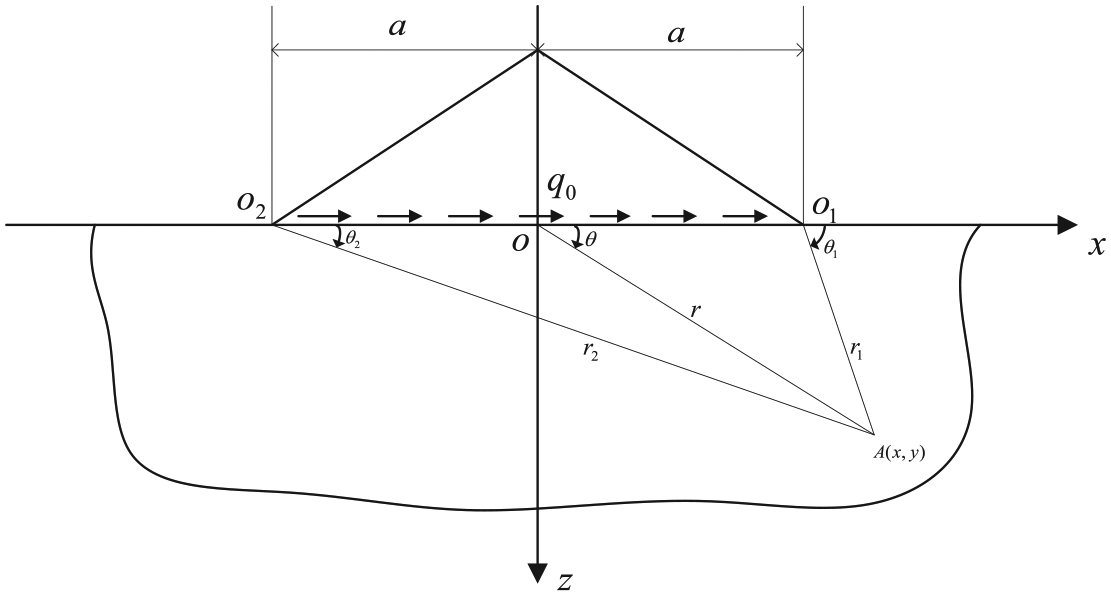
Schematic of the contact problem under tangential triangle load.
3. Formulation of contact problem
In surface elasticity theory, a surface is regarded as a negligibly thin membrane that has material constants different from the bulk material and is adhered to the bulk without slipping.
3.1 Basic equations of surface elasticity
In the absence of body force, the equilibrium equations, constitutive law and geometry relations in the bulk are as follows:

where G and
Assume that the surface of the material adheres perfectly to its bulk without slipping. Then the equilibrium conditions on the surface are expressed as

where
The surface stress tensor is related to the surface strain tensor by

where
3.2 General solution for the contact problem
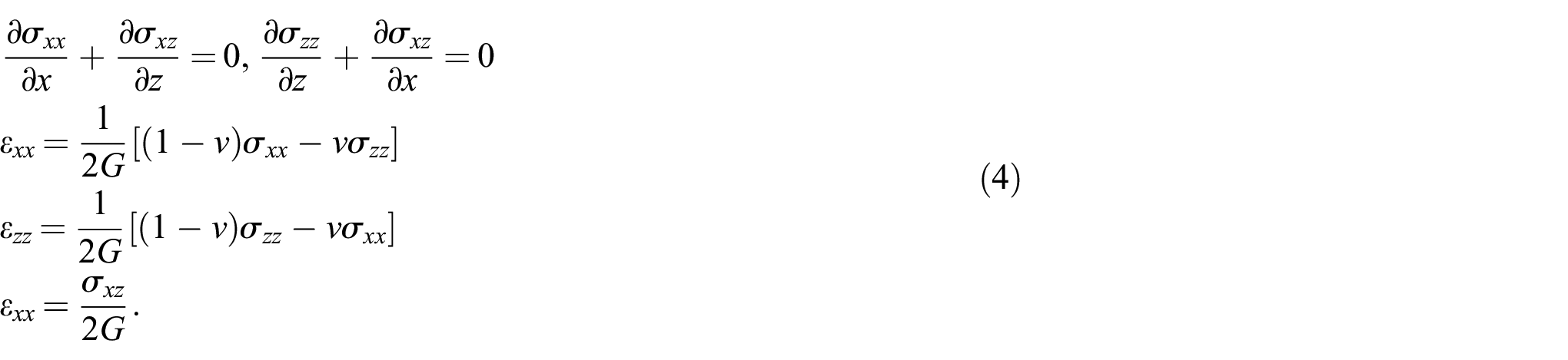
For the considered plane problem, the equilibrium equations and Hooke’s law in the bulk reduce to
The strains are related to the displacements by

which satisfy the following compatibility condition:

As in classical theory of elasticity, the Airy stress function

Then the equilibrium equations in equation (7) are satisfied automatically, and the compatibility equation in equation (10) becomes

To solve the boundary value problem, the Fourier integral transformation method is adopted to the coordinate x. Then, the Airy stress function

Substituting equations (9) into equation (8) and considering the condition that the stresses vanish at infinity, one obtains

where A and B are generally functions of
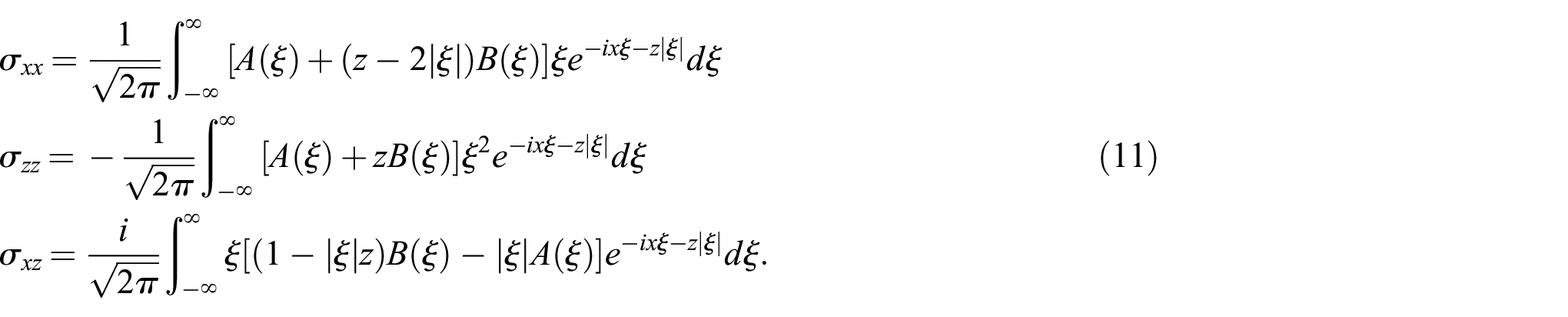
Substituting equation (10) and equations (9) into equation (8), the stresses can be written as
By substituting the stresses into equation (8) and using equations (9), the displacements are derived as

4. Elastic solution under tangential triangle distribution force
In this case, let us consider the effect of a tangential triangle distribution force
In this case, the boundary conditions (3) on the contact surface (

where

Substituting equation (14) into the surface condition equations (13) leads to

where


where b is a length parameter depending on the surface property and material elastic constants. It should be pointed out that this parameter indicates the thickness size of the zone where the surface effect is significant, and plays a critical role in the surface elasticity. For metals, b is estimated of the order of nanometers [3].
Substituting equations (15) into the surface condition equations (11) and (12), the solution of stresses and displaces under pure shear load were obtained:
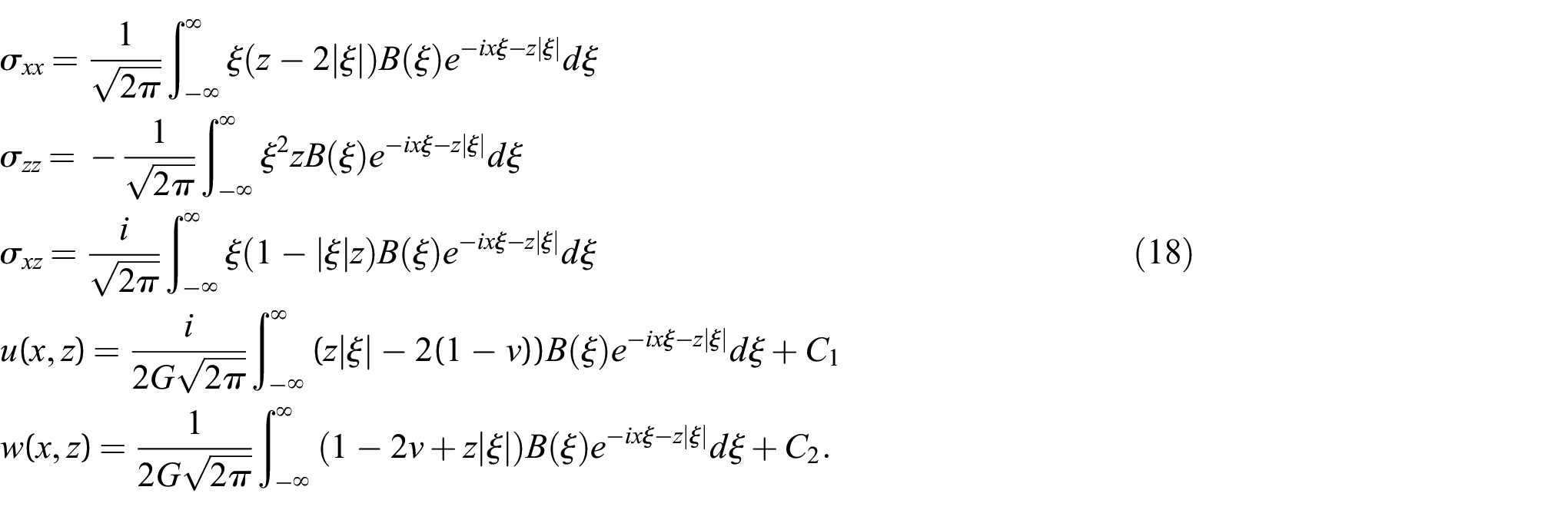
Substituting equation (17) into equation (14), one obtains

Therefore,

Substituting equation (20) into equations (18), the stresses component and displaces component are obtained as
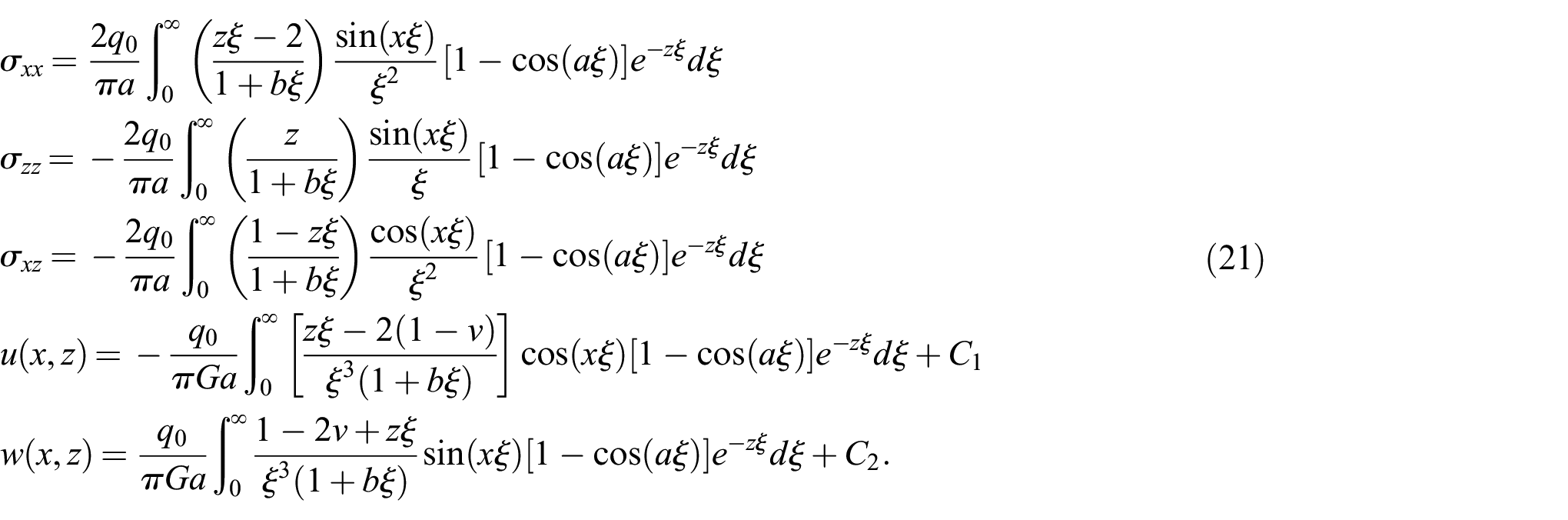
It is seen, when b = 0, that is, the surface influence is ignored in (21), the stresses of the half-plane are consistent with those in the classical elastic results and the displacement is consistent with the same result [18], respectively.

where

On the contact surface

If the shear displacement u is specified to be zero at a distance

Assuming that the origin has no displacement in the z direction, that is,

On the contact surface

5. Numerical results and discussion
It is instructive to examine the influence of the surface elasticity on the stresses and displacements of the contact surface and compare them with those in the classical contact problem. Figures 2 and 3 show the distribution of the stresses
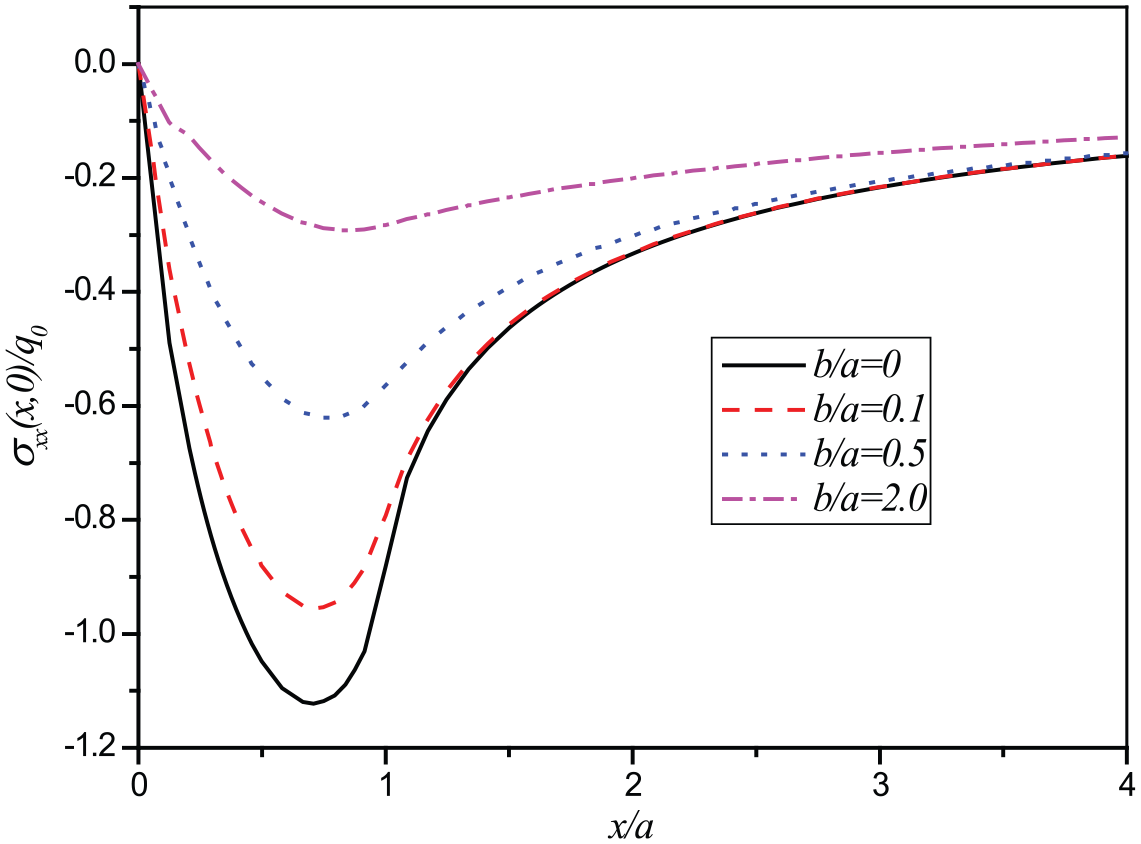
The distribution of the normal stress
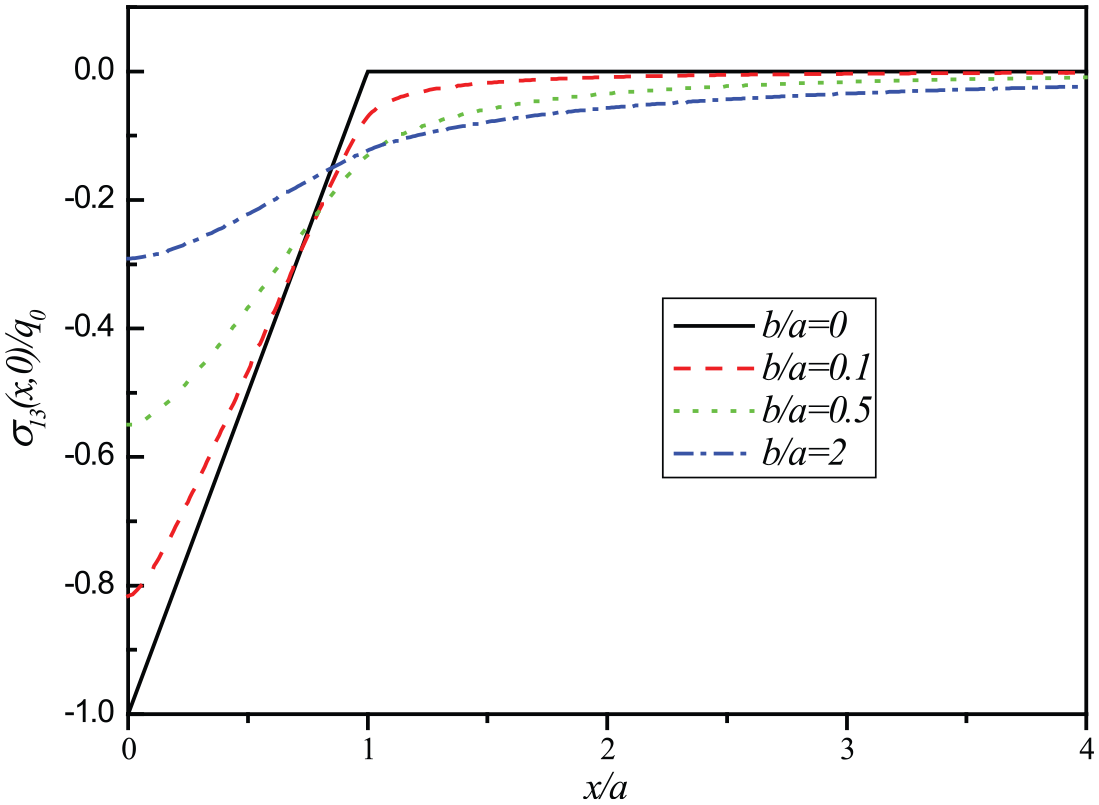
The distribution of the shear stress
For the illustration of the effects of surface elasticity,
Due to the different surface elasticity value, the horizontal displacement is as displayed in Figure 4, where we set
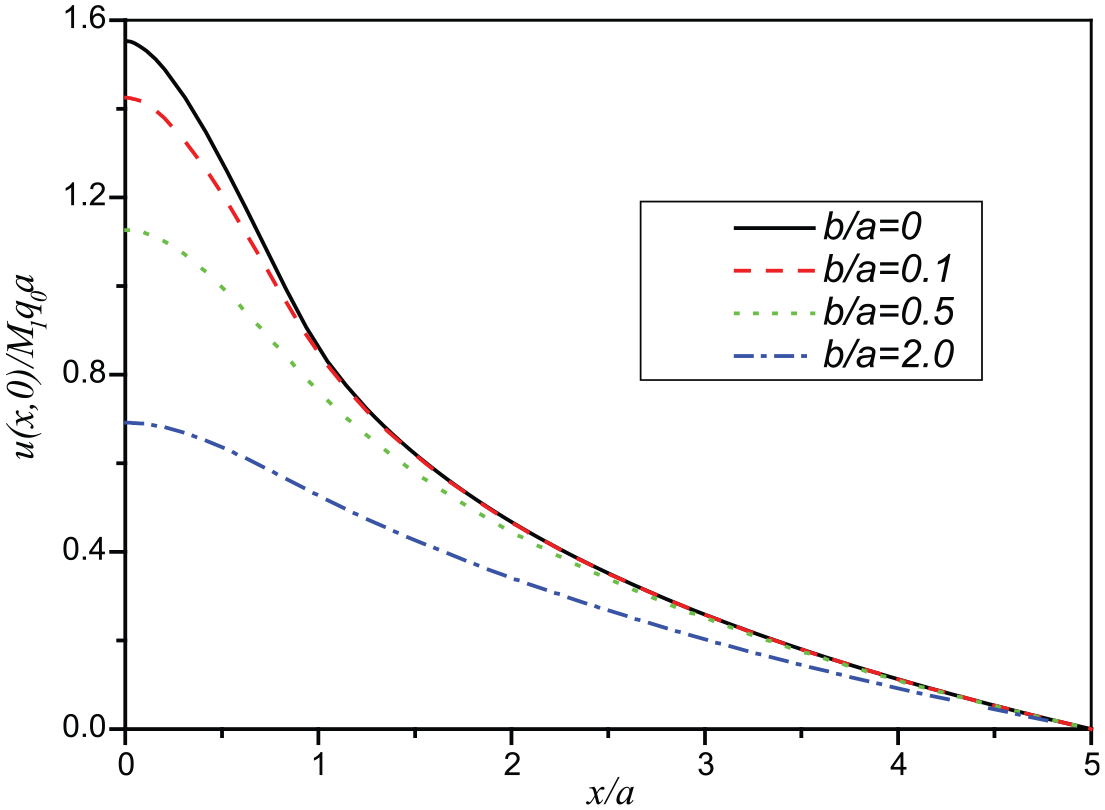
The distribution of the surface tangential displacement u.
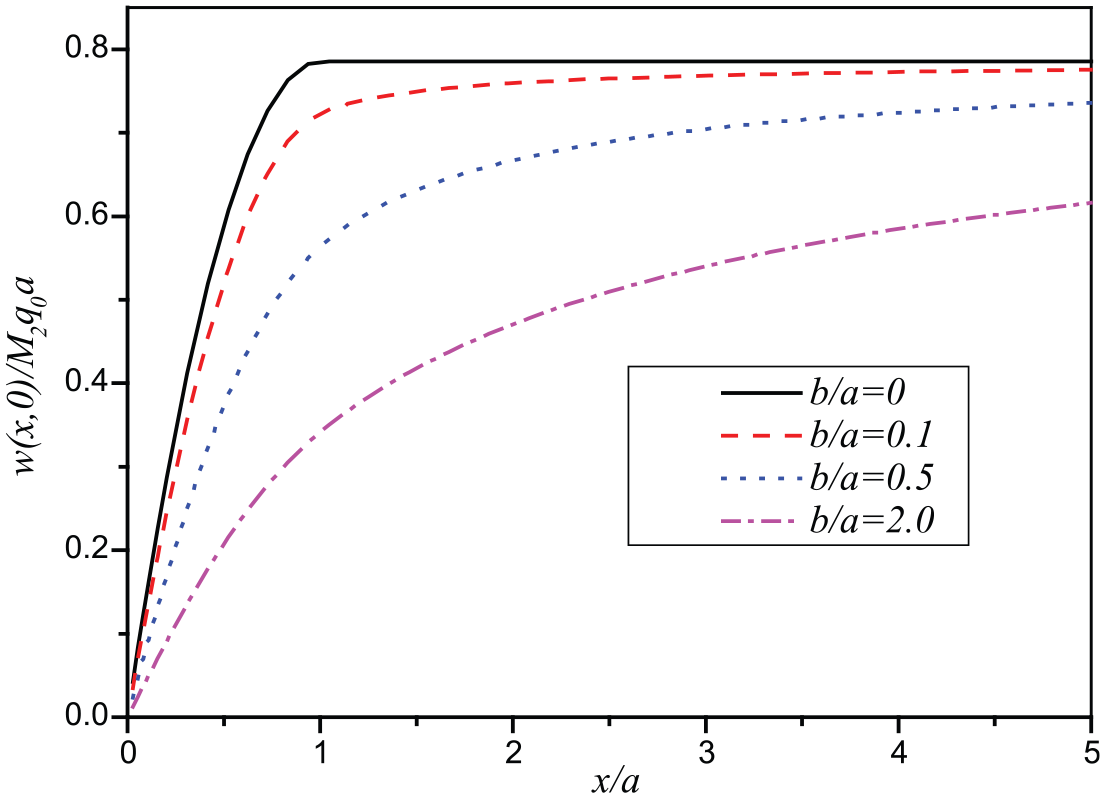
The distribution of the surface normal displacement w.
6. Conclusions
The two-dimensional nano-contact problems for elastic bulk materials subjected to a tangential triangle distribution load are investigated with the surface elasticity effect. It is found that the surface elasticity theory illuminates some interesting characteristics of nano-contact problems, which are distinctly different from the classical solutions of elasticity without surface effects. The contact shear stresses and the normal displacements of the deformed surface change smoothly across the loading boundary; moreover, horizontal displacement and the indent depth decrease continuously with the increase of surface elasticity, which shows a significant dependence on the surface elasticity. Therefore, the effects of surface elasticity should be considered for nano-contact problems. This conclusion can be employed to measure the surface elastic modulus of soft solids and biological tissues.
Footnotes
Declaration of Conflicting Interests
The author(s) declared no potential conflicts of interest with respect to the research, authorship, and/or publication of this article.
Funding
The author(s) received no financial support for the research, authorship, and/or publication of this article.