A calculation method for the meridional profile of axisymmetric bridges between two spheres of different size is introduced in this manuscript. From geometrical data of the capillary bridge, such as the neck radius and boundary conditions (filling and contact angle), the shape of the capillary bridge is calculated analytically as a solution of the Young–Laplace equation. Its free surfaces, of constant mean curvature, may be classified into portions of nodoid, unduloid, and other limit cases. Moreover, other properties of the liquid bridge can be computed analytically, such as the associated capillary force exerted on the solid surfaces, liquid volume, mean curvature, and free surface area.
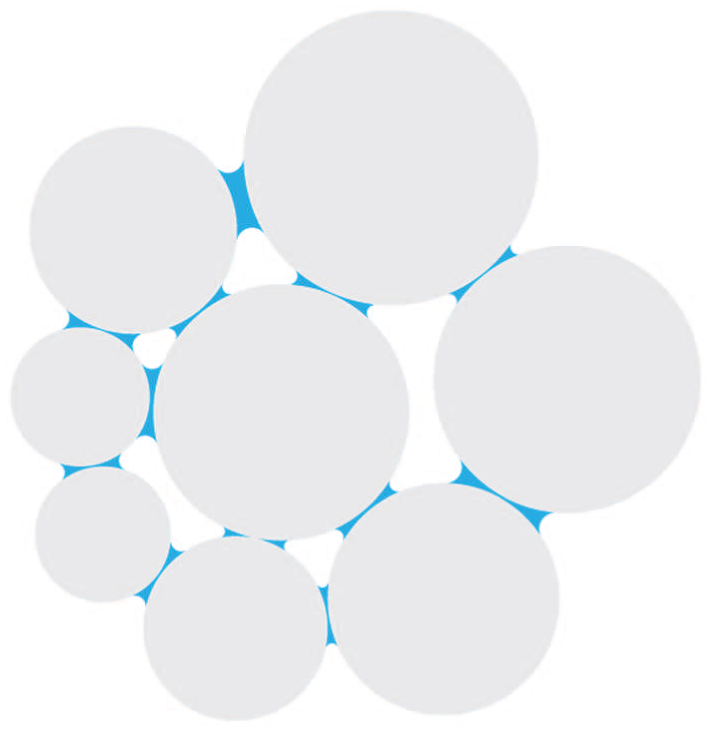
In granular materials, when a volume of water is introduced between two neighboring particles, a capillary bridge might be formed (Figure 1). The presence of capillary bridges between grains has an important impact on the behavior of unsaturated granular materials, especially in soils. Capillary cohesion, caused by the surface tension, strongly influences the behavior and flow properties of granular materials when water-induced effects are taken into account [1]. Generally, wet granular materials are of primary interest in many fields of engineering science, for example in geomechanics or in wet processing of powders [2–4]. Thus, many studies have focused on the properties of capillary bridges, where both theoretical [5–9] and experimental aspects are analyzed [10–12]. The geometry of capillary bridge profiles corresponds to a solution of the Young–Laplace equation. Nodoid or unduloid shapes are the most frequently encountered profiles in practice (see Gagneux et al. [12]). In some particular limit cases, the meridional profile may be also that of a right circular cylinder, a catenoid, or a portion of sphere [9].
Pendular regime in wet granular materials.
Many analytical approaches have investigated properties of a capillary bridge between two elastic solids, such as between a sphere and a plane [13] or between two adjacent spheres. However, most of the studies on spherical bodies are restricted to the monodisperse case1 [7, 9, 14, 15] and primarily focused on the convex meridional profile of the liquid bridge. The coalescence of capillary doublets between touching spheres of the same radius has also been studied theoretically by Gagneux and Millet [16]. However, in most numerical simulations of granular media using discrete element methods, spheres of different diameters, corresponding to a polydisperse granular assembly, are considered. Therefore, it is necessary to analyze all possible cases of capillary bridges between polydisperse particles and to construct a complete information set of the liquid bridge properties (exact shape, volume, free surface area, etc.).
This manuscript is an attempt to provide extended analytical descriptions of the meridional profile of a liquid bridge between two particles of different size, including any wetting angle, for both convex and concave meridians. Moreover, based on the solution of the Young–Laplace equation, analytical formulas for the associated capillary force and liquid volume can be obtained as well. In every case presented in the following sections, an exact parametric description of the meridian is given, and some examples enable the analytical approach presented to be illustrated and verified. Note that some applications to solid–fluid mixture theory [17, 18], or to study the stability of the capillary bridge through the approach developed by Sauer and Duong [19], are conceivable. It should be noted that a recent study with very similar motivations has been conducted numerically by Qiang-Nian et al. [20], using the shooting method for the boundary-value problem (the Runge–Kutta method to integrate a system of ordinary differential equations, associated with the Raphson–Newton iteration method).
2. Calculation of capillary bridge profile characteristics
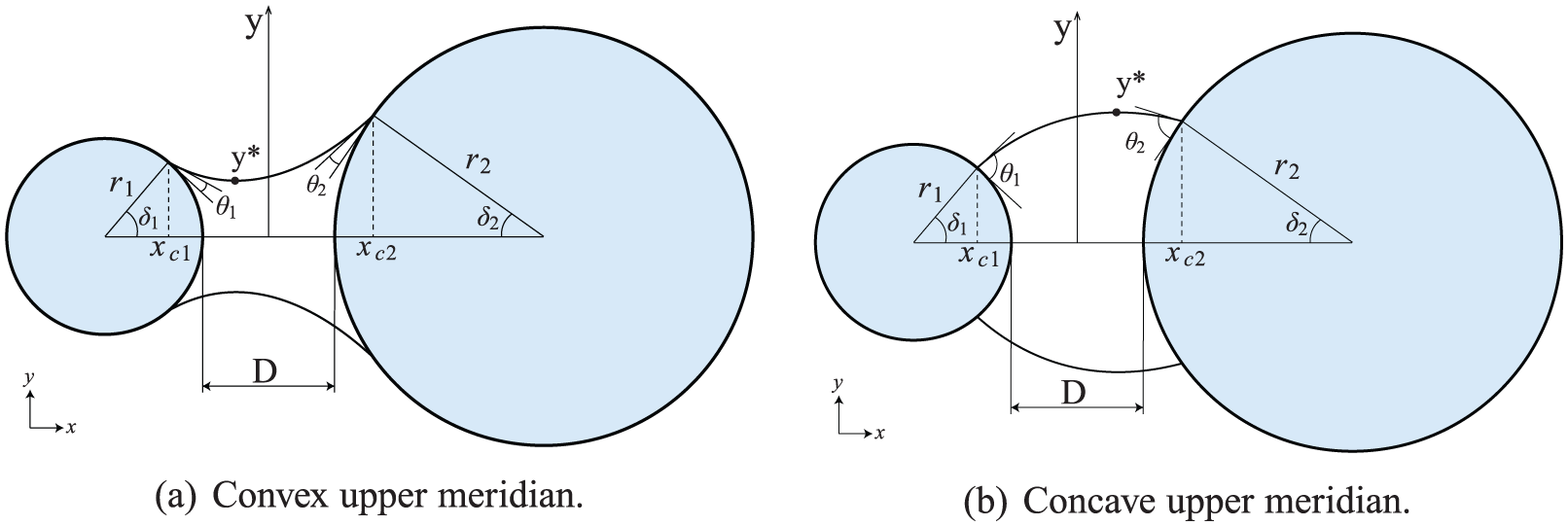
This manuscript analyses the meridional profile of the capillary bridge between two spheres of different radius. Let us consider two particles with radii and , , separated by a distance , as shown in Figure 2. The origin of the Cartesian coordinates corresponds to the neck of the capillary bridge (where , see the appendix). The corresponding half-filling and wetting angles are denoted and , respectively, and represents the neck radius of the bridge. Gravity is not taken into account in the following calculations; therefore, the capillary bridge is axisymmetric around the axis.
Representation of the capillary bridge between two unequal-sized spherical particles (polydisperse case).
We recall that the associated Young–Laplace equation for axisymmetric profiles is given by
where is the pressure difference between the inside and outside of the capillary bridge and denotes the surface tension of the liquid.
Integration of the Young–Laplace equation (equation (1)), or a first integral of the Euler–Lagrange–Beltrami equation via calculus of variations, leads classically to the nonlinear first-order differential equation
where is a constant, revealing the conservation law
at any point of the profile. Note that is directly linked to the associated capillary force :
It is important to note that equation (3) is general and valid at any point of the capillary bridge profile (see Gagneux and Millet [9]). This leads to the conventional method of estimation of the capillary force at the neck of the bridge, known as the “gorge method” [6, 21]:
which is, in fact, a particular case of equation (3).
According to the signs of and , equation (2) corresponds to Delaunay roulettes [22]
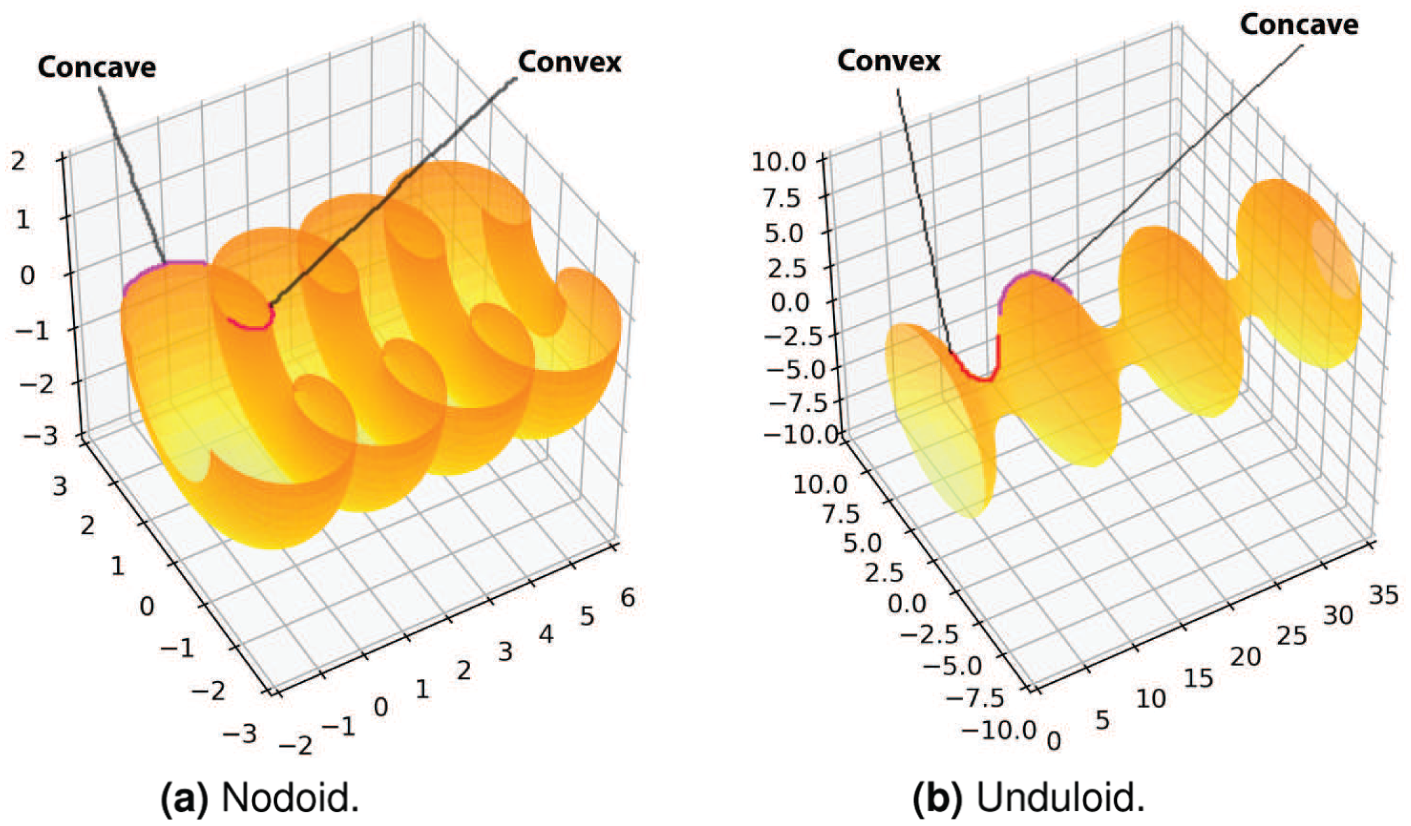
with the parameters and . The case , corresponds to an elliptic roulette (unduloid meridian, Figure 3b), whereas the case , , corresponds to a hyperbolic roulette (nodoid meridian, Figure 3a). As shown in Gagneux and Millet [9], the convex meridional profile configuration leads to the pressure difference , with for a nodoid and for an unduloid.
Plots of nodoid and unduloid surfaces. (Only half of the surface is shown, to demonstrate the internal structure.)
Thus, the following situations may be encountered:
Convex upper meridian of nodoid with parameters and , , ;
Convex upper meridian of unduloid with parameters and , , ;
Concave upper meridian of nodoid with parameters and , , ;
Concave upper meridian of unduloid with parameters and , , .
For a capillary bridge defined by the meridional profile , the bridge’s volume is given by:
where
and
denote the volume of the spherical caps wetted by the liquid on each sphere, with and the abscissas of triple points (Figure 2).
In the following sections, each case of the meridional profile of the liquid bridge is calculated and accompanied by numerical examples to confirm the exactitude of the calculation. In this paper, we focus on polydisperse configurations with two spheres of different radii, constituting an extension of the monodisperse case already addressed in Gagneux and Millet [9] and Gagneux et al. [12].
3. Convex upper meridian (negative Gaussian curvature of the free surface)
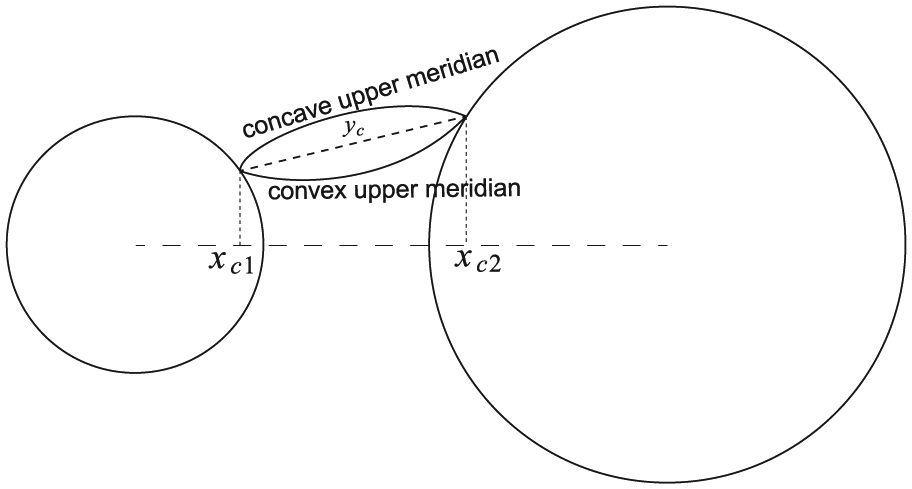
To identify the property of the meridional profile, we use the line joining the triple points (Figure 4), defined by:
Concave upper meridian (generating a convex bridge) or convex upper meridian (generating a concave bridge).
The upper capillary bridge profile is therefore convex if
or concave if
Intrinsically, we can define the free surface with negative Gaussian curvature (the product of the two principal curvatures) in the case of a convex upper meridian, and positive Gaussian curvature in the case of a concave upper meridian. The sign of the Gauss curvature locally characterizes the surface shape.
In other words, the meridian is considered convex if the curvature turns toward the inside of the liquid bridge, and concave in the contrasting direction of the curvature.
For all upper meridians addressed in this manuscript (concave or convex), the boundary conditions can be determined at triple points (equations (10a), (10b), (10c), and (10d)) and at the neck (equation (10e)) as follows:
3.1. Nodoid with convex upper meridian
Result 1.If the observed geometrical data of the capillary bridge are such that
then the meridian of the capillary bridge is a portion of a nodoid, whose parametric equations are given by:
with . The bounds , verify the condition , and are given by
The eccentricity is defined as , where and , with are given by:
Moreover, the capillary pressure may be recovered from the measured data as:
Finally, the associated liquid volume and free surface area of the capillary bridge can be calculated as:
Proof. This case corresponds to and . The Young–Laplace equation can be rewritten as
with the parameters
and (see equation (5)), which corresponds to the nodoid case.2□
Combining equation (14a) and the associated boundary conditions at the triple points and the liquid bridge’s neck (equation (10)) yield:
Combining equations (15a) and (15b) leads to the compatibility relation between and , such that:
The parameters and can be obtained as solutions of equation (15):
provided that the systems (equations (15a) to (15c) and equations (15b) and (15c)) admit a unique solution. This is the case if and . The second condition comes directly from the condition (equation (8)) of a convex upper meridian.
It is to be noted that and can be also calculated without consulting the neck radius , by solving equations (15a) and (15b). We have
Provided the system (equations (15a) and (15b)) admits an unique solution, this is the case if . Naturally, in the case of monodisperse particles, where , the system (equations (15a) and (15b)) degenerates and only one condition (for , , ) is necessary, coupled with equation (15c). We recover the resolution already performed by Gagneux and Millet [9] for monodisperse particles.
An important consequence of this remark is that determining the characteristic of capillary bridges from equation (18), although very convenient in some cases, becomes very sensitive when and the material is the same. In this case, the determinant of the system (equations (15a) and (15b)) approaches zero and the formulas in equation (18) are not recommended.3
Note that the solution presented in equation (18) enables a unique meridional profile to be built from the data set if and only if conditions and are satisfied, which yields
or
This approach is not valid in the monodisperse case between two identical spheres, since the condition
is not satisfied and equation (15) becomes redundant. The condition is equivalent to , meaning that the ordinates of the liquid bridge’s triple points are different.
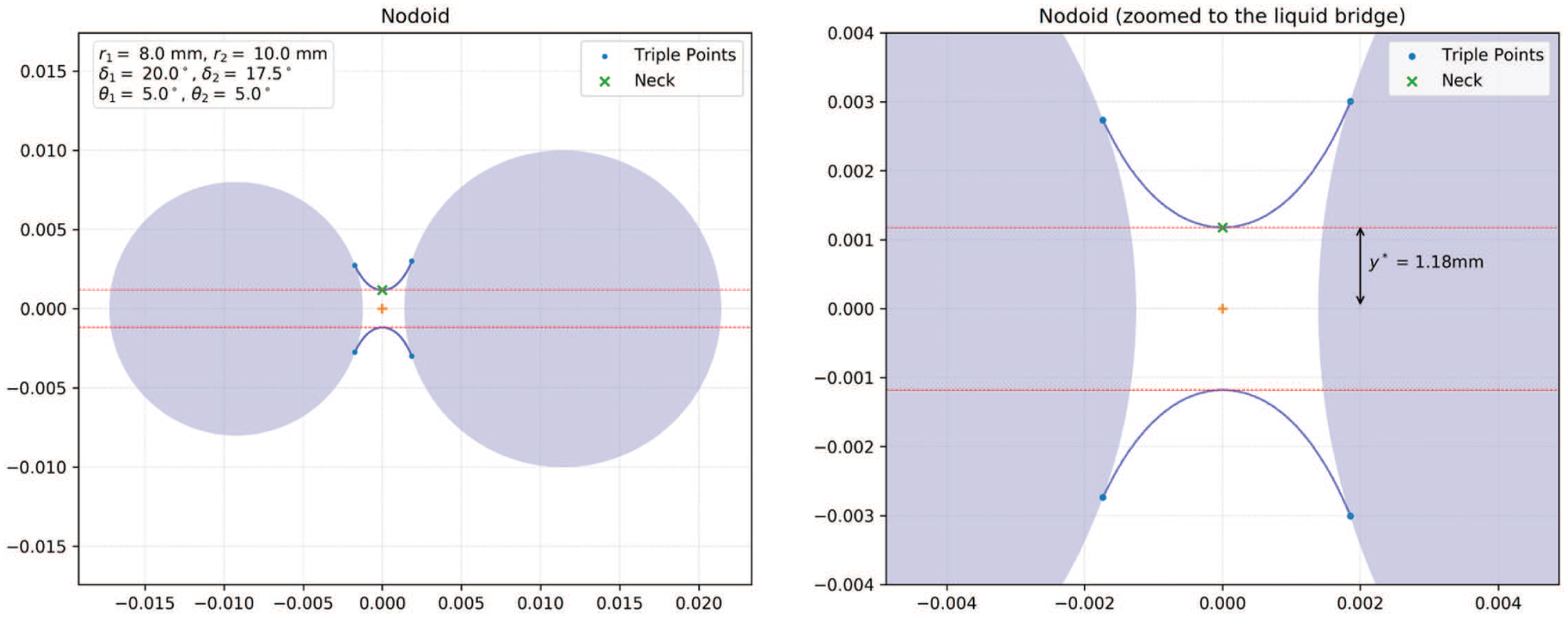
Figure 5 illustrates an example of determination of the convex upper meridian of a nodoid knowing only the half-filling angle and wetting angles (). In the case considered, we have , , , , and . Note that the values considered satisfy the condition , and the compatibility relation (equation (16)).
Example of upper convex meridian of the capillary bridge with , , , , . Nodoid surface.
Given compatible geometrical data, the following numerical procedure enables the exact parameterization of the upper meridian, a solution of the Young–Laplace equation, to be determined. The values of considered are obviously compatible and correspond to a solution of the Young–Laplace equation in the nodoid case considered here (they could be observed experimentally for the same given volume calculated in step 7 of the procedure):
From considered values , and are calculated using equation (18). Only positive outputs of and are accepted, and satisfy the compatibility condition mentioned in equation (16).
are calculated.
The meridional profile is determined using the parametric equations in equation (12), The origin is defined at and (as explained in the appendix). The coordinates of triple points (,), (, ) are calculated as and , respectively.
The centers of two spheres , are located based on the given values, , , and the calculated results, , .
The distance between the two spheres is computed as .
The neck radius can be defined from the quadratic equation (equation (15c)), which produces. Since , there is an unique accepted solution . Note that automatically satisfies the condition (equation (11)) in the nodoid case being considered.4
The associated liquid volume and the free surface area can be computed using equations (13d) and (13e).
3.2. Unduloid with convex upper meridian
Result 2.When the observed data are such that
then the upper meridian is convex and is a portion of an unduloid whose parameterization is given by:
where
and , are defined from the boundary condition at the triple points , . Thus
are given by
and the pressure difference may be calculated as:
The expression of liquid volume and the free surface area stands:
Proof. Let us consider the case and . Thus, the Young–Laplace equation can be written as:
Applying the boundary conditions presented in equation (10), equation (24) leads to the system:
Similar to the nodoid case, combining equations (25a) and (25b) leads to the compatibility condition between and ():
Solution of equations (25a) to (25c) leads to the following expressions of and :
provided the associated system of equations has an unique solution. This is the case if and . As , these conditions lead to:
in the case of a convex upper meridian. The condition , , in the case of the convex meridian (unduloid case), leads to the supplementary condition
which is automatically satisfied according to equation (28). Note that the compatibility condition presented in equation (20) is satisfied. □
It is also possible to express and with respect to and only (without involving ). The associated expressions result from equations (25a) to (25b):
respecting the following conditions:
or
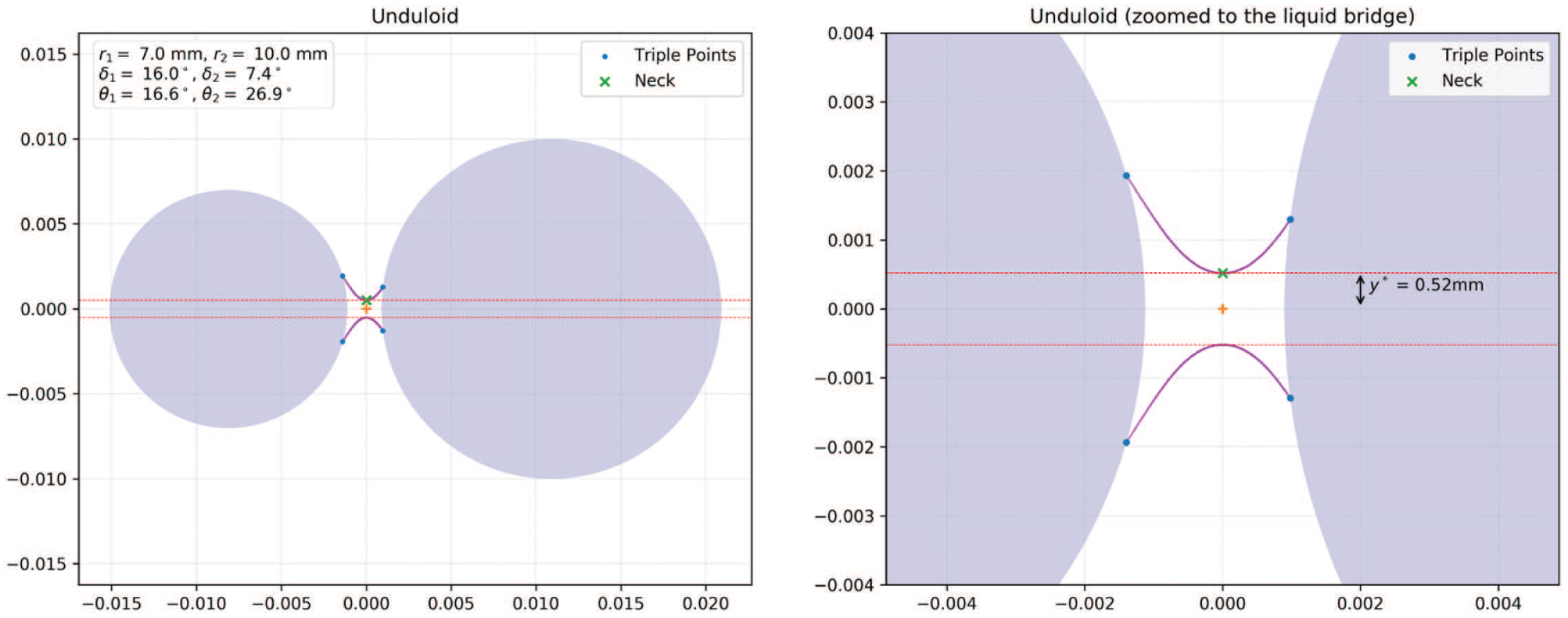
Figure 6 presents an example of the determination of the convex meridian of an unduloid for the given compatible geometric data: , , , , , . Note that for the values considered, the compatibility condition (equation (26)) is again satisfied and corresponds to an unduloid shape according to equation (20). The procedure of resolution is similar to that performed in the nodoid case and is not recalled here, for the sake of simplicity.
Example of upper convex meridian of the capillary bridge with , , , , , . Unduloid surface.
4. Concave upper meridian (positive Gaussian curvature of the free surface)
In this section, concave meridian capillary bridges are investigated. Both of the mean curvatures are positive in this case. Thus, the difference between internal and external pressures, is positive; therefore,
4.1. Nodoid with concave upper meridian
Result 3.When observed geometrical data are such that
the free surface of revolution is a part of a nodoid whose meridian is an arc of a hyperbolic Delaunay roulette.
The associated parameterization of the meridional profile may be written as
with , where are defined from the boundary conditions and . It is important to note that the difference between the concave and convex profiles is the boundary condition value at and . The parameters and can be calculated as follows:
The associated liquid volume and free surface area are calculated as follows:
Proof. Consider the case and . The associated nonlinear differential equation is written as
The condition for the unique solution of equation (35) is similar to the convex case. The solution of the equation (35) gives the value of and as:
In the case of the concave meridian, we have ; therefore, the conditions , are automatically satisfied. Other results relating to the capillary bridges can be achieved in the same way as in the convex nodoid meridian. □
The solution of and independent of is calculated as follows:
respecting the following condition:
or
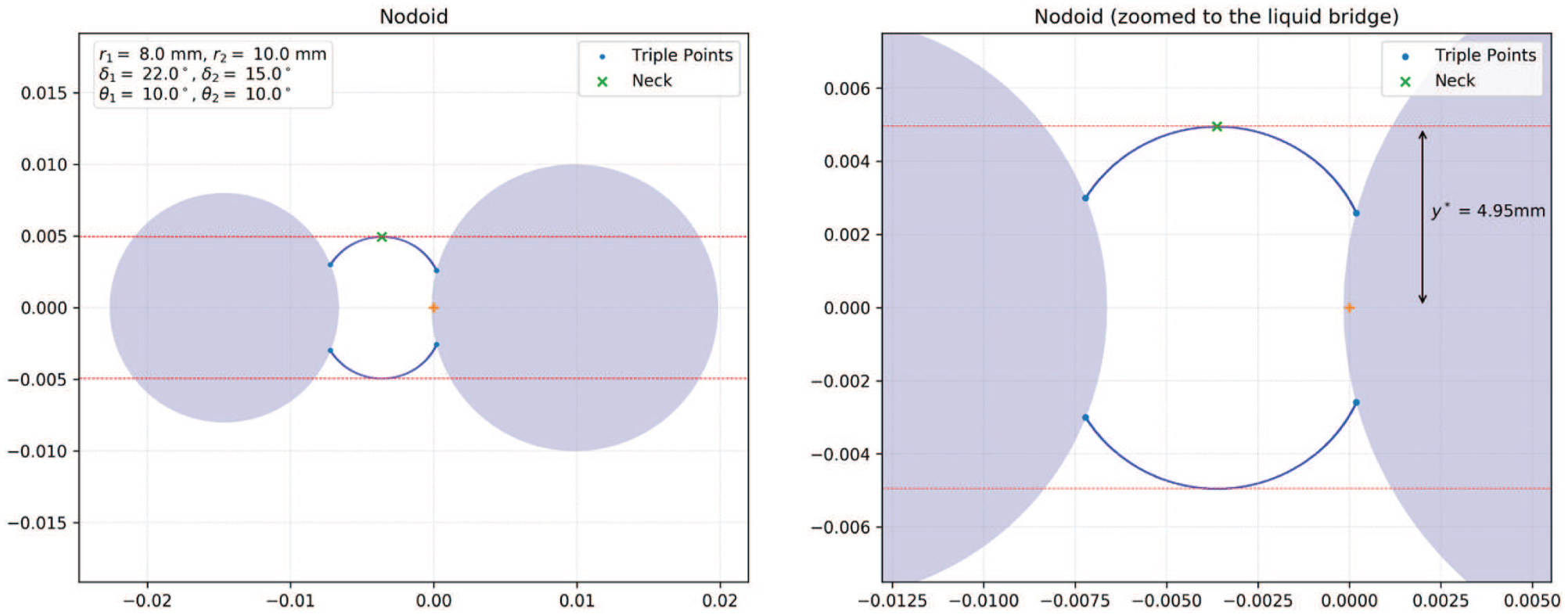
Figure 7 demonstrates an example of a concave upper meridian of a nodoid corresponding to the given compatible geometrical data , , , , , . As mentioned previously, the same procedure of “semi-analytical” resolution of the Young–Laplace equation is performed, except that step is adapted to the upper concave meridian of the considered case, where we have.
Example of upper concave meridian of the capillary bridge with , , , , . Nodoid surface.
4.2. Unduloid with concave upper meridian
Result 4.The concave unduloid meridian case is found when the observed data are such that
The free surface of revolution has the form of an unduloid whose meridional profile is an arc of an elliptic Delaunay roulette. The parametric meridian of the liquid bridge is given by:
where , are defined from the conditions and . The parameters and can be calculated as:
The associated liquid volume and free surface area are calculated as follows:
Proof. Let us consider the last case, where and . The associated nonlinear differential equation reads
with .
Equation (42) becomes a system of equations for and by applying the conditions in equation (10):
Solving the system (equations (43a) to (43c)) provides the value of and as follows:
respecting the compatibility relation determined by equations (43a) and (43b)
In the case of a concave meridian, ; consequently, the condition , makes
The solution of (, ) apart from is presented as follows:
respecting the following conditions:
or
□
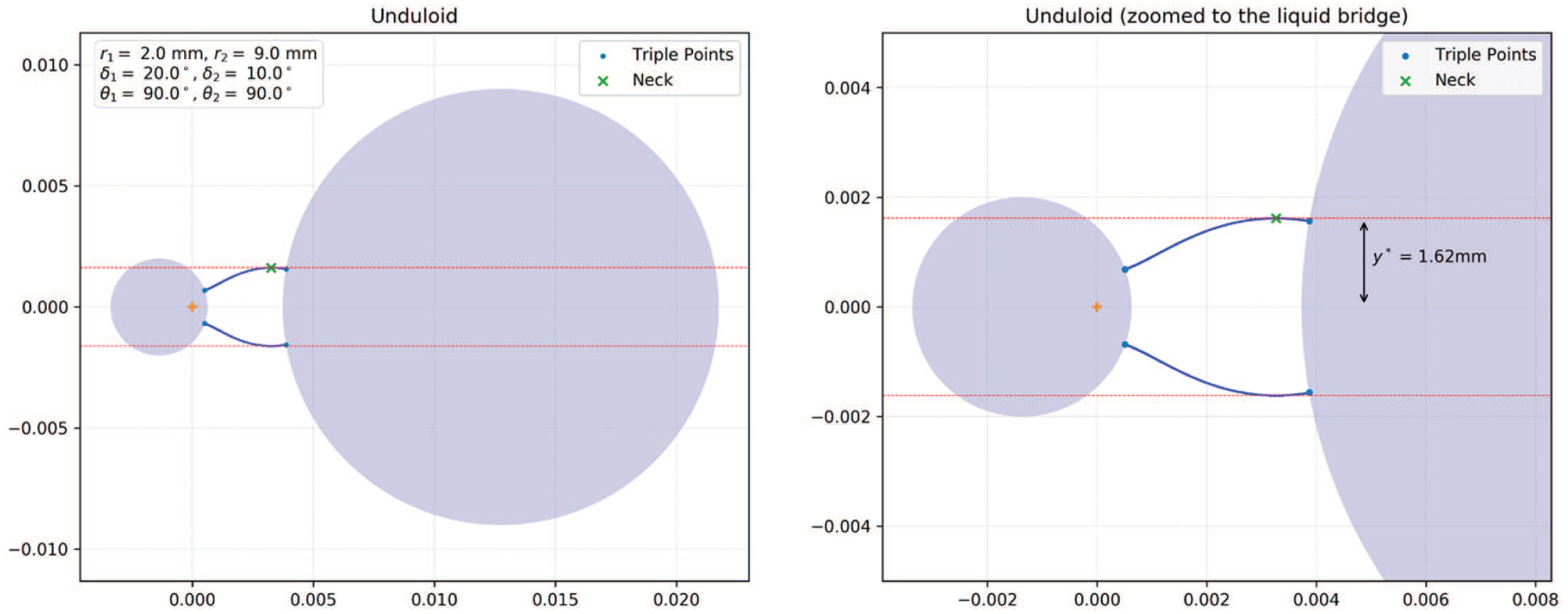
Figure 8 demonstrates an example of a concave upper meridional profile of an unduloid liquid bridge for given compatible geometrical data , , , , , . The neck radius in this case is calculated as .
Example of upper concave meridian of the capillary bridge with , , , , , . Unduloid surface.
4.2.1. Special case where the liquid profile has an inflection point
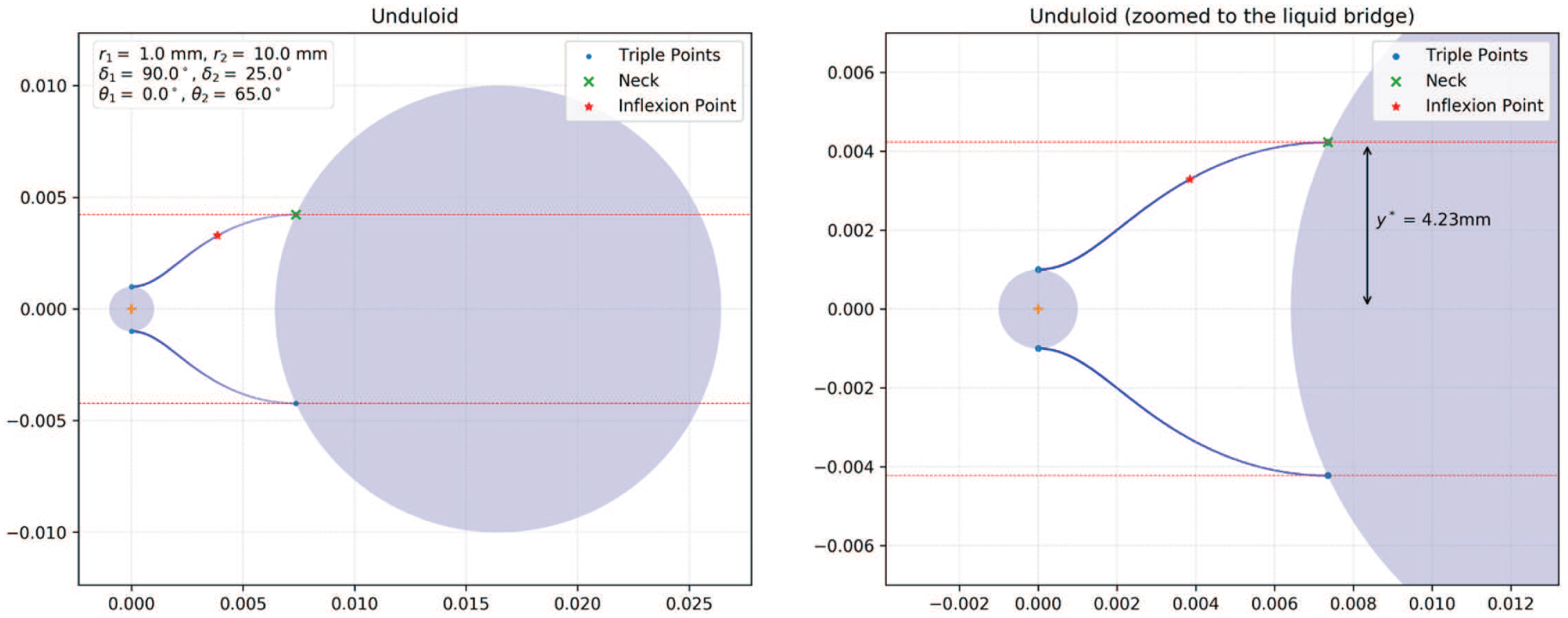
It is important to note that a special case of unduloid may be encountered in practice, where the meridional profile comprises both convex and concave parts. In other words, the upper meridian (and also the lower one) contains an inflection point located on the profile, marking the transition between convex and concave meridional profiles (). This special (and sensitive) case only occurs for particular values of the geometrical parameters and happens with the parameterization of the upper meridian for the unduloid case. For example, such an unduloid with inflection point is presented in Figure 9 for , , , , , .
Meridional profile with inflection points, unduloid case, with , , , , , .
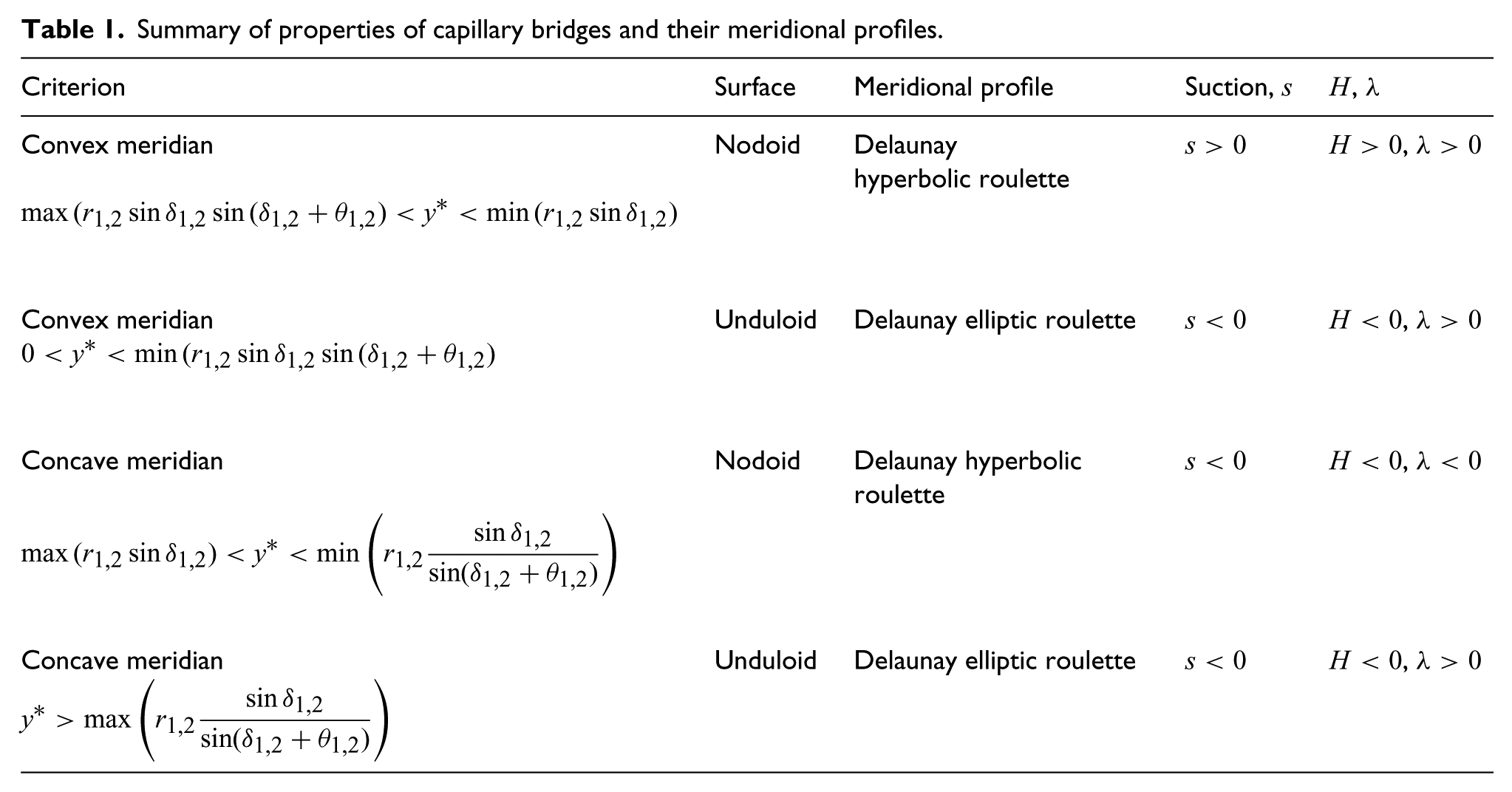
A summary of all the investigated cases is given in Table 1.
Summary of properties of capillary bridges and their meridional profiles.
Criterion
Surface
Meridional profile
Suction,
,
Convex meridian
Nodoid
Delaunay hyperbolic roulette
,
Convex meridian
Unduloid
Delaunay elliptic roulette
,
Concave meridian
Nodoid
Delaunay hyperbolic roulette
,
Concave meridian
Unduloid
Delaunay elliptic roulette
,
5. Conclusion
The properties of capillary bridges between two particles of different sizes are investigated in this manuscript. Two types of upper meridians of capillary bridge profiles (convex and concave) are considered. In each case, the exact geometry of the capillary bridge is determined as a solution of the Young–Laplace equation for given compatible geometrical data. The corresponding capillary force, volume, and free surface area of the liquid bridge are determined explicitly. Some examples of different possible configurations, solutions of the Young–Laplace equation, have been given to validate the correctness of the addressed analytic approach.
The radius of unequal-sized spheres being fixed, we obtain an explicit criterion based on the observation of the contact and wetting angle and the gorge radius, to classify the nature of the surface of revolution and its associated meridian (portion of nodoid or unduloid, with concave or convex meridian). Moreover, a special case of a capillary bridge with a meridian presenting one inflection point is revealed.
In all the cases encountered, illustrative examples are addressed to enforce the analytical approach presented. They correspond to a solution of the Young–Laplace equation obtained for given compatible geometrical data. Of course, they may also be observed experimentally for the same values of geometrical data. A comparison with experimental results obtained for polydisperse particles, following the démarche presented in Gagneux et al. [12] for the monodisperse case, will constitute the aim of a subsequent work.
Footnotes
Appendix
Funding
The author(s) received no financial support for the research, authorship, and/or publication of this article.
Notes
References
1.
SauerRA.A contact theory for surface tension driven systems. Math Mech Solids2014; 21(3): 305–325.
RadlSKalvodaEGlasserBJ, et al. Mixing characteristics of wet granular matter in a bladed mixer. Powder Technol2010; 200(3): 171–189.
4.
SchwarzeRGladkyyAUhligF, et al. Rheology of weakly wetted granular materials: A comparison of experimental and numerical data. Granular Matter2013; 15(4): 455–465.
5.
ErleMADysonDMorrowNR.Liquid bridges between cylinders, in a torus, and between spheres. AIChE J1971; 17(1): 115–121.
6.
LianGThorntonCAdamsMJ.A theoretical study of the liquid bridge forces between two rigid spherical bodies. J Colloid Interface Sci1993; 161(1): 138–147.
VogelTI.Liquid bridges between balls: The small volume instability. J Math Fluid Mech2013; 15(2): 397–413.
9.
GagneuxGMilletO.Analytic calculation of capillary bridge properties deduced as an inverse problem from experimental data. Transp Porous Media2014; 105(1): 117–139.
10.
WillettCDAdamsMJJohnsonSA, et al. Capillary bridges between two spherical bodies. Langmuir2000; 16(24): 9396–9405.
11.
RabinovichYIEsayanurMSMoudgilBM.Capillary forces between two spheres with a fixed volume liquid bridge: Theory and experiment. Langmuir2005; 21(24): 10992–10997.
12.
GagneuxGMilletOMielniczukB, et al. Theoretical and experimental study of pendular regime in unsaturated granular media. Eur J Environ Civil Eng2016; 21(7–8): 840–853.
13.
RubinsteinBYFelLG.Theory of pendular rings revisited. arXiv2012; arXiv:12077096.
14.
Megias-AlguacilDGaucklerLJ.Capillary forces between two solid spheres linked by a concave liquid bridge: Regions of existence and forces mapping. AIChE J2009; 55(5): 1103–1109.
15.
KruytNMilletO.An analytical theory for the capillary bridge force between spheres. J Fluid Mech2017; 812: 129–151.
16.
GagneuxGMilletO.An analytical framework for evaluating the cohesion effects of coalescence between capillary bridges. Granular Matter2016; 18(2): 16.
17.
PlacidiLDell’IsolaFIaniroN, et al. Variational formulation of pre-stressed solid–fluid mixture theory, with an application to wave phenomena. Eur J Mech A Solids2008; 27(4): 582–606.
18.
Dell’IsolaFMadeoASeppecherP.Boundary conditions at fluid-permeable interfaces in porous media: A variational approach. Int J Solids Struct2009; 46(17): 3150–3164.
19.
SauerRADuongTX.On the theoretical foundations of thin solid and liquid shells. Math Mech Solids2017; 22(3): 343–371.
20.
Qiang-NianLJia-QiZFeng-XiZ.Exact solution for capillary bridges properties by shooting method. Z Naturforsch A Phys Sci2017; 72(4): 315–320.
21.
GrasJPDelenneJYEl YoussoufiMS.Study of capillary interaction between two grains: A new experimental device with suction control. Granular Matter2013; 15(1): 49–56.
22.
DelaunayC.Sur la surface de révolution dont la courbure moyenne est constante. J Math Pures Appl1841; 1841: 309–314.