







Abstract
A Cosserat-rod-based continuum approach is presented to obtain phonon dispersion curves of flexural, torsional, longitudinal, shearing, and radial breathing modes in chiral nanorods and nanotubes. Upon substituting the continuum wave form in the linearized dynamic equations of stretched and twisted Cosserat rods, we obtain an analytical expression of a coefficient matrix (in terms of the rod’s stiffnesses, induced axial force, and twisting moment) whose eigenvalues and eigenvectors give us frequencies and mode shapes, respectively, for each of the above phonon modes. We show that, unlike the case of achiral tubes, these phonon modes are intricately coupled in chiral tubes owing to extension–torsion–inflation and bending–shear couplings inherent in them. This coupling renders the conventional approach of obtaining stiffnesses from the long wavelength limit slope of dispersion curves redundant. However, upon substituting the frequencies and mode shapes (obtained independently from phonon dispersion molecular data) in the eigenvalue–eigenvector equation of the above-mentioned coefficient matrix, we are able to obtain all the stiffnesses (bending, twisting, stretching, shearing, and all coupling stiffnesses corresponding to extension–torsion, extension–inflation, torsion–inflation, and bending–shear couplings) of chiral nanotubes. Finally, we show unusual effects of the single-walled carbon nanotube’s chirality as well as stretching and twisting of the nanotube on its phonon dispersion curves obtained from the molecular approach. These unusual effects are accurately reproduced in our continuum formulation.
1. Introduction
Phonons are linearized eigenmodes of atomic-level vibration in crystalline solids. They are used to determine thermomechanical and electrical properties of crystals as well as their stability [1–5]. Phonon dispersion curves are typically obtained by using the translational periodicity inherent in crystals to block diagonalize the large Hessian matrix associated with the crystal’s supercell [1, 2]. Each of the smaller block matrices then yields a set of phonons corresponding to a particular wave vector. As the periodic unit cell of chiral nanotubes is usually very large, the method generates significantly large number of dispersion curves in phonon spectra. However, chiral nanotubes as well as uniformly bent and twisted achiral nanotubes possess much smaller helically repeating cell [6, 7]. Several researchers [8–12] have used this smaller helically repeating cell and helical isometry to block diagonalize the large Hessian matrix. This drastically reduces the number of phonon dispersion curves per wave vector and also reduces the computational cost of obtaining them significantly. 1 There are two types of phonon modes for bulk crystals: acoustic and optical. The acoustic modes also have their continuum analogues and their frequencies approach zero in the long wavelength limit. The frequencies of optical modes, on the other hand, approach a finite value in the long wavelength limit. The optical phonons do not have any analogue in usual continuum theories. In the case of nanorods and nanotubes, however, both the radial breathing and shearing phonon modes have continuum analogues but their frequencies do not approach zero in the long wavelength limit [13–15]. In fact, when helical symmetry is used in block diagonalization, the flexural phonon mode’s frequency also does not vanish at zero wave vector but at a non-zero wave vector [12].
In [16], Graff derived elastic wave solutions for longitudinal, torsional, shearing, and bending modes of vibration in isotropic rods about their stress-free configuration. In [17], Rego and Kirczenow substituted elastic constants for square GaAs nanowires in these wave solutions to obtain their phonon spectra corresponding to the above-mentioned modes. Conversely, the phonon modes having continuum analogues are also used in estimating elastic stiffnesses of nanostructures. Popov et al. [18], for example, evaluated Young’s modulus and shear modulus for achiral as well as chiral SWCNTs from the slopes of longitudinal and torsional dispersion curves in long wavelength limit. However, we show later that their calculation for chiral nanotubes is incorrect because these slopes are no longer proportional to elastic moduli owing to extension–torsion coupling present in chiral tubes. Several authors have also obtained bending stiffness of stress-free achiral nanotubes from the curvature of flexural dispersion curve [19–22]. We again show that owing to non-zero bending–shear coupling in chiral nanotubes, the bending stiffness cannot be obtained directly from this curvature.
One can also obtain stiffnesses by directly imposing deformation. For example, one can bend isolated segment of a chiral nanotube and clamp the end atoms in a bent state. The bending stiffness can then be obtained by comparing the induced deformation or energy with classical beam theories [23–25]. However, such methods not only require the nanotube to be long so that they behave as a continuum beam, the method also suffers from end effects as demonstrated in [24]. James [6] proposed a theory of objective structures using which one can deform achiral nanorods or nanotubes in pure bending mode without end effects and subsequently obtain their bending stiffness. However, their method cannot be employed to bend chiral nanostructures. Their method cannot be used to obtain shearing stiffness of either achiral or chiral nanostructures. Kumar et al. [7] recently proposed the helical Cauchy–Born (HCB) rule to obtain all the stiffnesses of nanorods and nanotubes modeled as special Cosserat rods. The method requires imposing uniform strain field (along the arc-length) on nanorods and nanotubes in order to obtain their stiffnesses. However, their method also cannot be applied to deform chiral nanotubes in pure bending or pure shearing mode.
To the best of the authors’ knowledge, no accurate technique exists to obtain bending, shearing, and several coupling stiffnesses of chiral nanotubes. Furthermore, the continuum wave solutions for longitudinal, torsional, flexural, shearing, and radial breathing modes in chiral rods taking into account the inherent extension–torsion–inflation and bending–shear couplings have not been obtained yet. Similarly, a continuum investigation into the effect of finitely stretching and twisting of elastic rods on these modes is also missing in the literature. There has been very limited work in this regard. For example, in [26] Aghaei et al. showed the first-order influence of stretching a nanotube on its flexural phonon dispersion curve. Chang [27] studied the effect of axial strain and twist on radial breathing frequency of SWCNTs but from purely atomistic perspective. The goal of this paper is to address the above-mentioned limitations.
The paper is organized as follows. In Section 2, we briefly discuss the theory of special Cosserat rods. In Section 3, we then discuss continuum wave solutions of longitudinal, torsional, shearing, and bending modes in stretched and twisted chiral rods and obtain a generalized eigenvalue–eigenvector equation whose solution gives us frequencies and mode shapes of these wave modes. We also obtain analytical formulas of frequencies of these modes and discuss how coupling stiffnesses as well as the induced axial force and twisting moment affect these frequencies. In Section 4, we derive continuum wave solution for longitudinal, torsional, and radial breathing modes in chiral elastic tubes using the general theory of Cosserat rods and discuss how the three modes are coupled to each other. In Section 5, we then present a methodology to obtain all the stiffnesses of chiral nanotubes by matching both frequency and mode shape information of various phonon modes obtained directly from molecular approach with the ones obtained using our continuum wave solution. In Section 6, we then obtain stiffnesses of both achiral and chiral SWCNTs using the methodology described in Section 5. In Section 7, we show interesting effects of stretching and twisting a SWCNT on its longitudinal, torsional, radial breathing, and bending phonon dispersion curves and further show that these effects are replicated accurately using our continuum approach. Finally, Section 8 concludes our paper.
Notation
The set of unit vectors
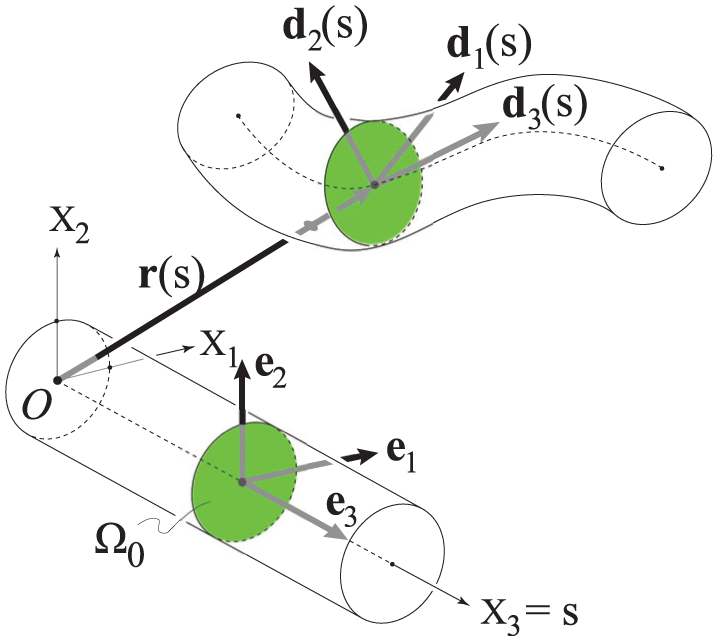
A typical rod deforming from its straight state reference configuration.
2. Brief overview of the theory of special Cosserat rods
We begin with the kinematics of special Cosserat rods.
2
Figure 1 shows a typical rod deforming from its straight state reference configuration. The variable


The first two components of

Here, (


Here,


We have assumed the above diagonal form for
For a hyperelastic rod, we further assume the existence of a twice-differentiable, scalar-valued function

Using the symmetry group relevant for circular rods, Healey [29] classifies such rods into transversely hemitropic and transversely isotropic rods. The relevant symmetry group for hemitropic rods is as follows:

Here,

The coefficients

Here, the quantities (
3. Linearized wave solution in stretched and twisted rods
In this section, we obtain linearized wave solution in infinitely long elastic rods assuming no distributed load or distributed couple acts on the rod. We first linearize the dynamic equations of motion (3) about a uniformly stretched and twisted static configuration of the rod. Let (


Here, (

The quantity


The linearization of equation (3a) upon imposing uniformity of strains (

while the linearization of equation (3b) yields

We then assume the following wave forms for (

Here,

where

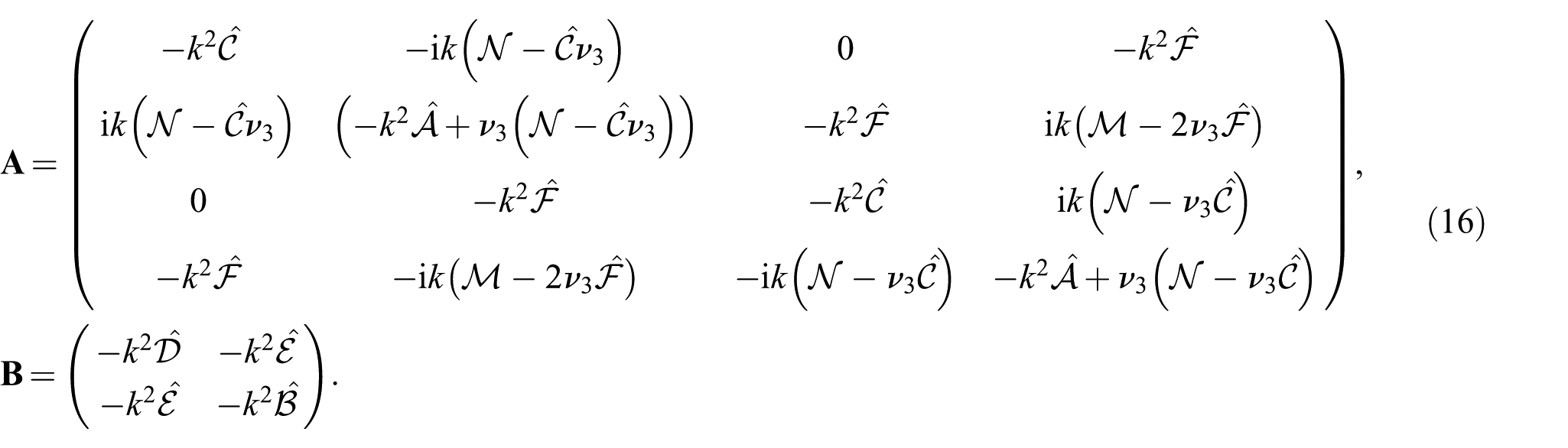
Here,
3.1. Longitudinal and torsional mode frequencies
The two eigenvalues corresponding to submatrix

It implies that the ratio

3.2. Bending and shearing mode frequencies
The formulas for bending (

We can note the influence of axial force and twisting moment on the bending frequency. Owing to the presence of

We also note that the twisting moment

Furthermore, in the case of achiral tubes, the bending–shear coupling stiffness
Finally, we Taylor-expand the shearing mode frequency about the long wavelength limit and obtain

We note that in order to obtain the shearing stiffness

Another observation to note from formula (22) is that the shearing dispersion curve has non-zero slope at
4. Continuum wave solution for radial breathing mode
In order to understand the radial breathing mode from continuum perspective, we need to explicitly account for the tube’s inflation in the continuum model. As the cross-sectional deformation is not an independent measure in the special Cosserat rod model, we use the general Cosserat rod model [30] for this purpose and restrict ourselves to its coupled extension–torsion–inflation deformation. Kumar and Mukherjee [30] derived the quadratic form of strain energy for this model whose restriction to extension–torsion–inflation deformation is as follows:

Here,

Here,

To obtain the linearized wave solution, we linearize equations (3) and (26) with the following perturbation forms:

Assuming the energy form as in (24), the linearized dynamic equations become



Upon further substituting the following wave forms for perturbations:

we obtain the following generalized eigenvalue problem for the frequencies and mode shapes of longitudinal, torsional, and radial breathing modes:

Owing to the presence of coupling stiffnesses, the three modes get coupled to each other. This complicates the procedure to obtain all the stiffnesses from phonon dispersion curves directly. At

The characteristic equation of the eigenvalue problem (30) can be solved numerically to obtain dispersion curves of all the three phonon modes. However, in case of stress-free achiral tubes, we obtain the following analytical formulas for the three frequencies:
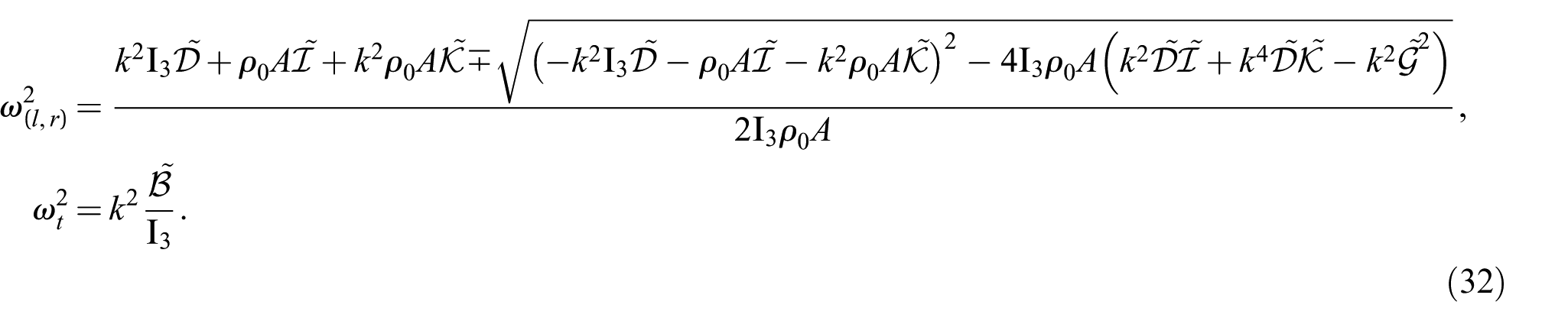
Note that the torsional mode is decoupled from the remaining two since the coupling constants

5. Deducing stiffnesses of chiral nanotubes using phonon dispersion data from molecular simulation
We saw in the preceding section that due to the structure of matrix

We shall use this equation in an inverse way to obtain the five parameters. We first generate phonon dispersion curves from molecular simulation as described in Appendix B. We then take three frequency data corresponding to three different wavenumbers of bending mode and two data from the shearing mode and further substitute them in the above characteristic equation to get five nonlinear equations for the five unknown parameters. 6 The nonlinear equations are then solved using the Newton–Raphson method.
The characteristic equation corresponding to longitudinal and torsional modes cannot be used to obtain the three stiffnesses (
5.1. Extracting (
) from atomic displacements
In the case of longitudinal, torsional, and radial breathing modes, only (

The quantity

Here,

Here, “
To extract

Here,
Finally, to obtain

5.2. Deducing stiffnesses (
) of chiral nanotubes
As only the submatrix

Finally, we take one frequency data each from longitudinal and torsional phonon dispersion data, extract the corresponding mode shape and substitute them into the above equation to get a total of four equations for the three unknowns. We then solve this system using a least-squares method to obtain all the stiffnesses.
5.3. Deducing stiffnesses (
)
The inflation stiffness

From the phonon solution, we then take one frequency data each from longitudinal, torsional, and radial breathing modes and also extract the corresponding mode shapes. These frequencies and mode shapes are then substituted in the above equation to get a total of nine equations for the six unknowns. Finally, we solve this system using a least-squares method to obtain all the stiffnesses. Note that one cannot obtain the six unknown stiffnesses by forming a system of six equations using just the longitudinal and torsional mode data. This is due to the fact that these two modes are insensitive to
6. Deducing stiffnesses of SWCNTs from phonon dispersion curve
We now deduce stiffnesses of both achiral and chiral SWCNTs using the methodology presented in the preceding section. The phonon dispersion curves are obtained using the SWCNT’s two-atom helically repeating cell. The readers are requested to go through Appendix B in order to get familiar with the notation used in this section. Owing to the presence of a group generator g (see Appendix A) in longitudinal, torsional, and radial breathing phonon modes, the summation in Section 5.1 could be done over just the two-atom repeating cell of the SWCNT instead of all atoms in the cross-section. The Tersoff–Brenner potential [31] is used to model interactions between carbon atoms. For the stiffnesses of the special Cosserat rod model, we compare our results with those obtained using the HCB rule of [7]. Similarly, for the general Cosserat rod stiffnesses, we compare our results with those obtained in [32].
6.1. (10,10) SWCNT
To generate a (10,10) stress-free SWCNT using two-atom basis, the following group generators are used:
6.1.1. Stiffnesses in the stress-free configuration
Let
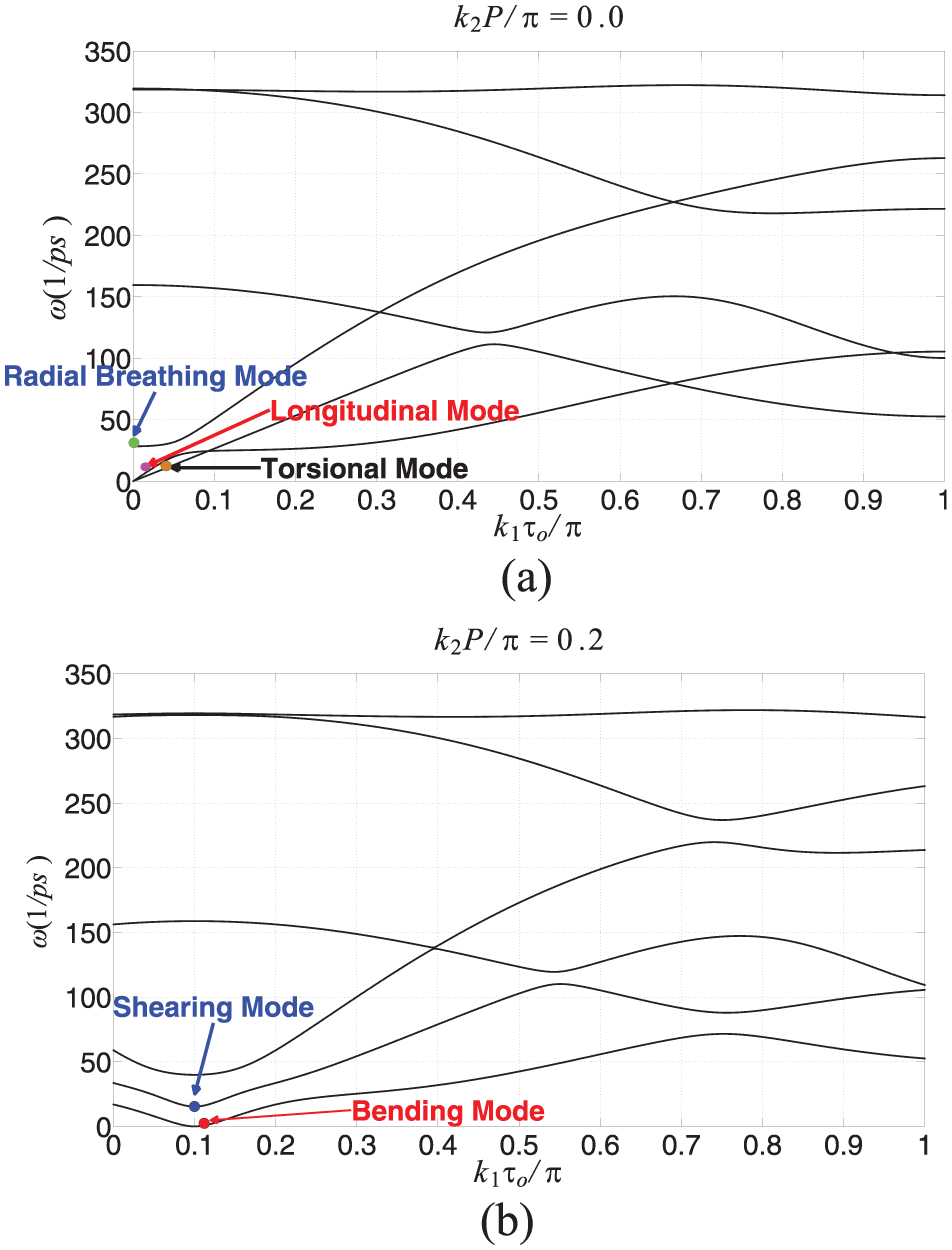
Phonon dispersion curves of a (10,10) stress-free SWCNT depicting (a) longitudinal, torsional, and radial breathing modes and (b) shearing and bending modes.
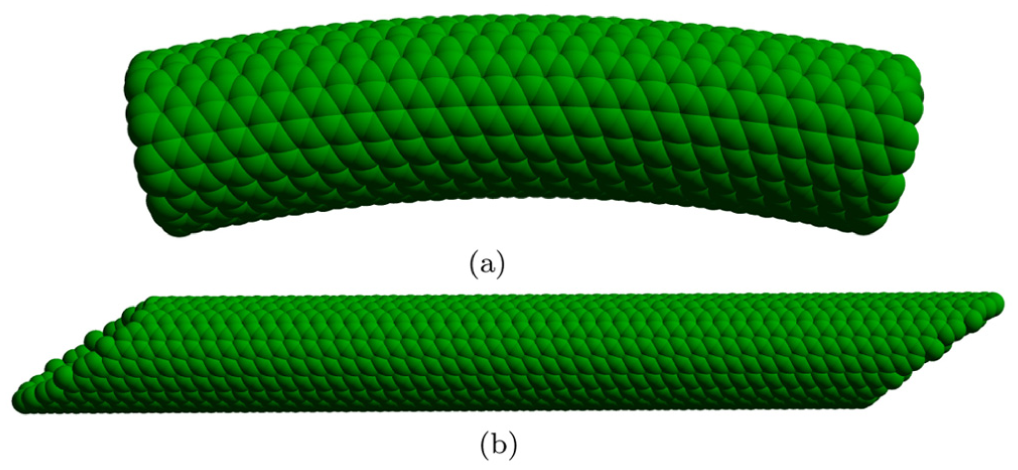
(a) Bending mode observed in the lowest branch of Figure 2(b) at
In the case of longitudinal, torsional, and radial breathing modes, the continuum wavenumber k is the same as
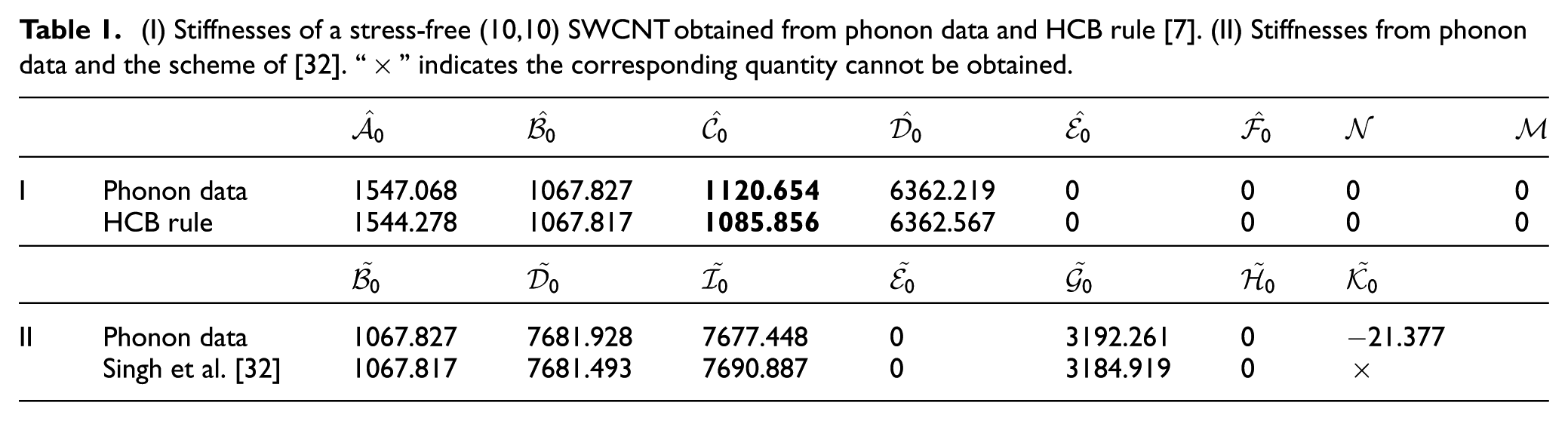
There is a slight difference in only shearing stiffness of about 3% (marked in bold in Table 1). To investigate this discrepancy, we obtained shearing stiffness using our approach for arm-chair SWCNTs of different radii, normalized these values with those obtained from HCB rule and present in Figure 4(a). It can be observed that with increasing nanotube radius, the difference between the two approaches becomes insignificant. This difference may be existing because the phonon approach is based on linearized dynamics while the HCB rule is based on static energy minimization. 10
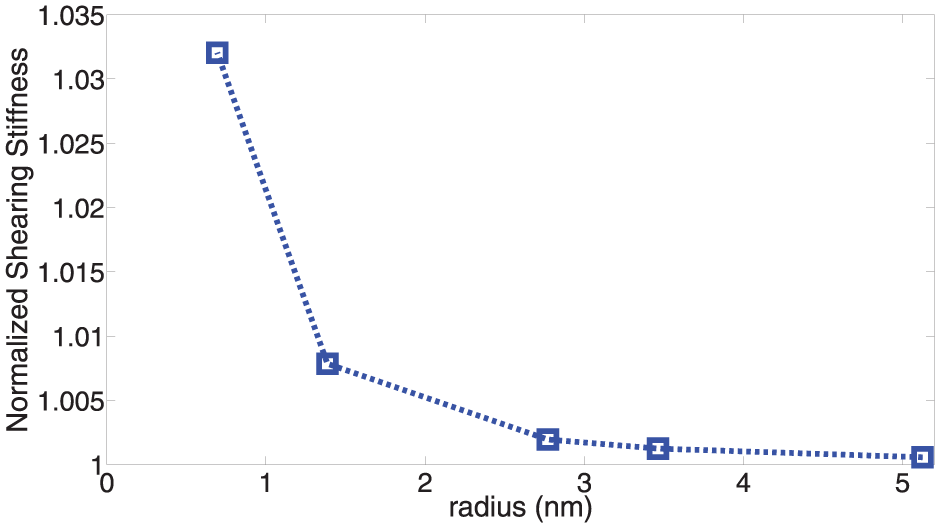
Normalized shearing stiffness versus radius in arm-chair SWCNTs of different radii.
6.1.2. Stiffnesses in uniformly twisted configuration
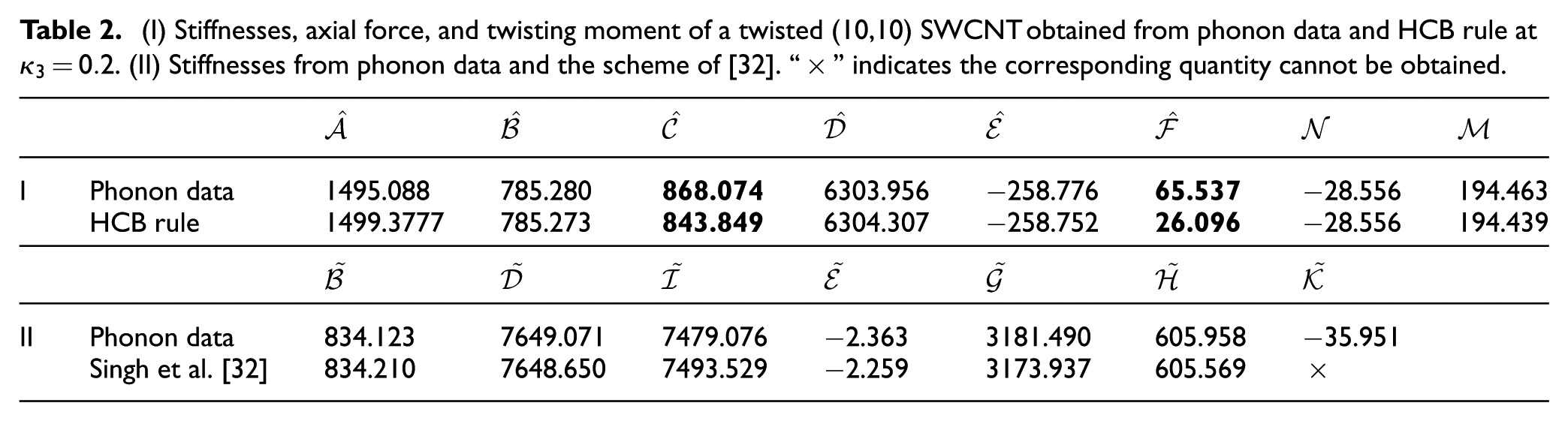
We now evaluate various stiffnesses for the twisted (10,10) nanotube at
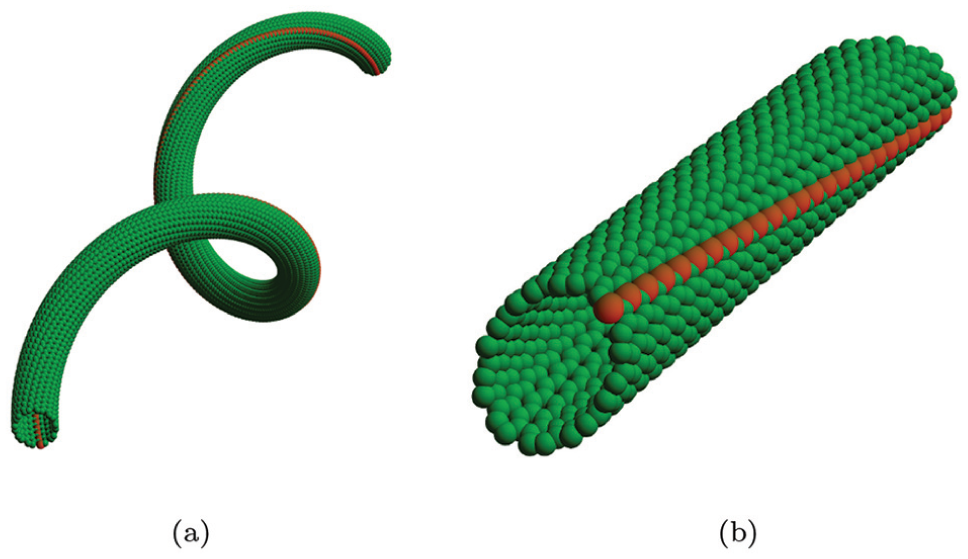
(a) Out-of-plane bending mode and (b) shearing mode in a twisted (10,10) SWCNT.
(I) Stiffnesses, axial force, and twisting moment of a twisted (10,10) SWCNT obtained from phonon data and HCB rule at
6.2. Stress-free chiral (10,7) SWCNT
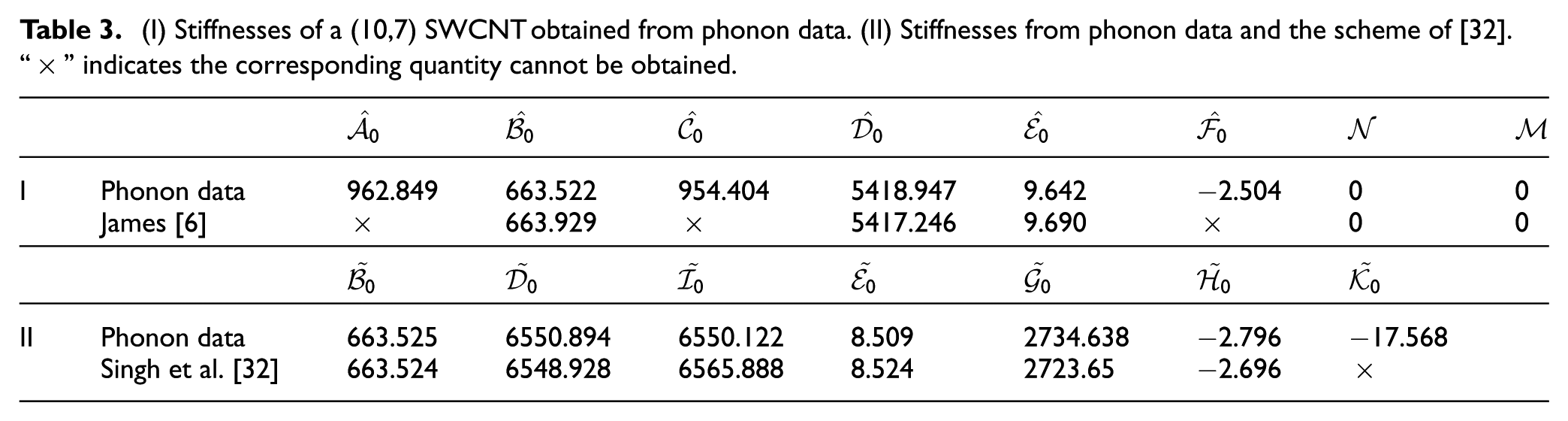
We finally take up the example of a (10,7) chiral nanotube and evaluate its stiffnesses in the stress-free configuration. The group parameters in this case are
(I) Stiffnesses of a (10,7) SWCNT obtained from phonon data. (II) Stiffnesses from phonon data and the scheme of [32]. “×” indicates the corresponding quantity cannot be obtained.
7. Unusual effects of extension and torsion on phonon dispersion curves of (10,10) SWCNTs
We now present some interesting effects of extension and torsion on phonon dispersion curves of (10,10) SWCNTs and further show that they are accurately replicated using our continuum formulas.
7.1. Coupling of longitudinal, torsional, and radial breathing modes
We note from equation (30) that the longitudinal, torsional, and radial breathing modes get coupled when the coupling stiffnesses

which characterizes the wavenumber at which the two modes transition into one another. This transition phenomena has also been reported earlier [35]. However, the analytical formula at which this transition occurs has been missing. We note from Figure 6(a) that the dispersion curves as well as the transition point are very well replicated using our general Cosserat rod continuum model. In Figure 6(b), we again look at these dispersion curves but for the twisted state of the SWCNT. Owing to twist, all three modes get coupled to each other now. Again, our general Cosserat rod continuum model accurately replicates the phonon dispersion molecular data. We are not reporting the continuum formulas for the two transition points (longitudinal↔radial and radia↔torsional) though since they turn out to be very long. However, their numerical values match with the ratio obtained from molecular data. We find that the lowest branch transitions from torsional to radial breathing mode; the second lowest branch transitions from longitudinal to radial breathing mode and then finally to torsional mode while the third branch transitions from radial breathing to longitudinal mode. Another point to note is that the special Cosserat rod model (as per equation (17)) fails to capture the trend from molecular data at high wavenumber.
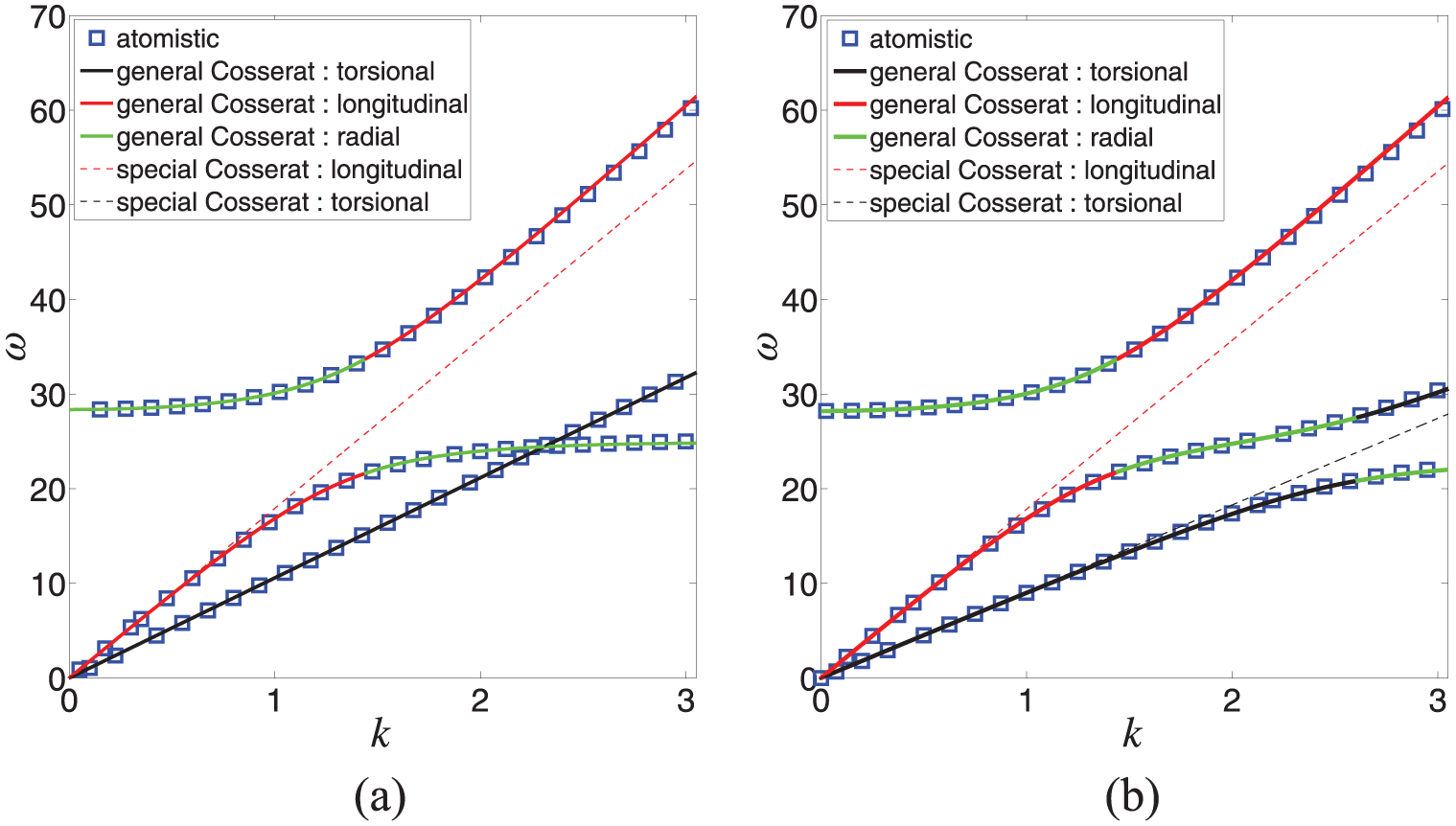
Longitudinal, torsional, and radial breathing modes of a (10,10) SWCNT: (a) stress-free configuration; (b) twisted configuration (
To get an idea of the three frequencies and the transition point in terms of material constants, we think of stress free achiral SWCNTs as a linearly isotropic thin tube for which the formulas of various stiffnesses are already available [32]. We report the same here:

Here,

The radial breathing mode frequency further simplifies to the following in long wavelength limit:

The inverse dependence of radial breathing mode frequency on tube’s radius is well known [20]. We also find the transition wavenumber in equation (42) to be inverse of the tube’s radius, i.e.,

7.2. Effect on bending phonon frequency
We now discuss the effect of extension, compression, and twist on bending phonon dispersion curve. We first consider the effect of extension. In Figure 7, we present this dispersion curve obtained using atomistic calculation as well as by solving equation (34). Both continuum and atomistic data match pretty well. We also observe that the dispersion curve has non-zero slope at
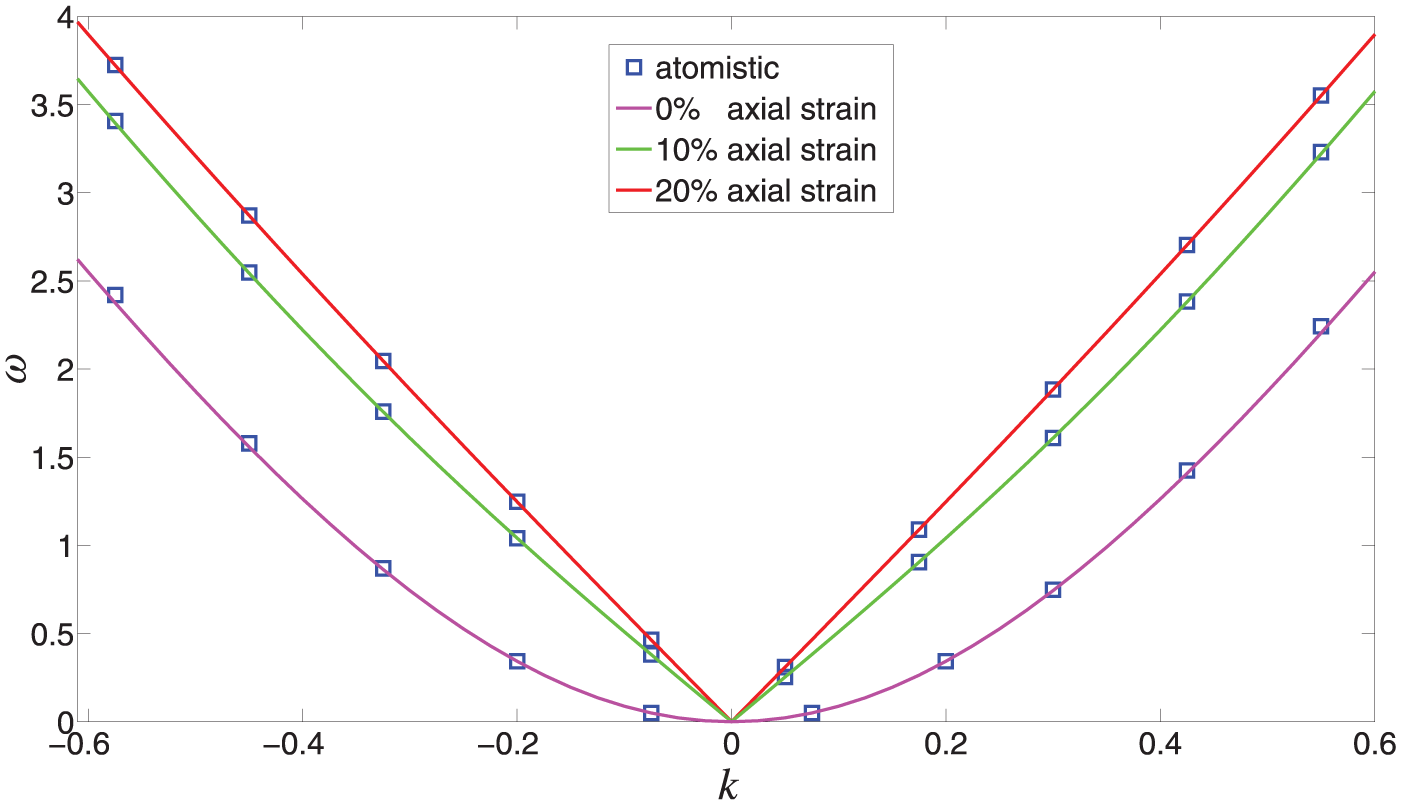
Bending frequency in the stress-free and axially stretched state.
We then consider the bending dispersion curve in compressed and twisted state. We again note from Figure 8 that continuum and atomistic results match pretty well. We are presenting the square of bending frequency here which exhibits unusual pattern. In compressed state, the dispersion curve is symmetric about
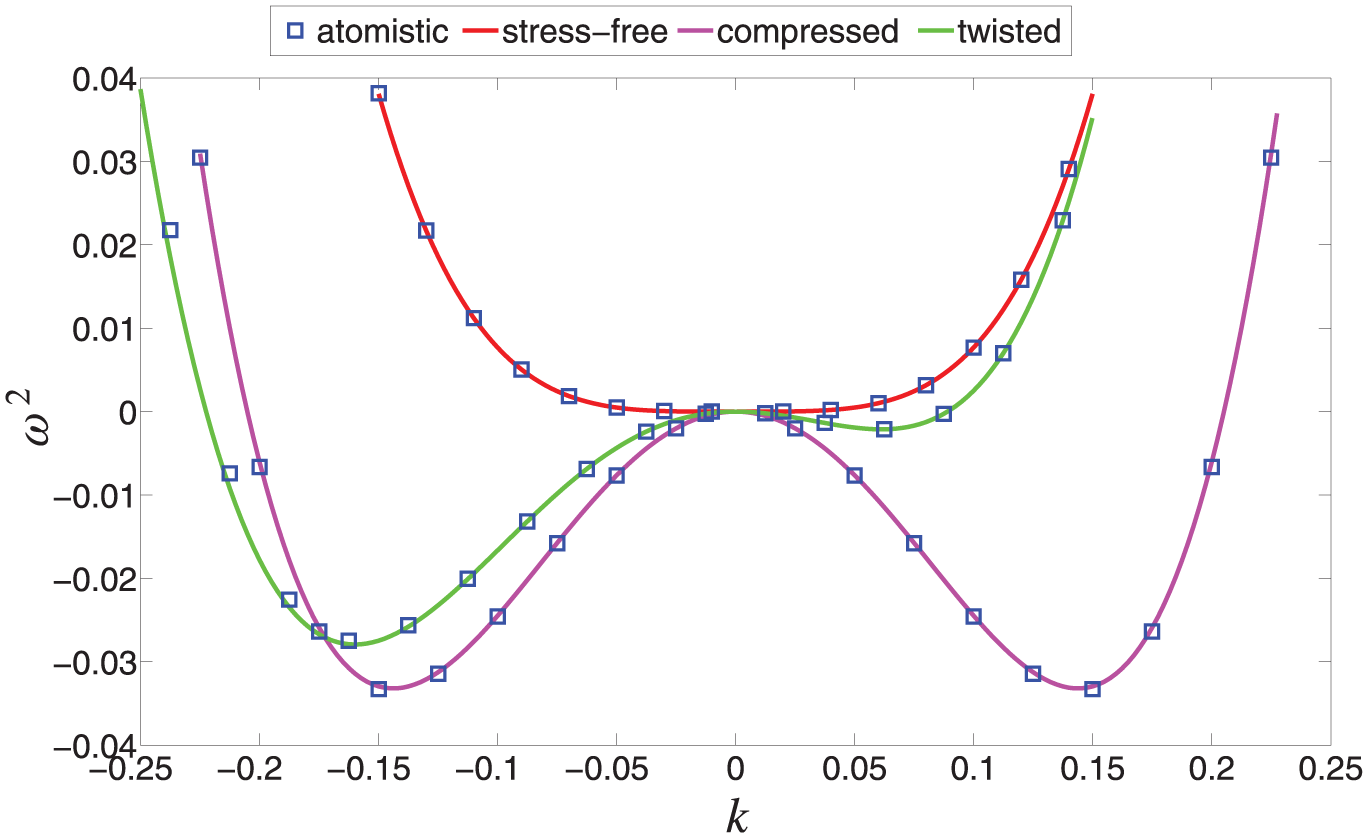
Bending frequency in the stress-free, axially compressed (
Finally, using the continuum formula for bending frequency, we also obtained the wavenumber at which

All bending phonons having wavenumber less than the above value are unstable. In fact, this instability is related to Euler buckling of clamped–clamped rods. As the nanotube is compressed and twisted, all phonons having wavelength larger than the critical buckling length corresponding to the induced compressive force and twisting moment will automatically become unstable owing to Euler buckling. Conversely, the formula (47) can also be used to find the buckling load of compressed and twisted continuum rods or nanotubes of length
7.3. Instability in torsional mode at large twist
We now show in Figure 9(a) the effect of twisting a nanotube on its torsional dispersion curve. The continuum solution here corresponds to torsional wave solution of the general Cosserat rod model. We note that the continuum and atomistic solutions match pretty well. They start to deviate at higher wavenumber though. An interesting point to note is the negative values for
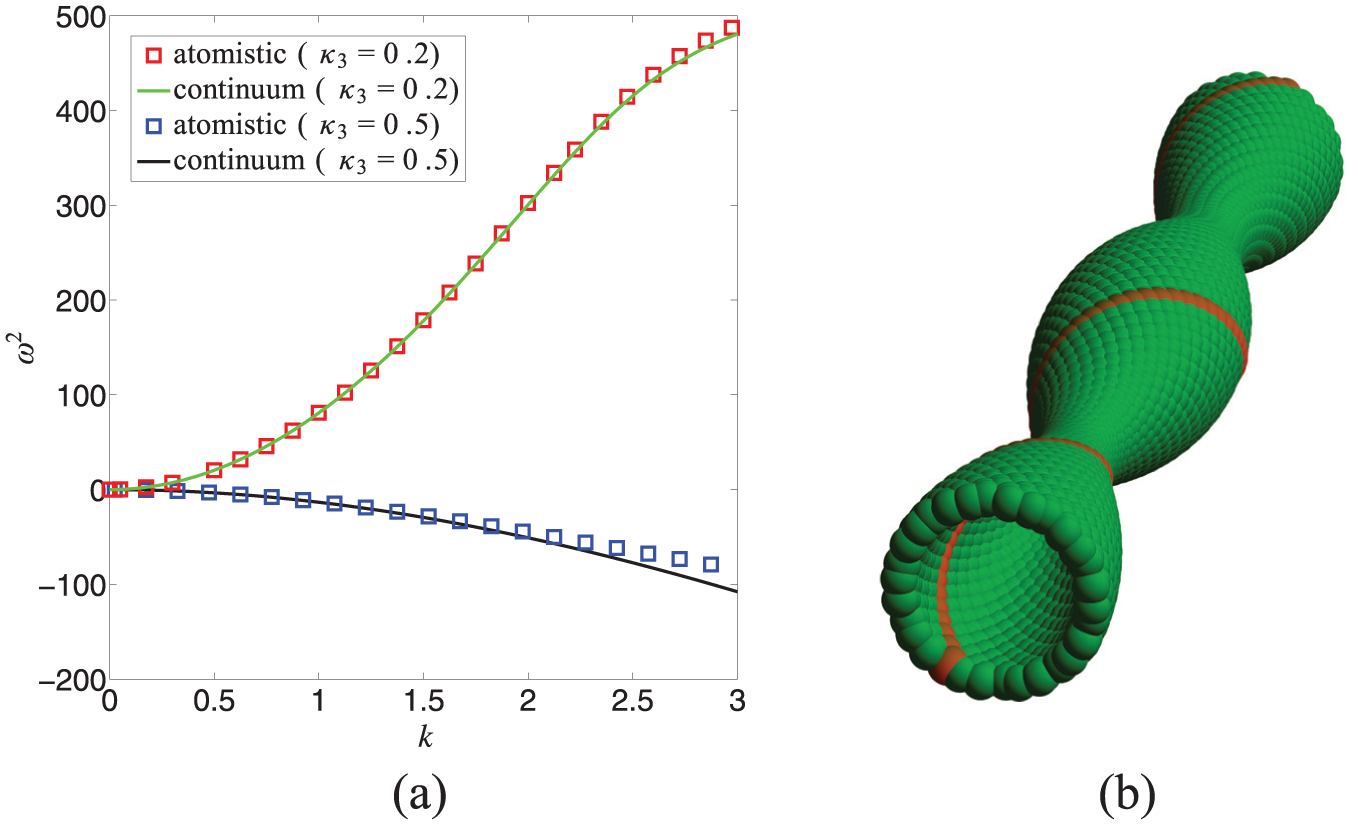
(a) Torsional dispersion curve in twisted state. (b) Phonon mode shape for
8. Conclusions
We have presented a novel technique to obtain stiffnesses of chiral nanorods and nanotubes modeled as Cosserat rods from their phonon dispersion curves. The approach is straightforward having no end effects as prevalent in several existing techniques. We have also derived continuum wave solutions in chiral Cosserat rods for longitudinal, torsional, bending, shearing, and radial breathing modes and obtained formulas for their frequencies in terms of the rod’s stiffnesses as well as the induced axial force and twisting moment. Along the way, we have derived the dynamic equation corresponding to inflation of tubes in Appendix A. Our study allows a clearer understanding of how the rod’s coupling stiffnesses (extension–torsion–inflation and bending–shearing couplings) as well as twisting of the rod lead to coupling of various wave modes in continuum tubes and that of phonon dispersion modes in nanorods and nanotubes. We also saw unusual effects of stretching and twisting a nanotube on its phonon dispersion curves which we were able to reproduce accurately using our continuum formulas. Finally, the continuum formulas derived could be useful in tuning the dispersion curves by changing the nanostructures’s stiffness properties as well as by stretching and twisting a nanostructure. Such tunings could be potentially useful in blocking or facilitating waves of certain frequency range to pass through these structures.
Footnotes
Appendix A. Derivation of the dynamic equation corresponding to inflation
Appendix B. Generating phonon dispersion curves for SWCNTs
In this appendix, we present how to generate phonon dispersion curves of stretched and twisted SWCNTs by using helical symmetry inherent in them. The whole SWCNT can be generated using its two-atom basis and applying helical symmetry operations to it. If we denote by
Here
Here
Here (
For illustration, we present the phonon dispersion curves obtained using the two-atom basis as well as using the periodic unit cell for a (10,10) SWCNT in Figure 10. The periodic unit cell methodology has 40 atoms per unit cell and accordingly it has 120 branches for every wave vector. It is just that in case of periodic unit cell, the wave vector is a scalar whereas in case of two-atom basis, the wave vector has two components (
Funding
The author(s) disclosed receipt of the following financial support for the research, authorship, and/or publication of this article: P Gupta acknowledges the financial support received from a DST-INSPIRE fellowship and A Kumar acknowledges the support from SERB, India (grant number YSS/2014/000023).
