







Abstract
An analytic stress solution is presented for a circular tunnel problem in a half plane with a concentrated force acting on any position in the field under gravity. The solution uses the complex variable method and the power series method. The influence of the unbalanced force system on the tunnel boundary is considered. The relationship between two analytic functions is established by using surface stress boundary condition. The analytic functions can be determined from the tunnel stress boundary condition. Based on the principle of superposition, the stresses of the surrounding rock can be calculated by superimposing three partial solutions which are obtained separately. The examples give contour plots of the principal stresses in the surrounding rock, focus on the stress distribution on the ground surface and the tunnel boundary and analyze the effect on the stress distribution of some main parameters.
1. Introduction
In tunnel engineering, as an economical and practical support method, rockbolts can effectively improve the bearing capacity and control the deformation of surrounding rock, which is widely used in practical engineering [1–5]. When addressing the issue of a tunnel with point anchored rockbolts, the rockbolts are usually simplified as two identical concentrated forces of opposite direction applied at the head and at the anchor points [1]. Moreover, when a tunnel is deeply buried, the problem can usually be simplified to an infinite plane strain problem. On this premise, Bobet [1] obtained the analytic solution for a circular tunnel in an infinite plane with a concentrated force, and then obtained the approximate solution of point anchored rockbolts in deep tunnels. When the depth of the tunnel is shallow, the problems become more complex to solve.
When the tunnel is buried at a shallow depth, the body force of rock mass should be considered, and the ground surface must be considered as a boundary. This kind of problem can only be simplified to a half plane problem. For the problem of shallow circular tunnels, Mindlin [6] first used a bipolar coordinate system to obtain the stress solutions of this problem under certain lateral stress coefficients. Verruijt et al. [7–9] obtained an approximate solution by mapping the region in the z plane onto an annulus region in the ζ plane with the help of conformal mapping method. In order to reflect the unbalanced force system caused by excavation, certain terms were added into the complex potential functions. But the problem was solved based on the displacements specified along the tunnel boundary, which cannot reflect the true situation of tunnel excavation. On the basis of Verruijt’s researches, Lu et al. [10] obtained the analytic solution of the problem by using the stress boundary condition along the tunnel boundary, which is more in line with the actual situation.
However, the above studies [6–10] only considered the body force of the rock mass without other loads. The situation becomes more complicated when loads are applied in the ground surface or the half plane domain. Flamant [11] firstly gave the stress expression for the case of a concentrated force acting on the half plane surface, namely Flamant’s solution. The classical stress solution for an elastic half plane loaded by a concentrated force was given by Melan as early as in 1932 [12]. For the problem of half plane weakened by a circular hole and with a concentrated force applied to the surface boundary, Proskura et al. [13] gave the stress and displacement fields for this problem using the bipolar coordinate system. Furthermore, for an elastic half plane with a tunnel loaded uniformly on the surface boundary, Yu et al. [14,15] and Fang et al. [16] presented an analytic solution for a circular tunnel to calculate the stress field and the settlement of the ground surface by using complex variable method. Kuliyev [17] presented an analytic solution for an elliptic hole with two rectilinear cracks based on the complex variable method and the principle of superposition. However, when a concentrated force acts on any position in the half plane, the solution process becomes more complicated and the exact analytical solutions for the problem are still unavailable in the current literatures.
Therefore, in this paper, an analytic solution is presented for a circular tunnel with a concentrated force acting at any position in the half plane. The solution considered the interaction of gravity and concentrated force in rock mass and the influence of the unbalanced force system caused by excavation based on the complex variable method and the principle of superposition. The mapping function and complex potential function proposed by Verruijt et al. [7–9] were adopted. The proposed analytical solution has great value for the conceptual understanding of the mechanical behavior of a shallow circular tunnel with a concentrated force. Furthermore, it can also be applied in solving the problem of point anchored rockbolts in circular shallow tunnels.
2. Statement of problem and basic equations
2.1. Statement of problem
There is a circular tunnel with radius
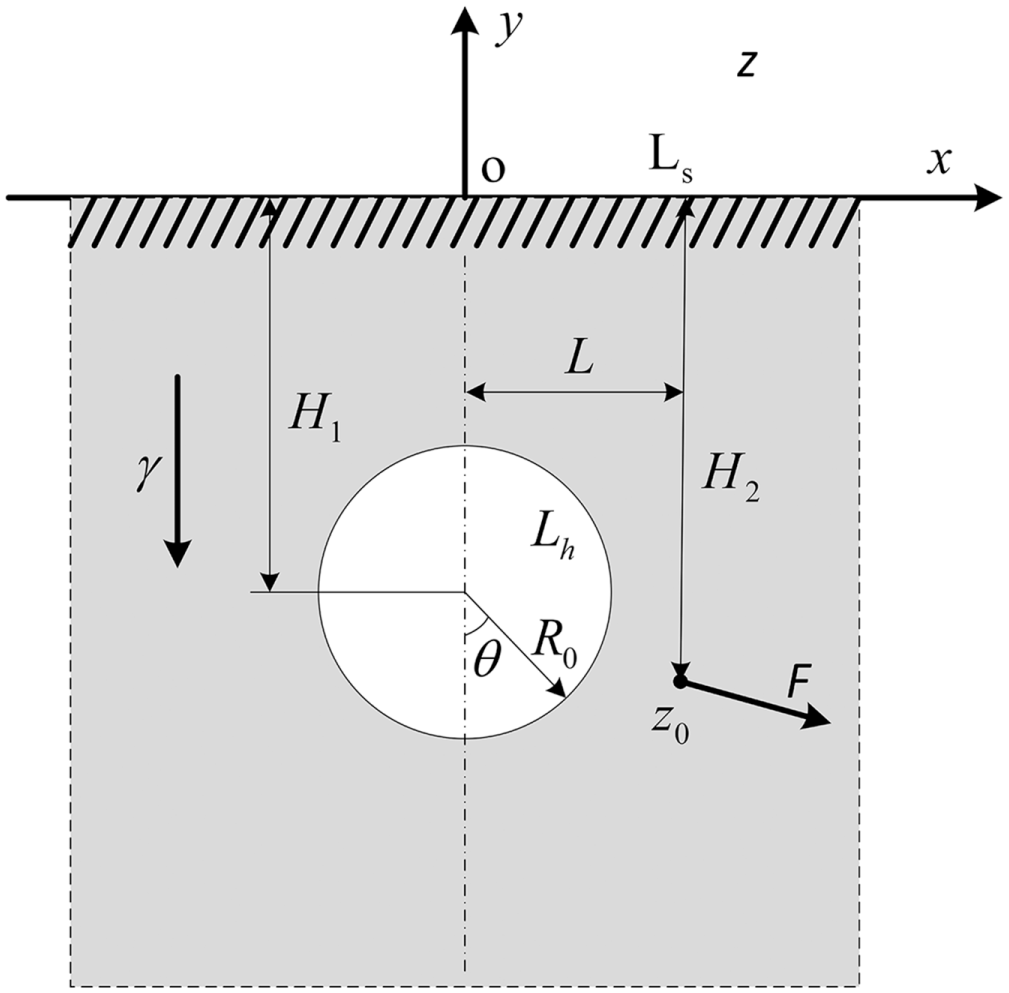
Circular tunnel in a half plane with a concentrated force.
2.2. Relationship between
and
For the two-dimensional elasticity problem, the stress boundary conditions can be described by two analytic functions,

where
When no force acts on the surface boundary and let C = 0, the stress boundary condition on the ground surface is

It can be obtained from equation (2) that

On the ground surface (y = 0), the imaginary part of any point z is zero, so

Equation (4) satisfies the stress boundary condition of the ground surface and the expression of

The analytic function

where
2.3. Conformal mapping to an annulus
Using the conformal mapping in the complex variable method, the region in the z plane can be mapped onto an annulus in the ζ plane, bounded by the circles

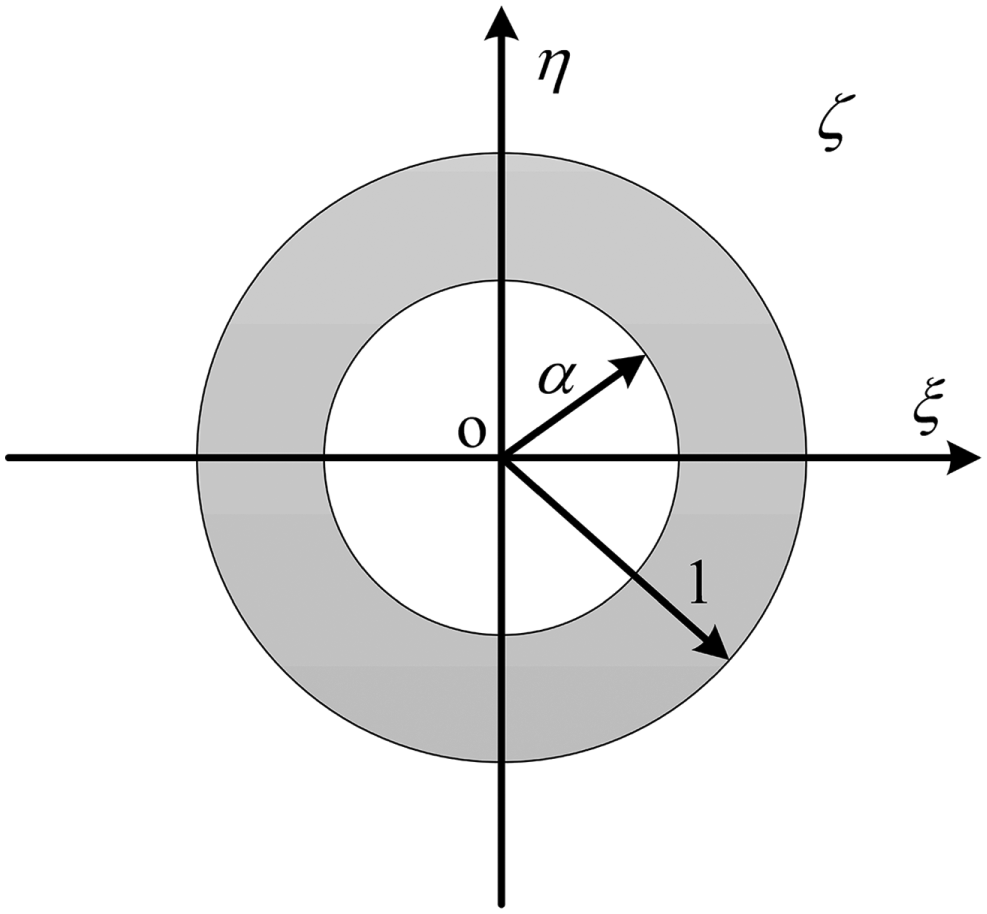
Plane of conformal transformation.
where

Through mapping function

3. The solving process
The solution of this problem can be obtained by the superposition of three partial solutions: The first part is the solution of a shallow circular tunnel under the action of gravity (Figure 3(a)). The second part is the solution of a concentrated force F acting at any point in the half plane without considering gravity and tunnel (Figure 3(b)). The process of excavation can be regarded as eliminating the forces along the boundary, or applying the equal but opposite surface traction on the boundary. Let
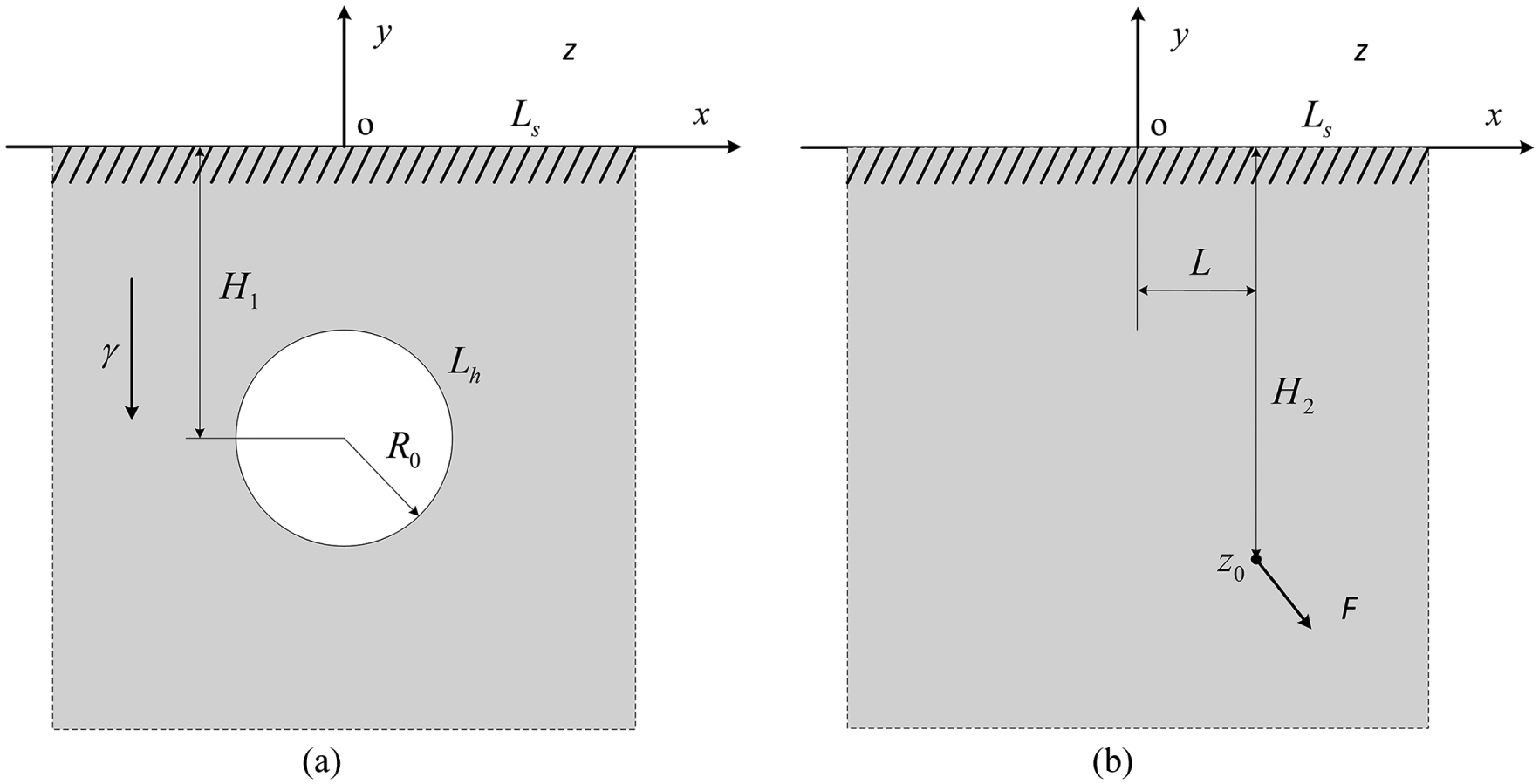
(a) Half plane with a circular tunnel. (b) Half plane with a concentrated force.
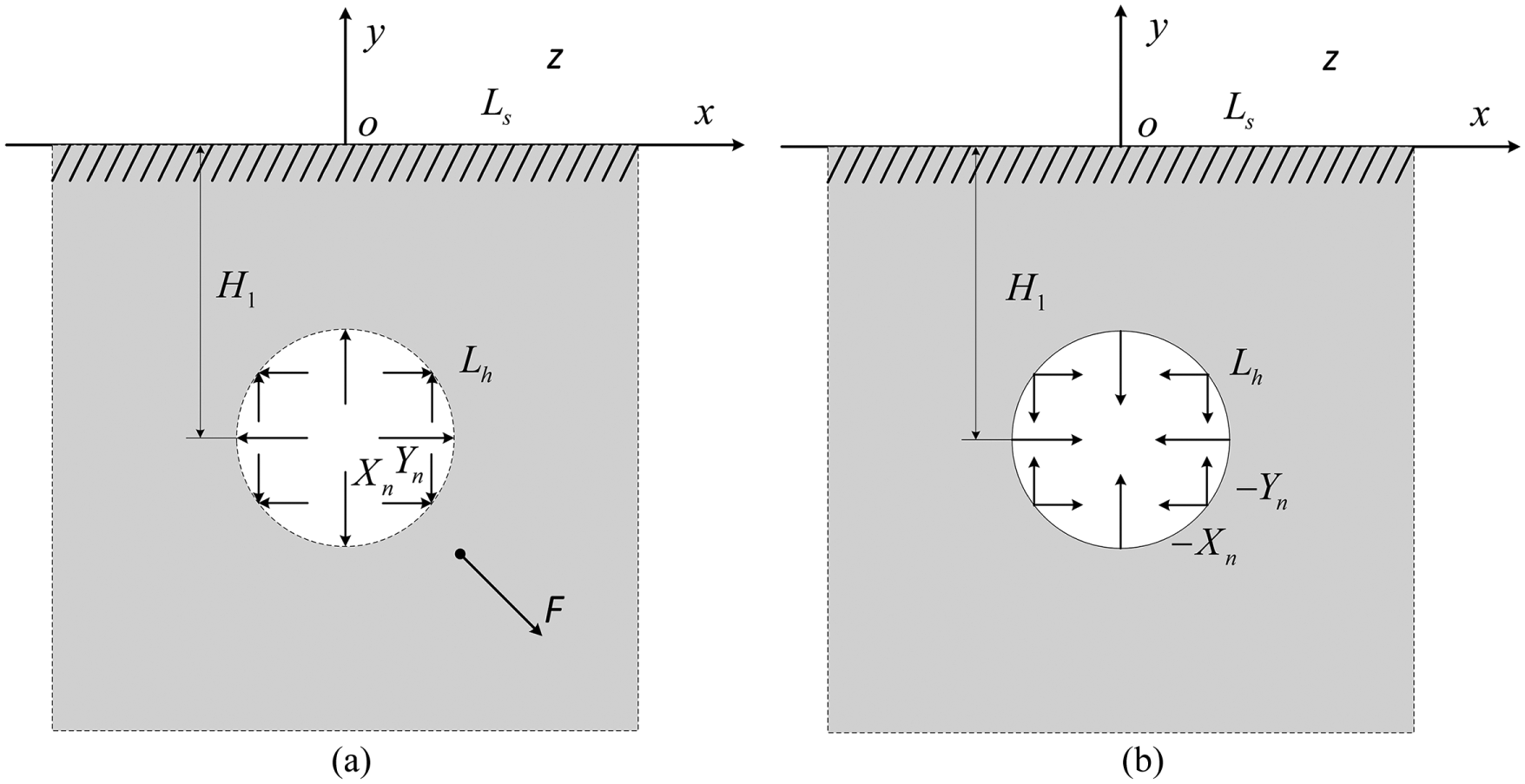
(a) Surface force components caused by the concentrated force acting on the proposed excavated boundary. (b) Applied equal and opposite surface force components on the boundary.
3.1. First partial solution
Before excavation, the stress distribution in the half plane is

where
Excavation of a tunnel is equivalent to applying the equal but opposite surface traction on the boundary. Under the action of the surface traction without considering the gravity, the analytic function

where
3.2. Second partial solution
For the second part, Melan [12] has given the stress expressions for the problem. However, Melan didn’t use the complex variable method so that the analytic function
It’s difficult to solve the problem directly by the complex variable method. Therefore, assume that there is a virtual circular hole with the point
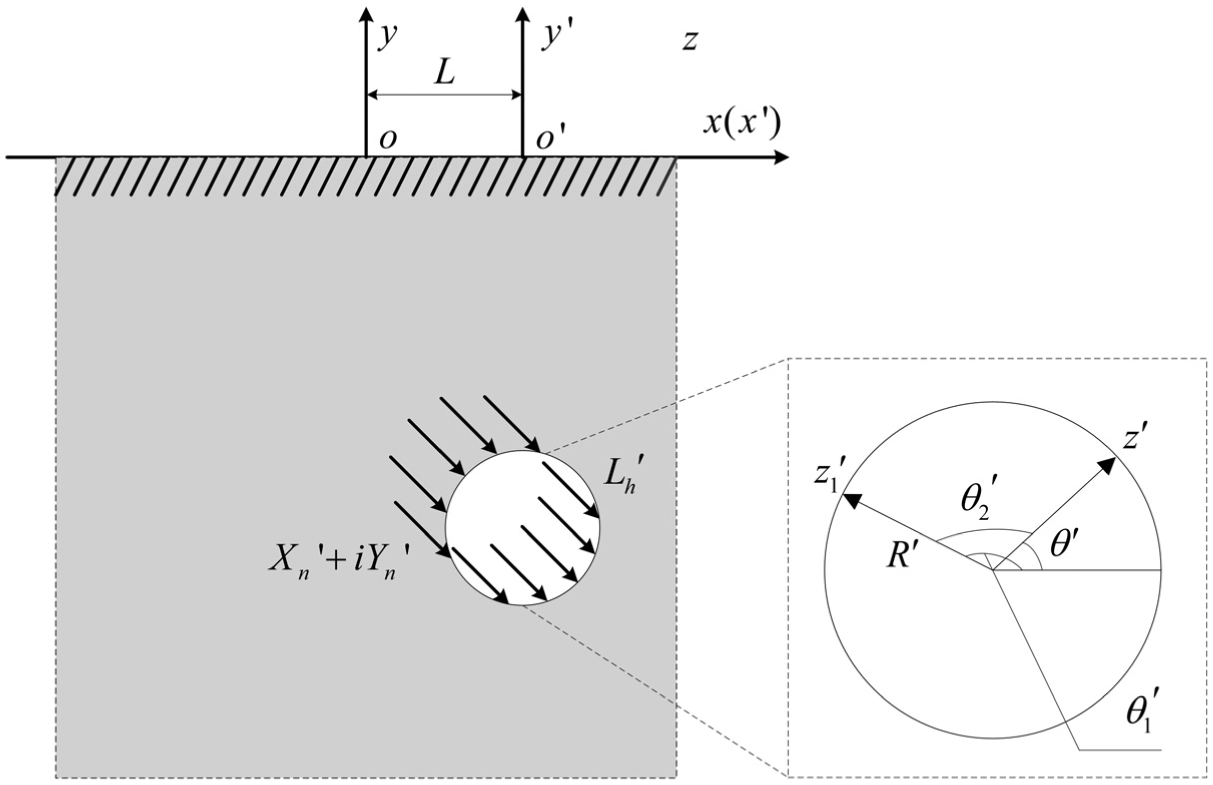
Parallel surface forces acting on the virtual circular hole.
A new coordinate system

where
Let the complex potential function corresponding to the case shown in Figure 5 is

where the expression of

Substituting equations (12) and (14) into equation (13) gives
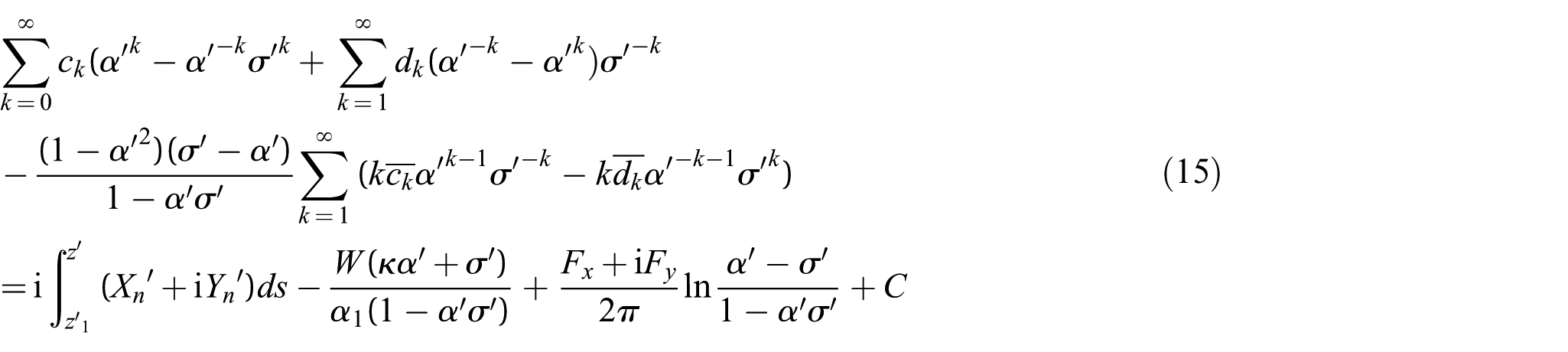
where
From Figure 5, we have

From equation (16), we have

If

Substituting equation (18) into equation (17) gives

where C is a complex constant. From equation (19), we have

Substituting equation (20) into equation (15) gives
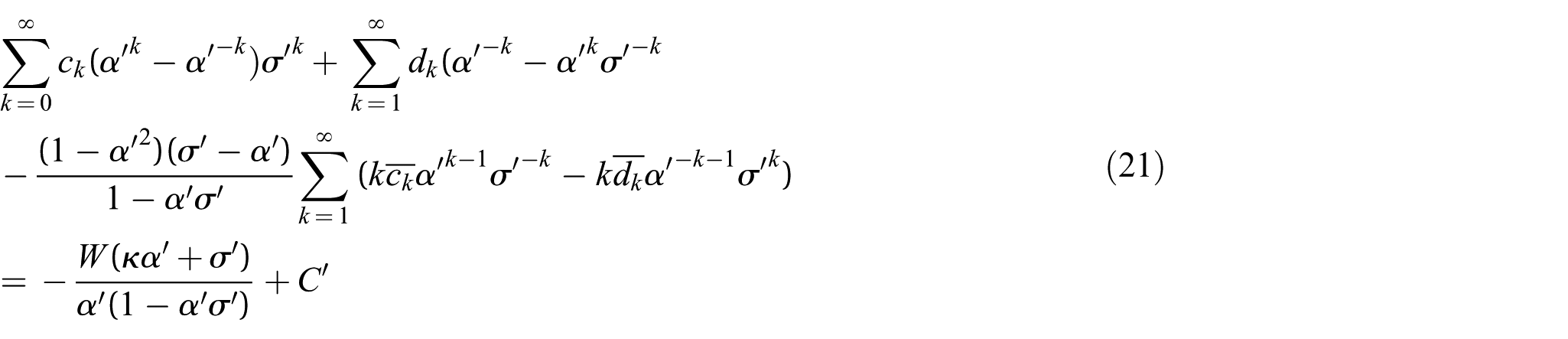
In order to solve the problem more easily, multiplying both sides of equation (21) by
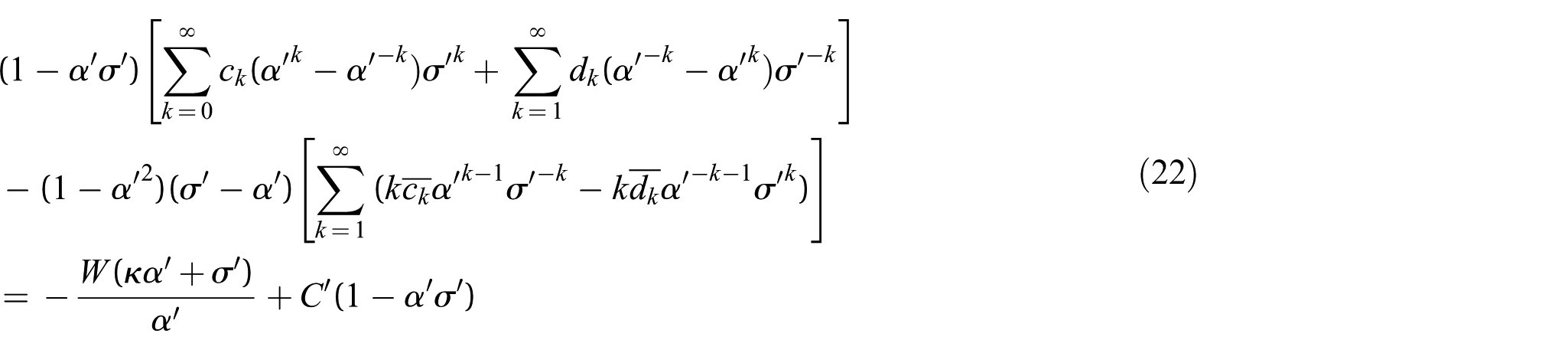
Comparing the coefficients of






From equations (25) and (28), the equation without the unknowns

Assuming that the highest positive and negative powers of

Therefore, only the following equations need to be solved:

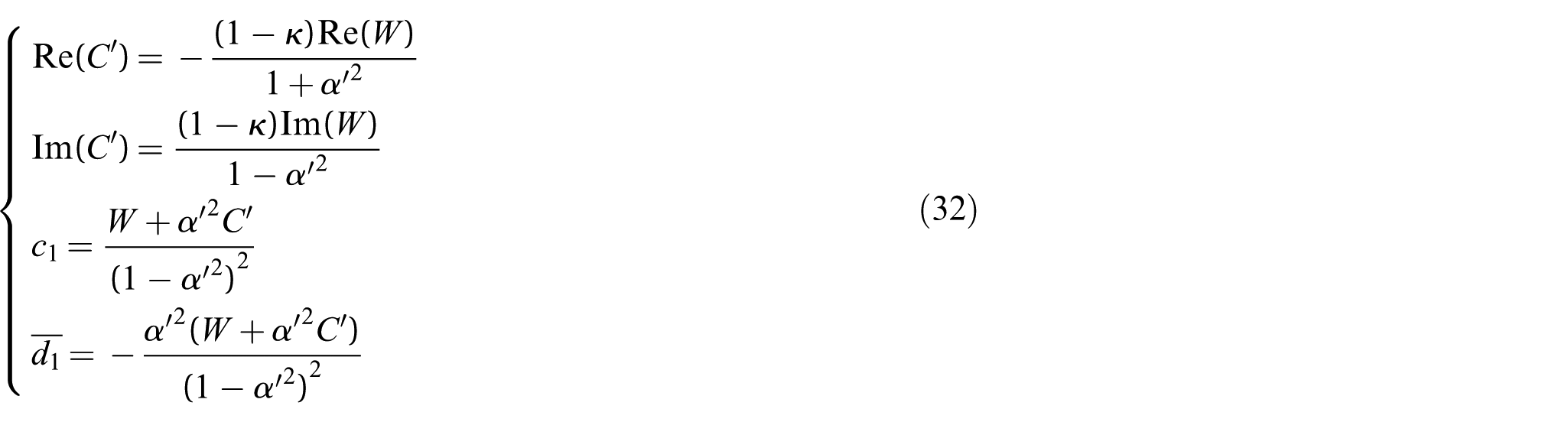
From equation (31), we have
When the radius

Therefore, the derivative of

Due to the stress components at each point are independent of the translation of the coordinate system, the expression of

Integrating equation (35) and neglecting the integral constant which does not affect the stress, we have

Equation (36) is the complex potential function in the second part.
3.3. Third partial solution
For the second part, the following equation is established on the boundary


Moreover,

Substituting equation (38) into equation (39), we have

Multiplying both sides of equation (21) by

Substituting equations (7) and (36) into equation (41), we have

The expressions for
Comparing the coefficients of σ in both sides of equation (42), the following equations can be obtained:




From equations (45) and (46), we have

Assuming that the highest positive and negative powers of ζ in

where

4. Solving formulas for stresses
Superimposing three parts of the complex potential functions:

The stress components


Substituting equation (4) into equation (52) gives

Superimposing

The stress components

where
5. Discussion on accuracy
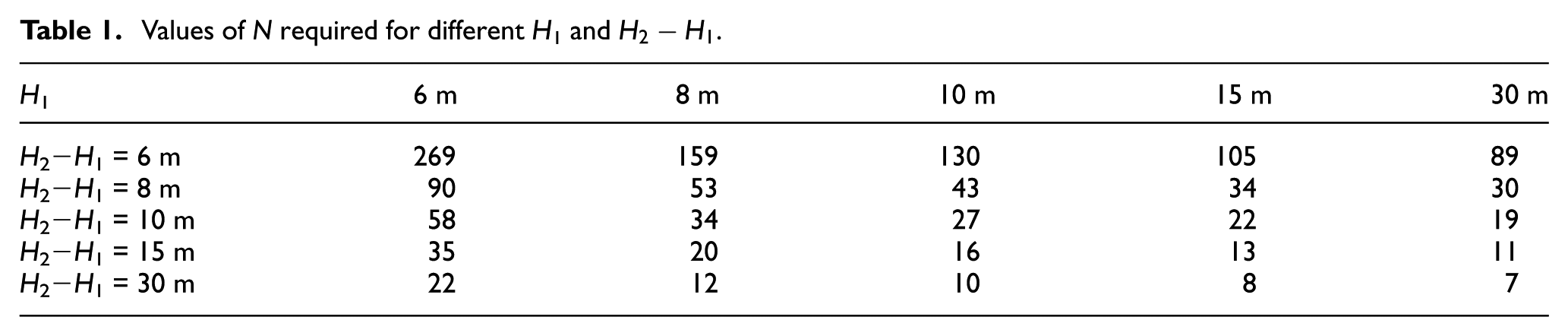
The analytic function

Let μ = 0.3,
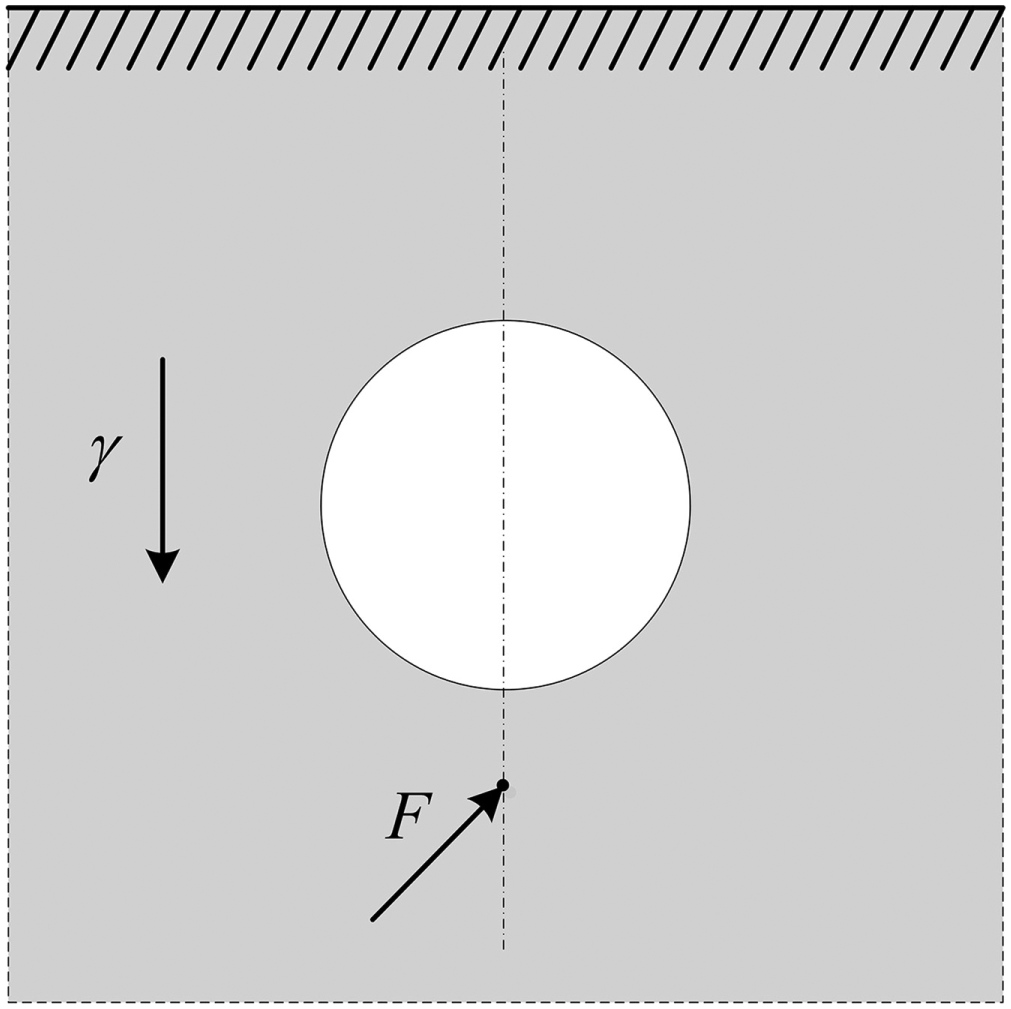
Concentrated force acting in the half plane.
Values of N required for different H1 and
6. Examples
6.1. The principal stresses of surrounding rock
The following example discusses the case of a vertical downward concentrated force acting at coordinate origin o. The specific parameters are shown in Table 2. The tensile stress is positive and the compressive stress is negative in this paper.
Specific parameters for calculation of principal stresses.

The principal stresses

Figures 7 and 8 show contour plots of principal stresses
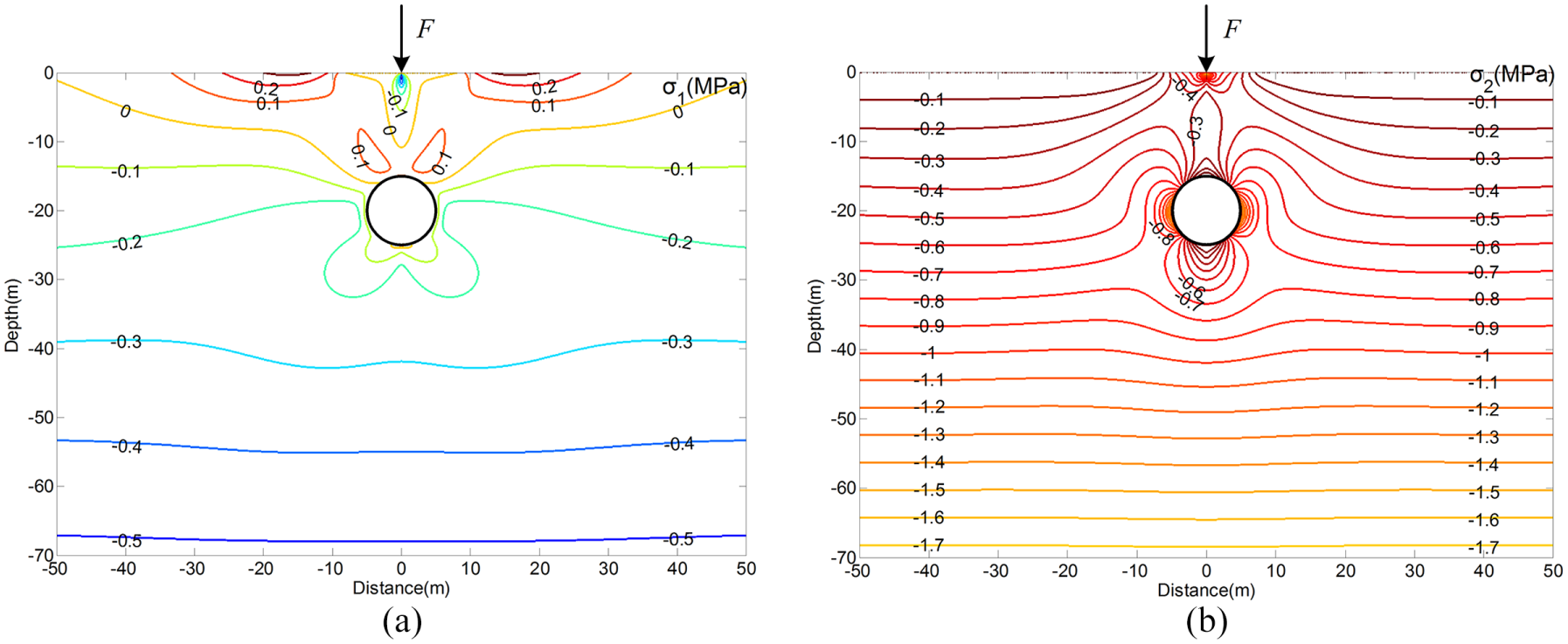
For k0 = 0.3, contour plots for the principal stresses: (a) major principal stress σ1; (b) minor principal stress σ2.
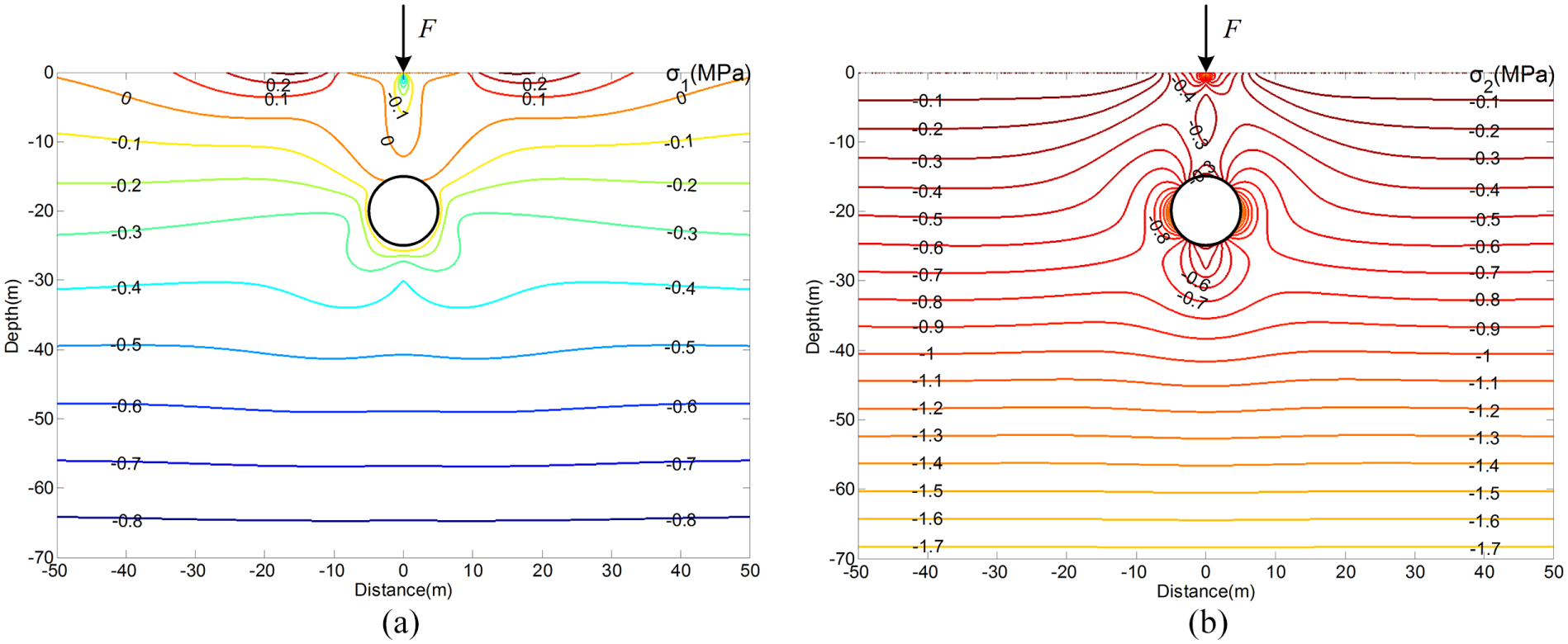
For k0 = 0.5, contour plots for the principal stresses: (a) major principal stress σ1; (b) minor principal stress σ2.
6.2. Effect of depth H1 on stress
Figure 9 presents the tangential stress
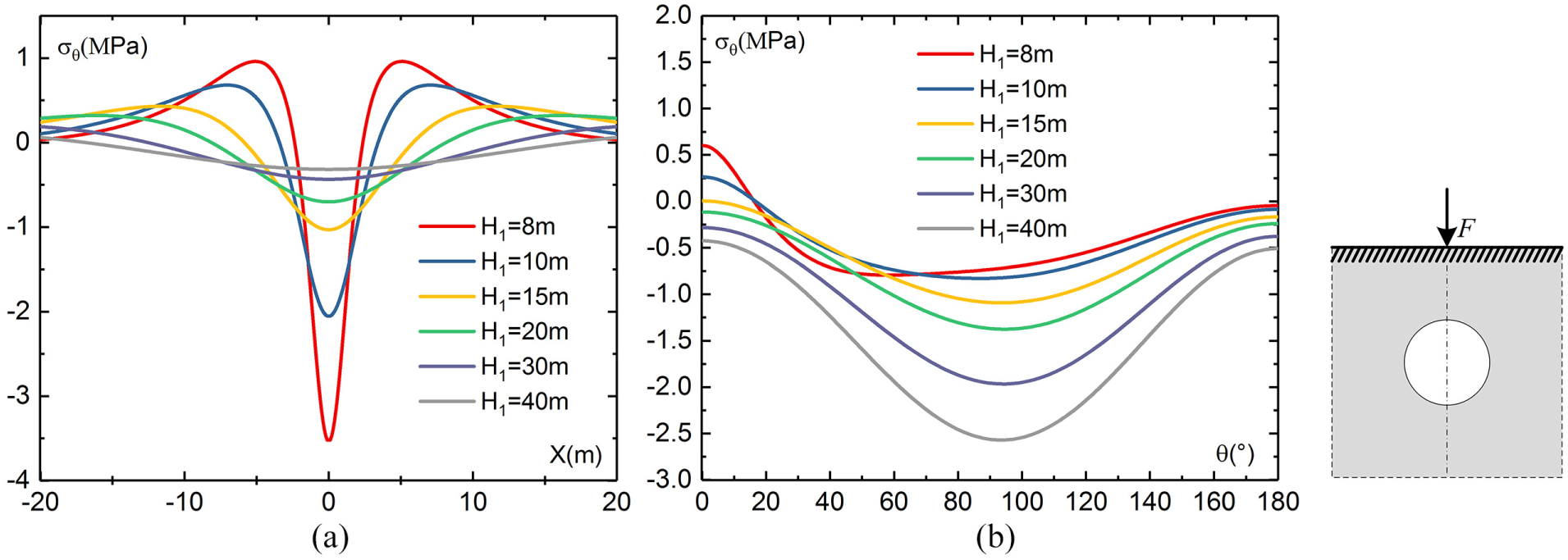
Distribution of σθ for various H1 values: (a) ground surface; (b) tunnel boundary.
Figure 9(a) presents the tangential stress
Figure 9(b) gives the distribution of
6.3. Effect of concentrated force F on stress
Figure 10 presents the tangential stress
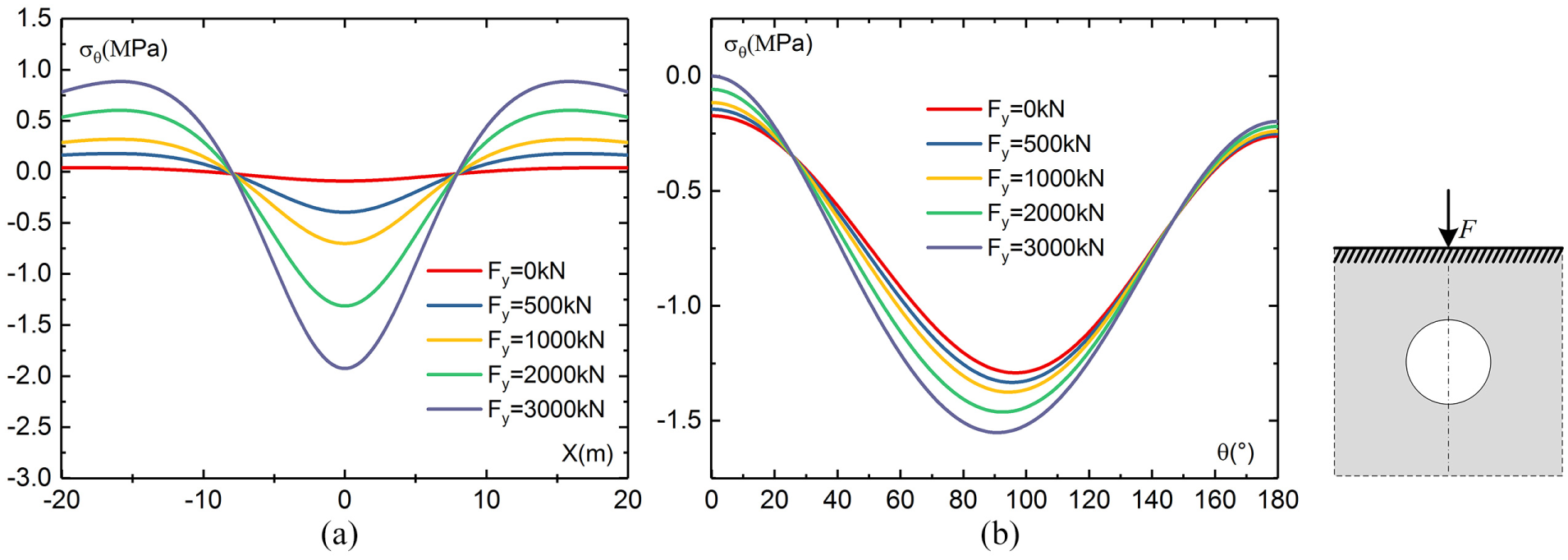
Distribution of σθ for various Fy values: (a) ground surface; (b) tunnel boundary.
Figure 10(a) shows that there is great compressive stress near the original point o due to the concentrated force. The maximum value of
Figure 10(b) shows that all curves converge at one point at about 26° (0.35 MPa) and 147° (0.62 MPa). The tangential stress
6.4. Effect of H2 on stress
Figure 11 presents the tangential stress
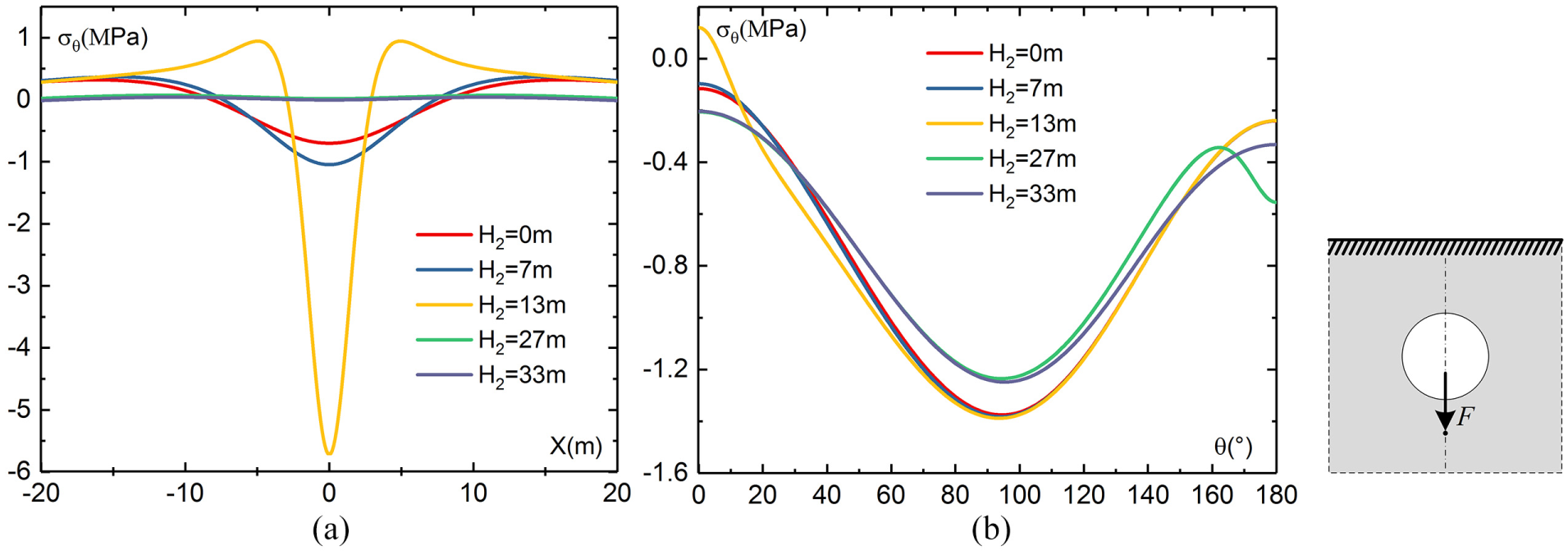
Distribution of σθ for various H2 values: (a) ground surface; (b) tunnel boundary.
Figure 11(a) shows that when the concentrated force acts above the tunnel (
Figure 11(b) shows that the maximum of the tangential stress
6.5. Effect of depth L on stress
Figure 12 presents the tangential stress
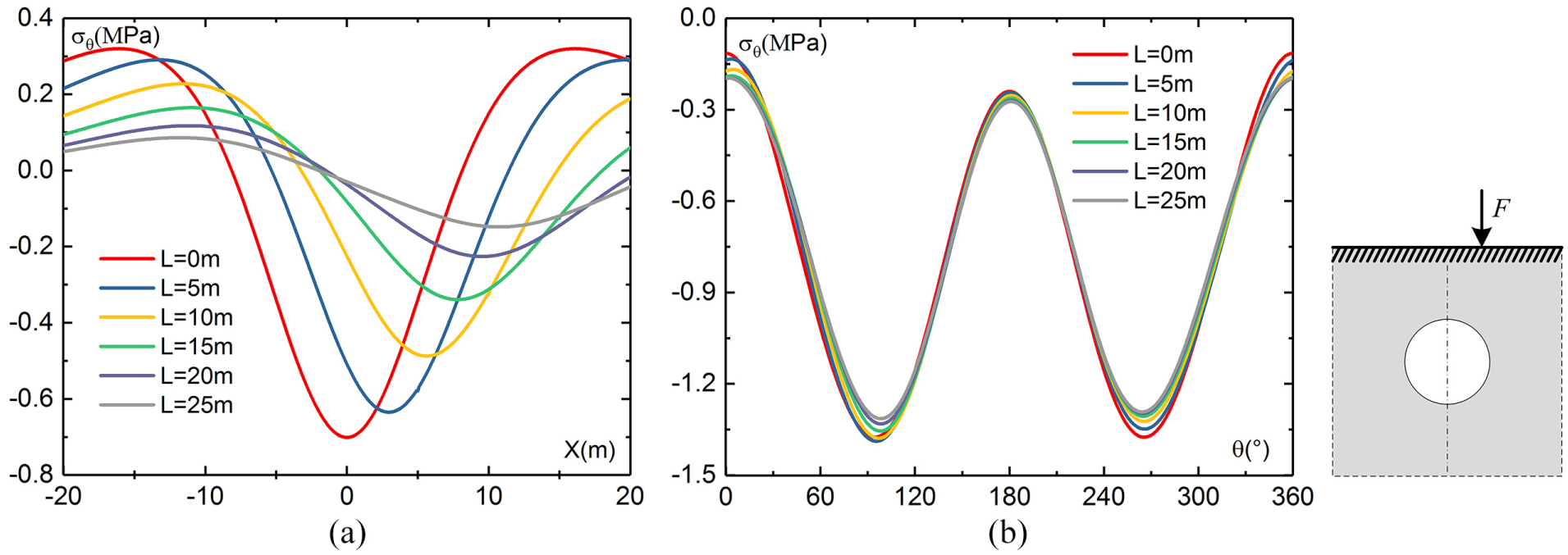
Distribution of σθ for various L values: (a) ground surface; (b) tunnel boundary.
Figure 12 shows that when L = 0 m, the minimum value of
Figure 12 shows that when
7. Conclusion
An analytical stress solution for an elastic half plane with a circular tunnel, which is subjected to a concentrated force acting at any position, is derived by using a complex variable method in this paper. The relationship between the two analytic functions
The examples show that for the tangential stress
Footnotes
Appendix
Let
Substituting equations (7) and (36) into equation (41) gives
Each item in equation (A-1) can be expanded by using the following Taylor expansion formula:
Expanding equation (A-1), we have
From equations (A-3) and (42), we have
Funding
The author(s) disclosed receipt of the following financial support for the research, authorship, and/or publication of this article: This work was supported by the National Natural Science Foundation of China (grant numbers 11572126 and 51704117).
