







Abstract
The article studies the stress–strain state of the spongy bone of an implanted jaw. A spongy bone can be considered as a multiporous area with its fissures and pores as the most visible components of a double-porous system. The work studies the stress–strain state of the spongy jaw-bone near the implant, which is under occlusal load. A mathematical model of the problem is the contact problem of the theory of elasticity between the implant and the jaw-bone. The problem is solved by using the boundary element methods, which are based on the solutions of Flamant (BEMF) and Boussinesq’s (BEMB) problems. The cases of various lengths of an implant diameter are considered. Stress contours (isolines) in the jaw-bone are drawn and the results obtained by BEMF and BEMB for the different-diameter implants are compared.
Keywords
1. Introduction
Attempts to give a theoretical substantiation of implantation, such as that of an important method of dental construction (prosthetics), date back to the 1960s [1]. The joint research of the engineers and dentists aimed at improving the implant design (structure) to ensure its complete integration with the bone tissue, meaning that an implant must be inserted in the bone tissue tightly (so that ossification occurs) and it must not be overloaded when used. An objective to create an implant of the best possible shape is mostly determined by the degree of modeling of the stress–strain state of biomechanical system “implant–bone tissue.” The objectives are studied by using numerical methods. Presently, the finite element method is accepted as the most efficient method for this purpose, as a universal method to model dental systems of different sizes.
Many research scientists have considered various problems of the connection between the jaw-bone and the implant [1–10]. For example, [1] demonstrates that under an oblique loading, the bone resorption occurred earlier, and both the volume of the resorbed bone and the implant movement were greater than with axial loading; [2], by using the analysis of the three-dimensional (3D) finite elements method, studies the impact of an implant’s type and length as well as bone quality on the implant’s stress–strain state; [3] considers the biomechanical analysis by using the finite element method for implants of different lengths in the rear area of the lower jaw, when the load is applied to the prosthesis attached to one implant; [4] studies the impact of the implant type and length on the stress distribution; [5] studies the impact of the prosthesis material on the bone tissue and implant; in [6], the authors have identified that notwithstanding the angle of inclination or the bone type, the values of stresses are greater in the case of combined loadings than with axial loading; [7] gives an analysis of the stress distribution in the implant in the case of immediate and progressive implant loading for bones of different densities; [8] gives various plans of stress–strain distribution between the bone and the implant at fixing the structure in the surface, etc.
In the past years, many research scientists have considered the modeling of the process of bone remodeling [11–17]. For example, [11] gives a mathematical model describing the bone tissue synthesis and resorption in the presence of a bio-resorbable material of the kind used in bone reconstruction and uses the formulated model to get numerical simulations. The paper of Giorgio et al. [12] is dedicated to the preliminary study of potential descriptive capacities of a novel diffusive stimulus model describing the remodeling process in bone tissues, and so on.
The main goal of the present work is to give the mathematical modeling of and study the stress–strain state of the spongy bone of the upper jaw with a front implant. The work considers a different approach to mathematical modeling of the stress–strain state of the biomechanical system “implant–bone tissue” and the method of solution, and studies the stress–strain state of the jaw spongy bone near the implant under the occlusal loading. A spongy bone can be considered as a multiporous body with its fissures and pores (matrixes) as the most visible components of a double-porous system [18]. A mathematical model of the problem is the contact problem of the theory of elasticity between the implant and the jaw-bone. When setting the problem, the following assumptions were made:
the interaction between the implant’s smooth surface and the bone tissue is modeled by means of an ideal unilateral link;
the impact of pressure in the hard phase of the bone is ignored (the hard bone phase is free from pressure influence);
a plane-deformed state is considered and a diametrical section of the jaw and implant are taken as the rated area;
occlusal loading is distributed uniformly along the implant.
The problem is solved by using the boundary element methods, which are based on the solutions of the Flamant (BEMF) and Boussinesq’s (BEMB) problems. The cases when the implant diameter is of different lengths are considered; stress isolines in the bone are drawn and the results obtained by BEMF and BEMB for the different-diameter implants are analyzed and compared. The two-dimensional (2D) problem of elasticity, when normal concentrated force is applied to one point of the boundary of an isotropic half-plane, is known as the Flamant problem [19,20]. The 3D problem of elasticity, when normal concentrated force is applied to one point of the boundary of an isotropic half-space, is known as Boussinesq’s problem [19,20].
2. Problem formulation and principal equations
A spongy bone is a porous body and is subject to the laws of the theory of poroelasticity. Poroelasticity studies the interaction between the solid and fluid phases of a porous medium saturated with a fluid. It is widely used both in geomechanics and in bone studies [21]. There are three main approaches to obtain the principal equations of the theory of poroelasticity. The first approach is based on the tradition of solid body mechanics, another approach is a mixture theory and is based on diffusive models, and the third approach provides a systematic method for deriving macroscopic equations, which govern the behavior of the medium in the microscale. In the present article, we will consider the first method.
The problem can be formulated as follows: the distribution of stresses caused by occlusive loading is studied near the front implant of different diameters in the spongy bone of the upper jaw (Figure 1). A spongy bone can be considered as a body made of a double-porous system (fissures and matrixes). A spongy bone is made up of two phases: solid and liquid.
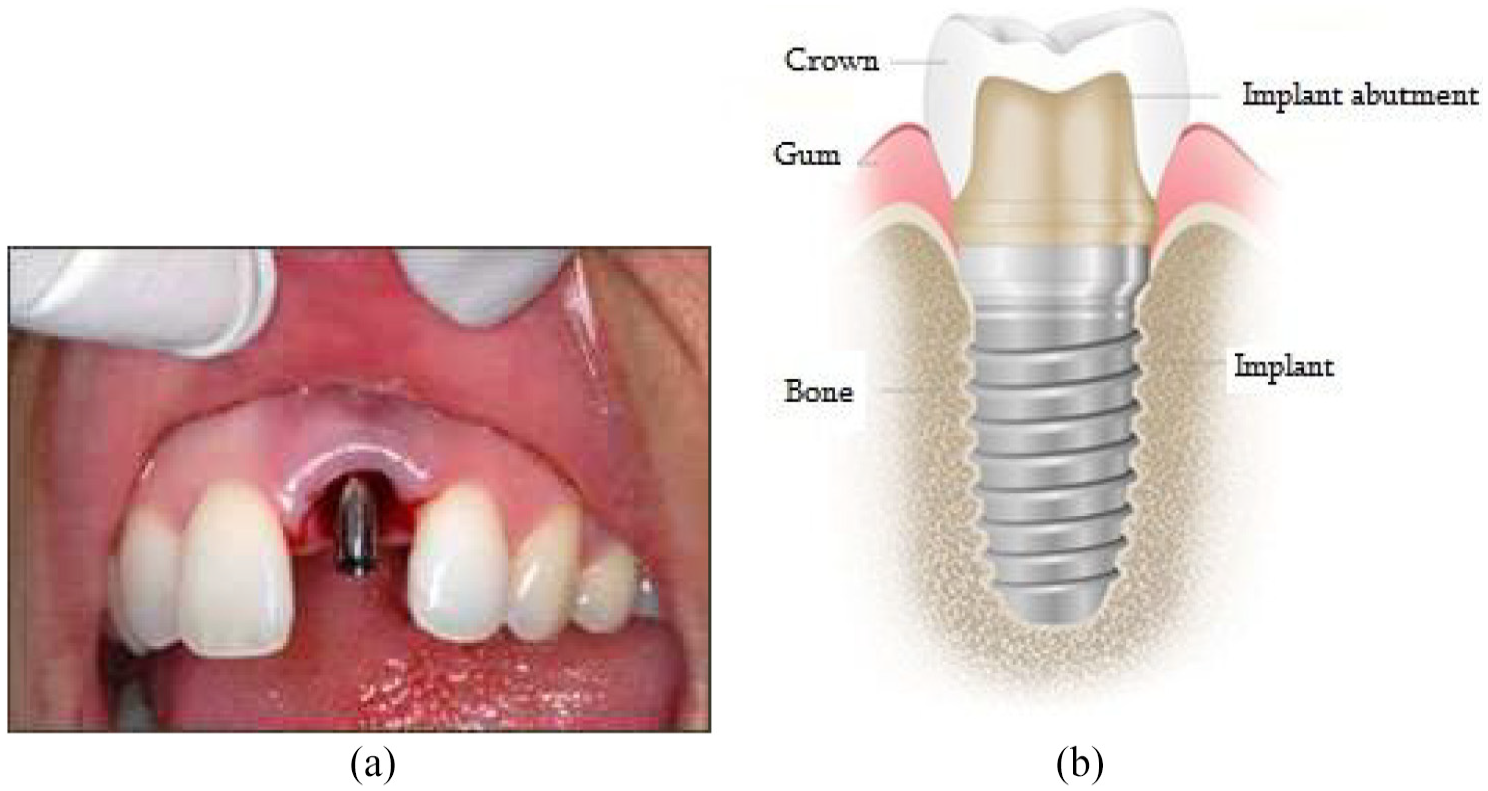
Modern screw implant with an abutment: (a) inserted implant before the crown is mounted; (b) prosthetics plan of implant.
For the hard phase, the impact of pressure on the solid deformation in every element is presented as follows [22]

where
In the fluid phase, for all components differing with their liquidity and conductivity, individual equations must be written. For component j, the equation is as follows

where
Let us consider the case when

which are the known equilibrium equations in displacements (Navier equations) of a homogeneous isotropic elastic body free of volume forces [23].
Equilibrium equations in stresses will be written as follows [24]

Stress–strain equations (Hooke’s law) will be written as follows

Deformation-displacement equations will be written as follows

Here
3. Mathematical modeling and solution of the problem
The mathematical model of the stress–strain state of the spongy bone of the implanted jaw is the contact problem between the implant and the jaw-bone, as presented in Figure 2. This problem is a punch (indenter) problem of a parabolic shape [25] when constant force P acts on it. The problem represents the case when displacements and stresses are given on the boundary of an elastic half-plane, that is, when it is a mixed boundary problem. Besides, it is known that if the equation of
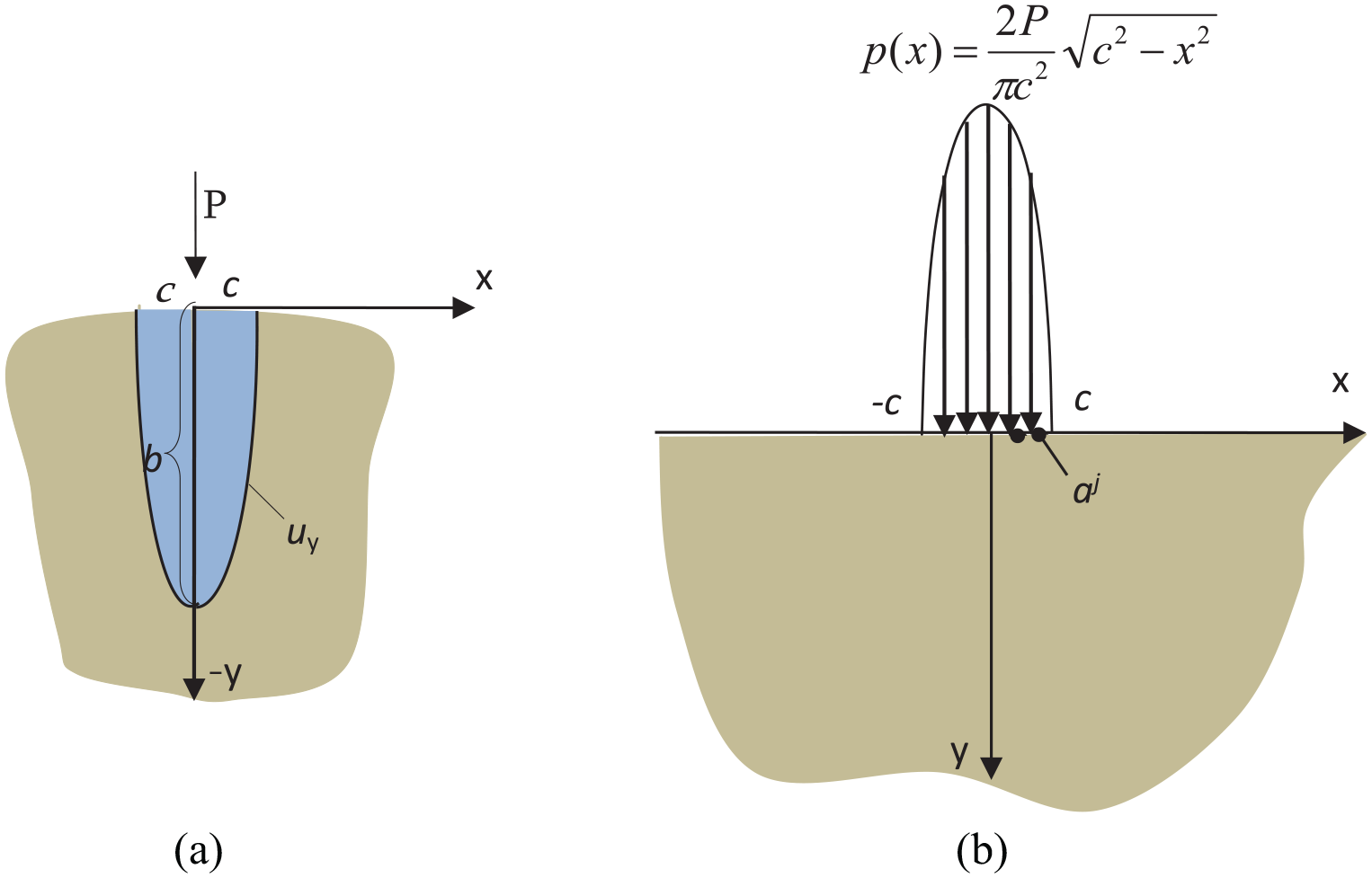
Two-dimensional elastic half-plane subjected to a frictionless parabolic-cylindrical rigid indenter: (a) physical problem; (b) boundary element model.
If displacement

Thus, instead of a mixed boundary problem, finally we will have a boundary problem in stresses, that is, a problem for a half-plane is considered (see Figure 2(b)), when the tangent stress along the whole boundary and normal stress along section

Let us solve the (3), (4) contact problem for the punch (indenter) of a parabolic shape by using the BEMF and BEMB.
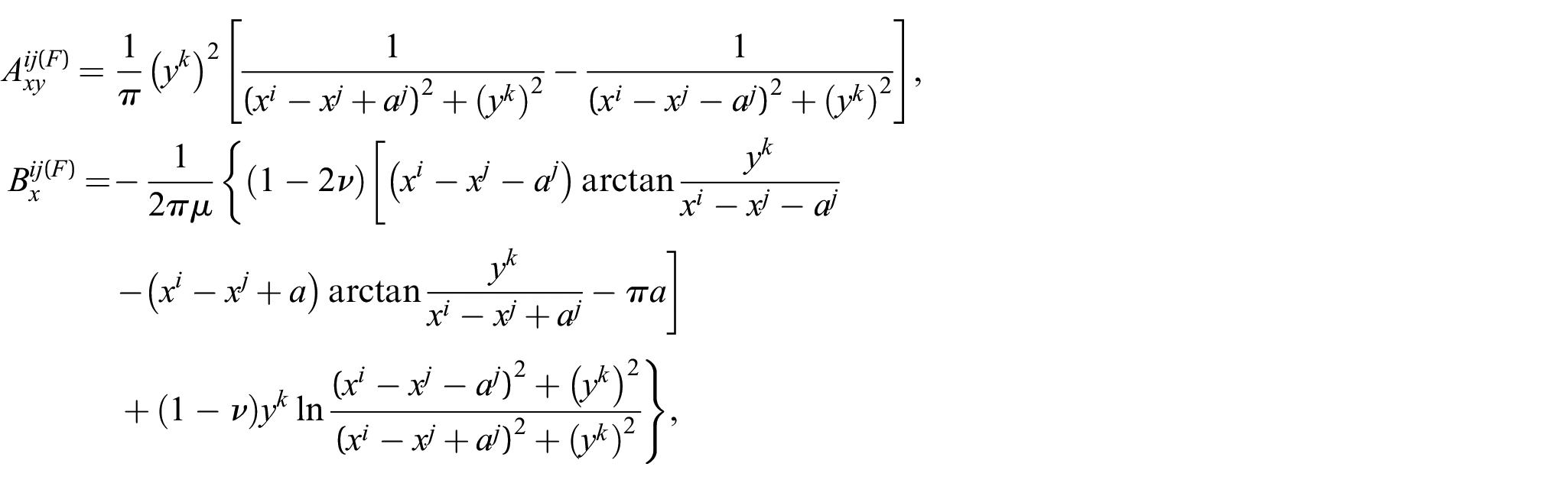
By using solutions to the Flamant problem [19,20,27], for problems (3) and (4), the numerical values of stresses and displacements at points





where N is the number of boundary elements and
Influence coefficients


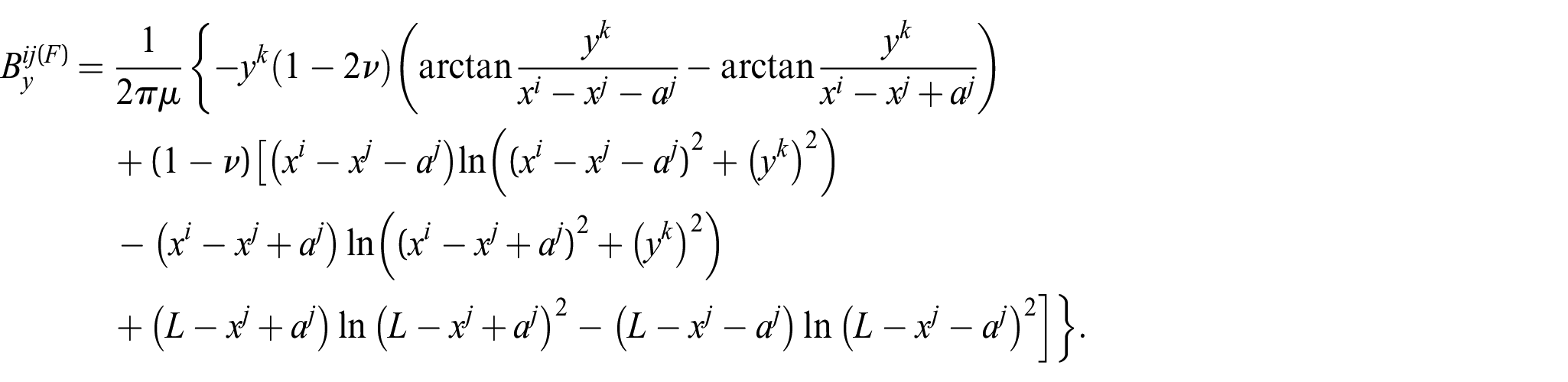
By using the [19,20] solutions to Boussinesq’s problem for problems (3), (4), the numerical values of stresses and displacements at points
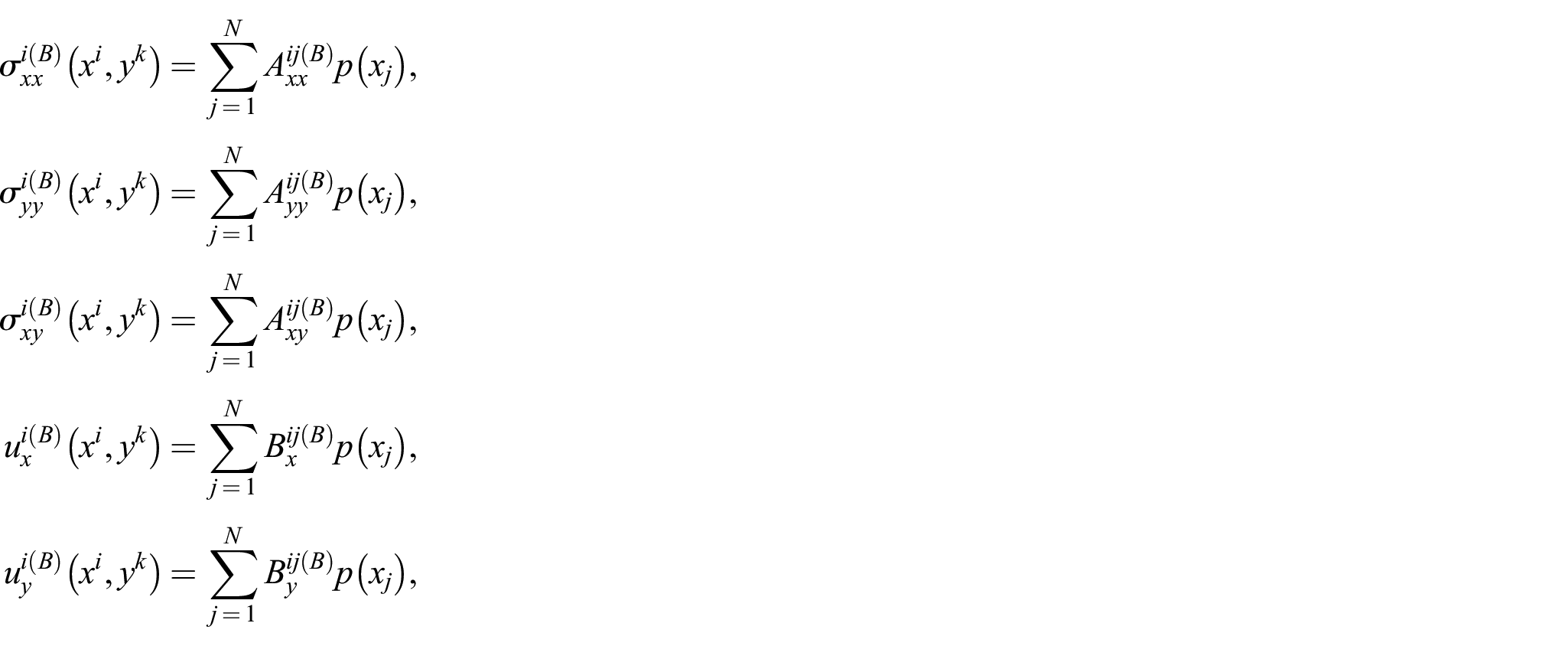
where
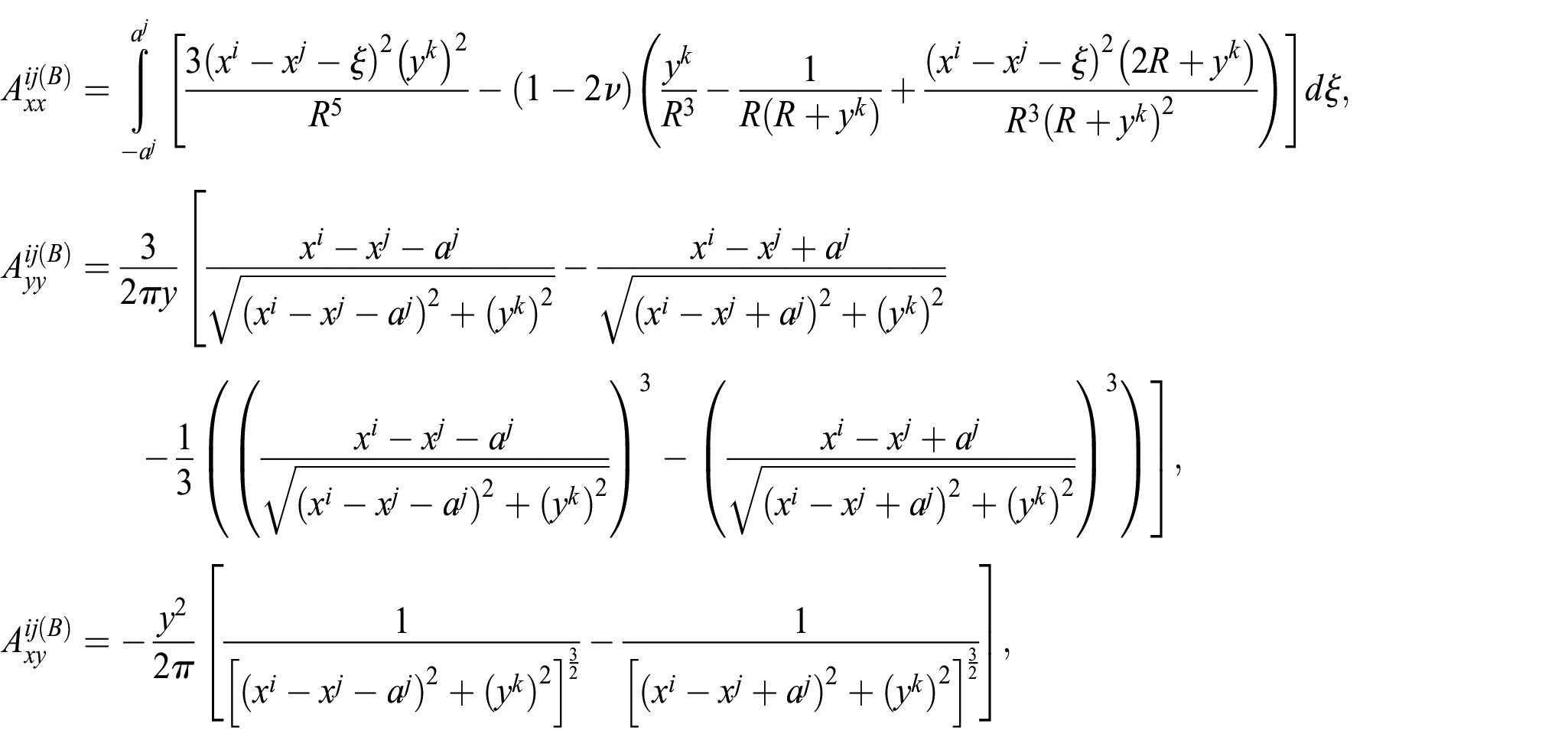
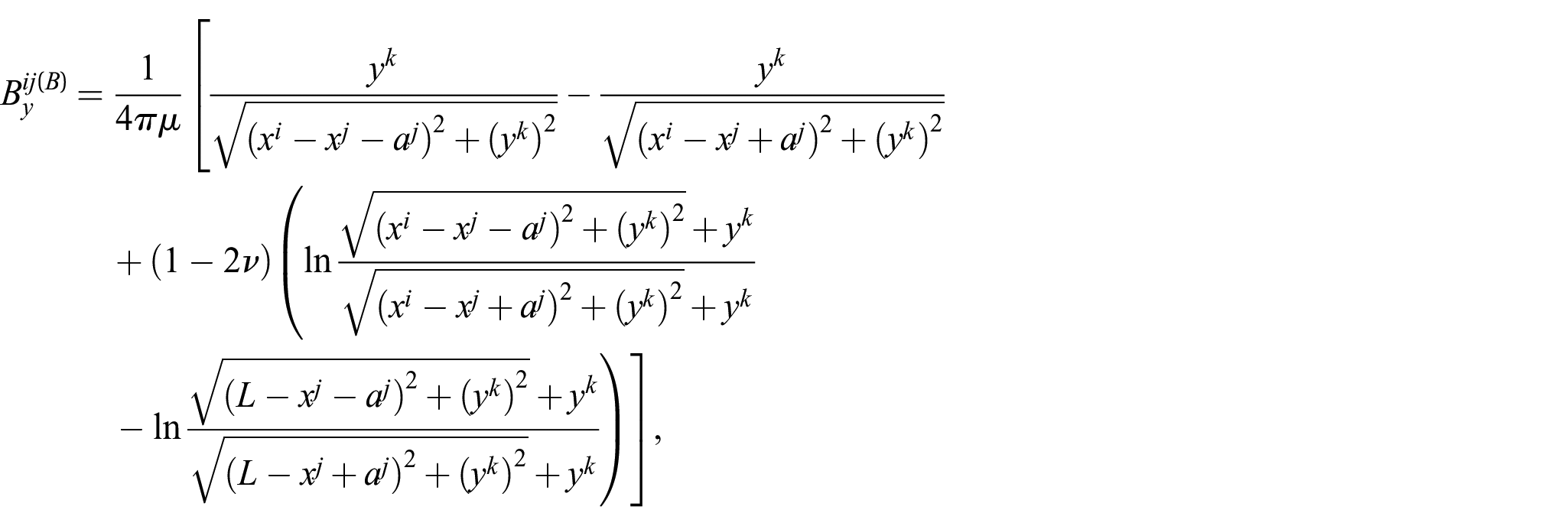
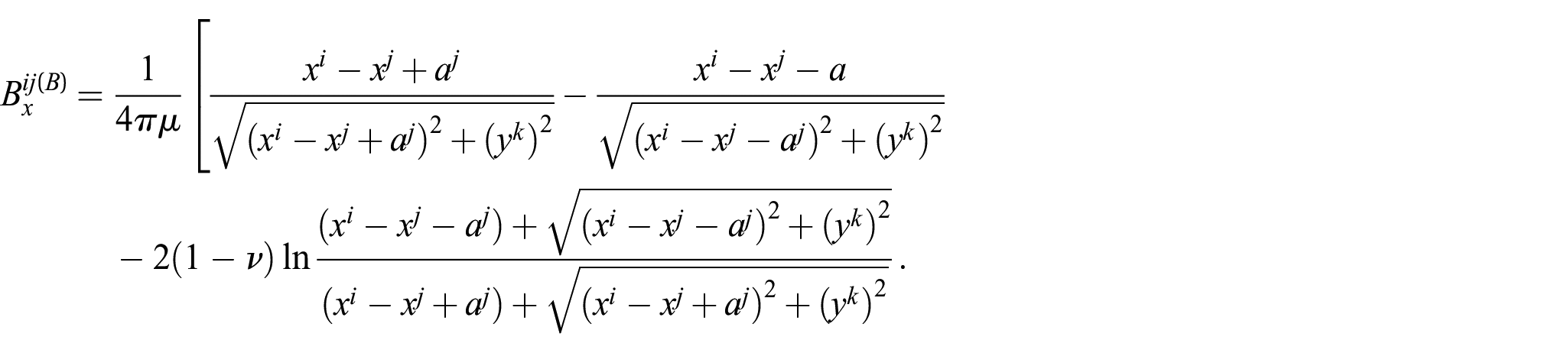
Influence coefficients
4. Numerical results and discussion
By using MATLAB software, the numerical results were obtained and graphs of normal and tangent stresses (see Figure 3) and isolines (see Figures 4 and 5) were drawn for the following data:

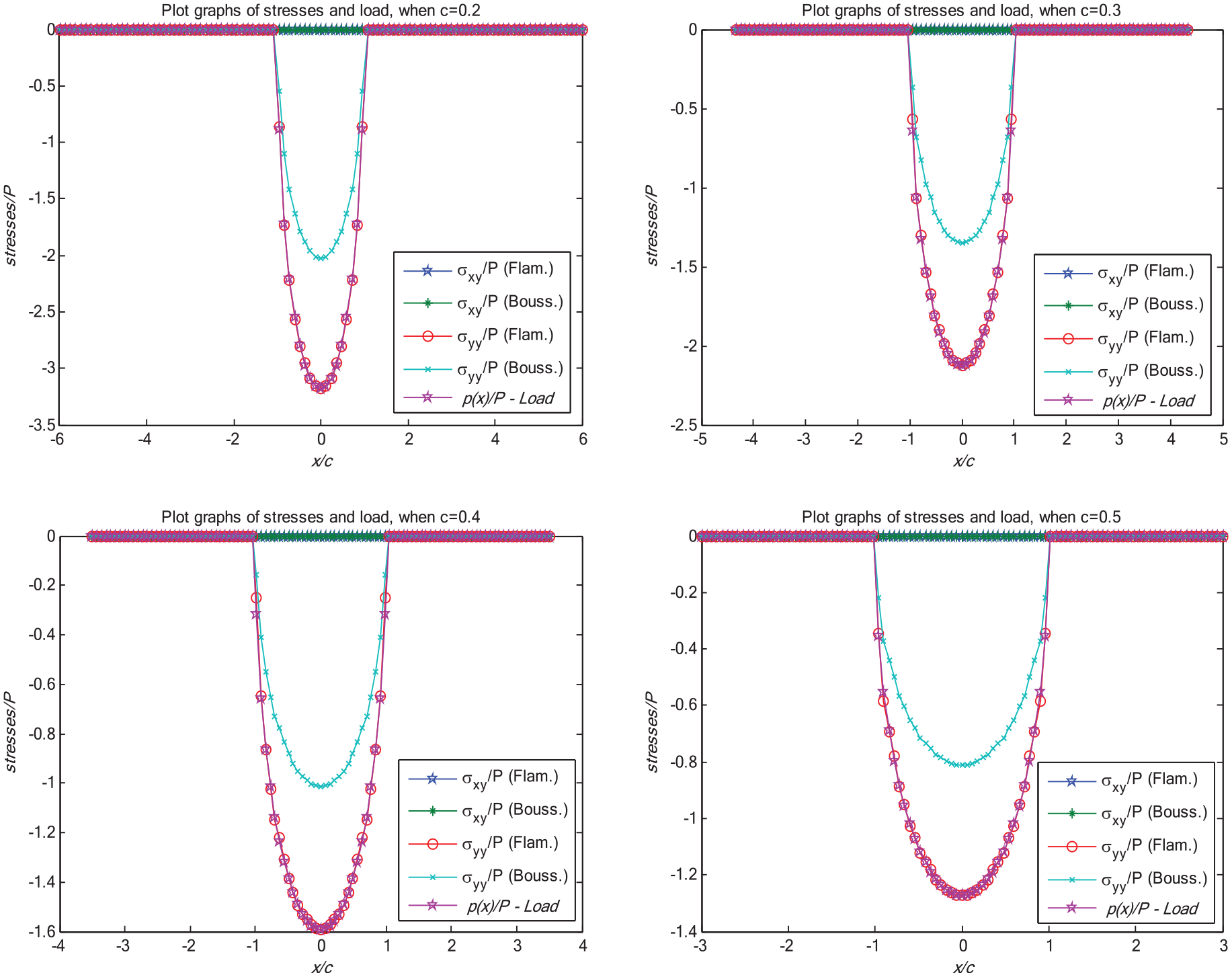
Graphs of normal
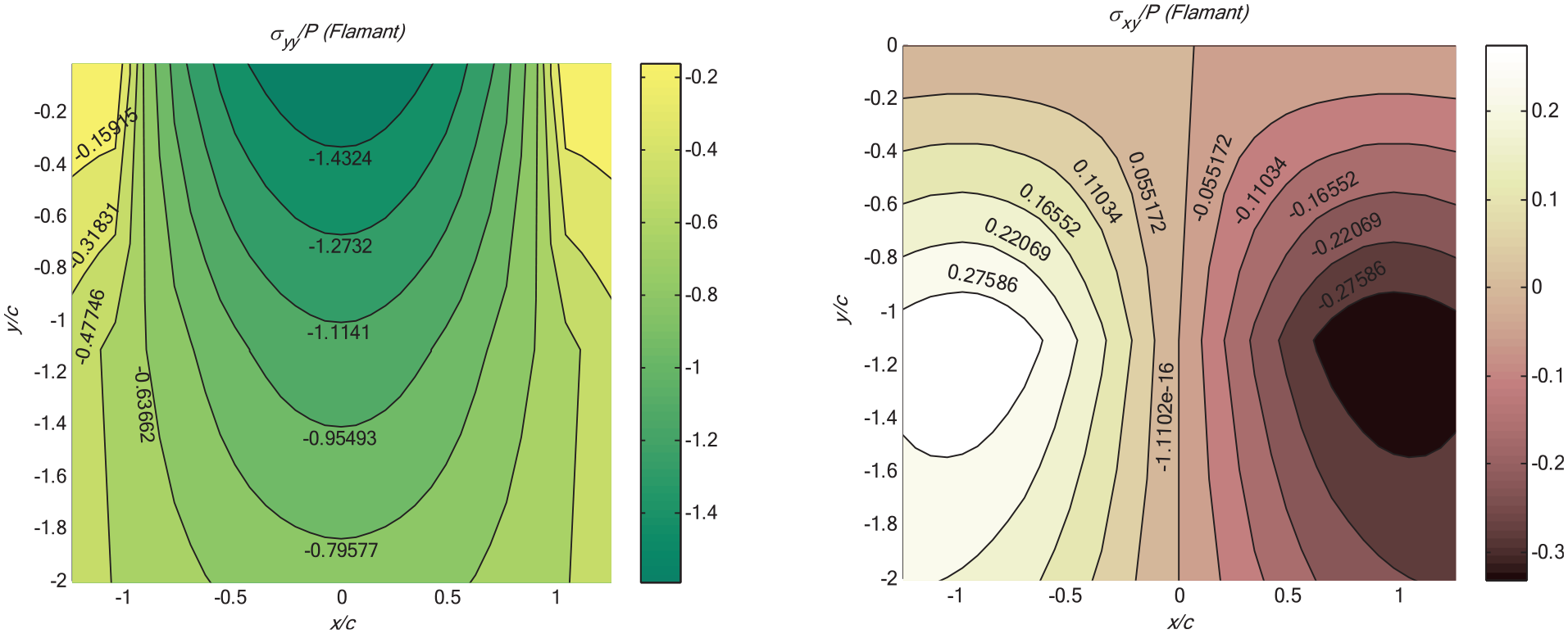
Contours of normal and tangent stresses obtained by using the boundary element method based on the solution of the Flamant problem.
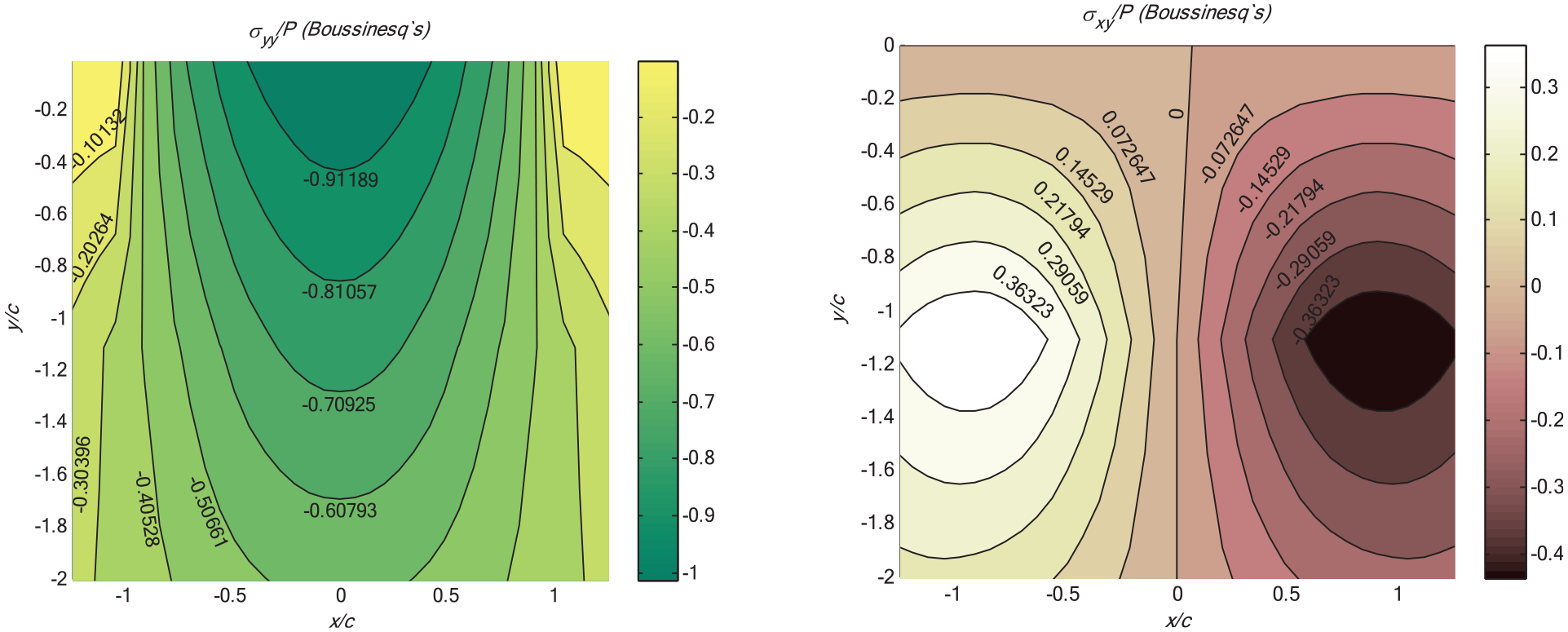
Contours of normal and tangent stresses obtained by using the boundary element method based on the solution of the Boussinesq’s problem.
Figure 3 shows the numerical values of normal and tangent stresses on the contact line obtained by the BEMF and BEMB for four different lengths of implant radius
Figure 4 shows the contours of normal and tangent stresses obtained by using the BEMF for the implanted jaw spongy bone, and Figure 5 shows the contours of normal and tangent stresses obtained by using the BEMB. The comparison between them evidences that, visually, the results in both cases (with the BEMF and BEMB) are similar; however, if looking at figures, we will see that the coincidence of numerical values obtained through the BEMF is more accurate, for example, the coincidence between obtained
5. Conclusion
The main results of the present work are as follows:
the mathematical modeling and study of the stress–strain state of the spongy bone of the upper jaw during occlusal loading was accomplished;
a mathematical model of the problem is the contact problem of the theory of elasticity between the implant and the jaw-bone when the contact surface is of a parabolic shape;
the problem was solved by using the boundary element methods, which are based on (a) the singular solution of the Flamant problem (BEMF) and (b) the singular solution of Boussinesq’s problem (BEMB);
the stress–strain state of the spongy bone of the upper jaw near the front implant under occlusal loading for the implants with different-length diameters was studied and the graphs of stresses on the contact line and contours (isolines) of the maximum stress values in the bone were drafted;
the results obtained through the BEMF and BEMB for implants with different-length diameters were analyzed and compared to one another.
Footnotes
Acknowledgements
This work was presented at the Seminar of the I. Vekua Institute of Applied Mathematics of Iv. Javakhishvili Tbilisi State University. I would like to thank my colleagues for their useful discussions.
Funding
The author(s) received no financial support for the research, authorship, and/or publication of this article.
