







Abstract
We analysed the problem of determining the exponents in the asymptotic solution of the isotropic theory of elasticity problem at the top of the wedge-shaped region where its sides (or one of them) are supported by a thin coating and lean without friction on the rigid bases. On the other side of the wedge-shaped region, it is assumed that there are various boundary conditions, including when there is a thin coating. Mathematically, the problem reduces to the problem of determining the roots of transcendental characteristic equations arising from the condition for the existence of a nontrivial solution of a system of the linear homogeneous equations. The characteristics of the stress tensor components have been determined for the various combinations of boundary conditions and physical and geometric parameters. The qualitative conclusions are made. In particular, we have established the combinations of the values of these parameters at which the singular behaviour of stresses arises.
Keywords
1. Introduction
In the linear theory of elasticity in the neighbourhood of an irregular boundary (corner points in two-dimensional problems, edges in three-dimensional problems, etc.) with certain geometry, singularities in stresses can arise. Taking this behaviour into account is important in constructing numerical methods for solving boundary value problems, and can also be used in assessing the critical state of a material (e.g. the occurrence and growth of cracks).
Photoelastic analysis of the stress field around cuspidal points of rigid inclusions was reported by Gudos [1]. Lim and Ravi-Chandar in their work [2] applicated the classical methods of photoelasticity and Mach–Zehnder interferometry in a combined arrangement in order to determine both principal stresses and their orientations simultaneously. The work by Misseroni et al. [3] demonstrated the photoelastic experimental investigations showing that the stress field near a stiff inclusion embedded in a soft matrix material can effectively be calculated by employing the model of rigid inclusion embedded in a linear elastic isotropic solid. In the manuscript by Noselli et al. [4], the approach of how to produce elastic materials containing thin inclusions and by providing photoelastic investigation of these structures was presented.
The research by Aksentyan [5] demonstrated that the problem of studying the stress feature in the neighbourhood of a three-dimensional edge of an isotropic elastic body can be divided into planar and antiplane problems of the theory of elasticity. The concurrent work by Parton and Perlin [6] dedicated to the plane problem proposed a method for determining the indices with particular stresses at the top of the wedge-shaped region under various boundary conditions on its sides. This work considered the cases when the components of the displacement vector are assumed to be zero on the sides of the wedge (the sides are fixed, case II), the traction vector is null at the edge (the sides are free, case II-II) or the shear stress, normal displacement
Finding smaller asymptotic behaviour indicators is used in problems of determining the critical state of a material (e.g. at the crack-tip by calculating the stress intensity factors). In addition, the definition of these indicators (not only smaller ones) can be used to construct an asymptotic series in a neighbourhood of an irregular point of the boundary. This can be used in constructing a numerical scheme for solving an inhomogeneous problem (e.g. by the finite element method). Moreover, the coefficients of this series can be found according to the scheme proposed by Mazya and Plamenevsky [8].
The work by Kalandiia [9] proposed another approach to the study of this issue with the construction of an asymptotic solution in a Cartesian coordinate system. This method is also applicable in the case of an anisotropic body when the above-mentioned method meets certain difficulties. A general approach to constructing an asymptotic series was proposed by Belokon [10]. In our work [11,12] we considered a series of problems on the equilibrium state of elastic bodies, which were supported by a thin flexible coating and contained internal cracks. These publications present the results of a study of plane problems of the theory of elasticity, respectively, for a strip and a wedge impaired by the internal cracks and reinforced by a thin coating at the boundaries. We also considered the cases for both stiffer and softer coating material in comparison with the material of the main body. As a mathematical model of the coating, special boundary conditions appear, formulated on the basis of an asymptotic analysis of the solution of the problem for an elastic strip [13]. Kim et al. [14] researched the boundary conditions in the neighbourhood of the crack-tip in-plane and antiplane problems, which made it possible to reduce the stress singularity. The work of Kim et al. [15] studied the influence of boundary amplification on local singular fields in linearly elastic materials. The problem for a quarter of the plane of a compressible hyperelastic material undergoing plane finite deformations was considered by Kim et al. [16]. The body is subject to mixed (free–fixed) boundary conditions. It was found that the deformation field is smooth in the neighbourhood of the top and is actually bounded in the top itself, in contrast to the analogous case of classical linear elasticity.
The problems of stress concentration in composite elastic bodies, in addition to the problems of the strength of machine parts and structural elements, are of geophysical interest. Williams [17] extended the problem of the symmetric and antisymmetric loading of an isotropic homogeneous plate containing a crack to the case when the crack line separates two separate isotropic homogeneous regions. The work determined the module of the singular behaviour of stresses in the neighbourhood of the crack-tip. The research by Bogy [18] focused on the problems of plane deformation and the generalized plane stress state of two dissimilar orthogonal elastic wedges fastened together on one of their edges, and on the rest, arbitrary normal and shear force within the framework of the classical theory of elasticity. The asymptotic behaviour of the solution in the neighbourhood of the conjugation line was investigated. The results are generalized to the case of arbitrary angles by Bogy [19]. As before, the emphasis is on the study of the dependence of the order of the stress singularity in the neighbourhood of the wedge top on the values of the physical and geometric parameters of the problem. The work of Munz and Yang [20] demonstrates a technology for calculating the stress–strain state of a composite elastic body using the finite element method in the neighbourhood of singular points of the interface. Chue and Liu [21] presented a general solution for determining the order of the stress singularity in an anisotropic wedge. The order depends on the angle of the wedge, the boundary conditions and the material properties. The order of stress features at the top of a wedge from common anisotropic materials was studied by Chuang et al. [22]. The mixed boundary conditions are set on its sides. Qian and Akisanya [23] estimated the magnitude of the stress intensity at the top of the wedge angle using a contour integral based on the inverse Betti’s theorem in combination with the finite element method. The features of stresses in a bimaterial anisotropic wedge with an arbitrary orientation of the fibres were studied by Chue and Liu [24]. Felger and Becker [25] carried out a study of the features of stresses in wedges using an integrated approach in the theory of shear plate deformations. The main focus is on calculating the singularity index as a fundamental quantity in fracture mechanics. The authors considered the isotropic homogeneous and bimetallic wedges.
This manuscript is dedicated to the study of stress concentration at the top of the wedge-shaped region when on its edges there is a thin coating that is in smooth contact with two rigid bases (case VV), as well as a combination of condition V on one edge of the wedge with conditions I, II, III and IV on the another.
2. Statement of the problem
Let us consider the static problem of the theory of elasticity about the flat deformation of a wedge-shaped region, reinforced at the boundary with a thin coating.
We write the equations of equilibrium in displacements in the polar coordinate system

Let us give an expression for the components of the stress vector at the boundary of the neighbourhood

Hereinafter,
We write down the boundary conditions for the wedge-shaped region, α≤
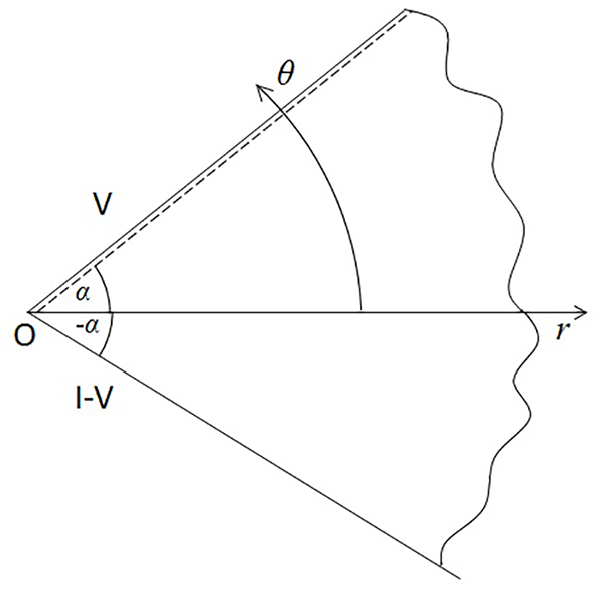
Statement of the problem.
Given the results of Aleksandrov and Mkhitaryan [13], they have the form


The subscript c corresponds to coating; h is the thickness of the coating; and the prime represents the radial coordinate derivative.
In this paper, we consider the homogeneous boundary value problem (1), that is, with zero values of the components of the displacement and stress vector specified at the boundary of the region; therefore, condition (3) is simplified and takes the form V. For a border with a coating and free of stresses, IV, it was previously formulated by Kim et al. [14,15]. Thus, it is possible to specify one of the types of boundary conditions at each of the boundaries of the region


3. Construction of an asymptotic solution
In this paper, we consider the problems when condition V is specified on both sides of the wedge-shaped region, namely, the case of V-V, as well as for cases of mixed conditions, that is, various boundary conditions are set on the sides of the region (V-I, V-II, V-III, V-IV; indexation is obvious here).
In accordance with work by Parton and Perlin [6], we will research for a solution to the system of Equations (1) in the form of a product of functions

Let us proceed to the solution of the system of ordinary differential equations by substituting (6) into (1)


The solution to this system is


In this case, the expressions for displacements and stresses will take the form




We proceed to satisfy the boundary conditions (5) of problem V-V. This leads to a system of linear homogeneous fourth-order algebraic equations. Obviously, the condition under which a homogeneous system of equations has a nontrivial solution is that the principal determinant of the system is equal to zero

Hereinafter, the index of the main determinant of the system of equations corresponds to the number of the second boundary condition (on the edge

Similarly, we write down the boundary conditions and characteristic equations for the cases of mixed boundary conditions.
The problem V-I


The problem V-II


The problem V-III


The problem V-IV


4. The definition of stress and displacement
Given the mechanical properties of the wedge and lining materials, Equations (10), (12), (14), (16) and (18) contain two parameters: the exponent and the angle of the solution. Below are the dependencies of the indicator on the angle of the solution in the studied problems. The Young’s modulus of the coating material was taken five times more compared to the modulus of the base material, with

Figure 2 shows the solution to problem V-V.
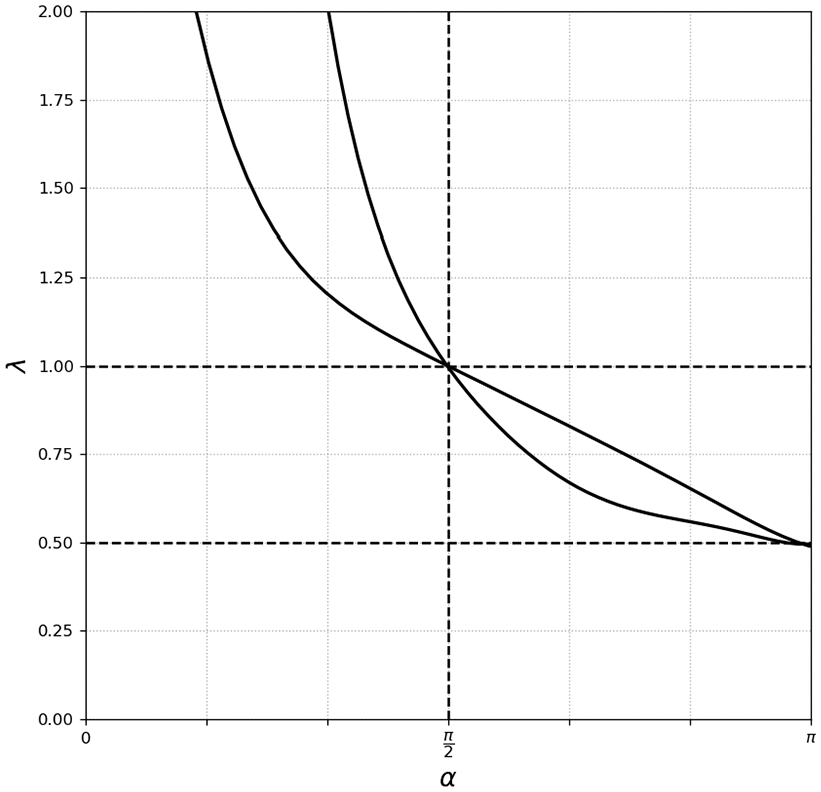
The dependence of the indicator on the angle of the solution to problem V-V.
Figure 3 shows the solution to problem V-I.
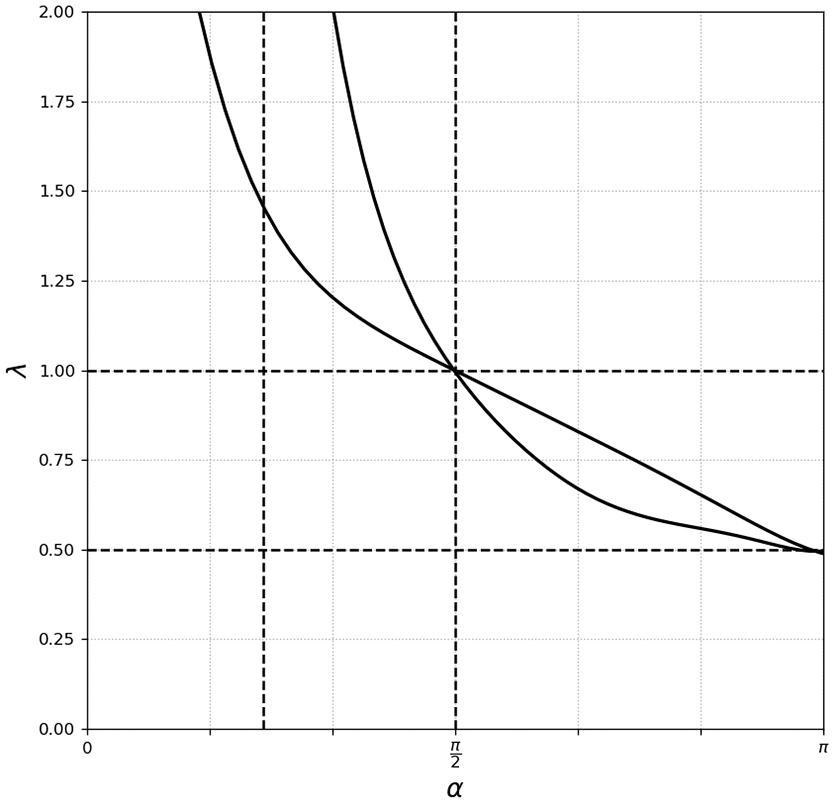
The dependence of the indicator on the angle of the solution to problem V-I.
It should be noted that in problems V-V and V-I the voltages become singular when the angle of the wedge solution becomes larger than
Figure 4 shows the solution to problem V-IV.
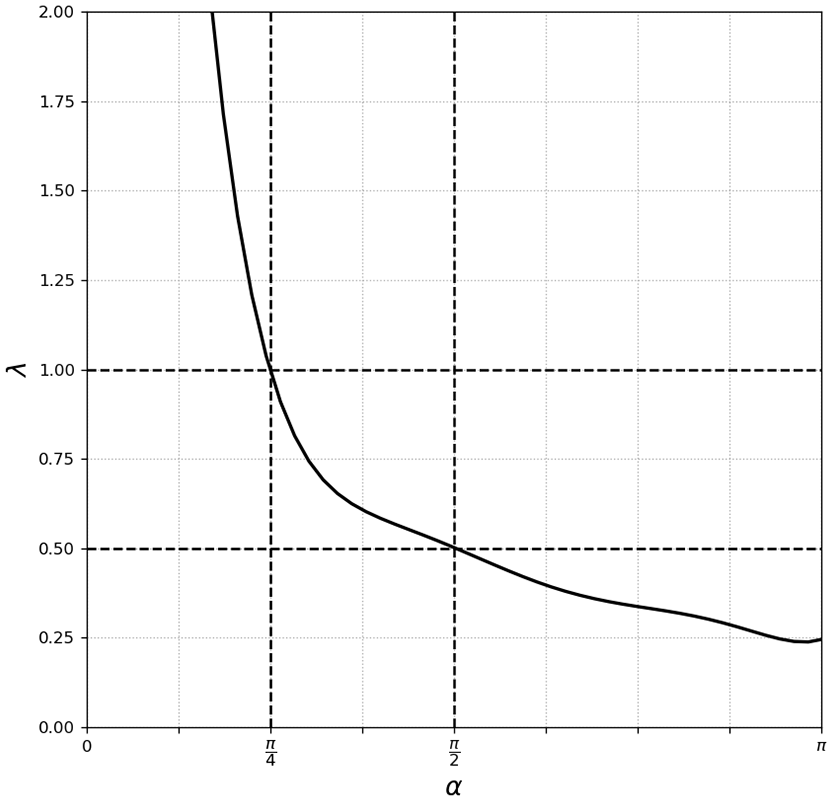
The dependence of the indicator on the angle of the solution to problem V-IV.
Figure 5 shows the solution to problem V-III.
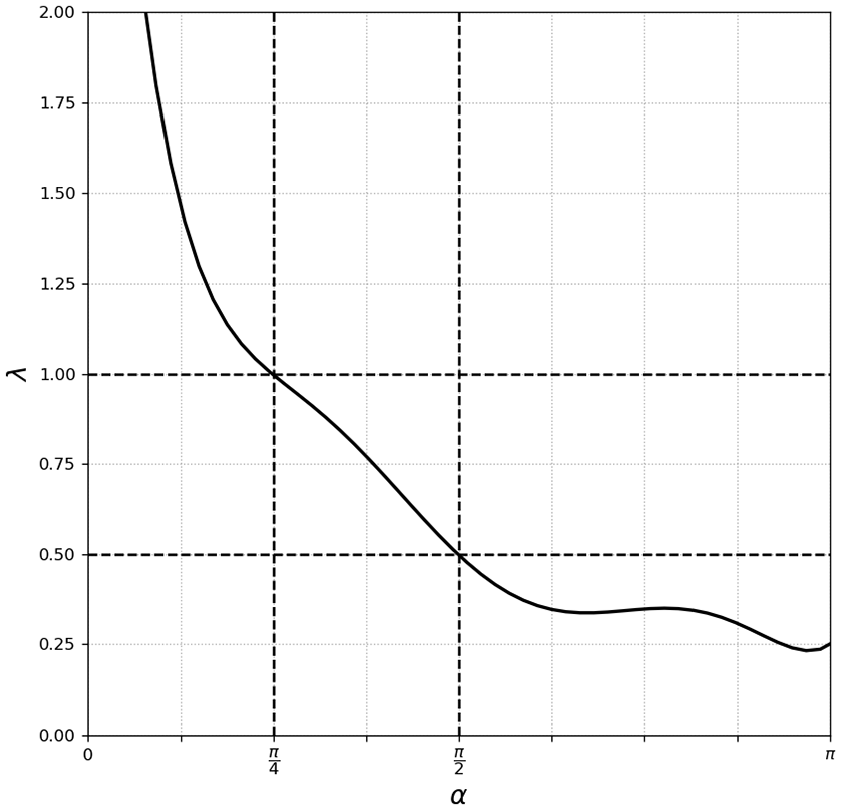
The dependence of the indicator on the angle of the solution to problem V-III.
It should be noted that for the above cases for a more rigid coating, the appearance of a singular solution does not depend on the ratio of the shear modulus and occurs at
Figures 2–5 show the dependence on the solution angle of the first roots of the equations for finding the exponent at g=5. The calculations demonstrated that the results do not change qualitatively for 1 < g < 10.
Figure 6 shows the solution to problem V-II.
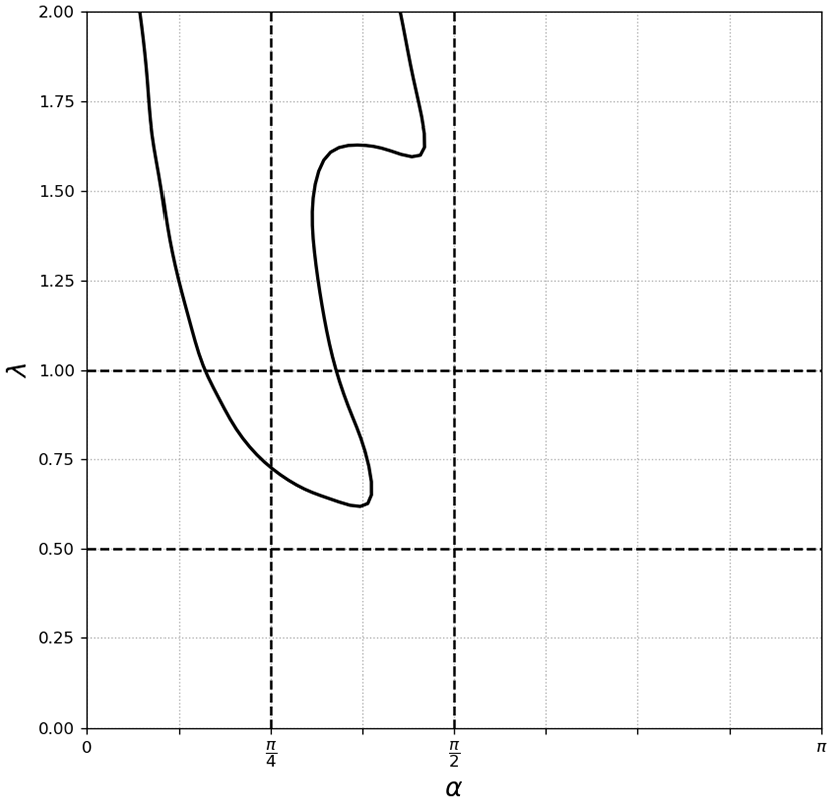
The dependence of the indicator on the angle of the solution to problem V-II.
The results presented in Figure 6 demonstrate that in the case of V-II, the appearance of a singular solution depends on the mechanical properties of the wedge and coating, so in the case under consideration for
The values of the roots of the equations can be used in constructing an asymptotic solution where several terms are held, and the value of the exponent must be greater than 0.5 for a solution belonging to the energy class. When the strength characteristics of an elastic element contain a corner point, the behaviour of the indicator with the smallest real part is important. Moreover, when this value becomes less than unity, a singularity arises in the stress components.
5. Conclusion
In this article, we have analysed the behaviour of the asymptotic solution index in the neighbourhood of the corner point depending on the angle of the solution in a plane isotropic problem of the theory of elasticity when one boundary has a thin coating and is fixed along normal (condition V in (5)). We have considered a set of possible conditions (conditions I–V in (5)) at the other boundary, including the presence of coverage (conditions IV, V in (5)). In particular, problem IV-V with an equal angle of solution can be interpreted as the problem of introducing a smooth flat stamp into a half-plane coated on the boundary. In the considered five boundary value problems, we constructed the asymptotic solutions and obtained the equations that relate the exponent, the solution angle and the mechanical properties of the main body material and the coating. A numerical analysis of these equations has been carried out for a more rigid coating compared with the main body of the coating, given the mechanical characteristics. The results obtained in this work can be used in assessing the strength of parts with coatings and in constructing numerically analytical methods for analysing the stress–strain state of elastic bodies with coatings.
Footnotes
Funding
The authors disclosed receipt of the following financial support for the research, authorship and/or publication of this article: This work was supported by the Russian Foundation for Basic Research (in the framework of projects 19-08-00074, 19-38-90248).
