






Abstract
This paper analyzes the free vibration frequencies of a beam on a Winkler–Pasternak foundation via the original Timoshenko–Ehrenfest theory, a truncated version of the Timoshenko–Ehrenfest equation, and a new model based on slope inertia. We give a detailed comparison between the three models in the context of six different sets of boundary conditions. In particular, we analyze the most common combinations of boundary conditions deriving from three typical end constraints, namely the simply supported end, clamped end, and free end. An interesting intermingling phenomenon is presented for a simply-supported (S-S) beam together with proof of the ‘non-existence’ of zero frequencies for free-free (F-F) and simply supported-free (S-F) beams on a Winkler–Pasternak foundation.
Keywords
1. Introduction
Beams resting on elastic foundations and their dynamic behavior have been subject of much interest since the pioneering studies of Winkler [1] and Pasternak [2]. In the beginning, Winkler set his model as a continuous layer of independent linear springs attached to the beam that exert a force
Vibrations of Timoshenko–Ehrenfest beams on an elastic foundation have been treated in several works, namely by Abohadima et al. [3], Auciello [4], Avramidis and Morfidis [5], Atternejad et al. [6], Calio and Greco [7], de Rosa [8], Hassan and Nassar [9], Manevich [10], Matsunaga [11], Obara [12], Sadeghian and Ekhterai Toussi [13], Wang and Gagnon [14], Wu [15], Yin [16], Yokoyama [17,18], and others. As example, in the work by de Rosa [8], the free vibration frequencies of Timoshenko–Ehrenfest beams on a two-parameter elastic foundation (Winkler and Pasternak) are examined; two variants of the equations of motion are deduced, and both axial flexibilities and rotational flexibilities of the constraints are taken in to account. Yokoyama [17,18], indeed, worked on a finite element technique for determining the vibration characteristics of a uniform Timoshenko–Ehrenfest beam-column supported on a two-parameter elastic foundation. The governing equations are derived using Hamilton’s principle. Calio and Greco [7] analyzed the free vibration and the stability of axially loaded Timoshenko–Ehrenfest beams on an elastic foundation by considering an elastic soil containing two parameters having the characteristics of both Winkler and Pasternak foundations.
In the present paper, we conduct the vibration analysis of a beam on a Winkler–Pasternak foundation via traditional the full, original Timoshenko–Ehrenfest beam theory and two of its truncated versions. Indeed Timoshenko [19] wrote in 1916 about his collaboration in the development of the theory jointly with Paul Ehrenfest (1880–1933). He stressed the cooperation in his later paper [20]. He refrained from mentioning Bresse’s [21] contribution on considering rotary inertia, later incorporated also by Rayleigh [22], apparently independently of Bresse [21]. Later on, Timoshenko [20,23] re-published the results of the joint work with Ehrenfest as two scientific papers almost coinciding with each other. However, in 1972, Timoshenko [24] reiterated about his cooperation with Ehrenfest by re-publishing the book in [19]. It appears, therefore, that the beam theory incorporating the effects of rotary inertia and shear deformation ought to be called the Bresse–Rayleigh–Timoshenko–Ehrenfest theory. Hereinafter we will utilize a more concise name of the Timoshenko–Ehrenfest theory, to make justice to the joint work of Timoshenko with Ehrenfest. Detailed comparison between the three presented models is conducted in the context of the titles. In this paper we extend the studies by Cazzani et al. [25,26] to investigate the effect of boundary conditions (BCs) in the beam on an elastic foundation; an analogous effort for a beam without an elastic foundation was conducted by Kocatürk and Şimşek [27–38].
2. Governing Timoshenko–Ehrenfest equation
The original Timoshenko–Ehrenfest equation for a beam on a Winkler–Pasternak foundation has been obtained by incorporating the effect of the foundations into the translational and rotational equilibrium equations
where V is the shear force, M is the bending moment,
Substitution of constitutive equations for the bending moment and shear force is
where E is the Young’s modulus, G is the shear modulus, K is the shear correction factor, and
We are making use of Equations (4) and (5) to eliminate
Since we are looking for a solution of the form
where
3. Truncated version of the Timoshenko–Ehrenfest equation
The truncated version of the original Timoshenko–Ehrenfest equation that we discuss was introduced by Elishakoff [28] in 2010 and later on by Elishakoff et al. [29] (see also Elishakoff and Livshits [30]). The formula has been obtained by replacing Equation (5) with
which takes into account the rotary inertia effect. Making use of Equations (4) and (9) to eliminate ψ and introduction of the non-dimensional coordinate brings the next equation
which differs from the original Timoshenko–Ehrenfest by the lack of some terms. As a consequence, we can introduce three artificial parameters, named
4. Derivation of the slope inertia version of the Timoshenko–Ehrenfest equation
Another version of the original Timoshenko–Ehrenfest that we discuss considers the slope inertia effect and was introduced by Elishakoff et al. [31] in 2015. This theory is based on the application of Hamilton’s principle, which reads
to obtain the differential equation of motion of a general beam where T is the kinetic energy related to a beam on a Winkler–Pasternak foundation
and
Application of Hamilton’s principle brings the following equation
which contains a sixth-order derivative for the displacement
5. Unified formulation of the problem
The three differential equations can be re-written in a unified manner as
where
We remark here that same results can be obtained by reducing the equation of motion for a beam in terms of cross-section rotation
We set
Where
Coefficients
where
Thus,
Thus,
We set
where
We study the sign of coefficients
Thus,
We finally deal with the model based on slope inertia by setting
where
Once again, we study the sign of parameters
As a consequence, the denominator is positive for
Here we present a comparison between the found values of the natural frequencies. With the help of some simple mathematical calculus, we prove that the following relationships hold
Hereinafter we assume that the modulus of the elastic foundations will be varying; however, in the first case we consider that
Also, by varying
for
for
for
6. Solution of the equation of motion
The characteristic equation associated to Equation (16) reads
the solutions to which are
The nature of these solutions has been investigated by following the next procedure (Figure 1):
identify the sign of the discriminant
verify whether
verify whether
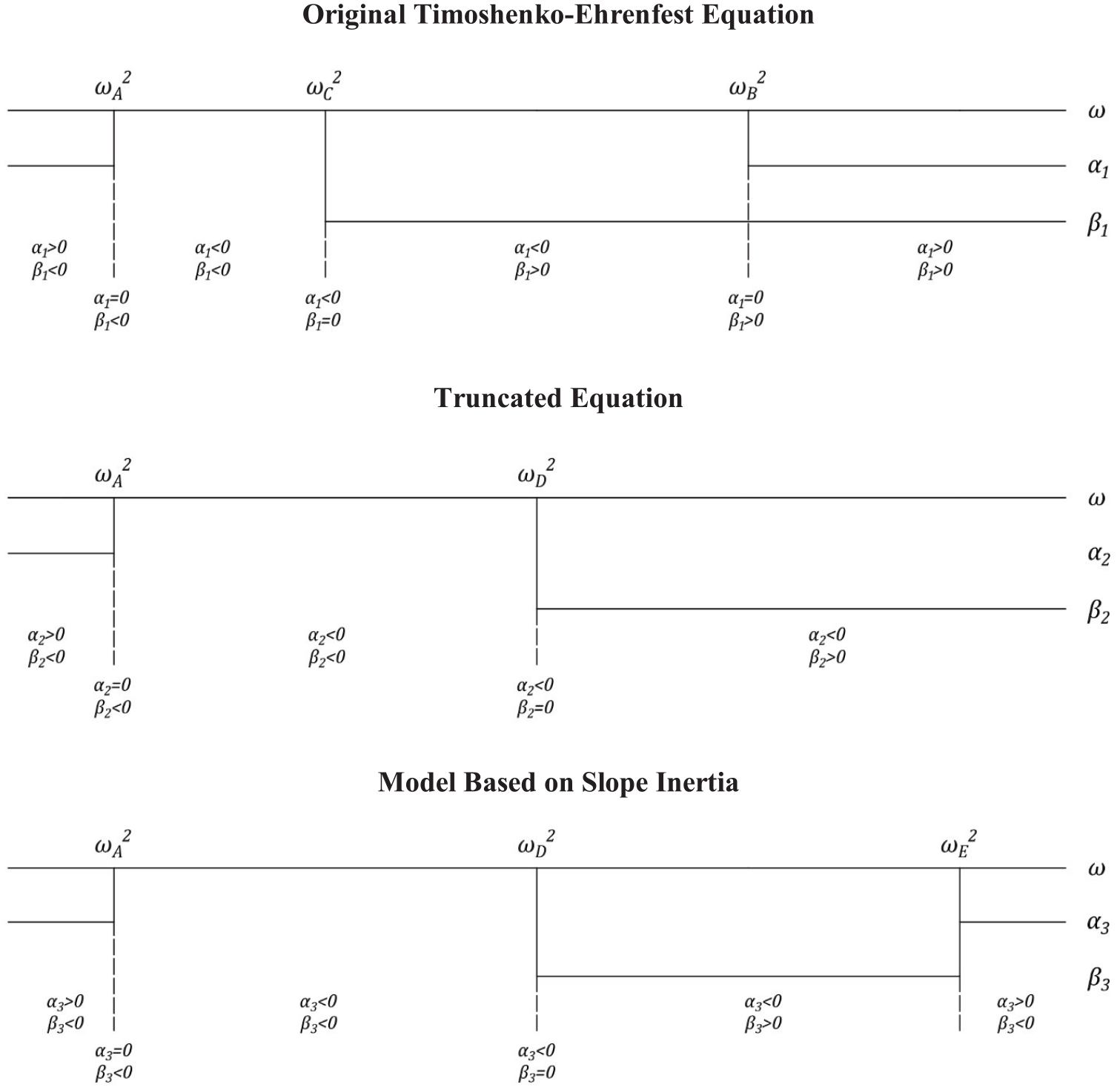
Summary of the sign of parameters
6.1. Original Timoshenko–Ehrenfest equation
We re-write Equation (36) as
for which the solutions are
where
Possibilities and solutions for roots in case
Possibilities and solutions for roots in case

The solution consists of a couple of real roots and a null real root
The solution consists of a couple of real roots and a couple of imaginary conjugated roots
The solution consists of a couple of real roots and a couple of imaginary conjugated roots
The solution consists of a couple of real roots and a couple of imaginary conjugated roots
The solution consists of a null real root and a couple of imaginary conjugated roots
The possibilities and solutions for the roots in case
Possibilities and solutions for roots in case

6.2. Elishakoff’s truncated version
We re-write Equation (36) as
for which the solutions are
where
The possibilities and solutions for the roots in case
Possibilities and solutions for roots in case

The solution consists of a couple of real roots and a null real root
The solution consists of a couple of real roots and a couple of imaginary conjugated roots
The solution consists of a couple of real roots and a couple of imaginary conjugated roots
The solution consists of a couple of real roots and a couple of imaginary conjugated roots
6.3. Slope inertia version
We re-write Equation (36) as
for which the solutions are
where
The possibilities and solutions for the roots in case
Possibilities and solutions for roots in case

The solution consists of a couple of real roots and a null real root
The solution consists of a couple of real roots and a couple of imaginary conjugated roots
The solution consists of a couple of real roots and a couple of imaginary conjugated roots
The solution consists of a couple of real roots and a couple of imaginary conjugated roots
The possibilities and solutions for the roots in case
Possibilities and solutions for roots in case

7. Vibration mode of the Timoshenko–Ehrenfest beam
We write the solutions for the three differential equations for
According to the analysis, only the following forms of mode shapes appear by varying ω:
Form 1 of mode shape: four real solutions;
Form 2 of mode shape: two real solutions and two purely imaginary conjugated roots;
Form 3 of mode shape: four purely imaginary conjugate roots;
Form 4 of mode shape: two imaginary conjugate solutions and a null real root;
Form 5 of mode shape: two real solutions and a null real root.
Hereinafter, we present results separately for each form. Note that
Thus, coefficients {D1,…,D4} and {C1,…,C4} are interdependent.
7.1. Form 1 of the mode shape
We re-write Equations (44) and (45) as
The relationships between the above parameters are
hence
where
7.2. Form 2 of the mode shape
We re-write Equations (44) and (45) as
The relationships between the above parameters are
hence
where
7.3. Form 3 of the mode shape
We re-write Equations (44) and (45) as
The relationships between the above parameters are
hence
where
7.4. Form 4 of the mode shape
We re-write Equations (44) and (45) as
The relationships between the above parameters are
hence
where
7.5. Form 5 of the mode shape
We re-write Equations (44) and (45) as
The relationships between the above parameters are
hence
where
8. Application of the three models for a beam on a Winkler–Pasternak foundation
The modal analysis of a beam on Winkler–Pasternak foundation has been developed by using the three analyzed models in order to depict the complete spectrum of the beam.
8.1. Material properties
We focus attention on a particular beam whose characteristics are in agreement with Cazzani et al. [33,34], except for the length of the beam, which has been set equal to
straight uniform and homogeneous beam whose length is
square cross-sectional area with side length
cross-sectional area
area moment of inertia
material density
Young’s modulus
Poisson’s ratio
shear modulus
shear correction factor
modulus of the Winkler and Pasternak foundations
In these circumstances, the following results for the natural frequencies are obtained
We observe that the difference between
8.2. Case study 1: beam simply supported at both ends
The BCs for a simply supported beam are
where the homogeneous condition
where Δ is a squared matrix composed of the coefficients in front of
8.2.1. Form 1 of the mode shape
We substitute the BCs in Equation (94) into the relative equations coming from (47) and (53), obtaining four different equations in four unknowns
We reduce the number of equations by comparing (96) and (97). Indeed, we obtain
Since
we say that
A non-trivial solution exists when the determinant of Δ is equal to zero
Since
for which the solutions are
8.2.2. Form 2 of the mode shape
We substitute the BCs in Equation (94) into the relative equations coming from (56) and (62), obtaining four different equations in four unknowns
We reduce the number of equations by comparing (106) and (107). Indeed, we obtain
Since
we say that
A non-trivial solution exists when the determinant of Δ is equal to zero
Since
for which the solutions are
8.2.3. Form 3 of the mode shape
We substitute the BCs in Equation (94) into the relative equations coming from (65) and (71), obtaining four different equations in four unknowns
We reduce the number of equations by comparing (116) and (117). Indeed, we obtain
Since
we say that
A non-trivial solution exists when the determinant of Δ is equal to zero
Since
for which the roots are
8.2.4. Form 4 of the mode shape
We substitute the BCs in Equation (94) into the relative equations coming from (80) and (81), obtaining four different equations in four unknowns
In this case we cannot reduce the system of equations. Hence, it reads
where matrix Δ never has
for which only the non-trivial solution is given by
for which the non-trivial solution is given by
8.2.5. Form 5 of the mode shape
We substitute the BCs in Equation (94) into the relative equations coming from (80) and (81), obtaining four different equations in four unknowns
Again, we cannot reduce the system of equations. Hence, it reads
where matrix Δ never has
for which only the non-trivial solution is given by
for which the non-trivial solution is given by
8.3. Construction of the spectrum for a simply supported beam
We give here an analytical derivation of the spectrum for a beam on a Winkler–Pasternak foundation. Note that the so-called ‘Form 1 of the mode shape’ is of no interest for future studies since its occurrence can be disregarded. Indeed, there is no value of natural frequencies capable of bringing that kind of solution. For this reason, hereinafter, the related results are not presented. Also, we ought to remark that the so-called ‘Form 4 of the mode shape’ appears only in the original Timoshenko–Ehrenfest equation and it refers to the case
8.3.1. Original Timoshenko–Ehrenfest model
8.3.1.1. Form 2 of the mode shape
Solutions for
Where
whose roots are
Since only admissible solutions are the positive ones
The corresponding normalized form of the mode shape reads
8.3.1.2. Form 3 of the mode shape
Solutions for
while the normalized mode shape for
8.3.1.3. Form 4 of the mode shape
The Solution of system (130) depends on the rank of matrix
while if
8.3.1.4. Form 5 of the mode shape
The solution of system (139) depends on the rank of matrix
8.3.1.5. Results for the natural frequency
The results for the natural frequency are shown in Table 6. The value of the natural frequency is expressed in rad/s, while all the other parameters are dimensionless. Note that two branches of frequencies appear when dealing with the original Timoshenko–Ehrenfest equation. Indeed, the first 10 natural frequencies appearing in Table 6 belong to the first branch of frequencies. The next, 11th, and 12th natural frequencies belong to the second branch, whereas the 13th belongs again to the first spectrum. Such an alternating behavior has been called the ‘intermingling phenomenon.’ Also, we report values of
Natural frequencies predicted by the original Timoshenko–Ehrenfest equation for a simply-supported (S-S) beam on a Winkler–Pasternak foundation.

8.3.2. Elishakoff’s truncated version
8.3.2.1. Form 2 of the mode shape
Solutions for
where
whose roots are simply
Since the only admissible solutions for
The definition of the corresponding normalized form of mode shape is given by Equation (145).
8.3.2.2. Form 3 of the mode shape
Solutions for
8.3.2.3. Form 5 of the mode shape
The solution of the system (139) depends on the rank of matrix
8.3.2.4. Results for the natural frequency
The results for the natural frequency are shown in Table 7. Note that we report values of
Natural frequencies predicted by the truncated model for a simply-supported (S-S) beam on a Winkler–Pasternak foundation.

8.3.3. Slope inertia version
8.3.3.1. Form 2 of the mode shape
The solutions for
which can be re-written as
where
whose roots are simply
Since the only admissible solutions for
The normalized form of the mode shape is given by Equation (145).
8.3.3.2. Form 3 of the mode shape
Equation (146) admits as a solution the roots
8.3.3.3. Form 5 of the mode shape
The solution of system (139) depends on the rank of matrix
8.3.3.4. Results for the natural frequency
The results for the natural frequency are shown in Table 8. Note that we report values of
Natural frequencies predicted by the model based on slope inertia for a simply-supported (S-S) beam on a Winkler–Pasternak foundation.

A graphical representation of the obtained natural frequencies for a simply-supported (S-S) beam on a Winkler–Pasternak foundation by using all three models is given in Figure 2. The intermingling phenomenon appears after the 10th frequency when using the original Timoshenko–Ehrenfest equation.
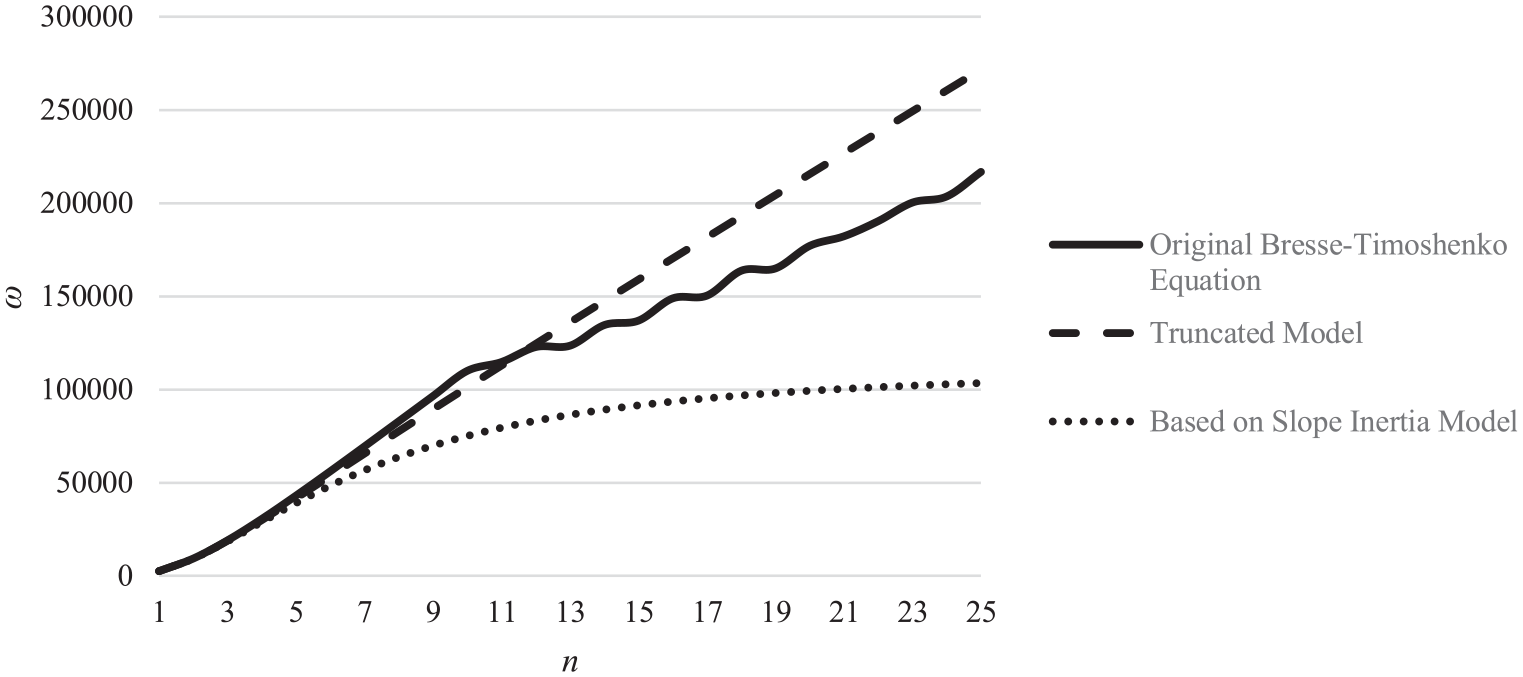
Results for natural frequencies for a simply-supported (S-S) beam on a Winkler–Pasternak foundation.
9. Discussion of results
The presented study refers to the case in which the length of the beam is eight times bigger than its height. The analysis reveals that the intermingling phenomenon happens only when dealing with the original Timoshenko–Ehrenfest equation of a S-S beam. In this situation, two branches of natural frequencies exist, while, for all other cases, only one branch of frequency appears.
According to the exposed tables, the truncated version of the Timoshenko-Ehrenfest equation and the model based on slope inertia are reliable only for the very first values of natural frequency when a beam on a Winkler–Pasternak foundation is considered. Indeed, the difference between the numerical results is very small only in the first region of natural frequencies.
Particular attention has been focused on the S-S beam. Indeed, the use of a stiffer foundation could reduce the number of frequencies prior to the beginning of the so-called intermingling phenomenon. As a consequence, depending on the material properties, there exist a values of
Intermingling phenomenon for a simply-supported (S-S) beam using the original Timoshenko–Ehrenfest equation with

The study shows also that when we consider BCs that differ from the simply supported one, it has not been possible to arrive at a closed-form solution for the governing equations of all the treated cases. Indeed, the values of natural frequencies have been obtained by using a Computer Algebra System, such as Maple.
In what follows we conduct two comparisons for the obtained frequencies with those reported in other studies. We start observing that when parameters
We also confirm that the solutions presented in this paper coincide with the results reported by Wang et al. [35], except for a very small difference. Indeed, by following their paper, we introduce the following parameters
where the value
Comparison of the first natural frequency with that of Wang et al. [33].

10. Conclusion
This paper presents an analysis of the original Timoshenko–Ehrenfest equation and two of its truncated versions for a beam on a Winkler–Pasternak foundation. It reveals that some differences exist between the three models. Indeed, the so-called ‘Elishakoff’s truncated model’ differs from the original Timoshenko–Ehrenfest equation by the absence of one term related to
The study reports some important differences for the analyzed models when dealing with different BCs applied to a Timoshenko–Ehrenfest beam on a Winkler–Pasternak foundation. It shows that two branches of frequencies exist only when dealing with the original Timoshenko–Ehrenfest equation for a simply supported beam. This distinction disappears when we consider the two truncated models. Indeed, these two theories represent a correction of only the first branch of natural frequencies. Thus, we can use these theories only when the contribution of the second branch of natural frequencies is negligible with respect to the first one. We remark that all the other discussed cases of BCs present only one branch of natural frequencies indiscriminately from the used model.
For the given material properties, the first 25 natural frequencies predicted by the original Timoshenko–Ehrenfest beam theory have been evaluated for a simply supported beam in order to illustrate an interesting intermingling phenomenon appearing after the 10th natural frequency in a beam in which its length is eight times longer than its height. For the same kind of BC only the first 10 natural frequencies out of the above set of 25 natural frequencies are reported numerically by using the two truncated models, since they are able to predict only the first branch of frequencies. However, the behavior of these frequencies is shown in detail in Figure 2 for the first 25 frequencies. As a consequence, if the excitation spectrum covers the first 10 or fewer frequencies, the use of the original Timoshenko–Ehrenfest theory is not needed, as it turns out to be overcomplicated.
Footnotes
Acknowledgements
This work was conducted as the part of Master’s Thesis of Mr Giulio Tonzani when he served as a Visiting Scholar at Florida Atlantic University. We are appreciative of the helpful comments of the reviewers.
Funding
The author(s) received no financial support for the research, authorship, and/or publication of this article.
