







Abstract
This paper makes a rigorous case for considering the continuum derived by the homogenization of extensive quantities as a polar medium in which the balances of angular momentum and energy contain contributions due to body couples and couple stresses defined in terms of the underlying microscopic state. The paper also addresses the question of invariance of macroscopic stress and heat flux and form-invariance of the macroscopic balance laws.
1. Introduction
Continuum-on-continuum homogenization provides a convenient theoretical framework for analyzing media in which there exists sufficient length- and time-separation between the macroscopic body and its microstructural components, while, at the same time, both may be accurately modeled as continuous media. This may well be the case for bulk metals (with their polycrystalline microstructure) and composites (with, say, their matrix-fiber microstructure). In the general thermomechanical setting, the goal of homogenization theories is to deduce (homogenized) macroscopic counterparts for all the kinematic and kinetic variables that enter the microscopic description of the continuous medium.
The pioneering work of Irving and Kirkwood [1] on the upscaling of classical statistical mechanics of particle systems to continuum mechanics and subsequent related developments [2–4] motivated a recent study of continuum-on-continuum homogenization, which led to the rigorous derivation of formulae for macroscopic stress and heat flux based on a minimal set of assumptions, that is, extensivity of mass, momentum, and energy [5]. Although phase-space averaging was substituted by mass-weighted volume averaging and interacting particles in the microscale were replaced by a continuum, the critical dependence on extensivity and the procedural similarity in the derivations render the continuum-on-continuum homogenization method in [5] a close relative to the original Irving–Kirkwood method. It may be also viewed as an extension of the mass-weighted volume averaging particle-to-continuum homogenization method of Hardy [6] to the continuum-on-continuum case. The resulting formulae incorporate naturally the volumetric effect of inertia on both stress and heat flux. Incorporating inertia has been investigated [7–10] and can be considered in practical computations using, e.g., two-scale finite element methods [11]. Although it can be plausibly assumed that at appropriately small length scales such volume effects become negligible compared to surface effects, as is argued in the continuum homogenization literature (see, e.g., [12–15]), volumetric effects become dominant in the presence of non-trivial velocity fluctuations, as is the case with wave propagation in heterogeneous media where wavelengths are of the order of the length scale [16–20]. The proposed method is broadly related to the filtering employed in large eddy simulation (LES) methods in turbulence modeling [21]. However, unlike LES methods, the deviations of the velocity from the average are not modeled (which is necessary in turbulence for closure), but rather exactly calculated from the microscale problem. In addition, the nature of the averaging in the proposed homogenization method differs in crucial ways from the purely spatial averaging in LES. Yet, it is possible that the proposed homogenization may form a practical basis for the development of model-free LES-like methods for turbulence. It is also important to note that continuum homogenization theories based on extensivity have been already considered in other field theories, such as electrodynamics [22].
The present paper explores the polar nature of the macroscopic continuum in the homogenization theory, motivated intuitively by the premise that the length scale of the underlying microstructure is generally bound to yield non-vanishing body and surface couples [23]. The polar nature is verified experimentally [24,25] and established methodologically by the approach adopted in [26] for upscaling atomistic systems with internal couples to the continuum hydrodynamics. In particular, it is shown that the distinction between macroscopic angular momentum and moment of momentum, argued masterfully in [27], albeit with only a general allusion to directed media, is a natural implication of the homogenization theory. In fact, it is rigorously confirmed that couple forces, defined in terms of the microscopic state, enter in a non-trivial statement of macroscopic angular momentum balance [28,29]. The proposed theory differs from the micromorphic theory [30–33] both methodologically and philosophically. Indeed, the micromorphic theory relies on homogenization rules for kinetic quantities, such as stress and heat flux, which are not extensive. In addition, constitutive laws for the micromorphic continuum are postulated in the macroscale without explicit reference to the material constitution or to geometric features of the underlying microstructure. In contrast, the proposed theory relies strictly on homogenization of extensive quantities and derives the macroscopic constitutive response explicitly from the microstructure. A key further novelty of the proposed analysis is in the kinematics of the macroscale, which is naturally enriched by an angular velocity quantifying the local rotatory effect of the motion and enables the decomposition of the kinetic energy into translational and rotational components. The angular velocity is related to a macroscopic quantity akin to a local moment of inertia, whose evolution is governed by its own balance equation. The concept of local moment of inertia in a polar medium was considered initially in [34], where a balance equation is proposed without, however, an associated moment of inertia flux term. Other theories of polar media either neglect the moment of inertia or assume it to be independent of time [35–37]. In contrast, the present theory provides an explicit definition of a local macroscopic moment of inertia in terms of the microscopic state and a corresponding balance law for its evolution that contains a moment-of-inertia flux term. In addition, in a wider sense, the proposed theory provides a straightforward path for modeling structured materials, both solid and fluid, as polar media, in which angular momentum balance becomes non-trivial, through, e.g., the transfer of torques to inclusions and suspensions.
The paper also addresses the question of invariance in the macroscale based, again, on a minimal set of assumptions on the form-invariance of the extensive relations. In addition, the inertial effects on stress and heat flux are shown to play a crucial role in the transformation of these quantities under superposed rigid-body motions. In addition, they may point to a path toward the formal resolution of related long-standing controversies on the invariance of stress in turbulence [38–40] and heat flux in rotating particle flows [41–43].
The organization of the paper is as follows. Section 2 contains an outline of the continuum homogenization procedure, as well as expanded discussion on angular momentum. The homogenization of total internal energy and its various constituent parts is addressed in Section 3, whereas the matter of invariance is investigated in Section 4 for the principal extensive quantities and Section 5 for stress and heat flux. Concluding remarks are offered in Section 6.
2. Overview of the extensive homogenization method
2.1. Review of previous results: balance of mass and linear momentum
The premise of the homogenization theory adopted in this work is that there exists a body with highly heterogeneous microstructure, whose thermomechanical response can be well described by classical continuum mechanics. The precise nature of the heterogeneity need not be specified, as the theory does not depend explicitly on it. Further, for practical modeling purposes, it is desirable to deduce an effective thermomechanical response of the same body by averaging out its heterogeneity, while retaining a continuum mechanics-like representation of kinematic and kinetic quantities, as well as corresponding balance laws. As a result, the same body is simultaneously considered both as a classical non-polar continuum (microscale) and as a homogenized continuum (macroscale), whose precise nature is explored here. The purpose of this section is to deduce the connection between the response in these two scales by invoking the principle of extensivity of mass, momentum, and energy.
Consider a body


Likewise, the corresponding balance laws for the macroscale take the form


Here,
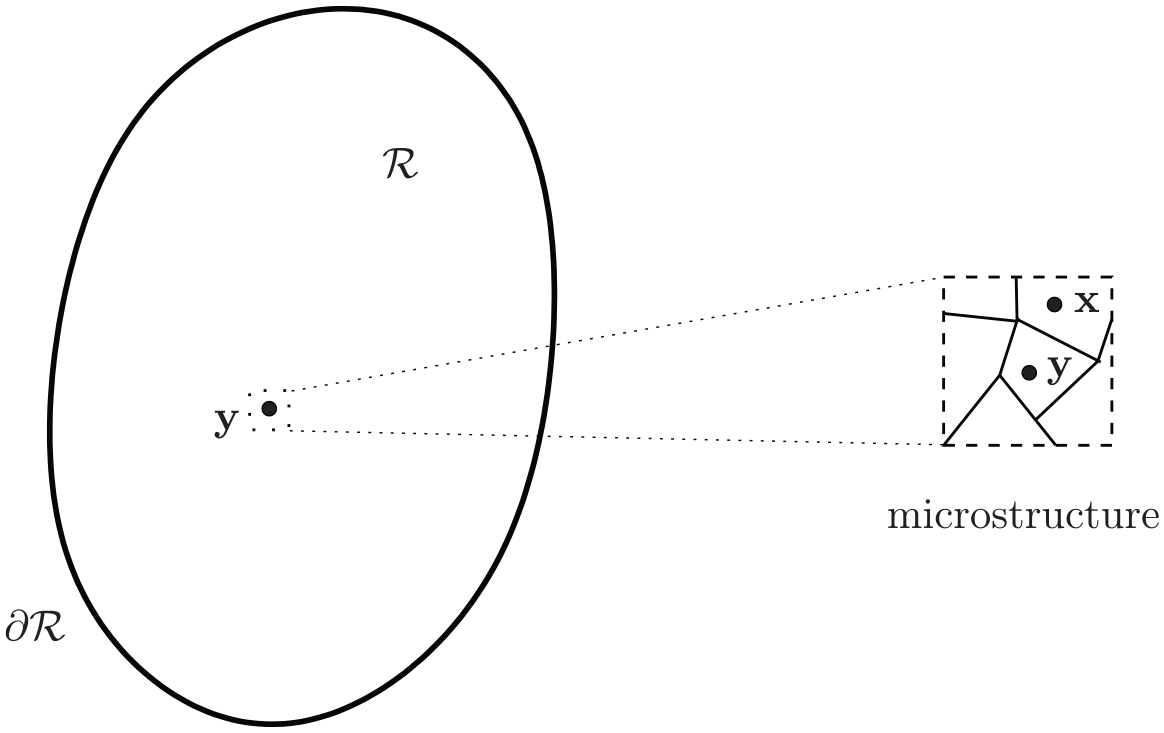
Illustration of a body and its microstructure; here,
Expressions for the macroscopic Cauchy stress and body force are derived by postulating homogenization relations for the extensive quantities of mass and linear momentum. These are given by


respectively, where
The function g is also assumed to be continuous, attain a maximum when

and

Equation (7) implies that

The latter has been shown in [5] to further imply that

This condition is of paramount practical importance in the ensuing derivations, as it allows microscopic derivatives of the coarse-graining to be written as equivalent macroscopic versions. The latter, with the use of the product rule, may be readily interchanged with the volume integrals associated with the extensive definitions.
The support of the coarse-graining function quantifies the length scale which characterizes the homogenization and is informed by the geometry and material constitution of the microstructure. In this sense, its specific form is a constitutive choice for the homogenization method and should be subjected to evaluation by experiment. Such a choice would be guided by the existence of an intermediate asymptotic length scale, at which the homogenized property becomes independent of this averaging domain. The existence of such a length scale would need to be assessed for different microstructures. More general forms of coarse-graining functions are possible that allow the modeling of spatially inhomogeneous microstructures, including surfaces and defects.
Taking material time derivatives of relations (5) and (6), using the balance laws (1) and (2) at the microscale, and comparing the resulting equations to the balance laws (3) and (4) at the macroscale, the macroscopic Cauchy stress tensor is found in [5] to be

to within a divergence-free term, whereas the macroscopic body force is given by

Equation (11) implies that the macroscopic Cauchy stress is symmetric, as is (on satisfying microscopic angular momentum balance) the corresponding microscopic stress. It also demonstrates the explicit presence of kinetic effects in addition to the (weighted) average of the microscopic stress. Furthermore, unlike the micromorphic theory, the stress tensor is determined without resorting to a combination of volume and surface averaging, hence it is, to within a divergence-free term, by necessity symmetric.
It is important to stress here that the proposed homogenization method assumes the existence of two distinct motions, one by the microscopic body (which is a classical non-polar continuum) and another by the macroscopic body, whose governing equations are derived from homogenization from the microscopic response. Unlike, e.g., LES, which is a purely spatial averaging method, practical computations in the proposed approach involve the solution to distinct initial/boundary-value problems, one in the macroscale and several local ones under periodic or other boundary conditions in the microscale. This is precisely what occurs in so-called FE2 methods [44, 45]. Of course, the support of g is small relative to the size of the body, and the computational cost of the individual microscale simulations is very small relative to the computational cost of the macroscopic simulation. In view of the preceding distinction of the two motions, the variable
One of the implications of the two distinct motions is that g is not a conventional coarse-graining function, but rather depends explicitly on the two motions by way of
2.2. Homogenization of angular momentum
The balance of angular momentum at the macroscale is not considered in the theory originally proposed in [5]. In this section, the consequences of the homogenization of angular momentum are investigated. In particular, the balance of macroscopic angular momentum is derived from its microscopic counterpart, and the associated couple stress tensor is identified along with the body couple in terms of microscopic variables. This process is motivated, in part, by the continuum formulation of angular momentum in the pioneering work of Dahler and Scriven [27], and demonstrates the polar nature of the continuum homogenization theory proposed in [5]. Related upscaling approaches for particle-to-continuum and granular media have been proposed in [26, 47].
As angular momentum is also an extensive quantity, an additional assumption in the continuous Irving–Kirkwood homogenization theory is that the total macroscopic angular momentum

in complete analogy to the earlier extensive definitions (5) and (6). This can be alternatively expressed with the aid of (6) as

where

It is readily concluded from (14) that the total macroscopic angular momentum is equal to the macroscopic moment of momentum
The integral form of angular momentum balance in the macroscale may now be expressed as

where

where

This local equation reflects the manner in which spin angular momentum is balanced by the couple stress and the body couple in the macroscale. Note that the spin angular momentum balance does not include the macroscopic stress
Expanding the left-hand side of (17) by employing the Reynolds transport theorem and taking advantage of (1), (2), (5)–(7), (10), the definition in (15), and the symmetry of the microscopic Cauchy stress gives rise to

where the (left) cross-product between a vector and a second-order tensor (see, e.g., [48, Section 2.1.7]) is employed in the last two terms of (19). Reconciling the right-hand sides of (17) and (19), it follows that the macroscopic body couple takes the form

whereas, to within a divergence-free term, the macroscopic couple stress is given by

The term on the right-hand side of (20) is due to the internal torque induced by the microscopic body force. Likewise, the two terms comprising the (unsymmetric) macroscopic couple stress in (21) signify the moment of the microscopic stress and the fluctuation in the internal spin, respectively. Note that when the velocity fluctuations are neglected, the macroscopic body couple and couple stress in (20) and (21) are still generally non-vanishing.
It is important to emphasize at this point that the macroscopic medium is polar in the sense of [49, Section 98], as it is subject to the body couple and couple stress defined in (20) and (21). The macroscopic angular momentum balance equations do not represent new physics, but rather underline the polar nature of the homogenized macroscopic medium derived from a conventional microscopic continuum. In addition, although the macroscopic Cauchy stress in (11) is symmetric (which is not precluded in a polar medium), macroscopic linear momentum balance equations (4) and angular momentum balance equations (18) are coupled by virtue of their dependence on the kinematics and stresses of the (shared) microstructure.
3. Homogenization of energy
In view of the polar nature of the macroscopic continuum, the homogenization of energy in [5] is reconsidered and alternative expressions are derived for the heat supply and heat flux by identifying the appropriate forms of the work by couple stress and body couple. In addition, an additive decomposition of the total internal energy is deduced by a suitable definition of the angular velocity of the macroscopic continuum.
The local form of energy balance in the microscale may be expressed conventionally as

where (upon omitting explicit reference to the superscript “m”)

It is tempting to put forth an expression for the macroscopic energy balance corresponding to (22), as done previously in [5]. Instead, appreciating the polar nature of the macroscopic continuum, as demonstrated in Section 2.2, it is instructive to start from the statement of extensivity for the total internal energy, in the form

and explore the full range of its implications in relation to macroscopic energy balance. To this end, upon invoking (5) and (6) and the preceding decomposition of the total microscopic internal energy, equation (24) readily leads to

Equation (25) shows that the total macroscopic internal energy consists of three distinct parts: the homogenized microscopic internal energy; the homogenized kinetic energy of the velocity fluctuations in the microscale; and, the macroscopic translational kinetic energy.
To reveal the central role of spin in the macroscopic energy, let

where, in general,

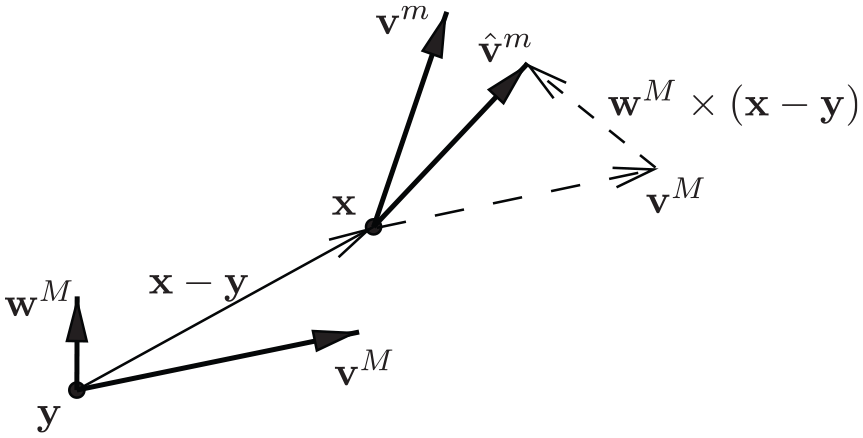
Schematic depiction of the velocities
The second term on the right-hand side of (27) can also be expressed as

in terms of the (homogenized) moment-of-inertia tensor

where

Note that the first term on the right-hand side of (30) involves the spin angular momentum in (15), only considered relative to the macroscopic velocity

Therefore,

which affirms the canonical relation between internal spin angular momentum and spin angular velocity. Therefore, given (14),

which demonstrates the additive decomposition of the macroscopic angular momentum into the moment of the macroscopic linear momentum and the internal spin angular momentum.
The preceding definition effectively eliminates the coupling between the translational and rotational velocity in the internal energy of (25). Indeed, taking into account equations (27), (28), and (30), in connection with the definition of

where the macroscopic internal energy

The last two terms in (34) correspond to the macroscopic kinetic energy due to translational and rotational effects, respectively. Moreover,
Starting from the extensivity relation (24), a local statement of macroscopic energy balance may be derived (see Appendix A) in the form

where

and the superscript “T” signifies tensorial transpose. In contrast to its microscopic counterpart in (22), equation (36) contains power terms involving the body couple
The structure of equation (36) implies that the macroscopic heat supply may be defined as

whereas, to within a divergence-free term, the macroscopic heat flux is given by

With the preceding definitions in place, the local statement of macroscopic energy balance (36) takes the form

It is important to observe here that the definitions in (38) and (39) and the energy balance statement in (40) readily reduce to those derived in [5] upon neglecting the angular velocity
Starting from (29), it can be readily confirmed with the aid of the Reynolds transport theorem, as well as equations (1), (7), and (10) that

where

is a third-order macroscopic moment-of-inertia flux tensor. Equation (41) expresses the (derivable rather than primitive) balance of the moment of inertia and stands in qualitative contrast to the conventional macroscopic mass balance equation (3). In particular, it demonstrates that there is non-material transport of rotational inertia owing to the fluctuations in the velocity, as evidenced by the third term on the left-hand side of (41).
4. Invariance of extensive relations
In this section, the question of invariance under superposed rigid-body motions is investigated systematically for the relations (5), (6), (13), and (24) between the principal extensive quantities in the two scales. In the ensuing developments, it is assumed that standard invariance properties apply to mass density, stress, heat flux, specific energy, and heat supply in the microscale.
By way of background, recall that, under superposed rigid-body motions, any macroscopic point

where


respectively. In complete analogy to (43)–(45), one may express the position, velocity, and acceleration of any microscopic material point



respectively.
At this stage, it is postulated that the relations (5), (6), (13), and (24) which connect the two scales must be form-invariant under superposed rigid-body motions (in the sense of [50, 51]). This reflects the physically plausible idea that extensive quantities should remain extensive under superposed rigid-body motion. Furthermore, it is assumed that the microscopic balance laws in (1), (2), and (22) are likewise form-invariant under superposed rigid-body motions.
Starting with (5), form-invariance implies that

Upon recalling

Form-invariance of the extensive relation (6) for linear momentum necessitates that

Substituting the expressions for the macroscopic and microscopic velocities from (44) and (47), appealing to (6), and using, again, (9) and the invariance of density and infinitesimal volume in the microscale, equation (51) yields

Setting

As (53) is valid for all vectors

which necessitates that the macroscopic point

therefore the center-of-mass condition (54) is itself form-invariant. This condition is of practical importance in computations, where its violation would lead to compounding errors, a point which is already well-recognized in the related molecular dynamics literature [52]. An immediate implication of (54) is that the spin angular momentum in (15) now coincides with its counterpart relative to the center of mass, which enters the definition of the angular velocity

with the last term on the right-hand side reflecting, again, the effect of the non-material transport of rotational inertia. Moreover, upon also taking advantage of (35), as well as of (3), (4), (41), and (56), the reduced form of the energy balance equation in the macroscale is easily derived from (40) as

Again, it is instructive to compare (57) to its microscopic counterpart (23) and, in particular, to note the energetic correspondence of
Proceeding to angular momentum, form-invariance of the extensive relation (14) implies that

This does not yield additional restrictions on any kinematic or kinetic variables. Rather, it furnishes an explicit relation between the angular momenta

where, for brevity,

As seen from (60), additional angular momentum is generated by the superposed angular velocity
Lastly, imposing form-invariance to the energy relation (24), as further expanded in (34) and (35), leads to

where

To start exploring the implications of (61), observe that

a well-known result in rigid-body dynamics, which follows from (43), (46), (9), and the invariance of microscopic density and volume. Next, upon taking advantage of the definition (31), written under superposed rigid-body motion as

one may relate the angular velocity

upon invoking (29) and, once again, (31). This, in conjunction with (63), implies that

which reveals the additive effect of the superposed angular velocity on

which proves that this term (unlike

it can be shown starting from (62), with the aid of (67) and (68)1, that

This means that the macroscopic internal energy (including the kinetic energy of the velocity fluctuations relative to

with each of the additional terms on the right-hand side corresponding to contributions due to the superposed rigid translation and rotation.
5. Invariance: macroscopic Cauchy stress and heat flux
Under a superposed rigid-body motion, the macroscopic Cauchy stress of (11) becomes

Assuming the usual invariance relation

Recalling (11) and the definition of

where

and

Note that the tensor
It is clear from (73) that the transformation of the macroscopic Cauchy stress under superposed rigid-body motions does not generally obey the conventional continuum mechanics invariance relation. In fact, all of the additional terms on the right-hand side of (73) involve the angular velocity
The importance of the transformation condition (73) in turbulence modeling (where the velocity fluctuations are of paramount physical importance) is alluded to in [38,39], where it was observed that satisfaction of the conventional invariance requirement by the (macroscopic) stress is tantamount to ignoring the effects of inertia in the constitutive prescription of stress. Assessing [39] in light of the present work, it is indeed tempting to argue that a turbulent fluid cannot be practically considered a classical continuum, but rather a homogenized one in which the fluctuations of the microscopic velocity relative to the macroscopic average velocity (corresponding to
Under superposed rigid-body motions, the macroscopic heat flux vector in (39) is given by

Taking into consideration the invariance properties of the microscopic stress and heat flux, and invoking (9), (39), (43), (44), (46), (47), and (67), the preceding expression leads to

As with the Cauchy stress, it is seen from (77) that the macroscopic heat flux is not invariant under superposed rigid-body motions, as observed previously [41–43]. However, unlike stress, the non-objective parts of the heat flux in (77) are neither individually nor jointly divergence-free relative to the coordinates in the superposed configuration.
6. Conclusions
The continuum-to-continuum homogenization theory inspired by the Irving–Kirkwood procedure gives rise to a polar macroscopic medium due to the length scale inherent in the coarse-graining process. The role of macroscopic angular momentum becomes non-trivial and a suitable definition of the local macroscopic spin enables the additive decomposition of the total internal energy into non-inertial, translational, and rotational components, thus enabling a canonical representation of the contributions of internal forces and stresses (both polar and non-polar) in the macroscopic balance of energy.
At the same time, the homogenization theory yields macroscopic stresses and heat fluxes that do not observe the conventional invariance requirement owing to presence of inertial effects. These departures, which have been long observed in fluctuation-dominated problems, such as turbulent flows, are now placed within the realm of a continuum-mechanical theory.
In broader terms, this paper has demonstrated that continuum-to-continuum homogenization may be an effective vehicle for investigating (and, hopefully, expanding) the boundaries of traditional continuum mechanics, as motivated by the study of inhomogeneous materials, through physically motivated and mathematically prescribed concepts such as inertial stress and heat flux, body and surface couples, and local angular velocity and time-evolving moment-of-inertia tensors. Whereas single-scale polar theories may postulate the existence and evolution of such quantities, the proposed approach relies on the underlying continuum-mechanical microscale and the proposed homogenization theory to constitutively specify them.
Although the proposed theory is applicable to homogenization away from boundaries, internal or external, it provides a reasonably general framework for future extensions to materials that exhibit discontinuities.
Footnotes
Appendix A. Derivation of the macroscopic energy balance equation
To derive the macroscopic energy balance equation (36), start by taking the material time derivative of the extensivity equation (24) and then invoke (1) and (3) to find that
The second term on the right-hand side of (A.1) may be expanded with the aid of the microscopic energy balance (22) and the definition of macroscopic body force (12) as
However, the divergence theorem, in conjunction with (7) and (10), implies that
and
Likewise, upon using (10) and (24), the third term on the right-hand side of (A.1) becomes
Inserting (A.2) and (A.5) into (A.1), and taking into account (A.3), (A.4), and the definition of the macroscopic Cauchy stress in (11) leads to
To extract the polar effects from the preceding statement of energy balance, recall the definition of the convected microscopic velocity
where use is made of (20). Likewise, it can be shown with the aid of (21) that
Lastly, upon taking into account the definition of
The macroscopic energy balance equation (36) is obtained by substituting (A.7)–(A.9) into (A.6) and using (26) to eliminate all residual terms.
Appendix B. Divergence-free terms in the macroscopic Cauchy stress
Preliminary to establishing the divergence-free property of the additional inertial terms in (73), two useful identities are deduced. For the first identity, start by taking the material time derivative of the invariance relation (9), which yields
Next, upon invoking (43), (44), (46) and (47), equation (B.1) may be rewritten as
and further reduced, upon observing (10), to
Given the arbitrariness of
The second identity is obtained by taking the material time derivative of the center-of-mass relation (54). To this end, appealing to the Reynolds transport theorem and using the microscopic balance of mass (1), it follows that
Using first (10) and then invoking (6) and (54), the preceding equation becomes
Expanding now the left-hand side of (B.5), and using the macroscopic mass balance equation (3), it is concluded from (B.6) that
which is the second identity of interest here.
It is now possible to show that the last three terms on the right-hand side of (73) are individually divergence-free. Indeed, consider the first term, which takes the form
and vanishes identically due to (B.7). The next term is
The three terms on the right-hand side of (B.9) themselves vanish individually due to (54), the skew-symmetry of
Again, each of the three terms on the right-hand side of (B.10) vanishes owing to (54), the skew-symmetry of
Author’s note
B Emek Abali is now affiliated with Department of Materials Science and Engineering, Uppsala University, Sweden.
Funding
This work was supported by a grant from the Max Kade Foundation to the University of California, Berkeley.
