







Abstract
In this paper, we present a variant of the second gradient continuum model that allows description of the spatial dispersion effects of high-frequency waves in anisotropic crystals. The considered model takes into account the strain and inertia gradient effects and the classical electro-mechanical coupling. The simplified constitutive equations of the model contain seven and four length scale parameters for piezoelectric hexagonal crystals and elastic cubic crystals, respectively. It is shown that all except one length scale parameter can be identified based on the fitting of the continuum model to the lattice dynamics calculations for the dispersion relations of the bulk acoustic phonons. Examples of the identification are presented for hexagonal piezoelectric ZnO and AlN and for cubic diamond and Si crystals. Using a calibrated model, we then obtain the dispersion relations for the high-frequency Bleustein–Gulyaev wave in piezoelectric crystals and for the shear horizontal surface wave in elastic crystals. The last one is predicted by the gradient models only for the high frequencies, while at low frequencies this wave degenerates to the bulk shear wave. Examples of calculations are also provided for the Rayleigh wave propagating through the homogeneous piezoelectric half-space and layered ZnO(AlN)/diamond/Si structures. It is shown that this kind of surface wave can be used to identify the last unknown length scale parameter of the model.
Keywords
1. Introduction
Fitting of the continuum dispersion relations to the lattice dynamics calculations is one of the effective methods to determine additional material constants of generalized continuum theories. This method has been proposed within the simplified strain gradient elasticity [1, 2] and then used in different theories, including the general Mindlin–Toupin second gradient elasticity [3–7] and flexoelectricity [8]. A similar approach has been used to analyze different lattice metamaterials at the level of structural mechanics [9, 10]. Quasi-static atomistic calculations have also been used to calibrate static second gradient models [11, 12].
In the present paper, we extend the lattice-dynamics-based calibration method for the piezoelectric materials and structures, which are described within the second gradient electro-elasticity theory [13, 14]. To the best of the author’s knowledge, this was not done previously and only elastic materials have been considered in such approaches [1, 4, 5]. In the present study, the variant of non-classical theory with strain and inertia gradient effects is considered. The electric field gradient effects [13, 15] and all the coupling effects apart from the standard piezoelectricity are out of consideration. Our choice is dictated by the need for model simplification, such that all non-classical phenomena can be described using a minimal number of additional parameters. In the present case, we use the model that allows correct description of the spatial dispersion effects for relatively high-frequency waves in the elastic and piezoelectric crystals. For example, the models with electric field gradients [15] would not allow us to describe such effects in purely elastic materials.
Note that the inertia gradient effects should be obligatorily included within the strain gradient theories to correctly describe the normal spatial dispersion [14, 16]. An additional fourth-order tensor of micro-inertia moduli arises in such theories [14, 16–18]. In the present paper, it is shown that for crystals with hexagonal and cubic symmetry, the model contains at least seven and four different length scale parameters, respectively. Simplifications in the constitutive equations are assumed for the sixth-order tensor of gradient moduli according to previously proposed approaches [19]. The comparison between dispersion relations for the bulk waves in the considered continuum model and corresponding lattice dynamics data validates these results. Namely, it is found that the models with reduced number of length scale parameters cannot describe with appropriate accuracy the lattice dynamics data in a wide frequency range.
Examples of calculations are provided in this paper for the piezoelectric hexagonal crystals ZnO and AlN that are widely used in different applications in sensors, filters, resonators, and so on [20, 21]. The lattice dynamics data for the phonon dispersion relations in these crystals is taken from literature [22, 23]. An example of the application of the calibrated model is presented for the layered ZnO(AlN)/diamond/Si structures, for which the length scale parameters of cubic diamond and silicon crystals are also found. All calculations are performed under quasi-electrostatic assumption.
2. Second gradient electro-elasticity theory
We consider a piezoelectric body that occupies the domain

where
The model considered is the classical electroelasticity [15] with additional strain gradient and inertia gradient effects according to Mindlin Form II [24]. In the static case, this model is the special variant of a more general theory that was considered previously in literature [25, 26] In the present study, we do not include some other effects such as flexoelectricity, high-grade coupling, and gradient electric field effects. We will try to use such reduced formulation of the model (1) to describe the known lattice dynamics data on the spatial dispersion of high-frequency waves in crystals.
Using a standard variational approach from equation (1), one can obtain the following equations of motion and charge equation in

where the stress



Natural and essential boundary conditions on

where the superposed bar denotes the prescribed value of the corresponding quantity on

where
Continuity conditions on the contact surface between two different materials must be prescribed with respect to the same quantities that arose in equation (6), as follows:

where the square brackets denote the difference between the values of the enclosed quantity on the two sides of the contact surface.
In the following, we will consider hexagonal and cubic single-crystal materials. For hexagonal crystals, the constitutive tensors of the model can be represented using the Voigt notation as follows:
Elastic moduli:

where
Piezoelectric constants and dielectric permittivities:

For the sixth-order tensor of gradient moduli, we will imply the following simplified assumption about its structure that is usually introduced for anisotropic materials [19]:

where

Tensor of micro-inertia coefficients

Using these conditions (13) and also accounting for the hexagonal symmetry of considered crystals, we can state that the micro-inertia tensor has a similar structure to the classical elasticity tensor, i.e., in Voigt notation, it can be represented as follows:

where we have five independent constants and it is valid that
Thus, the hexagonal crystal within the considered model should be characterized by the following set of material constants:
5 elastic constants:
3 piezoelectric constants:
2 dielectric constants:
2 length scale parameters:
5 micro-inertia coefficients:
among which the first 10 constants (elastic, piezoelectric, and dielectric) are standard and can be directly evaluated based on ab initio methods [22, 23]. Additional seven parameters are related to the non-classical gradient effects, and they can be found using several approaches developed within static and dynamic formulations of strain gradient elasticity [1, 4, 11, 12]. In the present case, we will use the method of fitting between the dispersion relations found based on the continuum gradient model and the corresponding relations found using ab initio lattice dynamics for the bulk acoustic phonons in crystals.
For the following analysis, it is useful to introduce the length scale parameters for the micro-inertia effects. Accounting for the dimensions of coefficients

where
As a result, in the presented model, we have seven length scale parameters. Two of them
In the following, we will also consider elastic crystals of cubic symmetry. The constitutive relations for the elastic cubic materials can be defined in a similar form to the presented one for the piezoelectric hexagonal structures (3)–(5) and (9)–(14), while the following sets of material constants should be used:
3 elastic constants:
1 dielectric constant:
1 length scale parameter:
3 micro-inertia coefficients:
and all piezoelectric constants should be set to zero for non-piezoelectric structures.
3. Bulk waves: calibration of the model
For the model calibration, we consider the following five uncoupled types of bulk waves that are possible in the hexagonal crystals (corresponding classical solutions can be found in Simionescu-Panait [28]):
1. Longitudinal wave in the plane of isotropy.
This case corresponds to the one-dimensional propagation of pressure wave along, e.g., the

where symbol
Assuming harmonic law for the displacement

2. Shear horizontal wave in the plane of isotropy.
Consider the propagation of shear wave along, e.g., axis

Dispersion relations for the harmonic waves

3. Longitudinal wave along axis of symmetry.
This case corresponds to the one-dimensional propagation of the pressure wave along the

Considering harmonic electro-elastic wave

4. Shear wave along axis of symmetry.
Consider the propagation of shear wave along the

The dispersion relations for the harmonic wave

5. Transverse shear wave propagated in the plane of isotropy.
Finally, consider the propagation of the shear wave along the

The dispersion relations for the harmonic electro-elastic wave

Thus, for the piezoelectric hexagonal crystal, we have five relations (16), (18), (20), (22), and (24) containing nine standard material constants
For the calibration of the strain gradient elasticity theory for the elastic cubic crystals, we will consider the longitudinal and shear waves, whose dispersion relations are similar to the solutions (16) and (18). For cubic crystal in these two relations, we have three standard parameters
The classical solutions for the constant phase velocities of the form
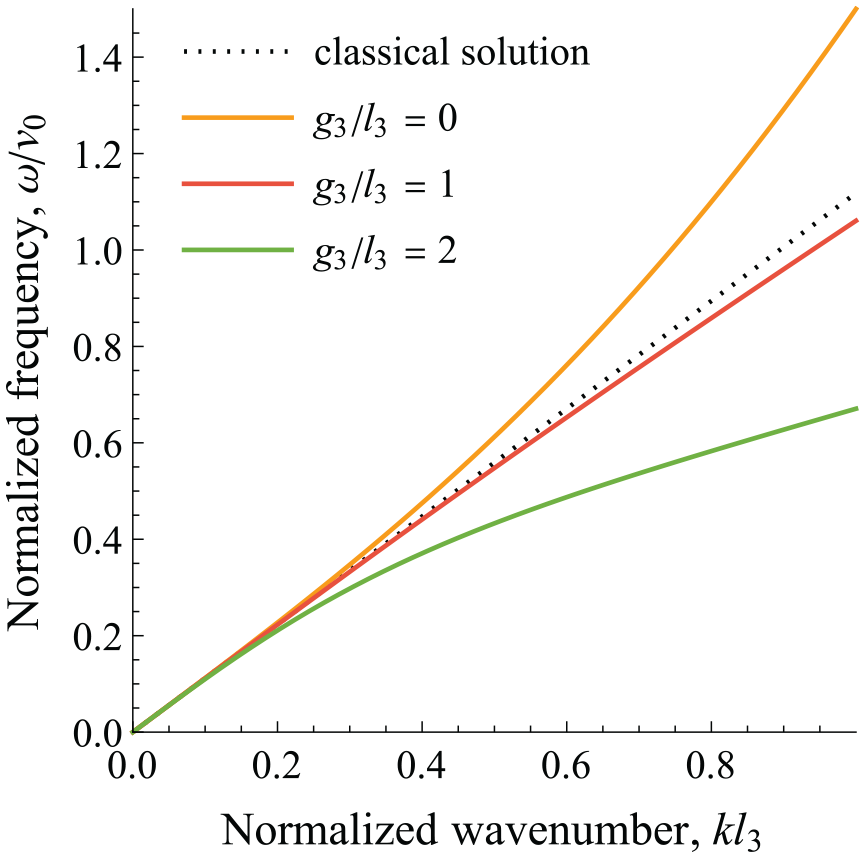
Illustration for the influence of the length scale parameters on the dispersion relations for the longitudinal wave along the axis of symmetry in hexagonal piezoelectric crystal (solution (20),
Up to date, a lot of data exist on the dispersion relations for different crystalline materials obtained based on the ab initio lattice dynamics [22, 23] and validated experimentally [29]. Although the full phonon dispersion for the crystal contains several acoustic branches and a lot of optical branches, for calibration of the second gradient continuum theories, we can use only the former. Optical phonons are out of consideration here, and their continuum description could be performed using only the models with additional internal degrees of freedom [10, 30]. Thus, in the rest of this section, we will use the known lattice dynamics data on the dispersion relations of acoustic phonons in several examples of anisotropic piezoelectric and elastic crystals.
Fitting of the continuum model will be performed using the derived solutions (16), (18), (20), (22), (24) and the lattice dynamics dispersion relations for the elastic waves in crystals. The correspondence between the derived continuum solutions and standard notations for the phonon band structure is presented in Table 1. Here, we show the crystallographic directions of wave propagation and corresponding notation in terms of the high symmetry points of the Brillouin zone in hexagonal crystals. For cubic crystals, we fitted solutions (16) and (18) to the lattice dynamics data for
Notations in continuum model and in lattice dynamics for hexagonal crystals.
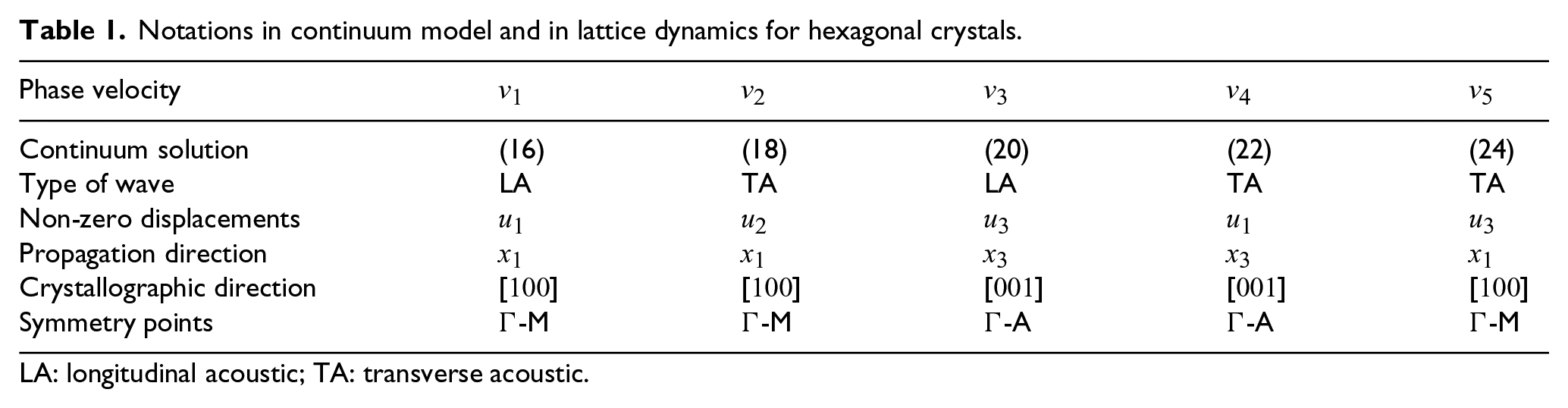
LA: longitudinal acoustic; TA: transverse acoustic.
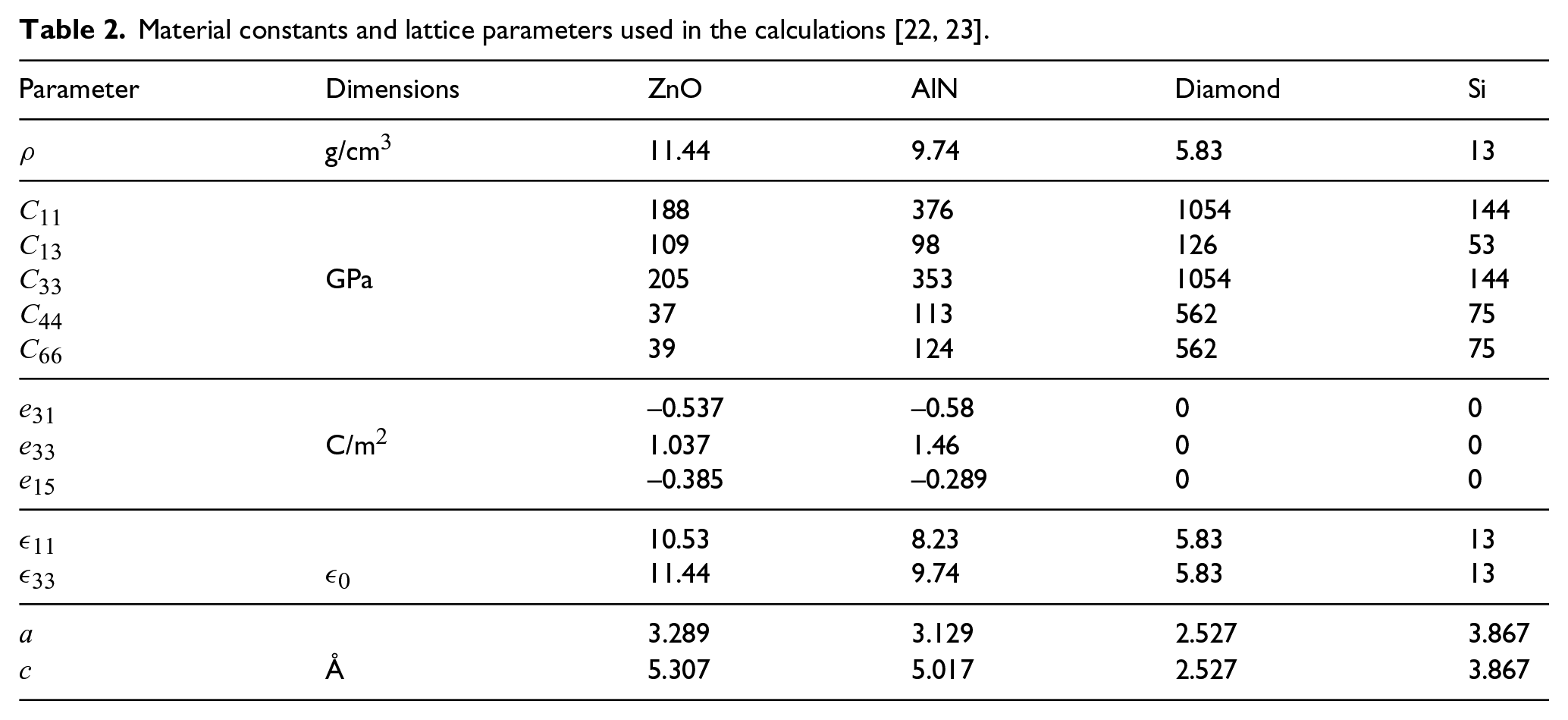
The length scale parameters are identified for the hexagonal piezoelectric crystals ZnO and AlN. The phonon dispersion relations obtained based on lattice dynamics for these materials are taken from literature [22, 23]. The elastic, piezoelectric, and dielectric constants have also been calculated in these references, and they were used in the present calculations (Table 2). Wavevector scaling was performed accounting for the Brillouin zone dimensions. Namely, in hexagonal crystals, it is
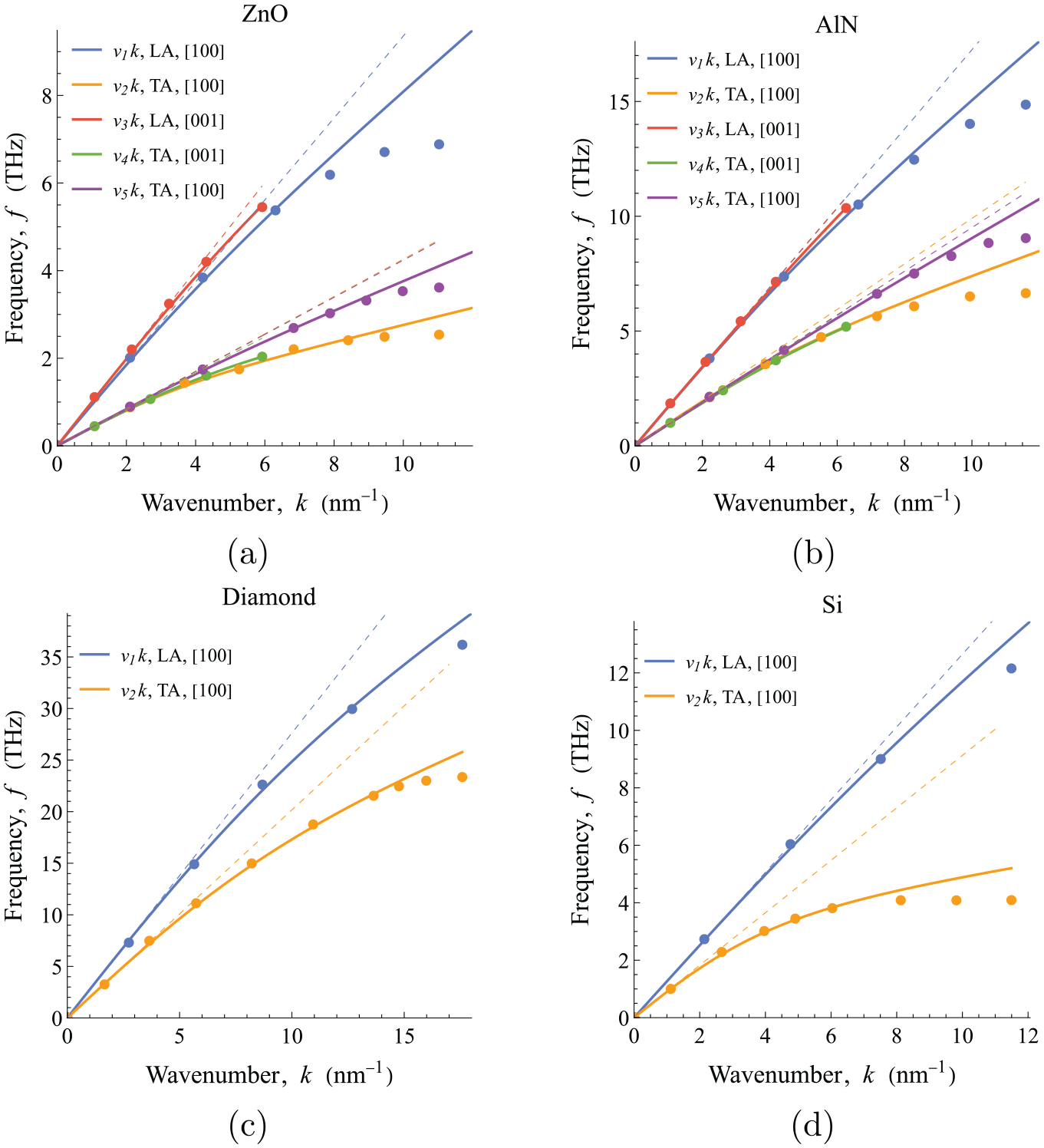
The results of fitting between continuum solutions and phonon dispersion relations are presented in Figure 2. The dependence of frequency
Identified length scale parameters (Å).
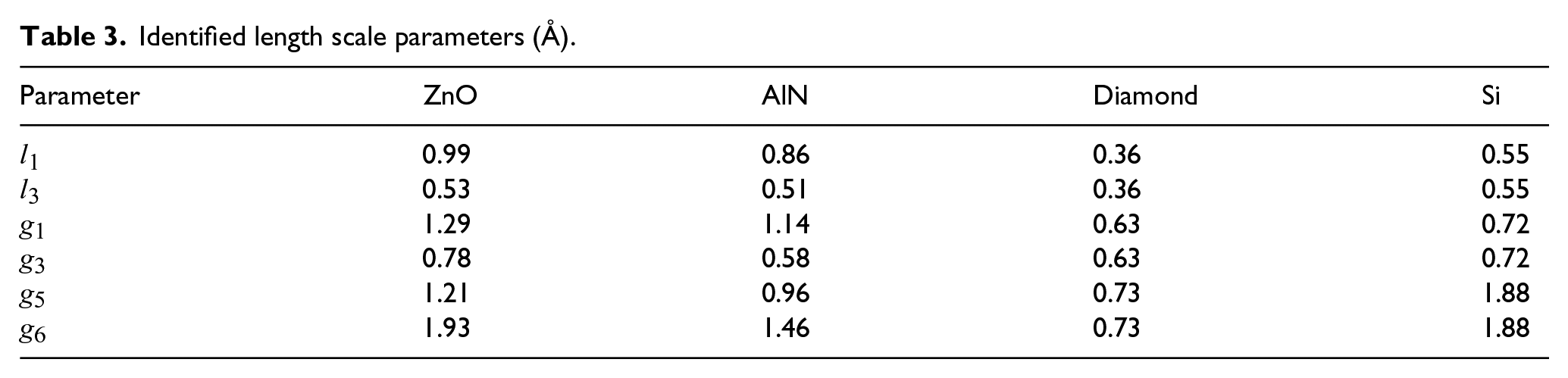
The important result of identification is that all the introduced length scales have different values (see Table 3). Therefore, we cannot use a more simple model with reduced number of additional parameters. Such an example of fitting the model with a single micro-inertia parameter
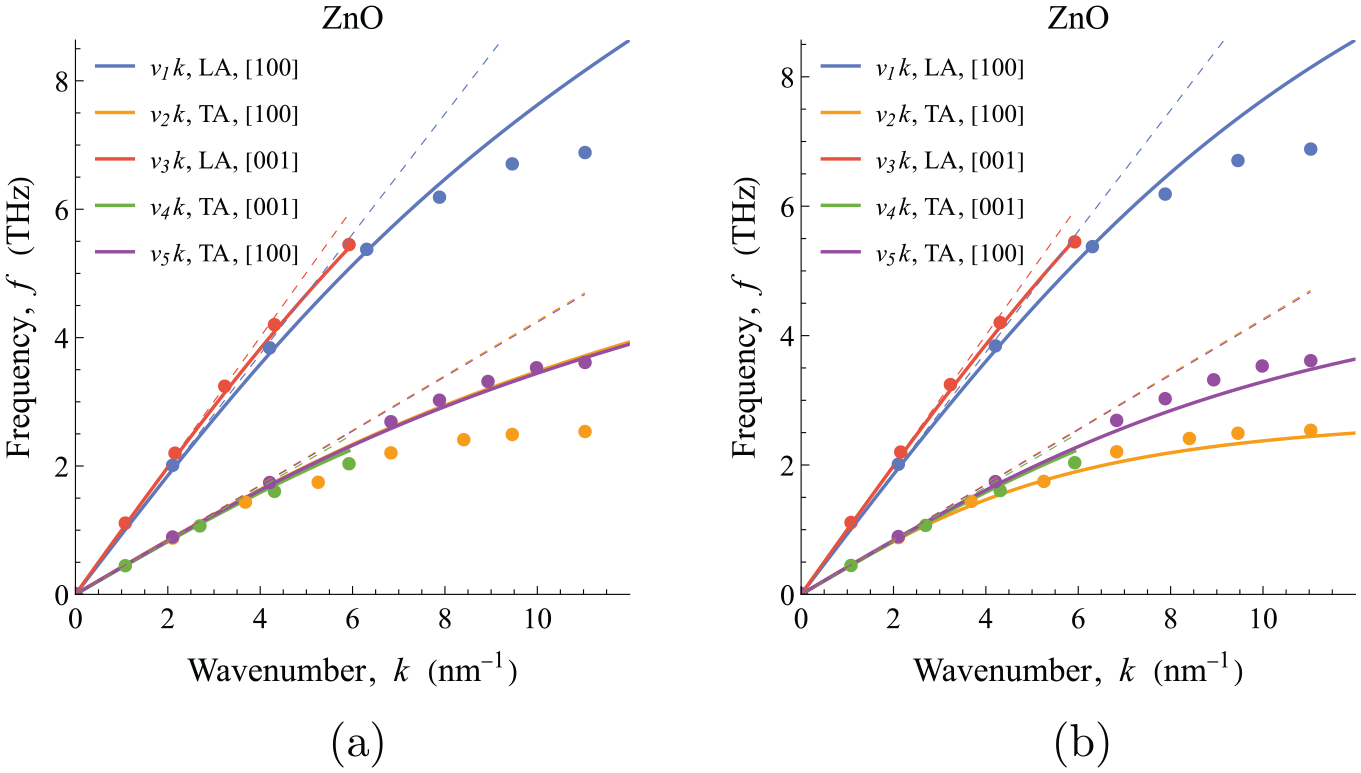
Example of adjusted dispersion relations of simplified continuum models to the lattice dynamics data for ZnO: (a) model with single micro-inertia coefficient
On the contrary, it can be assumed that the dispersion relations could be fitted by considering the micro-inertia terms only. Such an example, for which we use zero values of the elastic length scale parameters
4. Surface waves: predictions of the model
In this section, we present the results of the calculations for the surface waves obtained by considering the electro-elasticity model with identified length scale parameters. At first, we obtain a prediction for the dispersion relations of anti-plane shear horizontal waves propagated over the surface of piezoelectric and elastic crystals. These predictions do not contain any unknown parameters, and they are totally defined by classical and gradient constants presented in Tables 2 and 3. For the Rayleigh waves, we obtain the solutions, which contain the last length scale parameter
4.1. Bleustein–Gulyaev wave
Consider a special type of anti-plane surface wave propagated along the

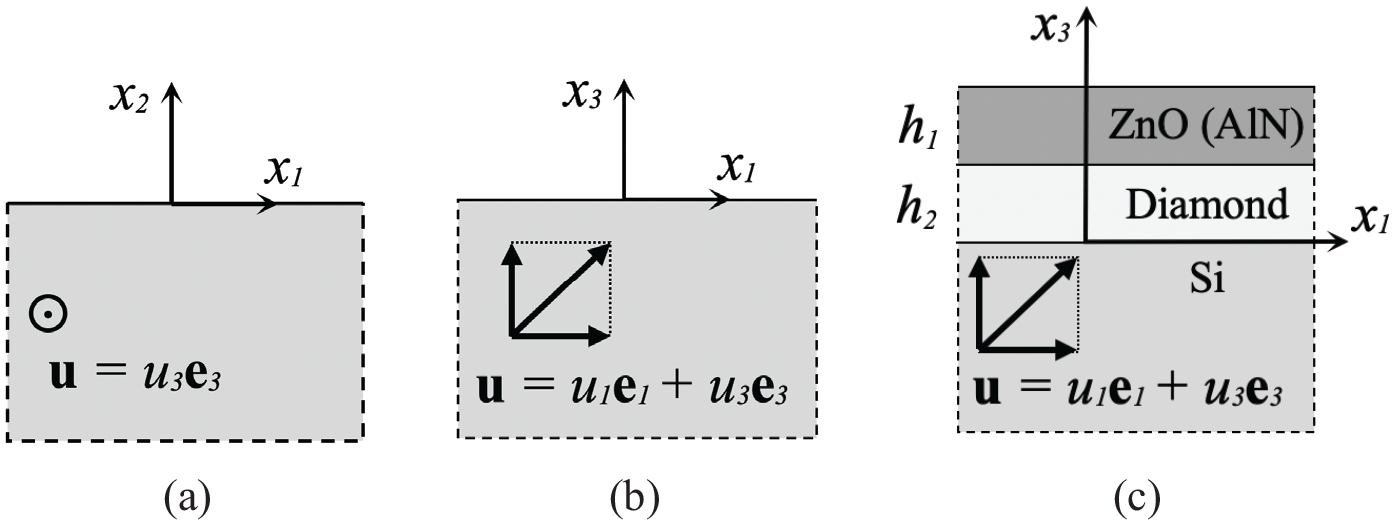
Coordinate systems and direction of motions in the problems with surface waves: (a) anti-plane shear horizontal wave, (b) Rayleigh wave on a half-space, and (c) Rayleigh wave in a three-layered structure.
It can be shown that the non-trivial equation of motion and the charge equation for the Bleustein–Gulyaev wave in second gradient electro-elasticity are the following [14]:

Introducing a new field variable

where
Stress-free boundary conditions on the surface

Electrostatic boundary conditions at

where
The solution of equations (27) for the harmonic surface wave with decaying behavior from the surface

where
Values of

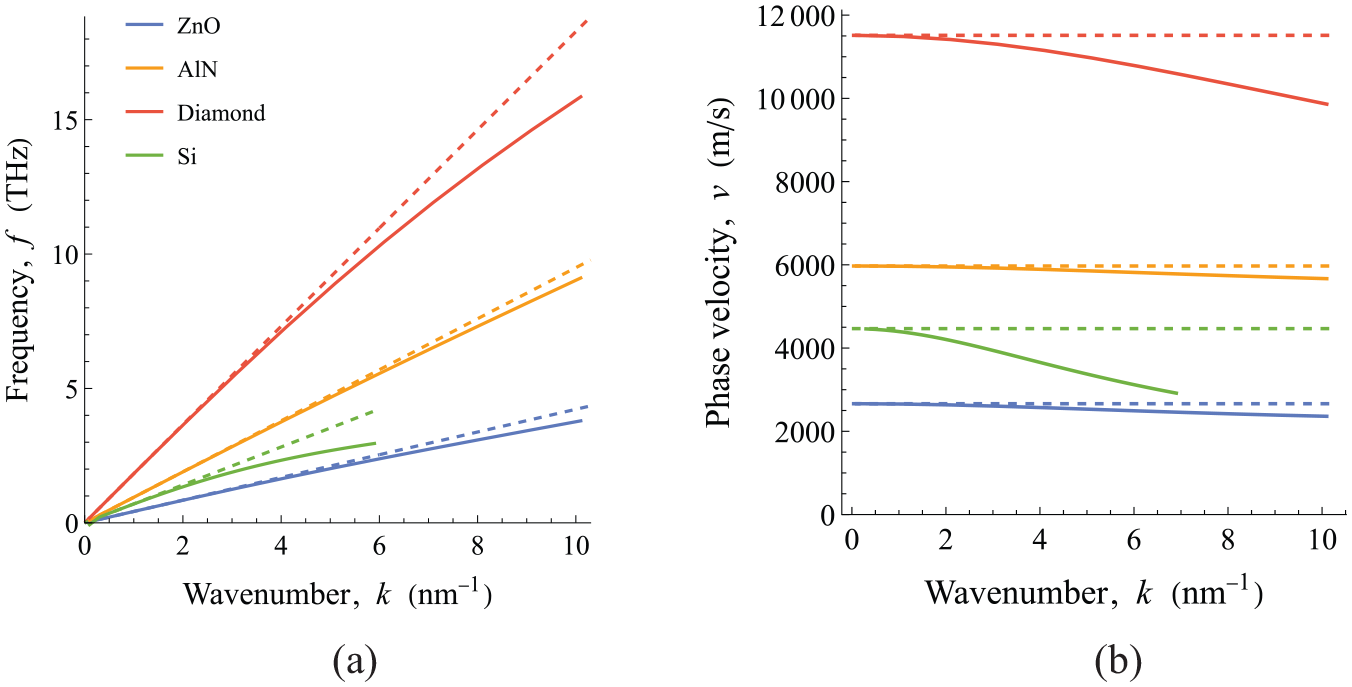
Predicted dispersion relations of high-frequency shear horizontal surface waves in ZnO and AlN crystals (Bleustein–Gulyaev waves) and in cubic diamond and Si crystals (strain gradient effects): (a) frequency
The corresponding classical values of Bleustein–Gulyaev phase velocities (2654 m/s for ZnO and 5953 m/s for AlN) are shown by dashed blue and yellow lines in Figure 5(b).
In Figure 5, we also show the calculated dispersion relations for the shear horizontal surface waves in elastic cubic diamond and Si crystals. Such waves are restricted within classical elastodynamics. Nevertheless, it was shown recently that these waves are allowed within the generalized continuum theories with surface, strain gradient, or flexoelectric effects [27, 31]. The presented results correspond to the predictions of strain gradient elasticity theory, which have been obtained for isotropic materials in Eremeyev et al. [27]. In the present study, we used the considered model (25)–(30) and reduced it to the solution for the elastic crystal assuming the absence of piezoelectric effect
4.2. Rayleigh wave
Now consider the Rayleigh waves, i.e., the surface shear waves with transverse and longitudinal motions of particles. These types of waves in piezoelectric materials are widely used in non-destructive testing and in microelectronics [21]. In the present section, we derive the high-frequency dispersion relations within considered electro-elasticity theory accounting for the strain gradient and inertia gradient effects.
We consider the hexagonal piezoelectric half-space with its axis of symmetry

where
Mechanical boundary conditions should be specified on the free surface of half-space

Representation of surface tractions in terms of displacements and electric potential can be obtained by substituting the constitutive relations (3)–(5) into equation (32). We do not present these relations here for brevity. The electric boundary conditions at

where
The displacement components and electric potential in the solid material and in the free space are assumed to be the following functions:

where attenuation coefficients
The dispersion relations
These calculations were performed numerically using material constants from Tables 2 and 3. The single unknown parameter in these calculations was the length scale
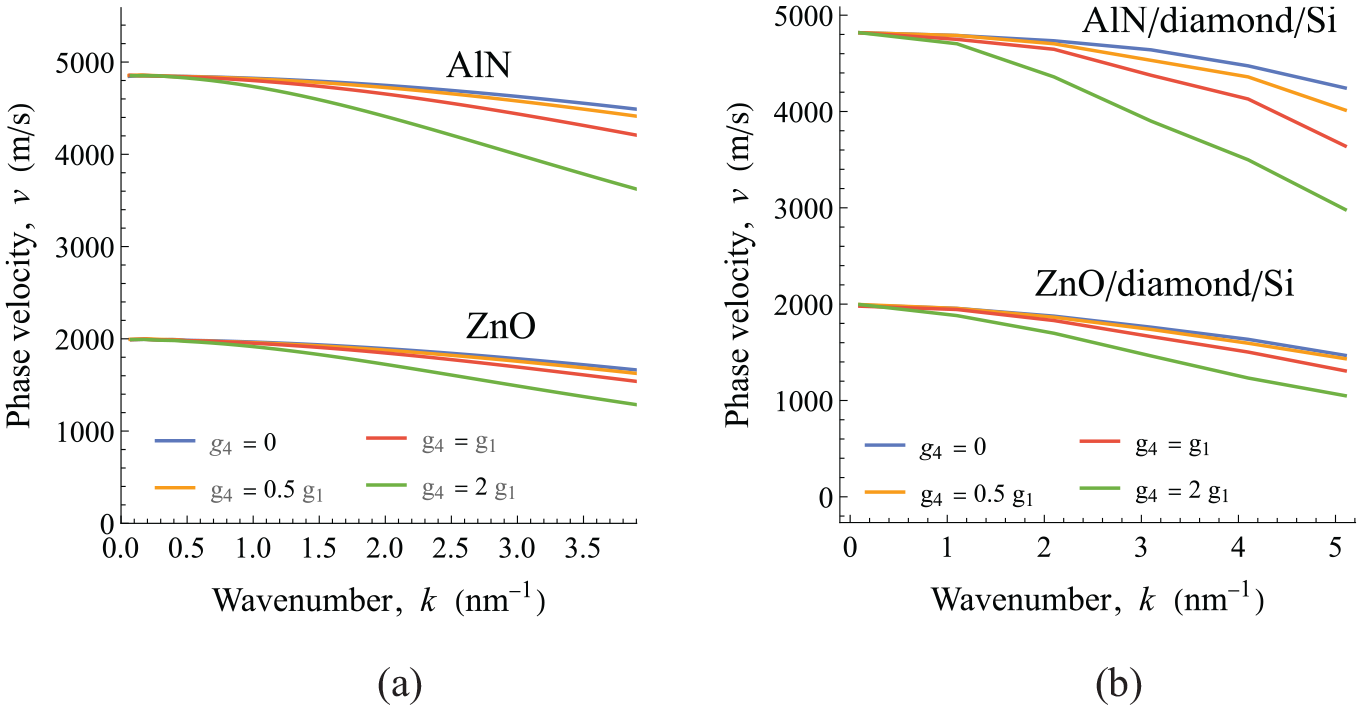
Predicted dispersion relations
Considering the Rayleigh waves in the plane
Finally, we consider the three-layered structures consisting of thin piezoelectric film (ZnO or AlN), diamond sub-layer, and silicon substrate (Figure 4(c)). Such structures are used in the high-frequency surface acoustic wave filters [20]. The axis of symmetry of the film materials is oriented along the surface normal (consider the so-called highly oriented piezoelectric films). The Rayleigh-type wave is propagated along the
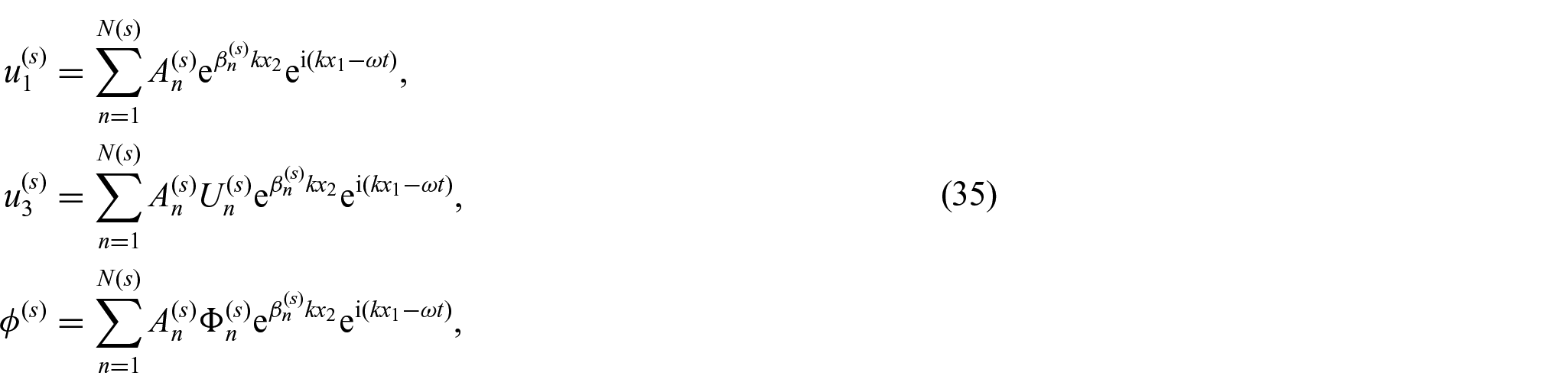
where
Boundary conditions at the free surface of the piezoelectric film
5. Conclusion
In this paper, we present a variant of the second gradient electro-elastic model that allows the correct description of the spatial dispersion effects in piezoelectric and elastic anisotropic crystals. We identify the length scale parameters of the model based on fitting its dispersion relations in bulk to the lattice dynamics calculations for the single-crystal materials. The examples of calculations within the calibrated model are presented for the high-frequency surface shear waves in piezoelectric and elastic structures. The presented predictions for the shear horizontal waves do not contain any unknown parameters. These relations can be used to directly predict experimental data (if some other effects such as surface elasticity do not arise [32], etc.). The solutions for the Rayleigh waves contain a single unknown length scale related to the micro-inertia effects. This parameter can be identified based on the lattice dynamics data for the velocities of the surface waves at THz range. A calibrated second gradient model can then be used for the refined analysis of the high-frequency processes in the advanced small-scale piezoelectric and elastic structures within the continuum approaches [33, 34]. An approach similar to the presented one can also be developed for wave propagation analysis in inhomogeneous materials with periodic internal structure (composites and meta-materials), in which the length scale parameters will have the order of the unit cell size and the spatial dispersion effects will arise even for a relatively low-frequency range [35].
Footnotes
Appendix 1
Declaration of conflicting interests
The author(s) declared no potential conflicts of interest with respect to the research, authorship, and/or publication of this article.
Funding
The author(s) disclosed receipt of the following financial support for the research, authorship, and/or publication of this article: This work was supported by the Ministry of Science and Higher Education of the Russian Federation (agreement No. 075-15-2022-1023 dated May 17, 2022).
