







Abstract
We study the delamination induced by the growth of a thin adhesive sheet from a cylindrical, rigid substrate. Neglecting the deformations along the axis of the cylinder, we treat the sheet as a one-dimensional flexible and compressible ring, which adheres to the substrate by capillary adhesion. Using the calculus of variations, we obtain the equilibrium equations and in particular arrive at a transversality condition involving in a non-trivial way the curvature of the substrate, the extensibility of the ring and capillary adhesion. By numerically solving the equilibrium equations, we show that delamination by growth occurs through a discontinuous transition from the fully adherent solution to the partially delaminated one. The shape of the delaminated part can take the form either of a ruck, with a small slope, or a fold, with a large slope. Furthermore, in the weak adhesion regime, complete delamination may occur. We construct the phase diagram between the different solutions in the parameter space. In the quasi-incompressible limit, numerical results are also supported by asymptotic calculations both in the strong and weak adhesion regimes.
1. Introduction
In everyday experience, the peeling of adhesive films from both hard and soft, curved substrates is a fairly recurring event. Although, for example, the formation of a wrinkle on a bottle label has trivial consequences, the delamination of thin films becomes a more significant issue for coating technologies such as stretchable electronics [1–3]. Thus, understanding the mechanics of adhesive sheets becomes crucial for applications, but also provides an interesting mathematical paradigm in which mechanics of slender bodies, adhesion properties and substrate geometry meet [4].
Delaminated blisters originate in compressed films [5, 6]. This compression may be due to external compressive forces applied to the edge of the sheet, or to the growth of the sheet when it is confined, or to thermal dilation.
Delamination blister formation is a classic problem, in pioneering works the analysis was limited to blisters with a small slope in the realm of small deformations theory. However, in many new applications, this limitation is inappropriate and many subsequent studies modeled thin films as nonlinear Euler’s Elasticae [7–9], allowing large deflections to be handled. Moreover, the occurrence of delamination blister has been studied extensively over the last two decades in a variety of situations with both inextensible and extensible rods adhered to flat adhesive substrates [10–15], considered either rigid or soft.
Delamination also occurs when flexible rings are confined within a small container, whether rigid or flexible, both in the presence or absence of adhesion [10, 16–19]. In these cases, the curvature of the confining wall affects the equilibrium shape by promoting the regions of adhesion, acting as an effective adhesion.
In an inextensible sheet, the transition to a delaminated shape from a flat or concave substrate requires an infinite compressive force [20]. In contrast, if a small compression of the sheet is allowed, the compressive force remains finite and delamination occurs via a discontinuous transition to a blister of finite amplitude [12, 13, 17].
In this work, we study the delamination of a compressible thin film that adheres to the outer surface of a cylinder by capillary action. The aim of the paper is to extent results obtained for a compressible adhesive sheet on a flat substrate to a circular substrate [13, 18], in the same time it generalizes the problem of a compressible film in contact with a curved surface [17] in presence of capillary adhesion. Extensibility and adhesion play a role in defining the two key characteristic lengths of the model, namely,
By comparing the stored energies of the adhered state, the small-slope ruck (Figure 1(c)), and the fold configuration (Figure 1(d)), we determine the possible behaviors of growing thin sheet. In the nearly-incompressible case, when the adhesion is sufficiently strong, i.e.,
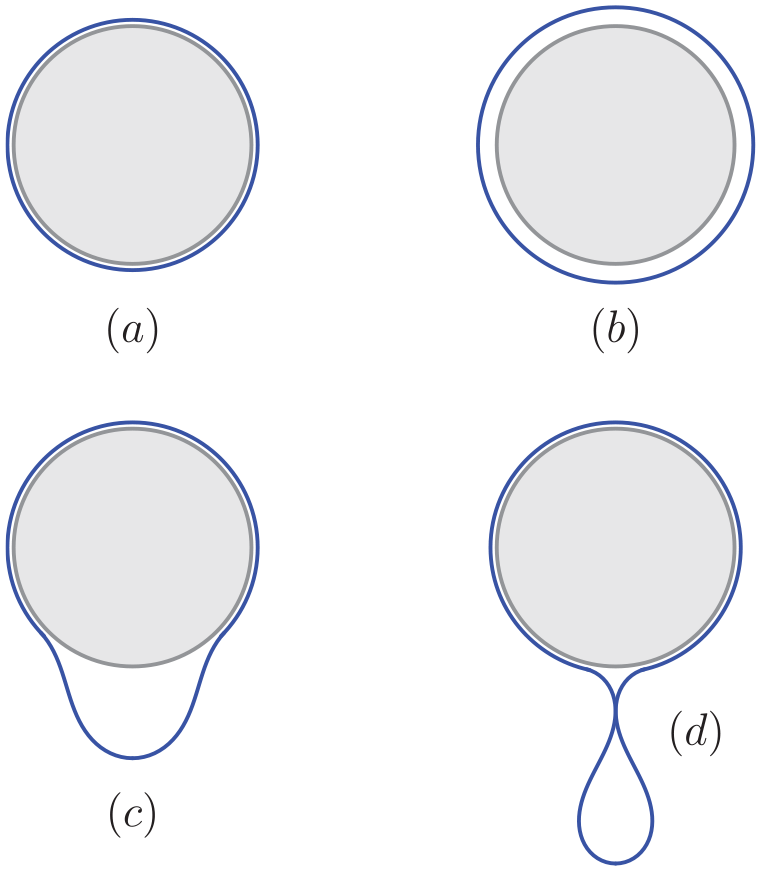
Schematic representation of the film profiles: (a) fully adhered configuration, (b) fully delaminated, (c) ruck, and (d) fold.
The article is organized as follows. In section 2, we posit the energy functional of the model from which we derive the equilibrium equations and the boundary conditions in section 3. The variational approach provides a novel transversality condition at the detachment point, which combines the intrinsic lengths in a non-trivial way. In section 4, we discuss the main results of our theory, and compare the numerical results with the asymptotic approximations, as derived in Appendix 1. Finally, in section 5, we draw the conclusions.
2. Energy functional
We consider an infinite cylinder of radius
The geometry of the curve is described by the position vector
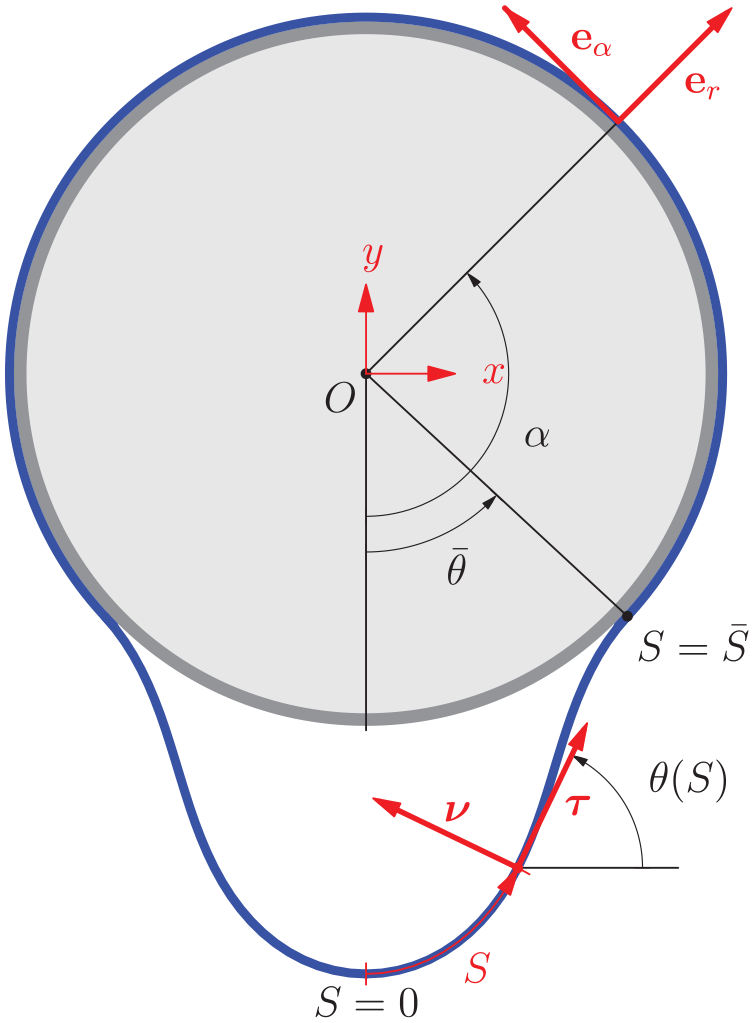
Schematic representation of the elastic film in contact with the outer surface of a cylinder of radius
We derive the equilibrium equations, and the boundary conditions for the partial delaminated solution, by imposing stationarity of the energy functional which comprises two parts: the energy of the detached region

with


Both

defines a characteristic length. Since
The last term in equation (2a) enforces the constraints

which translate the assumption that the rod is extensible but unshearable. The vector
The last term in the energy density (2b) is an adhesion-promoting term, proportional to the adhesion area through the constant

which is called the elastocapillary length.
3. Equilibrium equations
Let us consider

where bar above the variables denotes that these variables are calculated in
It is worth noticing that


The virtual displacement in the adhered region is purely tangential to the ring, i.e.,

Since the detachment point lies on a given curve (in our case a circumference), its virtual displacement can be due to either a longitudinal deformation of the rod (which occurs when the rod is stretched but material points in contact with the substrate do not change and

Note that, since the angle

whence

Using equations (6b) and (10), with the requirement that

The requirement that the first term of



which have to be supplemented with the shape equation (3). We are considering the following Dirichlet conditions in

so that also the corresponding variation fields,

This, together with equation (12c), yields
A similar argument for the adhered region yields


Assuming a constant
In order to study the remaining boundary terms, we assume the continuity conditions

while the request that the

Combining equations (12b), (15a), and (16), we derive

We note that in the context of the mechanics of elastic rods, this condition has been a subject of interest for many years. A comprehensive treatment of this transversality condition for elastic rods can be found in the works of O’Reilly [22, 23], where it is derived as a balance of “material momentum” and it is considered as an independent balance law in addition to the balance of forces and moments. As such, our equation (18) can be viewed as an implicit manifestation of a balance of “material momentum”. However, we prefer here a more direct approach and derive it from a classical variational principle. Unlike the cases classically studied, our condition (18) takes into account adhesion, extensibility, and curvature of the container, the combined effect of which, to the best of our knowledge, has never been explicitly considered before.
Furthermore, at

Note that, since in the adhered region

3.1. Known limiting cases
In the limit of vanishing capillary adhesion

By contrast, in the inextensible case

Finally, the flat limit (

3.2. Summary of the equations
For the reader’s convenience, we report here the main equations, the unknown fields, and the boundary conditions of our problem.
For the free part




where the stretch

The only unknown in the adhered region is the constant stretch ratio

Finally, we also have the identity (9)

Overall, we have four
The boundary conditions are


Finally, the transversality condition (18) yields the additional equation at the boundary, necessary to close the problem.
4. Results
We study the problem for different values of the parameter
We will consider three different sets of possible solutions, namely (see Figure 1):
(a) The completely adhered solution. This equilibrium configuration is a circumference of radius

(b) The fully delaminated solution is represented by a circumference, with no contact point with the substrate. This solution is admitted only if
(c), (d)Partially delaminated configurations, where the detached region is a symmetric blister of referential length
We have studied the problem by numerically solving equations (24) with the corresponding boundary conditions (28a) and (18), using the MATLAB function bvp4c, for several values of the parameters. A first feature of the solutions is that, given

has two characteristic trends that depend on the value of
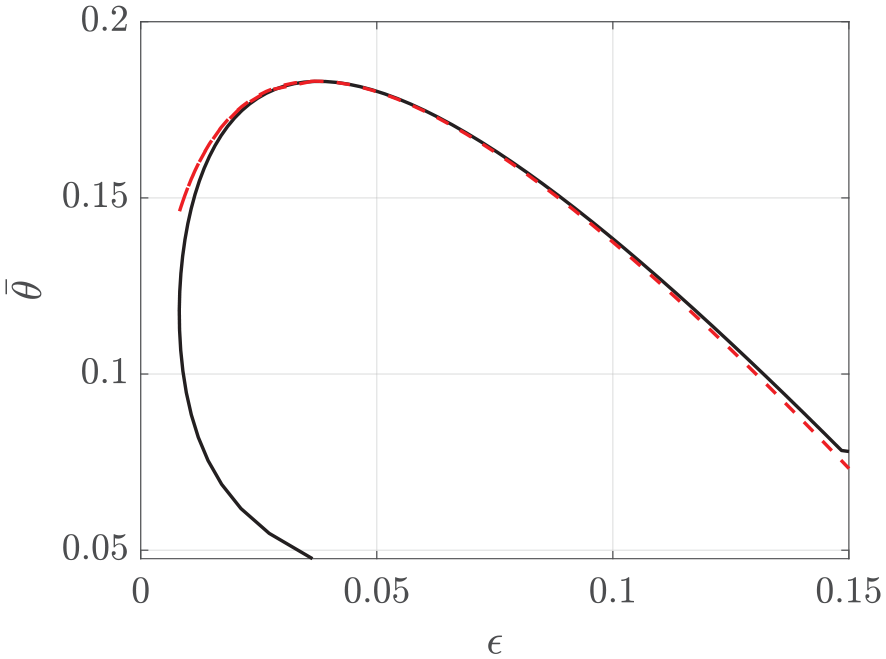
Detachment angle
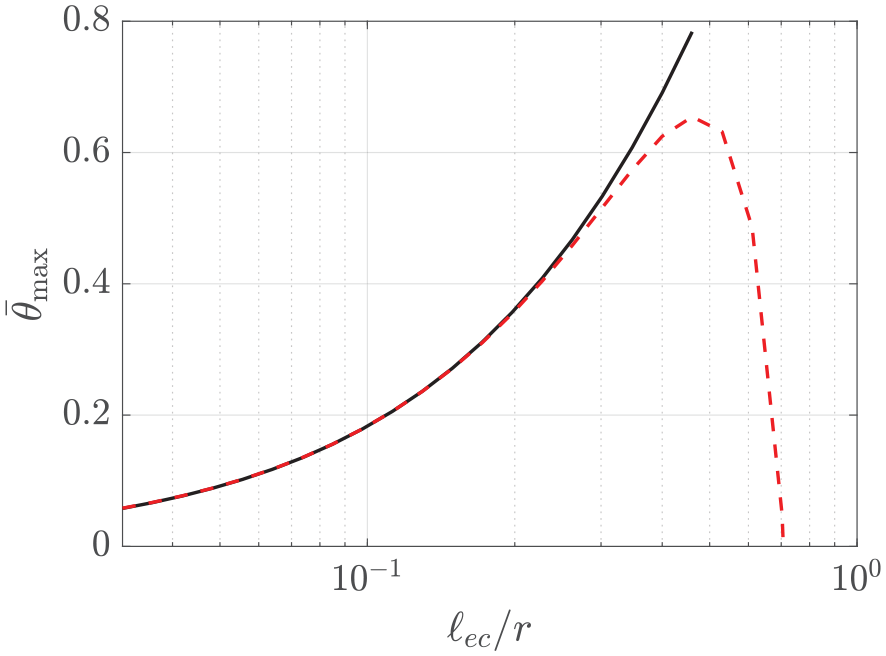
Maximum detachment angle as a function of
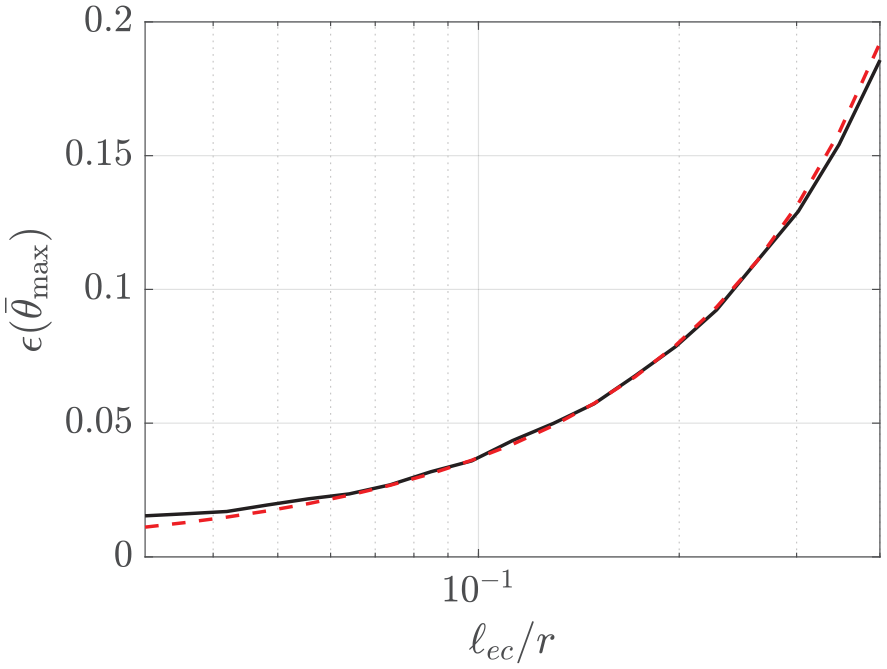
Maximum excess-length at detachment as a function of
We have explored the cases
Figures 6 and 7 show the comparison between the energies associated with each solution branch as a function of

and is shown as a red solid line. The energy associated with the partially delaminated solutions is instead calculated with a numerical simulation, drawn in blue in Figures 6 and 7. It is interesting to notice that the delaminated solution comprises two branches. The upper branch, with higher energy, corresponds to smaller rucks, whereas larger rucks correspond to the lower branch. For sufficiently small values of
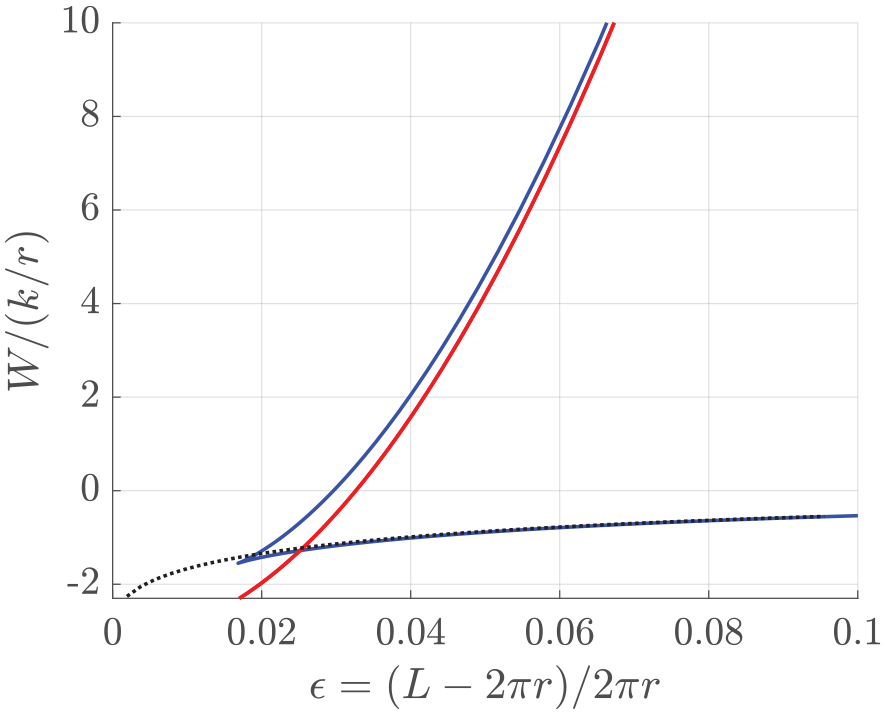
Energy profiles with
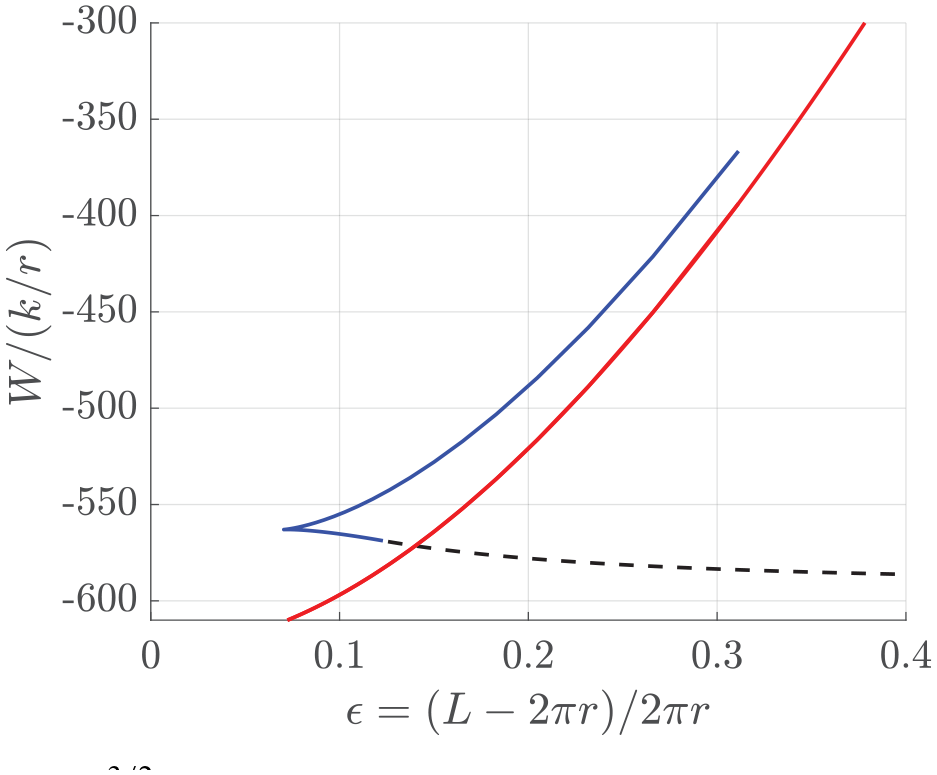
Energy profiles with
In Figure 6, we also report the energy of the delaminated solution in the inextensible case (Euler’s elastica), calculated as in equation (48). As expected, when the compression reaches a critical value, the tape buckles so to relax its internal stress and compression. Thus, the buckled solution is, to a good approximation, determined by minimizing the bending energy, while the compression energy can be neglected. It is then natural to assume that the solution with
From the numerical analysis with the two chosen values of
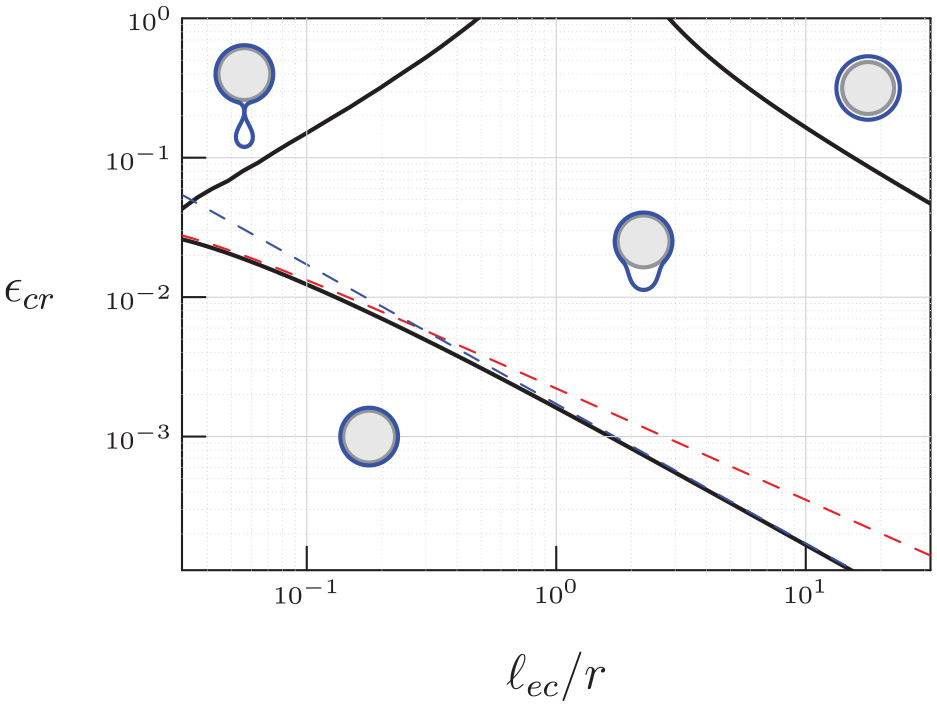
Phase diagram with
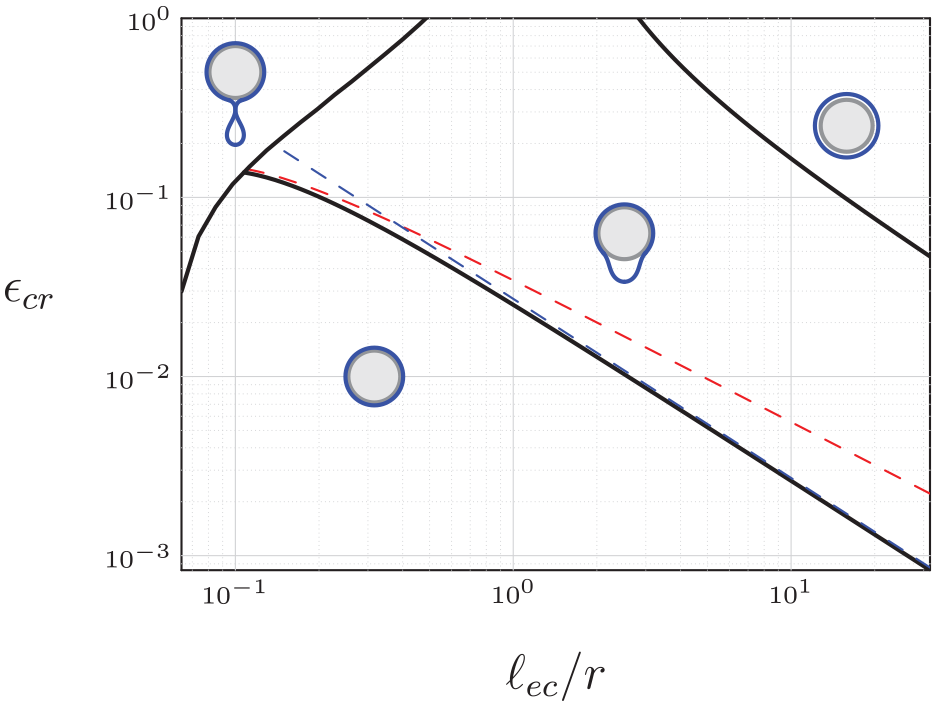
Phase diagram with
As can be seen from the phase diagrams in Figures 8 and 9, and from equations (64) and (68), the asymptotic approximations of
Furthermore, Figures 8 and 9 report also the transition lines from ruck to fold, that, for a fixed
Finally, the continuous line in the upper right part of the Figures 8 and 9 represents the critical threshold for the transition from buckling to complete delamination. This identifies the value of

In the two compressible cases treated, the numerical results are not significantly different from equation (32).
5. Conclusions
We have studied the delamination induced by the growth of a compressible thin elastic sheet adhering to the outside of a cylindrical surface, due to capillary adhesion. The quasi-incompressibility assumption is consistent with very thin sheets, where
We find that, due to the simultaneous presence of substrate curvature, capillary adhesion, and compressibility, the transversality condition, i.e. the additional boundary condition which serves to close the problem with unknown detachment length, is new and not obvious. This boundary condition, obtained through the classical methods of calculus of variations, reduces to expressions already known in the literature in special cases. This formula can be easily generalized to the case where the film covers the interior of the cylindrical surface instead of the exterior.
Our analysis is based on the numerical resolution of a nonlinear boundary value problem. The nonlinearity of the problem results in multiple solutions whose energies are subsequently compared with each other. We assume that the branch of minimum energy is the one that is actually observed in a possible experiment.
We can summarize the results as follows. If initially the sheet length is equal to the circumference of the cylinder, the sheet adheres perfectly. During growth, there is a first stage in which the sheet, while compressing, still adheres completely to the substrate, thanks to capillary adhesion. Above a certain compression threshold, the sheet undergoes a snap-buckling, partially detaching and forming a ruck, thus releasing its compression energy. The delaminated part is effectively stretch-free. This allows us to use Euler’s elastica model to approximated the solutions.
Euler’s elastica offers the enormous benefit of being integrable and admitting closed-form solutions in terms of elliptic functions. Given the complexity of these functions, the obtained solutions are not immediately interpretable. However, it is possible to develop asymptotic expansions of these solutions in terms of the excess-length
Footnotes
Appendix 1
Funding
The author(s) disclosed receipt of the following financial support for the research, authorship, and/or publication of this article: This work was supported by the by the MIUR Project PRIN 2020, “Mathematics for Industry 4.0”, Project No. 2020F3NCPX, and also conducted under the auspices of the GNFM-INdAM.
