







Abstract
A set of equations for the macroscopic theory of nonlinear elastic semiconductors valid for large deformation and strong fields is derived which generalizes the seminal work of de Lorenzi and Tiersten by including the inertia of the electrons and holes. Thus, the equations obtained can describe charge-carrier plasma waves and their interactions with elastic waves as well as electromagnetic waves. The equations can also be used when the charge carriers are ions rather than electrons and holes. Another generalization in this paper is that the internal energy densities of the mobile charges are allowed to depend on temperature in addition to charge/mass densities. The equations of the electromagnetic fields in the paper are in SI units.
Keywords
1. Introduction
In elastic semiconductors, the distribution and motion of mobile charges (holes and electrons) can be affected by stress or strain through mechanically-induced electric polarization or magnetization via piezoelectric or piezomagnetic and electrostrictive or magnetostrictive couplings. In Institute of Electric and Electronics Engineers, beginning in the 1960s, there have been attempts based on these effects to make acoustoelectric devices for charge transport and acoustic wave amplification [1]. This motivated limited research interest from the mechanics community [2,3], with more references in a review article [4]. These early studies gradually became less active for quite a period of time.
During the past two decades, various new piezoelectric semiconductor structures, some of them at nanoscales, have been synthesized including fibers, tubes, belts, spirals, and films using third-generation semiconductor materials such as ZnO and MoS2 [5]. These structures have found broad applications in electronics and phototronics in the form of single structures or arrays for sensing and transduction, electro- and photo-chemical processes, optoelectronics, and nanogenerators. The studies on the interactions between mechanical fields and mobile charges in various piezoelectric semiconductors structures, around PN junctions and metal-semiconductor (MS) junctions in particular, have formed new research areas called piezotronics and piezo-phototronics [6,7] with significant involvement and contributions from mechanics researchers [8–20].
In the pioneering work on elastic semiconductors by de Lorenzi and Tiersten [2], which is the theoretical foundation of most of the aforementioned studies, the inertia of charge carriers was not considered. It is well known that electrons and holes in semiconductors have inertia (effective mass) [21]. Although the charge-carrier inertia may be negligible in many applications, they are necessary for describing the propagation of disturbances in charge carriers called plasma waves which can interact with elastic and electromagnetic waves [22–26]. In this paper, we generalize [2] to include the inertia of the electrons and holes.
2. Multi-continuum model
When a deformable semiconductor is subjected to an electromagnetic field, the material experiences distributed electromagnetic body force and couple. The electromagnetic field also does work to the material during its polarization, magnetization, and conduction. Fundamental to the construction of a continuum theory for electro-magneto-elastic materials is the derivation of the electromagnetic body force, couple, and power due to the electromagnetic field. This can be achieved using the charged particle model [27,28] or the multi-continuum model [2,29–32], which may be viewed as a theory of mixtures [33]. In this paper, we use the multi-continuum model.
The model consist of six constituents of the lattice, bound charge, circulating current (or spin for simplicity), impurity, electron, and hole continua [2]. The lattice, circulating current, and impurity continua are assumed to be moving together. The electrons and holes are modeled as fluids that can flow through the lattice continuum. Fields associated with the electron and hole fluids are indicated by superscripts e and h, respectively. We will consider the inertia of the lattice (including the inertia of the impurity) and the inertia of the mobile charge fluids. The bound charge and spin continua are still considered as massless. The mobile charge inertia affects the momentum equations of the electron and hole fluids. However, since we are using the SI units which is more current instead of the Gaussian units in the study by de Lorenzi and Tiersten [2] or the Lorentz–Heaviside units in the study by Eringen and Maugin [27], a lot of other equations also change a little accordingly. Some of the derivations involved are somewhat lengthy and have been omitted, with all important results presented in the following.
Let the lattice be moving with
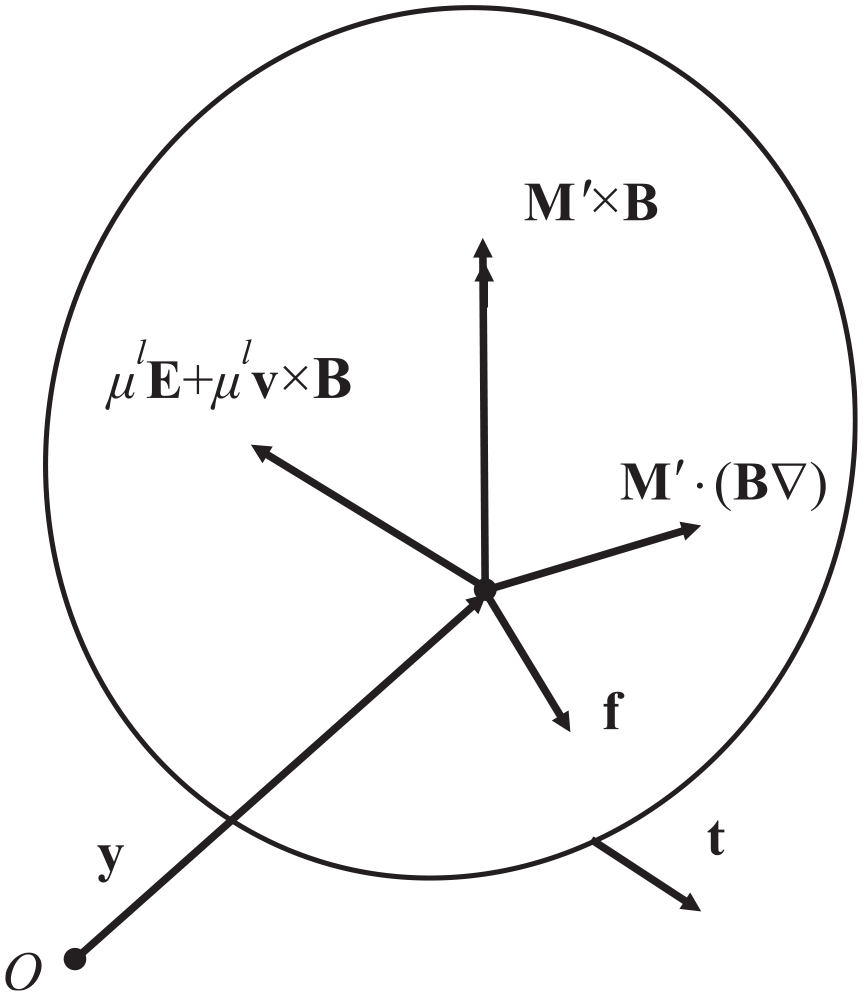
External loads on the lattice, μ
l
(
The bound-charge continuum can displace with respect to the lattice by a small displacement

which is referred to as the residual charge density. It is assumed that the small

With

where
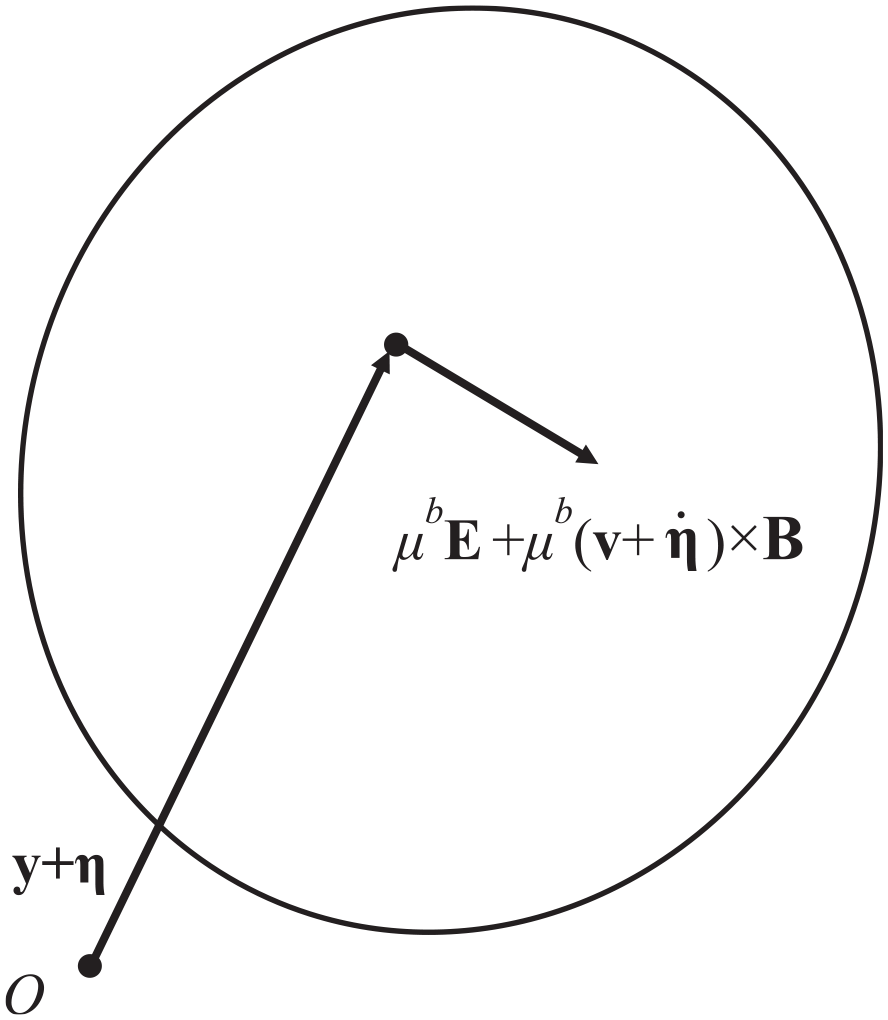
External loads on μ
b
(
The charge densities of the electron and hole fluids are denoted by μ
e
and μ
h
, respectively. They interact with the lattice through effective local electric fields
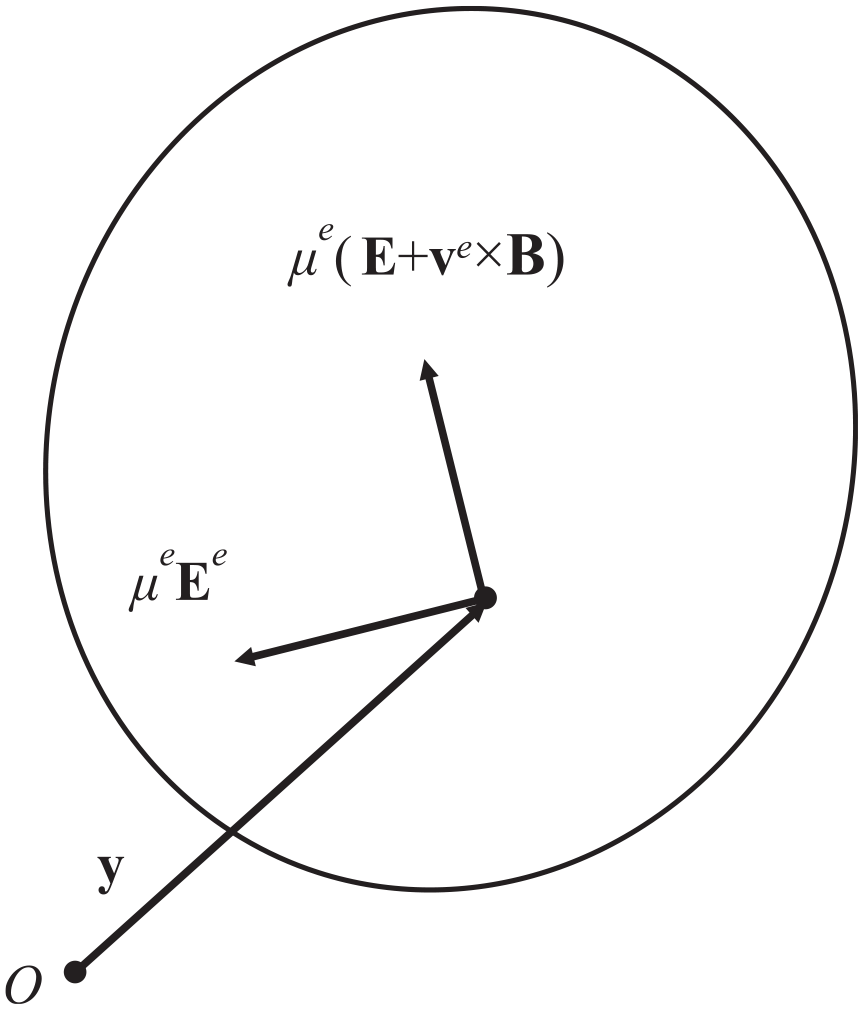
Loads on the free electron fluid.
Let


Then, from Figures 1 to 3, through some algebra, it can be shown that the electromagnetic body force, couple, and power on a unit volume of the lattice, spin, impurity, electron, hole continua at

where a superimposed dot represents the material time derivative d/dt following the lattice continuum [34]. The gradient operator in equation (6) is with respect to

where

and

Similarly, the electromagnetic couple on a unit volume of the combined continuum is found to be [2,32]

The electromagnetic body power on a unit volume of the combined continuum is given as [2,32]

where the conduction current with respect to the moving lattice has the following expression:

3. Integral balance laws
Consider a spatial region v with a boundary surface s whose outward unit normal is




The thermomechanical balance laws can be written for individual constituents or any combinations of them. The conservation of mass of the lattice (including the impurity, bound charge, and spin continua) is:

The conservation of charge for the electron and hole fluids separately are:


where, for simplicity, the exchange of charges among the constituents are not considered, i.e., we are not considering the generation and recombination of electrons and holes. We note that the conservation of mass for the electron and hole fluids are not independent to their conservation of charge because of their fixed charge-to-mass ratios.
The linear momentum equation for the lattice (including the impurity, bound-charge, and spin continua) may be written as

The electron and hole continua are assumed to be ideal fluids with pressure fields p e and p h [2], respectively. Their linear momentum equations assume the following forms:


where the inertia of fluids have been included.

The angular momentum equation of the combined continuum with all constituents is

The energy equation of the combined continuum of all constituents can be written as
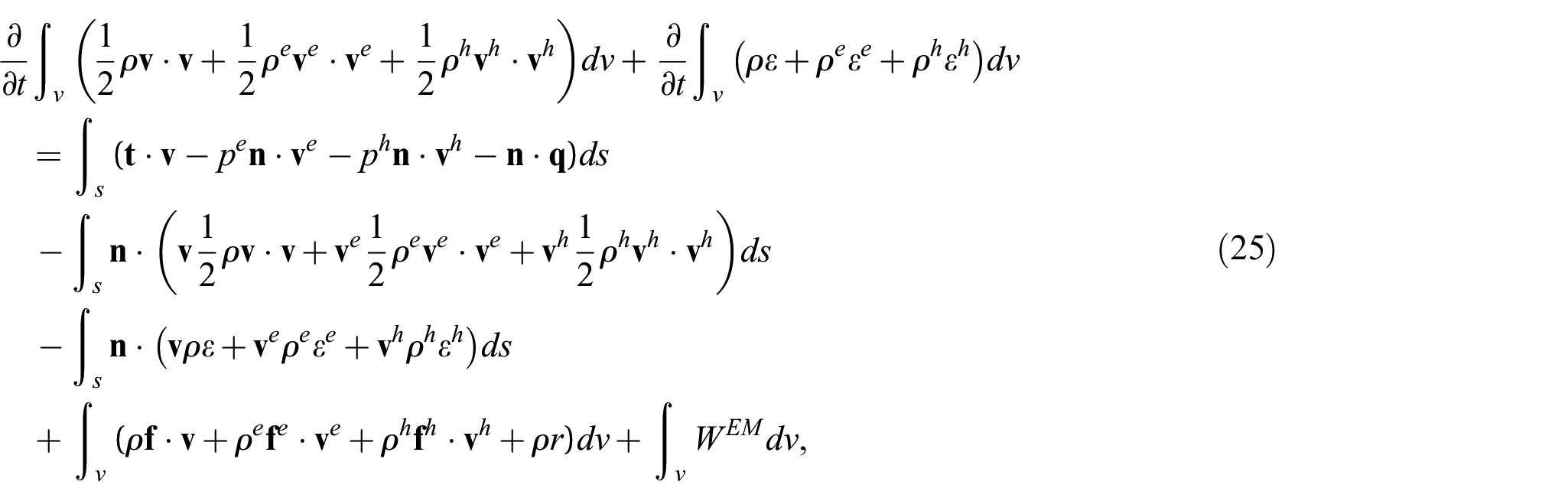
where ε, ε
e
, and ε
h
are the internal energy densities of the lattice, electron, and hole continua, respectively;

4. Differential balance laws
Using the divergence theorem [34] and Stokes’ theorem, introducing the Cauchy stress tensor










where d/dt, d e /dt, and d h /dt are material time derivatives following the lattice, electron fluid, and hole fluid, respectively. Equations (35) and (36) may be viewed as generalized Euler’s equations in fluid mechanics. Adding equations (34)–(36), we obtain

which corresponds to equation (23). The differential forms of the angular momentum equation, energy equation, and entropy inequality corresponding to equations (24)–(26) are found to be



5. Constitutive relations
Eliminating r from equations (39) and (40), we obtain the Clausius–Duhem inequality as

The following free energy densities for different constituents can be introduced through the corresponding Legendre transforms:

Then the energy equation in equation (39) and the Clausius–Duhem inequality in equation (41) take the following forms:
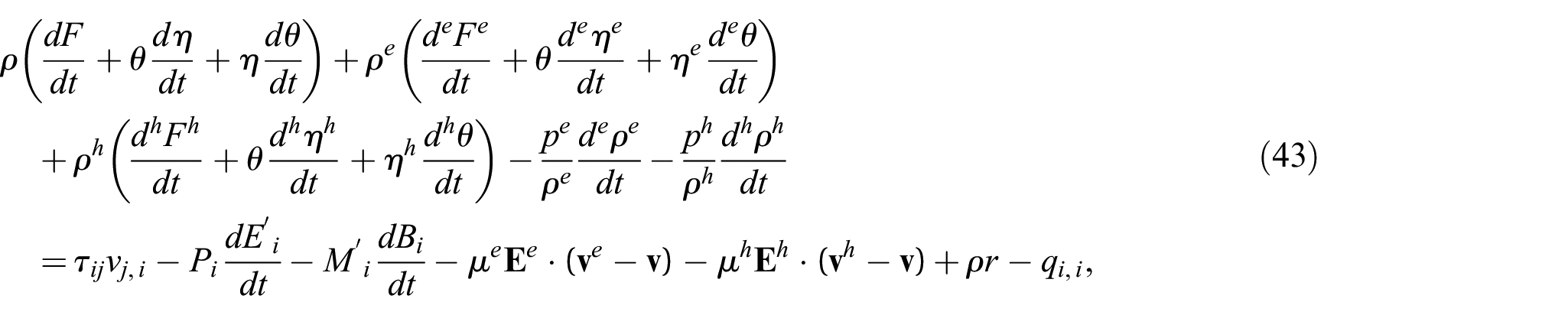

We break the stress, polarization, and magnetization into recoverable and dissipative parts as

The recoverable parts satisfy

Then the energy equation and Clausius–Duhem inequality reduce to


Equation (47) is the dissipation or heat equation. Equation (48) imposes restrictions on the dissipative parts of the constitutive relations.
For the recoverable fields satisfying equation (46), consider

Since [34]

we can write equation (48) as
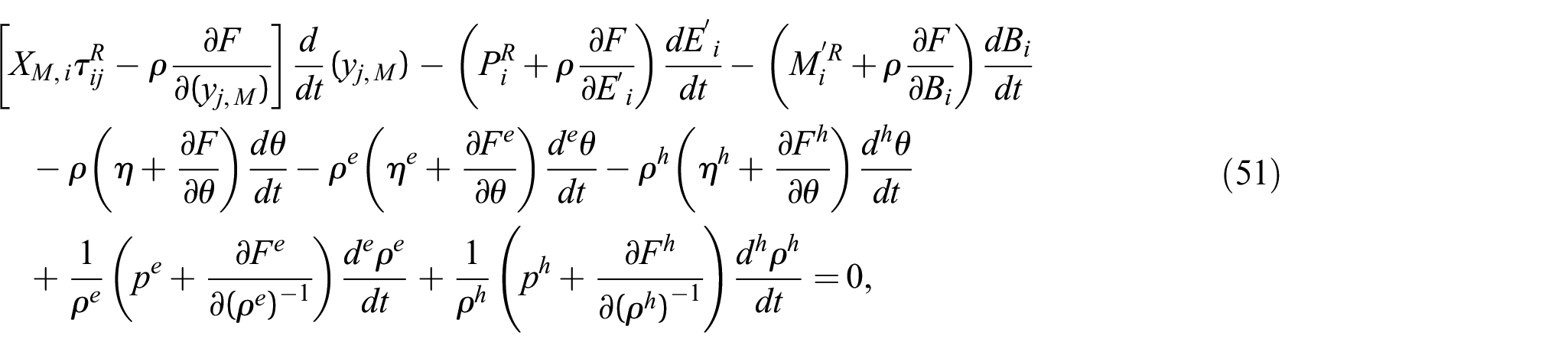
which implies the following recoverable constitutive relations:
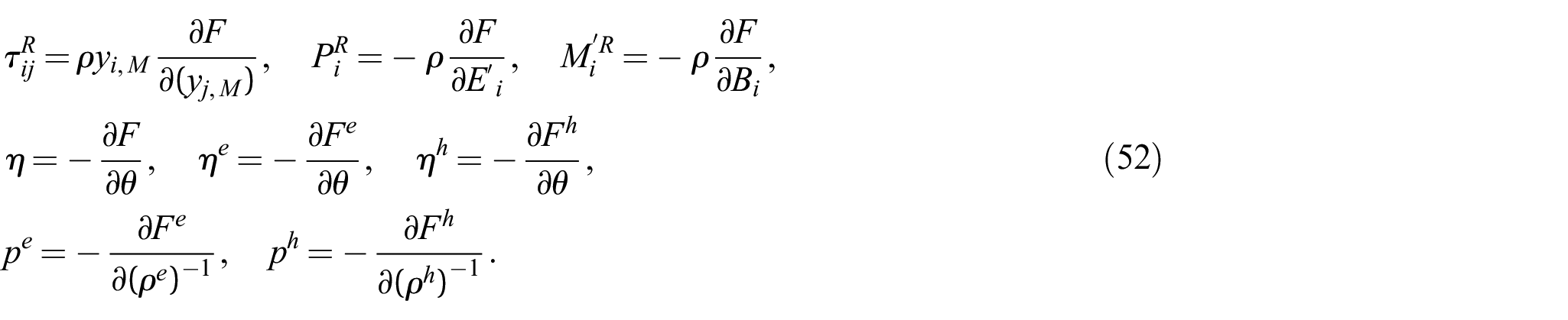
For rotational invariance (objectivity) [34], F can be reduced to a function of the following inner products and θ [2]:

We will use the finite strain tensor E KL instead of the deformation tensor C KL . Therefore, we take

Then the first three of the constitutive relations in equation (52) become

It can be verified that the aforementioned constitutive relations obtained from a rotationally invariant energy density F satisfy the angular momentum equation in equation (38) (Noether’s theorem [35]). The dissipative parts of the constitutive relations may assume the following forms [2]:

Similarly, the heat flux (may be viewed as generalized Fourier’s law for convenience) may be taken as [2]

For the interactions among the constituents, while constitutive relations may be given in terms of the interactions represented by

The dissipative constitutive relations are restricted by the Clausius−Duhem inequality in equation (48) and need to satisfy the requirements of rotational invariance too.
In addition, we have the following relationships [32]:


In summary, the basic unknown fields are
6. Propagation of shear-horizontal plane waves
As an example for the application of the general and nonlinear equations in the previous sections, we linearize the equations for small deformations and weak fields in an n-type piezoelectric semiconductor and study the propagation of plane waves [36]. We consider the case of quasistatic electric fields so that




The linear constitutive relations of piezoelectric crystals are

where

where k is Boltzmann’s constant, and θ is assumed to be a constant. For the interaction between the electron fluid and the lattice through collisions of the electrons with the lattice, we take

where [


where ρ0 and ρe0 are the reference mass densities of the lattice and electron fluid. In summary, we have the charge equation of electrostatics in equation (61), the conservation of electrons in equation (62), and the linear momentum equations in (68) and (69) which can be written as four linear equations for
Consider plane waves in hexagonal crystals which allow shear-horizontal motions described by

The piezoelectric constitutive relations in equation (65) reduce to


The relevant current components are

Equations (61) and (62) take the following form:


As an approximation, we drop the collision terms in equations (68) and (69) and the electric body force on the lattice (the qn0


Substituting equations (66) and (71)–(73) into equations (74)–(77), we obtain the following five equations for u3, φ,
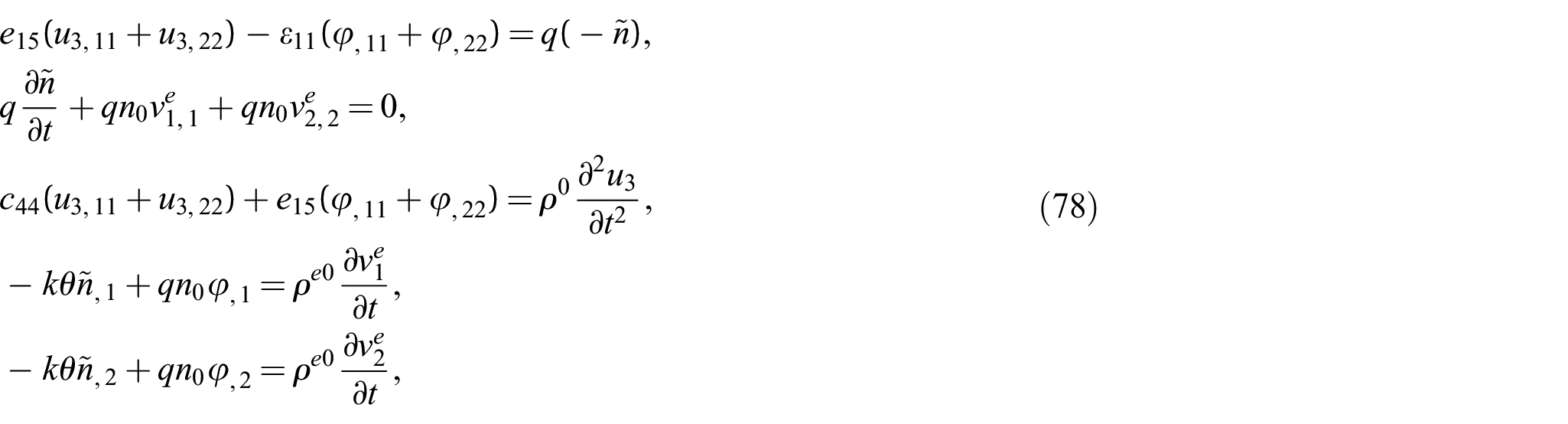
which can be reduced to two equations for u3 and

Consider plane waves propagating in the x1 direction with

Substituting equations (80) into (79), we obtain two linear homogeneous equations for A1 and A2. For nontrivial solutions, the determinant of the coefficient matrix of the equations has to vanish, which leads to the following equation that determines the dispersion relations of the waves:

where

Clearly, the waves determined by equation (81) are dispersive. When e15 = 0, equation (81) splits into uncoupled elastic and plasma waves with

Equation (81) is the same as the result in the study by Fayyaz et al. [22]. Hence, the linearized version of the equations in the present paper when some couplings are neglected can produce the same dispersion curves of coupled elastic and plasma waves known in the literature.
7. Conclusions
Nonlinear equations for elastic semiconductors are derived systematically by applying the relevant physical laws to a multi-continuum model. The equations obtained are more general than the equations in the literature in that the mobile charge inertia have been included and that the internal energy densities of the mobile charges may depend on temperature in addition to mass (or charge) densities. A specialized and simplified version of the equations in this paper when some of the couplings are neglected and the equations are linearized for small signals is capable of producing the same dispersion curves of the linear and coupled plasma-acoustic waves as in the works of Fayyaz et al. [22] and Xia et al. [36]. The charge carriers can also be ions instead of electrons and holes. The equations are in SI units which may be convenient to many researchers.
Footnotes
Declaration of conflicting interests
The author declared no potential conflicts of interest with respect to the research, authorship, and/or publication of this article.
Funding
The author received no financial support for the research, authorship, and/or publication of this article.
