







Abstract
This is an attempt to construct the well-posed hyperbolic heat conduction model based on the Caputo fractional derivative and to study the corresponding coupled thermoelastic problem. The continuous dependence on initial data and energy supply, and the uniqueness of the solutions are mathematically proved. The general closed-form solution of the time fractional conduction model for the initial Dirichlet boundary value problem is obtained analytically by applying the Laplace transform and finite Fourier sine transform in one-dimensional case. The application of theoretical study for heat propagation in the wire is considered. As a special case, two different examples have been discussed to study the analysis of the temperature distributions in the spatial geometry. The influence of the fractional orders on the speed of heat conductivity in the model is discussed. The physical behavior of the temperature distribution has been graphically represented for different fractional orders. Furthermore, the thermal stress analysis is studied using the coupled thermoelasticity theory. In the Laplace domain, the analytical solutions have been obtained. The Gaver–Stehfest technique was employed to numerically perform time domain inversions of the Laplace transforms, which satisfied Kuznetsov’s convergence theorem.
Keywords
1. Introduction
The Fourier approach to describe heat conduction shows the infinite speed of wave propagation. This situation is not generally regarded as a physical situation since it contradicts the causality principle. To remove this issue, Cattaneo [1] and Vernotte [2] improved Fourier law by incorporating a relaxation time parameter and introduced the new constitutive relation. Thermal lagging in wave theory was discussed by Joseph and Preziosi [3] and Ozisik and Tzou [4]. Zlamal [5] and Fulks and Guenther [6] studied an initial value problem (IVP) of the hyperbolic model. Nishihara [7] gave a review of the hyperbolic equation subject to the Cauchy problem.
Glass et al. [8] applied MacCormack’s predictor-corrector scheme; Kiwan et al. [9] applied the trial solution method; Chen [10] used methods of Laplace, Green’s function and the ϵ-algorithm acceleration; Ciegis [11] developed and applied explicit and implicit Euler schemes; Kalis and Buikis [12] applied the finite difference scheme and the difference scheme using the spectrum; Chen [13] used hybrid transform technique; Dassios and Font [14] applied means of variable separation method and Fourier series to obtain analytical and approximate solution of hyperbolic heat equation. Povstenko and Ostoja-Starzewski [15] discussed the hyperbolic equation with a harmonic source in the Cartesian domain. Coimbra et al. [16] studied temperature distribution in thermal lens spectroscopy through the hyperbolic conduction model.
Kaliski [17] and Lord and Shulman [18] developed generalized dynamic thermoelasticity based on hyperbolic heat equation. Chandrasekharaiah [19] and Chandrasekharaiah [20] gave a review of theories of generalized and hyperbolic thermoelasticity. Ignaczak and Ostoja-Starzewski [21] discussed the dynamic coupled thermoelasticity of second sound for solid materials. Povstenko [22] proposed a fractional heat equation for modeling thermoelasticity. Compte and Metzler [23] suggested different time fractional hyperbolic heat conduction models. Povstenko [24] developed theories for thermal stresses that depend on time fractional Cattaneo equations. Kudinov and Kudinov [25] studied dynamic stresses in an infinite plate through hyperbolic heat equation.
Atanackovic et al. [26] developed the space-time fractional Cattaneo heat equation. They obtained solutions of developed equation based on the Cauchy problem. Ghazizadeh et al. [27] used both explicit and implicit finite difference methods to obtain solutions of the fractional Cattaneo problem. Qi et al. [28] employed the Laplace transform method to solve the generalized fractional Cattaneo model for laser heating. The heat conduction model depends on the fractional single-phase-lagging approach and has been studied by Mishra and Rai [29]. Alikhanov [30] provided a priori estimations for solving fractional differential equations subject to different boundary problems.
The phrase well-posed problem was invented by Jacques Hadamard (1865–1963), and he thought that mathematical models for the description of physical phenomena should satisfy criteria of existence, uniqueness, and continuous dependence. When the problem is not well-posed, then the solutions have high sensitivity to changes. A small change in the data leads to a relevant difference in the behaviors of the solutions and causes numerical instabilities. Hence, well-posedness is a crucial step to examine the numerical aspects in the analysis of a problem.
In this paper, our aim is to show well-posedness of the problem and study the coupled thermoelasic problem of fractional hyperbolic model. The continuous dependence and the uniqueness are mathematically proved for hyperbolic model based on the fractional derivative subject to initial Dirichlet boundary conditions. The general closed-form solution of hyperbolic time fractional heat equation is obtained analytically by employing the Laplace transform and finite Fourier sine transform in one-dimensional case.
The application of theoretical study for heat propagation in the wire is considered. As a special case, two different examples have been discussed to study the analysis of the temperature distributions in the Cartesian domain. The physical behavior of the temperature variations has been graphically represented for different fractional orders. Furthermore, the thermal stress analysis is studied by considering the coupled theory of thermoelasticity.
2. Basic equations
The Cattaneo [1] and Vernotte [2] form is represented by

gives to hyperbolic model of heat conduction as

where

The fractional hyperbolic model of heat conduction using equation (3) is given by

where

denotes the Caputo [31] fractional derivatives.
Consider equation (4) in bounded domain B, some boundary and initial conditions are imposed on B whose boundary ∂B is a smooth border that allows the divergence theorem to be applied.
Suppose that the homogeneous boundary conditions are

and introduce the initial conditions as

where
The primary goal is to investigate the defined problem as determined by equations (4), (6), and (7).
3. Continuous dependence of the solution
This section represents proof of the continuous dependence for the above-defined problem. By considering initial data and supply term

where f is function of material point


Then

where


From equation (9), one can write

By taking the time derivative of equation (10) on both sides, one obtains

Using equation (14), one gets

By considering equation (8), one becomes

Using Holder’s result and the divergence theorem, equation (17) achieves

By taking integration of equation (18) on both sides, one gets

where

Hence the proof.
4. Uniqueness of the solution

then


By taking equation (4), one gets

On solving equation (24), one obtains

By taking integration with respect to material point over B, one becomes

Using the divergence theorem and Green’s identity, one gets

This is negative semi-definite because
The following holds with the help of equation (27)

where

By taking integration from

This gives the desired inequality.

has a unique solution for given initial and boundary conditions.
Let

Using equation (29), one obtains

This needs


Hence the proof.
5. Mathematical model
In the one-dimensional case
The fractional hyperbolic model of heat conduction becomes

subject to

and

where
The main objective is to achieve the closed-form solution of the above-defined problem.
5.1. General solution of the problem
The solution to equations (36)–(38) is determined using the Laplace transform and the finite Fourier sine transform.
The nondimensional quantities listed below have been introduced in equation (36)

where L denotes the characteristic length.
In view of nondimensional quantities, the fractional hyperbolic model of heat conduction equation (36) can be converted into nondimensional form as (neglecting bar symbol)

Applying the Laplace transform on both sides of equation (40), one obtains

where p represents the parameter of the Laplace transform, and overline denotes the Laplace transform.
Using equation (38), one obtains

Applying the finite Fourier sine transform and using equation (37), one achieves

where the asterisk denotes the finite Fourier sine transform, k represents parameter of the finite Fourier sine transform,
To find a solution in the time domain, one have [32]

where
Applying inverse Laplace transform and using equation (44), equation (43) becomes

Applying inverse finite Fourier sine transform, one becomes

This is the required solution.
5.2. Illustrative examples
To study analysis of temperature distributions under the framework of equation (36) by considering the copper wire of length
5.2.1. Example 1
Consider the nondimensional fractional hyperbolic model

subject to

and

The solution using equation (46) is represented by

5.2.2. Example 2
Consider the nondimensional fractional hyperbolic model

subject to

and

The solution using equation (46) is represented by

5.3. Numerical results and discussion
This section presents graphical representations of analytically derived solutions from the previous section for various fractional orders
Figures 1 and 2 represent the behavior of the obtained solutions of equations (50) and (54) with the use of three-dimensional (3D) plots and demonstrate the impact of fractional orders on temperature distributions along the wire under the framework of time fractional hyperbolic heat conduction equation. From both graphs, we can conclude that thermal energy is transported in wavelike patterns. The fractional parameters influence the propagation velocity of heat on temperature along the wire.
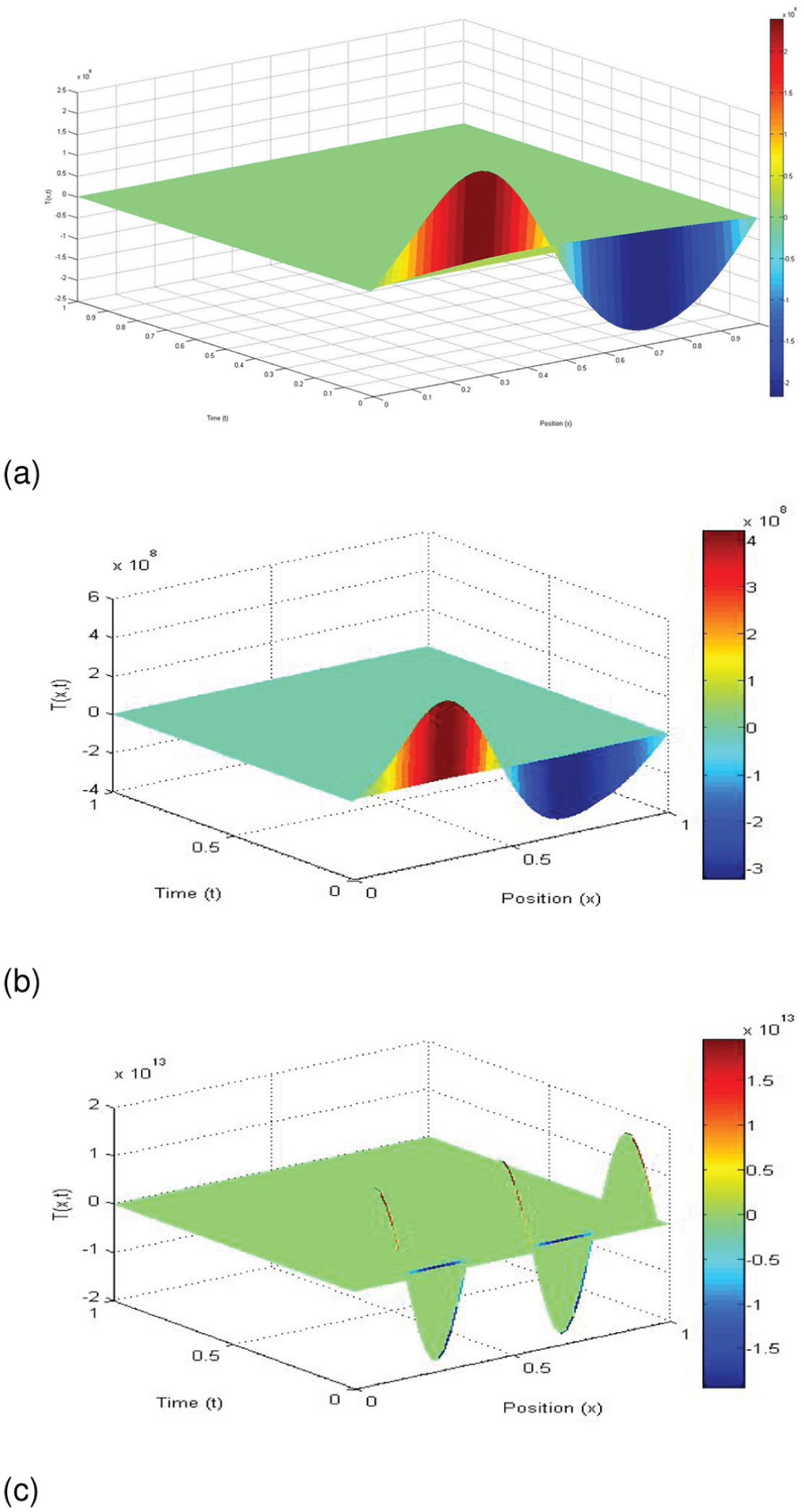
3D surfaces of temperature
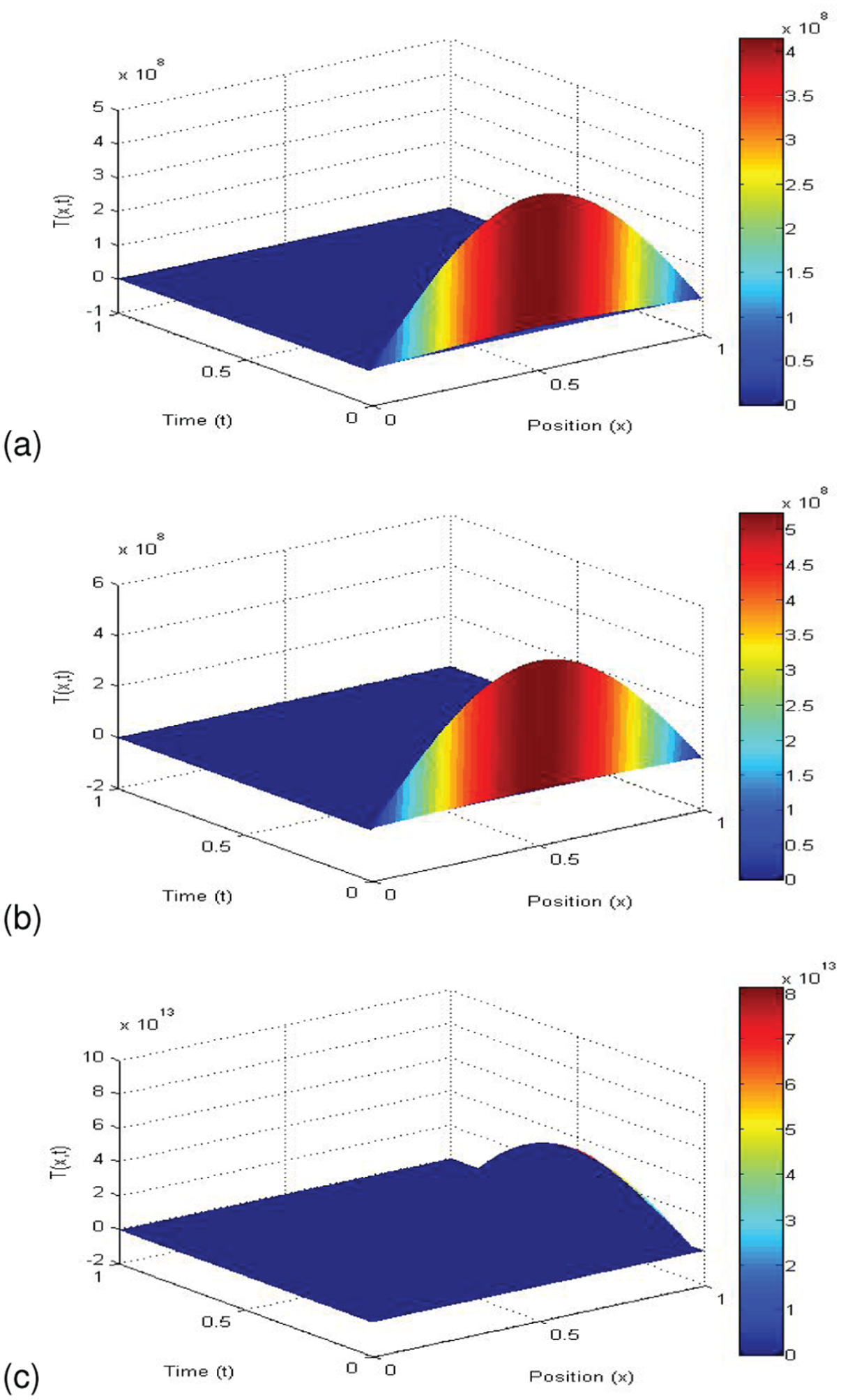
3D surfaces of temperature
6. Thermal stress analysis
This section is to study thermal stresses in a wire of length
The nondimensional form of the fractional hyperbolic model of heat conduction, equation of motion, and thermal stress equation are as follows:



The initial conditions

The Dirichlet boundary conditions

The mechanical boundary conditions

The governing nondimensional equations (55)–(57) converted in the Laplace domain as



Equation (61) reduces to

By taking differentiation of equation (62) with respect to x, equation (62) becomes

The temperature is obtained by solving equation (64)

Using equation (66), equation (65) becomes

The displacement function is achieved using equations (66)–(67) to equation (62), one obtains
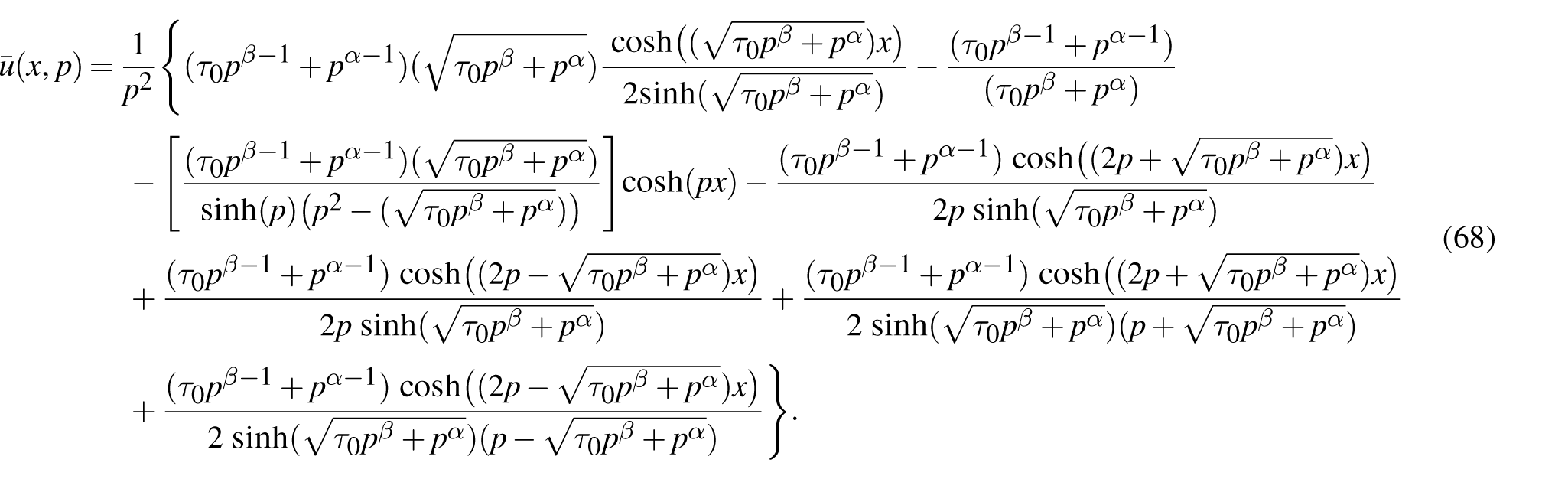
The stress

Equations (66)–(69) represent solutions in the Laplace domain.
6.1. Gaver–Stehfest method
Gaver [33] and Stehfest’s [34] method is used to approximate the time domain solution

where
6.2. Kuznetsov’s convergence theorem
Following Kuznetsov [35], let
6.3. Results and discussion
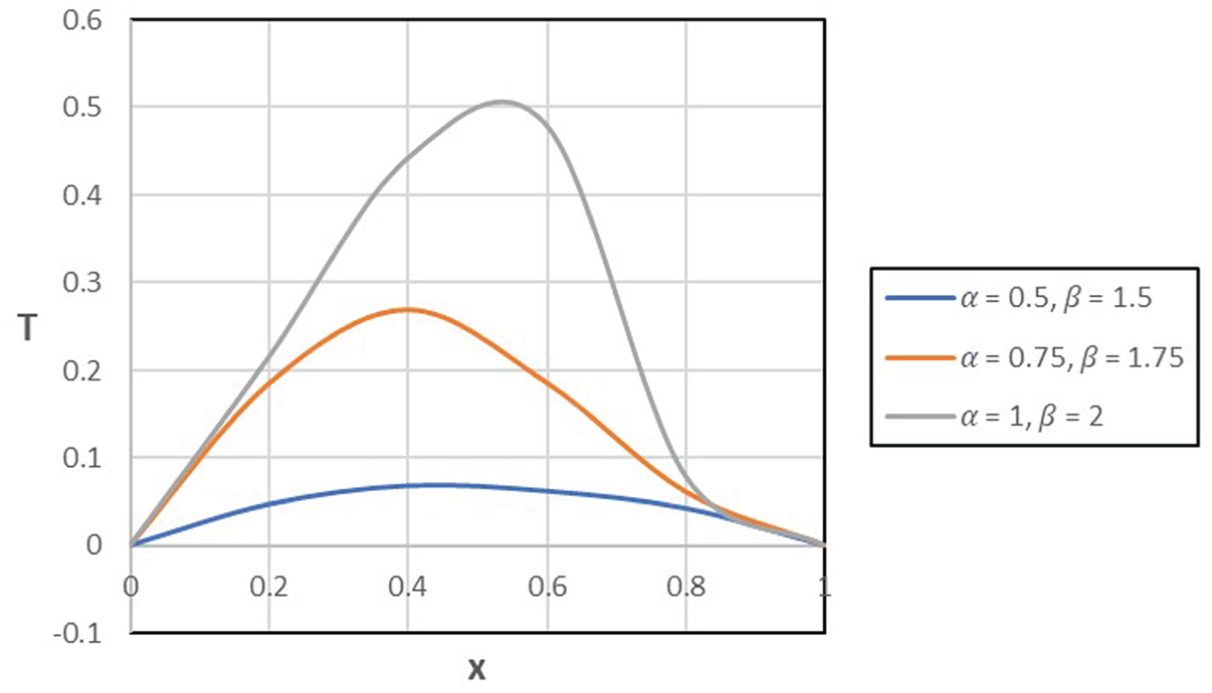
Temperature
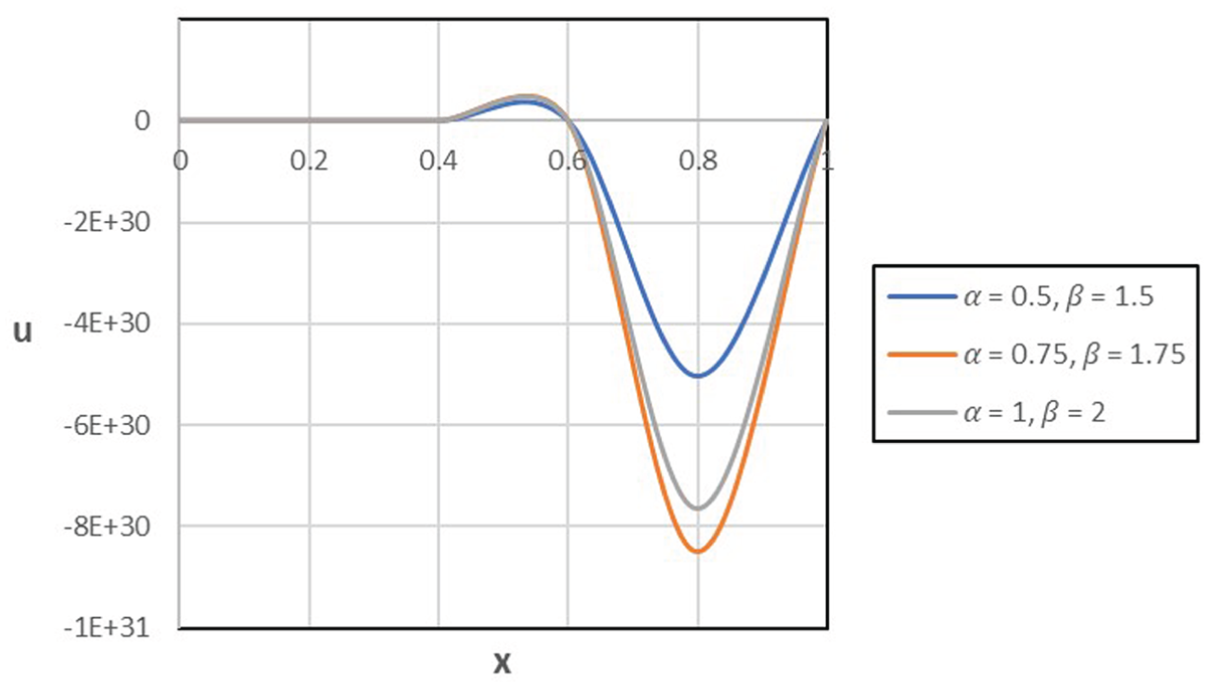
Displacement
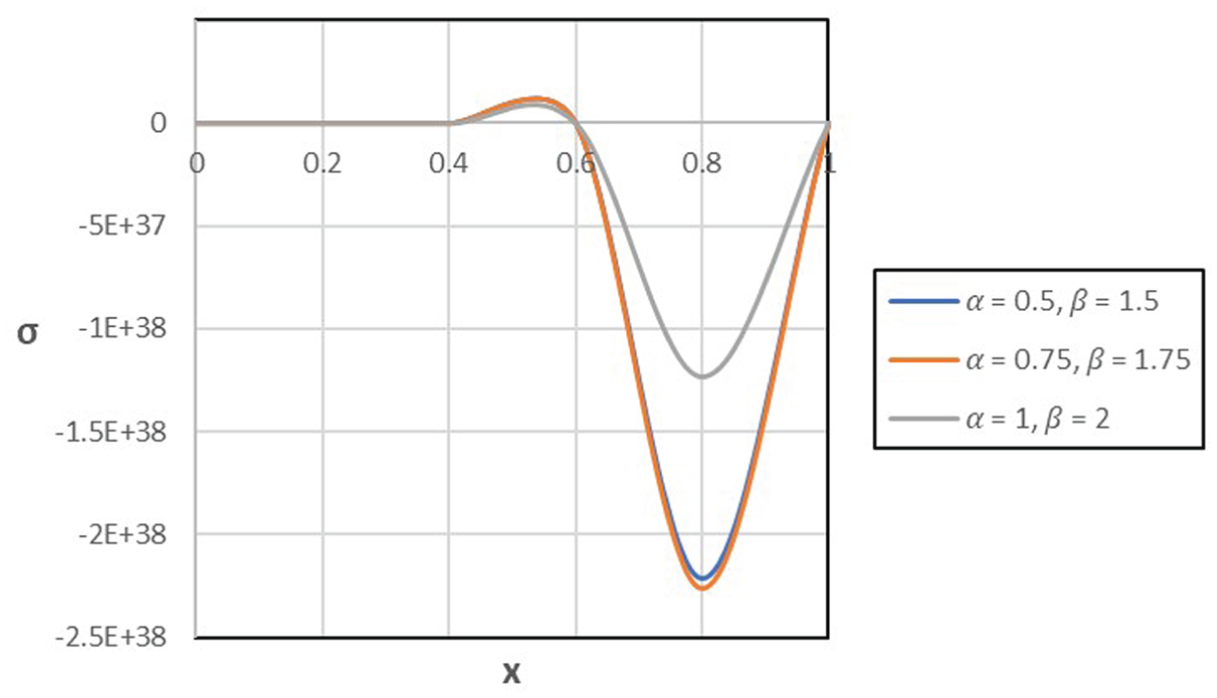
Stress
7. Conclusion
The main concluding remarks are as follows:
The continuous dependence on the initial data and energy supply term to the fractional hyperbolic heat equation satisfying condition
The uniqueness of the solution to the Caputo fractional hyperbolic model of heat equation subject to the initial boundary problem is mathematically proved.
The initial Dirichlet boundary problem of hyperbolic heat equation based on the Caputo time fractional derivatives of orders α
The general closed-form solution of fractional hyperbolic model is obtained analytically by employing the Laplace transform and finite Fourier sine transform.
The influence of changing the parameters of the fractional parameters on temperature variation has been studied. The solutions are computed for the temperature field satisfying the defined initial and boundary conditions.
The thermal stress investigation of the defined problem is studied using coupled theory of thermoelasticity. Due to the application of the relaxation time
The influence of changing the parameters of the fractional orders
According to numerical results, the fractional parameter evolved into a new measure of its ability to conduct thermal energy.
The obtained numerical results can be applied in the field of nano-electromechanical systems, heat transfer in rarefied media, laser-aided material processing, biological medicine, material flaw analysis, electromagnetic irradiation of a solid, and so on.
Footnotes

Funding
The authors received no financial support for the research, authorship, and/or publication of this article.
Declaration of conflicting interests
The authors declared no potential conflicts of interest with respect to the research, authorship, and/or publication of this article.