







Abstract
This paper studies the problem of torsional vibration of a radially inhomogeneous isotropic cylinder. It is assumed that the elastic moduli and the density of the cylinder material are power functions of the cylinder radius. Cases where the lateral surface of the cylinder is free from stresses and fixed are studied. After satisfying homogeneous boundary conditions specified on the lateral surfaces of the cylinder, dispersion equations are obtained. Exact solutions to the problem are constructed. For a cylinder of small thickness, an analysis of the roots of the dispersion equations with respect to a small parameter characterizing the cylinder thickness is performed. Asymptotic solutions are constructed that allow calculating the three-dimensional stress–strain state of a radially inhomogeneous isotropic cylinder of small thickness. The propagation of torsional elastic waves in a radially layered cylinder consisting of alternating hard and soft layers is investigated. A theorem on the stratification of the thickness resonance frequency is obtained. In the vicinity of the origin, in the vicinity of the thickness resonance frequency, for sufficiently large values of the wavenumber and frequency, when their ratio is finite, asymptotic curves for dispersion curves are determined. Using a combination of asymptotic and numerical analysis, dispersion curves for a three-layer cylinder are constructed.
Keywords
1. Introduction
The problem of propagation of torsional waves in a cylinder belongs to the classical problems of elasticity theory. This problem has important applied significance from an engineering point of view and has been studied by many researchers. In [1,2], the propagation of torsional waves was studied in composite infinite rods and in a two-layer cylinder. In [3], the propagation of torsional waves in a finite hollow cylinder made of piezoelectric material was investigated. In [4], torsional vibrations of a magneto-orthotropic hollow circular cylinder were studied. The phase velocities of perturbations for various wave numbers are calculated. In [5], dispersion curves were constructed for a torsional wave propagating in a thick transversely isotropic cylinder of infinite length. In [6], the propagation of torsional waves in an elastic solid cylinder subjected to an initial stress was investigated. In [7,8], using Biot’s theory, torsional vibrations of a poroelastic cylinder and a poroelastic composite cylinder were investigated. In [9], torsional vibrations in an initially stressed composite poroelastic cylinder were investigated within the framework of Biot’s theory. In [10], the influence of a magnetic field on torsional vibrations in poroelastic hollow cylinders was studied. A significant influence of a magnetic field on dispersion curves was shown. In [11–14], the propagation of torsional waves in a prestressed multilayer cylinder was studied within the framework of a piecewise homogeneous body model. In [15], the problem of torsional vibrations of an anisotropic hollow cylinder with different boundary conditions at the ends was investigated using a numerical-analytical method. In [16], an analytical and numerical study of torsional vibrations of a three-layer transversely isotropic cylinder filled with a viscous fluid is presented. In [17], the problem of torsional vibration of an isotropic cylinder is analyzed using the method of homogeneous solutions.
Despite the above-mentioned multidirectional studies, exact and asymptotic solutions to the problem of torsional vibration of a radially inhomogeneous cylinder have not been constructed; asymptotic expressions for determining the stress–strain state have not been established; and the problem of propagation of elastic torsional waves in a radially multilayered cylinder consisting of rigid and soft layers has not been investigated by analytical methods.
In this study, the problems of torsional vibration of a radially inhomogeneous cylinder and the propagation of torsional waves in a radially layered cylinder are considered. Torsional vibrations of a cylinder with free lateral surfaces and with fixed lateral surfaces are investigated, where the shear modulus and material density vary continuously (according to a power law) as functions of the radius. These problems mathematically and physically complement each other by examining the influence of different boundary conditions prescribed on the lateral surfaces of the cylinder on the same physical processes. For these problems, exact and asymptotic solutions are constructed. New classes of solutions with boundary-layer properties, absent in applied theories, are obtained.
Furthermore, the propagation of torsional waves in a radially layered cylinder composed of alternating rigid and soft layers is investigated, in which the material properties are piecewise continuous functions of the radius. These problems are chosen as successive steps from a radially inhomogeneous cylinder, where the material properties are continuous functions of the radius, to a radially layered cylinder, where the material properties are piecewise continuous functions of the radius. It should be noted that when the material properties are piecewise continuous functions of the radial coordinate, this gives rise to certain difficulties in the analysis. The study is structured as a successive complication of the physical model and the mathematical apparatus.
To achieve this goal, the following tasks have been set:
construction of exact solutions to the problem of torsional oscillation of a radially inhomogeneous cylinder;
construction of asymptotic solutions to the problem of torsional oscillation of a radially inhomogeneous cylinder of small thickness;
studying the behavior of constructed asymptotic solutions;
construction of asymptotic formulas for displacements and stresses;
study of the propagation of elastic torsional waves in a radially layered cylinder;
determination of possible asymptotics of dispersion curves; and
construction of dispersion curves based on asymptotic and numerical analysis.
2. Torsional vibrations of a cylinder with free lateral surfaces
2.1. Mathematical formulation of the problem
We study torsional vibrations of a radially inhomogeneous isotropic cylinder. We assume that in the cylindrical coordinate system
The equations describing torsional vibrations of a cylinder in a cylindrical coordinate system

The components of the stress tensor


It is assumed that

Substituting (2), (3) into (1) taking into account (4), we obtain:

Here
It is assumed that the lateral surface of the cylinder is free from stress:

and boundary conditions are specified at the ends of the cylinder

Here
2.2. Construction of exact solutions
We seek the solution (5), (6) in the form:

Substituting (8) into (5), (6), we have:


The function

Here β is spectral parameter.
Solution (9) has the form:

Here
Based on (12) we have:



We substitute (12) into (10):

For the existence of a non-trivial solution of the system of homogeneous linear equations (16), the determinant of this system must be equal to zero:

From the last equality, the following dispersion equation is obtained:

Here
The equation (17) has a countable set of roots


Substituting (18), (19) into (13)-(15) and carrying out summations over a countable set of roots (17), we have:



where
We will represent boundary value problems (9), (10) in the form of an operator equation


Let us introduce a Hilbert space

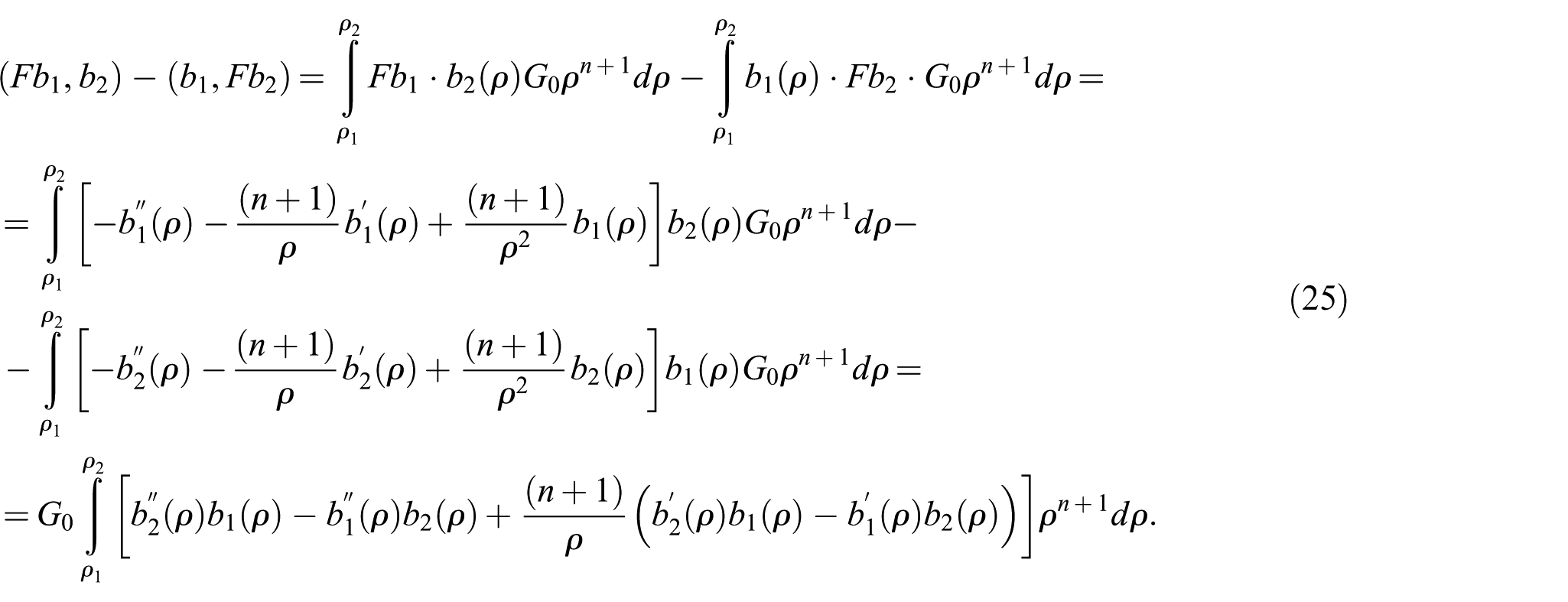
In (25), after integration by parts and taking into account the conditions (10), we finally have:

i.e.
For any
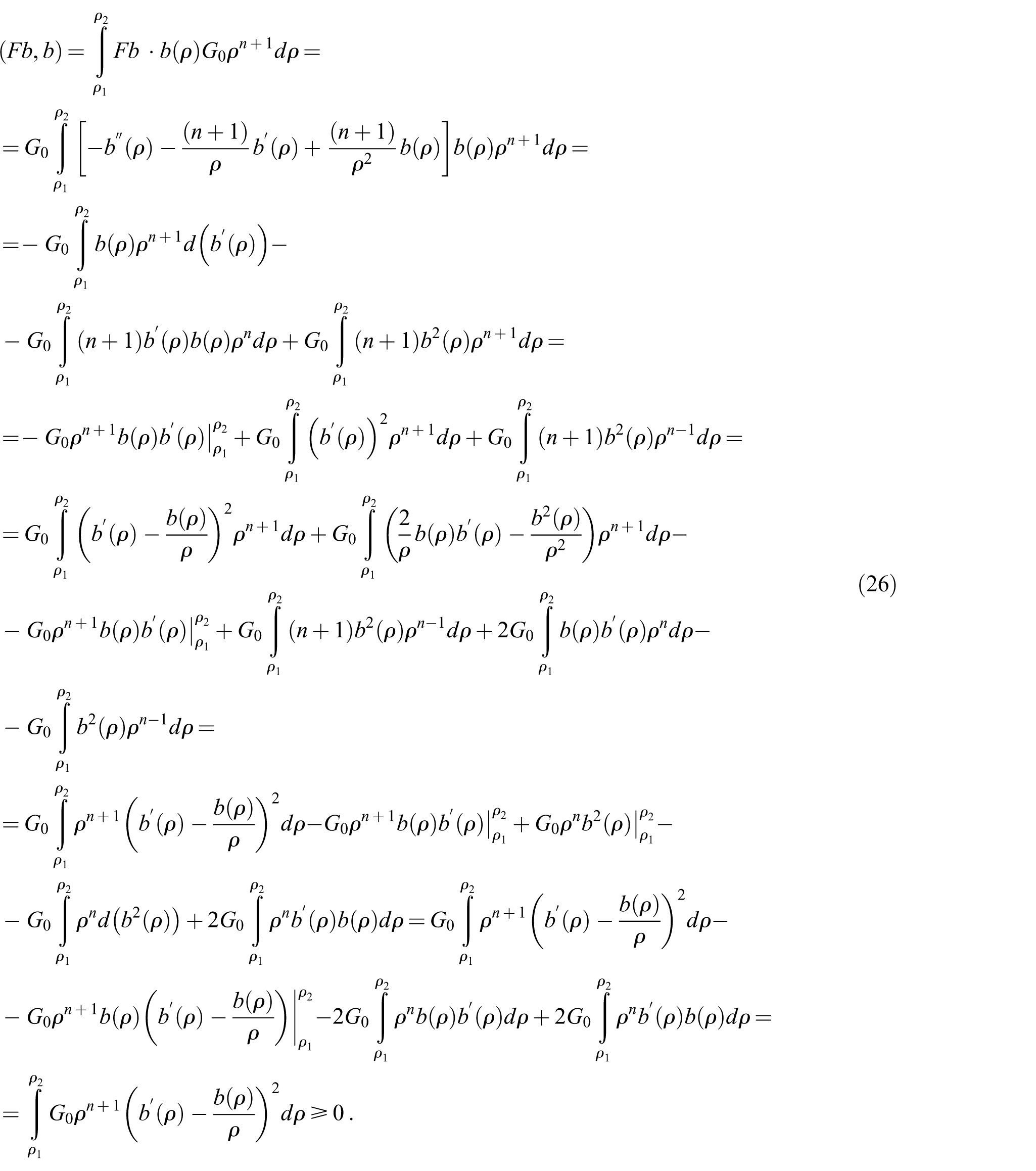
For any
The eigenfunctions

The eigenvalues
Since the eigenvalues of
We substitute expression (22) into (7):

Multiplying both parts of (28) by

We take into account the relation (27) in (29):

where
Based on (30) we obtain

From (31) we have:

2.3. Construction of asymptotic solutions
We assume that the cylinder has a small thickness. We will construct an asymptotic solution (5), (6) for a cylinder of small thickness. Let us introduce a small parameter
We note that

We substitute expressions (33) into (17):

We expand the expression
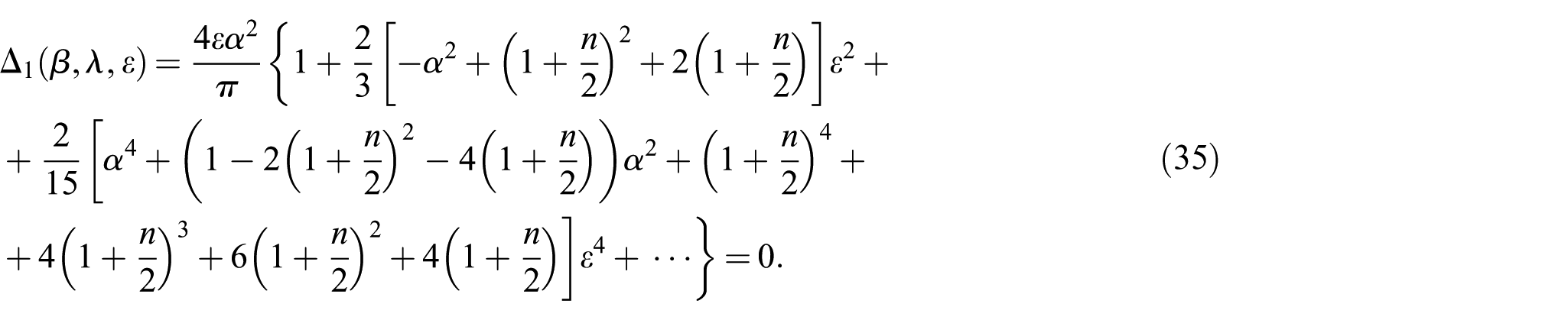
We note that

and

Based on (36), (37) we obtain that the number
From the equality

i.e.

In case

Substituting (39) into (17) taking into account

Let us consider the case
a)
Here only the case

Substituting (41) into (17) taking into account

For the solution corresponding to the root



In (19)-(21), assuming



The asymptotic formulas of the corresponding roots having asymptotics (41) have the form:



Note that (43)-(45) is a penetrating solution. With increasing distance from the ends of the cylinder, solutions (46)-(48), (49)-(51) decrease exponentially. These solutions have the character of a boundary layer and are absent from applied theories. The first terms of solution (46)-(48) are equivalent to the Saint-Venin edge effect of a plate with non-uniform thickness [17,21].
3. Torsional vibrations of a cylinder with a fixed lateral surface
3.1. Construction of exact solutions
Let us assume that the lateral surface of the cylinder is fixed

and at the ends of the cylinder the boundary conditions

are specified.
We seek the solution to the boundary value problem (9), (52) in the form (8):


Substituting the solution of equation (54), determined by formulas (12), into the boundary conditions (55), we obtain:

From the condition of existence of non-trivial solutions of system (56) we obtain the dispersion equation:

Carrying out summations over a countable set of roots



We represent the boundary value problem (54), (55) in the form

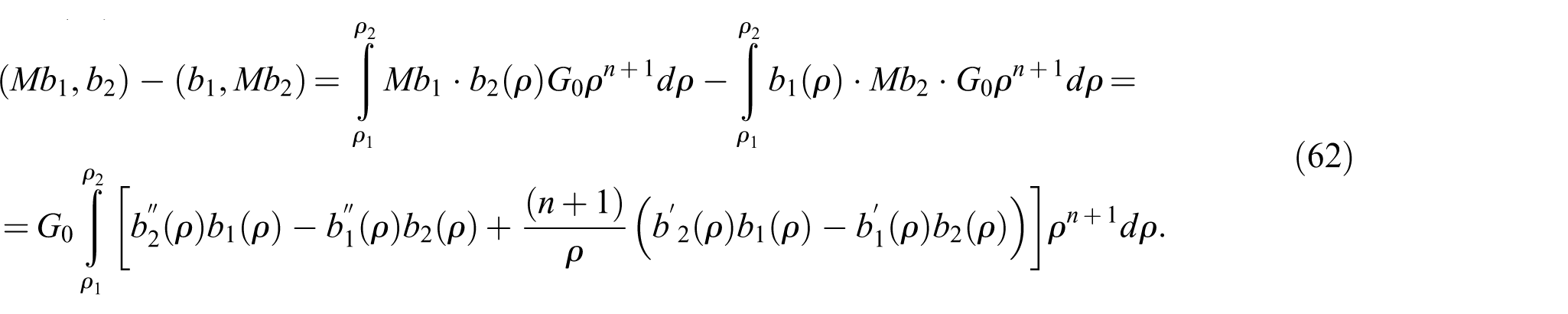
After integrating by parts in (62) and taking into account the boundary conditions (55), we have:

that is,
Based on (26) for an arbitrary function

From (63) for the case

i.e.

Taking into account (64) and (55), we have
The eigenfunctions
We substitute relation (60) into (53):

Multiplying both parts of (65) by

where

From system (66) the constants
3.2. Construction of asymptotic solutions
Let us construct an asymptotic solution to the problem (9), (52) for a cylinder of small thickness.
Substituting (33) into (58), we have:

The dispersion equation (67) for
For the asymptotic solutions corresponding to the indicated roots of the dispersion equation (67), we obtain:
a) λ=O(1) (ε→0)



b) λ = λ0ε−1→ ∞, ελ→const (ε→0)



Solutions (68)-(70), (71)-(73) have the character of a boundary layer and are absent from applied theories.
Based on the obtained asymptotic solutions, it is possible to construct a new refined applied theory for inhomogeneous cylindrical shells.
4. Propagation of elastic torsional waves in a radially layered cylinder
4.1. Statement of the boundary value problem
Let us consider the propagation of stationary elastic torsional waves in a radially layered cylinder consisting of alternating hard and soft layers of the number

We will take the small parameter
The inner radius of the «k»th layer will be designated as
The equation of motion of the «k»th layer in a cylindrical coordinate system has the form [18]:

where
The components of the stress tensor of the «k»th layer


where
The connection of layers will be considered rigid, which means that the following conjugation conditions are met:

where
We assume that the lateral surface of the cylinder is stress-free, i.e.

After substituting (75), (76) into (74), (77), (78) we obtain respectively:
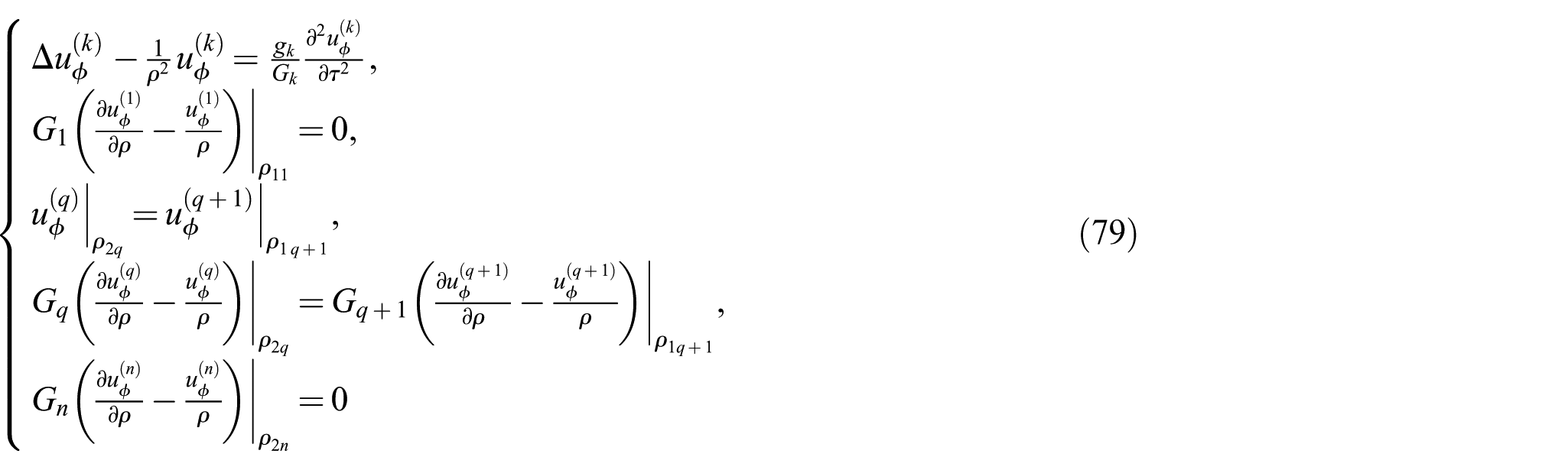
where
4.2. Asymptotic analysis of spectral problems
We seek the solution to the problems (79) in the form:

After substituting (80) into (79) we have:
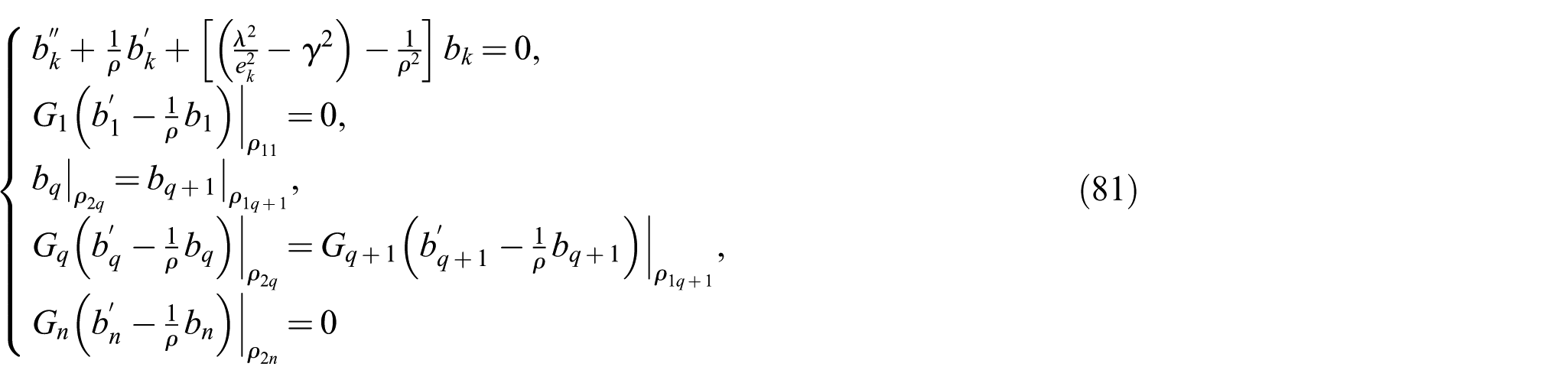
where
The boundary value problem (81) contains two spectral parameters λ and γ. The determination of the wave pattern in a radially layered cylinder is associated with the construction of dispersion curves
For a radially layered cylinder, the construction of dispersion curves can be fully accomplished using a combination of analytical and numerical methods. To improve the efficiency of the numerical analysis, it is necessary to find the possible asymptotic behavior of the dispersion curves
Let us study the set of thickness resonant frequencies. Setting
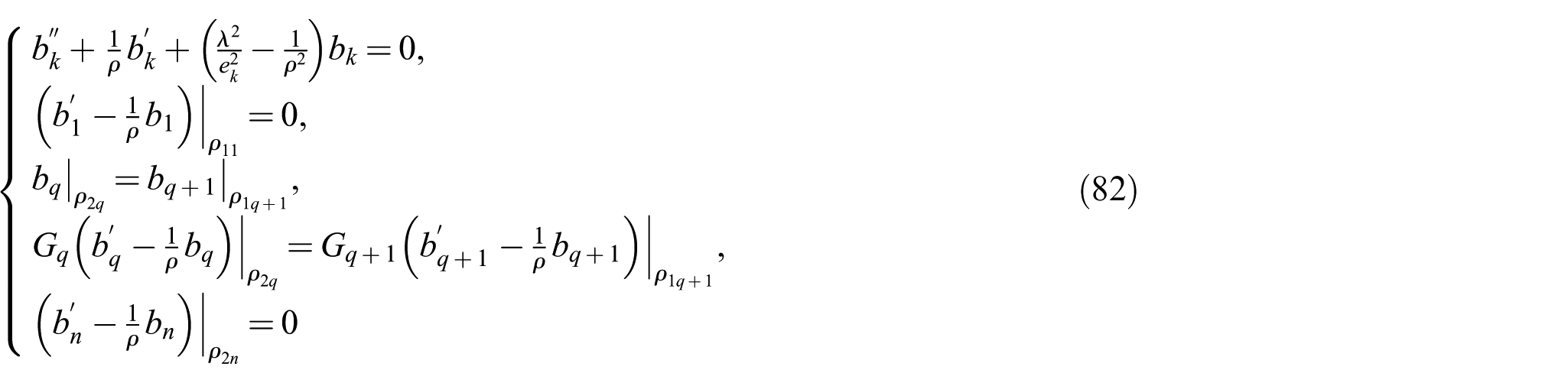
where
Let us analyze the spectral problem (82) for
a)
b)
The spectral problem (82) is reduced to the study of some homogeneous algebraic systems with a matrix whose elements analytically depend on the spectral parameter γ and linearly depend on the parameter

at that
1.

Where

Here
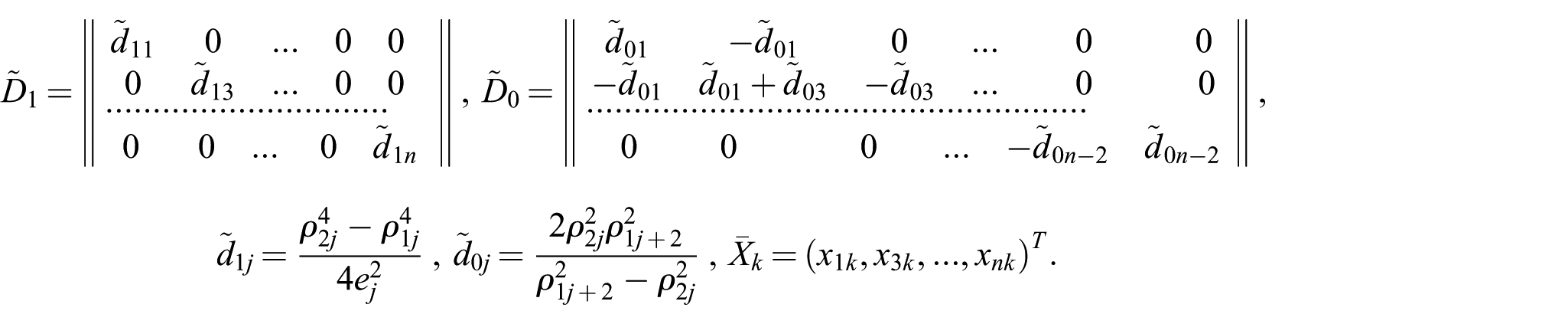
2.

where

3.

where

Here
Considering the cumbersome nature of the proof of the theorem, we note the general outline of the proof. The first limiting variant
The second limiting variant
Let us consider the construction of asymptotic approximations in the neighborhood of

Substituting (90) into (81) we have:

In the vicinity of

describes the beginning of the first dispersion curve.
In the vicinity of the resonant frequency

Substituting (92) into (81) after a certain transformation, we have:

In the vicinity of the resonant frequency

At low frequencies,

Let us consider the behavior of dispersion curves for
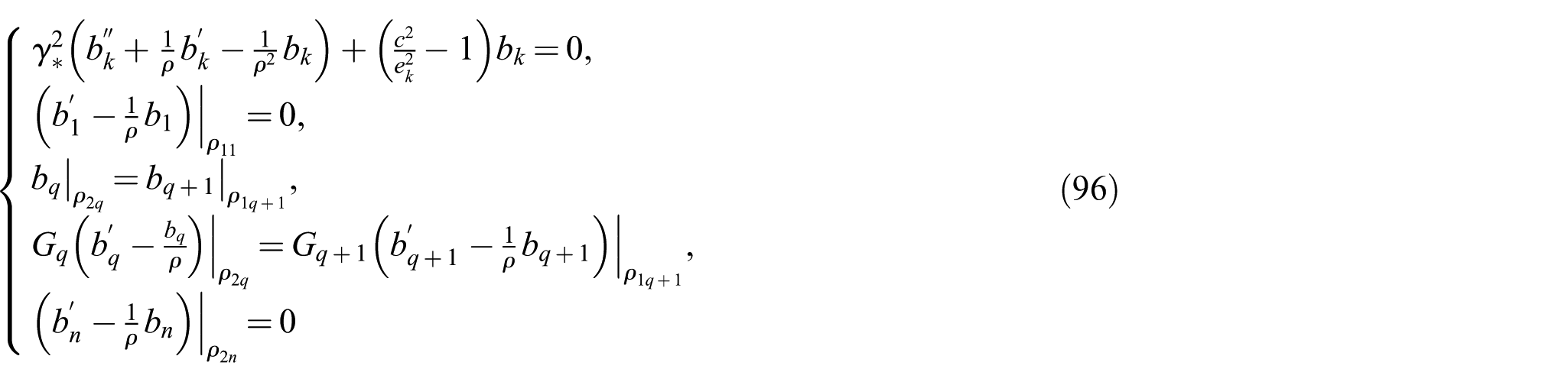
Let us transform (81) to the form:
where
It is clear that

Substituting (97) into (96) we obtain:

The asymptotes of the dispersion curves at
5. Numerical analysis
Let’s plot dispersion curves for a three-layer cylinder with a soft core. Figures 1 and 2 show dispersion curves for the following cases:
1)
In both cases
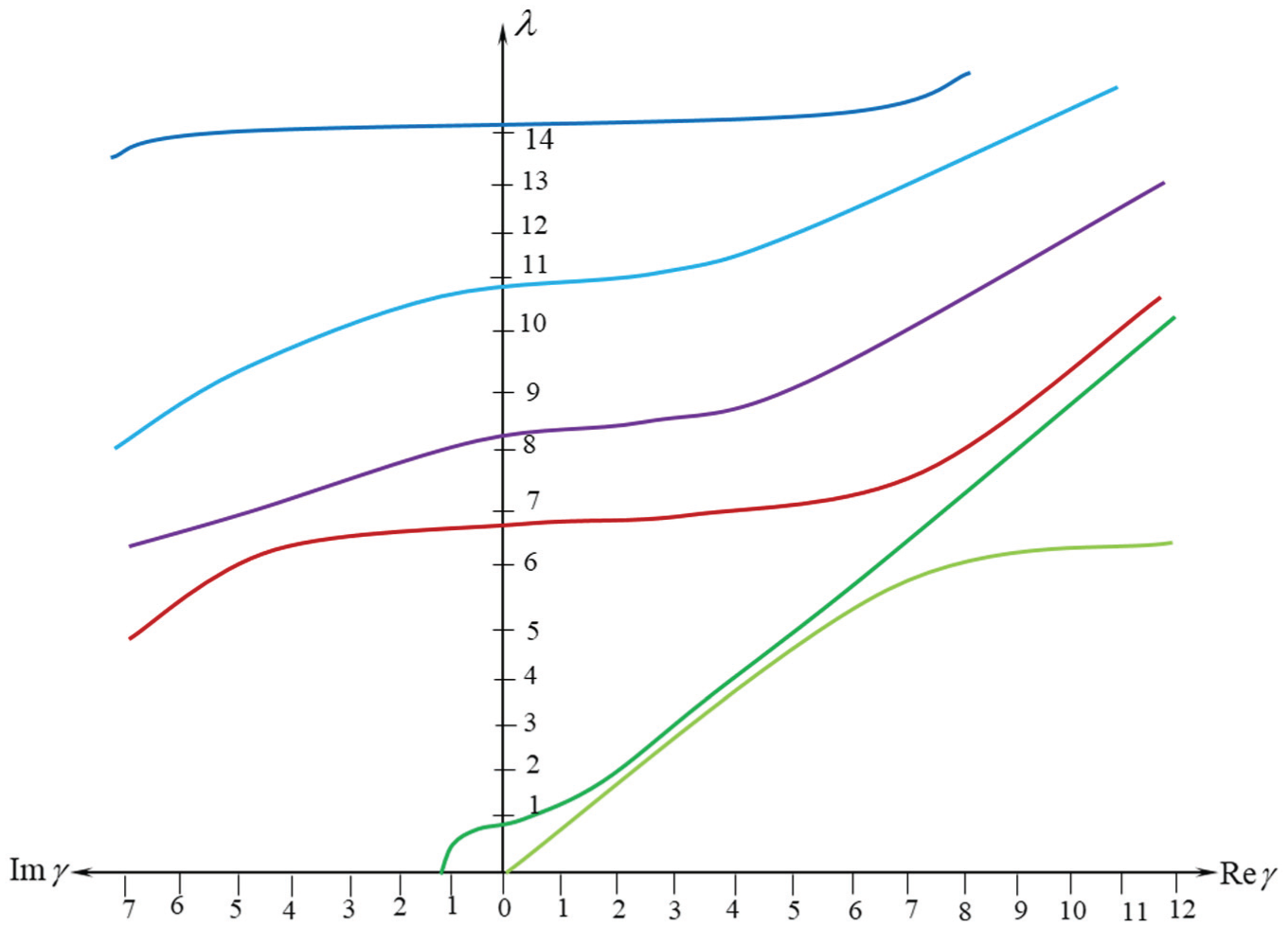
Dispersion curves for a three-layer cylinder with a soft core
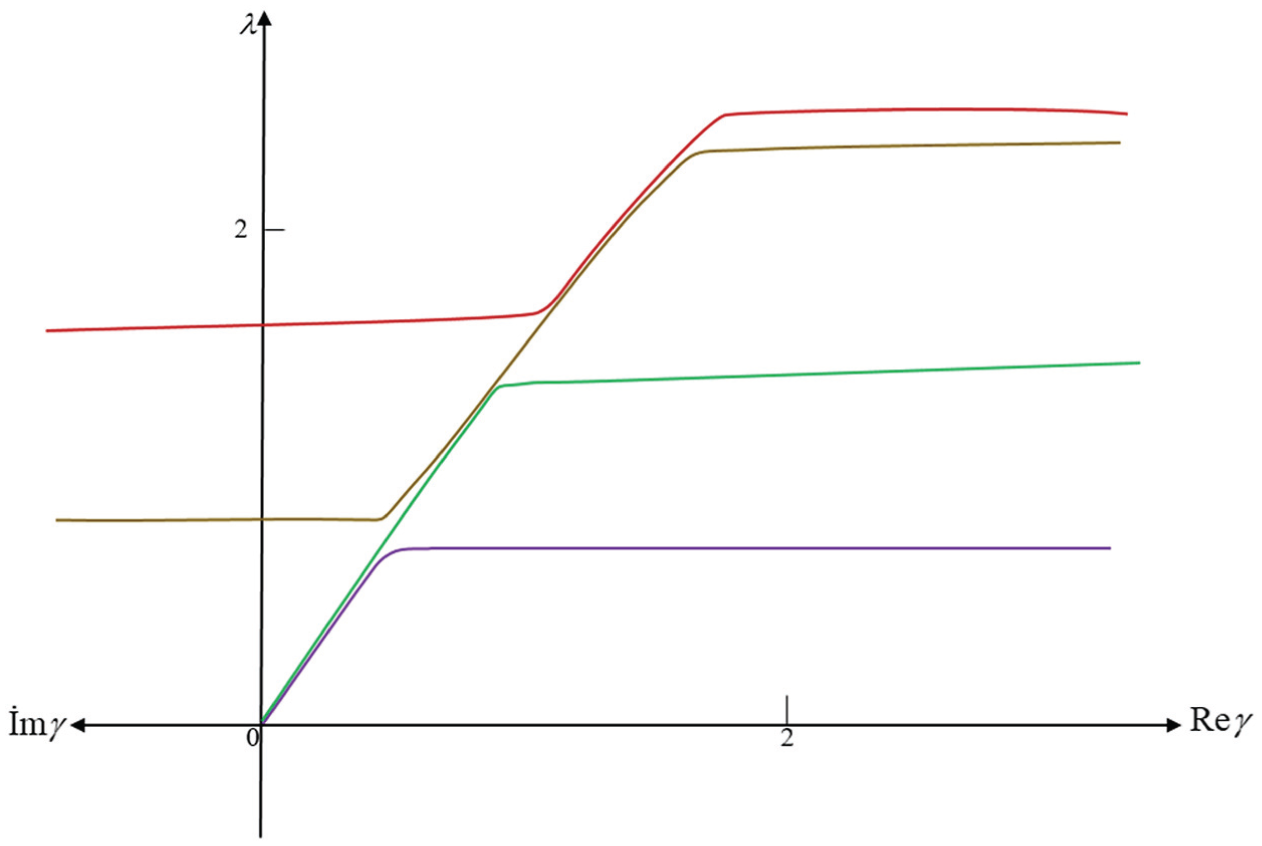
Dispersion curves for a three-layer cylinder with a soft core
Based on (84), for the first frequency of thickness resonance we have:

where
1. Let us conduct an analysis of dispersion curves when
On the second dispersion branch, in the region of imaginary wavenumbers, there is no propagating wave. At
2. Let us conduct an analysis of dispersion curves when
The first branch originates from a point
From the research conducted it turns out that in both cases 1)
Conclusion
Exact solutions to the problems of torsional vibrations of a radially inhomogeneous cylinder are constructed. Asymptotic solutions to the problems of torsional vibrations of a radially inhomogeneous cylinder of small thickness are constructed. Based on the analysis performed, the nature of the constructed solutions has been determined. Asymptotic formulas defining the stress–strain state of a radially inhomogeneous cylinder are obtained. The propagation of torsional elastic waves in a radially layered cylinder is studied. A theorem on the stratification of the thickness resonance frequency is obtained. In the vicinity of
Footnotes

Funding
The author received no financial support for the research, authorship, and/or publication of this article.
Declaration of conflicting interests
The author declared no potential conflicts of interest with respect to the research, authorship, and/or publication of this article.