






Abstract
Recently, the 40th anniversary of materials exhibiting negative characteristics was celebrated. The pioneering work began in 1984 when Herakovich [1] designed a layered composite with a negative Poisson’s ratio across the layers, followed in 1985 by inverse honeycomb designs [2, 3]. In 1986, Kolpakov and Rakin [4] introduced a layered composite with a negative coefficient of thermal expansion across the layers. Given two major periods of interest in composites with negative properties, one during the 1990s and 2000s, and another ongoing today, we revisit these pioneering layered composite models from a contemporary perspective. This paper demonstrates that although negative coefficients (Poisson’s ratio and thermal expansion coefficient) are rare in natural materials, they can be achieved in layered composites constructed from homogeneous material layers, the simplest composite structure designs. Using illustrative metamaterial models, we provide visual explanations of the micromechanical mechanisms underlying these negative-coefficient phenomena.
Keywords
1. Introduction
Since the early stages of intensive composite-material development in the 1940s and 1950s, it has been recognized that composite systems may exhibit effective properties distinct from those of their individual constituents. Historically, however, this observation was interpreted rather conservatively within the framework of the theory of mixtures, according to which a composite could interpolate or combine constituent properties, but not exhibit effective responses lying outside the admissible range of its phases.
Within this paradigm, the emergence of elastic–plastic behavior from elastic fibers embedded in a plastic matrix, or the enhancement of stiffness and strength through reinforcement, was considered a manifestation of new material behavior only in a limited sense. The microstructure was treated mainly as a means of property redistribution, rather than as a genuine source of qualitatively new macroscopic responses.
This view has been profoundly revised with the advent of metamaterials, for which macroscopic behavior is governed primarily by structural organization rather than chemical composition. In this context, it is now well established that suitably designed microstructures can produce effective properties unattainable in homogeneous classical continua. This insight has been formalized through a variety of generalized continuum theories, including Cosserat, higher-gradient, and nonlocal models, which provide rigorous frameworks for capturing size effects, internal rotations, and microstructural interactions (see, e.g., [5–10]).
In particular, Cosserat and higher-order continuum models have proven essential for understanding anisotropy, chirality, and coupling effects in architected materials and fiber-based metamaterials [11–14]. Pantographic and lattice-like microstructures, extensively investigated both theoretically and experimentally, clearly demonstrate that microstructural topology and kinematics can be exploited to generate strong and highly tunable anisotropy in the effective material response, often over a wide parameter range, thereby enabling unconventional macroscopic behaviors such as atypical Poynting effects and enhanced toughness [15–19].
Recent advances in the mechanics of architected and fibrous materials have further demonstrated that microstructural organization can induce deformation modes and effective responses that cannot be fully captured within classical first-gradient elasticity. In particular, second-gradient and higher-order continuum models have been shown to be essential for describing structured deformation patterns, curvature-driven effects, and strong, widely tunable anisotropy in lattice- and fiber-based systems, which in turn enables effective behaviors such as negative Poisson’s ratios and anomalous thermal expansion in suitably designed architectures [20–23]. The earliest mention of a material exhibiting a negative Poisson ratio (cubic pyrite) can be found in Love’s book [24], where a calculation of Poisson’s ratio based on Voigt’s experimental data has been conducted (for some more details, see also [25]). Complementary developments incorporating dissipation and internal friction at the microscale have clarified the role of kinematic constraints and energy redistribution in woven and fibrous composites, where constrained deformation mechanisms may further amplify anisotropic and nonstandard effective responses [26–30]. Moreover, enriched beam and continuum models reveal that microstructure-induced anisotropy strongly influences wave propagation and symmetric deformation modes in microstructured and layered systems [31–33], highlighting the broader implications of effective material properties, including auxetic behavior and direction-dependent thermal expansion, beyond purely static behavior.
Beyond engineered composites, similar theoretical frameworks have been successfully applied to biological materials, where anisotropy, internal structure, and evolution of substructure play a dominant role in determining macroscopic behavior. Generalized continuum models incorporating orthotropy, internal variables, and microstructure-driven evolution have been shown to capture key mechanisms of bone remodeling and mechanically induced adaptation [34–36]. Likewise, enriched plate theories with kinematically independent thickness have proven effective in modeling shape changes in soft biological tissues, such as corneal deformation before and after surgical intervention [37]. These biomechanical applications further illustrate the broad applicability of structural and microstructure-informed modeling approaches, reinforcing their relevance beyond purely engineered metamaterials. In this context, materials exhibiting a negative Poisson’s ratio have been directly employed in biomedical devices such as auxetic stents, where structurally induced anisotropy enables radial expansion under axial loading, illustrating how tailored effective properties translate into functional advantages [38].
Against this broader backdrop, the discovery of negative effective material characteristics represents one of the most striking outcomes of microstructural design. A seminal contribution was provided by Herakovich [1], who demonstrated that a laminated composite composed of anisotropic layers can exhibit a negative Poisson’s ratio across the layers, despite all constituents having positive Poisson’s ratios. Shortly thereafter, Kolpakov and Rakin [4] showed that laminated composites may also possess a negative homogenized coefficient of thermal expansion across the layers, even when all constituents expand positively. R. Lakes created the first synthetic auxetic material in 1987 using a method called thermomechanical processing of conventional polymer foam. His breakthrough idea was to alter the internal macrostructure of the material, converting ordinary convex cells into concave (re-entrant) structures. This volumetric compression (typically reducing the volume by a factor of 1.4–4) caused the straight ribs of the cells to buckle and fold inward, turning them into re-entrant (concave) shapes [39,40].
These results predate the widespread use of the term metamaterial, yet they embody its core principle: effective material behavior can be engineered through structural anisotropy and interaction mechanisms rather than intrinsic phase properties. Modern perspectives on metamaterial design, often grounded in variational principles and homogenization theory, have since reinforced this idea, emphasizing the role of microstructural kinematics and energetic coupling [41–44].
The renewed interest in architected materials over the last decade, driven by advances in additive manufacturing and experimental characterization, has further highlighted the relevance of layered and fiber-based composites as canonical platforms for metamaterial behavior. In particular, such systems provide simple yet versatile settings in which strong anisotropy can be designed and tuned, enabling effective responses that include negative Poisson’s ratios and anomalous or negative thermal expansion in appropriately engineered configurations [45,46]. Recent studies have explored the impact of fiber topology, structural hierarchy, and internal dissipation mechanisms on the effective response of composite laminates and membranes [47–50], underscoring the enduring importance of classical laminate configurations within modern metamaterial research.
The present paper revisits the pioneering layered-composite models of Herakovich and of Kolpakov–Rakin from a modern theoretical viewpoint. Our objectives are threefold:
to reinterpret these classical examples within the framework of homogenization theory;
to show that negative Poisson’s ratios and negative thermal expansion coefficients can arise in laminated composites composed of homogeneous layers, representing one of the simplest possible composite architectures;
to provide clear micromechanical and metamaterial-style interpretations of the underlying deformation mechanisms.
By bridging classical laminate theory with contemporary metamaterial concepts and generalized continuum perspectives, we aim to clarify the mechanics of negative effective characteristics and to emphasize their fundamental nature, generality, and continued relevance for the rational design of advanced composite materials.
2. Layered composite possessing a negative Poisson’s ratio across the layers
As is known, the theoretically possible value of Poisson’s ratio of an isotropic material is
In the 1960s, there were unitary reports about experimental observation of a negative Poisson’s ratio. Many of the experiments were reported not to use common materials and under not common conditions. The review [53] reports an experimentally observed negative values of ν (quartz crystals at high temperatures) in [54] and for some directions in anisotropic modified pyrolytic graphite in [55]. Anisotropic reinforced composites with
In this situation, the theoretical analysis became, likely, the only way to resolve the problem of negative Poisson’s ratio.
2.1. Herakovich example of negative Poisson’s ratio of layered composite
In 1984, in paper [1], Herakovich analyzed Poisson’s ratio across the layers in laminated composite material formed of anisotropic layers with
Currently (period 2020–2026), materials with negative Poisson ratios are attracting increasing attention. A previous (much smaller) surge of attention occurred in the 1990s after the proof in 1985 of the existence of composite materials possessing negative Poisson’s ratios in all directions [2,3]. The number of articles devoted to materials with negative Poisson ratios is growing over time.
The search in Google Scholar for “auxetic” (used as a shorthand for “material with negative Poisson ratio” [60]) returns the number of results for the 5-year period indicated in Table 1.
The details of the search results.

For the 5-year period (1985–1990), a search for “auxetic” returns 40 results.
We present here an analysis of Herakovich’s example in terms of the homogenization theory. We carried out the calculations as follows (all calculations can be done explicitly, but they were carried out on a computer due to the cumbersomeness of explicit calculations).
Computations were the following. We consider a composite obtained by stacking alternating similar anisotropic layers of equal thickness with orientations ϕ and
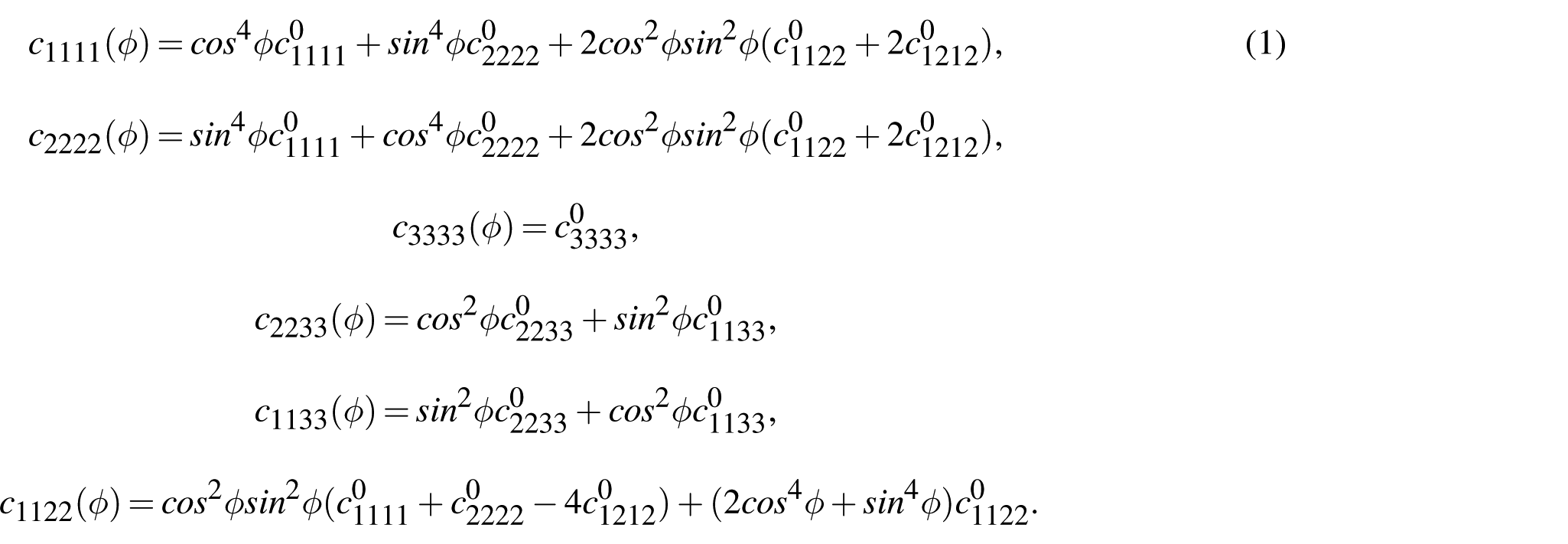
In (1),
Elastic constants of anisotropic material in terms of Young’s moduli and Poisson’s ratios.
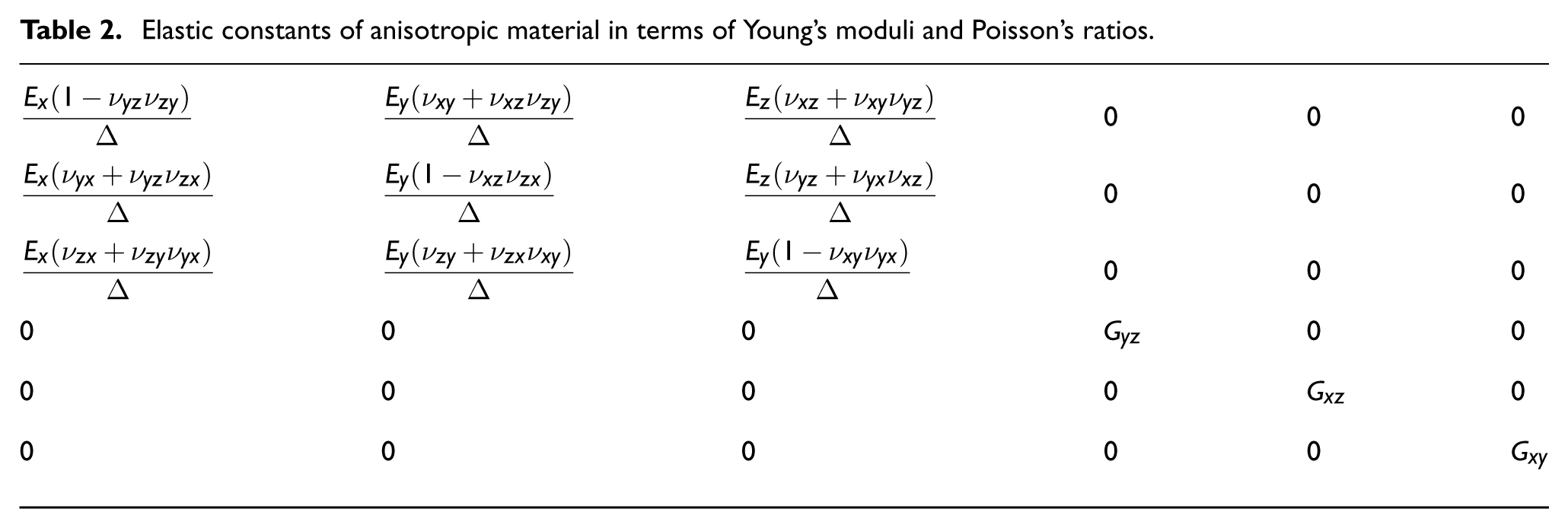
In Table 2,
After this, we calculate the homogenized elastic constants
One can compute the homogenized Poisson’s ratio
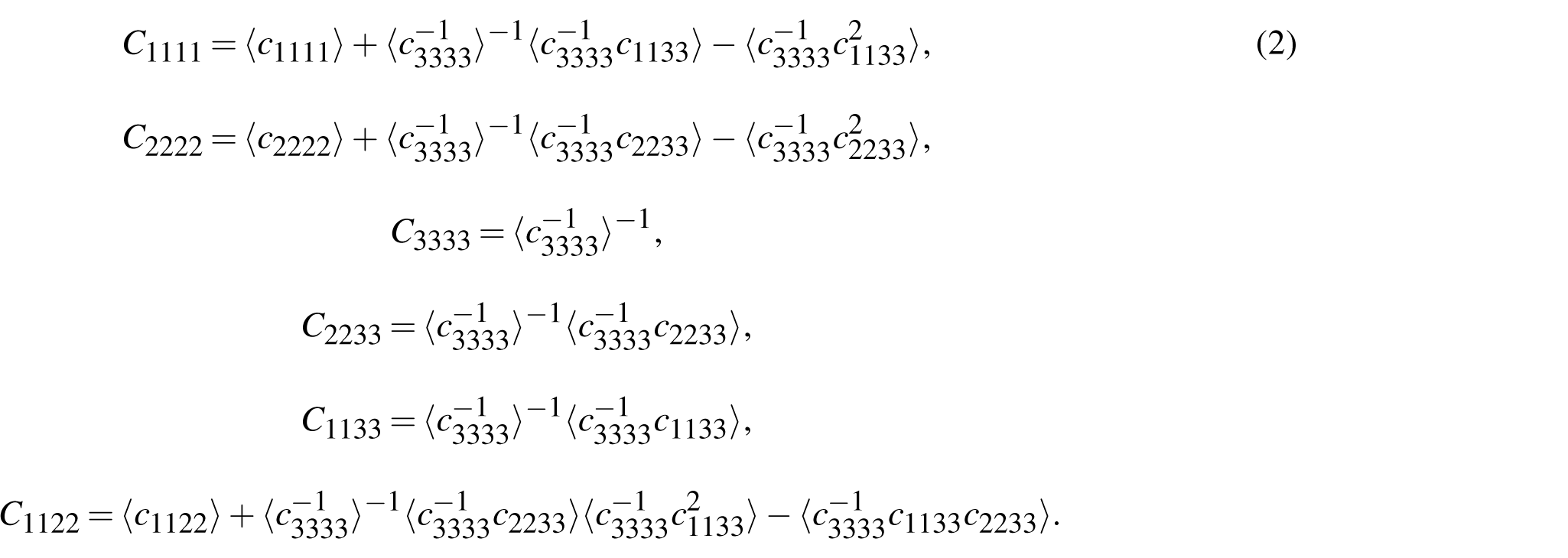
The calculations can be performed explicitly, but computer calculations are preferable because the resulting explicit formulas are cumbersome.
Computer programs were coded to perform the calculations described above, and computations were performed for the following parameters:
2.2. Metamaterial view on Herakovich example
Traditionally, Herakovich’s example has been associated with fiber-reinforced laminated materials [1,64–66]. Our calculations revealed that the homogenized Poisson’s ratio
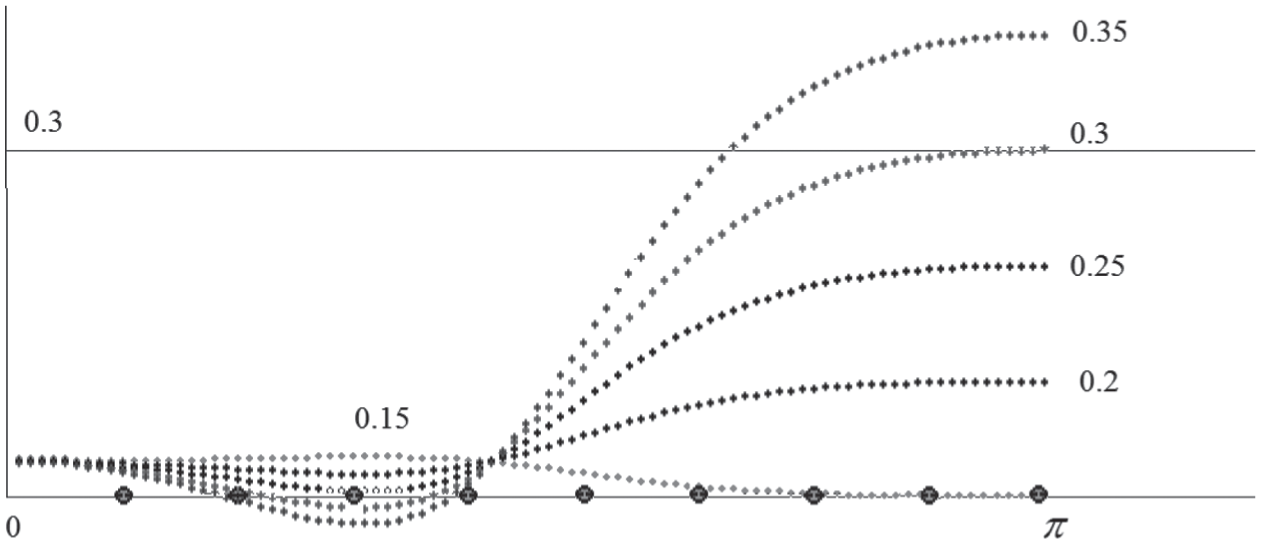
The homogenized Poisson’s ratio
In the mechanics described above, the fibrous or homogeneous structure of the layers does not play a role. In our opinion, this effect is due solely to the anisotropy of the microstructure. We illustrate this statement with a microstructural diagram (Figure 2). The scheme resembles the diagrams of frameworks with a negative Poisson’s ratio from [2,3] and implements the following deformation sequence: tension along the
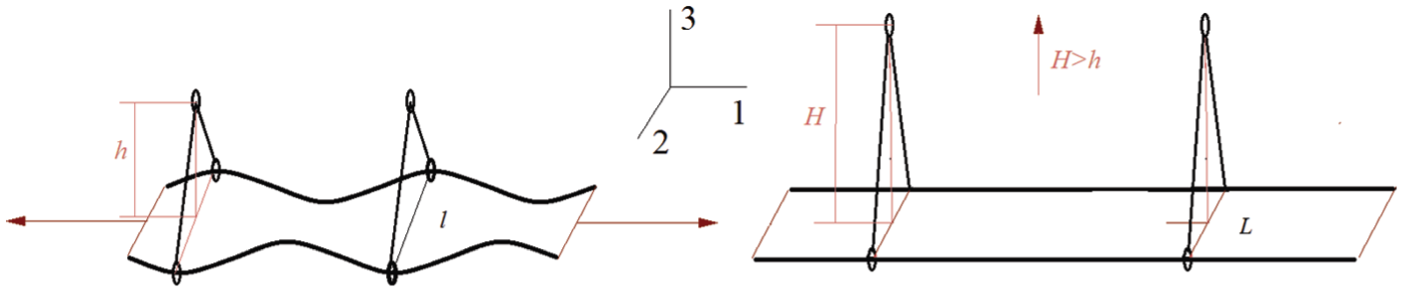
Micro-structural scheme of material with a negative Poisson’s ratio.
As we understand, the role of fibers in the Herakovich effect consists exclusively of creating anisotropy of layers (Figure 3).
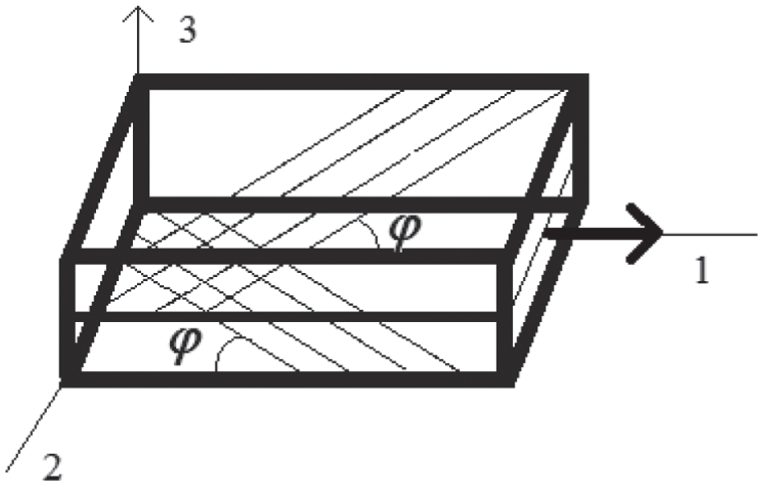
Fiber
Herakovich’s example can be clearly illustrated using the corresponding metamaterial. As indicated above, a metamaterial is understood as an artificial material, the properties of which are determined not so much by the composition of its original substances but by their specially designed microstructure.
As follows from the above, Herakovich’s example requires large positive Poisson’s ratios
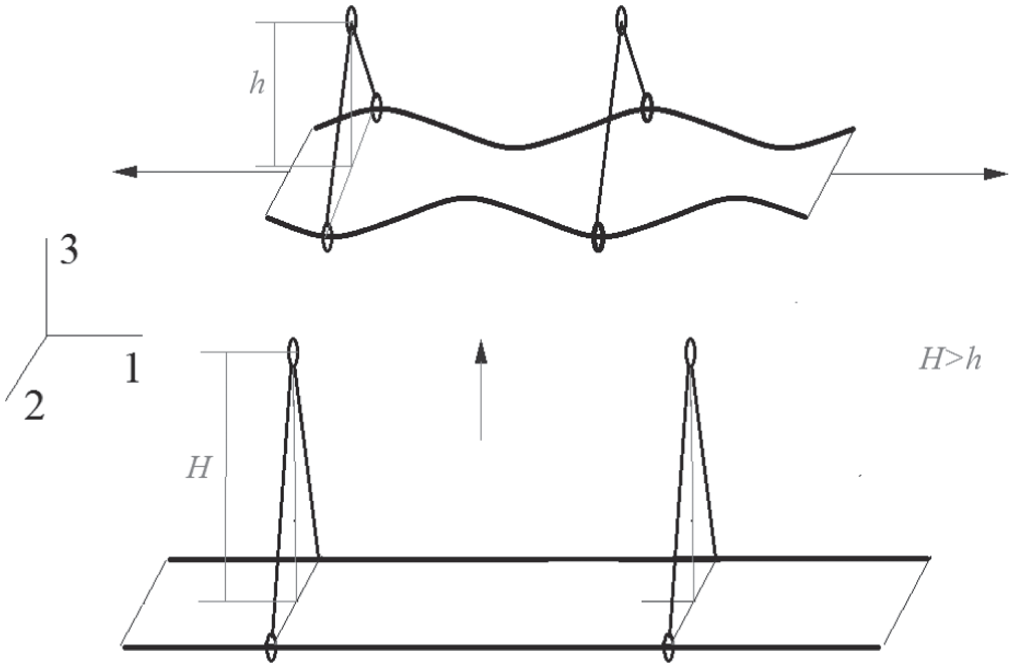
Metamaterial interpretation of the Herakovich example.
The wavy fibers straighten under tension along the
The above reasoning suggests that the deformation scheme described above can be implemented using layers of homogeneous materials (see Figure 5) (the correspondence of notations of coordinate:

where
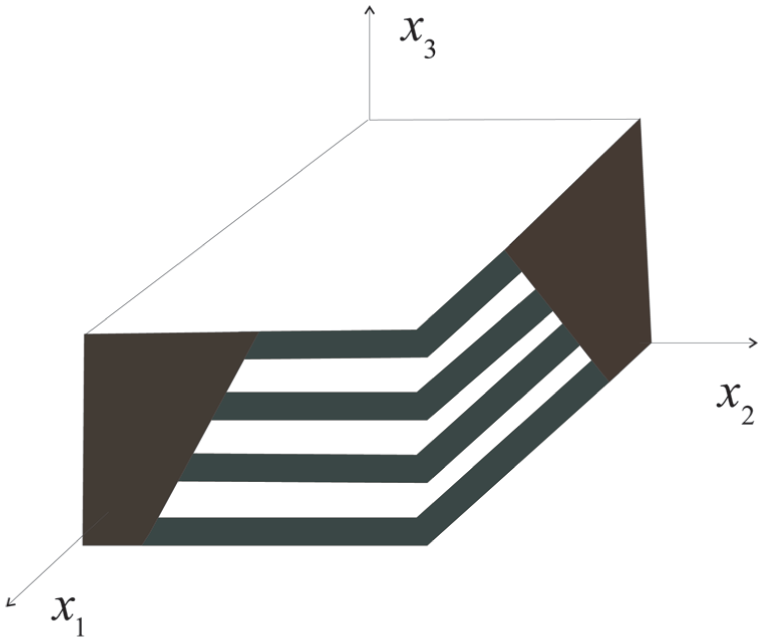
A laminated two-layer material.
That is, the sign of the deformation D across the layers is determined by the sign of the multiplier
The real rigidities of both the hard and soft layers are finite and non-zero, and their specific contents are positive (say, the carrier layer may be thin and hard but cannot have zero thickness and infinite stiffness). Therefore, it is necessary to verify the imaginary analysis by computations for realistic characteristics of the layers. In the case under consideration, such computations are easier to realize numerically. There was a coded computer program computing the homogenized elastic characteristics
The computed homogenized Poisson’s ratio across the layers is presented in Figure 6 as a function of the relative thickness λ of the isotropic layer.
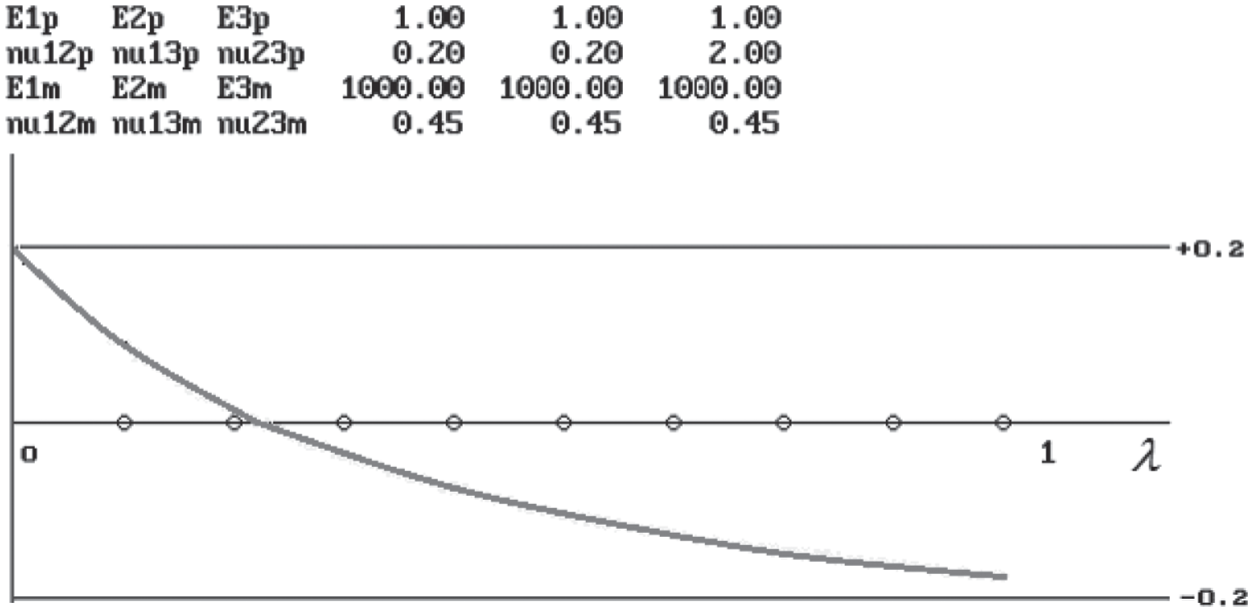
Poisson’s ratio as a function of the relative thickness of the isotropic layer.
Table 3 displays the Young’s moduli and Poisson’s ratios (the relative values of the Young’s moduli used in computations are presented) of the materials of the layers. It is seen that the first material is orthotropic, and the second material is isotropic.
Young’s moduli and Poisson’s ratios of the material of the layers.

Figure 7 illustrates the local deformations corresponding to the formula (3).
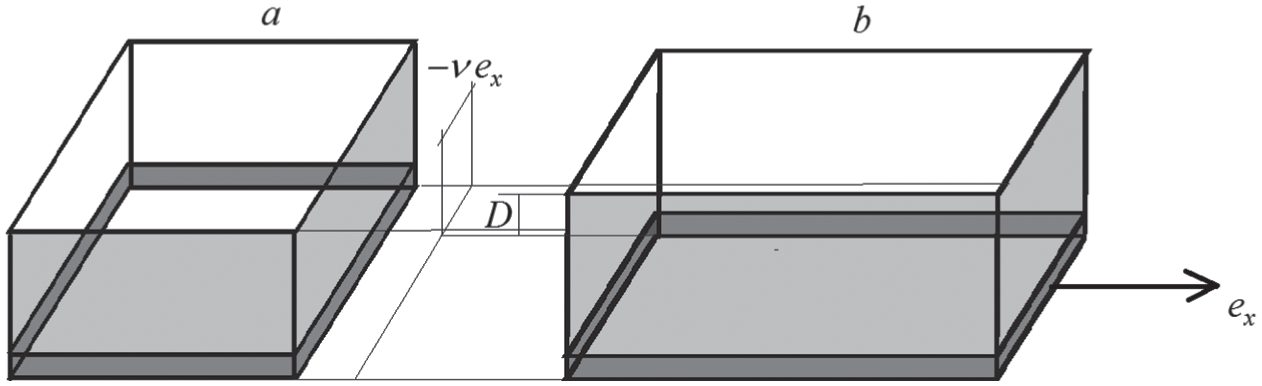
Thin rigid homogeneous isotropic layer (dark grew) glued to a thick homogeneous soft anisotropic layer (light grew), before and after deformation.
Figure 8 shows a diagram of the “metamaterial” explaining the appearance of the negative Poisson’s ratio in the laminated composite shown in Figure 7.
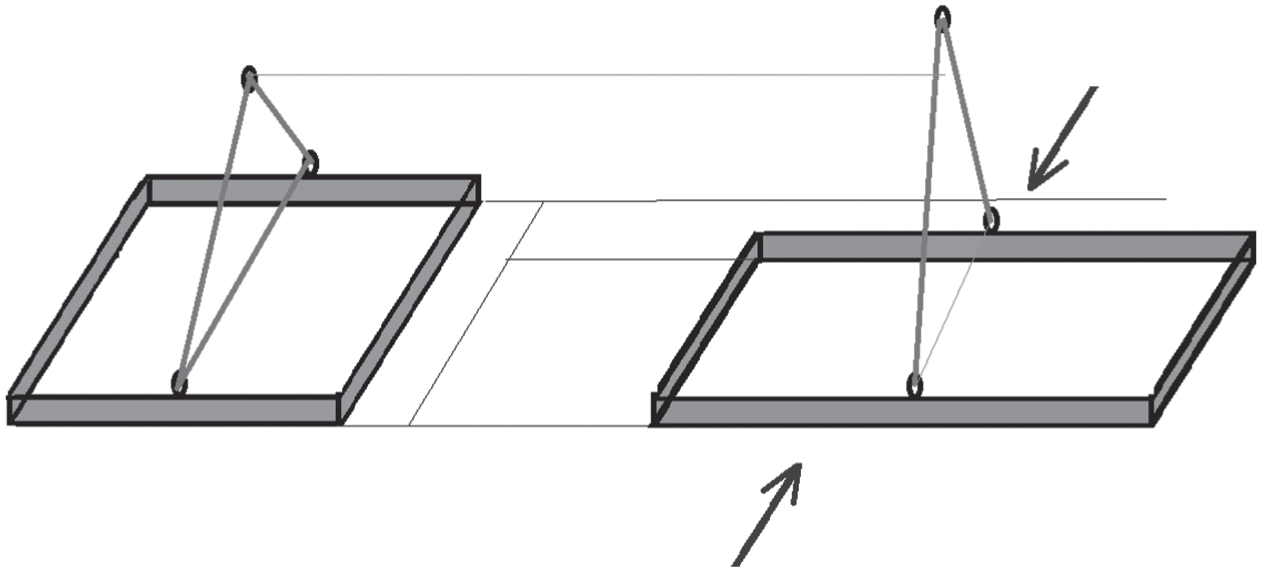
Metamaterial possessing a negative Poisson’s ratio.
3. Laminated composite possessing a negative homogenized coefficient of thermal expansion across the layers
As noted above, in courses on elasticity theory and continuum mechanics until 1984–1985 (publications by Herakovich, Kolpakov, and Almgren with theoretical predictions of the negative Poisson’s ratio of composites), it was common to assert that the negativity of Poisson’s ratio does not take negative values; see, e.g., [51,52]. In the 1988 paper, we already find: “Although a negative Poisson’s ratio is not forbidden by thermodynamics, this property is generally believed to be rare in crystalline solids. In contrast to this belief, 69 percent of the cubic elemental metals have a negative Poisson’s ratio …” [67].
In contrast to materials with a negative Poisson’s ratio, materials with a negative coefficient of thermal expansion have long been known in practice. An example of a solid with a very small positive coefficient of thermal expansion is Invar (about
Natural solids exhibiting negative thermal expansion have small negative coefficients of thermal expansion; a typical example is quartz glass with
The question was also about the mechanisms of the negative thermal expansion coefficient and the possibility of producing materials with a negative thermal expansion coefficient from materials with a positive thermal expansion coefficient.
3.1. Kolpakov–Rakin example of negative thermal expansion of layered composite
The homogenized (also referred to as macroscopic, effective, or overall) thermal expansion coefficients

These formulas are valid under the assumption that Poisson’s ratios of the layers are equal.
Using the formulas (4), it is possible to design laminated composite materials possessing negative thermal expansion [4].
Introduce the following functionals:

The average value in (5) is computed as
Let only the positivity condition be imposed on the elastic characteristics of the layers:

The proof of this proposition may be found in [4,73].
In these notations, equalities (4) take the form

Consider
The next question is whether there exist real materials with a positive coefficient of thermal expansion whose composition possesses a negative homogenized coefficient of thermal expansion. The answer to this question was given in [4], where the real materials were presented, whose compositions possess negative
Designs of laminated composites possessing negative thermal expansion.
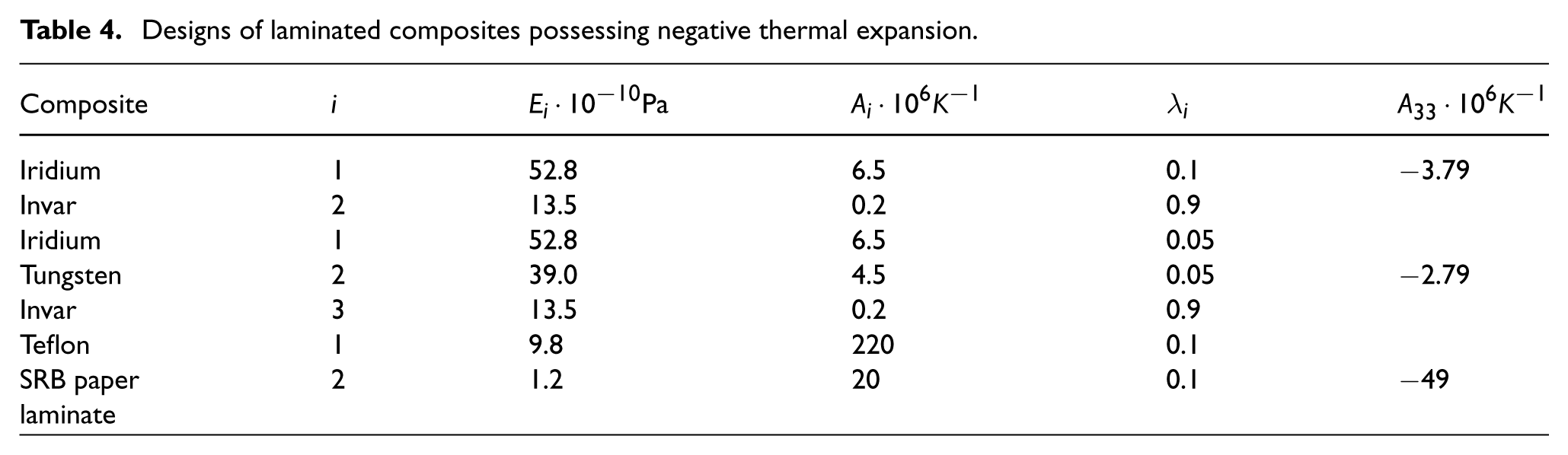
Figure 9 explains the appearance of the negative thermal expansion across the layers.

Micro-structural scheme of material with negative thermal expansion.
The bottom (black) solid carrier layer has a positive thermal expansion coefficient and expands under heating. If the carrier layer is stiff and the top (grown) layer is soft, the bottom layer expands the top layer. The vertical deformation of the top layer is also the sum of compression due to Poisson’s effect and thermal expansion. If the coefficient of thermal expansion of the top (grown) layer is about zero, the deformation of the layer is compression due to Poisson’s effect. Then, the total vertical deformation of the top and bottom layers is the sum of the tension of the top layer due to Poisson’s effect and thermal expansion of the bottom layer. It is not evident what will prevail, the tension or the expansion. The calculations presented above demonstrate that every term may prevail over another for specific thermomechanical characteristics and thickness of the layers.
Figure 10 shows a diagram of the “metamaterial” corresponding to the laminated material shown in Figure 9.
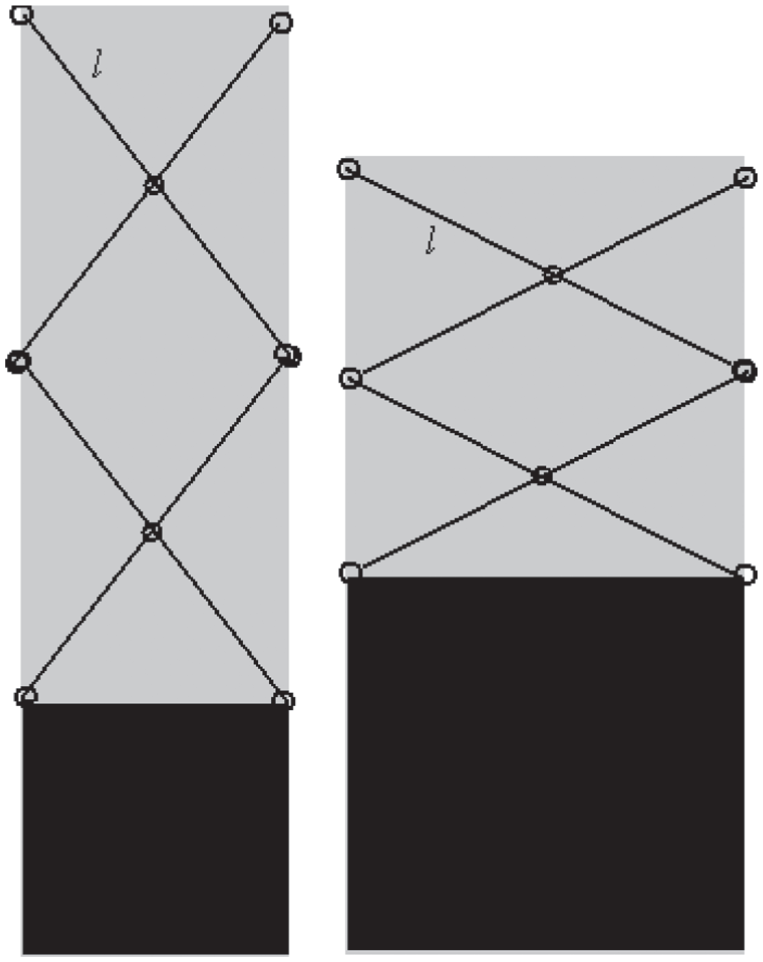
Metamaterial possessing negative thermal expansion.
3.2. Pseudo-Invar laminated material
For some engineering applications, see, e.g., in [74,75], a material with a very low, ideally zero, coefficient of thermal expansion is desirable. The best-known homogeneous material with a low coefficient of thermal expansion is Invar (see Table 4). This has given rise to the name “design of pseudo-invar composite” to the problem of designing materials with low coefficient(s) of thermal expansion.
In the terms used in the previous section, zero thermal expansion coefficient

or

4. Conclusions
The phenomenon of negative Poisson’s ratio discovered by Herakovich is a usual property of laminated materials, at least from a theoretical point of view. Negative Poisson’s ratio across the layers may be observed for a two-layer composite made of homogeneous layers, the simplest design of a laminated composite. The necessary condition is that one of the layers is anisotropic. A two-layer composite also provides us with a material with negative thermal expansion across the layers.
The mechanics of negative Poisson’s ratio and negative thermal expansion are clearly explained from the metamaterial point of view.
Footnotes
Authors’ note
Expanded text of lecture at University of Cassino and Southern Lazio, Cassino, Italy, September 2025.

Funding
The authors received no financial support for the research, authorship, and/or publication of this article.
Declaration of conflicting interests
The authors declared no potential conflicts of interest with respect to the research, authorship, and/or publication of this article.