






Abstract
In the context of linear thermoelasticity theories, we study the plane deformation of an arbitrarily shaped nano-inclusion embedded in an infinite isotropic matrix under uniform remote in-plane heat flux. The nanoscale thermoelastic effects are modeled using the theories of interface heat conduction, interface thermoelasticity and interface tension. An efficient series-based algorithm is developed to determine the full thermoelastic field in the entire composite system. Numerical examples are presented to validate the feasibility of the present solution and to explore how the interface stretching stiffness and the interface residual tension influence the thermal stress distribution around the vertices of the inclusion for some common inclusion shapes including ellipse, triangle, square, pentagon and hexagon.
1. Introduction
With the framework of continuum mechanics, the elastic analysis of an infinite plane containing circular inclusion(s), elliptical inclusion(s) and even arbitrarily shaped inclusion(s) has attracted considerable attention among researchers, in which the stresses and displacements between the matrix and inclusion are continuous. While the dimension of the composite material decreases the nanoscale value with higher interface-to-bulk ratio, interface energy effects play significant roles in the stress distribution and the continuum mechanics model is no longer applicable. Literatures have demonstrated that, even in thermoelectric energy conversion systems, interfacial heat leap and interfacial resistance can lead to significant discrepancies between theoretical predictions and experimental results [1]. Similarly, in an elastic system, the interface energy also significantly affects the stress distribution. To evaluate the interface energy effects, which is generally comprised of the surface elasticity and residual tension, Gurtin and coworkers [2,3] proposed the Gurtin–Murdoch model abbreviated as the “G-M” model, in which the interface is regarded as a thin film with zero thickness and perfectly adheres to the bulk material. Thus, the displacement field is treated as being continuous across the interface. However, the stress traction undergoes a jump due to the initial surface stress and the deformation-dependent surface stress, and the magnitude of this jump depends on the surface stress and the configuration of the interface as elucidated in Dai et al. [4]. For the interface configuration, there exist three models: the simplified G-M model, the incomplete G-M model and the complete G-M model. The simplified G-M model [5–12] focus on either the interface stretching stiffness or interface residual tension resulting in the independent investigation about respective impact on the elastic field. The comprehensive influence [13,14] of residual tension and interface energy effects on the stress distribution is investigated in incomplete G-M model based on the undeformed configuration. However, in the case where the magnitude of residual tension is relatively large and even in minor deformation, the residual tension has a prominent impact on the stress distribution of nanocomposite and structure. Thus, the geometric deformation cannot be neglected for the nanocomposites, especially in the case with larger interface residual tension. To remedy this defect, Dai et al. [15] proposed the complete G-M model based on the deformed configuration incorporating the effects of deformation on the interfacial normal vector and mean curvature.
In addition to the elastic analysis of nanocomposites, the thermoelastic analyses of nanocomposites under the remote uniform heat flux have attracted much attention of researchers. Corresponding to the simplified, incomplete and complete G-M models for elastic deformation, there also exist the simplified, incomplete and complete G-M model within thermoelastic theory. Based on the simplified G-M model, Dai et al. [16] obtained the closed-form solutions for circular nano-inclusion under remote heat flux, but omitted the residual tension which plays a crucial role in predicting the elastic behavior of soft solid-based structures and composites. To obtain the accurate stress distribution, Zhang [17] investigated the role of interface tension in the thermoelastic analysis of an arbitrarily shaped inclusion embedded in the infinite isotropic plane under plane strain deformation, but only present the numerical analysis for a circular inclusion without considering inclusions of other shapes. For the complete G-M model, Tang et al. [18] obtained the closed-form solution for a circular nanohole under remote uniform heat flux and analyzed the influence of surface effects on thermal stress fields. For the elliptical nano-inclusion, Zhang et al. [19] explored the thermoelastic field with interface conduction, interface elasticity and the residual tension. To the best of authors’ knowledge, the thermoelastic field around the non-elliptical inclusion under remote uniform heat flux has not been fully investigated. Consequently, in this paper, we aim to the non-elliptical inclusion and compare the influence of classical interface, interface conductivity, stretching stiffness and the residual tension on the thermal stress field around the inclusion and matrix, respectively.
The structure of this article is as follows. The problem formulation of the model, loading and boundary conditions with interface conduction, interface elasticity and residual tension are given in Section 2. In Section 3, the conformal mapping techniques are used in conjunction with Fourier expansion methods to derive both the temperature and stress fields. Section 4 presents numerical examples about the influence of both the interface conduction and interface stress effects on the thermal stress concentration for the triangular, square and pentagonal inclusions. The main results are summarized in Section 5.
2. Problem formulation
We consider an infinite matrix containing an arbitrarily shaped nano-inclusion in the framework of plane strain deformation. The matrix is subjected to a uniform remote heat flux with Cartesian components
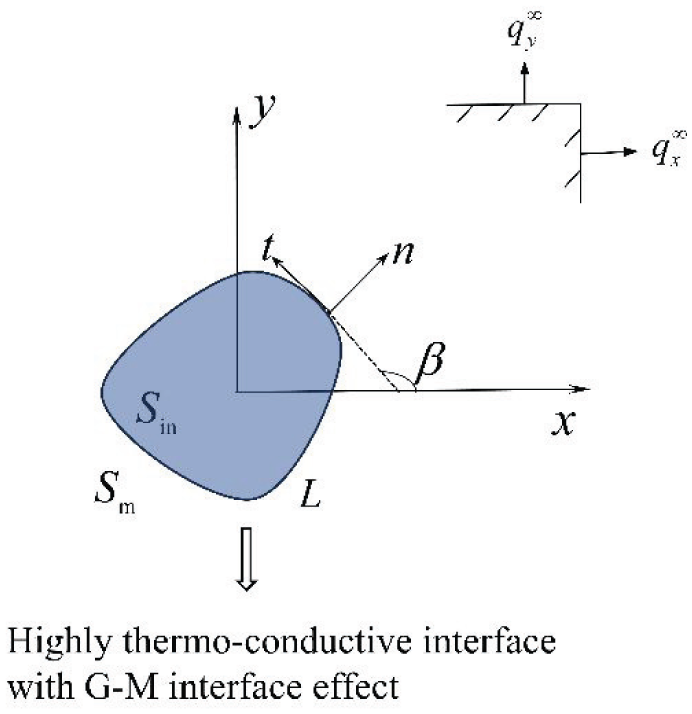
Elastic matrix with an arbitrarily shaped inclusion under uniform remote heat flux.
Assuming that the thermal flux is conserved and the reference temperature is zero, the steady-state temperature field

where i represents the imaginary unit and


with


where the
The boundary conditions on interface in the heat conduction require the continuity of temperature and jump of the heat flux [16] and are described as


where

which are combined to yield

The mechanical boundary conditions incorporating the highly conductive Gurtin–Murdoch model to capture the nanoscale size effect result in the continuity of interfacial displacement [5] and is expressed as

substituting the analytical function into the above equation, we obtain

While the Gurtin-Murdoch model admits a jump in traction across the interface, and the magnitude of which is governed by the interfacial equilibrium equation, whose derivation and details are present in Zhang et al. [19], leading to the following expression

where
3. Solution procedure
3.1. Solution to the temperature field
For the matrix subjected to the remote heat flux

where

while the function
Introduce a conformal mapping for the arbitrarily shaped inclusion [19]

where the constants r and

where N denotes the number of terms taken in the corresponding finite series, and

where

where coefficients

the corresponding functions related to the angle α may be expressed on the boundary L as

Substituting equations (16) to (20) into equation (9) and noticing the

on L, the interface conduction boundary condition is transformed into
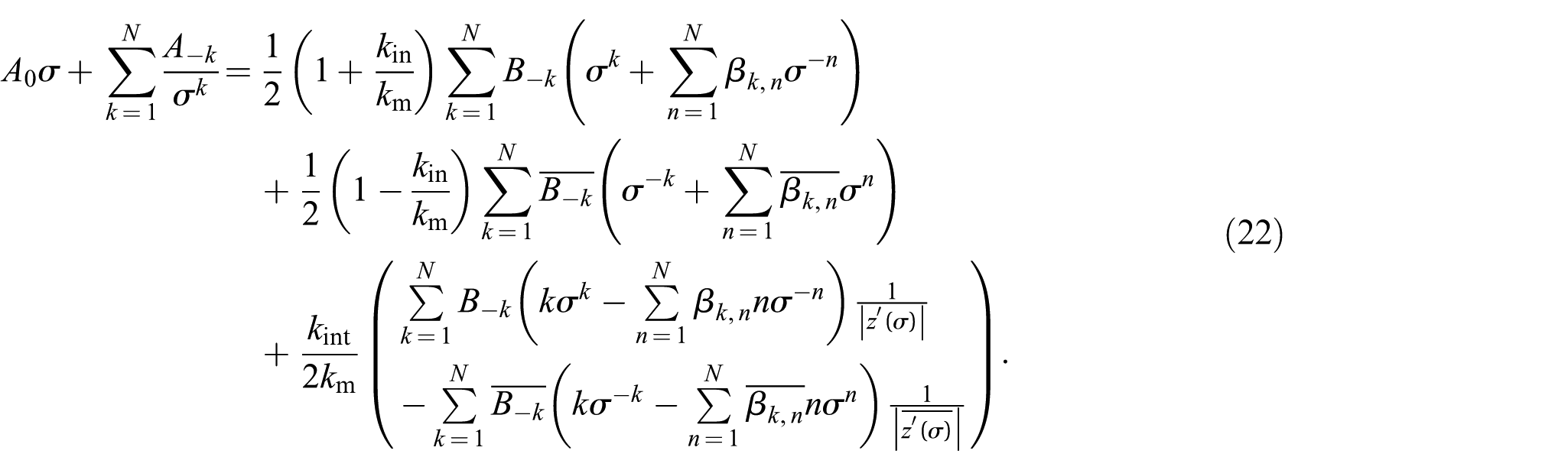
In the above equation, all terms are expressed as the Fourier series of σ except the last two terms, which are analytical within the unit circle and thus can be expanded into the Fourier series. The explicit expressions are given below

Substituting the above equations into equation (22) and equating the coefficients of the same power of σ on two sides yield a system of 2 N linear complex equations (equivalent to 4 N real equations). By solving the equations with linear algebra techniques, all unknown coefficients introduced in equation (16) can be fully ensured, thereby determining the temperature and heat flux fields in the matrix and inclusion.
3.2. Solution to the stress field
After the temperature potentials

where

while for

In equations (24) and (26),

The corresponding derivatives of the potential functions can be derived using the chain rule
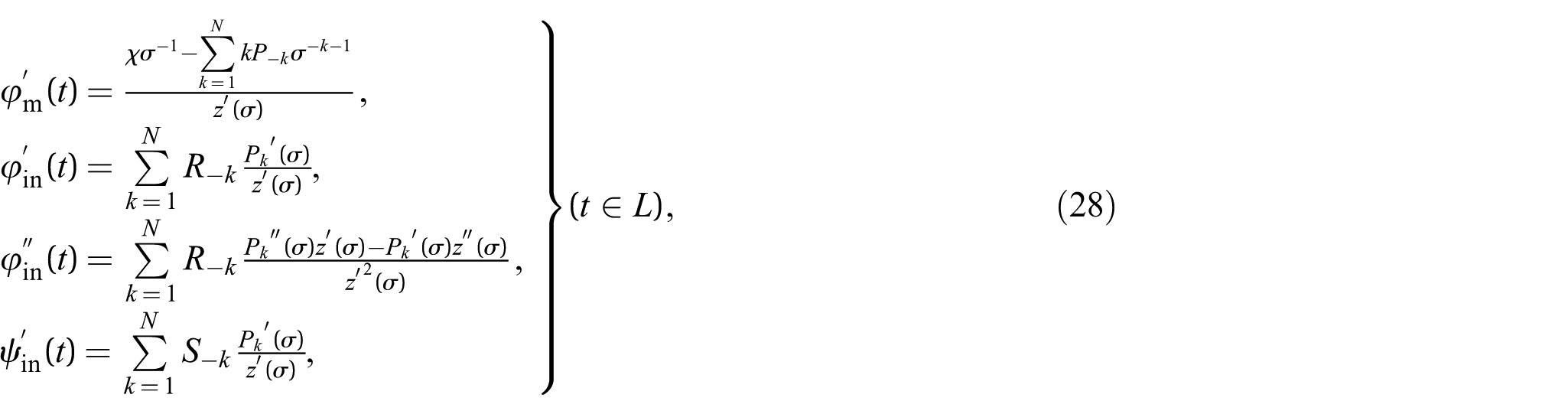
In addition, integrating z for
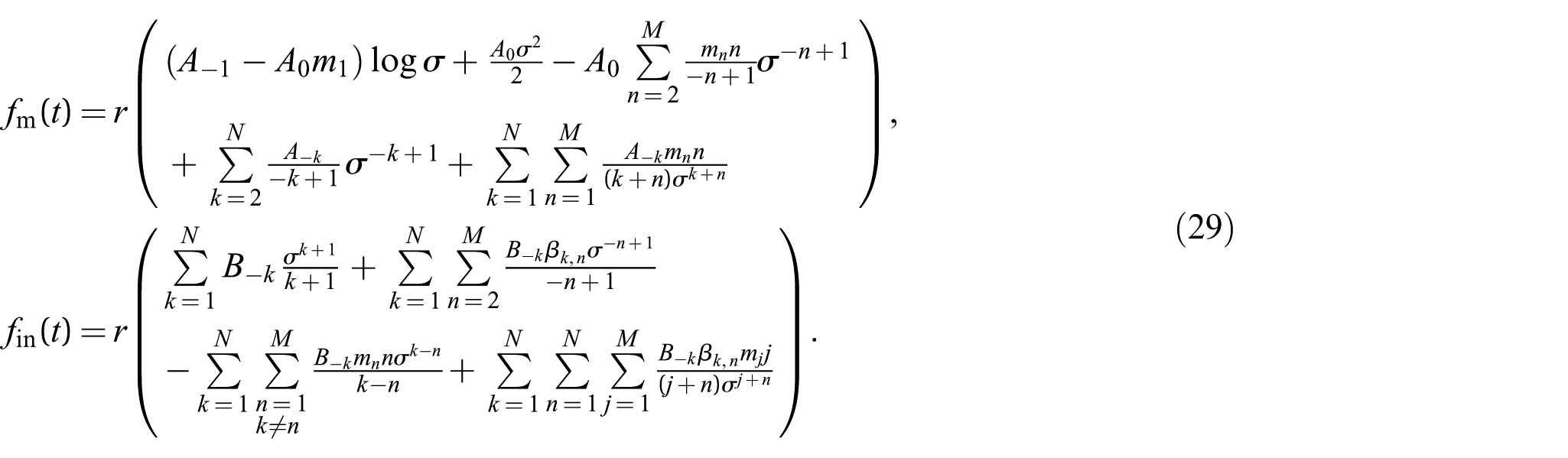
Substituting equations (24) to (29) into equations (11) and (12), and then expanding known terms into the truncated Fourier series, we obtain the stress and displacement boundary conditions (the specific expressions are presented in Appendix 1).
Similar to the determination of the unknown coefficients in the temperature field, the coefficients
4. Numerical example
In this text, we obtain the series-form thermoelastic field of an arbitrarily shaped inclusion surrounded by the infinite elastic matrix under the remote uniform heat flux and consider the interface elasticity and residual tension. In what follows, we pay more attention to the influence of the interface residual tension on the stress distribution. For illustrative purposes, we define some dimensionless parameters

to characterize material constants and interface parameters.
4.1. Verification of the present solution
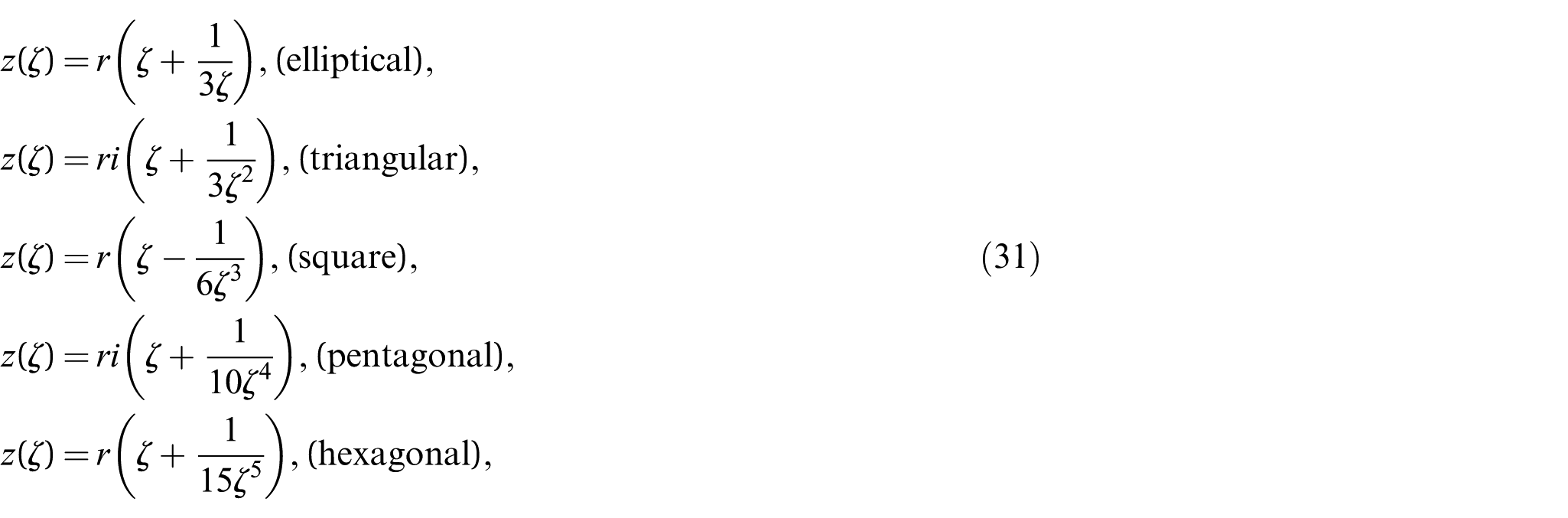
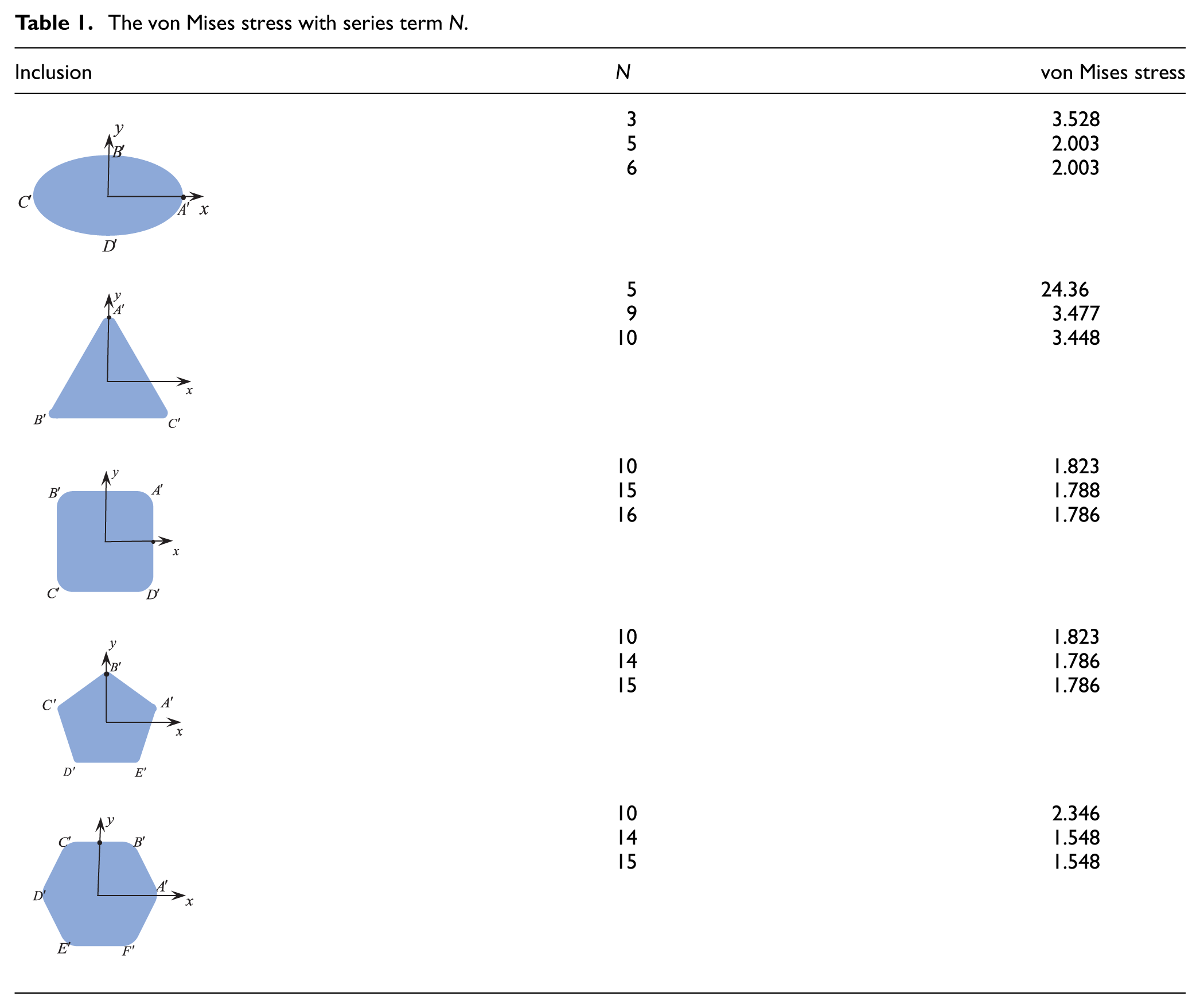
The convergency is presented by the term of series N and demonstrated by the fact that the relative error of von Mises stress corresponding to the two adjacent N is less than 1%. The von Mises stresses with classical interface at the endpoint of the elliptical inclusion, and the vertex of triangular, square, pentagonal and hexagonal inclusions are shown in Table 1, respectively. With M = 1, the conformal mapping functions are given as follows [11]
The results show that for inclusions with vertices, the number of series term for stress convergence is greater than that for elliptical inclusion. In the following numerical examples, the stress contributions obtained by the present solution are all based on convergent solutions.
The von Mises stress with series term N.
In Zhang et al. [19], the thermoelastic field of an elliptic nano-inclusion embedded in the infinite elastic matrix under remote heat flux is presented. The present solution for an arbitrarily shaped inclusion can be reduced to that of the elliptical inclusion, which verifies the effectiveness of the present method. The normalized von Mises stress on the matrix side is expressed as

The von Mises stresses on the matrix side around the elliptical nano-inclusion for interfaces of only the interface elasticity and the interface elasticity with residual tension are presented in Figure 2 when
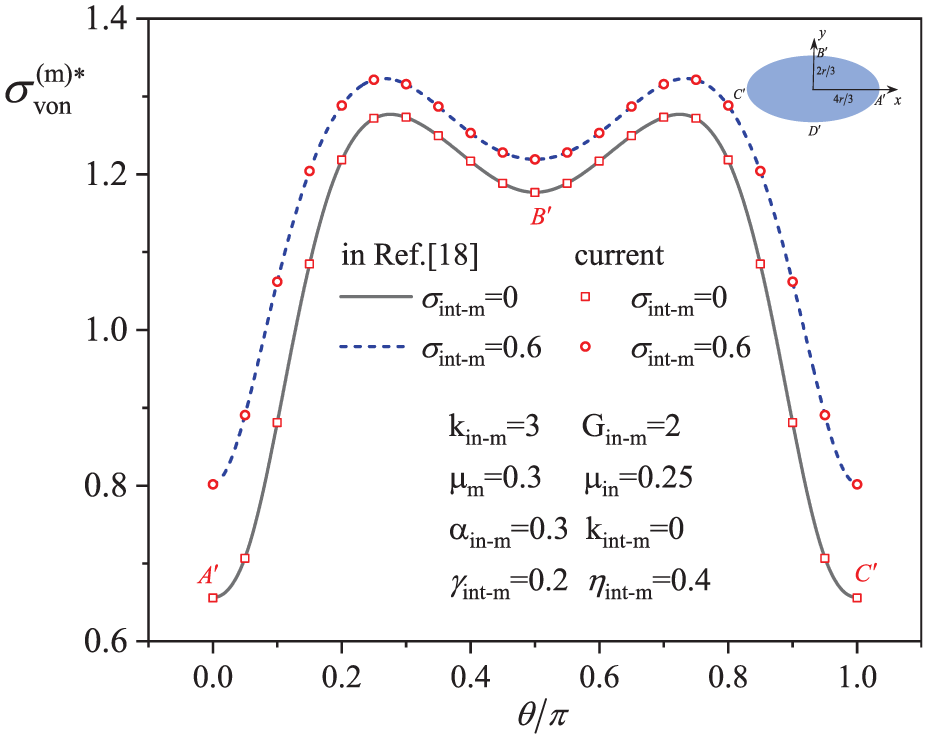
The interfacial von Mises stress on the matrix side around the elliptical nano-inclusion for interfaces of only the interface elasticity and the interface elasticity with residual tension.
4.2. The effect of interface elasticity with residual tension on the stress distribution
After verifying the current solution, we investigate the influence of elasticity interface with residual tension on the stress distribution around matrix side of arbitrarily shaped inclusion. The von Mises stress distribution near the matrix side of elliptic, triangular, square, pentagonal and hexagonal inclusions embedded in the elastic matrix under remote uniform heat flux is shown in Figures 3 to 7, respectively. Each figure consists of four subfigures labeled (a), (b), (c) and (d), corresponding to the varying interface stretching rigidity. In what follows, we pay more attention to the stress distribution of the endpoints of elliptic inclusion and the vertices of the other inclusions. It is shown in Figures 3 to 5 that the
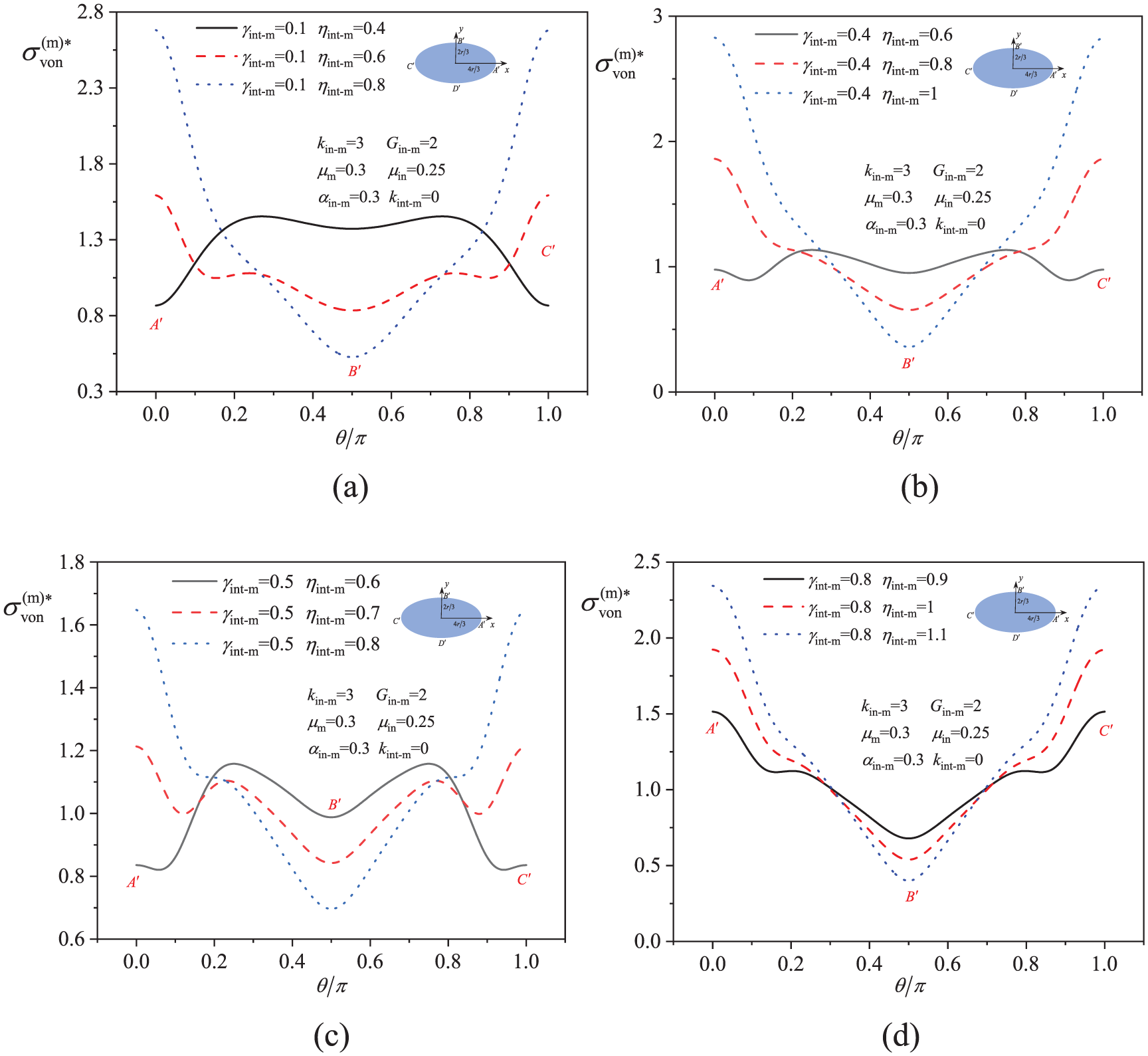
The interfacial von Mises stress around elliptic inclusion with stretching stiffness: (a)
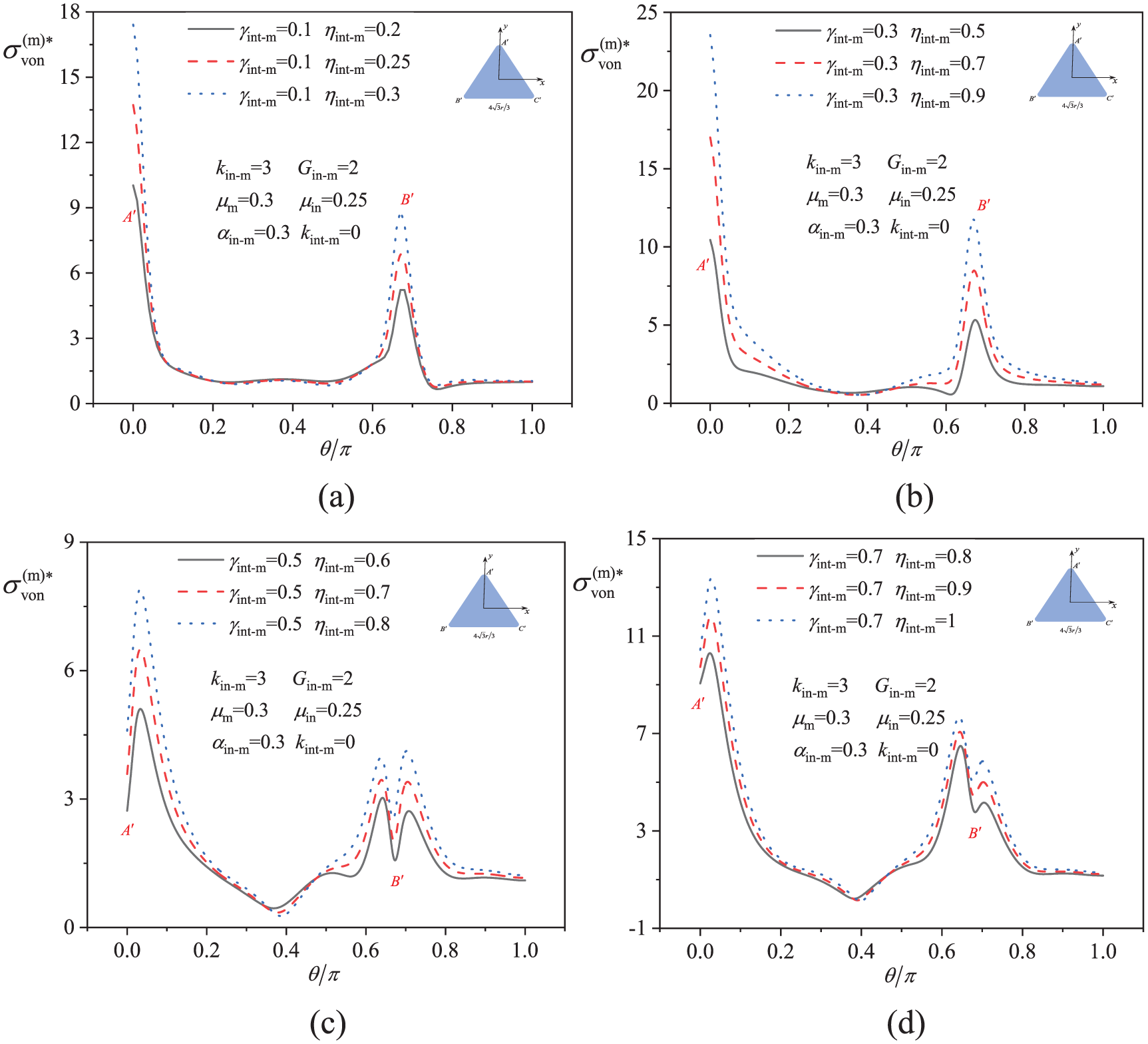
The interfacial von Mises stress around triangular inclusion with stretching stiffness: (a)
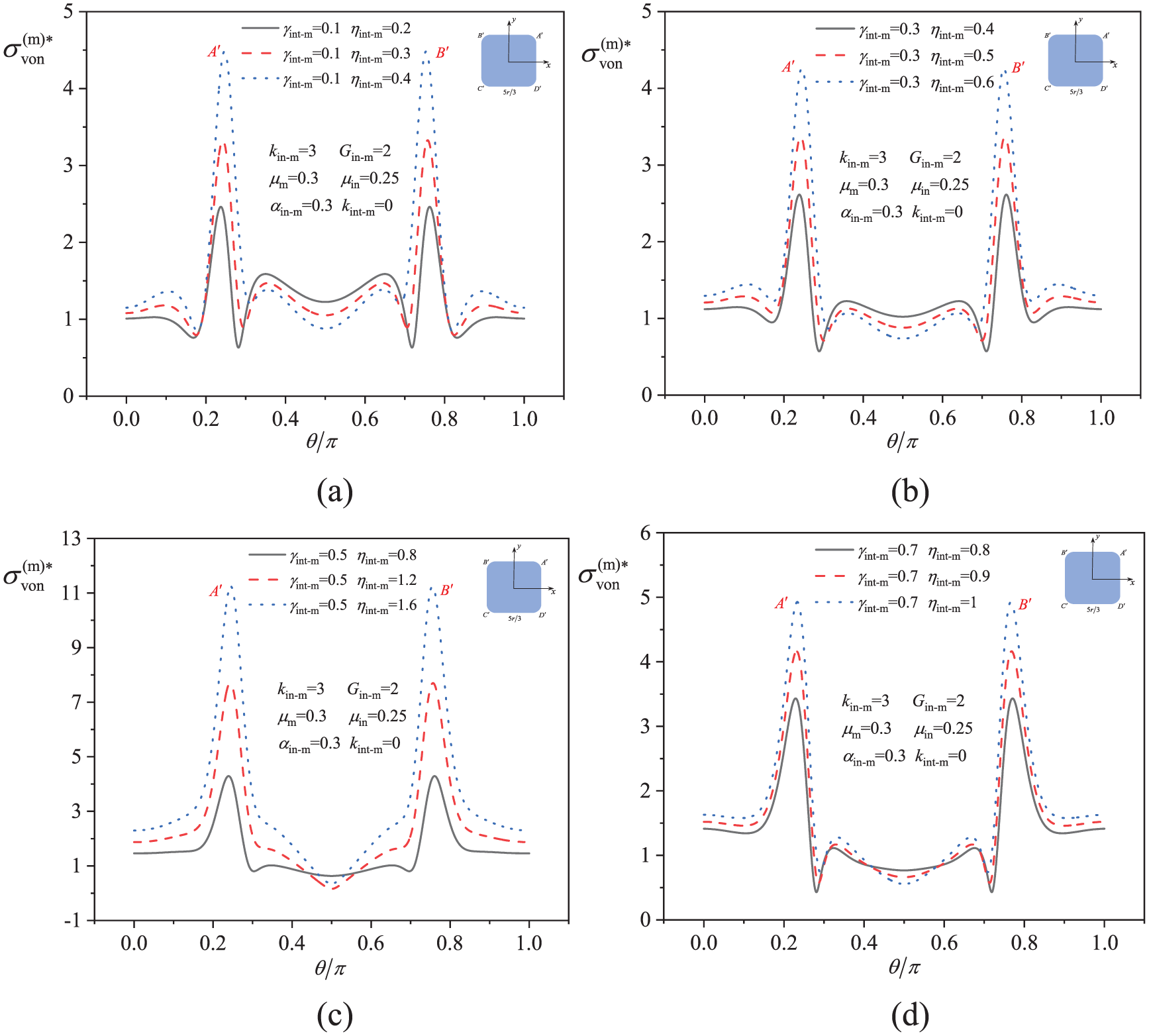
The interfacial von Mises stress around square inclusion with stretching stiffness: (a)
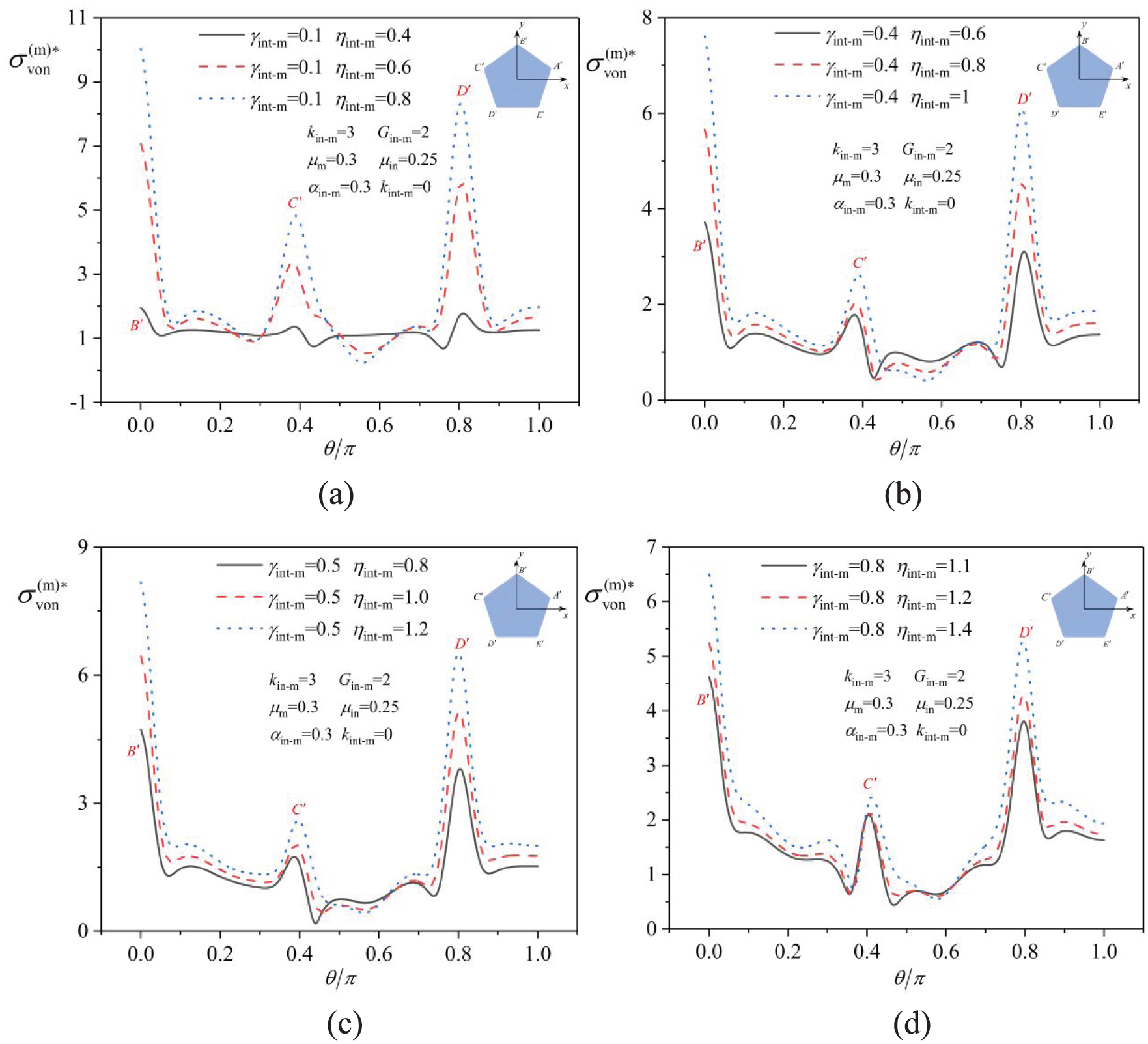
The interfacial von Mises stress around pentagonal inclusion with stretching stiffness: (a)
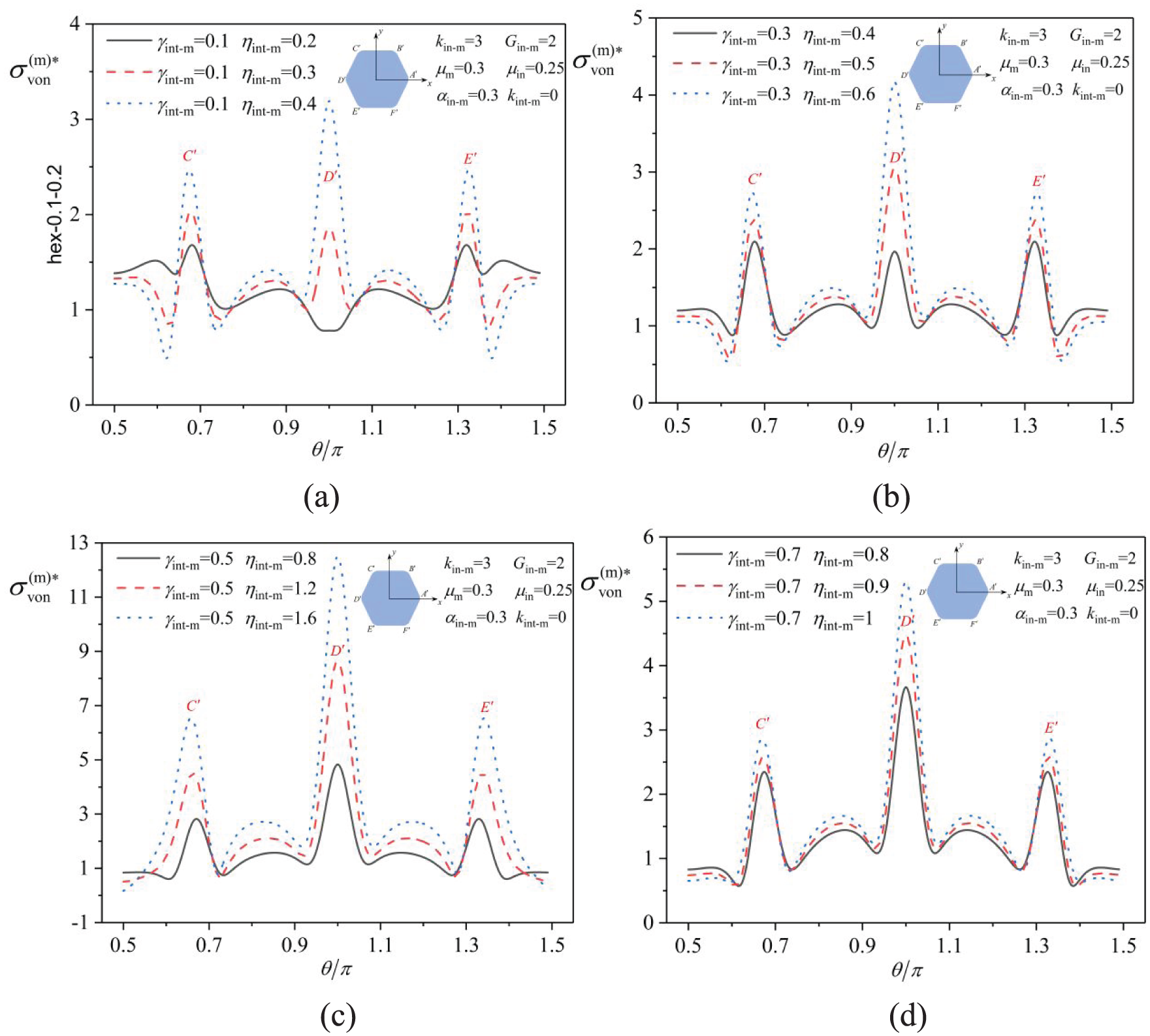
The interfacial von Mises stress around hexagonal inclusion with stretching stiffness: (a)
Furthermore, the effect of residual tension on the stress field of these inclusions is presented in Figures 8 to 12. Each figure consists of four subfigures: subfigure (a) shows the stress distribution at the interface with only residual tension, while subfigures (b), (c) and (d) show the stress with varying interface elasticity along with residual tension. As illustrated in Figures 8(a), 9(a), 10(a), 11(a) and 12(a) for the elliptical, triangular, square, pentagonal and hexagonal inclusions, the residual tension-induced von Mises stress at the endpoints of the elliptical inclusion and all the vertices of the other inclusions increases with the elevation of the residual tension. When the interface elasticity and residual tension are both taken into account at the interface, the influence of residual tension on the stress field near the matrix side differs from that with only residual tension at the interface. Specifically, the role of residual tension changes from strengthening to weakening the stress distribution with an increase in stretching rigidity (e.g., the endpoints of the major axis on the elliptical boundary, such as points
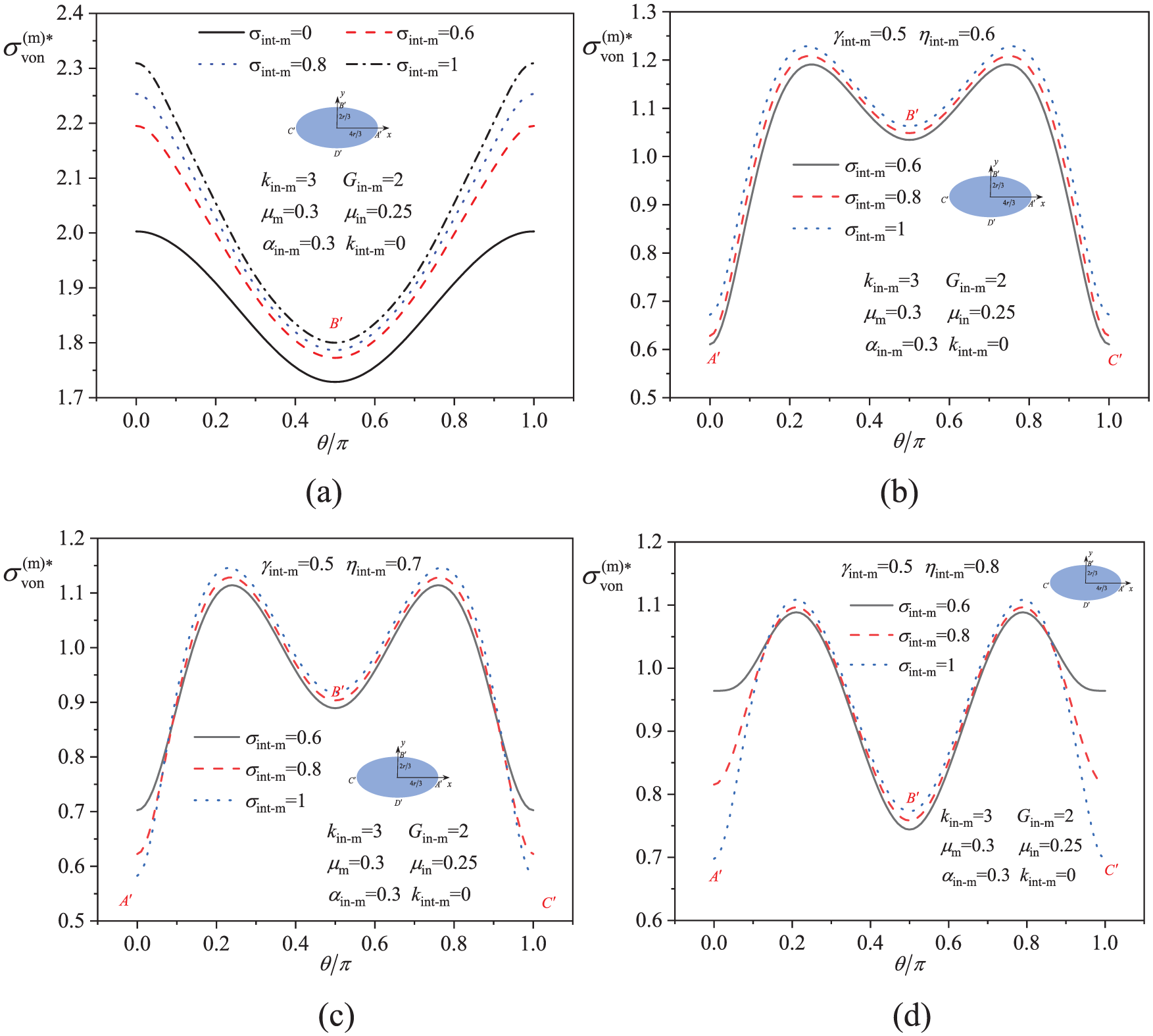
The interfacial von Mises stress around elliptic inclusion with interface residual tension and elastic parameter: (a)
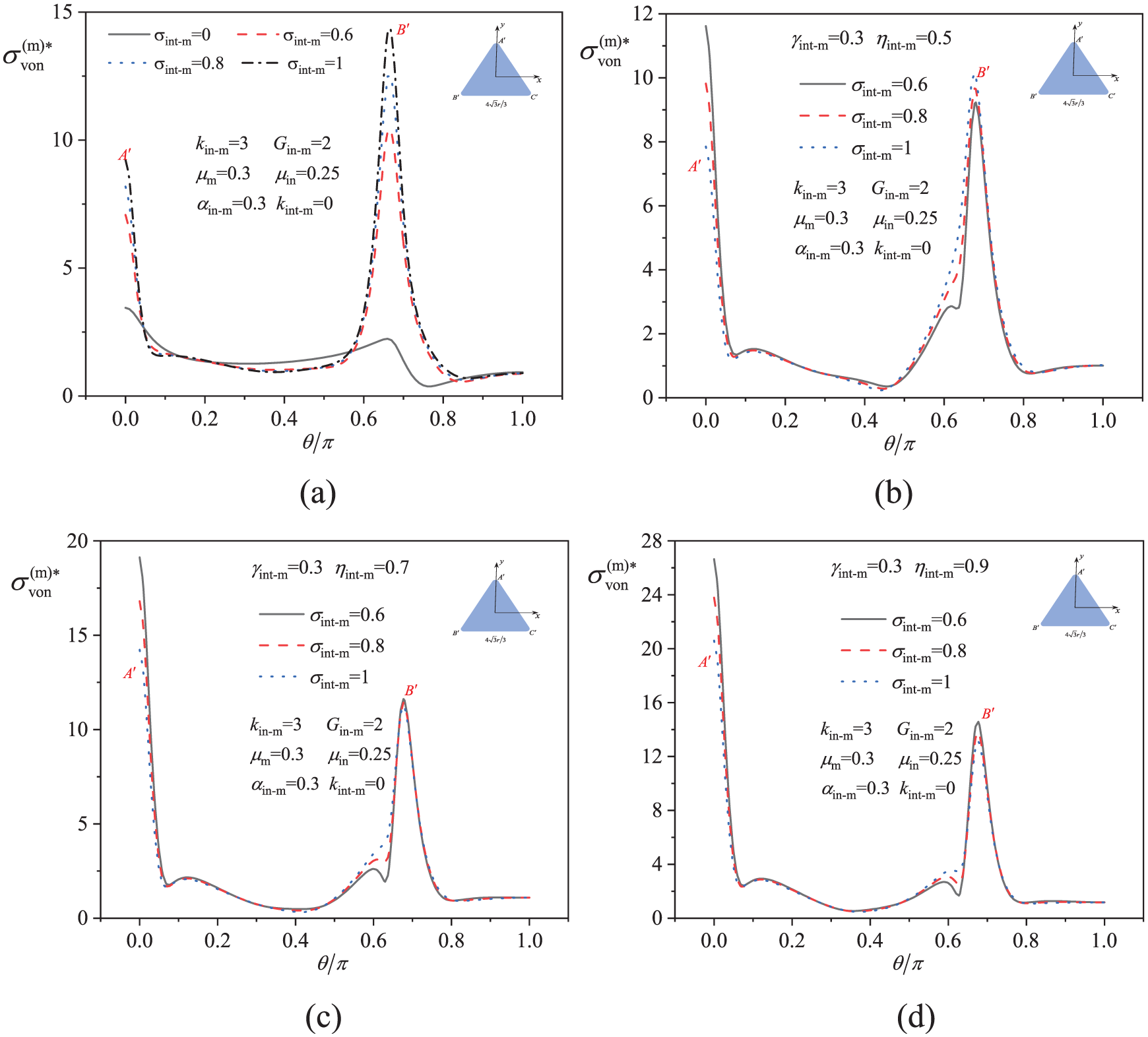
The interfacial von Mises stress around triangular inclusion with interface residual tension and elastic parameter: (a)
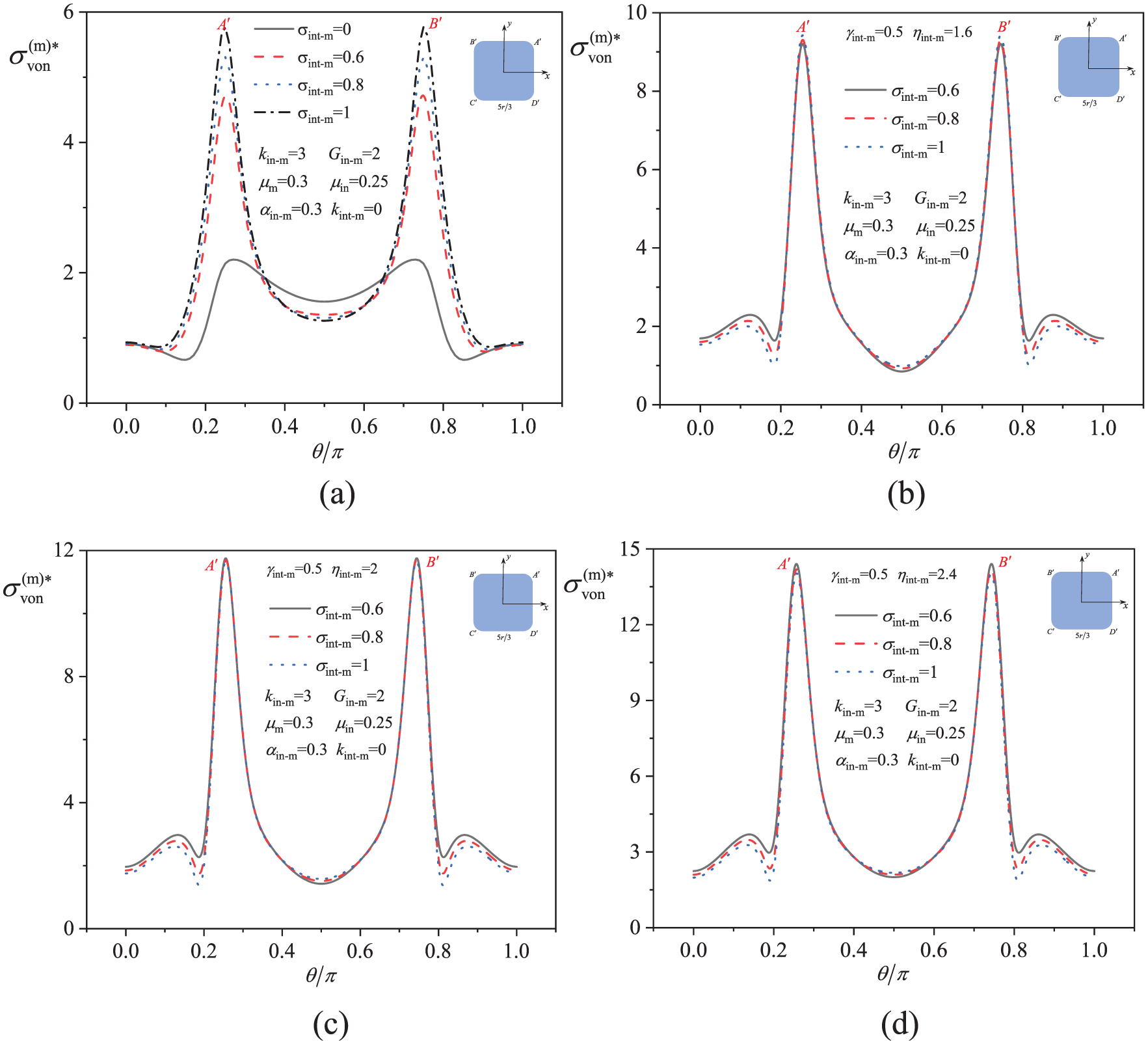
The interfacial von Mises stress around square inclusion with interface residual tension and elastic parameter: (a)
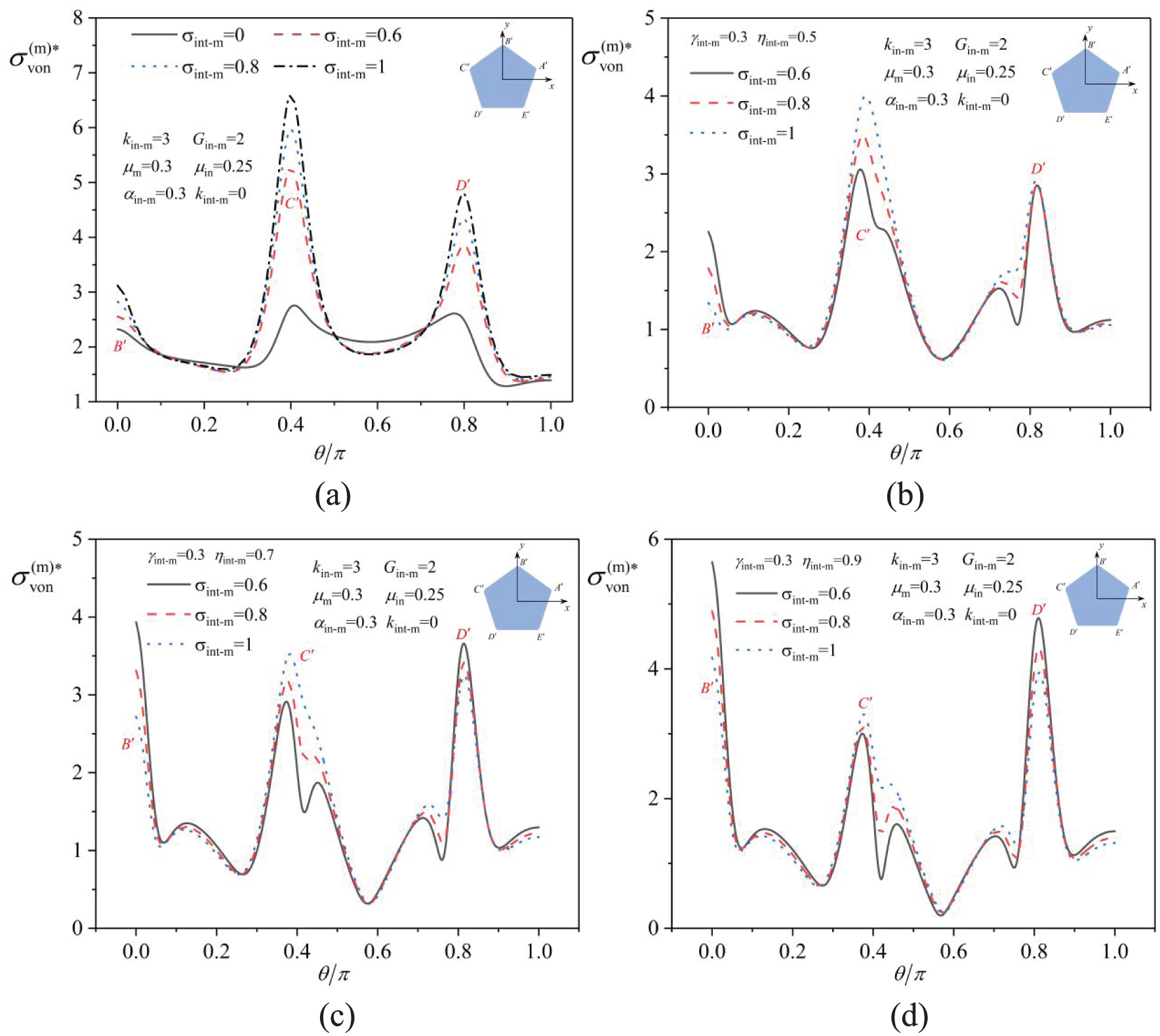
The interfacial von Mises stress around pentagonal inclusion with interface residual tension and elastic parameter: (a)
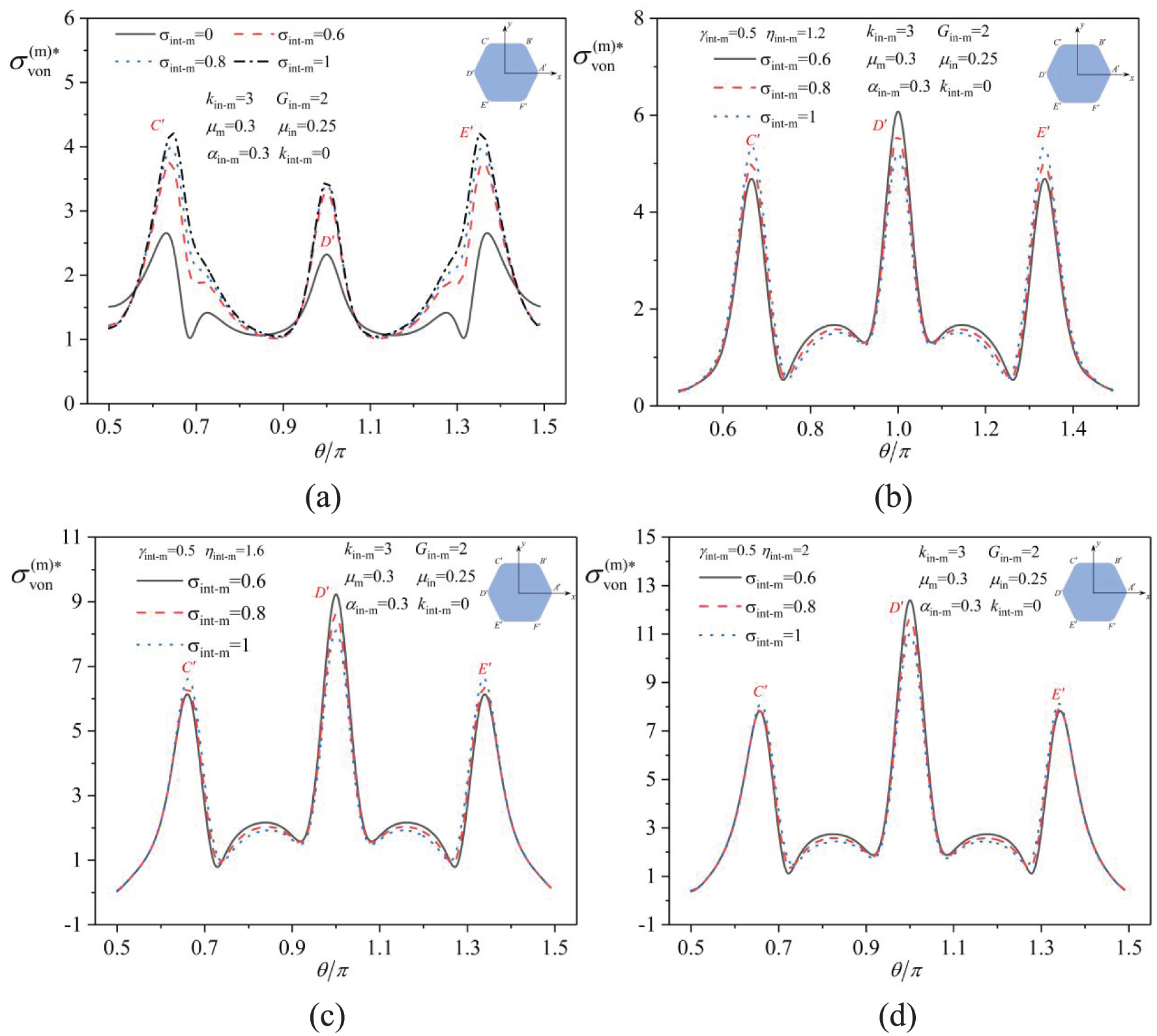
The interfacial von Mises stress around pentagonal inclusion with interface residual tension and elastic parameter: (a)
5. Conclusion
We examine the thermoelastic field in a thermoelastic matrix enclosing an arbitrarily shaped nano-inclusion for a remote heat flux. The interface heat conduction, interface elasticity and the interface tension are all incorporated into the thermoelastic model to capture the nanoscale interface effects. A series solution is established for determining the full thermoelastic field in the whole composite. Numerical examples are presented to illustrate the interface tension on the thermal stress concentration at the endpoints or vertices of the inclusion for a few common non-circular inclusion shapes, such as elliptical, triangular, square, pentagonal and hexagonal shapes. The main findings are summarized as follows:
For a given remote heat flux, as the interface thermoelastic parameter
The role of residual interface tension in tuning the thermal stress concentration around the inclusion depends significantly on the magnitude of the interface stretching stiffness. Specifically, in terms of a typical category of situations, additional incorporation of a residual interface tension (of given magnitude) in the thermoelastic model may intensify the thermal stress concentration around the inclusion if the interface stretching stiffness is relatively small, while it may relieve the thermal stress concentration when the interface stretching stiffness exceeds a certain critical value.
Footnotes
Appendix 1
The stress boundary condition is expressed as
The displacement boundary condition can be formulated as

Funding
The authors disclosed receipt of the following financial support for the research, authorship, and/or publication of this article: We acknowledge the National Natural Science Foundation of China (No. 12402191).
Declaration of conflicting interests
The authors declared no potential conflicts of interest with respect to the research, authorship, and/or publication of this article.