






Abstract
We investigate transport in multilayer systems combining heterogeneous diffusion, interfacial resistance, and volumetric dissipation. Unlike classical diffusion models, the presence of dissipative bulk terms and imperfect interfaces leads to a dissipative diffusion–transmission operator structure. We show that the spectral properties of the associated diffusion–efflux operator are governed by a single mechanism: the competition between volumetric dissipation and interfacial transmission. This competition is quantified by a dimensionless parameter that controls both the principal eigenvalue and the spatial structure of the corresponding eigenfunction. In particular, the system exhibits a transition between extended and localized modes, providing a spectral mechanism for transport limitation in heterogeneous media. Variational localization arises as a variational consequence of dissipative contrasts and does not require modification of the constitutive diffusion law. The formulation admits a natural interpretation within the framework of generalized continuum mechanics, where interface terms define a surface energy analogous to micromorphic or Cosserat-type interactions. Numerical experiments confirm the predicted scaling laws and the emergence of variational localization across regimes. These results provide a unified spectral framework for understanding transport in systems with internal interfaces and dissipation.
Keywords
1. Introduction
Transport in heterogeneous media is often governed by the combined effects of diffusion, interfacial transmission, and internal dissipation. Such situations arise naturally in composite materials, porous media, and biological systems, where transport occurs across multiple layers with distinct properties and imperfect interfaces [1–5]. In many of these systems, the presence of internal interfaces and volumetric removal mechanisms leads to transport behavior that cannot be captured by classical homogeneous diffusion models.
From a mathematical perspective, these processes give rise to elliptic operators combining three distinct contributions: bulk diffusion within each layer, transmission conditions across interfaces, and reactive or dissipative terms in the volume. Diffusion in composite media and transmission problems have been extensively studied in the context of homogenization theory and elliptic partial differential equations [1,3,5–7]. Likewise, elliptic operators with discontinuous coefficients and interface conditions have been analyzed in connection with layered structures and composite materials [8–10]. Reactive terms have also been investigated in diffusion–reaction equations and dissipative systems [11,12].
However, when volumetric dissipation and interfacial resistance are present simultaneously, the resulting operator exhibits a fundamentally different structure. In particular, the system is no longer conservative: mass is removed through volumetric sink terms, and transport across interfaces is impeded by finite transmission. As a consequence, the long-time behavior of the system is governed not only by diffusion but also by a competition between bulk dissipation and interfacial coupling. Despite the extensive literature on each of these effects taken separately, their combined influence on the spectral properties of the associated operator remains insufficiently understood.
The objective of this work is to provide a rigorous analysis of this combined effect through the spectral structure of the diffusion–efflux operator. We focus on the principal eigenvalue and its associated eigenfunction, which determine the dominant decay rate and spatial structure of the system [13,14]. Our goal is to identify the mechanism governing transport across layered domains and to characterize how it depends on the relative strength of volumetric and interfacial contributions.
Our analysis reveals that the behavior of the system is governed by a single mechanism: the competition between volumetric dissipation and interfacial transmission. This competition is quantified by a dimensionless parameter

which compares the strength of bulk dissipation to interface coupling. Here:
k denotes an effective volumetric dissipation (or efflux) coefficient,
P is an effective interface permeability coefficient,
L is a characteristic length scale of the multilayer structure.
We show that this parameter controls both the magnitude of the principal eigenvalue and the spatial structure of the corresponding eigenfunction.
In particular, the system exhibits a transition between two qualitatively distinct regimes. When interfacial coupling dominates, the principal mode extends across the entire domain, and the multilayer structure behaves effectively as a single medium. In contrast, when volumetric dissipation dominates, the principal mode localizes in regions of weaker absorption, leading to transport limitation. This variational localization 1 phenomenon arises as a direct consequence of the variational structure of the operator and is closely related to eigenfunction concentration in heterogeneous media [15,16].
A key aspect of the present work is the interpretation of the model within the framework of generalized continuum mechanics. The interfacial terms define a surface energy penalizing discontinuities across internal boundaries, which can be interpreted as microstructural interactions analogous to micromorphic coupling or Cosserat-type interactions. From this perspective, the spectral problem characterizes the dominant mode of a dissipative continuum with interfacial structure, providing a direct link between operator theory and the mechanics of heterogeneous media.
The analysis is based on a variational formulation of the problem, in which the operator is associated with a bilinear form combining bulk and interfacial contributions. This approach allows us to derive spectral bounds, identify scaling regimes, and obtain quantitative variational localization estimates for the principal eigenfunction. The theoretical predictions are supported by numerical experiments, which confirm the scaling behavior of the principal eigenvalue and the emergence of variational localization across regimes.
The novelty of the present work is not the introduction of a new diffusion–reaction model itself, but the identification of a spectral transition mechanism generated by the combined action of volumetric dissipation and imperfect interfacial transmission. While diffusion–reaction transmission problems have been studied extensively in homogenization and elliptic interface theory, the present work shows that the principal eigenpair of the associated operator exhibits two distinct regimes governed by the dimensionless ratio Π. In particular, the analysis reveals: (1) spectral scaling laws linking the dominant eigenvalue to bulk and interface dissipation, (2) variational localization of the principal mode in weakly dissipative regions, and (3) a variational interpretation of this variational localization mechanism in layered heterogeneous media. The contribution is therefore primarily spectral and variational rather than constitutive.
Although the motivation for this study is rooted in transport phenomena across biological membranes—where interface permeability and active removal play a key role [17–21]—the framework developed here applies more broadly to diffusion processes in heterogeneous systems with imperfect interfaces and dissipation.
The paper is organized as follows. Section 2 introduces the biophysical foundations of the model and discusses the underlying transport mechanisms. Section 3 presents the multilayer formulation and its variational structure, including the non-equilibrium nature of the operator. Section 4 is devoted to the spectral analysis, where the main result establishing the transition between regimes is stated. Section 5 provides a detailed interpretation of this transition, including its connection to generalized continuum mechanics. Section 6 develops quantitative scaling laws and variational localization estimates. Finally, Section 7 presents numerical experiments validating the theoretical predictions.
2. Biophysical motivation
Transport across bacterial envelopes provides a prototypical example of diffusion in heterogeneous media with interfaces and active dissipation. In particular, Gram-negative bacteria exhibit a multilayered cell-envelope architecture in which fundamentally different transport mechanisms coexist and interact. A schematic cross-section of this architecture is shown in Figure 1, and the individual components are described in detail below.
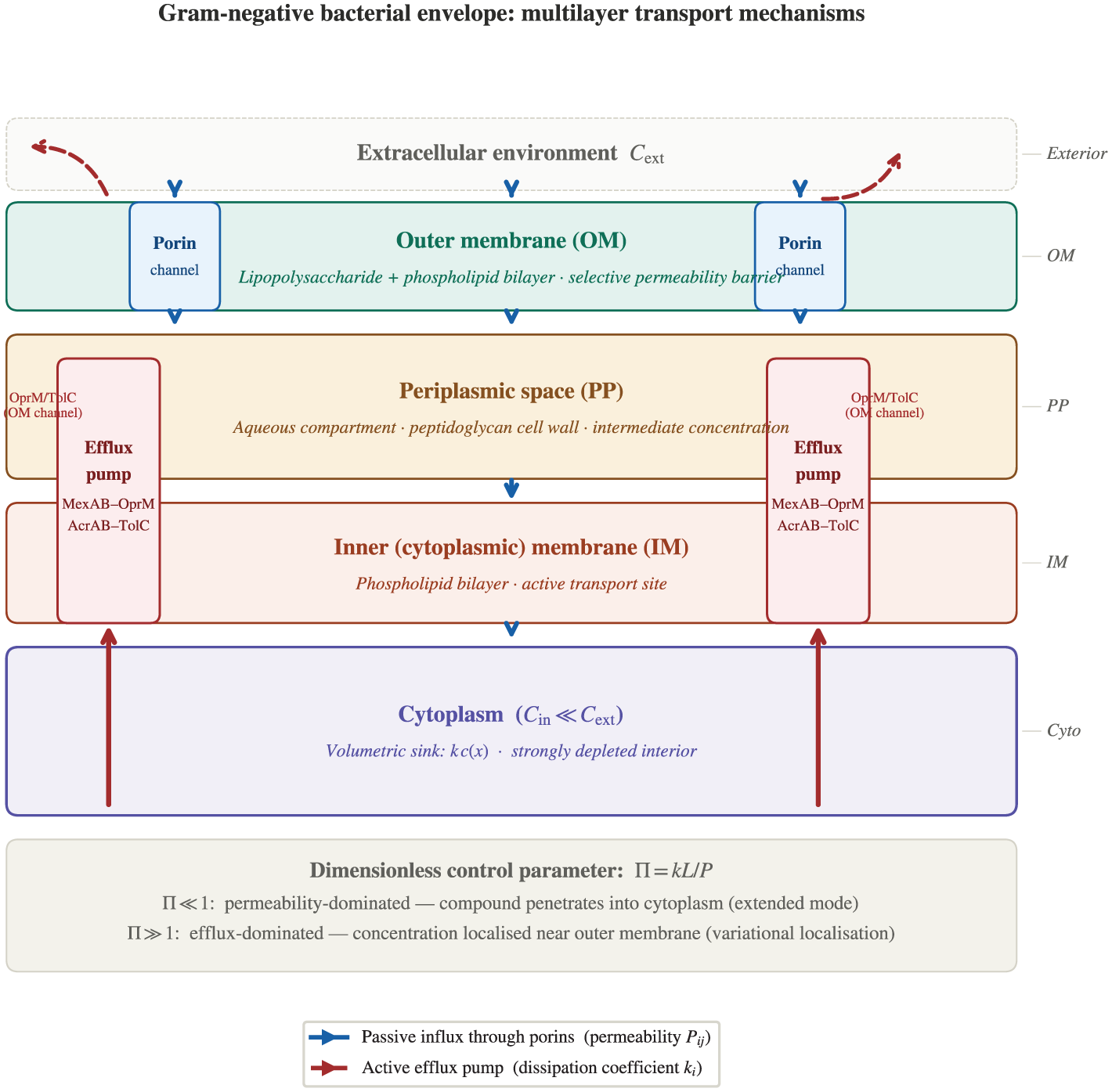
Cross-sectional schematic of the Gram-negative bacterial cell envelope and its multilayer transport mechanisms.
2.1. Envelope architecture
The Gram-negative cell envelope consists of three principal compartments separated by two membrane barriers (Figure 1):
2.2. Active efflux and multidrug resistance
A key feature distinguishing Gram-negative transport from simple passive diffusion is the presence of active efflux systems. Multidrug resistance (MDR) efflux pumps of the resistance-nodulation-division (RND) family continuously expel a broad spectrum of compounds—including antibiotics, detergents, and metabolic by-products—from the cytoplasm directly to the extracellular space [19,20].
These tripartite complexes span all three envelope compartments:
the
the
the
The best-characterized examples are
2.3. Competition between influx and efflux
The interplay between passive influx through porins and active efflux through pump complexes governs the steady-state intracellular concentration of any permeating compound. When efflux is strong relative to the permeability of the OM, solutes are expelled faster than they enter, leading to a pronounced depletion of the intracellular concentration:

This inequality is a hallmark of intrinsic antibiotic resistance in Gram-negative pathogens [18,19] and motivates the central modeling assumption of this work: the dynamics are governed by the competition between influx across imperfect interfaces and volumetric removal in the bulk.
From a modeling perspective, this competition leads naturally to a description in terms of diffusion in a composite medium with transmission conditions at interfaces and reactive (dissipative) terms in the bulk. Specifically, the interface permeability coefficient

where L is a characteristic length scale of the multilayer structure. As shown in Sections 4 to 7, Π acts as a spectral control parameter: for
This setting motivates the study of diffusion operators incorporating heterogeneous coefficients, interfacial resistance, and dissipation, which are analyzed rigorously in the following sections.
3. Continuum model
3.1. Geometric setting
Let

where each

for
3.2. Governing equations
Let

where
3.3. Interface conditions
Across each interface

together with an imperfect transmission condition

where
3.4. Boundary and initial conditions
The system is supplemented with suitable boundary conditions on

3.5. Variational formulation
We introduce the Hilbert space

equipped with the natural norm

The weak formulation of the problem is obtained by multiplying each equation by a test function

The corresponding weak problem reads: find

in a suitable weak sense.
3.6. Operator formulation
The bilinear form

with interface contributions incorporated through the variational formulation.
This operator will serve as the basis for the spectral analysis developed in the subsequent sections.
3.7. Non-equilibrium nature of the transport operator
The transport dynamics considered here differ fundamentally from classical diffusion due to the combined presence of heterogeneous diffusion, interfacial transmission, and volumetric dissipation. These mechanisms introduce a non-conservative structure in the governing operator, beyond standard Fickian diffusion.
A key consequence is the lack of mass conservation. Indeed, the total mass satisfies

reflecting the presence of volumetric sink terms. The system therefore exhibits intrinsically dissipative dynamics.
From an operator-theoretic perspective, this non-equilibrium character 2 is encoded in the spectral structure of the diffusion–efflux operator. In particular, the competition between interfacial resistance and volumetric dissipation governs both the principal eigenvalue and the spatial structure of the associated eigenfunctions.
As a result, the dominant modes may exhibit strong spatial heterogeneity, including variational localization in subregions of weak dissipation. This behavior does not arise from modifications of the constitutive diffusion law, but directly from the variational structure of the operator.
This observation provides the foundation for the spectral transition described in Theorem 1.
4. Spectral structure and regime transition
We now analyze the spectral properties of the multilayer diffusion–dissipation operator introduced in Section 3. The goal is to identify the mechanisms governing the principal eigenvalue and the spatial structure of the corresponding eigenfunction and to characterize the transition between transport-dominated and dissipation-dominated regimes.
4.1. Operator setting and variational structure
Let

endowed with the natural norm.
The bilinear form

Under standard assumptions on
The spectral problem reads: find

The principal eigenvalue

and is associated with a nonnegative eigenfunction
4.2. Main spectral result: transition and variational localization
The bilinear form

Their interplay governs both the magnitude of

Assume that the diffusion tensors are uniformly elliptic and that the boundary conditions and/or the volumetric dissipation eliminate the constant null mode, so that a Poincaré-type inequality holds on the partitioned domain.
Assume further that the effective parameters

for positive constants independent of
Then, there exist positive constants

Moreover, assume that a region

with

Assume also that there exists an admissible comparison function concentrated in a weakly dissipative region outside

Then, the principal eigenfunction satisfies the variational concentration estimate

for some constant
In particular, the principal eigenvalue is controlled by the competing volumetric and interfacial dissipation scales, while the principal eigenfunction has small
The proof of this theorem is provided in Appendix 1.
4.3. Spectral interpretation, parametric dependence, and regime structure
Theorem 1 identifies a single dimensionless parameter governing the spectral behavior:

The parameter
More precisely,
This transition is not imposed at the level of the constitutive equations, but emerges from the spectral structure of the operator and the associated variational problem.
The variational characterization (9) also immediately yields monotonicity properties of the principal eigenvalue with respect to the dissipation and transmission coefficients.


combined with the variational characterization (9). □
The above results show that the spectral properties of the operator are governed by the competition between volumetric and interfacial dissipation. In particular,
the principal eigenvalue reflects the dominant dissipation mechanism;
the associated eigenfunction encodes the spatial structure of transport;
variational concentration arises as a consequence of heterogeneous dissipation.
The resulting framework provides a unified spectral interpretation of transport limitation in multilayer systems and forms the basis for the quantitative scaling laws and numerical validations developed in the subsequent sections.
5. Interpretation and regime analysis
The spectral results established in Section 4 provide a unified framework for understanding transport in multilayer systems with interface resistance and volumetric dissipation. In particular, the principal eigenpair
5.1. Competing dissipation mechanisms
The variational structure

reveals the presence of two competing dissipative effects: volumetric dissipation within each layer and interfacial dissipation across layer boundaries.
The principal eigenfunction
5.2. Dimensionless control parameter
The spectral behavior identified in Section 4 is governed by the dimensionless parameter

which measures the relative strength of volumetric dissipation and interfacial transmission.
Rather than introducing new regimes, this parameter provides a compact interpretation of the spectral transition described in Theorem 1. In particular, Π compares two competing energetic contributions: the bulk penalty associated with volumetric dissipation and the interfacial penalty associated with discontinuities across layers.
From a physical standpoint, Π can be viewed as a ratio of characteristic time scales. Small values correspond to rapid interfacial equilibration compared to bulk dissipation, while large values indicate that volumetric removal dominates over transport across interfaces.
The transition between extended and localized modes therefore emerges as a direct consequence of the relative magnitude of these two mechanisms, as quantified by Π.
5.3. Mechanics interpretation
To emphasize the variational structure independently of the transport interpretation, we denote the generic state variable by u. In the present diffusion setting, u corresponds to the concentration field, rather than to a mechanical displacement. The notation is adopted solely to facilitate comparison with generalized continuum theories.
The variational structure of the bilinear form

admits a natural interpretation within the framework of generalized continuum mechanics with interfacial interactions.
Energy structure and interfacial mechanics. Introducing the jump

the total energy can be written as

The first term represents bulk diffusion and volumetric dissipation, while the second term defines a surface energy penalizing discontinuities across interfaces. The coefficient
In a rate-dependent interpretation, this interface contribution corresponds to a dissipation potential

with associated interfacial flux

consistent with transmission laws in heterogeneous media.
Micromorphic-type analogy. The multilayer structure can be interpreted as a discrete micromorphic system. Each subdomain
This is directly analogous to micromorphic models, in which a macroscopic field u is coupled to a micro-field φ through an energy of the form

In the present setting, the role of the mismatch
Cosserat-type interaction structure. The interface term also admits an interpretation as a continuum analogue of Cosserat-type interaction energies. In discrete generalized continua, one often considers interaction energies of the form

The contribution

can be viewed as the continuous counterpart of such interactions, where the interfaces act as coupling surfaces between neighboring substructures. The parameter
Implications for spectral behavior. Within this generalized continuum framework, the spectral problem associated with
The variational localization phenomenon identified in Theorem 1 admits a direct mechanical interpretation: the system minimizes its energy by concentrating in regions where volumetric dissipation is minimal, while the interfacial energy regulates the degree of coupling between layers.
In the limit of large
This interpretation places the diffusion–efflux operator within the class of generalized continua with interfacial interactions and provides a direct link between spectral properties and the mechanics of heterogeneous media.
6. Spectral scaling and variational localization
We now refine the spectral characterization of the operator by quantifying the scaling of the principal eigenvalue and the variational localization properties of the corresponding eigenfunction.
Let
6.1. Spectral bounds
The principal eigenvalue is controlled by the competition between volumetric and interfacial dissipation.

6.2. Asymptotic regimes
The bounds above imply the following asymptotic behavior.


6.3. Variational localization of the principal mode
The spatial structure of the principal eigenfunction reflects the same competition.

Then,

where C depends only on the geometry and diffusion coefficients.
The above results show that both the magnitude of the principal eigenvalue and the spatial structure of the eigenfunction are governed by the same mechanism: the competition between volumetric and interfacial dissipation.
In particular, the system exhibits a transition from extended modes to localized modes, and the principal eigenvalue reflects the dominant dissipation mechanism. This provides a quantitative spectral characterization of transport limitation in multilayer systems.
7. Numerical validation
7.1. One-dimensional multilayer configuration
We consider a one-dimensional domain

representing an outer and an inner layer, respectively. The concentration fields


together with transmission conditions at the interface


Boundary conditions are prescribed as


and the initial condition is taken as

7.2. Numerical discretization
The system is discretized on a uniform grid with N nodes and mesh size

The interface conditions are incorporated by modifying the discrete operator at the interface node. In particular, the permeability condition yields

which replaces the standard stencil and enforces coupling between the two subdomains.
Time integration is performed using an implicit Euler scheme,

resulting in a linear system solved at each time step.
7.3. Parameter regime
Unless otherwise specified, we consider the parameter set

with permeability parameter
The behavior of the system is characterized by the dimensionless parameter

which quantifies the relative strength of volumetric dissipation and interfacial transport.
7.4. Numerical regime analysis and spectral validation
Steady-state solutions are computed for varying values of the permeability parameter P and the volumetric dissipation coefficient k. The resulting concentration profiles exhibit a transition from nearly continuous behavior across the interface at large P to strongly discontinuous profiles at small P, reflecting the increasing influence of interfacial resistance. Increasing k produces a pronounced attenuation of the solution in the inner region, consistent with dominant volumetric dissipation.
To quantify transport into the inner layer, we introduce the integrated concentration

Numerical results show that

The dependence of
To visualize the global structure of the system, a regime diagram in the
The spectral structure of the operator is further examined through numerical computation of the principal eigenvalue
Overall, the numerical simulations validate the main theoretical predictions of the paper:
the system exhibits two distinct spectral regimes governed by Π;
interface resistance induces concentration discontinuities and delayed transport;
volumetric dissipation strongly suppresses concentration in inner regions;
the principal eigenvalue and eigenfunction accurately capture the observed transport behavior.
These results support the interpretation of transport limitation as a spectral consequence of the balance between permeability and volumetric dissipation in heterogeneous multilayer systems.
8. Results and discussion
8.1. Steady profiles and interface effects
Figure 2 shows steady-state concentration profiles for representative values of the interface permeability P and efflux rate k.
For large permeability (

This behavior is consistent with the variational structure, where small P penalizes flux and allows concentration mismatch across the interface.
Increasing the efflux parameter k induces a strong decay of the solution in the inner region. In the regime of large k, the solution is effectively suppressed beyond the interface, indicating that volumetric dissipation dominates transport.
These observations illustrate the competition between interfacial and volumetric contributions in the energy functional.
8.2. Dependence on efflux
Figure 3 displays the inner concentration

as a function of k for several values of P. The dependence is monotone, with a rapid decrease as k increases.
For fixed P, the transition from significant penetration to negligible concentration occurs over a narrow range of k, indicating a sharp change in the dominant transport mechanism. Larger values of P shift this transition to higher values of k, reflecting the increased ability of the system to transmit mass across the interface.
When expressed in terms of the dimensionless parameter

the curves exhibit a consistent scaling behavior, supporting the theoretical prediction that Π governs the transition between regimes.
8.3. Spectral regimes, variational concentration, and transport behavior
Figure 4 shows the inner concentration as a function of the permeability parameter P for different values of the volumetric dissipation coefficient k. As expected, increasing P enhances transmission across the interface and increases the concentration within the inner region. The dependence is strongly nonlinear, with maximal sensitivity occurring near the transition regime
To further characterize this transition, Figure 5 presents a contour plot of the inner concentration in the

separates two distinct transport regimes:
The transition between these regimes is sharp and agrees closely with the scaling predicted by the spectral analysis, confirming that Π acts as the relevant spectral control parameter for the system.
The spectral structure of the operator is further illustrated in Figure 6, which shows the principal eigenvalue

which shows that the long-time dynamics are governed by the principal spectral mode of the operator.
The dependence of
Figure 7 further demonstrates the change in the spatial structure of the principal eigenfunction across regimes. For
This concentration mechanism follows directly from the variational characterization

since regions with large dissipation coefficients contribute strongly to the energy functional. Consequently, minimizing configurations preferentially concentrate in regions where volumetric dissipation is weaker.
Overall, the numerical results show that the observed transport behavior is a direct consequence of the spectral and variational structure of the diffusion–transmission operator. Interface resistance induces concentration discontinuities and limits flux across layers, while volumetric dissipation suppresses transport within strongly absorbing regions. The interplay of these mechanisms produces regime-dependent behavior governed by the dimensionless parameter Π and reflected both in the magnitude of the solution and in the spatial structure of the principal eigenfunction.
These simulations therefore provide numerical validation of the spectral mechanism underlying transport limitation in heterogeneous multilayer systems.
9. Conclusion
We have developed a spectral framework for transport in multilayer systems combining heterogeneous diffusion, interfacial resistance, and volumetric dissipation. The analysis shows that the behavior of the system is governed by a single mechanism: the competition between bulk dissipation and interfacial transmission.
This competition is captured by a dimensionless parameter, which determines both the magnitude of the principal eigenvalue and the spatial structure of the corresponding eigenfunction. In particular, the system exhibits a transition between extended and localized modes, reflecting a change in the dominant dissipation mechanism. This transition arises directly from the variational structure of the operator and does not require modification of the underlying constitutive law.
The variational structure admits an analogy with generalized continuum theories featuring interfacial or microstructural interaction energies. The interface terms define a surface energy penalizing discontinuities, which can be interpreted as microstructural interactions analogous to micromorphic coupling or Cosserat-type interactions. From this perspective, the spectral problem characterizes the dominant mode of a dissipative continuum with interfacial structure.
The theoretical predictions are supported by numerical experiments, which confirm the scaling of the principal eigenvalue and the variational localization of the dominant mode across regimes. Together, these results provide a unified explanation of transport limitation in heterogeneous systems.
The framework developed here opens several directions for future work, including extensions to nonlinear transport, time-dependent interface properties, and the integration of data-driven or operator-learning approaches for complex multiscale systems.
Footnotes
10. Figures
We present here the numerical results supporting the theoretical analysis. The figures illustrate the role of interface permeability, efflux, and spectral structure in shaping transport across the multilayer system.
Appendix 1

Funding
The author received no financial support for the research, authorship, and/or publication of this article.
Declaration of conflicting interests
The author declared no potential conflicts of interest with respect to the research, authorship, and/or publication of this article.