






Abstract
This study investigates the coupled thermal and chemical interactions in a nonlocal homogeneous isotropic thermoelastic diffusive thick circular plate subjected to axisymmetric heat supply. Both surfaces of the plate are assumed to be stress free. Employing Laplace and Hankel transform techniques, analytical expressions for the field quantities are obtained in transformed domain. The corresponding solution in the physical domain is obtained through a specially developed algorithm. Numerical simulations are presented graphically to illustrate behavior of components of displacement, stresses, temperature change, mass concentration and material potential. The influence of the nonlocal parameter and diffusion phenomena on various field variables is examined in detail. The results show that the classical (local) model predicts higher mechanical responses, while increasing nonlocal effects significantly reduce displacement and stress magnitudes. These findings demonstrate that nonlocal thermoelastic diffusion theory is essential for accurately modeling size-dependent behavior in advanced materials especially at micro and nano-scales.
1. Introduction
In recent years, the investigation of nonlocal thermoelastic diffusive solids has attracted considerable attention due to their wide-ranging applications in advanced materials science, including micro- and nano-scale structures as well as biomechanical systems. Understanding the frequency-dependent behavior of these materials under various loading conditions has become a key area of research. This study provides a concise overview of major developments in the field, with particular emphasis on theoretical formulations and computational advancements [1].
A plate is a flat structural element for which the thickness is small compared with the surface dimensions. The thickness is usually constant but may be variable and is measured normal to the middle surface of the plate [2]. Tripathi et al. [3] examined the fractional-order thermoelastic behavior induced by a heat source with periodically varying intensity formulated within the framework of generalized thermoelasticity incorporating a single relaxation time. The influence of the fractional-order parameter and the relaxation time on the temperature distribution and the associated thermal stresses had been examined.
Kumar and Partap [4] investigated the propagation of axisymmetric vibrations in a homogeneous, isotropic micropolar thermoelastic cubic crystal plate, bounded by layers or half-spaces of inviscid liquid and subjected to stress-free boundary conditions within the frameworks of the Lord–Shulman (LS) and Green–Lindsay (GL) theories of thermoelasticity. The temperature field within the plate is obtained by solving the heat conduction equation using the method of separation of variables, after which the stress components are evaluated through appropriate Michell’s stress functions and Goodier’s thermoelastic displacement potential function [5]. A general solution to the governing field equations of the two-temperature generalized thermoelastic theory is obtained for an infinite medium [6]. The thermoelastic behavior of a microscale beam subjected to a moving heat source is analyzed within the framework of the Green–Naghdi type III theory [7].
Tripathi et al. [8] focused on the analysis of thermoelastic disturbances in a circular plate of finite thickness and infinite radial extent, initially maintained at a uniform temperature and subjected to an axisymmetric thermal loading. Tripathi et al. [9] studied the quasi-static uncoupled thermoelastic framework incorporating a time-fractional heat conduction equation to model a thin circular plate, with the lower surface held at zero temperature and the upper surface assumed to be thermally insulated. A quasi-static uncoupled thermoelastic model based on a heat conduction equation involving a time-fractional derivative of order α was applied to a two-dimensional thin hollow circular disk, where a time-dependent heat flux was prescribed at the outer boundary while the inner circular boundary is thermally insulated [10].
Tripathi et al. [11] examined the fractional-order thermoelastic stress response of a thin circular plate subjected to an axisymmetric thermal loading. Initially, the plate was assumed to be at a prescribed temperature distribution
Lata and Singh [13] analyzed axisymmetric deformations in a two-dimensional nonlocal, homogeneous, and isotropic thermoelastic solid in the absence of energy dissipation. Bhandwalkar et al. [14] studied the mathematical solution of a generalized fractional-order thermoelastic problem for a thick circular plate of finite thickness
Chandel et al. [15] investigated a spherically symmetric nonlocal elastic sphere subjected to point impulsive thermal loading by employing a three-phase-lag thermoelastic heat transfer model combined with a memory-dependent derivative involving various memory kernels, which may provide a more general framework than fractional derivatives. Moving loads are of significant importance in applications such as high-speed machining, seismic wave propagation, and material stress testing where a thorough understanding of the coupled thermal, elastic, and diffusive responses of materials is essential [16].
Nonlocal thermo-poro-acoustic wave propagation in porous materials under laser excitation was investigated by Abo-Dahab et al. [17]. Almuneef et al. [18] studied laser-induced wave reflection in nonlocal rotating two-temperature thermoelastic solids with variable thermal conductivity.
Based on the above literature, it is evident that substantial progress has been made in the analysis of thermoelastic, nonlocal, and fractional-order models under various thermal and mechanical loadings. Previous studies have addressed size-dependent effects, moving and impulsive heat sources, diffusion phenomena, and memory-dependent or fractional formulations within different theoretical frameworks. However, despite these advances, the coupled influence of nonlocality, thermal relaxation, and diffusion on axisymmetric or transient responses of thermoelastic structures has not been fully explored, highlighting a clear research gap that motivates the present study.
2. Basic equations
Following Eringen [19], the stress tensor at arbitrary point

By employing Eringen’s nonlocal formulation, the nonlocal stress tensor

Constitutive equation for coupled thermoelastic diffusive medium can be expressed as

Following Ram et al. [20] and Malik et al. [21], the basic equations for isotropic nonlocal thermoelastic media with diffusion and without energy dissipation while neglecting the body forces can be given by




where T is temperature change, ρ is density,
3. Formulation of problems
Consider a two-dimensional homogeneous nonlocal isotropic thermoelastic diffusive thick plate of thickness 2b occupying the space

Also stress–strain relations and strain–displacement relations assume the form





where
using (8) to (13) in cylindrical form of equations (4) to (6) yields




The initial and regularity conditions are given by

In our calculation, we use the following dimensionless quantities for simplification

We express the displacement variables

We define the Hankel transform as

where ζ is the Hankel Transform variable,
1.
2.
3.
4.
where subscript “0” denotes order 0 and subscript “1” denotes order 1.
The Laplace transform of a function f with respect to time variable t, with s as a Laplace Transform variable, is defined as

By using the dimensionless quantities defined by (19) on equations (14) to (17) and suppressing the primes for convenience and then applying Helmholtz decomposition defined by (20) on the resulting equations, thereafter applying (21) and (22), yields




where

Equations (23) to (26) possess a non-trivial solution if determinant of their coefficients vanishes. By simplifying, we get following polynomial equations


where

The solution of equation (27) can be written as

where
Solution of equation (28) can be written as

where

where
4. Boundary conditions
We consider a thermal source and chemical potential source along with vanishing of stress components at the stress-free surface at




We assume that boundary conditions are equivalent to local boundary conditions [22].
By using the dimensionless quantities defined by (19) on equations (32) to (35) and suppressing the primes for convenience and then using (29) and (30) in the resulting equations yields




where
By solving the system of equations (36) to (39), the non-trivial values of

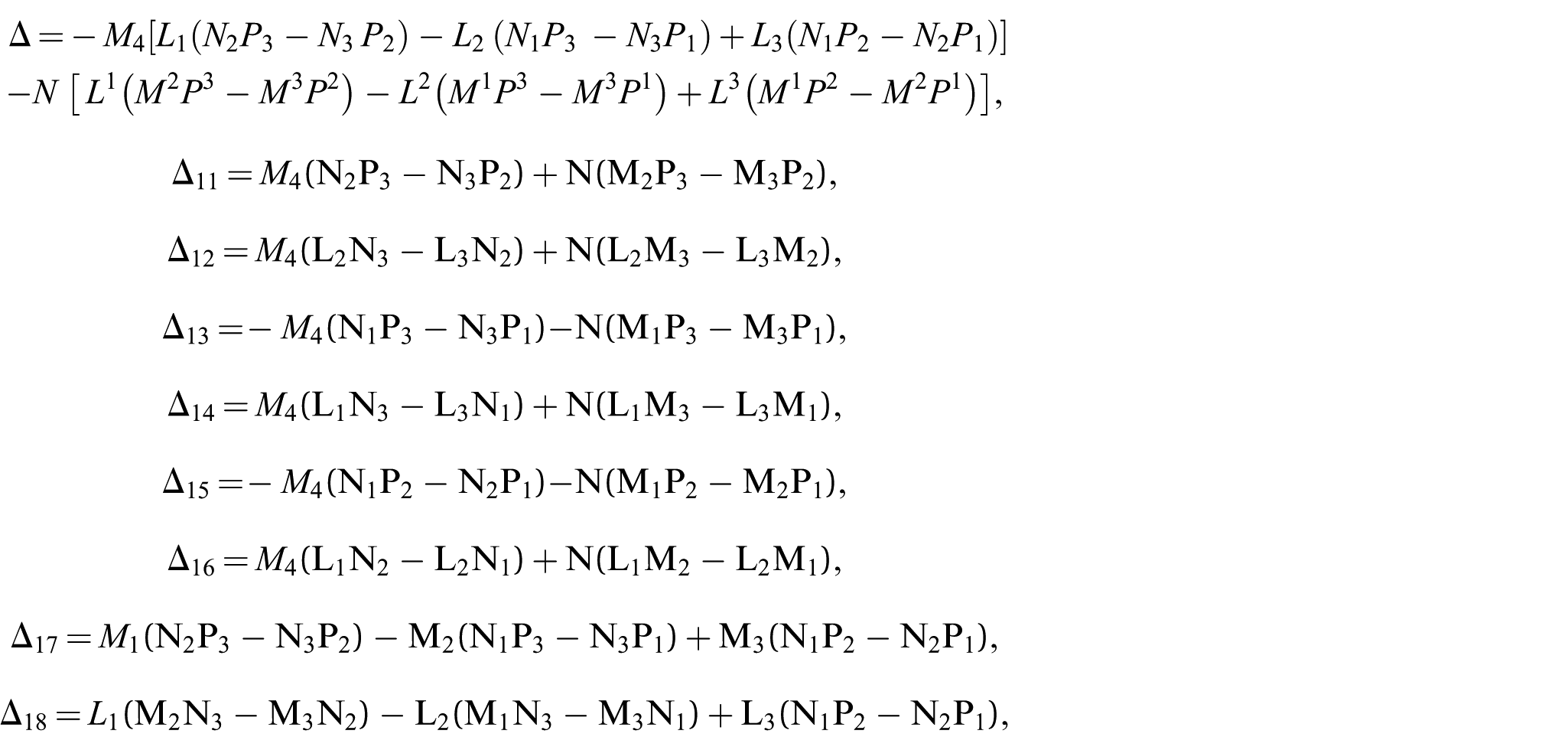
With the use of (20), (21) and (22), and (29) and (30) and with the aid of (9) and (12), we obtain the components of displacement, stress, temperature change, mass concentration, and chemical potential as follows







5. Applications
As an application of the above problem, we take the source functions as

Applying Integral Transforms defined by (21) and (22) on equation (48), we obtain

Also we define

Applying Integral transform defined by (21) and (22) on equation (50) gives

Making use of the values of
6. Particular cases
If we ignore the impact of diffusion (i.e.,
If we take the nonlocal parameter
7. Inversion of the transforms
To obtain the solution in physical realm, the transforms in equations (41) to (47) are to be inverted. These transforms are of the form

The inverse Laplace transform is calculated using Honig and Hirdes’ [24] methods and we get equations in the
8. Numerical results and discussion
In order to investigate angular frequency effects on nonlocal thermoelastic media with diffusion, the material considered is copper. As mentioned in the studies of Malik et al. [21], the material constants of copper metal are given in Table 1.
Copper parameters and their values.
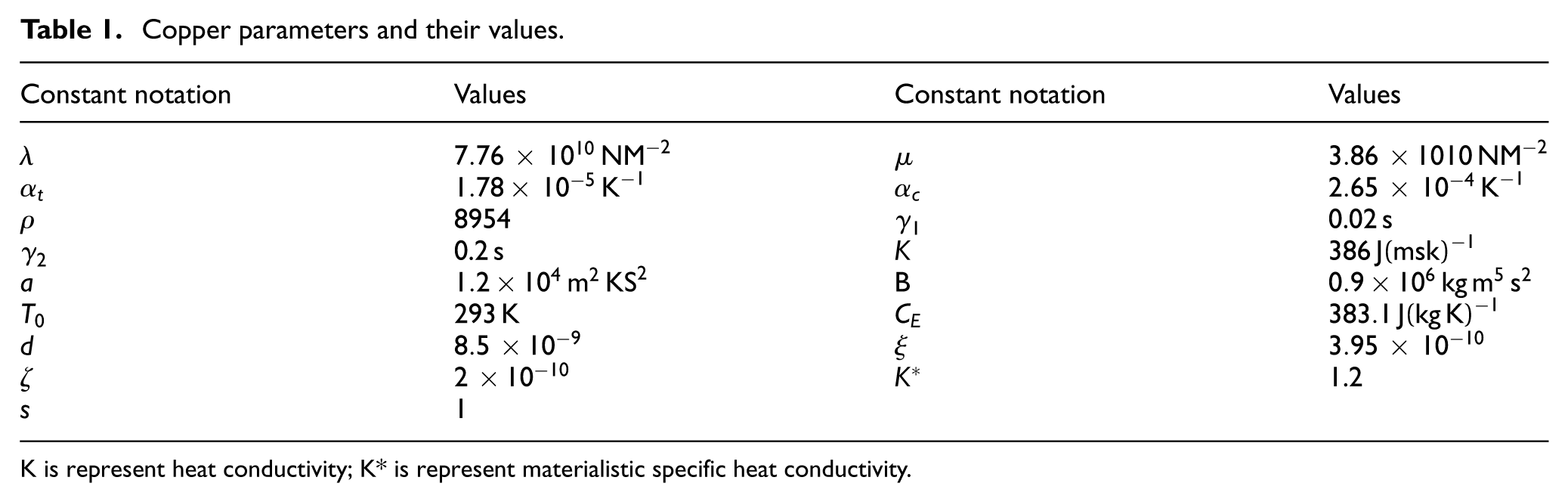
K is represent heat conductivity; K* is represent materialistic specific heat conductivity.
9. Discussion
Figure 1 shows the variation of vertical displacement along the radial distance of a plate for different nonlocal parameters ξ = 0, 0.01, and 0.02. It is observed that the displacement amplitude is maximum for the local case ξ = 0 and decreases progressively with increasing nonlocal parameter. This reduction indicates the softening effect induced by nonlocal interactions within the material. Hence, nonlocal effects play a significant role in suppressing the deformation response of the plate.
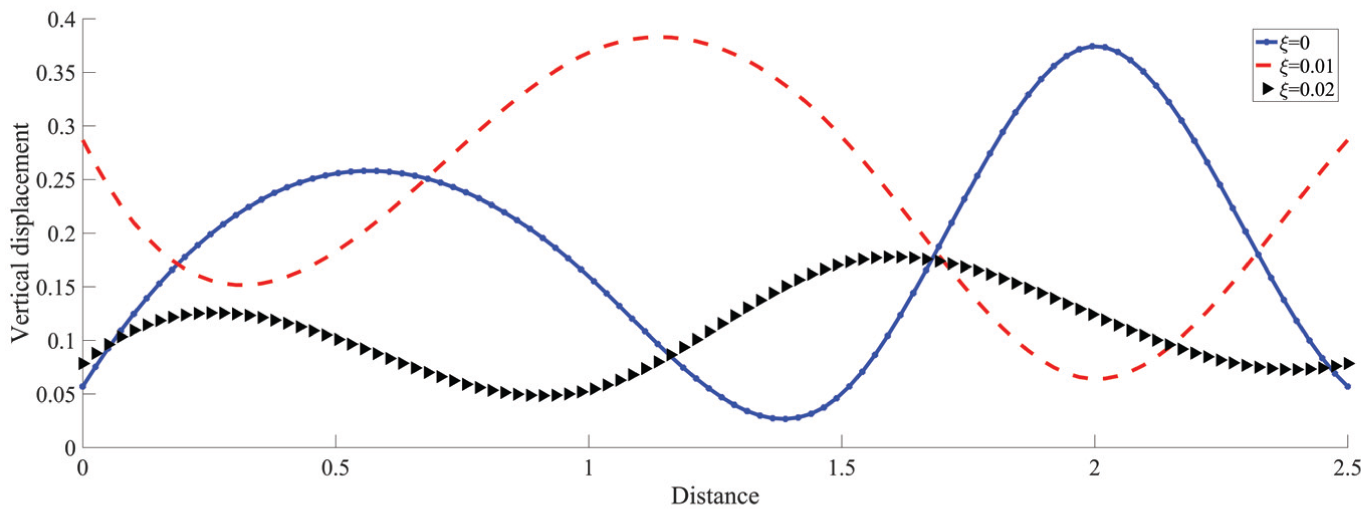
Variations in vertical displacement with radial distance.
Figure 2 depicts the distribution of normal stress along the radial distance of the plate for ξ = 0, 0.01, and 0.02. It is observed that the normal stress attains its maximum magnitude in the local case ξ = 0 and decreases as the nonlocal parameter increases. This behavior indicates that nonlocal effects significantly reduce the stress intensity due to the inclusion of long-range material interactions. Therefore, nonlocality plays an important role in moderating the stress response of the plate.
Variations in normal stress with radial distance.
From Figure 3, the variation of shear stress with radial distance is presented for different nonlocal parameters. The local model (ξ = 0) predicts higher stress levels, while increasing nonlocality leads to a noticeable reduction in shear stress magnitude. This behavior highlights the influence of long-range interactions in reducing stress concentration. Hence, nonlocal effects significantly modify the mechanical response of the plate.
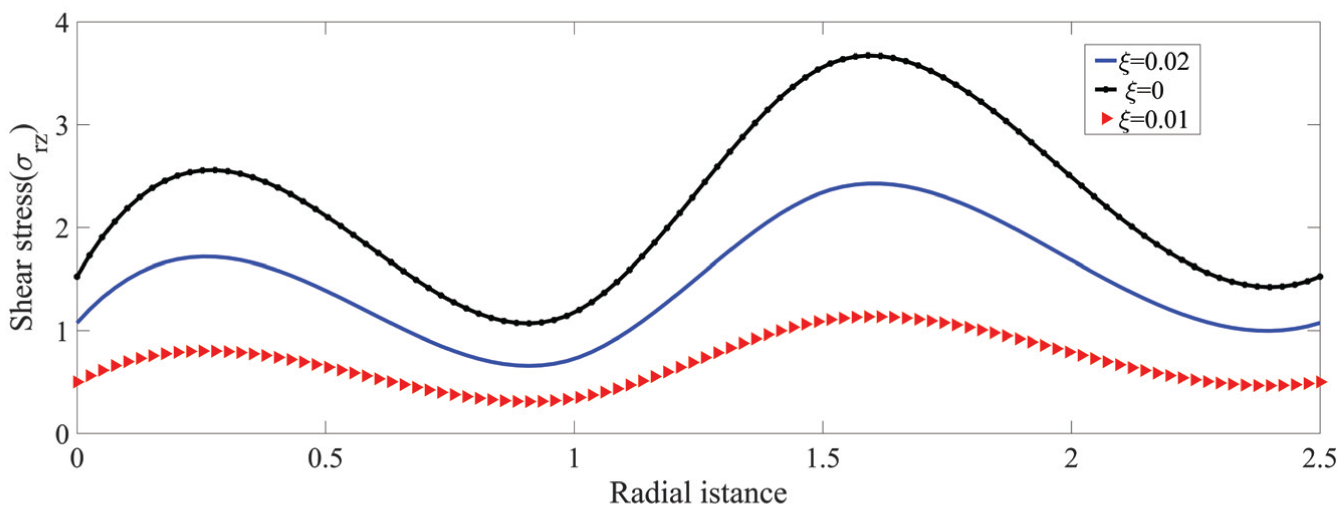
Variations in shear stress with radial distance.
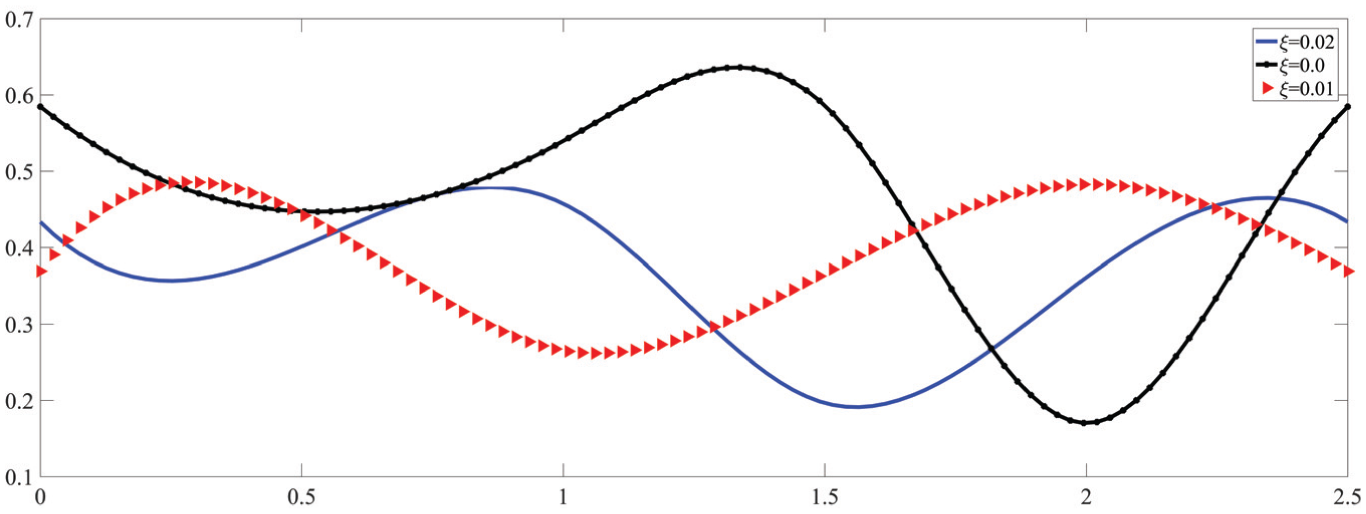
Figure 4 illustrates the variation of temperature change along the radial distance of the plate for the local case ξ = 0 and nonlocal cases ξ = 0.01 and ξ = 0.02. It is observed that the temperature change is significantly higher in the nonlocal case ξ = 0.01, while the local model predicts comparatively lower temperature variations. Increasing the nonlocal parameter modifies both the amplitude and phase of the temperature profile due to long-range thermal interactions. This confirms that nonlocal effects have a pronounced influence on the thermal response of the plate.
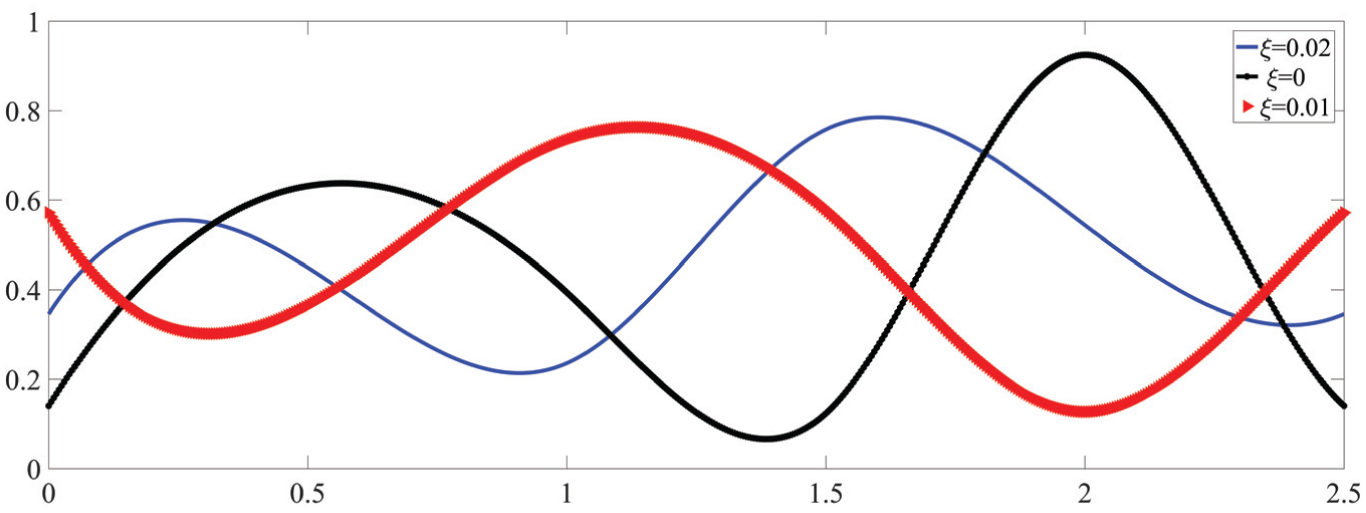
Variations in temperature change with radial distance.
Figure 5 presents the distribution of mass concentration along the radial distance of the plate for the local case ξ = 0 and nonlocal cases ξ = 0.01 and ξ = 0.02. It is clearly observed that the local model predicts higher peak values of mass concentration, whereas the inclusion of nonlocal effects reduces the amplitude and alters the spatial distribution. As the nonlocal parameter increases, the concentration profile becomes smoother and more diffused, indicating enhanced long-range interactions in the material. This demonstrates that nonlocality significantly influences mass diffusion behavior in thermoelastic solids.
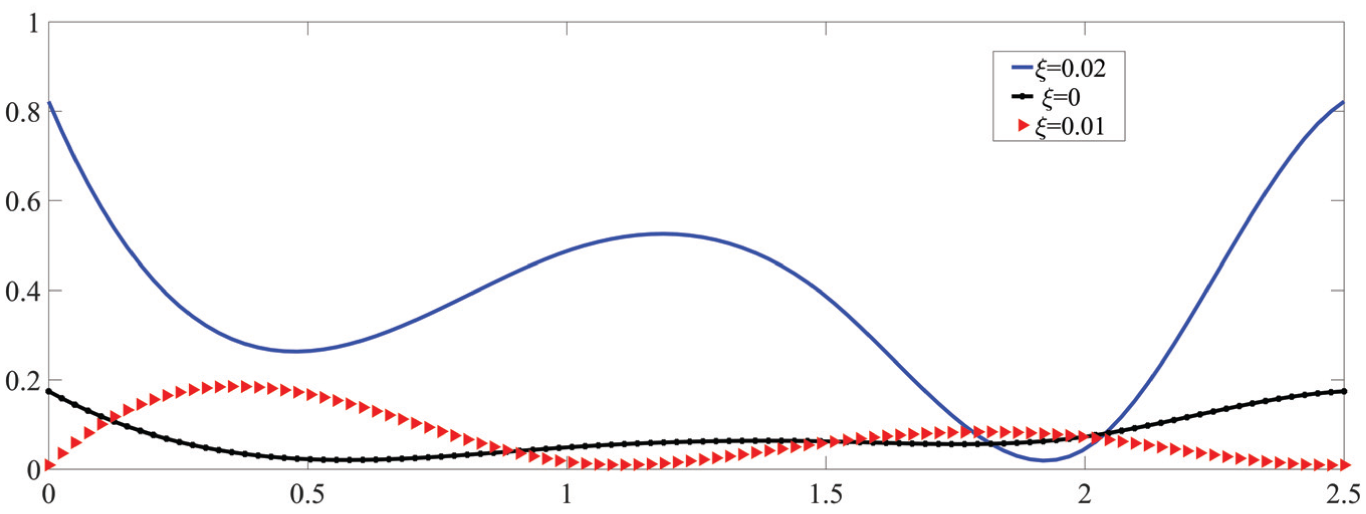
Variations in mass concentration with radial distance.
Figure 6 illustrates the variation of material potential along the radial distance of the plate for different nonlocal parameters = 0, 0.01, and 0.02. It is observed that the material potential increases significantly with an increase in the nonlocal parameter. This behavior reflects the influence of nonlocal interactions on the stored energy distribution within the material. Hence, nonlocal effects play a crucial role in modifying the energetic response of the plate.
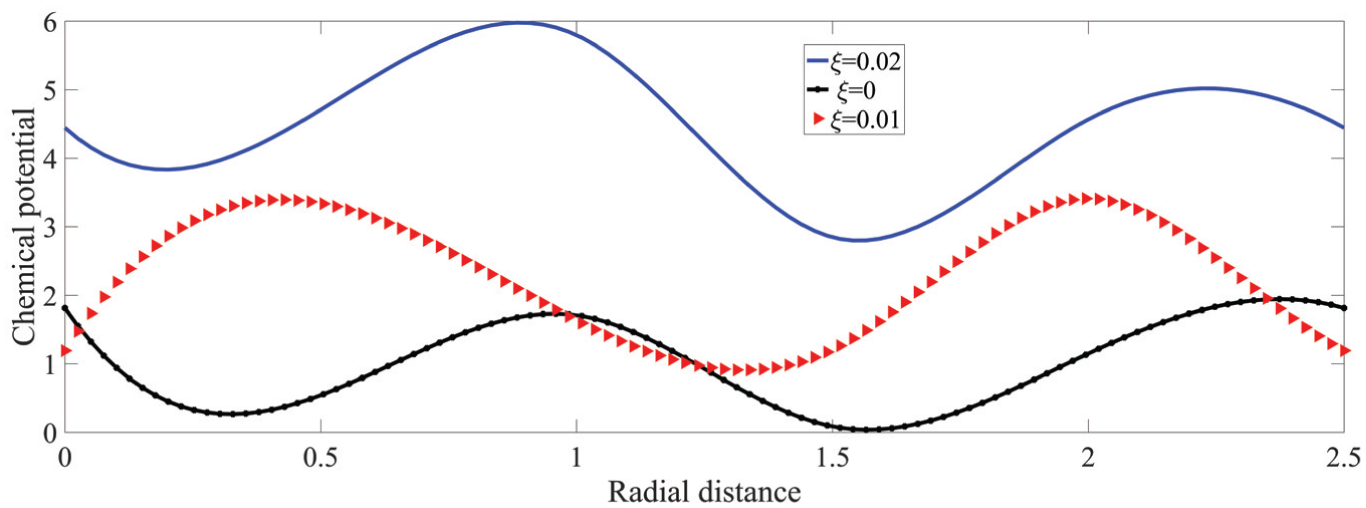
Variations in material potential with radial distance.
10. Conclusion
In this study, the influence of nonlocal parameter on the behavior of a nonlocal homogeneous isotropic thermoelastic thick circular plate has been investigated. The plate is subjected to axisymmetric heat supply and is investigated under thermal and mass concentration effects. The field variables are obtained in transformed domain. The interactions due to change in nonlocal parameter has been depicted graphically. The results clearly demonstrate that the local model predicts higher magnitudes of displacement and stress components compared to the nonlocal models. An increase in the nonlocal parameter leads to a noticeable reduction in mechanical responses. The present analysis is particularly relevant for micro- and nano-scale structures. Overall, the study confirms that nonlocal thermoelastic diffusion theory provides a more realistic representation of coupled mechanical, thermal, and diffusive responses in advanced materials.
Footnotes

Funding
The authors received no financial support for the research, authorship, and/or publication of this article.
Declaration of conflicting interests
The authors declared no potential conflicts of interest with respect to the research, authorship, and/or publication of this article.