






Abstract
In a generalized plane stress state, the contact interaction of two identical stringers, symmetrically loaded by tangential forces, with an elastic infinite or semi-infinite plate is studied. A related problem of symmetric tangential force transfer from two reinforced strip-shaped stringers to an elastic half-space under antiplane deformation is also considered. Stringers are modeled as a one-dimensional elastic Melan continuum. A modified contact formulation is proposed, assuming equality of axial horizontal displacements of the stringer points and elastic foundations boundary points, unlike the commonly used strain-equality model. In this formulation, solving the problems under consideration is reduced to solving a single Fredholm governing integral equation of the first kind with a symmetric kernel, represented by the sum of its principal part in the form of a symmetric logarithmic function and a regular part in the form of the modulus of the difference of arguments. A numerical-analytical solution of the governing integral equation is constructed by the method of mechanical quadratures using spectral relations for the symmetric logarithmic kernel, containing Chebyshev polynomials of the first kind with the argument of an incomplete elliptic integral of the first kind.
1. Introduction
Contact problems of the interaction of stringers with massive deformable bodies are often encountered in engineering practice, particularly in studies of load transfer from thin-walled elements to various structures and their components. Such problems arise in measuring technology during strain measurement, in the design of aircraft, in the mechanics of composites reinforced with thin-walled elements. Such problems arise in measuring technology during strain-gauge measurement, in aircraft design, and in the mechanics of composites reinforced with thin-walled elements. However, around stringers as one of the types of stress concentrators, local stress fields, stress concentrations characterized by large and intensively changing gradients, arise. Stress concentration significantly affects the strength characteristics of structures and their parts, reducing them. As a consequence of these circumstances, it became necessary to theoretically study the problems of contact interaction of various types of thin-walled elements with massive elastic bodies. On the other hand, the emergence of such a necessity was conditioned by the internal logic of the development of the theory of classical contact problems in the theory of elasticity, since these two areas of the theory of elasticity are closely interrelated both ideologically and methodologically. As a result, intensive research efforts by numerous authors were initiated on the problems of contact interaction between stringers and massive elastic bodies.
The mathematical treatment of contact and structural problems has greatly benefited from advances in continuum mechanics and generalized elasticity theories. In particular, higher-gradient and second-gradient continuum models have proven effective in capturing the mechanical behavior of complex microstructured materials and metamaterials [1–8]. Pantographic structures and lattice-based metamaterials, for instance, have been extensively studied through both analytical and numerical approaches, demonstrating the richness of generalized continuum frameworks [9–17]. The relevance of such frameworks extends to wave propagation, buckling behavior, and large-displacement responses in structured media [13,18,19]. Variational and hemivariational formulations have also provided powerful tools for the analysis of granular materials and masonry structures, where contact and friction play a central role [20–22]. The present work on stringer-plate contact interaction fits naturally within this broader landscape of contact and interface mechanics.
The first studies on the problems of contact interaction between stringers and massive elastic bodies date back to the work of Melan [23].
In this work, two problems on the transmission of a horizontal concentrated force from an infinite stringer fastened to a semi-infinite or infinite plate to elastic bodies (plate, rod) are considered.
In the first problem, a semi-infinite plate is reinforced by an infinite stringer at its boundary, and in the second problem, an infinite stringer-rod is embedded in an infinite plate. It is assumed that in the first problem, the bending rigidity is negligibly small, so that the normal contact stresses are neglected and eventually a one-dimensional elastic continuum or uniaxial stress state model is assumed for the stringer. In the second problem, the vertical displacements of the boundary points of the upper and lower elastic half-planes delimited by the stringer are assumed to be equal to zero. The closed (exact) solutions of the both problems are represented by Fourier integrals.
Subsequently, Melan’s problems were generalized and developed in various directions. In the article by Koiter [24], the problem of contact of a semi-infinite stringer with a semi-infinite plate is considered. Using the Mellin integral transform, solving the problem is reduced to solving a difference functional equation, and its exact solution is constructed.
In [25], again using the Mellin integral transformation, an exact solution was obtained for the governing difference functional equation of the contact problem for an elastic wedge-shaped plate reinforced on its edges by semi-infinite stringers. Various contact problems on the load transfer from stringers of finite length to one or two elastic semi-planes or an elastic plane, taking into account temperature stresses, were studied by Bufler [26]. In another work by Bufler [27], based on the exact solution (within the framework of two-dimensional elasticity theory) to the problem of the stress-strain state of a piecewise-homogeneous elastic half-plane, a limiting transition was carried out when the strip-stringer height tends to zero and the modulus of elasticity tends to infinity in such a way that their product, the strip-stringer rigidity, remains constant. Through this transition, a differential equation for the deformation of a stringer according to Melan’s model was obtained, thereby providing a justification for this model.
In [28,29], the Melan problems were reconsidered using new physical models, and the contact problem on load transfer from a tensile transverse stringer to an elastic semi-infinite plate was examined. The article by Erdogan and Gupta [30] discusses the problem of load transfer from a finite stringer to an elastic foundation. The problem of contact interaction of a finite-length stringer with an elastic half-plane in a slightly different formulation was also considered in [31], where the governing integro-differential equation of the Prandtl type was reduced to an infinite system of linear algebraic equations (SLAE).
The main results of the study of the problems concerning the contact interaction of stringers with massive elastic bodies of various geometric shapes, obtained before 1976, are summarized in the collective monograph [32], which also briefly presents the methods used to solve these problems. More broadly, the mechanics of contact between structural components and elastic media shares deep methodological connections with the modeling of reinforced and composite structures. Discrete and continuum models for masonry structures, including block-based and fiber-reinforced systems, have been analyzed using variational principles and finite element techniques [21,33–36]. Woven fabrics and pantographic sheets, modeled as generalized continua, exhibit similarly complex interface and friction phenomena that are described through Rayleigh dissipation functions and Coulomb-type constitutive laws [37–40]. The asymptotic derivation of reduced continuum models from discrete micro-structures, an approach central to the justification of one-dimensional stringer models, has been rigorously pursued in recent literature, including for higher-gradient and third-gradient one-dimensional continua obtained via asymptotic expansion [41–45]. Discrete formulations of one-dimensional elastic rods in large-motion dynamics, which share the same modeling philosophy as the stringer model adopted here, have also been developed and validated numerically [46–49]. The contact condition adopted in the present work, based on displacement equality rather than strain equality, is consistent with the spirit of these displacement-based variational formulations. Many results on the study of interaction of stringers, as well as other stress concentrators, thin-walled inclusions, stamps, and cracks, with massive deformable fields, obtained in recent decades, are reflected in monographs [50–53].
In all the above-mentioned works, the condition of equality of their axial deformations at the contact sections is taken as the condition of contact between stringers and massive base bodies. This formulation typically predetermines the types of governing mathematical equations, which are often singular integro-differential equations of the Prandtl type, Fredholm integral equations (IEs) of the second kind, or difference functional equations. In many applied problems it also is hypersingular equations [54]. However, if the displacements of the points of the stringer-elastic base pair are determined, for example, when the system of external forces acting on this pair is self-equilibrated, then the condition of equality of displacements of the points of stringers and elastic bases can be adopted as the contact condition. In this formulation of the problem of contact interaction between stringers and massive elastic bodies, the governing equations reduce to Fredholm IEs of the first kind. This circumstance brings the contact problems of stringers closer to the classical contact problems of compression of two elastic bodies, based on Hertz’s assumptions.
The distinction between the two contact formulations carries concrete physical implications. In the classical strain-equality formulation, only the incremental deformation compatibility between the stringer and the elastic base is enforced at the interface, leaving the absolute displacement field kinematically underdetermined. As a consequence, the rigid-body translation of the stringer, a quantity directly linked to the overall stiffness of the stringer-elastic-base system, cannot be recovered from the solution. In the proposed displacement-equality formulation, full kinematic compatibility is enforced between the displacement of the stringer points and the displacement of the corresponding boundary points of the elastic body. This provides a physically more complete description of the mechanical interaction, and in particular allows direct determination of the rigid horizontal displacement Δ of the stringer, which characterizes the stiffness of the assembled system and is of direct engineering relevance in the design of reinforced structural elements. It should be noted, however, that the applicability of the displacement-equality condition requires the total displacement field of the stringer-base system to be uniquely determined. This is guaranteed when the system of external forces acting on the stringer-base pair is self-equilibrated, as is the case in all three problems considered here. In configurations where the resultant force on the system is non-zero, the far-field displacement would grow without bound unless additional regularity or boundary conditions are prescribed, and the strain-equality formulation may then be more appropriate. Within the self-equilibrated framework of the present work, however, the displacement-equality condition offers both greater physical fidelity and a richer set of computable output quantities.
The solution methodology employed here, combining spectral integral relations with Chebyshev polynomials and mechanical quadrature techniques, also bears relevance to recent computational strategies for identifying constitutive parameters in reduced-order structural models, such as those developed for pantographic and articulated beam systems [41,55–58]. The numerical results presented below complement and extend the analytical tools available for contact problems in elastic media.
Based on the assumptions outlined above, the present paper considers the following three problems:
The contact problem of two identical stringers, symmetrically loaded with tangential forces, with an infinite elastic plate;
The same problem in the case of a semi-infinite elastic plate;
The contact problem of two identical, symmetrically tangentially loaded infinitely long ribbon-like stringers with an elastic half-space under antiplane deformation.
All three problems are mathematically described by a single Fredholm IE of the first kind with a symmetric kernel represented by the sum of its principal part in the form of a logarithmic function symmetric in arguments and its regular part in the form of the modulus of the difference of arguments. The solution of the governing Fredholm IE of the first kind is constructed by combining the methods of spectral integral relations in Chebyshev polynomials of the first kind with an argument in the form of an incomplete elliptic integral of the first kind for the integral operator generated by the symmetric logarithmic kernel and the methods of mechanical quadratures, using the Lagrange interpolation polynomial over Chebyshev nodes in a modified form. A numerical analysis of the contact problems under consideration was performed. Depending on the characteristic physical and geometric parameters, regularities in the changes of tangential contact stresses under stringers and their rigid horizontal displacements were identified. The results of the numerical analysis were summarized in graphs and tables.
The scientific novelty of the article is as follows:
The problems of contact interaction of stringers with massive elastic bodies are considered in a new modified formulation based on the characteristic condition of equality of displacements of contacting bodies in contact zones;
This formulation enables taking more fully into account possible mechanical effects of contact problems and, in particular, makes it possible to determine the values of rigid horizontal displacements of stringers characterizing the stiffnesses of the stringer-elastic-base systems;
In the given formulation, the solution of contact problems for stringers is reduced to a new class of governing mathematical equations-namely, Fredholm IEs of the first kind. For their efficient solution, methods based on spectral integral relations and mechanical quadratures are used.
The necessary information from the mathematical theory of elasticity, the theory of elliptic functions, methods of spectral relations and interpolation polynomials used in the article is presented in Appendices 1 to 3.
2. Formulation of problems and derivation of their governing equations
Let an elastic infinite plate
We assume that stringers are symmetrically loaded along their upper faces, along their midlines, in the direction of the axis Ox, by tangential forces of intensity
With the above method of loading an infinite thin elastic plate
Proceeding to the derivation of the governing equations of the problem, we make use of formula (40) from Appendix 1. According to this formula, in the case of distributed tangential forces of intensity

From this, since

Next, considering the stringers, we restrict our attention, due to symmetry, to only the right stringer over the segment

Here,
Next, we introduce the axial force

and, taking into account Hooke’s law for the stringer, we will have:

Therefore, to calculate

From here, we find

or

Assuming in (4)

Adding equalities (4) and (5), we obtain

Since, according to the formulas given above,

then from (7), we have

Hence

where Δ is the desired rigid horizontal displacement of the right stringer.
Now, substituting expressions (1) and (8) into the condition of contact of the stringers with the plate

for

Next, we move on to dimensionless quantities, assuming that

As a result, the governing IE (9) takes the form
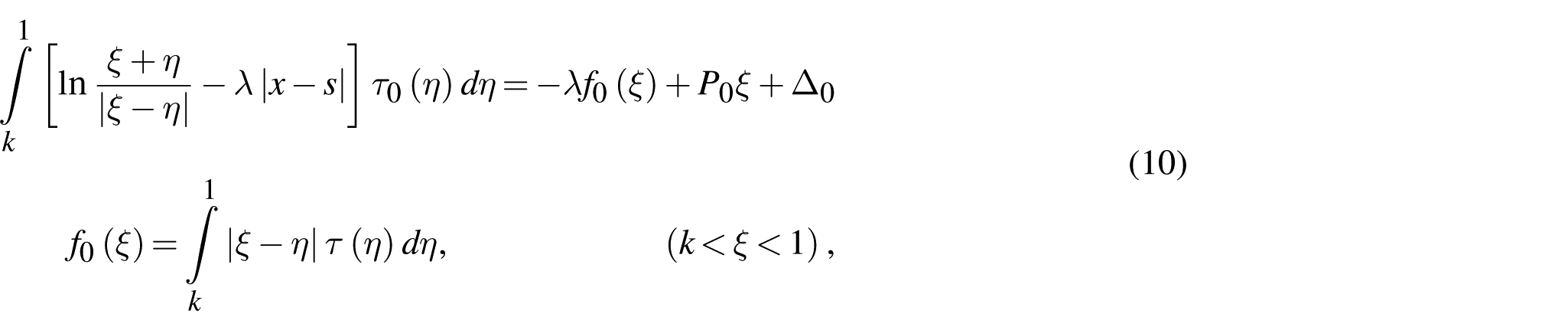
the equilibrium condition of the right stringer (6) takes the form

and the dimensionless axial stresses
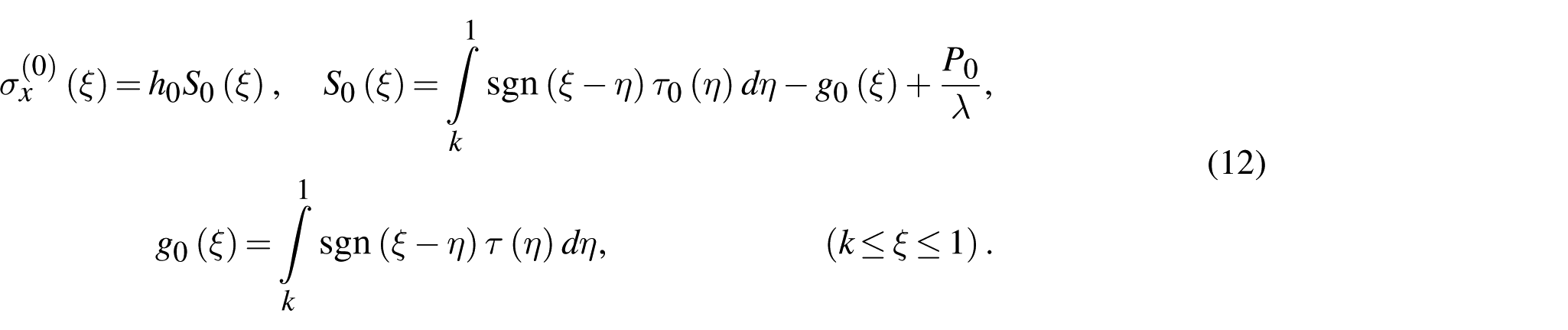
The IE (10) must be considered under condition (11). Although Fredholm equations of the first kind are in general ill-posed, the present equation is comparatively well-behaved: its logarithmic kernel admits a complete spectral decomposition in Chebyshev polynomials of the first kind with algebraically, rather than exponentially, decaying eigenvalues (see Appendix 2, relations (46)), which prevents severe ill-conditioning in the numerical treatment. Existence and uniqueness of the solution are ensured within the class of functions with the singularity structure prescribed in (25), with the equilibrium condition (11) removing the indeterminacy in the rigid displacement
Next, we consider a similar problem for an elastic semi-infinite plate, where the plate is reinforced along its boundary by two identical stringers, again symmetrically loaded on their upper faces with tangential forces of intensity
Adhering to the notations adopted above and again assuming that all force factors are related to the unit of plate thickness h, we obtain in this case

Now, turning to the right stringer of height d, we write its differential equation of deformation

From here, as above, we easily obtain that


where Δ is again a rigid horizontal displacement of the right stringer, and its equilibrium condition have the form

Let us move on to the following dimensionless quantities:

In terms of these variables and quantities, the governing IE of the problem under consideration, derived from the contact condition

with the help of (13) and (15) can once again be represented in the form of equation (10), while condition (16) takes the form of equation (11), and
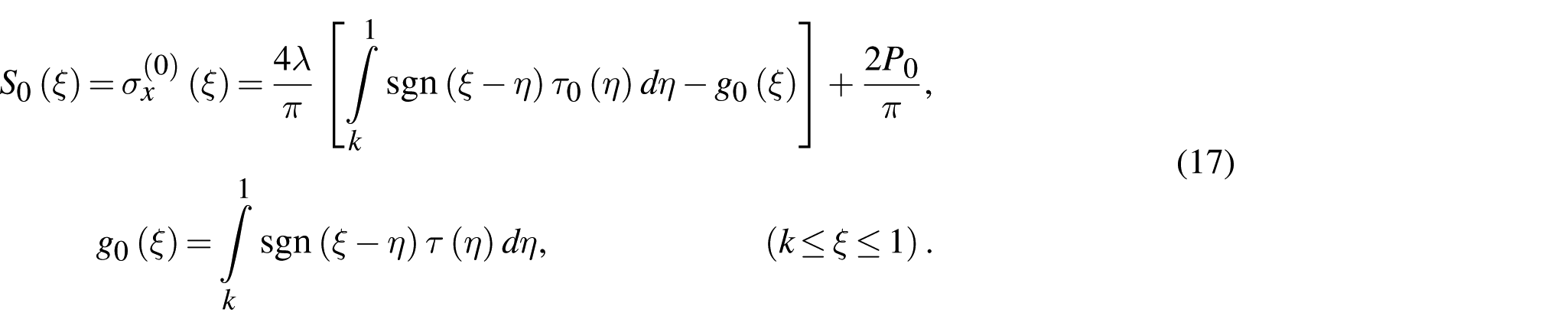
Finally, we consider a similar contact problem for an elastic half-space under antiplane deformation. Let an elastic half-space
We derive the governing IEs of this problem. To this end, we first determine the displacements of the boundary points of the elastic half-space
Indeed, together with the function

Since according to Hooke’s law

and

Integrating both parts of this equality with respect to y, we find (up to an additive constant)

From this

Next, we write the differential equation for the deformation of the right stringer

Taking into account Hooke’s law

we get, as above,


where
The equilibrium condition of the right stringer is

Now, we substitute (18) and (19) into the contact condition

As a result, we arrive at the following governing IE:

In these dimensionless quantities, formulas (20) and (21) take the following form, respectively,


Thus, all the considered contact problems are described by the unified IEs (10) and (22) under the unified conditions (11) and (24). The expressions
3. Solution of the governing equations (10) and (11)
Using the method of mechanical quadratures with the help of spectral relations (46) from Appendix 2, we reduce the solution of this IE to solving a finite SLAE. For this purpose, we represent the solution of the IEs (10) and (11) in a form that explicitly accounts for the singularities at the endpoints of the interval

where

Now, using formulas (43) and (45), the IE (10) is transformed to the form

and the condition (11) takes the form

Next, as nodal points, as in Appendix 3, we take the roots of the equation

and according to (C5), we put

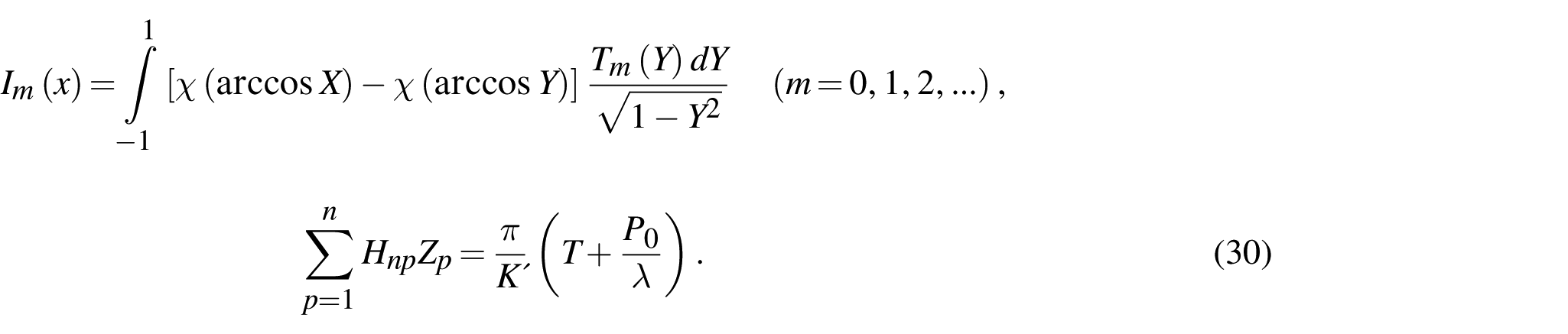
Substituting (28) into equation (26) and condition (27) and taking into account the spectral relations (46), after simple transformations we have
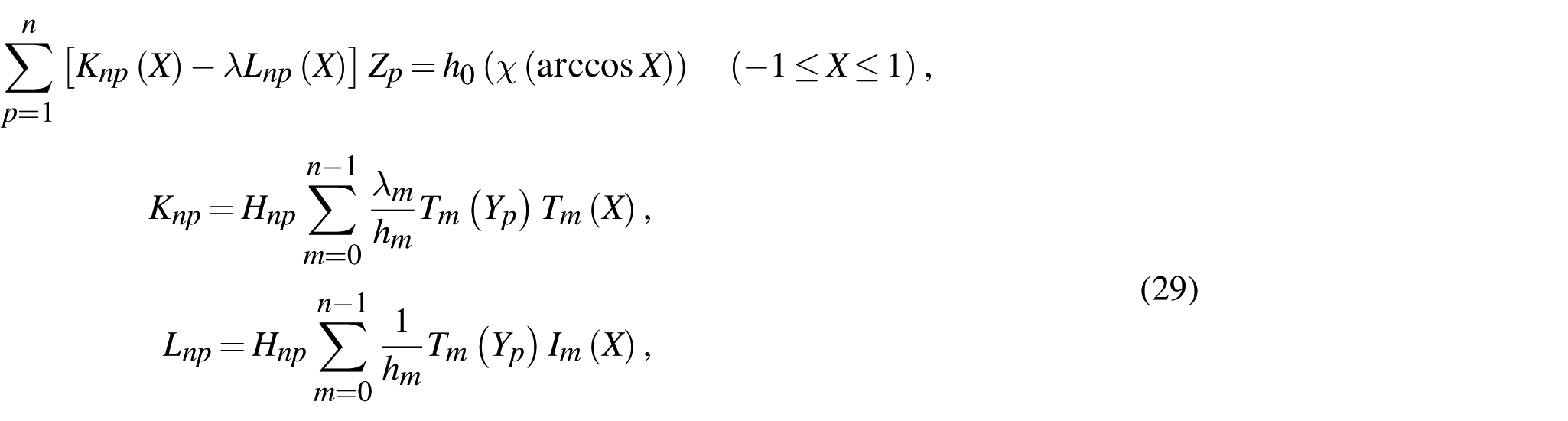
Finally, in (29), we put

As a result, to determine the unknowns we arrive at the following finite SLAE:

To determine the constant

Substitute this expression for

Hence,

From (28),

However, according to (45)

and

Therefore, after solving SLAE (31), the tangential contact stresses under the right stringer along the segment

where
We also determine the concentration factors (CFs) of tangential contact stresses at the near ends of the stringers

where (25) is taken into account. From here, introducing the dimensionless CF, we obtain

However

after simple transformations, we obtain

Since

Thus, after solving SLAE (31), the solution of which is represented by formula (32), the formulas (33) and (35) to (37) will be the calculation formulas for calculating the characteristics of the contact problems considered above.
Note that through the solution of SLAE (31), one can also write formulas for (12), (17), and (23).
4. Numerical results
To obtain numerical results for the solution of the governing IE (10)–(11), we consider, as shown in the previous section, the finite SLAEs (31). When solving system (31), we set

Solving system (31) with

The graph of the variation of the rigid horizontal displacement with respect to is shown in Figure 1. Before presenting the numerical results, we briefly address the convergence of the mechanical quadrature scheme. Since the endpoint singularities of
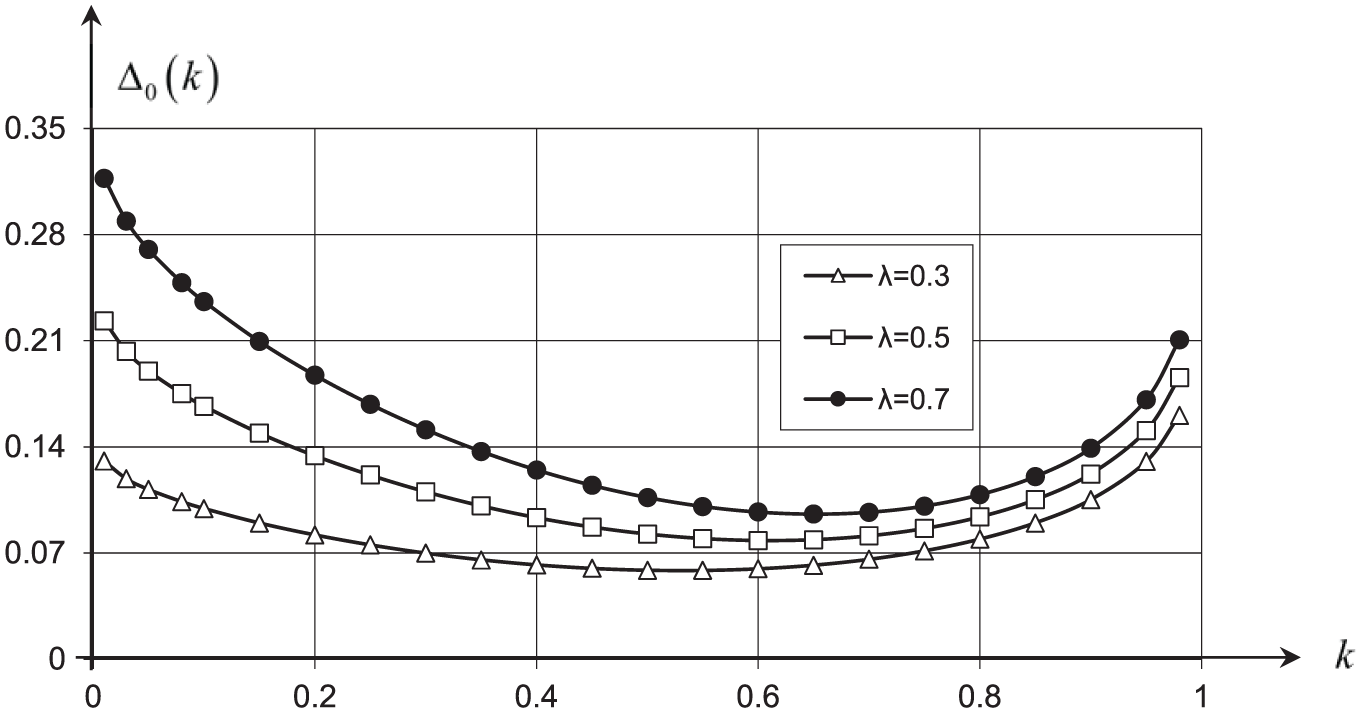
Graphs of
As seen in Figure 1, the values of
The tangential contact stresses under the stringer are determined from formula (35):

where
Figure 2 shows that the tangential contact stresses initially increase from
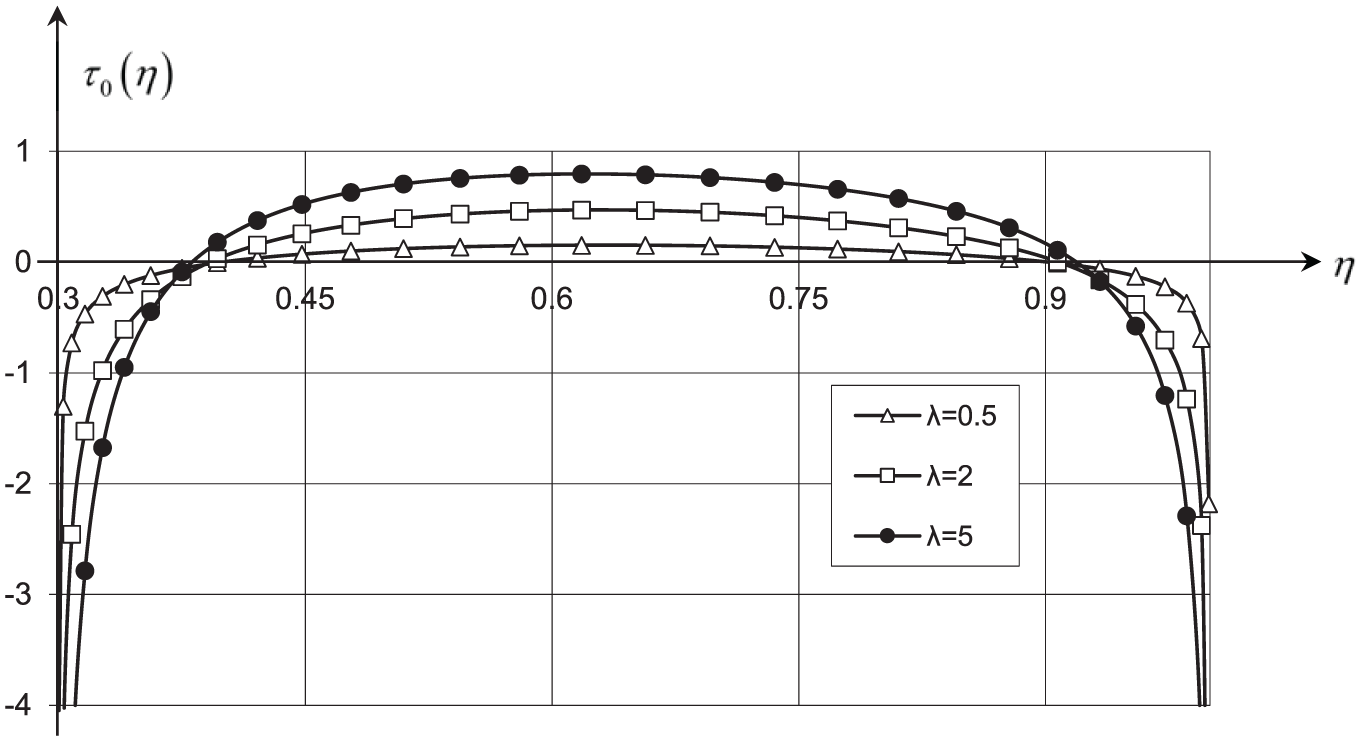
Graphs of
A table below presents the concentration factors of the tangential contact stresses at the near ends of the stringers

Table 1 presents the concentration factors of the tangential contact stresses
Values of the concentration factors of the tangential contact stresses
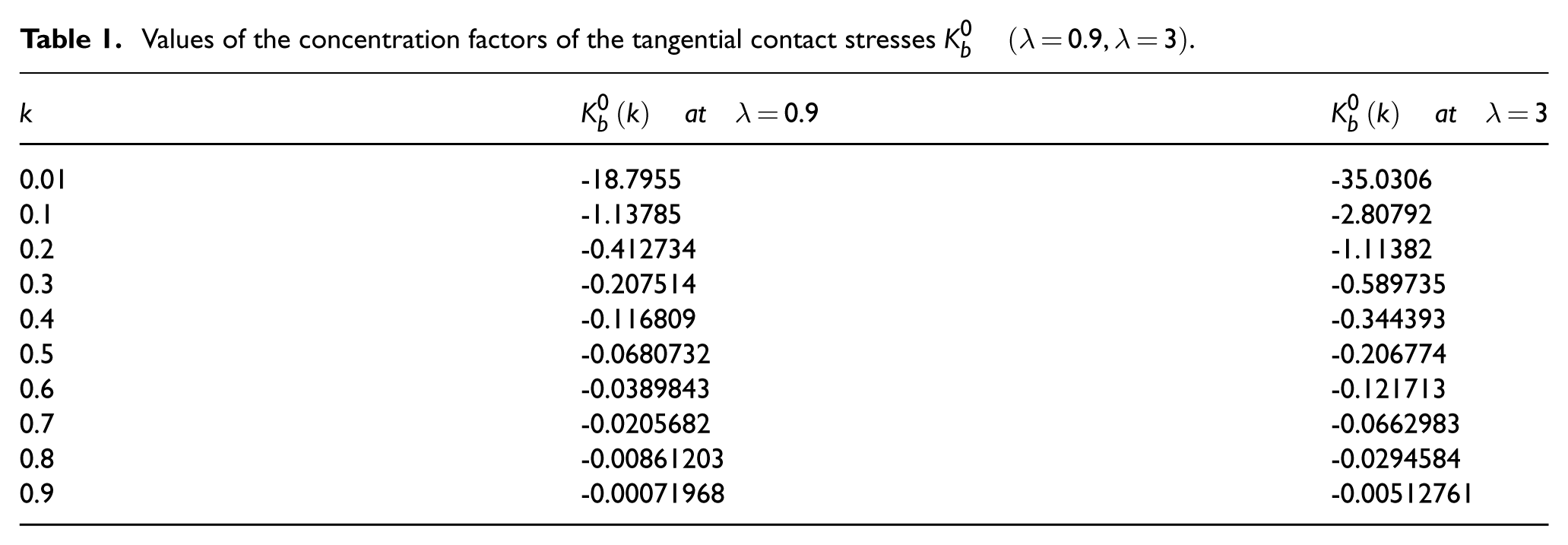
These results admit clear physical interpretations in terms of the stress-transfer mechanisms between the stringers and the elastic medium. The rigid horizontal displacement
5. Conclusions
In this study, a novel approach to the analysis of contact interaction between stringers and massive elastic bodies has been developed. The proposed formulation is distinguished by its incorporation of the characteristic condition of displacement equality in the contact zones, offering a more precise representation of mechanical interactions within the system. Unlike the classical strain-equality formulation, which enforces only incremental deformation compatibility and cannot recover the rigid displacement of the stringer, the present approach enforces full kinematic compatibility and thereby enables direct determination of the stringer rigid horizontal displacement: a key indicator of the stiffness of the stringer-elastic-base system. The applicability of this formulation is naturally suited to self-equilibrated loading configurations, under which the displacement field is uniquely determined. This innovative framework not only enables the accurate determination of rigid horizontal displacements of stringers-key indicators of the stiffness properties of the stringer-elastic-base systems, but also redefines the mathematical structure of the problem. Specifically, the contact interaction is reduced to a new class of governing equations in the form of Fredholm IEs of the first kind. The implementation of spectral integral relations and mechanical quadrature techniques for their solution further highlights the analytical strength of the proposed method. Collectively, these advancements contribute to a deeper understanding of the mechanics of contact systems and provide a robust foundation for future theoretical and applied investigations in this field. Depending on the characteristic physical and geometric parameters, regularities in the changes of tangential contact stresses under stringers and their rigid horizontal displacements were identified and interpreted in physical terms. In particular, the non-monotonic dependence of the rigid displacement on the stringer geometry reveals the existence of an optimal configuration maximizing joint stiffness, while the unbounded growth of stress concentration factors as the stringers approach each other highlights a critical design limit beyond which interfacial failure is expected.
Footnotes
Appendix 1
Here, we present the expressions for the displacements of points of an elastic infinite plate depending on a horizontal concentrated force of the magnitude X, which is related to the unit height of the plate and applied at its point
For this purpose, we will use the complex potentials
The complex combination of displacement components, accurate to an additive constant, will be determined by the formula
where
Hence, when the force X is applied at a point
Appendix 2
To solve the governing Fredholm equation of the first kind (10) and (11), the following spectral integral relations obtained in [60,61] by the methods of the logarithmic potential theory in combination with the method of conformal mappings are used:
where
Note that ϑ and φ can be expressed through an incomplete elliptic integral of the first kind. Indeed, we change the variable of integration from u to
where
Next, based on the standard orthogonality conditions for Chebyshev polynomials of the first kind, we have [62]
Let us write the orthogonality conditions for
and take into account that
We also establish the functional relationship between the variables ϑ and ϑ, for which, according to equation (42), we have [62]
From this, taking into account the definition of the Jacobi elliptic sine function
Hence
Now, using the functional relationship (45) between the variables ξ and ϑ, we transform the spectral relations (41) into the variables X, Y first setting
As a result, we arrive at the following relations:
Furthermore, according to (45), we set here
and take into account (43). As a result, we arrive at the following spectral relations:
Referring again to the function
Since
the convergence of the Fourier sine series (47) can be accelerated using the following transformation:
Consequently, (47) can be written as
The sum of the first series can, however, be readily evaluated. Namely,
Next, we use the formula for the sum of an infinitely decreasing geometric progression and after elementary transformations, we arrive at
Appendix 3
Let us also turn to the Lagrange interpolation polynomial at Chebyshev nodes. This polynomial for the function
where
where
As a result,
Next, we turn to the Christoffel–Darboux formula for Chebyshev polynomials of the first kind
Here,
Now in (51), we put
Hence,
moreover,
From this,
Next, in (49), (50), and (52) we replace X with Y,
Then, we substitute the expression from (52) into (49) or into (50). As a result, we arrive at the following final form of the interpolation polynomial over the Chebyshev nodes with respect to the variable Y:

Funding
The authors received no financial support for the research, authorship, and/or publication of this article.
Declaration of conflicting interests
The authors declared no potential conflicts of interest with respect to the research, authorship, and/or publication of this article.