






Abstract
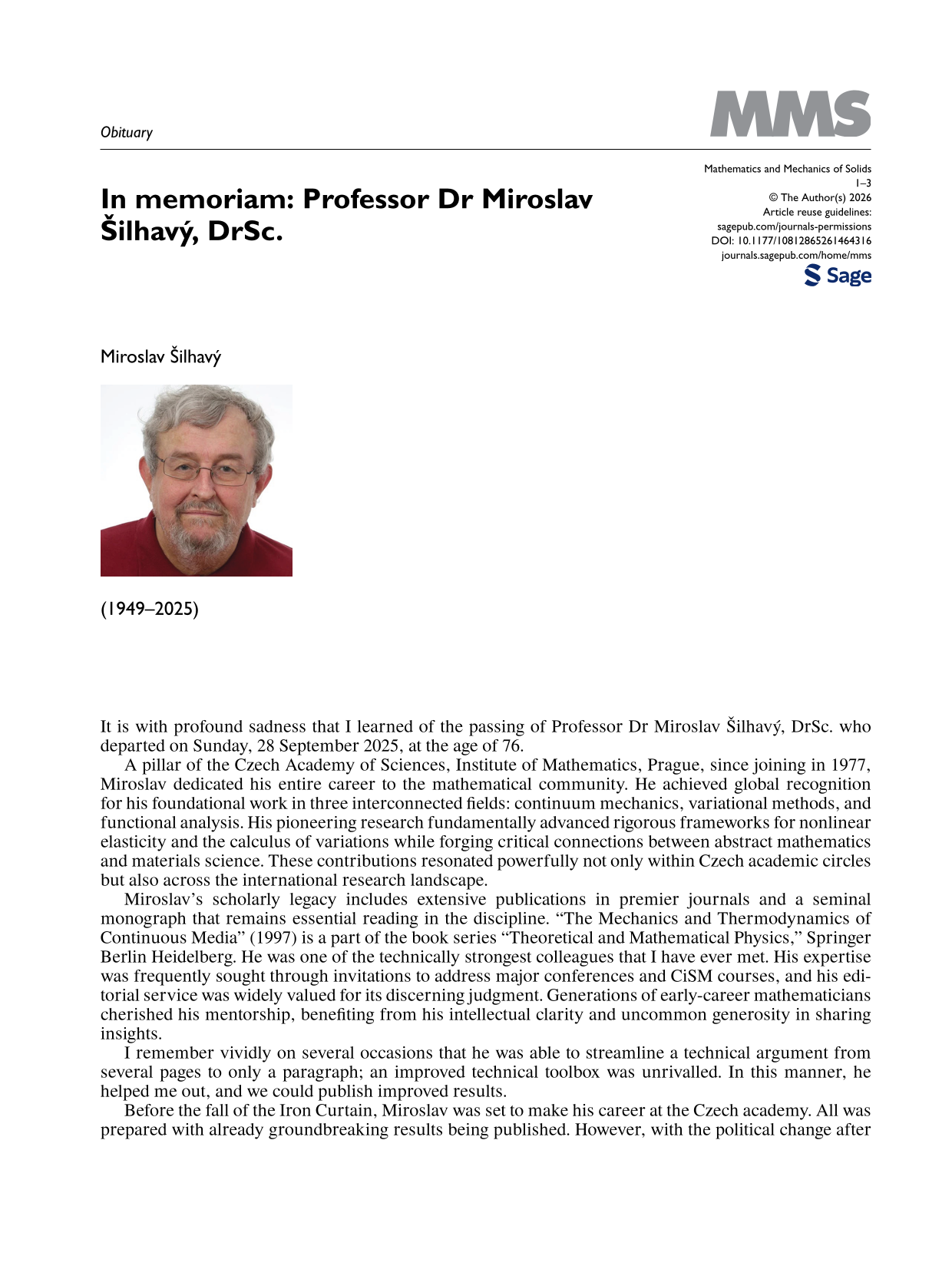

It is with profound sadness that I learned of the passing of Professor Dr Miroslav Šilhavý, DrSc. who departed on Sunday, 28 September 2025, at the age of 76.
A pillar of the Czech Academy of Sciences, Institute of Mathematics, Prague, since joining in 1977, Miroslav dedicated his entire career to the mathematical community. He achieved global recognition for his foundational work in three interconnected fields: continuum mechanics, variational methods, and functional analysis. His pioneering research fundamentally advanced rigorous frameworks for nonlinear elasticity and the calculus of variations while forging critical connections between abstract mathematics and materials science. These contributions resonated powerfully not only within Czech academic circles but also across the international research landscape.
Miroslav’s scholarly legacy includes extensive publications in premier journals and a seminal monograph that remains essential reading in the discipline. “The Mechanics and Thermodynamics of Continuous Media” (1997) is a part of the book series “Theoretical and Mathematical Physics,” Springer Berlin Heidelberg. He was one of the technically strongest colleagues that I have ever met. His expertise was frequently sought through invitations to address major conferences and CiSM courses, and his editorial service was widely valued for its discerning judgment. Generations of early-career mathematicians cherished his mentorship, benefiting from his intellectual clarity and uncommon generosity in sharing insights.
I remember vividly on several occasions that he was able to streamline a technical argument from several pages to only a paragraph; an improved technical toolbox was unrivalled. In this manner, he helped me out, and we could publish improved results.
Before the fall of the Iron Curtain, Miroslav was set to make his career at the Czech academy. All was prepared with already groundbreaking results being published. However, with the political change after 1989, life for East European scientists got more difficult, and Miroslav successfully sought connections to West European universities and colleagues. Among them, we note a longer research stay at the University of Pisa.
I met him first as a young postdoc around 2002/2003 at an international conference, where the mutually interesting subject was polyconvexity and anisotropy. At this time, he was a leading expert on (among others) isotropic polyconvexity and quasiconvex relaxation. We were delighted to welcome him as a speaker at the CISM School on ’Poly-, quasi- and rank-one convexity in applied mechanics’ in Udine from 24 to 28 September 2007, where we brought together D. J. Steigmann, A. R. Raoult, J. M. Ball, Miroslav Šilhavý, J. Schröder and myself. For me, this event will always be recollected with the warmest feelings for Miroslav. My last exchange with him dates back to spring 2025, when I explained to him some aspects of my recent research. He told me that he still followed the new developments but that he stopped working himself. His absence leaves a void in our academic family.
I extend my deepest condolences to his loved ones, friends, and all privileged to collaborate with him. His intellectual legacy and the scholarly community he nurtured will forever honor his memory.
Since it is impossible for me to summarize all the scientific achievements of Miroslav, I will restrict myself to a snippet on planar polyconvexity in the following. Miroslav Šilhavý worked extensively on rank-one convexity, polyconvexity, and quasiconvexity for planar isotropic elasticity. He had gained a nearly complete mastery of the subject, apart from the still challenging open problem whether rank-one convexity implies quasiconvexity in the planar case [1]. Here, we want to give a short account where Šilhavý’s technical insights decisively improved a polyconvexity result. Indeed, it had been previously shown that

is rank-one convex for
The notion of polyconvexity has been introduced into the framework of elasticity by John Ball in his seminal paper. In the two-dimensional case, a free energy function
We have remarked that the rank-one convexity holds true for
Here, we use a direct approach based on the fact that the function
1. Šilhavý’s improved polyconvexity result
The function
The next statement looks simple, but the idea of using the convexity in F of the largest singular value is decisive:

for every

where we used the convexity of f asserted above. Thus,
Therefore, one can conclude.