






Abstract
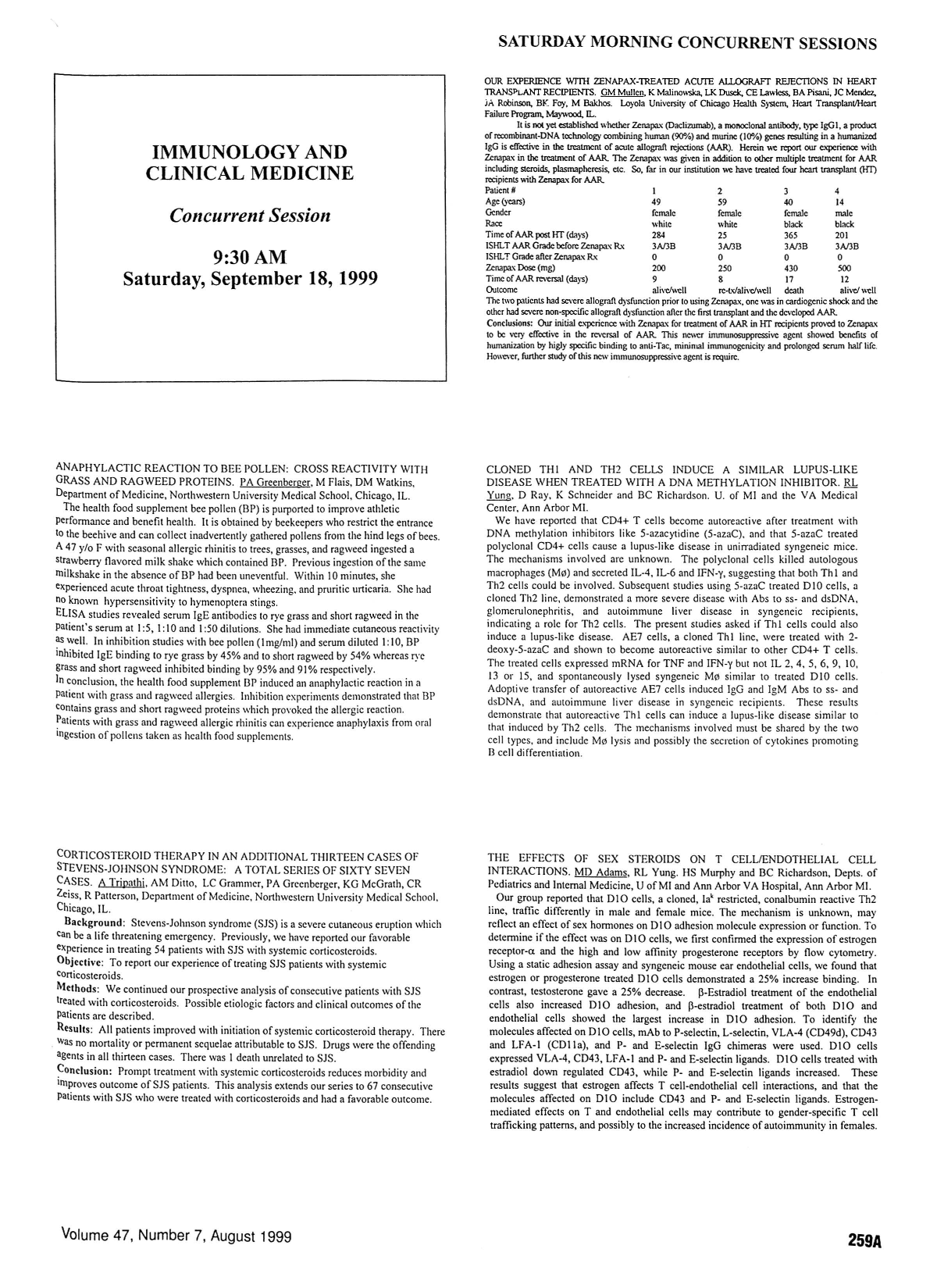
Our Experience with Zenapax-Treated Acute Allograft Rejections in Heart Transplant Recipients
GM Mullen, K Malinowska, LK Dusek, CE Lawless, BA Pisani, JC Mendez, JA Robinson, BK. Foy, M Bakhos. Loyola University of Chicago Health System, Heart Transplant/Hcart Failure Program, Maywood, IL.
It is not yet established whether Zenapax (Daclizumab), a monoclonal antibody, type IgG1, a product of recombinant-DNA technology combining human (90%) and murine (10%) genes resulting in a humanized IgG is effective in the treatment of acute allograft rejections (AAR). Herein we report our experience with Zenapax in the treatment of AAR. The Zenapax was given in addition to other multiple treatment for AAR including steroids, plasmapheresis, etc. So, far in our institution we have treated four heart transplant (HT) recipients with Zenapax for AAR.
The two patients had severe allograft dysfunction prior to using Zenapax, one was in cardiogenic shock and the other had severe non-specific allograft dysfunction after the first transplant and the developed AAR.
Anaphylactic Reaction to Bee Pollen: Cross Reactivity with Grass and Ragweed Proteins
The health food supplement bee pollen (BP) is purported to improve athletic performance and benefit health. It is obtained by beekeepers who restrict the entrance to the beehive and can collect inadvertently gathered pollens from the hind legs of bees. A 47 y/o F with seasonal allergic rhinitis to trees, grasses, and ragweed ingested a strawberry flavored milk shake which contained BP. Previous ingestion of the same milkshake in the absence of BP had been uneventful. Within 10 minutes, she experienced acute throat tightness, dyspnea, wheezing, and pruritic urticaria. She had no known hypersensitivity to hymenoptera stings.
ELISA studies revealed serum IgE antibodies to rye grass and short ragweed in the patient's serum at 1:5, 1:10 and 1:50 dilutions. She had immediate cutaneous reactivity as well. In inhibition studies with bee pollen (1mg/ml) and serum diluted 1:10, BP inhibited IgE binding to rye grass by 45% and to short ragweed by 54% whereas rye grass and short ragweed inhibited binding by 95% and 91% respectively.
In conclusion, the health food supplement BP induced an anaphylactic reaction in a patient with grass and ragweed allergies. Inhibition experiments demonstrated that BP contains grass and short ragweed proteins which provoked the allergic reaction. Patients with grass and ragweed allergic rhinitis can experience anaphylaxis from oral ingestion of pollens taken as health food supplements.
Cloned Th1 and Th2 Cells Induce a Similar Lupus-Like Disease When Treated with a Dna Methylation Inhibitor
We have reported that CD4+ T cells become autoreactive after treatment with DNA methylation inhibitors like 5-azacytidine (5-azaC), and that 5-azaC treated polyclonal CD4+ cells cause a lupus-like disease in unirradiated syngeneic mice. The mechanisms involved are unknown. The polyclonal cells killed autologous macrophages (Mø) and secreted IL-4, IL-6 and IFN-γ, suggesting that both Th1 and Th2 cells could be involved. Subsequent studies using 5-azaC treated D10 cells, a cloned Th2 line, demonstrated a more severe disease with Abs to ss and dsDNA, glomerulonephritis, and autoimmune liver disease in syngeneic recipients, indicating a role for Th2 cells. The present studies asked if Th1 cells could also induce a lupus-like disease. AE7 cells, a cloned Th1 line, were treated with 2-deoxy-5-azaC and shown to become autoreactive similar to other CD4+ T cells. The treated cells expressed mRNA for TNF and IFN-γ but not IL 2, 4, 5, 6, 9, 10, 13 or 15, and spontaneously lysed syngeneic Mø similar to treated D10 cells. Adoptive transfer of autoreactive AE7 cells induced IgG and IgM Abs to ss- and dsDNA, and autoimmune liver disease in syngeneic recipients. These results demonstrate that autoreactive Th1 cells can induce a lupus-like disease similar to that induced by Th2 cells. The mechanisms involved must be shared by the two cell types, and include Mø lysis and possibly the secretion of cytokines promoting B cell differentiation.
Corticosteroid Therapy in An Additional Thirteen Cases of Stevens-Johnson Syndrome: a Total Series of Sixty Seven Cases
The Effects of Sex Steroids on T Cell/Endothelial Cell Interactions
Our group reported that DIO cells, a cloned, lak restricted, conalbumin reactive Th2 line, traffic differently in male and female mice. The mechanism is unknown, may reflect an effect of sex hormones on DIO adhesion molecule expression or function. To determine if the effect was on DIO cells, we first confirmed the expression of estrogen receptor-α and the high and low affinity progesterone receptors by flow cytometry. Using a static adhesion assay and syngeneic mouse ear endothelial cells, we found that estrogen or progesterone treated DIO cells demonstrated a 25% increase binding. In contrast, testosterone gave a 25% decrease. β-Estradiol treatment of the endothelial cells also increased D10 adhesion, and β-estradiol treatment of both DIO and endothelial cells showed the largest increase in DIO adhesion. To identify the molecules affected on D10 cells, mAb to P-selectin, L-selectin, VLA-4 (CD49d), CD43 and LFA-1 (CD11a), and P and E-selectin IgG chimeras were used. DIO cells expressed VLA-4, CD43, LFA-1 and P- and E-selectin ligands. DIO cells treated with estradiol down regulated CD43, while P- and E-selectin ligands increased. These results suggest that estrogen affects T cell-endothelial cell interactions, and that the molecules affected on DIO include CD43 and P- and E-selectin ligands. Estrogen-mediated effects on T and endothelial cells may contribute to gender-specific T cell trafficking patterns, and possibly to the increased incidence of autoimmunity in females.