







Abstract
A commercial solution of chitosan was applied on mandarins ‘Oronules’ at different solid content (0.6%, 1.2% and 1.8%). Additionally, one group of mandarins was coated with a polyethylene-shellac commercial wax, and another group remained uncoated (control). Mandarins were stored at 5 °C up to 28 days followed by 7 days at 20 °C simulating retail conditions. One group of mandarins was stored at 20 °C for 9 days simulating direct retail conditions. The commercial wax decreased weight and firmness loss of mandarins compared to uncoated samples, whereas the chitosan coating did not effectively decrease weight loss of mandarins. Chitosan-coated mandarins at the highest solid content retained firmness after cold storage and contained more phenolics than uncoated ones. Although all the coatings restricted gas exchange and modified the internal atmosphere of the mandarins, with a greater effect at higher chitosan concentration, sensory quality was not affected. In general, the internal quality and the health-related properties of mandarins were not negatively affected by coating application. However, there is a need to further improve the water barrier properties of the chitosan coating.
Introduction
Spain is the main exporter of clementine citrus mandarins, including in this group Oronules ‘clementine’. This clementine cultivar is highly appreciated for its excellent organoleptic quality (Ortiz et al., 1988). Citrus fruit are coated in the citrus packing houses to improve their appearance and extend their shelf-life (Petracek et al., 1999). In general, commercial waxes used by the citrus industry enhance shine, reduce water loss and act as a vehicle for fungicides. However, it has also been reported by many authors that waxing of citrus can adversely affect fruit flavor (Baldwin et al., 1995; Hagenmaier, 2002; Hagenmaier and Baker, 1993; Hagenmaier and Shaw, 2002; Porat et al., 2005), due to the overproduction of volatiles associated with anaerobic conditions when coatings offer a high barrier to gases. The success of coatings for citrus mainly depends on the selection of appropriate formulations that not only reduced fruit weight and firmness loss, but also give a desirable internal gas composition. In addition, for a specific coating formulation, the solid content (SC) of the formulation can affect the gas barrier of the coating (Cisneros-Zevallos and Krochta, 2003).
Commercial coatings used for citrus fruit include waxes such as carnauba, petroleum-based waxes such as polyethylene wax, acetoglycerides, oleic acid, and resins such as shellac to improve fruit gloss (Baldwin et al., 1997). In recent years, concerns about environmental protection and food safety, has led to an increased interest in the development of ‘edible coatings’ to replace synthetic ingredients, like polyethylene, by natural ingredients.
Edible coatings incorporate proteins, polysaccharides and lipids (Baldwin, 1994). Polysaccharides have been widely used because of their ability to form films and their selective permeabilities to O2 and CO2 (Nisperos-Carriedo, 1994). Among polysaccharides, chitosan (poly β-(1 → 4)N-acetyl-D-glucosamine) has been used as coating of some fruits and vegetables, due to its antimicrobial and biostimulant activities, as well as film forming properties (Zeng et al., 2010; Zhang et al., 2011). Films and coatings based on chitosan present a selective permeability to O2 and CO2, and good mechanical properties. However, its hydrophilic nature makes it poor moisture barrier (Vargas et al., 2008). Many works have shown the benefits of chitosan in fruits, such as strawberry, mango, peach, grapes, by providing a modified atmosphere and controlling decay (Bautista-Baños et al., 2006; Li and Yu, 2000; Sanchez-Gonzalez et al., 2011; Srinivasa et al., 2002; Vargas et al., 2006). In citrus fruit, significant reduction of postharvest Penicillium decay and delay of fruit senescence during long-term cold storage of different citrus species and cultivars have been observed after the application of certain chitosan formulations (Abbas et al., 2008; Chien and Chou, 2006; Chien et al., 2007; El Ghaouth et al., 2000; Fornes et al., 2005; Galed et al., 2004). However, the antimicrobial activity seems to depend on its molecular weight and the degree of deacetylation and of chemical degradation.
Fruits and vegetables, especially citrus fruit, constitute an important nutritional source of health related compounds, mainly vitamin C, as well as polyphenolic compounds such as flavonoids. The variety and abundance of antioxidant compounds in citrus make synergy between these compounds possible, contributing to the high total antioxidant capacity of the fruit (Sanchez-Moreno et al., 2003). The functional and nutritional quality of fruits should be maintained during postharvest until these reach the consumer. Despite this interest for maintaining the health-related quality of fruit, scarce works have studied the influence of citrus postharvest treatments on their bioactive compounds (Biolatto et al., 2005; Contreras-Oliva et al., 2011; Del Caro et al., 2004; Girennavar et al., 2008; Patil et al., 2004; Perez et al., 2005; Rapisarda et al., 2008; Vanamala et al., 2005, 2007), with no works related to the effect of fruit coating. Therefore, there is a necessity for determining possible effects of usual postharvest practices applied on citrus fruit such as waxing, especially when the coating formulation includes bioactive substances like chitosan. Although it is well known that coatings induced important changes in the fruit internal atmosphere, no information can be found about their effect on health-related compounds of clementine mandarins. Therefore, the objective of this work was to study the effect of a commercial chitosan formulation applied at different SC on the physiology, sensory, and health-related quality of mandarins cv. ‘Oronules’ and compare its effect with a commercial coating.
Materials and methods
Materials
Crab-shell chitosan, Biorend®, was supplied by Idebio, S.L. This product is manufactured as a water solution (pH = 4.8) of chitosan at 1.8 g/100 mL. Polysorbate 80 (Tween 80) was from Panreac Química, S.A. (Barcelona, Spain). 2,2-diphenyl-1-picrylhydrazyl (DPPH•), potassium dihydrogen phosphate (KH2PO4), meta-phosphoric acid (MPA), phosphoric acid (H3PO4), Folin-Ciocalteu's phenol reagent, sodium carbonate (Na2CO3), gallic acid and standard L-ascorbic acid (AA) were purchased from Sigma (Sigma-Aldrich Chemie, Steinhein, Germany). Acetic acid glacial and dimethyl sulfoxide (DMSO) were from Scharlau (Sentmenat, Spain). Methanol was from BDH Prolabo (Poole, UK). 1,4-dithio-DL-threitol (DTT) and hesperidin (hesperitin-7-0-rutinoside) were obtained from Fluka (Sigma Co., Barcelona, Spain). Narirutin (naringenin-7-rutinoside) and didymin (isosakuranetin-7-rutinoside) were purchased from Extrasynthese (Genay, France). All solvents used were of HPLC-grade and ultrapure water (Milli-Q) was used for the analysis.
Methods
Sample preparation and coating application
Mandarins cv. ‘Oronules’ were harvested from a local grove in Valencia (Spain) and transported the same day to the research laboratory. Fruit were selected for size, color and absence of physical damage, and then dipped 1 min in 500 ppm imazalil solution to avoid decay during storage, following air drying.
Mandarins were coated on the commercial chitosan solution prepared at three soluble contents (SC): 0.6%, 1.2% or 1.8% (0.6% Ch, 1.2% Ch and 1.8% Ch). To improve wetting of the coating to the citrus surface, 0.1% (v/v) of Tween 80 was added to the chitosan solutions. Fruit were dip-coated by immersion in the chitosan solutions for 20 s, drained of excess coating and dried in a tunnel at 55 °C for 2 min. With the aim of comparing these chitosan coatings with commercial procedures, a commercial wax coating (CW): Citrashine conservación 10% (Cerexagri Ibérica, S.A., Spain) was applied by spraying with nozzles in the citrus processing line placed at the Instituto Valenciano de Investigaciones Agrarias (IVIA), followed by drying in a tunnel at the same conditions used with the chitosan coatings. Control fruit consisted on uncoated mandarins that were initially washed and dried in the tunnel under similar conditions to coated fruit. CW consisted of a polyethylene/shellac mixture at total SC of 10%. After coating, fruit were stored for 28 days at 5 °C and 90–95% relative humidity (RH), followed by 6 days at 20 °C simulating retail handling conditions. Additionally, one group of fruit from each treatment was stored directly in retail conditions at 20 °C and 75% RH for 8 days.
Weight loss
Three lots of 30 fruit per treatment were used to measure weight loss. The same fruit were weighted at the beginning of the experiment and at the end of each storage period. The results were expressed as the percentage loss of initial weight.
Fruit firmness
Firmness of 20 fruit per treatment was determined at the end of each storage period using an Instron Universal Testing Machine (Model 4301, Instron Corp., Canton, MA). Each fruit was placed between two flat surfaces and compressed at a constant speed of 5 mm/min, by closing together the upper surface, which consists on a probe that ends in a flat area of 2.5 cm in size. The machine gave the deformation (mm) after application of a load of 10 N to the equatorial region of the fruit. Results were expressed as percentage of deformation related to initial diameter.
Internal gas composition
Ten fruit per treatment were used to calculate internal gas concentrations. Internal CO2 and O2 concentrations of each sample were obtained by withdrawing 1 mL internal gas sample from the mandarin central cavity with a syringe while the fruit was immersed under water. The gas sample was then injected into a gas chromatograph (Thermo Fisher Scientific, Inc., Waltham, MA) fitted with a Porapak QS 80/100 (1.2 m × 0.32 cm) column, followed by a molecular sieve 5A 45/60 (1.2 m × 0.32 cm2) column. Temperatures were 35 °C, 125 °C and 180 °C, respectively, for the oven, injector and thermal conductivity detector. Helium was used as carrier gas at 22 mL/min flow rate. Peak areas obtained from standard gas mixtures were determined before and after analysis of samples and results were expressed as percentage.
Ethanol and acetaldehyde content
Ethanol and acetaldehyde concentration in juice were determined by head-space gas chromatography (Davis and Chace, 1969). Three juices of 10 fruit each, per treatment, were prepared for the analysis. Five milliliters of juice were transferred to 10 mL vials with crimp-top caps and TFE/silicone septa seal. Volatiles were analyzed using a gas chromatograph (Thermo Fisher Scientific, Inc., Waltham, MA) with a flame ionization detector and a 1.2 m × 0.32 cm Porapack QS 80/100 column. Temperatures of the oven, injector, and detector were 150 °C, 175 °C, and 200 °C, respectively. Helium was used as the carrier gas at a flow rate of 28 mL/min. A 1 mL sample of the headspace was withdrawn from each vial previously equilibrated in the autosampler incubation chamber for 10 min at 40 °C. Ethanol and acetaldehyde were identified by comparison of retention times with standards. Results were expressed as milligram per liter juice.
Sensory evaluation
The effect of coatings on sensory quality of the samples, initially and after each storage period, was conducted by 10 to 15 trained judges. Panelists rated flavor on a 9-point scale, where 1 to 3 represented a range of non-acceptable quality with the presence of off-flavor, 4 to 6 represented a range of acceptable quality, and 7 to 9 represented a range of excellent quality. Off-flavor presence was evaluated using a 6-point scale, in which 0 represented absence of off-flavor and 5 high presence of off-flavor.
One sample consisted of segments taken from about 4 individual fruits. Samples were presented to panelists in trays labeled with 3-digit random codes and served at room temperature (25 ± 1 °C). The judges had to taste several segments of each sample in order to compensate, as far as possible, for biological variation of the material. Mineral spring water was provided for rinsing between samples.
Fruit internal quality
Soluble solids content (SSC) was measured with a digital refractometer (Atago, Model PR1) and titratable acidity (TA) was determined by titration with 0.1 N NaOH to pH 8.1 and expressed as g citric acid per L of juice. The maturity index (MI) was calculated as SSC/TA ratio. Three juices of 10 fruit each, per treatment, were prepared to determine the above parameters.
Bioactive compounds
The total antioxidant capacity was analyzed by the DPPH• assay (Brand-Williams et al., 1995). One-mL of juice diluted with 2 mL of methanol was centrifuged at 14,000 rpm and 4 °C for 5 min. Five methanolic dilutions from the supernatant (7.5 µL) were mixed with 392.5 µL of DPPH• (24 mg/L) and kept in darkness for 30 min. Afterwards, the change in absorbance at 515 nm was measured in a Multiskan spectrum microplate reader (Thermo Labsystem, USA). For each dilution, the percentage of remaining DPPH• was determined on the basis of the DPPH• standard curve. The amount of juice in each dilution was plotted against the amount of DPPH• radical remaining. Using this curve, the EC50 value was calculated, which expresses the amount of mandarin juice needed to reduce 1 kg of DPPH• by 50% (L juice/kg of DPPH•); thus, lower EC50 values mean higher antioxidant capacity.
Total ascorbic acid (TAA) was determined by the sum of ascorbic acid (AA) plus dehydroascorbic acid (DAA), by using the reducing agent DTT (Dhuique-Mayer et al., 2005). One-mL of sample was diluted to 10 mL with 2.5% (w/v) meta-phosphoric. Two-ml of this solution were mixed with 0.4 mL of DTT (0.02 g de DTT in 1 mL ultrapure water) for 2 h in darkness. Afterwards, the extracts were filtered through a 0.45 mm Millipore filter and analyzed by HPLC. The HPLC analyses were performed on a Lachrom Elite HPLC (Merck Hitachi, Germany) equipped with a L-2200 autosampler, L-2130 quaternary pump, L-2300 column oven and L-2450 diode array detector. System conditions were: injection volume 20 µL, oven 25 °C, detector wavelength 245 nm, flow rate 1 mL/min, column Lichospher 100 RP-18 of 25 cm × 0.4 cm with 5 µm particle size (Merck, Darmstadt, Germany). The mobile phase was 2% KH2PO4 adjusted to pH 2.3 with H3PO4. Results were expressed as milligrams of ascorbic acid per litre of juice.
Flavanone glycosides, hesperidin, narirutin and didymin (mg/L) were determined by the method described by Cano et al. (2008) slightly modified. Two-mL of juice were homogenized with 2 mL of DMSO:MeOH (1:1 v/v) and centrifuged for 30 min at 12,000 rpm and 4 °C. The supernatant was filtered through a 0.45 µm nylon filter and analyzed by HPLC-DAD using the HPLC equipment described above. System conditions were: injection volume 10 µL, oven 25 °C, detector wavelength 280 nm, flow rate 1 mL/min, column Lichospher 100 RP-18 of 25 cm × 0.4 cm preceded by a precolumn (4 mm × 4 mm) with 5 µm particle size (Merck, Darmstadt, Germany). The mobile phase was acetonitrile (phase A):0.6% acetic acid (phase B) with initial condition of 10% A for 2 min, reaching 75% A in the following 28 min, then back to the initial condition in 1 min and held for 5 min prior to the next sample injection. The main flavanone glycosides were identified by matching their respective spectra and retention times with those of commercially obtained standards. Narirutin, hesperidin and didymin contents were calculated by comparing the integrated peak areas of each individual compound to that of its pure standards.
Mandarin juice was analyzed for total phenolic concentration by the Folin-Ciocalteu (FC) colorimetric method (Singleton and Rossi, 1965): 0.3 mL of mandarin juice was diluted with 1.7 mL of 80% aqueous methanol. Appropriately diluted extract (0.4 mL) was mixed with 2 mL of FC commercial reagent (previously diluted with water 1:10, v:v) and incubated for 1 min before 1.6 mL sodium carbonate (7.5% w/v) was added. The mixture was incubated for 1 h at room temperature. The absorbance of the resulting blue solution was measured spectrophotometrically at 765 nm (Thermo UV1, Thermo Electron Corporation, UK) and the concentration of total phenolics was expressed as gallic equivalents (mg/L).
Antioxidant capacity, total vitamin C, flavanone glycosides and total phenolics were determined in 3 juices of 10 fruit each, per treatment.
Statistical analysis
A complete randomized design was used to perform the analysis of the samples. Two-way ANOVA was performed to determine the effect of treatment and storage time on the quality attributes. Because of significant interactions, individual one-way ANOVA was also performed for each level of each factor. Significant differences between means were determined by least significant difference (LSD) at p ≤ 0.05. Data were analyzed using STATGRAPHICS Plus 2.1 (Manugistics, Inc., Rockville, Maryland, USA).
Results and discussion
Weight loss
As expected, weight loss of coated and uncoated ‘Oronules’ mandarins increased as storage time increased, reaching values around 10% (Figure 1). For all storage periods, the commercial wax was the most effective treatment reducing weight loss of the mandarins; whereas, chitosan only reduced weight loss compared to the control in mandarins coated with 1.2% and 1.8% Ch after 9 days of storage at 20 °C, and mandarins coated with 1.2% Ch after 1 week of storage at 5 °C plus 1 week at 20 °C.
Weight loss (%) of coated and uncoated ‘Oronules’ mandarins during storage. Means within each storage time with the same letter are not different (p ≤ 0.05).
Commercial waxes used by the citrus industry are made of natural or synthetic waxes (e.g., beeswax, carnauba, polyethylene), fatty acids, oils, shellac, emulsifier, plasticizers, anti-foam agents, and surfactants (Hagenmaier, 1998). The hydrophobic nature of these ingredients contributes to significantly reduce weight loss of coated fruit. However, the hydrophilic nature of polysaccharides makes them to be poor moisture barrier at high RH, which is the case of fruit application. In this sense, at a RH gradient 100/50 (%/%) the value of water vapor permeability (WVP) of stand-alone chitosan films is 360 × 10−11 g/m.s.Pa (Park et al., 2001); whereas, for lipids and resins, such as shellac and carnauba, WVPs are 0.5 × 10⁻¹¹ and 0.033 × 10⁻¹¹ g/m.s.Pa, respectively (Martín-Polo et al., 1992; Vargas et al., 2008) at a RH gradient 0/100 (%/%).
In spite of the low moisture barrier offered by chitosan films, some works have shown an effect of chitosan reducing weight loss of citrus fruit (Chien et al., 2007; Galed et al., 2004; Salvador et al., 2003), pepper and cucumbers (El Ghaouth et al., 1991), and strawberries (Hernández-Muñoz et al., 2006). Differences with our results might be due to differences in the fruit type and cultivar, storage conditions and the chitosan nature. Previous works reported that similar hydroxypropyl methylcellulose-lipid edible coatings were effective reducing weight loss of ‘Ortanique’ mandarins, whereas they did not reduce weight loss of coated ‘Valencia’ oranges (Valencia-Chamorro, 2009; Valencia-Chamorro et al., 2009). Many works have also shown that the effectiveness of chitosan coatings depend, among others factors, on the molecular weight (Mw) and the degree of deacetylation (Chien et al., 2007; Bautista-Baños et al., 2006). For instance, coating ‘Murcott’ mandarins with low Mw chitosan (15 kDa) was effective controlling fruit weight loss, whereas no differences were found between mandarins coated with high Mw chitosan (357 kDa) and control samples (Chien et al., 2007).
Fruit firmness
Firmness of uncoated mandarins after storage was lower than firmness at harvest (6.7% deformation), as can be seen by the higher percentage deformation of the fruit, whereas mandarins coated with the commercial wax maintained mandarin firmness during cold storage followed by 1 week storage at 20 °C (Figure 2). After cold storage at 5 °C followed by one week at 20 °C, mandarins coated with 1.8% Ch were firmer (lower deformation) than uncoated mandarins. However, after 9 days of storage at 20 °C firmness of 1.8% Ch-coated mandarins did not differ from control samples, and only 1.2% Ch showed a slight effect maintaining firmness.
Firmness (% of deformation) of coated and uncoated ‘Oronules’ mandarins during storage. Means within each storage time with the same letter are not different (p ≤ 0.05). Firmness at harvest was 6.7% deformation.
Rodov et al. (2000) reported that firmness of citrus fruit depends primarily on turgidity and weight loss rate. However, other authors have reported that a correlation between citrus fruit weight loss and firmness is not always observed (Hagenmaier, 2000; Navarro-Tarazaga et al., 2008; Pérez-Gago et al, 2002). In this work, the lower weight loss observed on mandarins coated with the commercial wax correlates with a higher firmness of these mandarins. However, such a correlation between firmness and weight loss was not observed on mandarins coated with chitosan. Although the chitosan coating had little or no effect controlling mandarin weight loss, mandarins coated with 1.8% Ch showed higher firmness than those coated with the chitosan at lower SC. The slight positive effect of the 1.8% Ch coating slowing down firmness loss of mandarins could be due to the biostimulating properties of chitosan, through an improvement of the rind of ‘Oronules’ mandarins. This cultivar, although very appreciated by its excellent flavor quality, shows a tendency to puffing after storage. Puffing is a physiological disorder characterized by the separation of the pulp from the rind (Burdon et al., 2007). Even though this defect did not become visible in this experiment, early stages of puffing could accelerate firmness loss of mandarins during storage. The beneficial effect of the high chitosan content (1.8% Ch) or commercial coating reducing firmness loss of ‘Oronules’ mandarins could help to slow down or minimize the appearance of puffing.
Internal gas composition
The application of the coatings modified the internal atmosphere in the fruit, increasing the CO2 level and reducing the O2 level compared to the control (Figure 3). Mandarins coated with 0.6% Ch presented the lowest internal CO2 and the highest O2 values among coated samples. As SC of the chitosan coating was increased, internal CO2 level of mandarins increased and the O2 level decreased. Many works have described a direct relation between the internal gas modification of coated fruit and coating thickness, which depends on SC, viscosity, and density of the coating formulation (Banks et al., 1993; Cisneros-Zevallos and Krochta, 2003; Navarro-Tarazaga and Pérez-Gago, 2006; Park et al., 2007). In our case, as SC of the chitosan coating increased the internal CO2 content increased by nearly a 30%, reaching values similar to mandarins coated with the commercial wax. Similarly, Salvador et al. (2003) also found no differences in the internal CO2 content of ‘Fortune’ mandarins coated with a commercial wax and with a chitosan coating at 1.25% SC.
Internal CO2 and O2 contents of coated and uncoated ‘Oronules’ mandarins during storage. Means within each storage time with the same letter are not different (p ≤ 0.05). At harvest, internal CO2 and O2 were 2.83 and 16.2 kPa, respectively.
Among the different ingredients incorporated into coating formulations, shellac has been known to reduce the O2 gas exchange to a greater extent than waxes, creating in many cases an anaerobic/fermentative environment within the fruit when internal O2 concentration becomes too low (Baldwin et al., 1995; Hagenmaier, 2000). Therefore, coatings having low O2 permeabilities were rated by a sensory panel as markedly less fresh than fruit with higher permeability coatings (Hagenmaier, 2002).
At the end of the cold storage period the concentration of internal CO2 and O2 levels on mandarins coated with the commercial coating reached values around 6% and 15%, respectively. In general, these levels of internal O2 could be considered not low enough to create anaerobic conditions inside the fruit (Baldwin et al., 1997).
Ethanol and acetaldehyde contents
Fruit coating application induces an increase in the amount of internal volatiles associated with anaerobic conditions due to the gas barrier offered by coatings. In this work, mandarins coated with 0.6% Ch showed no differences on volatile content with uncoated mandarins (Figure 4). As soluble contents of the chitosan coating increased, ethanol and acetaldehyde content of mandarins increased, which confirmed the creation of a modified atmosphere within the fruit. At the end of the storage period, the concentrations of ethanol and acetaldehyde of mandarins coated with 1.8% Ch and the commercial coating were the highest. These results correlate with changes in the internal gas composition (Figure 3).
Acetaldehyde and ethanol contents of coated and uncoated ‘Oronules’ mandarins during storage. Means within each storage time with the same letter are not different (p ≤ 0.05). At harvest, acetaldehyde and ethanol contents were 1.07 and 50.8 mg/L, respectively.
In general, the concentration of ethanol in the juice of coated mandarins after 4 weeks of storage at 5 °C followed by 1 week at 20 °C was in the range of 100–700 mg/L. Different works have reported higher ethanol content within coated citrus fruit after prolonged cold storage, with values that depended on citrus cultivar, coating type, and storage conditions (Baldwin et al., 1995; Hagenmaier and Baker, 1993; Hagenmaier and Shaw, 2002; Navarro-Tarazaga et al., 2008; Rojas-Argudo et al., 2009). In this work, the internal atmosphere caused by the coatings did not create anaerobic conditions inside the fruit, which translated in a moderated increase in the content of volatile components.
Sensory evaluation
Sensory quality of mandarins was evaluated within the range of acceptability after 4 weeks of storage at 5 °C plus 1 week at 20 °C, with values from 5.3 to 5.9 and no differences among treatments (data not shown). Several works showed that the contribution to off-flavor of volatile content depends on citrus cultivar. Ke and Kader (1990) established the minimum ethanol content associated with off-flavor in ‘Valencia’ oranges to be 2000 mg/L; whereas, Pérez-Gago et al. (2002) found flavor degradation in ‘Fortune’ mandarin at an ethanol content above 3000 mg/L and Navarro-Tarazaga and Pérez-Gago (2006) found that ethanol content of 1000 mg/L reduced flavor quality of ‘Clemenules’ mandarins. In our work, the highest ethanol content reached for ‘Oronules’ mandarins was 710 mg/L after 4 weeks of storage at 5 °C (Figure 4), which was not enough to induce flavor degradation in this citrus cultivar.
In an informal visual evaluation, coating was not perceived on the fruit surface other than for the higher gloss than all coated mandarins had compared to the control. When comparing fruit gloss, all the coated mandarins had higher gloss than the control and it increased as soluble contents of the chitosan formulation increased, observing little differences between the commercial wax and the 1.8% Ch coating.
Fruit internal quality
Coating application did not affect TA, SSC, or MI of ‘Oronules’ mandarins. SSC ranged from 11.5 at harvest to 12.8 at the end of storage. Acidity ranged from 10.9 g/L at harvest to 9.2 g/L at the end of storage. MI ranged from 10.6 at harvest to 12.0 at the end of storage. No differences among treatments were observed for these parameters. The effect of coating application on internal quality parameters has been shown to depend on coating type, fruit cultivar and storage conditions. Some authors have found no differences in these parameters after coating application on different citrus cultivars (Baldwin et al., 1995; Obenland et al., 2008); whereas others have found a decrease in SSC and TA losses compared to uncoated fruits, which was always related to a decrease in weight loss and respiration rate (Togrul and Arslan, 2004). Chien et al. (2007) observed that a low molecular weight chitosan coating beneficially influenced internal quality of ‘Murcott’ mandarins and coated fruit had higher acidity and lower SSC than uncoated fruit; whereas, a high molecular weight chitosan coating did not influence these parameters.
Bioactive compounds
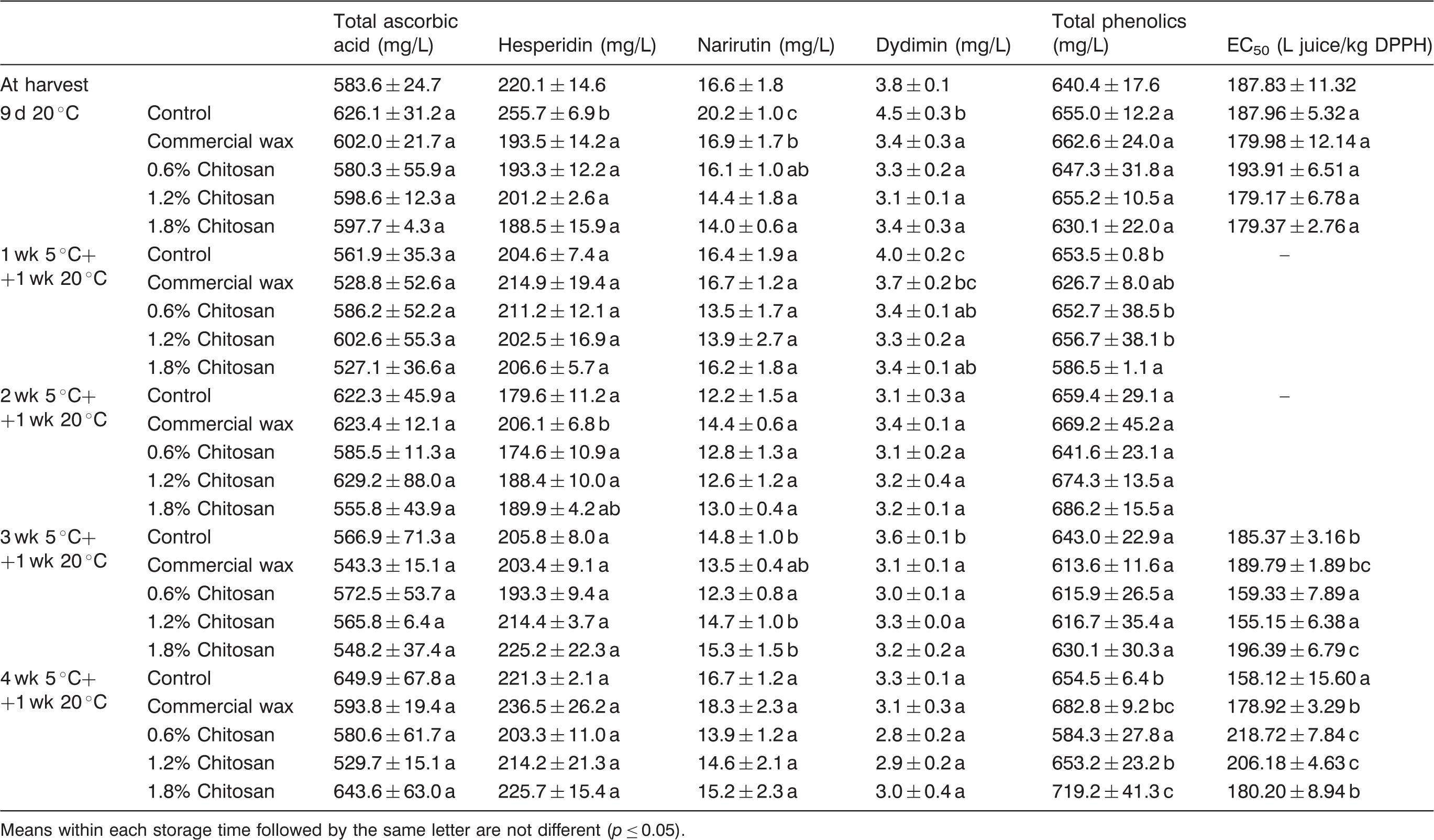
Total phenolics, flavonoids, ascorbic acid contents and antioxidant activity of coated and uncoated ‘Oronules’ mandarins after storage
Means within each storage time followed by the same letter are not different (p ≤ 0.05).
Hesperidin was the more abundant flavonoid in mandarins ‘Oronules’ followed by narirutin and didymin (Table 1). The contents of the different flavonoids were not affected by storage. In general coating application did not have an important effect on flavonoid levels, although some significant differences were found among treatments. Uncoated mandarins stored at 20 °C for 9 days contained higher content of hesperidine, narirutin and didymin than coated mandarins, which could be related to the higher weight loss of uncoated mandarins under this storage condition.
In addition to flavanones, citrus fruit also contain other phenolic compounds, such as flavones and hydroxycinnamic acids (represented by ferulic, caffeic, synapic, and p-coumaric acids) that, although present in a lower concentration, contribute to the total phenolic concentration (Gil-Izquierdo et al., 2002; Rapisarda et al., 1999). Several authors have reported that chitosan act as an exogenous elicitor in plant tissue inducing different responses, such as the de novo biosynthesis of phenolic compounds (Bautista-Baños et al., 2006; Lafontaine and Benhamou, 1996; Meng et al., 2008). In this work, some significant differences were found among treatments depending on storage time, which makes it difficult to draw any conclusion regarding the effect of coating composition (Table 1). Interestingly, at the end of the storage period, total phenolic content increased in mandarins coated with 1.8% Ch, which could be an indication of the chitosan activity as an exogenous elicitor of plant tissue.
The antioxidant capacity was expressed as EC50 or juice quantity necessary to reduce by 50% the DPPH
Conclusion
In general, the internal quality and the health-related properties of mandarins were not negatively affected by coating application, although the chitosan formulation should be improved by the incorporation of hydrophobic components to reduce weight loss. Ch-coated mandarins at the highest SC retained firmness after cold storage and contained more phenolics than uncoated ones, which could be related to the biostimulating properties of chitosan. Both commercial wax and the chitosan coating modified the internal atmosphere of the mandarins, with a greater effect at higher chitosan concentration, without affecting the sensory quality.
Footnotes
Acknowledgments
The authors thank Idebio S.L. and Fontestad S.A. for supplying the chitosan and fruit, respectively. Adriana Contreras was also funded by a scholarship from the Consejo Nacional de Ciencias y Tecnología (CONACyT).
Funding
This work was funded by the Consellería de Educación de la Generalitat Valenciana through the project GV/2007/187 and the European Social Fund.