







Abstract
The effect of the concentration temperature on the antioxidant activity, carotenoid and phenolic compounds of date syrup was investigated. Date juice was concentrated at 100 ℃ and at “60 ℃ in vacuum”. After concentration, total phenolic, tannin, non-tannin, flavonoid and carotenoid content were determined spectrophotometrically and high-performance liquid chromatography was used for determination of 5-Hydroxymethyl-2-furfuraldehyde content. The antioxidant activity of date syrup was evaluated by various antioxidant methods including total antioxidant, 2,2-diphenyl-1-picrylhydrazyl free radical scavenging test, ferric reducing antioxidant power and β-carotene bleaching. All date syrups showed strong antioxidant activity accompanied by high total phenolic contents. Results showed that concentration at 100 ℃ significantly enhanced the antioxidant activities and total phenolic contents of date syrups compared to vacuum concentration at 60 ℃. A good correlation between the antioxidant activity and total phenolic content and flavonoid was observed.
Keywords
Introduction
Dates (Phoenix dactylifera L.) are an important crop in the hot desert regions (arid and semi-arid regions) of the world and are marketed globally as a high-value fruit. It always plays an important part in the economic and social lives of the people of these regions. Tunisia is considered to be one of the date-producing countries, the mean annual yield of date fruits is about 120,000 tonnes (FAOSTAT, 2008). From this, around 36,000 tonnes is lost during picking, storage, commercialization and technologic transformation (Besbes et al., 2009; Masmoudi et al., 2008).
These important quantities of by-products are not consumed by humans because of the too hard texture, contamination with fungus and/or infestation by insect or simply due to their low quality. This category of dates is generally discarded or partially integrated in animal feed (Besbes et al., 2006). Some studies have been carried out to use these by-products to develop new products such as metabolites or biomass production (Abou Zeid et al., 1991; Besbes et al., 2009) or use a date of good quality to produce some products such as bakery, beverage, jam and the confections (Al-Hooti et al., 1997; Khatchadourian et al., 1983). Second-grade dates, beside nutritional components (carbohydrates, amino acid, proteins, dietary fibres …), contain various biologically active compounds (phenolic acids, flavonoids, carotenoids …), which possess antioxidant activity (Al-Farsi et al., 2005; Besbes et al., 2009).
Date syrup a food commodity locally known as «Rub Al Tamr» is produced in Libya, Iraq and Tunisia from some local date varieties (Barreveld, 1993).
The date syrup directly consumed or used as an ingredient in some food formulation such as: ice cream products, beverage, in confectionery, bakery products, sesame paste/date syrup blends, jam and butter (Barreveld, 1993).
During heat processing, food can be subjected to some chemical change. In the past few years, it is well know that the food processing e.g. heating, sterilization, cooking, radiation, roasting etc. generally can decrease significantly the concentration of nutriments and their biological activity (Tiwari et al., 2008). Many studies have shown that the heat processed fruits and vegetables are expected to have lower health-protecting capacity than fresh ones. This is because the most of the bioactive compounds are relatively unstable to heat. However, recent studies have shown that heat treated foods, especially fruits, vegetables and honey, have higher bioactive compounds and more biological activities (Choi et al., 2006; Rakić et al., 2007; Turkmen et al., 2006). This may be due to some chemical changes of processed foods. One of them is the non-enzymatic browning due the Maillard reaction and caramelisation. Caramelisation occurs on heat treatment of sugars at high temperatures and Maillard reaction taking place between reducing sugar and free amino acids (Toribio and Lozano, 1984).
Among the numerous formed Maillard reaction products (MRPs) and caramelisation products (CPs), some have been found to exhibit antioxidative activity (i.e. 5-Hydroxymethyl-2-furfuraldehyde (HMF) and melanoidins). The antioxidant proprieties could be due to radical scavenging activity (Benjakul et al., 2005; Morales and Jimenez-Pérez, 2001), scavenging of active oxygen species (Yilmaz and Toledo, 2005), metal chelating activity (Benjakul et al., 2005; Dittrich et al., 2003) as well as decomposition of hydroperoxide (Yoshimura et al., 1997). MRPs can be used to prevent lipid oxidation in food systems (Benjakul et al., 2005). HMF is a common product of these two reactions. It is formed from 3-deoxyhexosulose, the dehydration product derived from 1,2 enolization of glucose and fructose (Yaylayan, 1990).
On the other hand, the increase in the amount of bioactive compounds and biological activities can be related to the partial oxidation of polyphenols (Manzocco et al., 2001).
Processing methods can affect chemical constituents of food products. To preserve or improve the original activity of dates during preparation of date syrup, it is important to understand the effect of processing on functional components like total phenolic compounds and flavonoids. Some researchers have studied the effects of heat treatment of some fruits, vegetables and honey on the phenolics content and antioxidant capacity (Choi et al., 2006; Turkmen et al., 2006). However, no study dealing with the effects of the concentration temperature of date syrup on the chemical composition and antioxidant activity exist until now.
The aim of the present work was to evaluate the effect of concentration temperature on the changes in the overall antioxidant activities and antioxidant compounds (total phenolic, flavonoids and carotenoids) of date syrup. For this purpose, phenolics, flavonoids and carotenoids were determined spectrophotometrically. The antioxidant activity was measured by phosphomolybdenum method, 2,2-diphenyl-1-picrylhydrazyl free radical (DPPH), ferric reducing antioxidant power (FRAP) and β-carotene bleaching.
Materials and methods
Materials
Second-grade dates (hard texture) (Phoenix dactylifera L.) of the most abundant cultivars in Tunisia: Deglet Nour (DN), Allig (A) and Kentichi (K) were obtained from Tozeur region (Tunisia) and harvested in 2008. Dates were collected at full maturity “Tamr stage”. Ten kilograms from each variety were directly divided into bags of 500 g and stored at −20 ℃ until use.
Prior to syrup processing, the date fruits were gently defrosted, cleaned, pitted and crushed in a meat grinder (moulinex, type NE 401, France) to produce date paste.
Commercial pectinolytic enzymes, pectinase and cellulolytic enzymes from Aspergellus niger were obtained from Sigma Chemical Co., St Louis, MO, USA, and stored at 4 ℃.
Methods
Extraction of date syrup
Three independent experiments were conducted in each date sample.
Portion of 400 g of date paste were weighed and homogenised with 1200 ml of water. The pH was adjusted to 4, using citric acid, before the addition of enzyme preparation (50 U of pectinase/100 g and 5 U of cellulase/100 g). Samples were mixed thoroughly and placed in a thermostatically controlled water bath at 50 ℃ during 120 min. Then, the enzyme was inactivated by heating the suspension at 90 ℃ for 5 min. After completion of the enzymatic maceration, the produced juice was filtered by a filtering cloth and then centrifuged at 2907 g for 15 min. The supernatant juice was divided into two quantities, the first quantity was concentrated with mixing at 100 ℃ using a hotplate (Ufesa, Turkey) to 80°Brix and the second was concentrated with a rotary vacuum evaporator at 60 ℃ to 80°Brix (Abbès et al., 2011). The concentration of date juice was carried out in the dark using aluminium foil.
Determination of antioxidant components
Determination of total polyphenols contents
Total polyphenols were determined by Folin-ciocalteau procedure (Al-Farsi et al., 2005). Results were expressed as milligrams of gallic acid equivalents (GAE).
Determination of tannins
Total tannin content was determined by Folin-Ciocalteau procedure using insoluble polyvinyl-polypirrolidone (PVPP), which binds tannins (Maksimović et al., 2005). In all, 100 mg of PVPP was weighed into test tubes and 1 ml of aqueous solution of syrup was added and vortexed. After 15 min at 4 ℃, tubes were centrifuged for 10 min at 1500 g. In clear supernatant, non-tannin phenolics were determined the same way as the total phenolics. Calculated values were subtracted from total polyphenol contents. Total tannin contents were expressed as milligrams of GAE.
Determination of total flavonoid
Total flavonoids were determined according to the method of Zhishen et al. (1999). In brief, 1 ml of each sample (0.1 g/ml) was mixed with 4 ml of distilled water and 0.3 ml of Na NO2 (5%). After 5 min, 0.3 ml of AlCl3 (10 %) was added and allowed to stand for 1 min, then 2 ml of NaOH (4%) was added to the mixture. Immediately, 2.4 ml of water was added. The mixture was stirred and left to stand for 15 min. Absorbance was measured at 510 nm against a blank. The total flavonoid content was calculated on the basis of the standard curve for catechin solutions and expressed as catechin equivalents (mg catechin/100 g of syrup).
Determination of carotenoid content
Total carotenoids were extracted according to the method of Talcott and Howard (1999) with slight modification. In brief, 2 g of a sample and 25 ml of acetone/ethanol (1:1, v/v) with 200 mg/l butylated hydroxytoluene (BHT), which helped to protect the analytes from eventual oxidation, were ground with a mortar and pestle for 10 min. After extraction, sample was centrifuged at 1500 g for 15 min at 4 ℃. The residue was returned to the mortar and re-extracted with the extraction solvent until exhaustion of colour. Finally, the combined supernatants were made up to 100 ml with the extraction solvent. Absorbance was measured at 470 nm using a spectrophotometer (Shimadzu, UV mini 1240, Japan). Total carotenoids were calculated according to Al-Farsi et al. (2005), using the following equation, and expressed as milligrams per 100 g of fresh weight.

Ab is the absorbance at 470 nm, V is the total volume of extract, A1% is the extinction coefficient for a 1% mixture of carotenoids at 2500 and G is the weight of sample (g).
Evaluation of antioxidant properties
Determination of total antioxidant capacity
The total antioxidant capacity of date syrups samples was evaluated by the method of Prieto et al. (1999). The essay is based on the reduction of Mo(VI)-Mo(V) in the presence of antioxidants and subsequent formation of a green phosphate/Mo(V) complex at acid pH. The antioxidant capacity was expressed as equivalents of ascorbic acid (mg/g of sample).
Determination of the free radical-scavenging activity
Free radical scavenging activity of dates syrup was evaluated using the DPPH assay according to the method of Brand-Williams et al. (1995) with minor modifications. In the presence of an antioxidant, the purple colour of DPPH decays, and the change of absorbency can be followed spectrophotometrically. Different dilutions of syrup samples were prepared in distilled water. An aliquot of 0.1 ml of diluted sample was added to 1.9 ml of 130 µM DPPH dissolved in absolute ethanol and 1 ml of acetate buffer solution (100 mM, pH 5.5) and vortexed. The mixtures were left for 90 min at room temperature in the dark, after which the absorbency of the remaining DPPH was determined at 517 nm using a spectrophotometer (SHIMADZU, UV mini 1240, Japan) against a blank to eliminate the influence of date syrup colour. The blank constituted by the syrup at the same concentration, containing all reagents except DPPH. Distilled water was used as a control instead of syrup dates.
The radical scavenging activity was calculated as follows:

The radical scavenging activity of the samples on the DPPH was expressed as IC50 (The concentration of sample (mg/ml) needed to decrease the initial DPPH concentration by 50%) and was calculated by a linear regression analysis. All analyses were carried out in triplicate.
FRAP assay
The antioxidant activity of samples was investigated using the FRAP assay, which is based on the reduction of a ferric-tripyridyltriazine complex (Fe3+-TPTZ) to its ferrous (Fe2+-TPTZ) complex under acidic conditions, coloured form in the presence of antioxidants. Results were expressed in µM Fe2+/100 g fresh weight of syrup (Benzie and Strain, 1996).
β-carotene bleaching assay
In this assay, antioxidant capacity is determined by measuring the inhibition of the volatile organic compounds and the conjugated diene hydroperoxides arising from linoleic acid oxidation. The antioxidant activity of date syrup was determined according to the method of Jayaprakasha et al. (2001). β-carotene (0.2 mg), 20 mg of linoleic acid and 200 mg of tween-40 were mixed in 1 ml chloroform and the solvent was removed using nitrogen gas. The resulting mixture was topped up to 50 ml with oxygenated water and mixed well. The emulsion obtained was freshly prepared before each experiment. The β-carotene linoleic acid emultion (5 ml) was transferred into different test tubes containing 0.2 ml of test sample (date syrup) at different concentrations. A solution with 0.2 ml of water and 5 ml of the above emulsion was used as control. The tubes were covered with aluminium foil and were placed at 50 ℃ in a water bath. Absorbance was taken at Zero time (t = 0) at 470 nm. Measurement of absorbance was continued until the colour of β-carotene disappeared in the control reaction (t = 180 min). A mixture prepared as above without β-carotene served as blank. The antioxidant activity (AA) was expressed in terms of the bleaching of β-carotene as follows:

HMF analysis
HMF was analysed by high-performance liquid chromatography (HPLC) method (Rada-Mendoza et al., 2002). One gram of date syrup was placed in a 25-ml flask; 2 ml each of Carrez I and II reagents were added with stirring and the volume made up with Milli-Q water. The mixture was left for 30 min, after which the supernatant was filtered through a 0.45 µm membrane and subjected to chromatographic analyses. Quantitative evaluation of HMF was carried out by using an HPLC system equipped with Zorbax 300SB-C18 column (150 × 4.6 mm) and UV detecteur PDA. The elution solvent used was methanol/water (10/90; v/v). The samples were eluted with a constant flow of 1 ml/min. Volume injection was 20 µL. The amount of HMF was determined using an external calibration curve, measuring the signal at λ = 285 nm.
Browning
Formation of browning pigments was determined by measuring the absorbance at 420 nm using a SHIMADZU spectrophotometer UV-Vis (SHIMADZU UV mini 1240, Japon).
Statistical analysis
Results were given as means ± standard deviation of three independent determinations. One way analysis of variance (ANOVA) was used to compare the means. The means were separated by Duncan’s multiple range test. Differences were considered to be significant at p < 0.05. All statistical analyses were performed using the Statistical Package for the Social Sciences (SPSS) 11.0.
Result and discussion
Total phenolic content
Content of total and non-tannin phenolic, tannins, total flavonoid and carotenoid (mg of carotenoid/100 g) in different prepared date syrup.
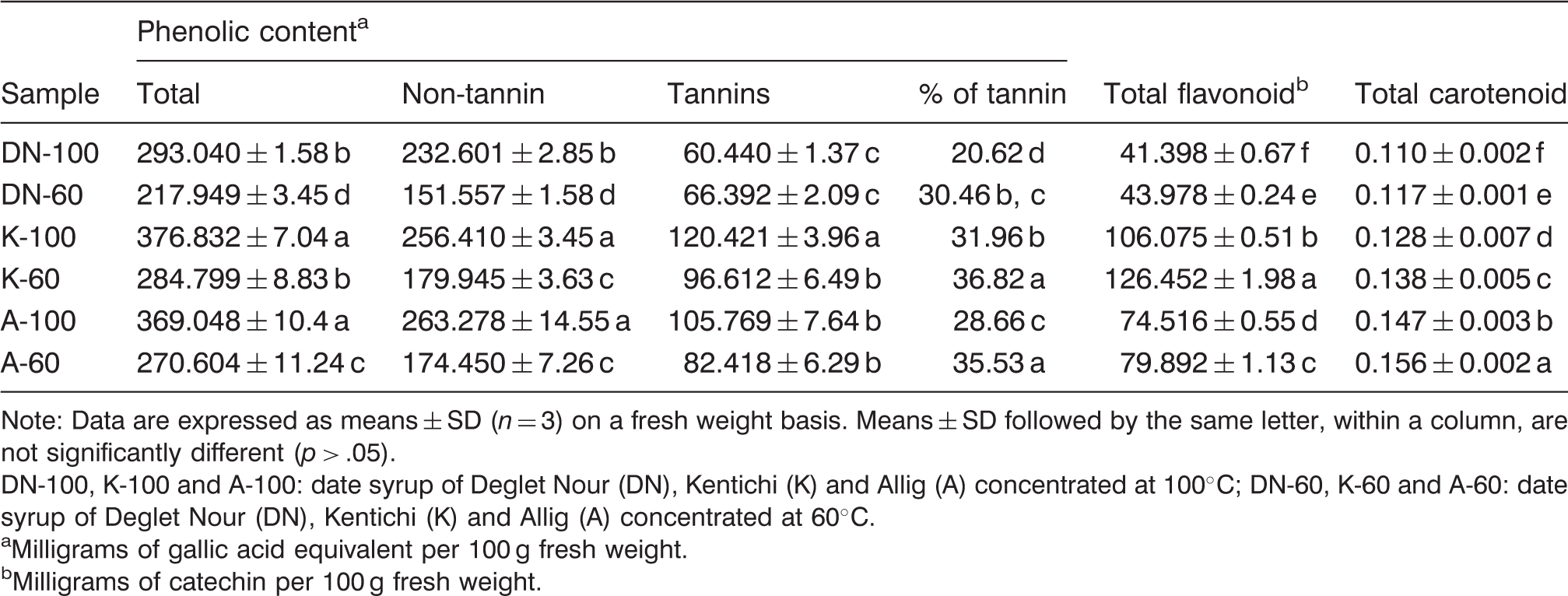
Note: Data are expressed as means ± SD (n = 3) on a fresh weight basis. Means ± SD followed by the same letter, within a column, are not significantly different (p > .05).
DN-100, K-100 and A-100: date syrup of Deglet Nour (DN), Kentichi (K) and Allig (A) concentrated at 100℃; DN-60, K-60 and A-60: date syrup of Deglet Nour (DN), Kentichi (K) and Allig (A) concentrated at 60℃.
Milligrams of gallic acid equivalent per 100 g fresh weight.
Milligrams of catechin per 100 g fresh weight.
The results obtained showed that the total flavonoid content was affected significantly (p < 0.05) by concentration temperature as well as the varieties (Table 1). The lowest value was determined in date syrup from “Deglet Nour” concentrated at 100 ℃ (41.398 mg catechin/100 g); the highest value was obtained from “Kentichi” date syrup concentrated at 60 ℃ (126.452 mg catechin/100 g). Concentration at 100 ℃ caused a significant (p < 0.05) loss (ranging from 5.86 to 16.11%) of flavonoids in date syrup. This reduction of flavonoids can be attributed to their destruction during concentration.
Total carotenoid content
Table 1 also shows the content of carotenoid in date syrup of Deglet Nour, Kentichi and Allig concentrated at various temperatures.
The content of carotenoids was affected significantly (p < 0.05) by the different treatments as well as date varieties (Table 1). Date syrup from Allig possessed a significantly higher content of carotenoids than Deglet Nour and Kentichi, whatever the concentration method.
For same varieties, date syrup concentrated at 60 ℃ had higher carotenoid content compared to the date syrup concentrated at 100 ℃. This may be due to the carotenoids degradation probably due to the low stability of carotenoids at high temperatures.
Similar results were observed after a heat treatment of tomatoes tamarillo fruit (Mertz et al., 2010; Shi and Le Maguer, 2000). According to Sian and Ishak (1991), the content of total carotenoids in papaya was decreased from 106.7 to about 89.5 µg/g dry weight and from 106.7 to about 86.2 µg/g dry weight after blanching and drying at 100 ℃ for 8 min, respectively. Al-Farsi et al. (2005) reported a significant (p < 0.05) loss in sun-dried Fard and Khasab varieties except Khalas, which was insignificant (p > 0.05). This difference could be due to enzymatic processes (catalase and peroxidase) and autoxidation during sun-drying of dates.
The obtained results suggest that the concentration at 100 ℃ gave the higher content of bioactive compounds (polyphenols). In order to obtain syrup with commercial value (with high nutritional quality), it is necessary to test the effect of concentration temperature on the antioxidant capacity of date syrups.
Antioxidant activity
Total antioxidant activity
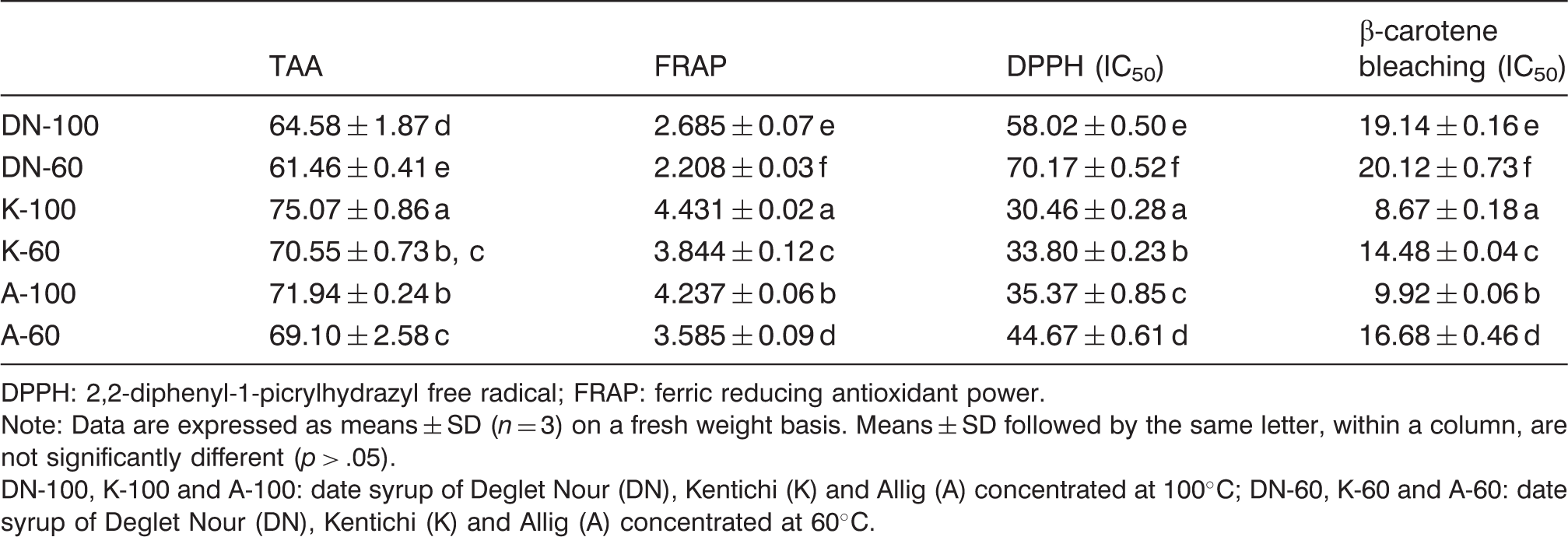
Total antioxidant capacity (TAA, mg of ascorbic acid/g), FRAP value (mM Fe(II)/100 g) and IC50 values (mg/ml) of different prepared date syrup.
DPPH: 2,2-diphenyl-1-picrylhydrazyl free radical; FRAP: ferric reducing antioxidant power.
Note: Data are expressed as means ± SD (n = 3) on a fresh weight basis. Means ± SD followed by the same letter, within a column, are not significantly different (p > .05).
DN-100, K-100 and A-100: date syrup of Deglet Nour (DN), Kentichi (K) and Allig (A) concentrated at 100℃; DN-60, K-60 and A-60: date syrup of Deglet Nour (DN), Kentichi (K) and Allig (A) concentrated at 60℃.
The relationship between TAA of various date syrup and total phenol contents was examined, and a positive correlation between them was observed (R2 = 0.7303, data not shown). This is in agreement with the results findings of other authors (Kumaran and Karunakaran, 2007), who also found a strong correlation between TAA and total phenolic contents in the case of extracts of five plants from the genus Phyllanthus from India. The good correlation coefficient indicates that phenolics are one of the main compounds responsible for the antioxidant activity of date syrup. For correlation between TAA and flavonoid content, the good coefficient (R2 = 0.6142, data not shown) indicates that flavonoids contribute to the antioxidant behaviour of date syrup. However, Kumaran and Karunakaran (2007) have reported that there is no correlation between the content of flavonoid and TAA.
DPPH radical scavenging activity
DPPH is a stable organic free radical and it is widely used for evaluation of antioxidant activity of various samples. Figure 1 shows the dose-response curve of DPPH scavenging activities of various date syrup. It is noticed that all the date syrups exhibited a potential free radical scavenging activity and were capable of scavenging free radical in an amount-dependent manner. The results revealed that date syrup with the highest effective radical scavenging activity was the one from Kentichi-100. In fact, at the dose 50 mg/ml, the scavenging effect of date syrup with the DPPH radical is as follows: K-100 (79.58%), A-100 (69.05%), K-60 (57.59%), A-60 (55.53%), DN-100 (51.19%) and DN-60 (38.20%). The results indicated that the high scavenging activity was found in dates syrups concentrated at 100 ℃.
Free radical scavenging activities of different prepared date syrup. Values are means of three replications ± SD. DN-100, K-100 and A-100: date syrup of Deglet Nour (DN), Kentichi (K)and Allig (A) concentrated at 100 ℃; DN-60, K-60 and A-60: date syrup of Deglet Nour (DN), Kentichi (K) and Allig (A) concentrated at 60 ℃.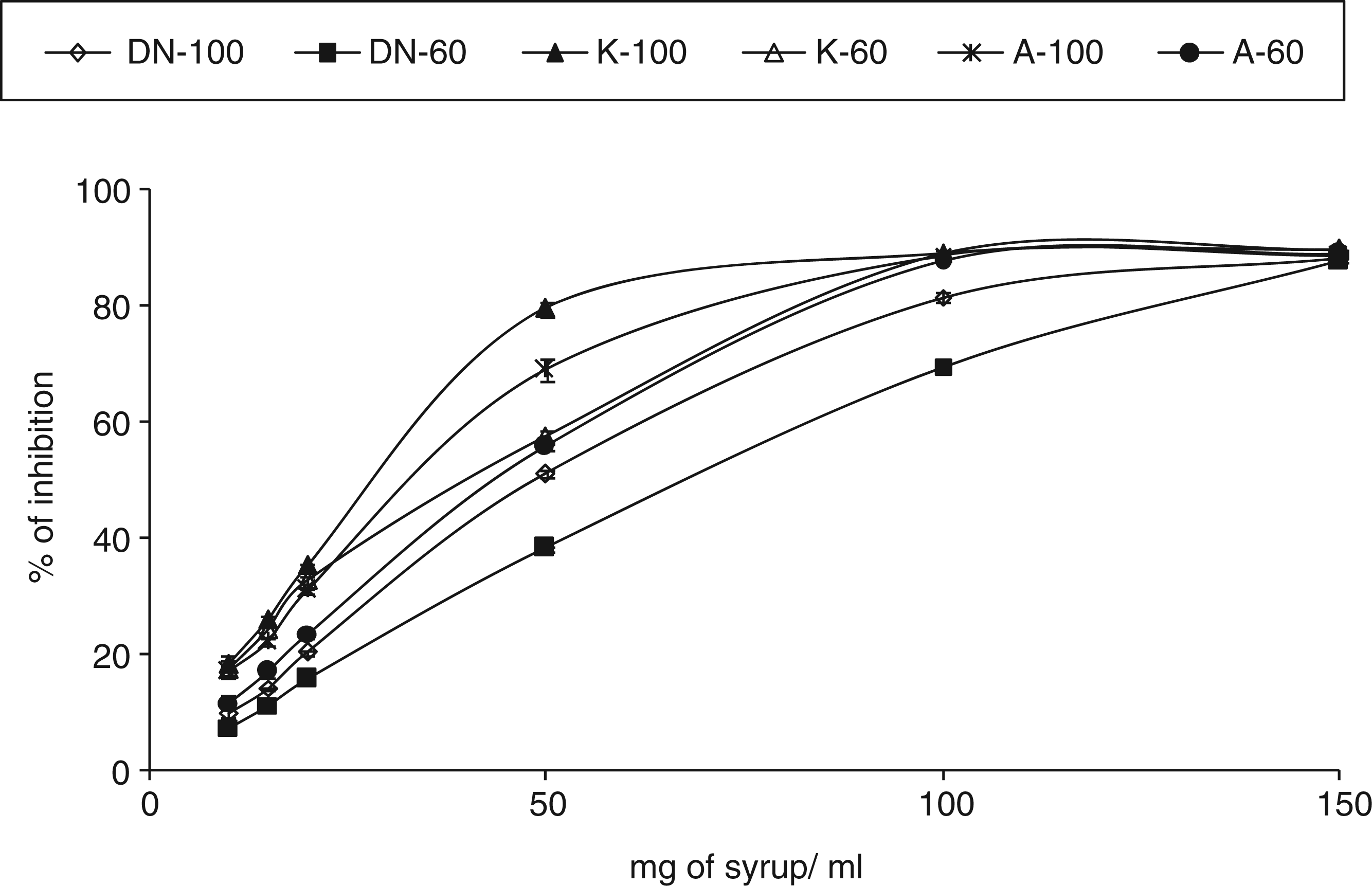
DPPH is usually expressed as IC50, the amount of antioxidant necessary to decrease the initial concentration of DPPH by 50%. When the IC50 value of the sample was lower, the antioxidant activity was higher. Table 2 presents the IC50 values of different date syrup, for the same variety, date syrup concentrated at 60 ℃ from Deglet Nour, Kentichi and Allig were least active. Their IC50 values were 70.17, 33.80 and 44.67 mg/ml, respectively, and were significantly (p < 0.05) higher than the IC50 of date syrup concentrated at 100 ℃.
The relationship between DPPH radical scavenging activity of various dates syrups and total phenolic contents was examined, and a positive correlation between them was observed (R2 = 0.907, data not shown). The high correlation coefficient indicates that phenolics are one of the main compounds responsible for the scavenging effect of date syrups. Many authors (Bertoncelj et al., 2007; Namiki, 1990; Rekha et al., 2010) have observed a direct correlation between free radical scavenging activity and total phenolic content. The free radical scavenging activity of phenolics are generally due to their redox proprieties, hydrogen donators and single oxygen quenchers (Rice-Evans et al., 1995).
Reducing power
To determine the reducing power we used the FRAP assay, a simple direct test that is widely used for antioxidant activity determination in many different samples (Bertoncelj et al., 2007; Maksimović et al., 2005). As shown in Table 2, the antioxidant activity determined by the FRAP assay was different according to the varieties as well as the concentration temperature, but in general for the same variety it was also higher in date syrup concentrated at 100 ℃. The reducing power of different date syrup is in the following order: K-100 (4.431 mM Fe(II)/100 g), A-100 (4.237 mM Fe(II)/100 g), K-60 (3.844 mM Fe(II)/100 g), A-60 (3.585 mM Fe(II)/100 g), DN-100 (2.685 mM Fe(II)/100 g) and DN-60 (2.208 mM Fe(II)/100 g). The results are in agreement with the results of DPPH scavenging activities (Figure 1). Positive correlations between phenolic content and FRAP values (R2 = 0.8223, data not shown) and between flavonoid and FRAP values (R2 = 0.7851, data not shown) were observed. The results obtained indicate that the phenolics and flavonoid are the components responsible for the antioxidant effects of date syrup. Our results are in agreement with those of other authors which demonstrated a strong correlation between antioxidant activity and reducing power of certain samples (Bertoncelj et al., 2007; Blasa et al., 2006; Fawole et al., 2011). The reducing proprieties are generally due to the ability of reductones to exert antioxidants action by breaking the free radical chain by donating a hydrogen atom.
Antioxidant activity measured by β-carotene bleaching method
Figure 2 shows the antioxidant activity of various date syrup determined by the β-carotene/linoleic acid system. In this test, the presence of different antioxidants neutralizes the linoleate free radical and other free radicals formed in the system that can delay the extent of β-carotene bleaching (Denyer and Stewart, 1998). The results obtained with date syrup indicated a concentration-dependent antioxidant capacity (Figure 2). Like the DPPH scavenging activities, high inhibition of bleaching of β-carotene was found in the date syrup concentrated at 100 ℃, for same variety. At the dose 50 mg/ml, the inhibition of bleaching of β-carotene of date syrup is as follows: K-100 (86.15%), A-100 (83.07%), K-60 (64.63%), A-60 (59.5%), DN-100 (63.38%) and DN-60 (54.00%).
Antioxidant activities of various date syrup measured by β-carotene bleaching method. Values are means of three replications ± SD. DN-100, K-100 and A-100: date syrup of Deglet Nour (DN), Kentichi (K) and Allig (A) concentrated at 100 ℃; DN-60, K-60 and A-60: date syrup of Deglet Nour (DN), Kentichi (K) and Allig (A) concentrated at 60 ℃.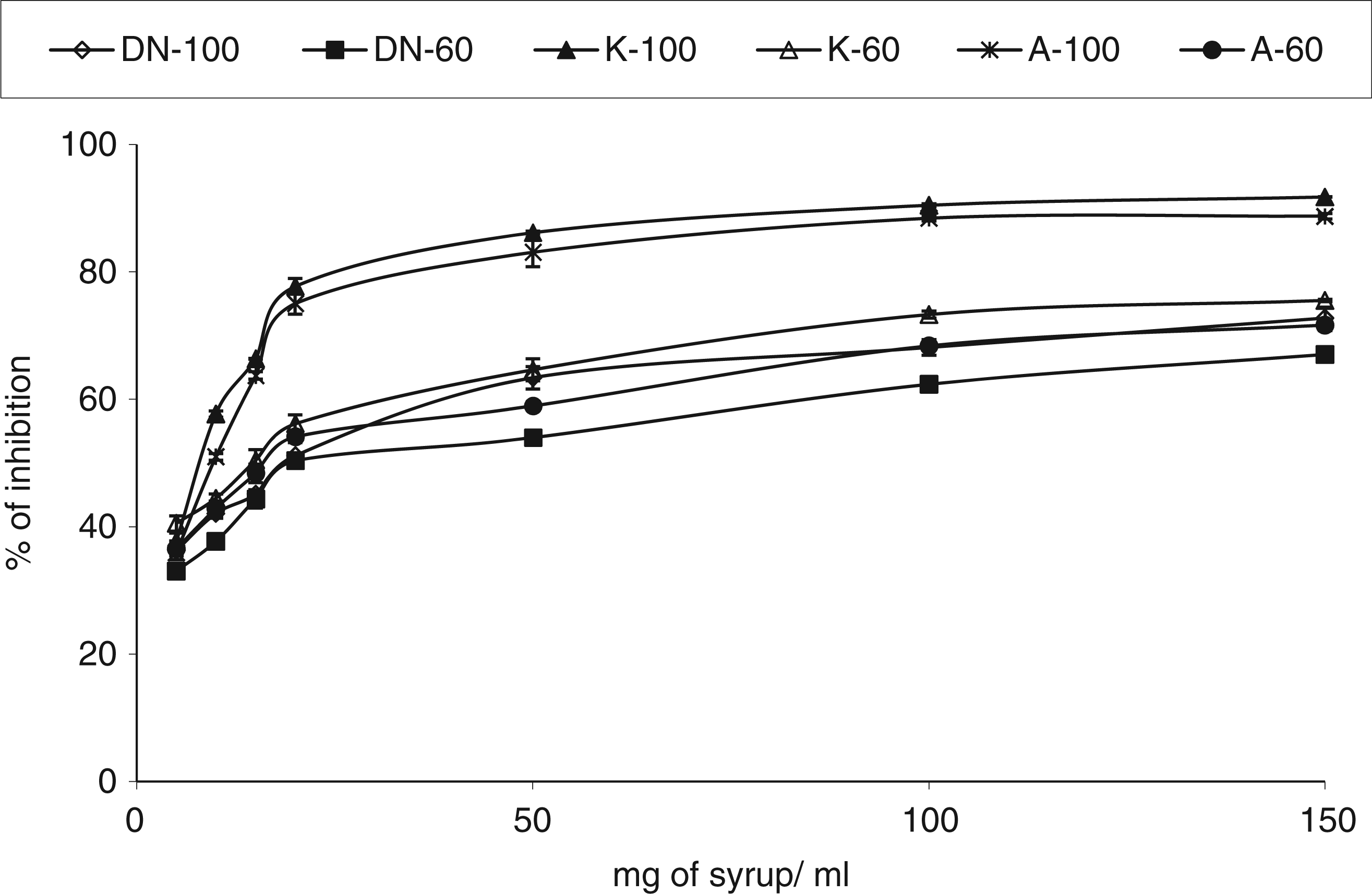
Table 2 presents the IC50 values of different date syrup, for the same variety, date syrup concentrated at 60 ℃ from Deglet Nour, Kentichi and Allig were least active. Their IC50 values were 20.12, 14.48 and 16.68 mg/ml, respectively, and were significantly (p < 0.05) higher than the IC50 of date syrup concentrated at 100 ℃.
Positive correlations between phenolic contents and antioxidant activity as inhibition of β-carotene bleaching values (R2 = 0.9647, data not shown) was observed. The high correlation coefficient indicates that phenolics are one of the main compounds responsible for the inhibition of lipid oxidation. The inhibitory effects on lipid peroxidation and antioxidation of linoleic acid have been attributed to the scavenging activity (Hatano et al., 2002).
The results presented indicate that a concentration of date juice at 100 ℃ significantly enhanced the overall antioxidant activities of date syrup. First of all, this may be attributed to the increased amount and availability of bioactive compounds such as phenolics which possess antioxidant activity. Several studies have shown that polyphenols play a major role in human health. In fact, the consumption of polyphenol-rich foods is associated with reduced risks of certain diseases, including cancer and cardiovascular and cerebrovascular diseases, by reduction of oxidative stress and inhibition of macromolecular oxidation (Al-Farsi et al., 2005; Bertoncelj et al., 2007). The antioxidant activities of polyphenols are associated to a number of mechanisms such as free radical-scavenging, hydrogen-donation, singlet oxygen quenching, metal ion chelation and acting as a substrate for radicals such as superoxide and hydroxyl. On the other hand, the improved antioxidant activity of date syrup concentrated at 100 ℃ could be due to the formation of novel compounds having antioxidant activity. In this study, a variety of brown pigment can be formed during non-enzymatic browning due to caramelisation and/or Maillard reaction.
HMF content
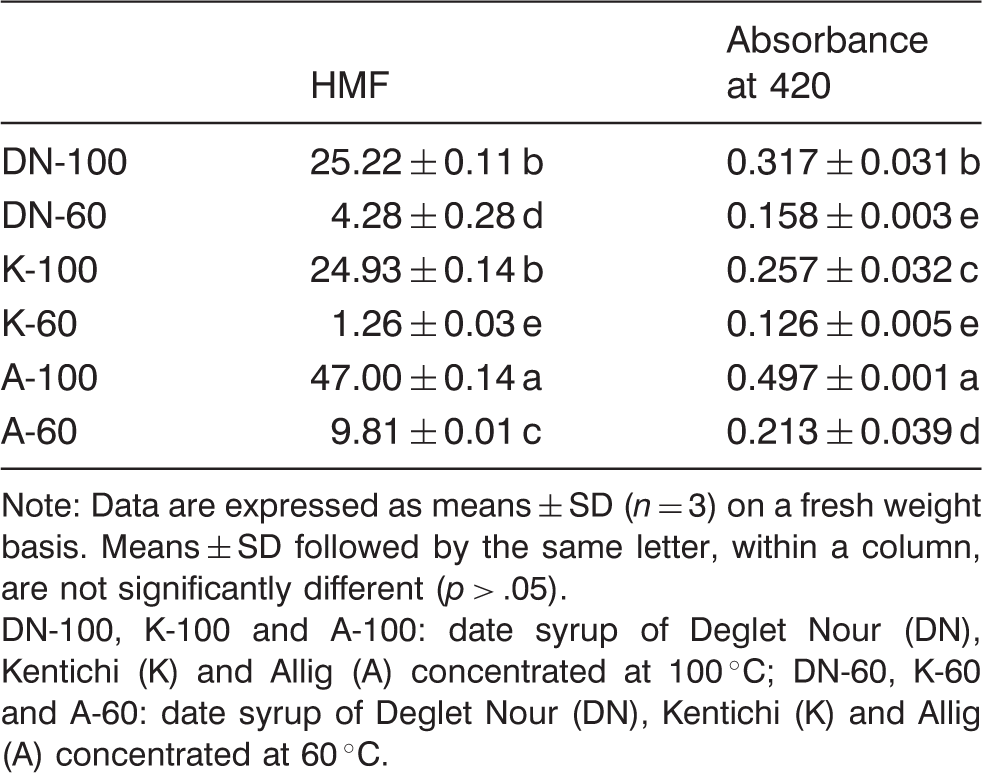
Figure 3 showed a high-performance liquid chromatogram sample of 5-hydroxymethyl-2-furfuraldehyde content (HMF) from date syrup of Deglet Nour concentrated at 100 (DN-100). The HMF content of date syrup ranged from 1.29 mg/100 g to 47.1 mg/100 g (Table 3). The total level of HMF were highest in date syrup concentrated at 100 ℃ whatever the varieties and lowest in date syrup concentrated at 60 ℃. In fact, their content was ca. 5.64 fold higher in DN-100 than that found in DN-60, ca. 19.41 fold higher in K-100 than in K-60 and ca. 4.8 fold higher in A-100 than in A-60. The high HMF content of date syrup concentrated at 100 ℃ may be attributed to the heat temperature.
High-performance liquid chromatography (HPLC) chromatogram of 5-hydroxymethyl-2-furfuraldehyde content (HMF) of DN-100 (DN-100: date syrup of Deglet Nour concentrated at 100 ℃) detected at 285 nm. Content of hydroxymethylfurfural (HMF) (mg/100 g) and browning of various date syrup. Note: Data are expressed as means ± SD (n = 3) on a fresh weight basis. Means ± SD followed by the same letter, within a column, are not significantly different (p > .05). DN-100, K-100 and A-100: date syrup of Deglet Nour (DN), Kentichi (K) and Allig (A) concentrated at 100 ℃; DN-60, K-60 and A-60: date syrup of Deglet Nour (DN), Kentichi (K) and Allig (A) concentrated at 60 ℃.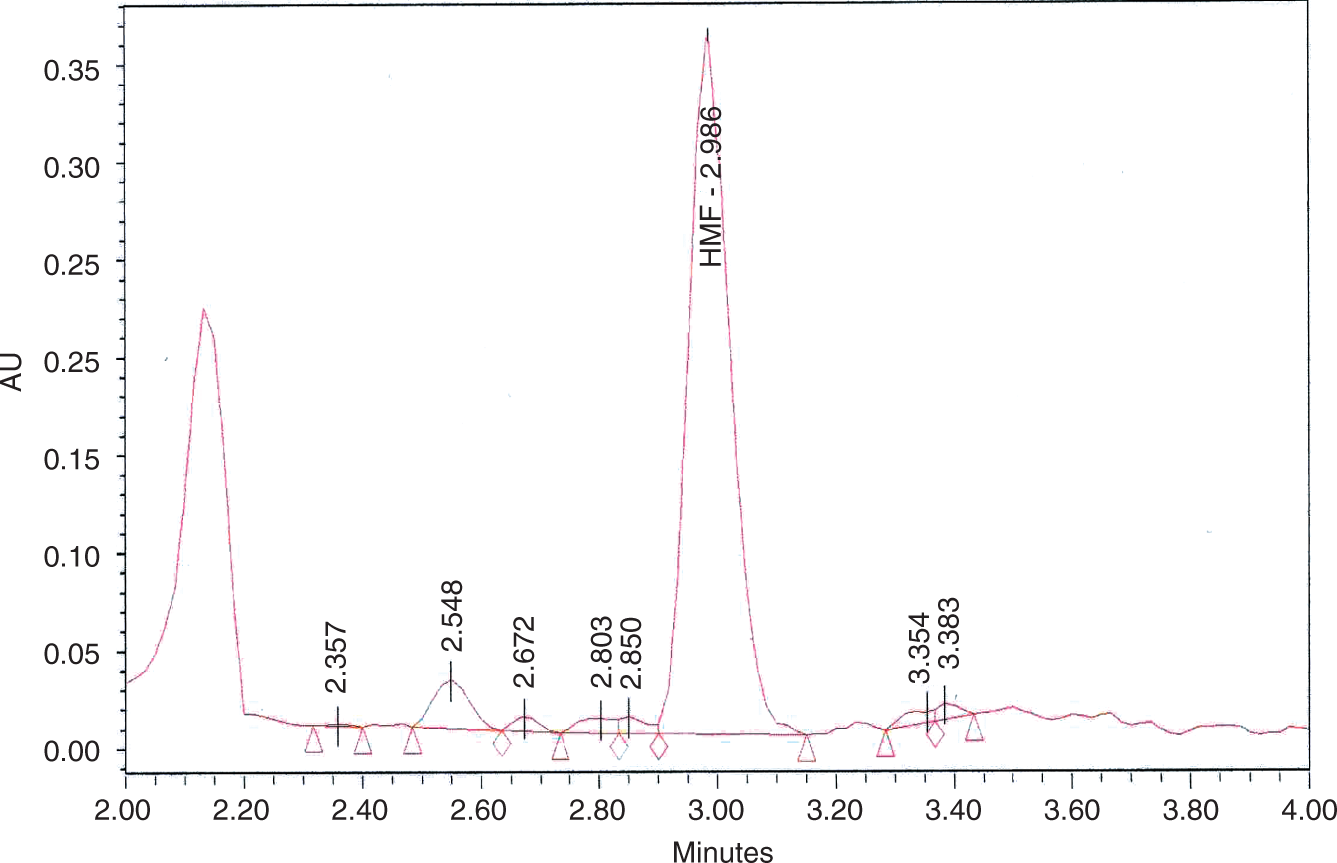
Many studies have shown that HMF exhibit strong antioxidant properties (Chen et al., 2009; Liu et al., 2010; Wang et al., 2004). In this study, positive correlations between HMF and antioxidant activity as inhibition of β-carotene bleaching (R2 = 0.5661, data not shown), DPPH scavenging activities (R2 = 0.3358, data not shown), TAA (R2 = 0.1625, data not shown), FRAP (R2 = 0.1819, data not shown) were observed. These low correlation coefficients can be attributed to the presence of various molecules with antioxidant activity such as phenolic compound, carotenoids and flavonoids.
The content of MRPs such as HMF depends on food composition and processing conditions i.e. coffee (100–1900 mg/kg), chicory (200–22500 mg/kg), malt (100–6300 mg/kg), breakfast cereals (6.9–240.5 mg/kg), bread (white) (3.4–68.8 mg/kg) and bread (toast) (11.8–87.7 mg/kg) (Kanjahn et al., 1996; Ramírez-Jiménez et al., 2000). These levels reported in coffee, chicory and malt are higher compared to those found in our samples (1.26 to 47 mg/100 g of fresh weight).
Data about MRPs’ effects on human health are quite contradictory. Many studies have shown that MRPs exhibit antioxidative properties and antimutagenic effect (Ames, 2009; Yen and Tsai 1993). It is not clear whether a human exposure to 5-HMF represents a potential health risk. Ulbricht et al. (1984) have shown that, at high concentrations, 5-HMF is cytotoxic, causing irritation to eyes, upper respiratory tract, skin and mucous membranes. They have also determined an oral LD50 of 3.1 g/kg of body mass in rats. In another experiment in rats, US EPA (1992) estimated an acute oral LD50 of 2.5 g/kg and between 2.5 and 5.0 g/kg for males and females, respectively. Data from epidemiological studies or case reports on potential association of 5-HMF with cancer risk in humans is not available.
In general term, the formation of HMF in Maillard reaction or caramelisation reaction have been associated to the formation of browning pigments such as melanoidins, which exhibit antioxidant activity (Jing et al., 2011; Morales and Jiménez-Pérez, 2004).
Browning
Browning, measured at 420 nm, is shown in Table 3. Like HMF content, high brown pigment formation was found in the date syrup concentrated at 100 ℃, for same variety. In this study, a positive correlation between HMF content and browning (R2 = 0.960, data not shown) was observed. The high correlation coefficient can be due to the formation of brown pigment during non-enzymatic browning at the same time of the formation of HMF compound. The correlation between browning and antioxidant activity as inhibition of β-carotene bleaching (R2 = 0.395, data not shown), DPPH scavenging activities (R2 = 0.202, data not shown), TAA (R2 = 0.086, data not shown), FRAP (R2 = 0.108, data not shown) was determined. The low correlation coefficient can be attributed to the different colour of dates varieties on the one hand and to the different kinetics of the two reactions (Maillard reaction and caramelisation) on the other hand.
Conclusion
It is well known that the food processing, generally, can decrease significantly the concentration of nutriments and their biological activity. This is because most of the bioactive compounds are relatively unstable to heat. The results presented indicate that the concentration at 100 ℃ can improve the content of antioxidant compound and increase the antioxidant activity. Moreover, the formation of novel compounds of MRPs such as HMF having antioxidant activity during Maillard reaction and caramelisation can improve the overall antioxidant activity. Results indicated the potentiality to prepare value-added products, especially date syrup, from three date by-products with high polyphenols contents and high antioxidant potential for producing specific health-promoting antioxidants in the food industry.
Footnotes
Funding
This work was supported by the ministry of the higher education and the scientific research (Tunisia) and CGRI Belguim French community (Belgium).