






Abstract
The effect of gamma irradiation (0–2 kGy) and storage time (0–28 days) on microbial growth and physicochemical characteristics of a packed pumpkin puree was studied. For that purpose, a factorial design was applied. The puree contained potassium sorbate, glucose and vanillin was stored at 25 ℃. Gamma irradiation diminished and storage time increased microbial growth. A synergistic effect between both variables on microbial growth was observed. Storage time decreased pH and color of purees. Sorbate content decreased with storage time and gamma irradiation. Mathematical models of microbial growth generated by the factorial design allowed estimating that a puree absorbing 1.63 kGy would have a shelf-life of 4 days. In order to improve this time, some changes in the applied hurdles were assayed. These included a thermal treatment before irradiation, a reduction of irradiation dose to 0.75 kGy and a decrease in storage temperature at 20 ℃. As a result, the shelf-life of purees increased to 28 days.
Introduction
Pumpkin (Cucurbita moschata Duchesne ex Poiret) is a vegetable that comes from tropical and subtropical zones like Mexico and South America. Its production and consumption have significantly grown in the last decades in Argentina. It is cheap, available throughout the year and it is a good source of nutrients, such as carotenoids, potassium ion and vitamins. It has low calories and is also an important source of fiber. Pumpkin has numerous culinary uses either alone or as an ingredient in pies, soups, stews and breads. Its consumption as a puree is highly usual, especially for kids and immunosuppressed people (de Escalada Pla et al., 2007; González et al., 2001).
Pumpkin puree is very sensitive to microbial spoilage due to its high water activity and its pH close to neutrality. In addition, physiological and biochemical changes take place even under refrigerated conditions. Its shelf-life is likely to be improved by applying minimal preservation processes based on the ‘hurdle’ concept. The combination of different preservation factors such as water activity reduction through solutes addition, pH depression, addition of lipophilic weak acids and the application of thermal and nonthermal technologies for microbial inactivation like gamma irradiation, have been used to increase the shelf-life of many minimally processed vegetables, such as grated carrots (Lacroix and Lafortune, 2004), pumpkin puree (Dutta et al., 2006), mango puree and pulp and orange juice (Noomhorm et al., 1998; Thakur and Arya, 1993; Youssef et al., 2002).
Gamma irradiation is a safe and effective emerging technology for food preservation. It can penetrate into the food and interact with microorganisms, disrupting its genetic material. The use of irradiation was proposed as the safest method for reducing the risk of foodborne pathogens, such as E. coli in fresh fruits and vegetables (Eyre, 2008). However, the interaction between irradiation and food components could cause the development of undesirable sensory and chemical changes in some foods (Thakur and Singh, 1995). Moreover, the resistance of a microbial cell to irradiation depends on its characteristics, process parameters and the extracellular environmental, i.e. temperature, water activity, pH, presence of oxygen and sorbates (Lacroix and Lafortune, 2004; Mañas and Pagan, 2005). The addition of sorbates before irradiation prevents off-odor development, improves the sensory quality and extends food shelf-life (Thakur and Arya, 1993; Thakur and Singh, 1995). However, sorbic acid can suffer radiolytic degradation depending on the composition of the system (Thakur et al., 1990; Singh et al., 1991).
The color of pumpkin puree is a parameter involved in its quality. β-Carotene is responsible for the orange color of pumpkin (González et al., 2001) and it has beneficial effects on health. However, its stability can be affected by isomerization and oxidation reactions during processing and storage promoting nutritional losses and undesirable changes in sensory properties (Ahmed et al., 2002; Dutta et al., 2006; Melendez-Martinez et al., 2004).
The effect of gamma irradiation and storage on the quality of purees and pulps has only been reported for tropical fruits such as mango and papaya, and no information is available on pumpkin puree. The objective of this work was to evaluate the effect of gamma irradiation and storage on the microbial growth and physicochemical characteristics of pumpkin puree.
Materials and methods
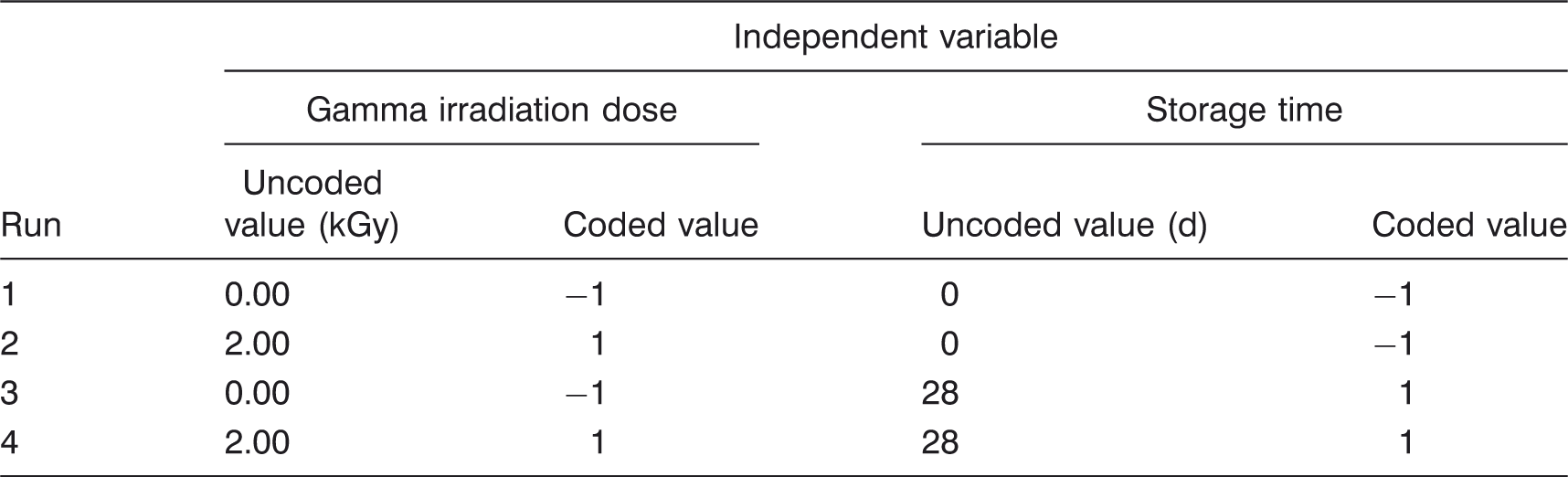
To perform the study, in a first step, a two-level, full factorial design was applied. The evolution of indigenous flora, pH, color and potassium sorbate (KS) content were measured in a packed pumpkin puree with a pH 5.00, stored at 25 ℃. Taking into account the results that were obtained, some changes in the applied hurdles were assayed in a second step: the inclusion of a thermal treatment before irradiation, the reduction of the irradiation dose and the decrease in storage temperature.
Preparation of pumpkin purees
Fresh pumpkins (Cucurbita moschata Duchesne ex Poiret) were purchased from a local market (Buenos Aires, Argentina). They were washed thoroughly with soap and tap water and rinsed with chlorinated water (0.05 g/kg of NaOCl). The pumpkin’s mesocarp was cut, in perpendicular direction to the axis, in 2-cm-thick slices. These slices were peeled off and 3-cm-diameter cylinders (≈12.5 g) were cut from each slice. They were exposed to steam at atmospheric pressure for 12 min, cooled by immersion in chlorinated water for 3 min and dried with tissue paper to remove excess water. After that, the cylinders were placed into a 500 mL beaker containing glucose (10 g/100 g of system); KS (0.12 g/100 g of system) and vanillin (0.050 g/100 g of system) and the ingredients were homogenized with a Sorvall Omni Mixer (OMNI Corporation, Connecticut, USA). The addition of glucose and vanillin was done following the results from a previous study on the preservation of pumpkin puree by hurdle technology (Gliemmo et al., 2010). The pH was adjusted to 5.00 by the addition of citric acid. The puree (50 g) was packed in polyvinyl chloride–polyvinylidene chloride copolymer bags (BB4L, Cryovac Inc., Sealed Air Corporation; thickness: 59 µm; oxygen permeability at 23 ℃: 30.4 cm3/m2.d.atm). The choice of depressing the pH to 5.0 by the addition of citric acid and the use of bags with low permeability to oxygen was based on previous studies suggesting that these conditions protect the color of puree (Gliemmo et al., 2009). Once bags were heat sealed, two treatments were applied: (i) irradiation and (ii) thermal treatment + irradiation.
The concentration of all the components were within the level admitted by the Argentine Food Code (2007) for low sugar products. Every ingredient used was reagent grade: KS and vanillin were from Sigma (St. Louis, Mo., USA); glucose and citric acid, from Anedra (Buenos Aires, Argentina).
Puree treatments
Irradiation and experimental design
The bags, placed in boxes, were exposed to gamma irradiation from a 550,000 Ci Cobalt 60 source (Semi-industrial facility, Ezeiza Atomic Centre, Argentina) at 25 ℃. The bags received a dose of 2.00 kGy that was confirmed by Ag2Cr2O7 dosimetry under the standards of the American Society for Testing and Materials (ASTM EL1401-91e1, 1995). The dose rate was 8.61 kGy/h.
The boxes were rotated 180° during the process to ensure dose uniformity (maximum dose/minimum dose). The uniformity attained was 1.08. After irradiation, the bags were stored at 25 ± 1 ℃ in a forced convection constant temperature chamber. The puree was sampled at selected times for microbiological and physicochemical analyses.
Two-level full factorial design used to evaluate the effects of gamma irradiation and storage time on microbial growth and physicochemical characteristics of pumpkin puree
Thermal treatment and irradiation
Nine sealed bags were heated in a bath at 50 ± 1 ℃ for 15 min before the irradiation treatment. Immediately after that, six bags received a dose of 0.75 kGy with a dose rate of 9.72 kGy/h using the above mentioned methodology. The dose uniformity was 1.06 kGy. Three nonirradiated bags were used as control.
All thermal treated bags were stored at 20 ± 1 ℃ in a forced convection constant temperature chamber. The puree was sampled at the initial time and after 28 days of storage, in triplicate. Microbiological and physicochemical analyses were performed.
Microbiological analysis
The puree samples (5 g) were aseptically taken from each bag and placed in a sterile bag containing 45 mL of 0.1% w/v peptone water. The content of the bags were blended for 1 min using a stomacher device. Then serial dilutions were prepared in 0.1% w/v of peptone water to determine the level of indigenous flora. The aerobic and anaerobic mesophilic bacteria were investigated in PCA (plate count agar). The anaerobic bacteria incubation was performed in an anaerobiosis jar with an anaerobic atmosphere generator (BioMérieux® S.A., France). Lactic acid and coliform bacteria were investigated in MRS (deMan, Rogosa and Sharpe) and VRBL (violet red bile agar), respectively. The plates were incubated at 30 ℃ for 48 h. The yeasts and molds were determined by surface plate count on Sabouraud agar after 5 days of incubation at 25 ℃. All the culture media used were from Biokar (Biokar Diagnostics, Beauvais, France).
Physicochemical analysis
The initial soluble solids content was determined for each sample with a hand-held sugar refractometer (Westover, USA) and results were expressed in °Brix.
The pH of each sample was determined by inserting an electrode (Solution Analyzer 5800-05, Cole-Parmer, Chicago, Ill., USA) into the puree sample.
The potassium sorbate content was measured in duplicate according to the AOAC (1995) oxidation method. In a previous study, this AOAC method had a 3.4% variance coefficient (Campos et al., 1991).
The color measurement was performed using a colorimeter (Minolta Co. Ltd., Osaka, Japan) with illuminant D65 and an observer at 10°. For that purpose, each puree pouch was placed onto a white tile and the three-color coordinates L* (lightness, 100 for white and 0 for black), a* (greenness to redness, −80 for green and 100 for red) and b* (blueness to yellowness, −80 for blue and 70 for yellow) were read. The color measurements were taken in triplicate samples. Each bag was measured in three different places and average values were calculated. Pumpkin puree color degradation was also expressed by the total color difference (ΔE*). This parameter is expressed by the following equation

Sensory evaluation of color difference
The Difference from Control Test was applied to establish from which ΔE* value an observer can detect color differences from a sensory viewpoint. The evaluation of sensory color differences along storage was done using nonirradiated purees and 2 kGy irradiated purees. Control puree was a frozen puree sample, stored at −18.0 ℃, thawed previous to evaluation (Meilgaard et al., 1991). Previous analysis revealed that freezing did not alter the color of the control sample. A group of six trained assessors with normal color vision and experience in visual assessment of color took part in the study. The samples were placed on coded watch glasses (10 g). The assessors received a puree sample and the known control. They were asked to evaluate the relative color difference using a numerical scale (1 = no difference from the control; 7 = large difference from the control). They also evaluated a blind control placed as an unknown sample. The samples and the blind control were distributed in randomized order together with a known control. The evaluations were made in three sessions. In parallel, the color of samples was measured with a colorimeter as it was previously mentioned.
Data analysis
Experimental data obtained from the full factorial design was subjected to a multiple regression analysis to fit the following first-order regression model

The adequacy of the regression model generated by the factorial design was examined by analysis of variance (ANOVA) at 5% significance level, correlation coefficients (R2) and the absolute average deviation (AAD) (Baş and Boyaci, 2007). Also, ANOVA and p-value were used to evaluate the significance of the linear and interaction terms of each model.
Significant differences of the three-color coordinates and ΔE* for nonthermally treated purees, and quality parameters of thermally treated purees were evaluated through an ANOVA and the least significant difference (LSD) test.
To analyze the data from sensory evaluation of color, an ANOVA for a randomized (complete) block design of two factors without interaction was used (Meilgaard et al., 1991). The factors were the subjects and treatments (none and 2 kGy irradiation treatments).
In all cases, statistical significance was evaluated at a 5% level (α = 0.05) and the analyses were performed using Statgraphics Plus for Windows, version 5.1 (Manugistics, Inc., Rockville, Maryland, USA).
Results and discussion
Since the total soluble solids content of pumpkin puree after steam treatment was 10.5 ± 0.5 °Brix, water activity was 0.994 and the pH value was 6.10, microbial spoilage was prone to occur. Thus, processing should be a must in order to extend shelf-life of the product.
Irradiation treatment
Regression analysis
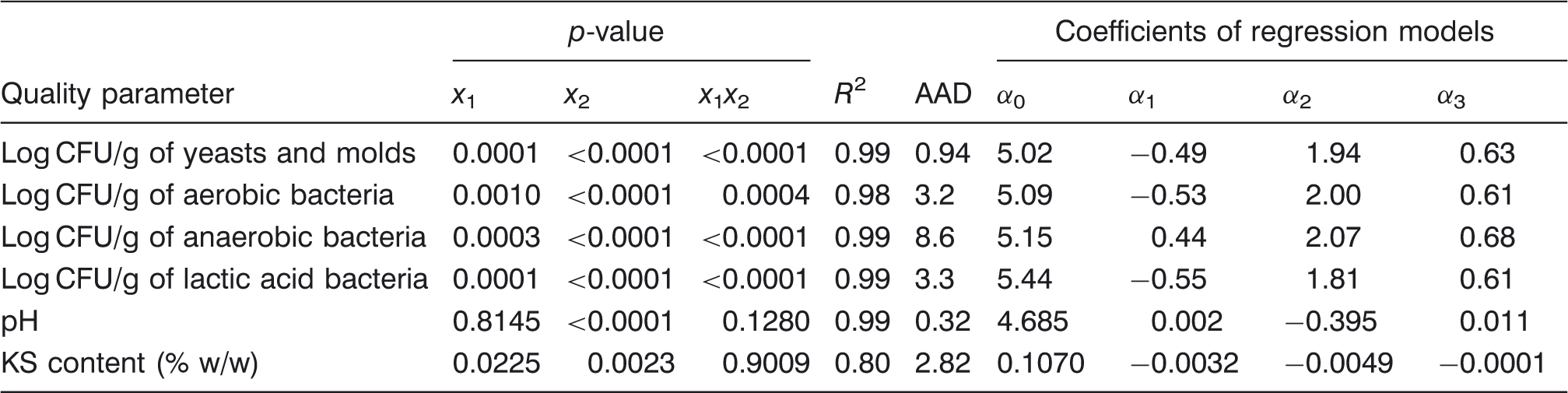
Probability (p) values, correlation coefficients (R2), absolute average deviation (AAD) and coefficients of the regression models for microbial growth, potassium sorbate (KS) content and pH of pumpkin puree. Independent variables, x1: irradiation dose and x2: time. Coefficients, α1: for irradiation dose; α2: for time; α3: for interaction
Microbiological analysis
Coliform bacteria growth was not detected in any sample during storage suggesting that processing conditions were hygienic.
The probability (p) values of terms of regression model indicate that gamma irradiation and storage time significantly affected microbial growth at a 95% confidence level (Table 2). Gamma irradiation diminished whereas time increased microbial growth as it was demonstrated by the signs of regression coefficients in Table 2. An increase in approximately 2.5 log CFU/g was determined for all microorganisms in the nonirradiated purees after 28 days of storage (Figure 1). The application of gamma irradiation produced a decrease in 2.5 log cycles of populations at initial time and did not have effect after 28 days of storage (Figure 1).
Estimated response surface graphs for the combined effect of time and the radiation dose in coded units on log CFU/g of indigenous flora of pumpkin purees.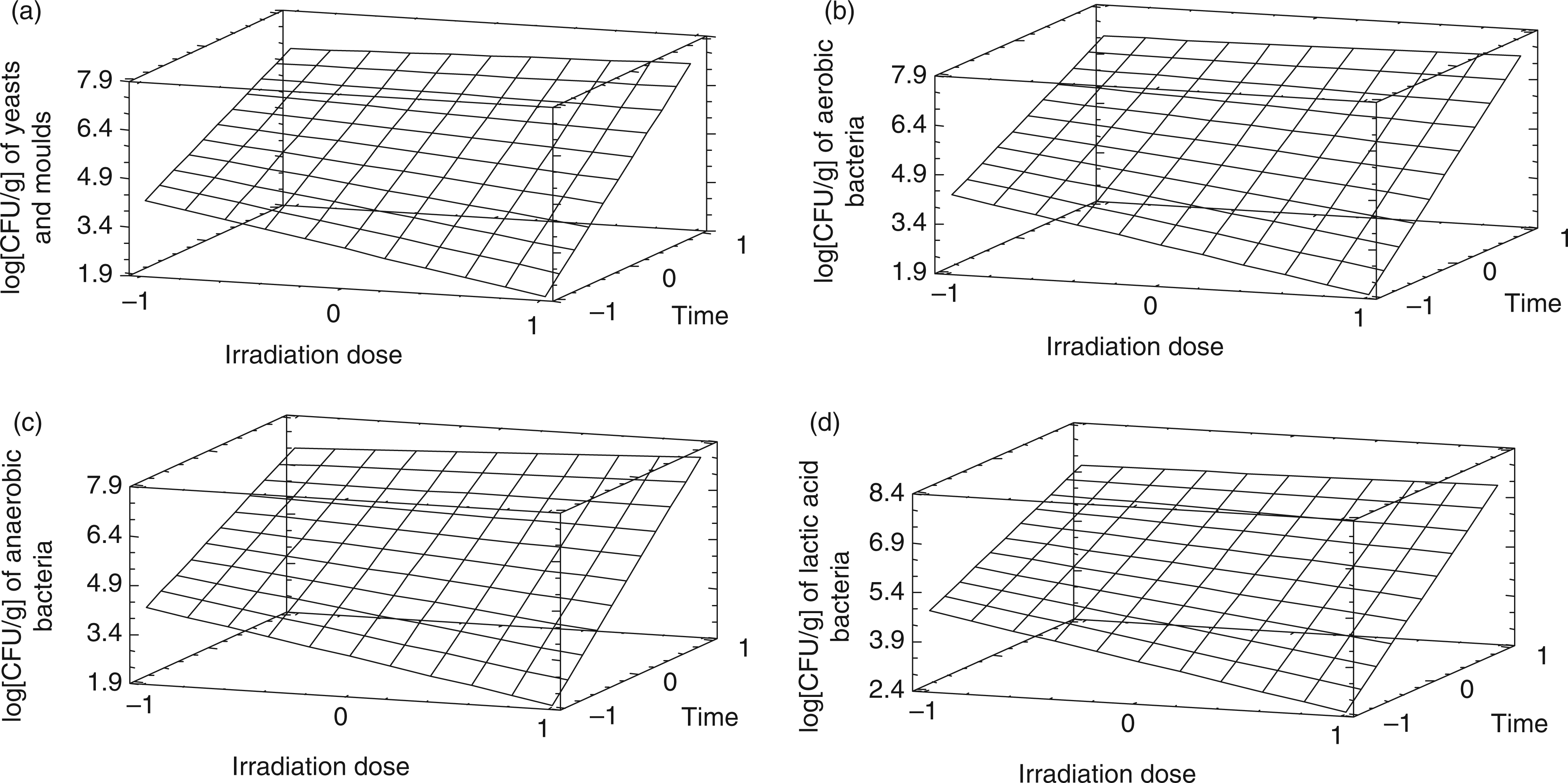
A significant interaction between irradiation and storage time on microbial growth was observed. Positive interaction coefficients suggest a synergistic effect (Table 2). This implies that the highest increase in population (5 log CFU/g) was observed in irradiated puree after 28 days of storage (Figure 1).
It must be remarked that after 5 days of storage, nonirradiated bags were inflated due to microbial metabolism whereas the swelling appearance of irradiated bags was delayed to 15 days.
Visual examination of Sabouraud plates showed that the microbial population was mostly constituted by yeasts, suggesting that they are more radioresistant than molds. Similar results were found by Noomhorm et al. (1998), Prakash et al. (2000), Jiang et al. (2010) and Rivera et al. (2011).
It is known that only the undissociated form of sorbic acid has preservative action (Sofos, 2000). Since the pKa of sorbic acid is 4.75 (Mihyar et al., 1997) at pH 5.00, only 29% of the preservative is in the effective form, which would correspond to 0.039% w/w of sorbic acid in the studied purees. Probably this concentration was not enough to inhibit microbial growth since levels greater than 0.050% w/w of sorbic acid were reported as the minimum inhibitory concentrations for some spoilage yeasts according to Praphailong and Fleet (1997). The mentioned facts stressed the need to use additional hurdles to minimize microbial growth and extend the shelf-life of the purees.
The resistance of a microbial cell to irradiation depends on several factors such as microbial characteristics, environmental factors and absorbed irradiation dose (Mañas and Pagán, 2005). The existence of a shoulder in typical radiation dose–survival curves is reported and it is related to repairable cellular damage in the low dose range (van Gerwen et al., 1999; Mañas and Pagán, 2005). In the present study, although absorbed irradiation doses diminished microbial population, they were not high enough to diminish growth to acceptable levels during storage.
The Argentine Food Code (2007) establishes counts of aerobic mesophilic bacteria ≤5 × 10⁴ CFU/g, and of yeasts and molds ≤103 CFU/g for ready to use dietetic foods. In order to avoid exceeding these values, irradiation dose (D) and storage time (t) were calculated using the following regression models expressed in coded units, and taking into account only the significant coefficients (Table 2):


Results indicated that a population of 5 × 10⁴ CFU/g of aerobic mesophilic bacteria would be found after 12 days of storage in samples irradiated at 1.14 kGy, and 103 CFU/g of yeasts and molds would be found after 4 days of storage in a puree irradiated at 1.63 kGy. Therefore, from the microbiological point of view, the puree would be acceptable with an absorbed dose of 1.63 kGy up to the 4th storage day.
It is important to emphasize that the studied purees were safe from Clostridium botulinum growth and its toxin production because they were packed in aerobic atmosphere and contained KS, an effective preservative to inhibit C. botulinum growth (Lund et al., 1987; Seward et al., 1982; Thakur and Singh, 1995).
Physicochemical analysis: pH evolution
The storage time significantly decreased the pH of the purees whereas the effect of irradiation was not significant (Table 2). The minimum value reached was 4.28 and it corresponded to the nonirradiated system after 28 days of storage (data not shown). The observed pH decrease could be related to lactic acid bacteria development (Figure 1, panel D). Similar behaviour was observed by Noomhorm et al. (1998) in mango puree stored at room temperature.
Physicochemical analysis: Potassium sorbate stability
Sorbate content significantly decreased with storage time and gamma irradiation as indicated by the negative sign of regression coefficients in Table 2. No significant interaction was observed between both variables on KS stability. A KS level of 0.11% w/w was reached in nonirradiated puree after 28 days of storage, in samples irradiated at initial time, while the level was 0.10% w/w in samples irradiated after storage.
Sorbic acid is prone to degrade through reactions of autoxidation and radiolysis. It is more susceptible to radiolytic degradation at acidic pH, and the degradation increases with the irradiation dose. The results obtained here suggest that KS degradation occurred by means of both reactions.
The rate of radiolytic degradation is controlled by diffusivity of the primary products formed by the radiolysis of water which are hydrated electrons, hydroxyl radicals and hydrogen atoms (Thakur et al., 1990). In moist systems, hydroxyl radicals are most reactive towards unsaturated compounds with conjugated polyene chains, but ionized carboxyl groups are relatively unreactive (Thakur et al., 1990). Although sorbic acid structure is reactive towards hydroxyl radicals, in the studied purees the percentage of its undissociated form is low, as explained above. Also, KS could be protected from radiolytic degradation by compounds such as pectins, polysaccharides and vanillin due to their competition to react with radiolytic products of water (Thakur et al., 1990). These facts would explain that the greatest loss of KS was of only 16.6%, corresponding to 0.10 g/100 g of residual KS, and it was found in the irradiated puree after 28 days of storage.
It must be stressed that KS degradation occurs via oxidative mechanisms and could generate brown and red pigments, which would therefore interfere in the color evaluation (Gliemmo et al., 2009).
Physicochemical analysis: Color stability
Three color coordinates (a*, b* and L*) and total color difference (ΔE*) of nonthermally treated purees
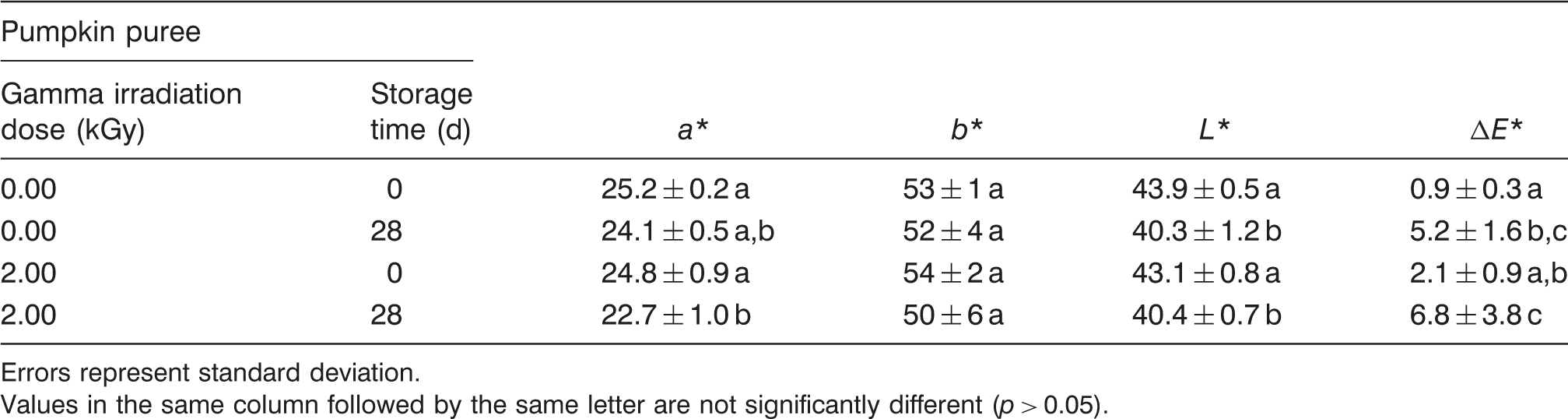
Errors represent standard deviation.
Values in the same column followed by the same letter are not significantly different (p > 0.05).
The maximum ΔE* calculated was 6.8 in irradiated purees at 28 days of storage. The color difference evaluation by sensory analysis allowed determining that from a ΔE* value of 6.00, differences of color between nonirradiated purees, 2 kGy irradiated purees and control puree (p = 0.67) were perceived by the naked eye. This trend was observed at 14 days of storage.
The estimated ΔE* of irradiated purees after 28 days of storage was coincident with the minimum of redness (Table 3). Loss of redness is related to the degradation of β-carotene (Dutta et al., 2006; Gliemmo et al., 2010; Kidmose et al., 2002). β-carotene may suffer radiolytic degradation through reaction with hydroxyl radicals (Thakur et al., 1990). During puree elaboration, thermal processing and homogenization improved β-carotene bioavailability since the cellulose structure of the plant cell is broken (Dutta et al., 2006). Therefore, the pigment would be more exposed to degradation reactions diminishing the food color during storage.
The decrease in lightness observed may be due to nonenzymatic browning reactions taking place together with oxidation and isomerization of β-carotene during storage time (Dutta et al., 2006). Moreover, the evaluation of redness loss may be influenced by brown and red pigments generated by the oxidative degradation of sorbate. On the other hand, irradiation may degrade soluble sugars of pumpkin puree and produce carbonylic compounds which may react with amino acids increasing browning development during storage (Thakur and Arya, 1993).
Thermal and irradiation treatments
Since an estimated shelf-life of 4 days is not acceptable for commercial purposes and 1.63 kGy seems to be a relatively high dose leading to negative effects on the sensory characteristics (Thakur and Singh, 1995), the irradiation dose was decreased to 0.75 kGy. To compensate, a thermal treatment (50 ℃ for 15 min) was applied before irradiation and the storage temperature was decreased to 20 ℃.
Microbiological analysis
The counts of coliform, lactic acid bacteria and yeasts and molds were <9 × 101 CFU/g in the irradiated and nonirradiated purees at the initial time and after 28 days of storage.
It must be stressed that prior to thermal treatment puree samples did not contain coliforms. The counts of lactic acid bacteria and yeasts–molds were 3.9 × 10³ and 4.2 × 10³ CFU/g, respectively. As expected, the thermal treatment helped to reduce microbial flora.
Microbial growth, pH, potassium sorbate loss (%) and total color difference (ΔE*) of thermally treated purees
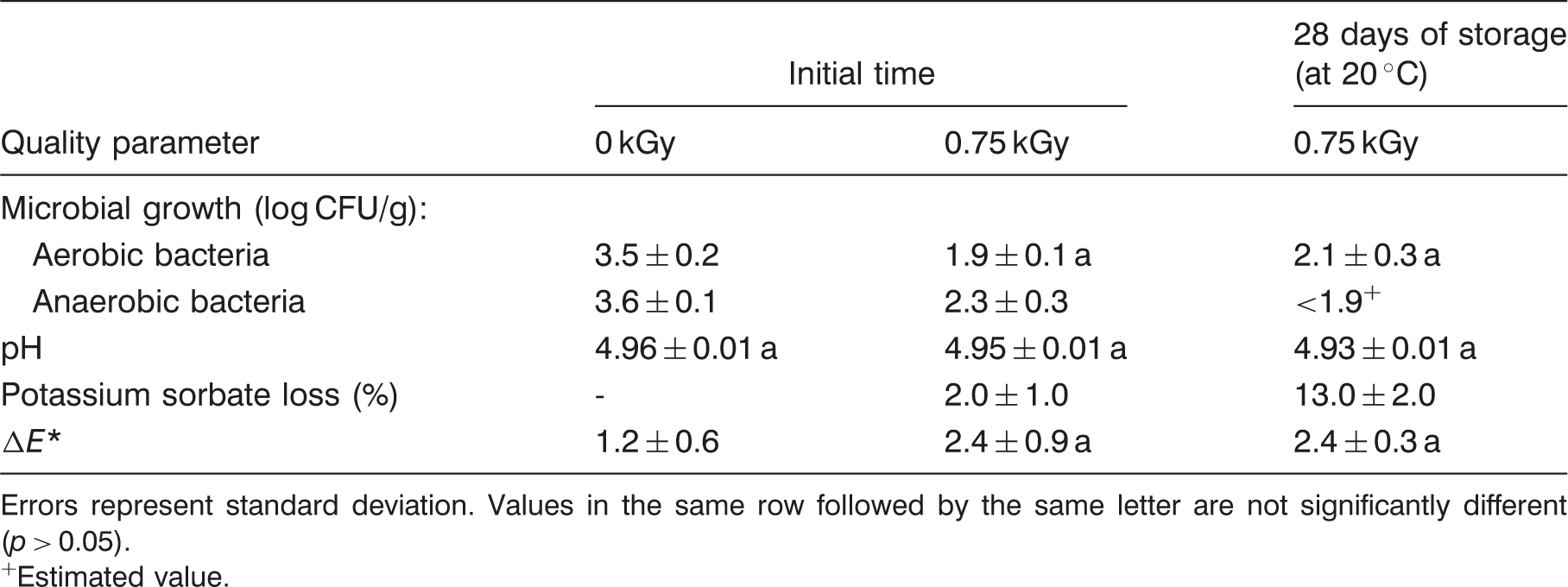
Errors represent standard deviation. Values in the same row followed by the same letter are not significantly different (p > 0.05).
Estimated value.
It is well known that the use of gamma irradiation in combination with heating works synergistically to extend the shelf-life of irradiated foods (Aguirre et al., 2012). Heating sensitizes pathogens such as listeria as well as enzymes to radiation treatment. Furthermore, the irradiation doses required are reduced when the food is heated before irradiation, diminishing the negative effect of radiation on the sensory characteristics of food (Cumming and Blank, 2000; Noomhorm et al., 1998; Patterson, 2001; Parker et al., 2010; Thakur and Singh, 1995).
Physicochemical analysis
Values of pH were constant for 28 days of storage (Table 4). This trend is linked to the microbial stability previously mentioned.
In relation to preservative stability, neither thermal treatment nor the application of 0.75 kGy produced significant losses in KS concentration, but after 28 days of storage a loss of 13% was obtained indicating that only time affected KS stability (Table 4). However, this loss did not affect the microbiological stability of the thermally treated purees.
The ΔE* increased with irradiation at the initial time reaching a value of 2.4. It remained constant in the irradiated puree along storage (Table 4). The mentioned increase was due to a slight enhancement in a* and b* values and a decrease in L*. Since sensory color differences of purees were perceived from a ΔE* value of 6.00, a color difference of 2.4 (Table 4) would not be perceived by the naked eye.
Conclusion
Indigenous flora of the nonthermally treated pumpkin purees increased during storage time and diminished with the application of gamma irradiation. The pH decrease was related to lactic acid bacteria growth. Total color difference increased with time, independently of irradiation. Considering microbial growth, a puree receiving an absorbed dose of 1.63 kGy and stored at 25 ℃ has a shelf-life of only 4 days.
On the contrary, in thermal treated purees, growth of coliform, lactic acid bacteria, yeasts and molds were not detected. Gamma irradiation diminished the growth of aerobic and anaerobic bacteria and kept counts within the microbiological limits established by the Argentine Food Code after 28 days of storage at 20 ℃. The pH values kept constant for this period of time. Potassium sorbate losses were slight and did not affect microbiological stability of purees. The total color differences for these purees were smaller after 28 days of storage and would probably not be perceived by the naked eye. According to the obtained results, heating before irradiation and storage at 20 ℃ allowed diminishing the irradiation dose necessary to assure microbial stability and, as a consequence, improved the color of the samples. The shelf-life of the puree could be extended to at least 28 days by the application of the proposed hurdles.
Footnotes
Funding
We acknowledge the financial support from Universidad de Buenos Aires, Consejo Nacional de Investigaciones Científicas y Técnicas de la República Argentina and Agencia Nacional de Investigaciones Científicas y Tecnológicas de la República Argentina.
Acknowledgment
Contributions from the Ezeiza Atomic Centre Irradiation Facility and High Radiation Doses Dosimetry Division staff are gratefully acknowledged.