







Abstract
The growing demand for fresh-like food products has encouraged the development of hurdle technology of non-thermal processing. In this study, freshly squeezed Chokanan mango juice was treated by paired combinations of sonication (for 15 and 30 min at 25 ℃, 40 kHz frequency) and UV-C treatment (for 15 and 30 min at 25 ℃). Selected physicochemical properties, antioxidant activities, microbial inactivation and other quality parameters of combined treated juice were compared to conventional thermal treatment (at 90 ℃ for 60 s). After thermal and combined treatment, no significant changes occurred in physicochemical properties. A significant increase in extractability of carotenoids (15%), polyphenols (37%), flavonoids (35%) and enhancement in antioxidant capacity was observed after combined treatment. Thermal and combined treatment exhibited significant reduction in microbial load. Results obtained support the use of sonication and UV-C in a hurdle technology to improve the quality of Chokanan mango juice along with safety standards.
Introduction
Mango (Mangifera indica L.) is a tropical fruit grown in 85 countries, ranking fifth in global production among other major fruit crops including bananas, citruses, grapes and apples. Mango production in Asia has increased about 15% from 2009 to 2011, contributing approximately 30.2 million metric tons to the international commodity market (FAOSTAT, 2013). In Malaysia, commercialisation of domestic mango cultivars especially Chokanan has reached the worldwide market as they are exported to Singapore, Brunei and Hong Kong. According to Spreer et al. (2009), there is a large stock of Chokanan mango yearly due to its ability to bear fruit even during rainy season. Thus, the market for value-added mango products such as juice, puree and nectar has progressively grown due to its perishable nature.
According to a study conducted by Rivera and Cabornida (2008), fruit juices have the highest acceptability among other beverages, generally due to their natural taste, as well as to the nutritional value associated with them. Consumption of mango juice has been linked to prevention of cancer, owing to its antioxidant properties (Block et al., 1992). Currently, thermal pasteurisation is the preferred technology used to achieve microbial inactivation and prolong the shelf life of juices. However, high temperature causes detrimental effects on nutritional quality of juices such as reported in cashew apple and pineapple juice (Rawson et al., 2011). Consumers' demand for a preservation technology that retains fresh-like quality and, at the same time, ensures food safety has resulted in growing interest for non–thermal-processing methods. Both sonication and short-wave ultraviolet-C (UV-C) light treatment are alternative novel technologies to achieve the U.S. Food and Drug Administration (FDA) condition of a 5 log reduction of food borne pathogens in fruit juices (FDA, 2000; Salleh-Mack and Roberts, 2007).
Propagation of high-power ultrasound at low frequencies (20–100 kHz) in liquid causes cavitation (formation and collapse of bubbles). Consequently, these ‘tiny hotspots’ provide energy to disrupt microbial cell membrane and alter the properties of food (O'Donnell et al., 2010). The UV-C light (peak emission at 254 nm) exhibits germicidal effect by preventing the reproduction of microorganisms and eventually may result in cell death (Guerrero-Beltrán and Barbosa-Cánovas, 2004). Sonication and UV-C treatment are simple, reliable and cost-effective with improved efficiency (O'Donnell et al., 2010; Pala and Toklucu, 2013). These technologies have different mode of microbial inactivation, therefore being potential choices for a hurdle concept. The hurdle technology is a combination of preservation techniques that may have a synergistic effect on microbial destruction, with minimal impact on the quality of the food product (Leistner, 2000).
The purpose of this study was to compare the effects of combined treatment (sonication and UV-C) and thermal treatment on the quality parameters of Chokanan mango juice such as microbial inactivation, physicochemical properties (pH, total soluble solids (TSS) and titratable acidity), colour, clarity, browning index, hydroxymethyl furfural content, carotenoid content, ascorbic acid content and antioxidant activities. The information obtained from this study could serve to improve the progress of utilising combined treatment of ultrasonic and UV-C for preserving the quality of Chokanan mango juice.
Materials and methods
Chemicals
Gallic acid, L-ascorbic acid, ( + )-catechin, 5-hydroxymethyl furfural, 2,6-dichlorophenol-indophenol (DCPIP) sodium salt, potassium ferricyanide, ferric chloride, Folin-Ciocalteu reagent, sodium hydroxide, trichloroacetic acid, thiobarbituric acid and 2,2-diphenyl-1-picrylhydrazyl (DPPH) were purchased from Sigma (MO, USA). Metaphosphoric acid, aluminium chloride and peptone water were purchased from R&M Chemicals (Essex, UK). Sodium bicarbonate, sodium nitrite and sodium carbonate were purchased from BDH (Poole, UK). All chemical solvents used were analytical reagent grade and purchased from Sigma (MO, USA).
Extraction of mango juice
Ripe Chokanan mango fruits of uniform size and free from external defects were purchased from a local market (Selangor, Malaysia) located about 30 km from the Postharvest Biotechnology Laboratory, University of Malaya. The fruits were rinsed with running water and air-dried at room temperature (25 ℃ ± 1 ℃). Each mango was peeled, and the seed was discarded. Mango pulp was macerated using a domestic juice extractor (Philips Juice Extractor HR 2820, Holland) and then centrifuged (Beckman J2-MI Centrifuge, California) at 12,000 rpm for 10 min at 4 ℃. The supernatant was filtered using a steel sieve with an approximate diameter of 2 mm to obtain the juice and remove any remaining fibre. The filtered juice samples were stored in sterile glass bottles prior to deployment into experiment.
Experimental treatments
The freshly squeezed mango juice was treated by four paired combinations of selected non-thermal technologies. Sonication was employed as the first hurdle followed by UV-C treatment. Selection of processing variables was based on preliminary studies on stand-alone treatments to achieve significant microbial reduction and quality retention (Santhirasegaram et al., 2013, unpublished data).
The following terms were used to describe different treatments in this study:
Control (freshly squeezed or no treatment); TT (thermal treatment); S15 + U15 (combined sonication for 15 min and UV-C treatment for 15 min); S30 + U15 (combined sonication for 30 min and UV-C treatment for 15 min); S15 + U30 (combined sonication for 15 min and UV-C treatment for 30 min); S30 + U30 (combined sonication for 30 min and UV-C treatment for 30 min).
All treatments and analysis were carried out in triplicates.
Thermal treatment
Mango juice (50 mL) stored in glass bottles was pasteurised in a covered water bath (Memmert, Germany) at 90 ℃ ± 1 ℃ for 60 s. After thermal treatment, the juice samples were immediately cooled to room temperature (25 ℃ ± 1 ℃) by immersing in an ice-water bath.
Sonication
The sonication of mango juice (50 mL) was performed using an ultrasonic cleaning bath (Branson Model 3510 Ultrasonic Cleaner, CT, USA) at 40 kHz frequency, as described by Santhirasegaram et al. (2013). The processing time was 15 and 30 min under dark condition. The actual power dissipated in the ultrasonic bath was 68–72 W, and the acoustic energy density was 1.36–1.44 W/cm3, which was determined by calorimetric method (Sutkar and Gogate, 2009; Gogate et al., 2011).
UV-C treatment
Juice samples were exposed to UV-C light under batch conditions. Mango juice (50 mL) was poured into four sterile Petri dishes (11 cm diameter, 0.8-cm fluid depth) and then exposed to a germicidal fluorescent UV-C lamp (30 W, 89.3 cm length, 25.5 cm diameter, Sankyo Denki, Japan) in a laminar flow cabinet (Gelman Science Biological Safety Cabinet Class II, NSW, Australia). The UV-C lamp has a peak emission at 254 nm. The distance between the juice surface and the UV-C lamp was 35 cm. The UV-C lamps were allowed to stabilise for 30 min prior to use. The duration of exposure was 15 and 30 min at 25 ℃ ± 1 ℃. The mean of UV radiation dose received by each juice sample is 3.525 J/m2 (Keyser et al., 2008). Juice samples were bottled directly after treatment.
Physicochemical analysis (pH, TSS and titratable acidity)
Mango juice pH was determined using a pH metre (Hanna Microprocessor pH 211, Italy) at 25 ℃ ± 1 ℃. TSSs were determined using a digital refractometre (Atago PR-1 digital refractometre, Tokyo, Japan) at 25 ℃ ± 1 ℃, and results were expressed in standard °Brix unit.
For determination of titratable acidity, diluted mango juice was titrated with standardised 0.1 N sodium hydroxide to a definite faint pink end point using phenolphthalein as an indicator. The titratable acidity (%TA) was calculated (Sadler and Murphy, 2010) using the following equation

Colour, clarity, non-enzymatic browning index and 5-hydroxymethyl furfural content
The colour of juice samples was measured using a Chroma Meter (Minolta Chroma Meter CR-200, Minolta, Osaka, Japan). The colour parameters L* (lightness), a* (redness/greenness) and b* (yellowness/blueness) were evaluated. Colour differences (ΔE), in comparison to control (Caminiti et al., 2011), were calculated using the following equation

Non-enzymatic browning index (NEBI) and 5-hydroxymethyl furfural (HMF) assay were carried out according to the method by Cohen et al. (1998). A standard curve of HMF (y = 0.0406x, r2 = 0.9967) was prepared, and results were expressed as milligrams of HMF per litre juice sample.
Total carotenoid content
Carotenoid was extracted according to Lee et al. (2001), while the total carotenoid content (Scott, 2001) using β-carotene as a reference was calculated using the following formula:

Ascorbic acid content
Ascorbic acid content in samples was determined based on the DCPIP visual titration method (Ranganna, 1977). Results obtained were expressed as milligrams of ascorbic acid per 100 mL sample.
Antioxidant activity (total polyphenol and flavonoid content, DPPH radical scavenging and reducing power assay)
Antioxidants were extracted according to Santhirasegaram et al. (2013) using 80% methanol.
Total polyphenol content of juice samples was determined using Folin-Ciocalteu assay (Singleton et al., 1965) modified to a microscale (Bae and Suh, 2007). A standard curve of gallic acid (y = 0.00566x, r2 = 0.9955) was prepared, and results were reported as milligrams of gallic acid equivalent (GAE) per 100 mL juice extract.
Total flavonoid content of juice samples was determined using a colorimetric method described by Sakanaka et al. (2005). A standard curve of ( + )-catechin (y = 0.0135x, r2 = 0.9943) was prepared, and results were reported as milligrams of catechin equivalent (CE) per 100 mL juice extract.
DPPH radical scavenging assay was carried out as described by Oyaizu (1986) and Bae and Suh (2007). A standard curve of ascorbic acid (y = 10.145x, r2 = 0.9907) was prepared, and results were reported as micrograms of ascorbic acid equivalent (AAE) per millilitre juice extract. The radical scavenging activity was calculated accordingly

A spectrophotometric method by Oyaizu (1986) was used for measuring the reducing power of juice samples. A standard curve of ascorbic acid (y = 0.0014x, r2 = 0.9906) was prepared, and results were reported as micrograms of AAE per milliliter juice extract.
Microbial inactivation analysis
The 3M Petrifilm plate methods are recognised as AOAC International Official Methods of Analysis (3M Food Safety, 2010). Microbial count of juice samples was determined using Petrifilm plates (3M Center, MN, USA) for aerobic bacteria, coliform, yeast and mould according to Santhirasegaram et al. (2013). Results were expressed as log (CFU/mL).
Statistical analysis
Data obtained were subjected to statistical analysis using SPSS 19.0 software (SPSS Inc., IBM). In this study, data were represented as mean values ± standard deviation. The significant differences between mean values of juice samples were determined by analysis of variance (one way-ANOVA) using Tukey's HSD (honestly significant difference) test at a significance level of p < 0.05.
Results and discussion
Physicochemical analysis (pH, TSS and TA)
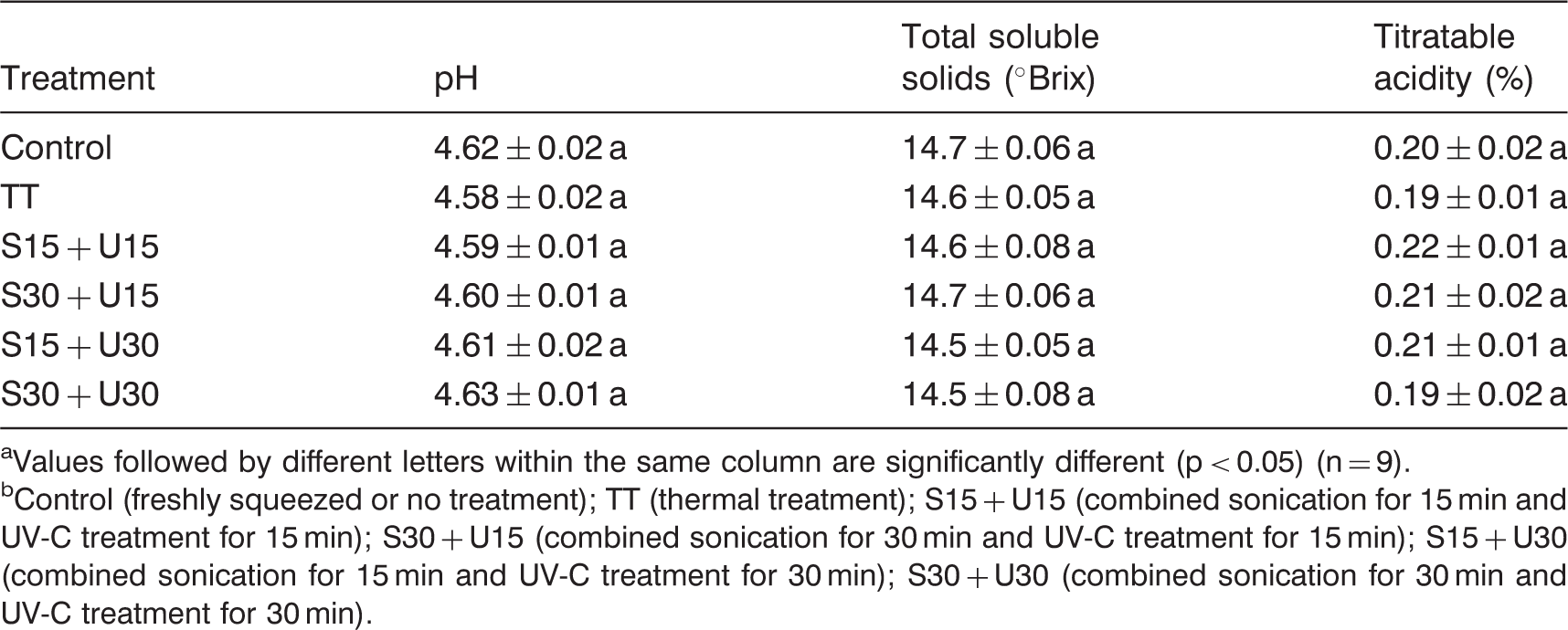
Values followed by different letters within the same column are significantly different (p < 0.05) (n = 9).
Control (freshly squeezed or no treatment); TT (thermal treatment); S15 + U15 (combined sonication for 15 min and UV-C treatment for 15 min); S30 + U15 (combined sonication for 30 min and UV-C treatment for 15 min); S15 + U30 (combined sonication for 15 min and UV-C treatment for 30 min); S30 + U30 (combined sonication for 30 min and UV-C treatment for 30 min).
Colour, clarity, NEBI and HMF content
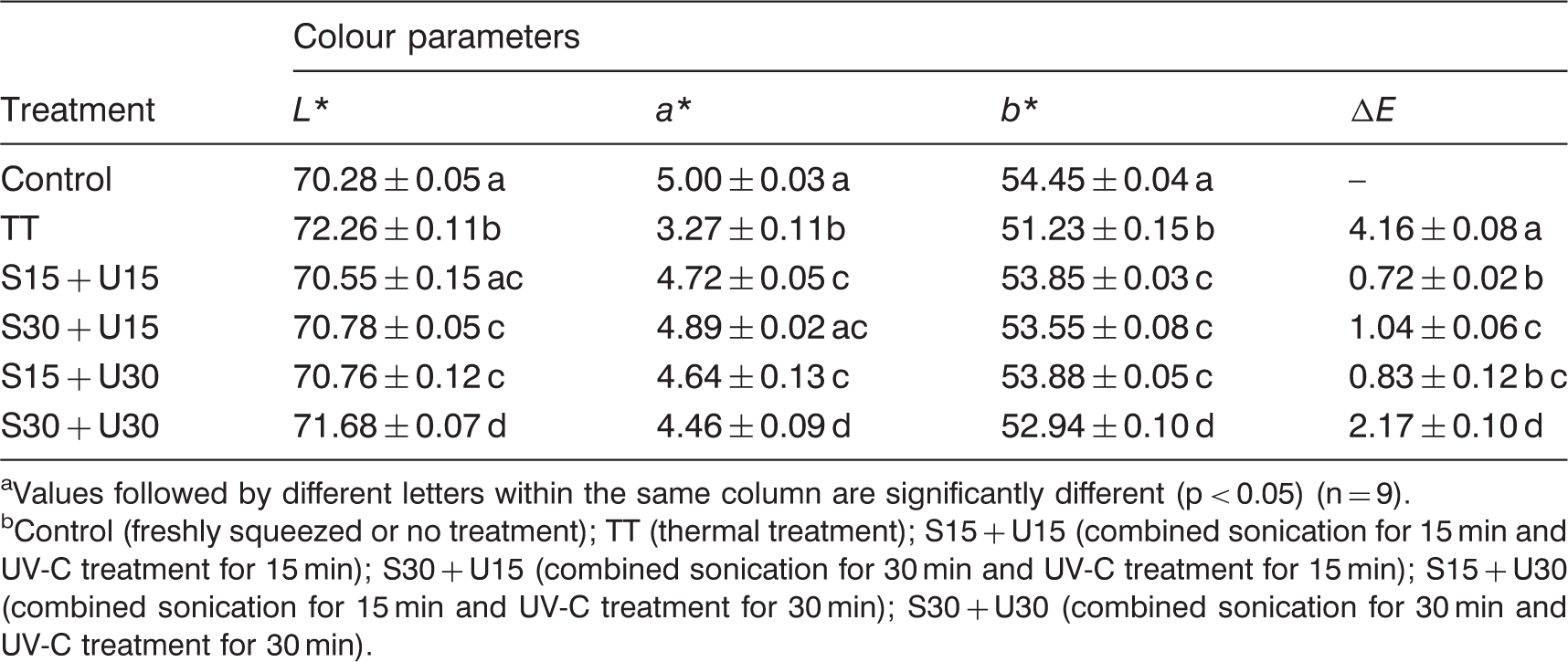
Values followed by different letters within the same column are significantly different (p < 0.05) (n = 9).
Control (freshly squeezed or no treatment); TT (thermal treatment); S15 + U15 (combined sonication for 15 min and UV-C treatment for 15 min); S30 + U15 (combined sonication for 30 min and UV-C treatment for 15 min); S15 + U30 (combined sonication for 15 min and UV-C treatment for 30 min); S30 + U30 (combined sonication for 30 min and UV-C treatment for 30 min).
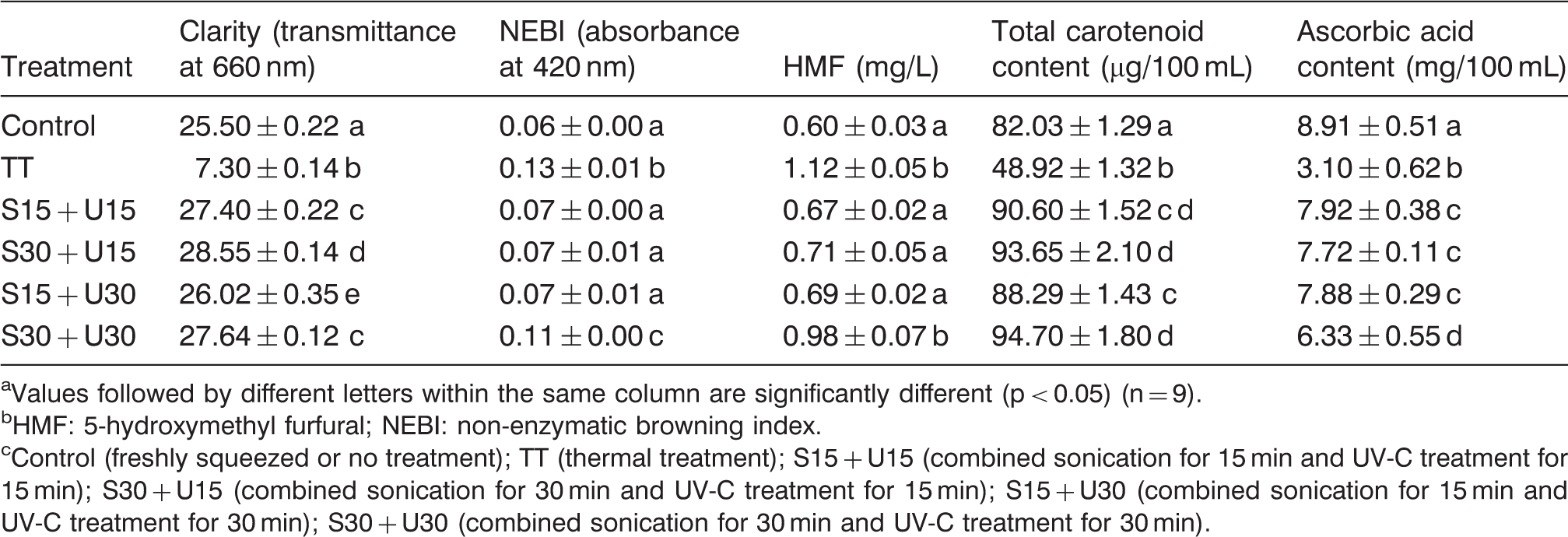
Values followed by different letters within the same column are significantly different (p < 0.05) (n = 9).
HMF: 5-hydroxymethyl furfural; NEBI: non-enzymatic browning index.
Control (freshly squeezed or no treatment); TT (thermal treatment); S15 + U15 (combined sonication for 15 min and UV-C treatment for 15 min); S30 + U15 (combined sonication for 30 min and UV-C treatment for 15 min); S15 + U30 (combined sonication for 15 min and UV-C treatment for 30 min); S30 + U30 (combined sonication for 30 min and UV-C treatment for 30 min).
The NEBI indicates browning of juice due to Maillard process (Caminiti et al., 2011), while HMF is one of the intermediates produced during this reaction (Rattanathanalerk et al., 2005). A significant increase in NEBI of juice (Table 3) subjected to thermal treatment was observed. Accordingly, HMF content also increased in thermal-treated samples (1.12 mg/L) when compared to the control (0.60 mg/L). This is a clear indication that heat accelerated the formation of browning compounds, consequently darkening the juice thus contributing to the highest increase in NEBI value and HMF. Likewise, enhanced browning index and HMF formation were observed in heat-treated strawberry juice (Aguiló-Aguayo et al., 2009). The results of NEBI and HMF agree with colour analysis for thermal-treated samples, whereby the decrease in + b* and increase in L* values denoted the colour change from yellow towards light brown. Conversely, combined treated samples, S15 + U15, S30 + U15 and S15 + U30, except S30 + U30, showed no significant variation in NEBI and HMF content, when compared to the control. This is consistent with the study conducted by Caminiti et al. (2011) on apple and cranberry juice blend subjected to combined non–thermal-processing methods, where no significant browning was promoted. Nevertheless, it is important to highlight that the concentration of HMF in all treated juice samples (thermal and combined method) were minimal and remained below the permitted limit (≤ 5 mg/L) by the Association of the Industry of Juices and Nectars from Fruits and Vegetables (AIJN, 1996).
Total carotenoid content
Juice samples subjected to thermal treatment exhibited significant loss of carotenoids (48.92 µg/100 mL) when compared to the control (82.03 µg/100 mL), as shown in Table 3. This could be attributed to the high temperature-induced degradation of main carotenoid pigments resulting in the rearrangement of structures (trans- to cis-form) and formation of epoxides (Rodríguez-Amaya, 1997). After combined treatment, juice samples showed significant enhancement (8 to 15%) in carotenoid content. S30 + U30 sample showed the highest increase in extractability of carotenoids (15%) when compared to the control. The modification of carotenoid-binding protein may improve the extraction yield of free carotenoids (Oms-Oliu et al., 2012). These phenomena were due to the sonochemical and UV photochemical reaction as a result of ultrasonic and UV-C treatment, respectively (Demirdoven and Baysal, 2008; Oms-Oliu et al., 2012). Therefore, the increased availability of free carotenoids possessing health promoting properties in combined treated juice samples is beneficial to consumers.
Ascorbic acid content
Ascorbic acid or commonly known as vitamin C possesses antioxidant properties that have been associated with protection against cancer (Block, 1991). There was significant reduction in ascorbic acid content in juice processed by thermal and combined method when compared to control (Table 3). For thermal-treated juice, a maximum reduction (65%) of ascorbic acid was exhibited when compared to the control. Similarly, significant loss of ascorbic acid was observed in thermal-processed orange juice, owing to its thermolabile characteristic (Pala and Toklucu, 2013). The least degradation of ascorbic acid after combined treatment was about 11% in S15 + U15 sample. The depletion of ascorbic acid occurs mainly due to oxidation induced by enzyme activities such as ascorbate oxidase and peroxidase (Oms-Oliu et al., 2012). Formation of hydroxyl radicals during UV photon generation and also by bubble implosion during sonication could be responsible for the decreased content of ascorbic acid (Bhat et al., 2011; Hart and Henglein, 1985). Minimal degradation of ascorbic acid content was observed in ultrasonic or UV-C-treated juices when compared to thermal treatment (Goh et al., 2012; Oms-Oliu et al., 2012). Hence, it is important to emphasise that combined treatment provides better retention of ascorbic acid when compared to thermal treatment due to the absence of heat supply.
Antioxidant activity (total polyphenol and flavonoid content, DPPH radical scavenging and reducing power assay)
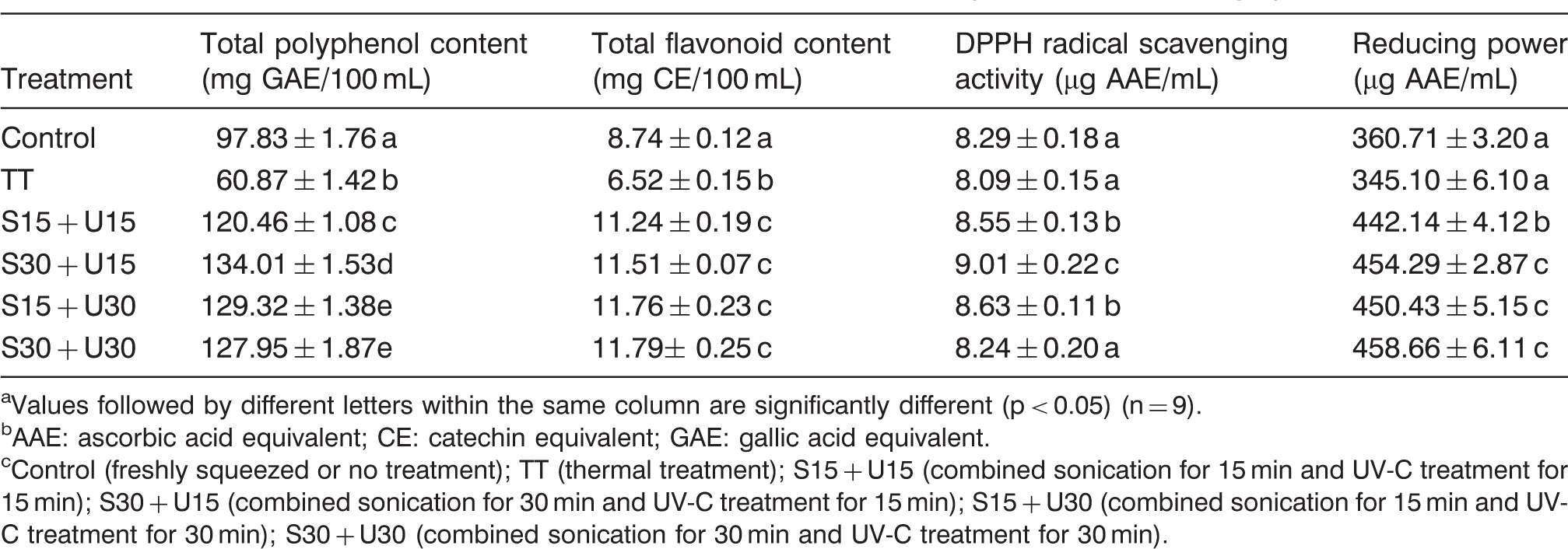
Values followed by different letters within the same column are significantly different (p < 0.05) (n = 9).
AAE: ascorbic acid equivalent; CE: catechin equivalent; GAE: gallic acid equivalent.
Control (freshly squeezed or no treatment); TT (thermal treatment); S15 + U15 (combined sonication for 15 min and UV-C treatment for 15 min); S30 + U15 (combined sonication for 30 min and UV-C treatment for 15 min); S15 + U30 (combined sonication for 15 min and UV-C treatment for 30 min); S30 + U30 (combined sonication for 30 min and UV-C treatment for 30 min).
Antioxidant activity may be evaluated by the ability to donate hydrogen to the stable-free radical DPPH or the reductive capacity by Fe3 + to Fe2 + transformation (Prabha and Vasantha, 2011). No significant changes were observed in percentage of DPPH inhibition after thermal treatment. Although thermal-treated juice samples showed a decrease in reducing power (345.10 µg AAE/mL), it was non-significant when compared to the control (360.71 µg AAE/mL). Similarly, Caminiti et al. (2012) reported that heat treatment did not induce significant changes in antioxidant capacity of orange and carrot juice blend. However, combined treated samples (S15 + U15, S30 + U15 and S15 + U30) exhibited significant increase in the percentage of DPPH inhibition compared to control. The highest percentage inhibition of DPPH was 91.4% (9.01 µg AAE/mL) for S30 + U15 sample, compared to the control, 84.1% (8.29 µg AAE/mL). Accordingly, all combined treated samples showed increase in reducing capacity. The maximum increase (27%) was from 360.71 µg AAE/mL to 458.66 µg AAE/mL in S30 + U30 sample. Previous studies have reported that non–thermal-processing methods increase extractability of antioxidants, such as observed in sonicated apple juice and UV-C-treated starfruit juice (Abid et al., 2013; Bhat et al., 2011). Therefore, combined treated samples with enhanced antioxidant capacity will be an added advantage to health conscious consumers, as it plays a role in prevention of the degenerative processes (Block et al., 1992).
Microbial inactivation analysis (coliform count, aerobic plate count, total yeast and mould count)
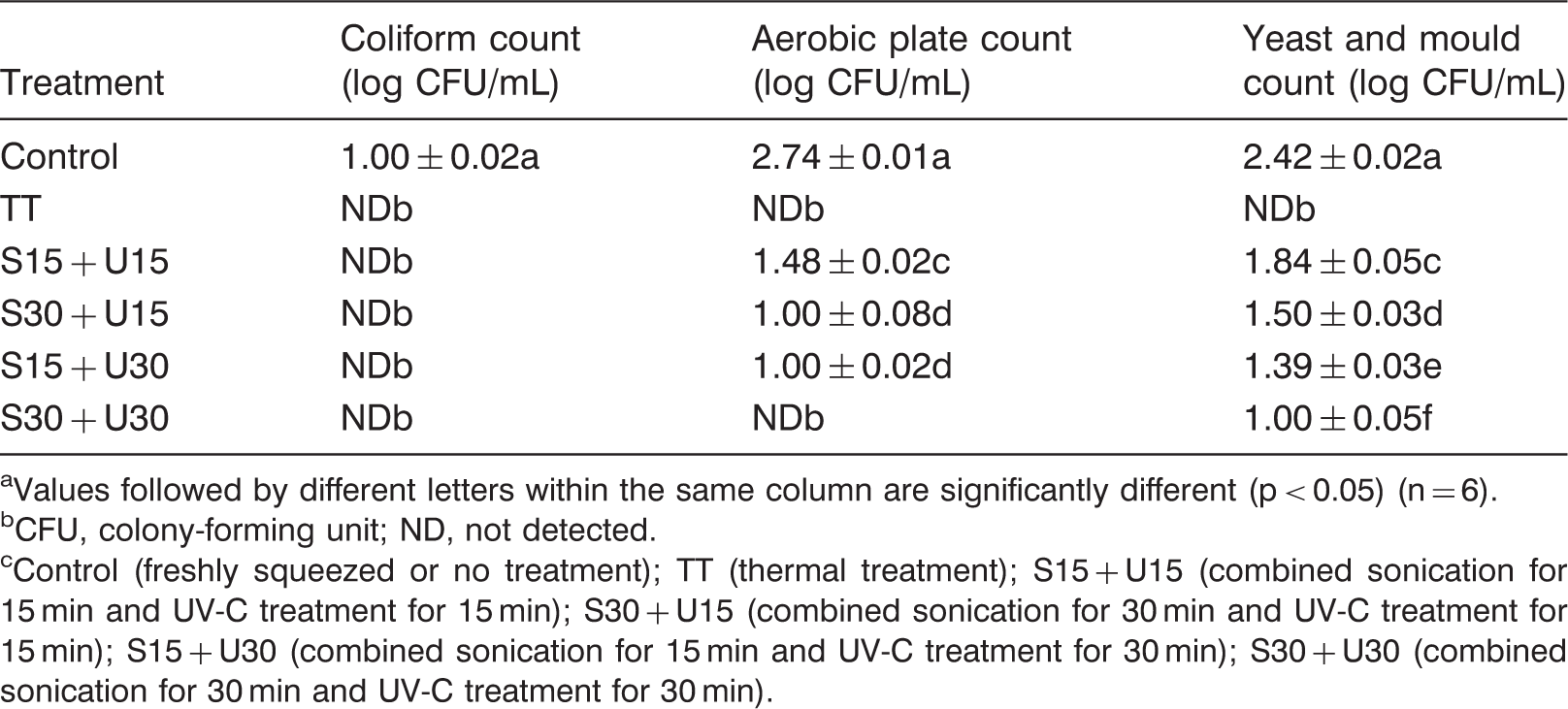
Values followed by different letters within the same column are significantly different (p < 0.05) (n = 6).
CFU, colony-forming unit; ND, not detected.
Control (freshly squeezed or no treatment); TT (thermal treatment); S15 + U15 (combined sonication for 15 min and UV-C treatment for 15 min); S30 + U15 (combined sonication for 30 min and UV-C treatment for 15 min); S15 + U30 (combined sonication for 15 min and UV-C treatment for 30 min); S30 + U30 (combined sonication for 30 min and UV-C treatment for 30 min).
As a hurdle, ultrasound and UV-C improve the rate of sterilisation of juice samples, which may be due to their synergistic effects. Previous studies have reported promising preservation of fruit juices by combined non–thermal-processing methods (Noci et al., 2008; Walkling-Ribeiro et al., 2008). In this study, the percentage of inactivation of total yeast and mould (24 and 59%) was lower than aerobic bacteria (46 to 100%) for combined treated samples, exhibiting maximum inactivation for S30 + U30 sample (59%). It was clearly exhibited that yeast and mould display greater resistance to sonication and UV-C due to difference in size of microbial cells and thickness of cell wall (Pala and Toklucu, 2013). However, complete inactivation of yeast and mould in juice samples was not observed in this study for all combined treated samples. Therefore, this hurdle sequence (ultrasound and UV-C) could be combined with mild heat or pressure treatment to enhance the decontamination efficiency.
Conclusions
Chokanan mango juice subjected to combined sonication and UV-C treatment (S15 + U15, S30 + U15 and S15 + U30) exhibited significant improvements in clarity, antioxidant capacity and extractability of carotenoids, phenolic compounds and flavonoids, when compared to freshly squeezed juice. In addition, combined treatment showed complete inactivation of coliforms and aerobic bacteria, along with significant reduction in yeast and mould count. Although thermal treatment was effective in completely inactivating microbial growth in juice, significant quality loss was observed. Combination of ultrasound and UV-C, therefore, is a promising hurdle for better retention of quality and a feasible alternative to thermal treatment. Further research work is needed to develop models to optimise the processing variables of this hurdle sequence, thus producing improved quality juice together with safety standards. Consequently, this study provides more attention for positive implementation of combined treatment on a pilot scale.
Footnotes
Funding
The authors thank the University of Malaya Postgraduate Research Fund [PV086/2012A] for supporting this research.