







Abstract
Due to the water scarcity in the Mediterranean countries, irrigation must be optimized while keeping fruit quality. The effect of deficit irrigation strategies on changes in quality parameters of the early “Flordastar” peaches was studied. The deficit irrigation was programmed according to signal intensity of the maximum daily trunk shrinkage; deficit irrigation plants were irrigated to maintain maximum daily trunk shrinkage signal intensity values close to 1.4 or 1.3 in the case of DI1 or DI2 plants, respectively. Results were compared to a control watered at 150% crop evapotranspiration. Fruits were stored up to 14 days at 0 ℃ and 95% Relative Humidity (RH) in air or in controlled atmosphere (controlled atmosphere; 3–4 kPa O2 and 12–14 kPa CO2), followed by a retail sale period of 4 days at 15 ℃ and 90–95% Relative Humidity in air. Weight losses were lower in controlled atmosphere stored peaches from deficit irrigation. Air-stored fruits developed a more intense red color due to a faster ripening, which was not affected by the type of watering. At harvest, deficit irrigation peaches showed higher soluble solids content, which provided a better sensory evaluation. The soluble phenolic content was initially higher (55.26 ± 0.18 mg gallic acid equivalents/100 g fresh weight) and more stable throughout postharvest life in DI1 fruits than in those from the other irrigation treatments. Concerning vitamin C, control fruits at harvest showed higher ascorbic acid than dehydroascorbic acid content (5.43 versus 2.43 mg/100 g fresh weight, respectively), while water stressed peaches showed the opposite results. The combination of DI2 and controlled atmosphere storage allowed saving a significant amount of water and provided peaches with good overall quality, maintaining the bioactive compounds analyzed.
Introduction
The cultivation of the 747,200 annual tons of peaches and nectarines produced in Spain (FAO, 2012) is usually carried out under irrigation regimes in arid regions with few and low quality water resources. The cultivation of stone fruit is unsustainable, as it requires a large amount of water (up to 7000 m3/ha year), which is not always available in these areas. For this reason, it is important to study crop strategies based on deficit irrigation (DI) in noncritical periods of the tree development that could allow important water savings and provide a product of good quality (Chalmers et al., 1981; Fereres and Soriano, 2007). The response of different species to DI has been previously studied, showing benefits in efficiency and water savings in olive, apple, lemon, mandarin, almond, loquat, peach, apricot, or table grape (Domingo et al., 1996; Fernández et al., 2006; Goldhamer et al., 1999; Pérez-Pastor et al., 2007). Although the possibility of obtaining fruits with a noncommercial caliber as a limiting factor has been highlighted (Crisosto et al., 2000; Ebel et al., 1993; Girona, 1989), it has been demonstrated that moderate DI followed by a good irrigation strategy does not reduce fruit size (Torrecillas et al., 2000). Water status indicators as maximum daily trunk shrinkage (MDS) provide continuous information about plant condition, which is successfully used to program the irrigation scheduling (Ortuño et al., 2009).
In the current work, an early ripening peach was selected (Prunus persica (L.) Batsch “Flordastar”) as its high water necessities match with low evaporative demand periods (Collins et al., 2009). Also, it is an interesting variety with high commercial value and suitable caliber for the European market (Conejero et al., 2011). However, the export of “Flordastar” peaches requires good postharvest handling, cold storage, and distribution to arrive at the customers with high quality attributes. The application of controlled atmosphere (CA) techniques allows the preservation of quality during cold storage (Kader, 1986; Mitchell and Kader, 1989). Ke and Kader (1992) reported that peaches and nectarines reduced their internal breakdown under low O2 and high CO2 atmospheres. Others authors also found that CA extended the shelf-life of peaches (Anderson, 1982; Gorny et al., 1998; Lurie, 1993; Retamales et al., 1992).
In addition, this technique contributes to lowering or avoiding chilling injuries of stone fruits that develop more intensely between storage temperatures of 2.2 and 7.6 ℃ (Lurie and Crisosto, 2005). It has been stated than the optimum storage temperature is 0 ℃ (Crisosto et al., 1999; Harding and Haller, 1934; Smith, 1934) although temperatures of 0–2 ℃ combined with high CO2/low O2 atmospheres can also be used to help delay normal ripening of peaches and enhance chilling injuries (Fernández-Trujillo et al., 1998).
As far as we know, no reports on behavior of early peaches cultivated under DI strategies combined with postharvest storage under CA have yet to be reported. Due to this, the main aim of the present work was to study how DI affects the overall quality and bioactive compounds changes of “Flordastar” peaches after a conventional and CA storage period followed by a retail sale period.
Materials and methods
Experimental conditions, plant material, and treatments
The cultivation was carried out in the Centro de Edafología y Biología Aplicada del Segura-Consejo Superior de Investigaciones Científicas (CEBAS-CSIC) experimental farm (38° 06′ N; 1° 02′W), located in Santomera (Murcia), Spain, under Mediterranean climate, with low rainfall (≈260 mm per year). The plant material consisted of 9-year-old peach trees (Prunus persica L., Batsch), cv. “Flordastar,” grafted on “GF-677” peach rootstock and trained to an open-center canopy. The experimental plot occupied 0.8 ha and the tree spacing followed a 5 m × 5 m square pattern. Trees were drip irrigated using a drip irrigation line for each row, with eight emitters per tree, each one with a flow rate of 2 l/h. Crop evapotranspiration (ETC) was estimated according to daily crop reference evapotranspiration (ET0), calculated using the Penman–Monteith equation (Allen et al., 1998), and a local crop factor (Abrisqueta et al., 2013). Three irrigation treatments were applied, a control and two DI treatments programmed according to a signal intensity (SI) of the MDS respect to the control trees (Conejero et al., 2011). The control plants were irrigated daily above the estimated ETC level (≈150% ETC) in order to obtain nonlimiting soil water conditions. DI treatments plants were irrigated under two different water states, each one under a different MDS SI. First of all, immediately after harvest of the previous year and in the early postharvest period, DI plants were irrigated to maintain MDS SI values close to 1.4 or 1.3 in the case of DI1 or DI2 plants, respectively; at the late postharvest period the DI1 were not irrigated, and DI2 plants were irrigated to maintain MDS SI values close to 1.6; after the winter vegetative stop, watering restarted during fruit set, and both DI treatments were irrigated to maintain MDS SI values close to unity, with no irrigation-related stress. The first period of water deficit (MDS levels for 1.4 and 1.3) starts after the harvest of the previous year, approximately 130 days of the year (DOY), and the second period (without water or 1.6) begins on DOY 190, to finish around the DOY 280 with leaf senescence, following the instructions of Conejero et al. (2011).
Maturity parameters at harvest of “Flordastar” peaches (early May).
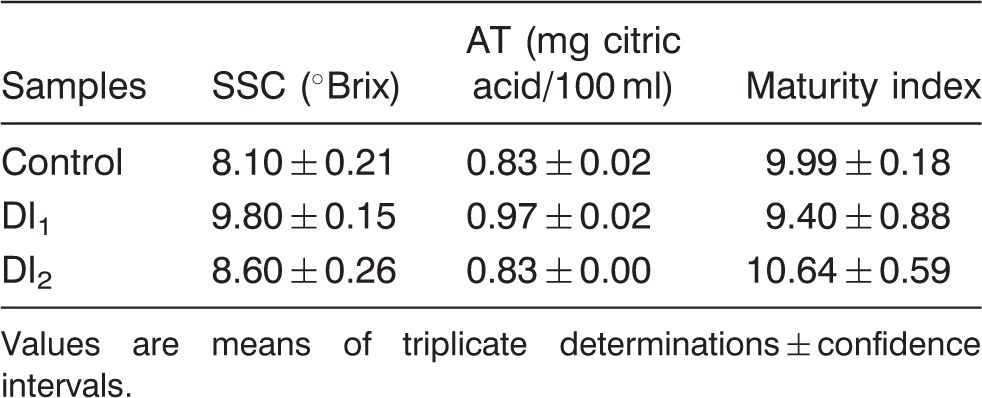
Values are means of triplicate determinations ± confidence intervals.
The effect of DI on quality of the “Flordastar” peaches (weight losses, epidermis color, soluble solids content (SSC), titratable acidity (TA), pH, firmness, and sensory quality evaluation), total phenolics and vitamin C, was studied on the initial day, at the end of cold storage (day 14), and at the end of the retail sale period (day 14+ 4). A cold storage of 14 days is enough for early ripening peaches with high commercial value at European Union markets. For the analysis of total phenolics and vitamin C, peaches were cut into small cubes, frozen in liquid N2, ground to a fine powder with a mincer (IKA, A 11 basic, Berlin, Germany) and kept at –80 ℃ until analyzed.
Weight losses
Groups of 10 uniform size peaches from each repetition were placed in the conditions above described (CA or air). Fruits were weighed on the initial and final days of cold storage and after the retail sale period, reporting the differences in percentage from the initial fresh weight.
Epidermis color
Epidermis color was measured in three different points in the equatorial area, by using the tristimulus colorimeter: Minolta Chroma Meter CIE 1976 (model CR-200, Minolta Corp., Ramsey, NJ) calibrated with a white plate and was expressed as CIELAB (L*a*b*) color space coordinates. Color indices used were a* and hue angle [H° = tan−1(b*/a*−)] as reported in Fernández-Trujillo et al. (1998) and Gil et al. (2006). Ten pieces per replicate were used.
SSC, pH, and TA measurements
Five of the peaches from each repetition were homogenized in a commercial blender (Moulinex, Barcelona, Spain), getting the juice from which SSC, pH, and TA was analyzed as described in Aguayo et al. (2007).
Firmness
A puncture test was used to evaluate firmness in 10 peaches per repetition, based on the resistance of each piece to a pressure applied by ELIB-5 K S.A.E. Ibertest (Madrid, Spain). During the puncture test, an 8 mm diameter flat-head stainless steel cylindrical probe penetrated the middle of both sides of the equatorial diameter (10 mm depth) at a speed of 50 mm/s.
Sensory evaluation
The determination of quality attributes was carried out according to López et al. (2011) with modifications. A trained seven-person panel (aged 24–65) carried out the sensory evaluation in a room at 20 ℃. Before performing the testing session, the panelists agreed in those attributes that better describe sensory changes. External dehydration and off-odors were scored on a nine-point scale of damage incidence and severity (1 = none, 3 = slight, 5 = moderate, limit of marketability, 7 = severe, and 9 = extreme). Appearance, flavor, texture, aroma, and overall quality were evaluated by using a nine-point scale (1 = extremely poor, 5 = fair, limit of usability, 9 = excellent).
Soluble phenolic content (SPC)
Ground frozen samples of 0.850 g were placed in glass bottles and 3 ml of methanol/water (7:3, v/v) added. The extraction was carried out during 1 h in an orbital shaker (Stuart, Staffordshire, UK) at 200 × g in darkness inside a polystyrene box with ice. Then, 1.5 ml of extracts were transferred to three 1.5 ml eppendorf tubes and centrifuged at 15,000 × g for 10 min at 4 ℃. The amount of soluble phenolic compounds in the supernatant obtained was determined according to Swain and Hillis (1959) with slight modifications. A 19.2 μl sample of extract was placed in a 96 well flat-bottom polystyrene plate (Greiner Bio-one, Frickenhausen, Germany) and 29 μl of Folin–Ciocalteu reagent (1 N) was added. After 3 min of incubation in darkness at room temperature, 192 μl of a solution containing Na2CO3 (0.4%) and NaOH (2%) was incorporated and the reaction was carried out for 1 h at room temperature in darkness. Afterwards, the absorbance was measured at 750 nm by a multiscan plate reader (Tecan Infininte M200, Männedorf, Switzerland). SPC was expressed as gallic acid equivalents (GAE) in 100 g fresh weight (f.w.). All extracts were analyzed in triplicate.
Vitamin C content
For monitoring vitamin C content the procedure used was as described by Wright and Kader (1997) based on the method of Zapata and Dufour (1992) with modifications. Ground frozen samples of 5 g were placed in a falcon tube protected against light and 10 ml citric acid buffer (0.1 M citric acid, 0.05% Ethylenediaminetetraacetic acid (EDTA), 4 mmol/l NaF, and 50 ml/l MeOH in nanopure water) was added. They were homogenized in a high speed blender (Ultraturrax, UT) during 30 s. The homogenate was filtered through cheesecloth and after adjusting the pH to 2.3–2.4 using HCl (6 N), the sample was passed through an activated Sep-Pak C18 cartridge (Waters, Mildford, MA). Seven hundred and fifty microliters of the extraction was kept in a 1.5 ml amber vial. Then, 250 μl of 1,2-phenylenediamine dihydrochloride solution (35 mg/100 ml) was added to the vial and after 37 min in darkness, samples were analyzed by High-Performance Liquid Chromatography (HPLC) (Series 1100 Agilent Technologies, Waldbronn, Germany). Total vitamin C and ascorbic acid contents were expressed as ascorbic acid equivalent (AAE)/100 g f.w. and dehydroascorbic acid content as mg of dehydroascorbic acid equivalents in 100 g f.w.
All quality measurements were evaluated on days 0, 14, and 14 + 4 using three repetitions per treatment.
Statistical analysis
A randomized design with three replicates per treatment was used where each plastic tray constituted a replicate (12 fruits). To determine the effect of irrigation treatment, atmosphere conditions, and storage time on each dependent variable, a three-way analysis of variance (P < 0.05) was carried out (Statgraphic Plus, version 5.1, 2001), Manugistic Inc., Rockville, MD, USA). Mean values were compared by multiple range least significant difference test to identify significant differences among treatments and significant interactions between factors.
Results and discussion
Weight loss
For each irrigation treatment, the use of CA reduced the weight loss after cold storage and retail sale period (Figure 1). Among irrigation treatments, DI2 peaches showed a slight weight loss as compared to the others. This could be due to the generation of a thicker cuticle caused by DI suffering (Crisosto et al., 1994). As expected, at the end of the retail sale period an increasing trend in weight loss in all cases was found. Despite this increment, the highest weight loss was under 3%. Overall, DI fruits registered the lowest weight loss (Figure 1), in agreement with Laribi et al. (2013) in pomegranates and Crisosto et al. (1994) in peaches, who considered this parameter as an important factor for the marketability of this commodity.
Weight losses of peaches stored up to 14 days at 0 ℃ plus 4 days at 15 ℃. Data represent means of 10 replicates (n = 10 ± SE). LSD (5%)Irrigation treatment × type of atmosphere = 0.14. LSD (5%)Time × type of atmosphere = 0.14.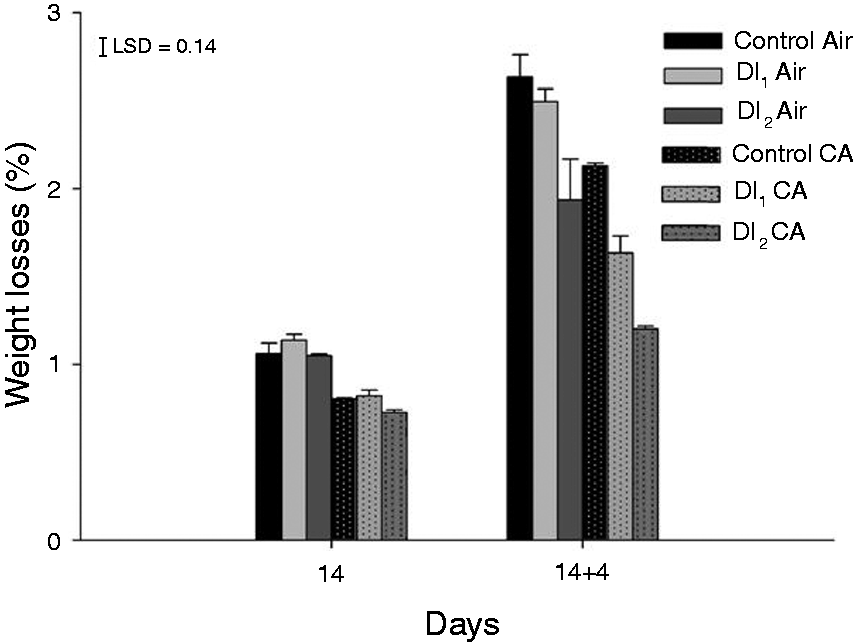
Epidermis color
According to Kader et al. (1982), the a-value is a reliable measure of peach fruit maturity. On the initial evaluation of epidermis color, no significant differences among irrigation treatment were found. The average values were 32.28 ± 0.34 for a* and 51.91 ± 0.55 for H° (Figure 2). This lack of differences agrees with results found by Alcobendas et al. (2012) in DI “Flordastar” peaches versus control ones, which could mean that DI strategies do not affect the epidermis color at harvest. The initial color of both air and CA treatments after cold storage was nearly as that at harvest due to low storage temperature, without detecting any influence of the irrigation treatment over these parameters. After the retail sale period, air-stored fruits showed an increase in a* values while in CA stored peaches no intensification in color was found (Figure 2). The epidermis color change in air-stored peaches is related to ripening advance as observed by Fernández-Trujillo et al. (1998) and Ferrer-Mairal et al. (2012). With respect to the impact of DI on color, we observed that after the retail sale period, DI fruits had higher values of a*, showing a more advanced maturation due to accumulation of carotenes as explained by Neta-Sharir et al. (2005).
Color a* of peaches stored up to 14 days at 0 ℃ plus 4 days at 15 ℃. Data represent means of 10 replicates (n = 10 ± SE). LSD (5%)Time × type of atmosphere = 0.98. LSD (5%)Time × Irrigation treatment = 1.20.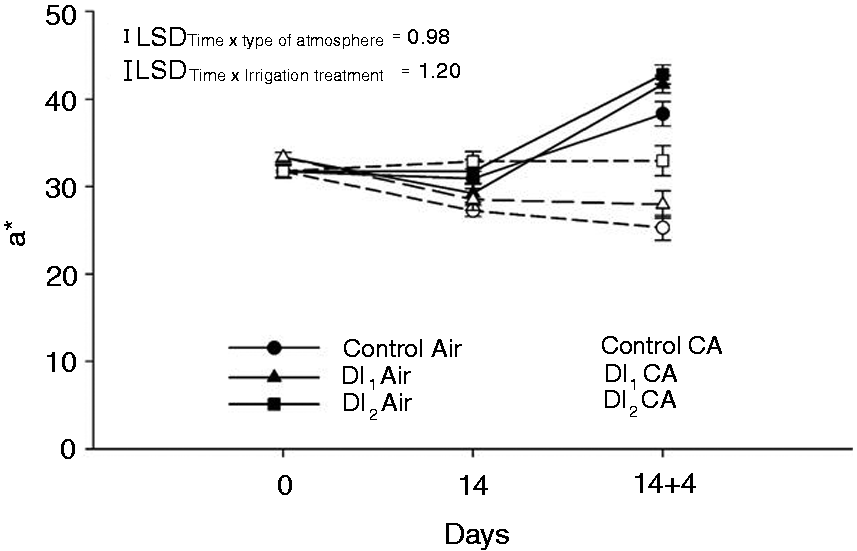
SSC, pH, and TA measurements
Solid soluble content (SSC), firmness, and soluble phenolic content (SPC) of “Flordastar” peaches stored up to 14 days at 0 ℃ plus 4 days at 15 ℃.
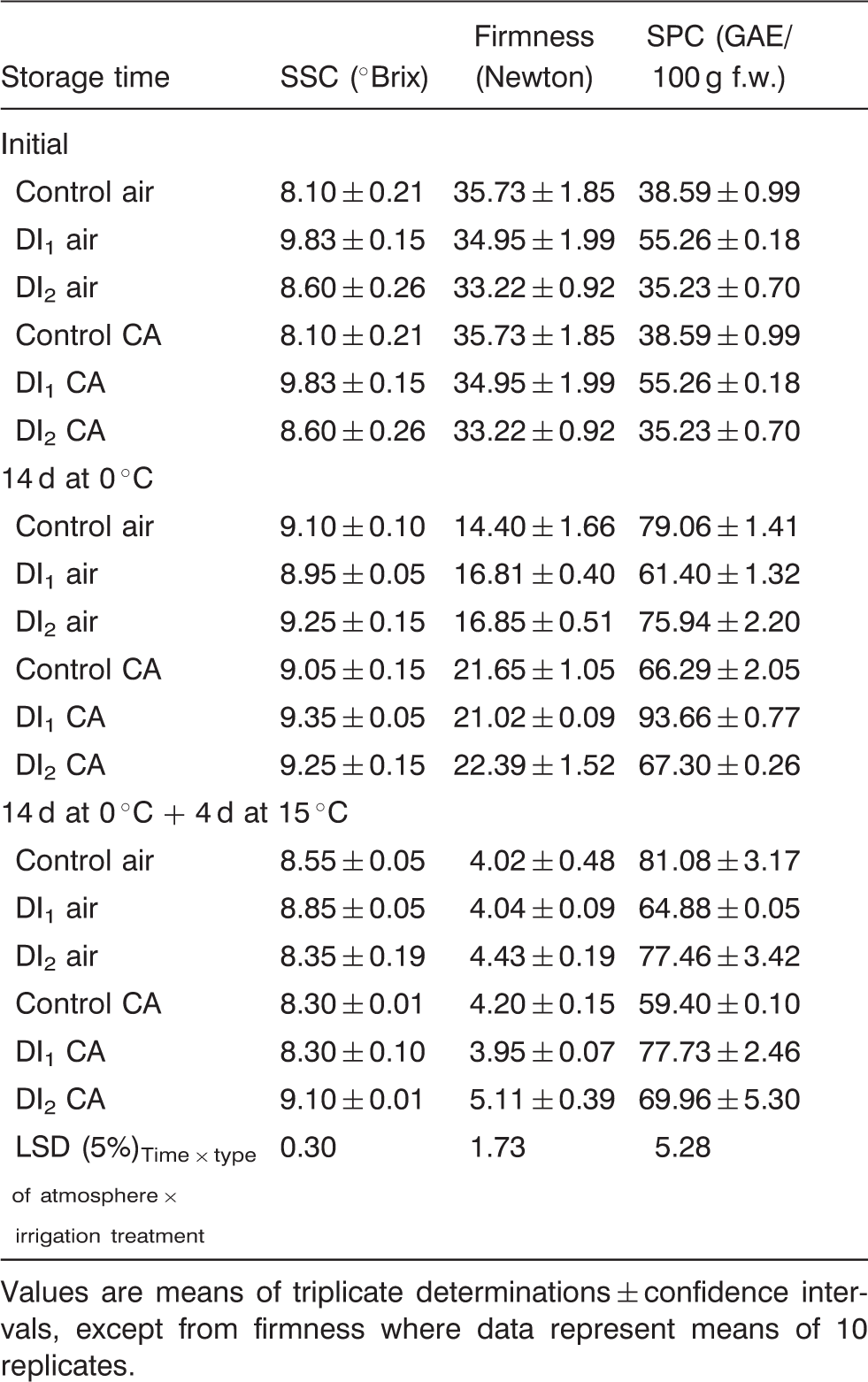
Values are means of triplicate determinations ± confidence intervals, except from firmness where data represent means of 10 replicates.
Sensory evaluation
The peach’s initial appearance from all irrigation treatments scored an average of 7.85 ± 0.15, with slight differences among them (Figure 3). At the end of cold storage, fruits kept in CA maintained the initial level, while the peaches’ appearance decreased to 7.70 ± 0.08 under air-stored conditions. After the retail sale period, this reduction was more noticeable, with the score reaching values below the marketability limit in those peaches stored under normal air conditions. Under CA storage, the best-rated peaches were DI2 fruits with scores of 7.50 ± 0.29. When taste was scored, we initially observed that DI fruits reached higher marks than the control (6.93 ± 0.23 versus 7.69 ± 0.06). This was probably due to the higher SSC, which is very appreciated by consumers (Crisosto, 1994; Iglesias and Echeverría, 2009). After 14 days at 0 ℃, no significant differences were found among irrigation treatments but the panelists could discriminate between types of atmosphere, with the fruits kept in air being the ones with higher acceptance scores (7.83 ± 0.12 versus 6.83 ± 0.08) (data not shown). This could be related to a faster maturation rate of the fruits stored under normal air conditions, which developed a more intense flavor. In the case of texture, all treatments maintained their initial levels after 14 days of storage with no differences among them (7.90 ± 0.24). The decrease in this parameter was observed after the retail sale period when fruits kept in air developed an important softening followed by those kept in CA (data not shown). Only DI2 fruits subjected to CA obtained values above the limit of marketability (5.50 ± 0.32). This fact was also observed by Cano-Salazar et al. (2013), who reported that “Big Top” and “Venus” nectarines had better the texture if stored in CA than normal air. As for aroma, the panel was not able to detect significant differences in aroma changes when subjected to different preharvest and postharvest treatments. As a global sensory evaluation, overall quality was scored. At day 0, DI2 peaches slightly reached greater overall quality scores (average of 7.88 ± 0.28) than control and DI1 fruits (data not shown). This initial higher acceptance was more noticeable after the retail sale period when this combination of treatments, DI2 under CA, was the best rated when compared to the other combinations. The sensory panel perceived this sample to be crispier, juicier, and sweeter as compared to the others, granting it the highest score as expected due to the results in SSC (Figure 3). Subsequently, after the retail sale period, the first signs of a slight external dehydration were observed in air-stored fruits, while CA stored peaches remained without signs of this damage (data not shown). No off-odors were detected in any treatment or sampling time.
Visual appearance of peaches stored up to 14 days at 0 ℃ plus 4 days more at 15 ℃. Data represent means of seven replicates (n = 7 ± SE). LSD (5%)Time × type of atmosphere = 0.96. LSD (5%)Time × Irrigation treatment = 0.59.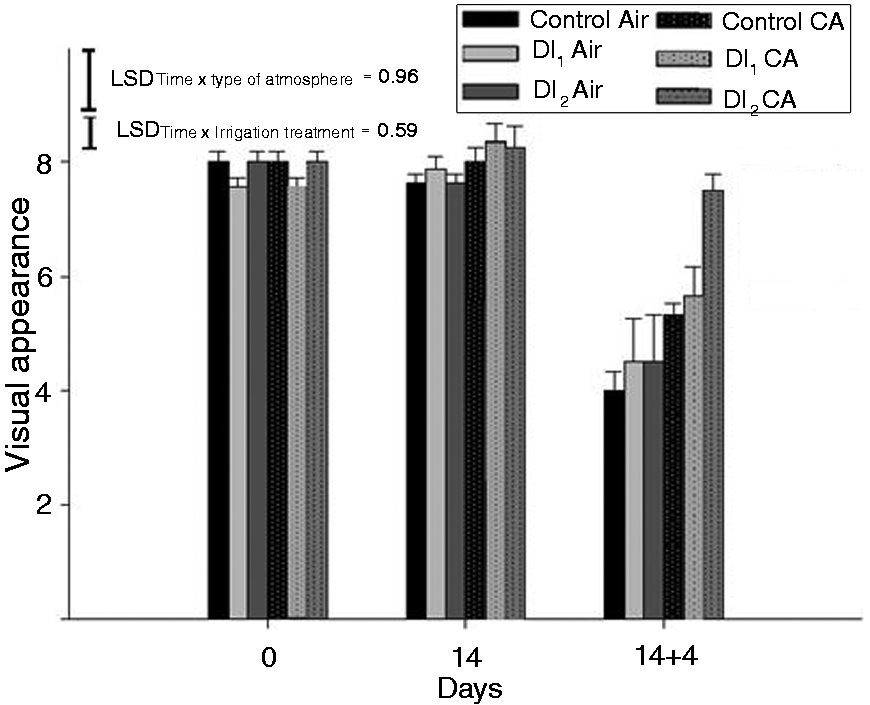
Firmness
At harvest, no significant differences in firmness among irrigation treatments (average level of 34.63 N) were found (Table 2). This firmness gradually decreased with chilled storage and this fact was more noticeable in fruits kept in normal air than those kept in CA (Table 2), without differences among irrigation treatments. Peaches and nectarines with 9–13.5 N are considered as in the best range for eating according to published guidelines (Crisosto, 1994). In the case of handling threshold, the threshold is defined as 35.6–53.4 N for long-distance shipments and 17.8–26.7 N for short-term local sales to avoid bruises (Schulte et al., 1994). After 4 days at 15 ℃, peaches from all treatments obtained firmness levels of 4.29 ± 0.18 N, under the recommended eating range. The results obtained in this parameter is valuable new information related to the potential postharvest handling of stone fruits (Zerbini et al., 2006), and our results suggest that early cultivars such as “Flordastar” should have a very short retail period to avoid fast softening under retail temperatures.
SPC
SPC is determined by genetic and environmental factors, but can be modified by oxidative reactions during processing or storage (Robards et al., 1999). In the current experiment, the triple interaction among factors (irrigation treatment, type of atmosphere, and storage time) induced important changes in this parameter (Table 2). At harvest, DI1 peaches showed higher values compared to the other treatments (55.26 ± 0.18 versus 35.23 ± 0.70 and 38.59 ± 0.99 mg GAE/100 g f.w. for DI2 and control, respectively). In a characterization study, Cantín et al. (2009) reported average values of 37.20 mg GAE/100 g f.w. for several peach and nectarine cvs., within the same range of our results. During cold storage, an average of 47% increase in all irrigation treatments except from DI1-air fruits whose increase was 10% was found (Table 2). According to Roby et al. (2004), DI strategies infer the activation of phenolic compound synthesis, mainly in the peel of the fruits subjected to water stress. Other studies suggest that the activation of this metabolic pathway is related with an increase in the activity of
Vitamin C content
Compared to ascorbic acid (AA) content at harvest, control peaches registered higher values than fruits from the other irrigation treatments (5.43 ± 0.38 versus 1.86 ± 0.01 and 3.97 ± 0.51 AA/100 g f.w., for DI1 and DI2, respectively). After cold storage and retail sale period, all treatments tended to decrease this content to achieve the same level of AA, with an average value of 1.49 mg AA/100 g f.w. (Figure 4(a)). The AA decrease throughout cold storage and the retail sale period is very probably due to the degradation of fruit tissue (Kalt, 2005) which releases the ascorbate oxidase enzyme, the major enzymatic system responsible of this fact. As an oxidation product, DHA also shows biological activity. It can be transformed into AA in the human body, with its role being important in total vitamin C activity (Lee and Kader, 2000). Initial DHA levels followed an opposite behavior when compared to AA content: DI1 and DI2 registered considerably higher DHA content than control (2.43 ± 0.10 and 4.55 ± 00.38 mg AA/100 g f.w., respectively versus 1.28 ± 0.12 mg AA/100 g f.w.). This fact could suggest that DI provokes a stress situation for the tree, activating metabolic pathways of biosynthesis of compounds as a defense mechanism, as was measured with SPC. During cold storage, DI2 peaches decreased their DHA content and control and DI1 slightly increased it. After the retail sale period, CA-stored fruits increased their DHA levels while air-stored peaches decreased or maintained it (Figure 4(b)). This initial difference in AA and DHA among control and DI treatments could be due to the water stress suffered during the cultivation period. During the retail sale period, AA decreased in stressed fruits because of its gradual oxidation to DHA, which increased, as other authors observed in fresh fruit and vegetables (Wills et al., 1984). As an addition of AA and DHA analysis, the changes of total vitamin C are shown in Figure 4(c). In general, CA-stored peaches better maintained their vitamin C content than the ones kept in air. DI peaches reached higher vitamin C content than control ones as reported by Buendía et al. (2008).
Vitamin C of peaches stored up to 14 days at 0 ℃ plus 4 days more at 15 ℃, expressed as mg of ascorbic acid equivalents per 100 g f.w. (mg AAE/100 g f.w.), as mg of dehydroascorbic acid equivalents (DHAE)/100 g f.w. and total vitamin C expressed as mg AAE/100 g f.w. Data represent means of three replicates (n = 3 ± SE). For AA LSD (5%)Time × Irrigation treatment = 0.56. In the case of DHA, LSD (5%)Time × type of atmosphere × Irrigation treatment = 0.73. Finally, for total vitamin C, LSD (5%)Time × type of atmosphere × Irrigation treatment = 0.86.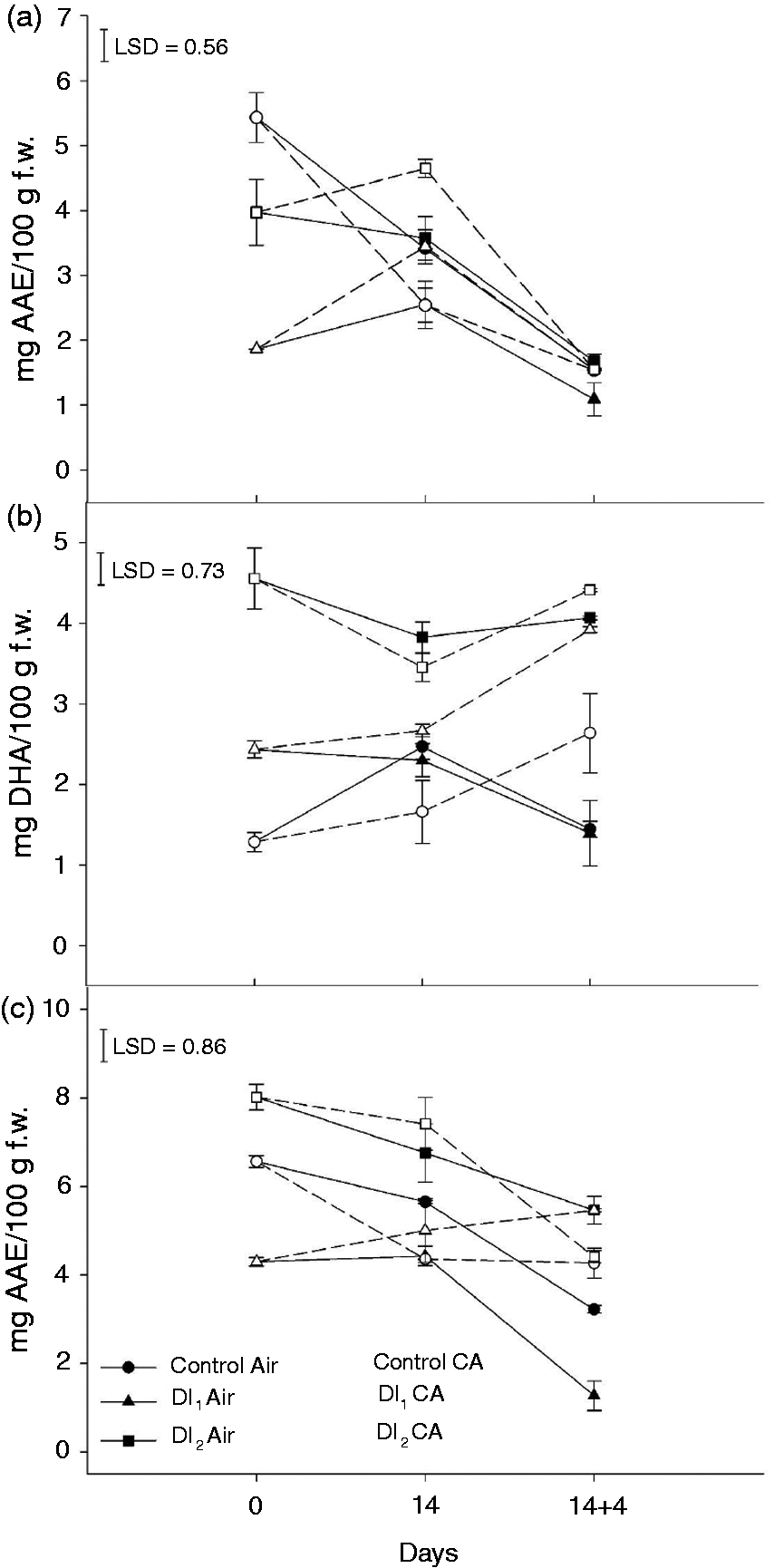
Conclusions
As the main conclusion, we can state that “Flordastar” peaches cultivated under DI reached a higher SSC at harvest, being more appealing to consumers, while achieving important water savings with either of the two DI strategies. DI1 showed more total phenolics than the other irrigation treatments. When combined with CA storage, DI2 peaches achieved a higher sensory quality and kept the initial levels of bioactive compounds such as vitamin C in better status as compared to air storage and the other irrigation treatments after the retail sale period. More research should be performed on methods needed for keeping a higher fruit firmness.
Footnotes
Acknowledgements
Thanks are due to Institute of Plant Biotechnology of the UPCT for the use of some equipment.
Funding
The authors are grateful to the Spanish Ministry of Economy and Competitiveness-FEDER for financial support (project AGL2010-19201-C04-02-AGR) and for the concession of a predoctoral grant to N. Falagán, and the Fundación Séneca (regional research center) also financed part of the preharvest study (project 11981/PI/09).