







Abstract
Sheared gels containing 0.2 wt% low-acyl gellan gum were prepared by different processing protocols using Na+ or Ca2+ as gel-promoting ions. Rheology and confocal laser scanning microscopy were used to gain information on the sample structure. Confocal laser scanning microscopy revealed the formation of a heterogeneous microstructure consisting of a dispersion of gel-like clusters. Small amplitude oscillatory shear stress results indicated that their viscoelastic properties had a predominant elastic component. Flow curves exhibited very high viscosities at low shear stress, an apparent yield stress and very shear thinning behaviour, supporting their applications as a stabilizer.
Introduction
Sheared gels are defined as suspensions of gel-like clusters with irregular shapes in an aqueous polymer-depleted phase obtained by interrupting the gel formation by shear while gelation is taking place in biopolymer solutions (García et al., 2011). They can show intermediate properties between strong and weak gels, but closer to the latter. The possibility of forming sheared gels has been attributed to polysaccharides which produce strong gels under quiescent cooling such as gellan gum, agar (Caggioni et al., 2007; García et al., 2011, 2015; Sworn, 2009; Sworn et al., 1995; Valli and Miskiel, 2001) k-carrageenan and agarose (Altmann et al., 2004; Gabriele et al., 2009; Norton et al., 1998, 1999, 2000, 2006). These sheared gels show an apparent yield stress, which is a finite stress that must be exceeded for the system to flow at a significant shear rate (García et al., 2015).
In this work, several processing protocols of low-acyl gellan (LA-gellan) sheared gels and several gel-promoting ions with different natures have been studied.
Gellan gum is an anionic polysaccharide that is obtained by microbial fermentation from Sphingomonas elodea (ATCC 31462) (Sworn, 2009). Gellan solutions produce strong gels upon cooling, although low-acyl gellan requires cations, acid or soluble solids to form gels.
In order to obtain LA-gellan gum sheared gels, three steps must be performed, as suggested by Sworn – dispersion, hydration and gelation under shear (Sworn, 2009). High shear is used in the first step to avoid the formation of lumps. In the hydration step, it is necessary to include gel-promoting ions (Na+, K+, Ca2+, H+) at high temperature, and in the third step the formation of a true or strong gel is prevented by shear. In the latter, double helices of LA-gellan gum tend to associate themselves forming a three-dimensional structural network due to the presence of calcium or sodium ions. This tendency is counterbalanced by shear forces, such that, eventually, a dispersion of gel-like clusters is formed.
The main applications of sheared gels are their role as a suspension agent (Sworn, 2009), emulsion stabilizer (García et al., 2014) and potentially as a satiety agent (Bradbeer et al., 2015). Gellan gum has been considered a food additive in the USA since 1992 and nowadays it is allowed as a food additive in other countries. According to the International Numbering System for food additives, its code is INS 418 (Morris et al., 2012).
Among food applications of LA-gellan gum as a sheared gel is its use in various beverage suspensions such as citrus beverages or chocolate milk beverages. These sheared gels are also used in translucent beverages to yield suspensions without extreme viscosity and to suspend coloured beads in the beverage, such as small transparent gel cubes in an apple juice (Valli and Miskiel, 2001).
Materials and methods
Materials and fluid gel preparation
Low-acyl clarified gellan gum (Kelcogel® F™) kindly supplied by CP-Kelco (San Diego, USA) was used as received. This material will be denoted as LA-gellan from now on in this paper. According to its manufacturer, the average molecular weight of LA-gellan was 2–3×10⁵ Da. Its concentration in sheared gels was 0.2 wt%. In order to get Na+ or Ca2+ gel-promoting ions, 99.5% purity NaCl purchased from Panreac (Barcelona, Spain) and 98% purity CaCl2 supplied by Merck were used. NaCl and CaCl2 concentrations used were 1.3 wt% and 0.2 wt%, respectively. The latter was chosen after a previous formulation screening whose target was to mimic the dynamic viscoelastic response of the sheared gel with 1.3 wt% NaCl. Deionised water was always used (electrolytic conductivity at room temperature: 2.1 μS/cm; calcium concentration: 69.1 ppb; sodium concentration: 16.6 ppb); 0.1 wt% sodium azide was used as a preservative of sheared gels. Batches of 600 g of LA-gellan sheared gels were prepared following the three abovementioned steps (dispersion, hydration and gelation) (Sworn, 2009). Powdered LA-gellan gum was dispersed by slow addition to a container located in a water-bath at 80 ℃. Hydration was reached by keeping the solution at 80 ℃ under 700 rpm for 25 min with an Ika-Visc MR-D1 homogeniser (Ika, Germany) and a sawtooth-type impeller. The ratio of the impeller diameter to the container diameter was 0.85. The temperature chosen guaranteed the correct gum hydration as it exceeded by 10 ℃ the required temperature when deionised water is used as solvent (Valli and Miskiel, 2001). Then, depending on the cation used to promote gelling, the required quantity of NaCl or CaCl2 was added and the solution was kept under mechanical treatment at 80 ℃ for a further period of 5 min. Evaporative losses were corrected for by adding appropriate amounts of deionised water. Subsequently, the solution container was placed in a thermostatic bath filled with water at 20 ℃ as coolant and the gelation step was performed using two different protocols. Sheared gels were obtained by submitting the sample to mechanical treatment under 700 rpm with the aforementioned Ika-Visc equipment for 1500 s (protocol 1) (García et al., 2015) or at 1000 rpm for 2400 s (protocol 2).
Sheared gels were kept under storage at 4.5 ℃ for at least 48 h before conducting the rheological study.
Confocal laser scanning microscopy
A Leica confocal laser scanning microscope, model TCS-SP2 was used with a 10× air immersion objective. In order to label the LA-gellan gum, we followed the method reported by Rodríguez-Hernández et al. (2003). The samples were observed at room temperature (∼20 ℃) under confocal laser scanning microscopy (CSLM) following a standard protocol which was reported elsewhere (García et al., 2011).
Dynamic viscoelastic experiments
A controlled-stress rheometer AR2000 (TA Instruments, Crawley, UK) was used to carry out stress sweep and frequency sweep tests as a function of gel-promoting ion concentration and the protocol used. These tests were performed at 20 ℃. A parallel plate sensor system with serrated surfaces, 40 mm diameter and a measuring gap of 1 mm was used. A thin layer of Dow-Corning 200® (Dow Chemical Co.) silicon oil fluid (kinematic viscosity, 20 cSt) was placed around the plate rim to avoid losses due to evaporation during the experimental time. Stress sweeps under oscillatory shear tests at three different frequencies (0.1, 1, 3 Hz), from 0.008 to 3 Pa were run to estimate the limits of the dynamic linear viscoelastic range (DLVR). The mechanical spectra were determined by small amplitude oscillatory shear (SAOS) in the 3–0.01 Hz frequency range by selecting a stress within the linear range.
Steady shear flow tests
Characterization of the flow behaviour was carried out using a Haake RS100-controlled stress rheometer from Thermo Scientific (Karlsruhe, Germany), with a parallel plate sensor system with serrated surfaces (60 mm diameter and a measuring gap of 1 mm). It was necessary to use a serrated surface sensor system to avoid wall depletion phenomena since, as shown in Figure 1, the structure of LA-gellan gum sheared gels consists of a heterogeneous microstructure. In order to account for the shear rate variation with the plate radius, the results were corrected by using the following equation (Malkin and Isayev, 2006)
CLSM microphotograph of 0.2% wt% gellan gum sheared gel and 1.3% wt% NaCl (at room temperature).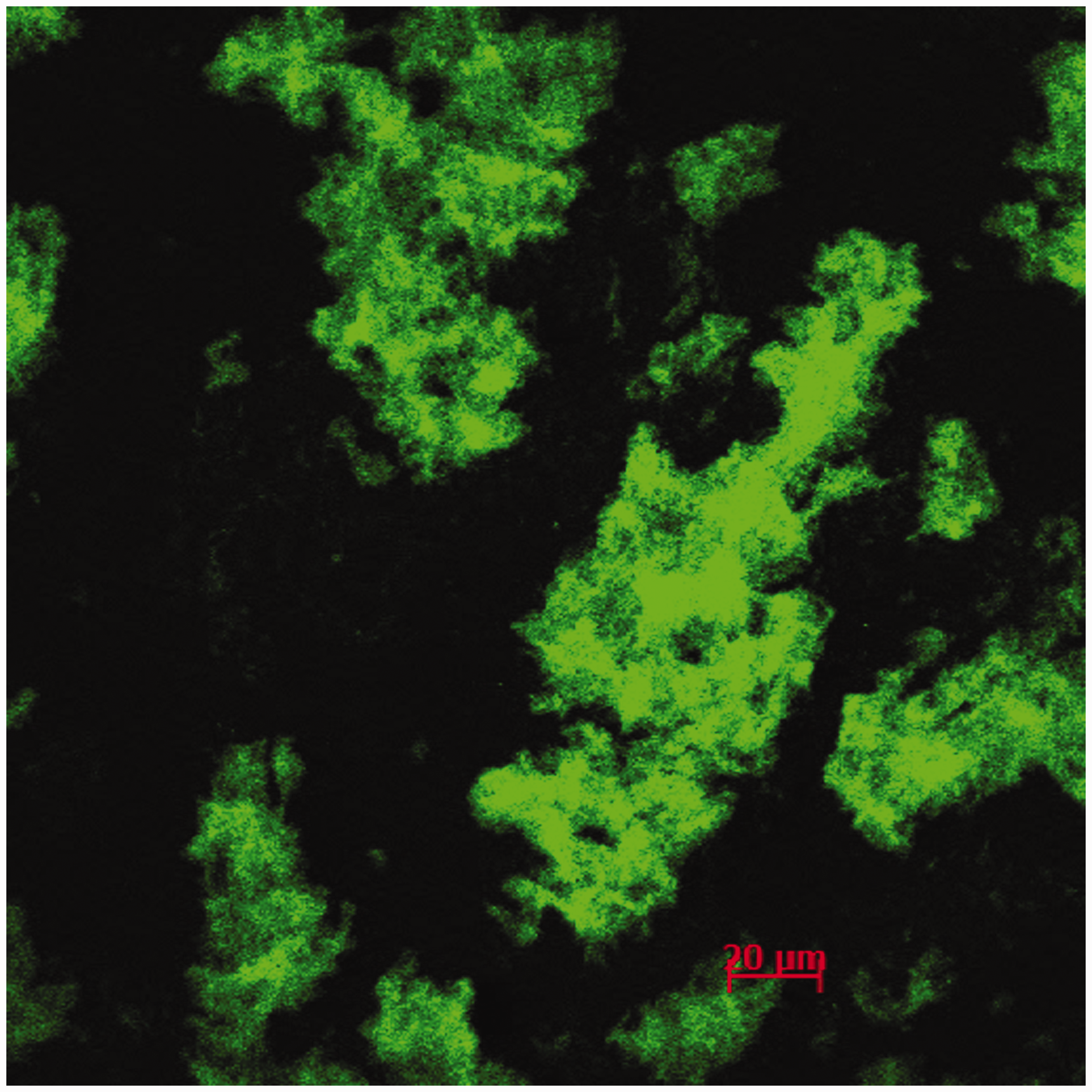


The tests were performed in the 0.5–33 Pa shear stress range by a step-wise procedure, with 5 min at each shear stress in order to attain the steady-state regime.
Before starting the rheological tests (dynamic viscoelastic experiments and steady shear flow tests) samples were kept in the quiescent state at the measuring position for an equilibration time of 600 s to allow stress relaxation after the loading process.
Results and discussion
CLSM
To prepare LA-gellan sheared gels, the samples were submitted to several mechanical treatments. The applied energy in these procedures disrupted the process of the formation a strong gel. However, the occurrence of a heterogeneous microstructure consisting of a dispersion of gel-like polymer clusters (clear zone) with irregular shapes in an aqueous biopolymer depleted phase (dark zone) was observed by CLSM. Figure 1 shows, by way of example, the microstructure of the sheared gel containing 1.3% NaCl, which turned out to be quite similar to that reported for a fluid gel prepared with a different mechanical process (García et al., 2011).
Rheological characterization
Dynamic viscoelasticity: SAOS
In order to guarantee that the oscillatory shear test does not damage the sample structure, tests must be carried out at a stress and a strain within the DLVR. Consequently, previous stress sweep tests were performed at three different frequencies to ensure that the conditions for linear viscoelastic behaviour were fulfilled, since the limiting stresses and strains guaranteeing the linear viscoelastic response may depend on the frequency used. Let us consider the following equation

We carried out the mechanical spectra of this study in controlled-stress mode; hence τo was kept constant, and as a result, at the lower frequencies, γo must be checked because it may go out of the linear region. This may happen because G* will show the lowest values at the lower frequencies and according to equation (3) the resulting value of γo may be too high. Interestingly, we emphasize that if a controlled-strain mode had been chosen, the risk of an unexpected failure of the linear viscoelastic condition could have taken place at the higher frequencies.
For this reason, it is necessary to perform the stress sweep tests at different frequencies and consider both the critical stress and the critical strain to determine the DLVR. In this test, the storage modulus (G′) and the loss modulus (G″) remain constant up to a critical stress and strain. The onset of the non-linear region starts when these moduli become dependent on the applied stress and strain.
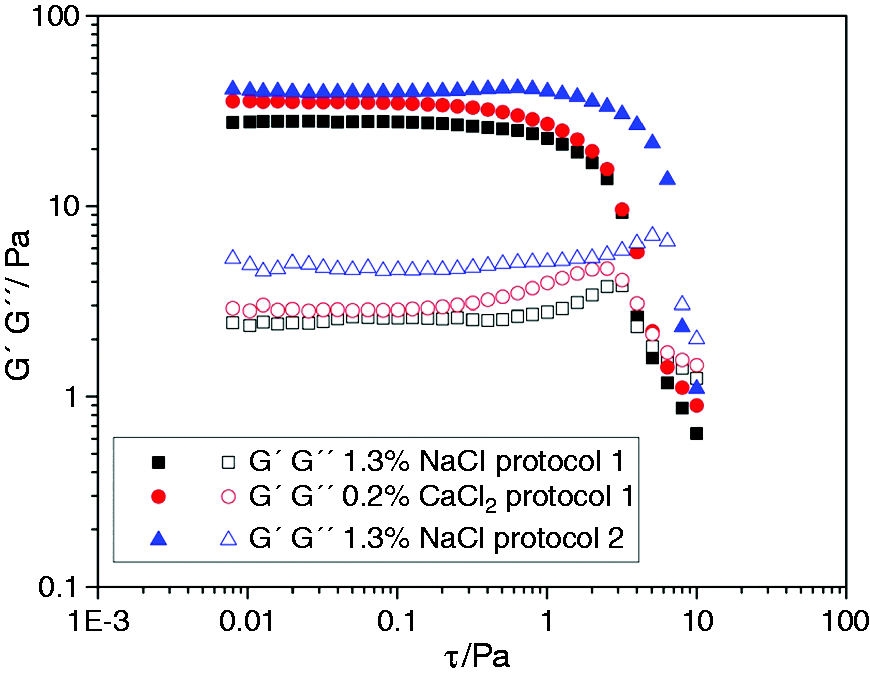
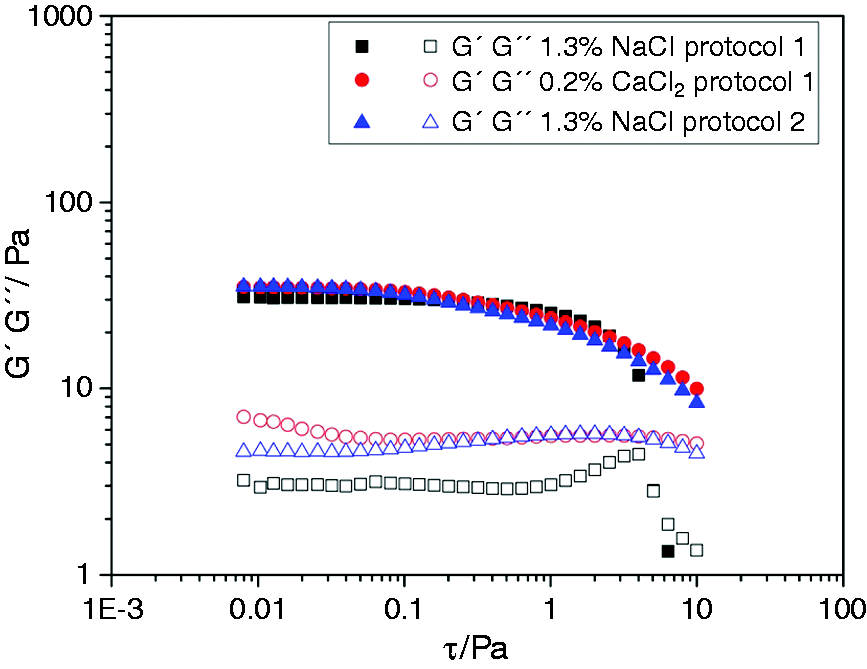
Figures 2 to 4 illustrate a clear rise of G″ at the onset of non-linear response, which took place at the same time as G′ started falling. It is interesting to note that G″ achieved a peak value at the beginning of the non-linear range, which may be associated with energy dissipation attributed to microstructure reorganisation before collapsing, as reported for some concentrated O/W emulsions and dispersions of surfactant-based lamellar liquid crystals (Alfaro et al., 2000; Lequeux et al., 1997).
Stress sweep tests performed at 0.1 Hz for sheared gels containing 0.2 wt% LA-gellan gum and different types of gel-promoting ions and obtained by different protocols. Temperature: 20 ℃. Stress sweep tests performed at 1 Hz for sheared gels containing 0.2 wt% LA-gellan gum and different types of gel-promoting ions and obtained by different protocols. Temperature: 20 ℃. Stress sweep tests performed at 3 Hz for sheared gels containing 0.2 wt% LA-gellan gum and different types of gel-promoting ions and obtained by different protocols. Temperature: 20 ℃.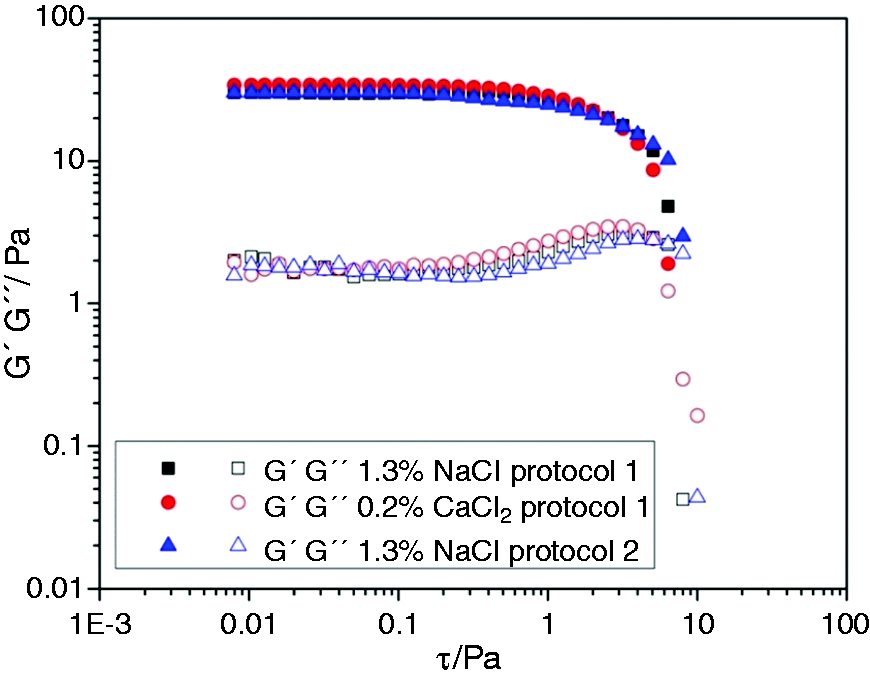
Critical stress (
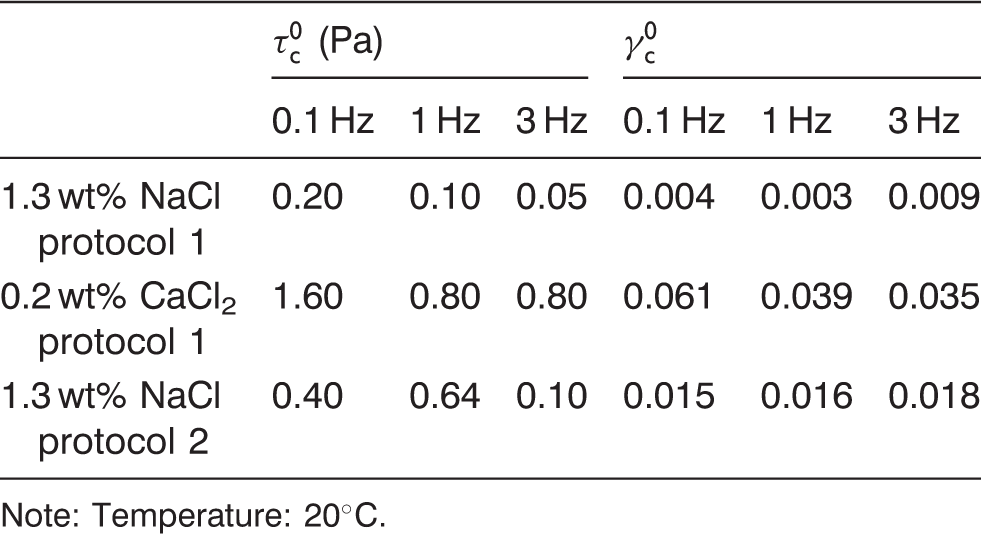
Note: Temperature: 20℃.
Frequency sweeps (Figure 5) were conducted following a decreasing frequency protocol. In this way, a maximum number of data can be obtained in the shortest possible experimental time since the higher the frequency, the shorter the data acquisition time will be. This experimental procedure has the advantage that biased data due to sample drying or diffusion of sealing fluid is minimised.
Mechanical spectra for sheared gels containing 0.2 wt% LA-gellan gum and different types of gel-promoting ions and obtained by different protocols. Temperature: 20 ℃.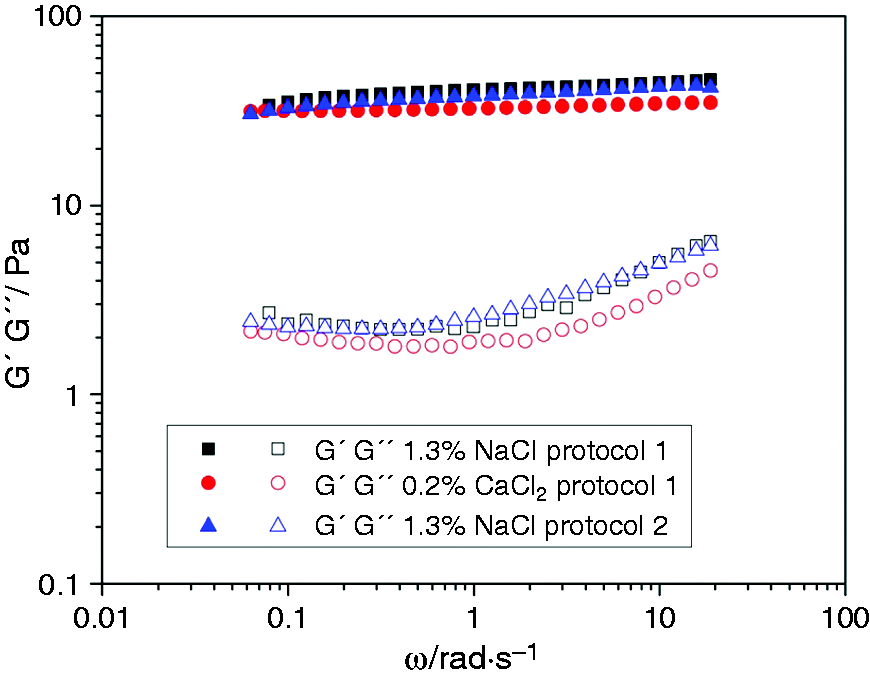
All the mechanical spectra studied exhibited very slow characteristic slopes for the frequency dependence of G′, which is typical of gel-like materials. In addition G″ showed a minimum value at intermediate frequency. This behaviour resembles that of strong gels but the fact that G′ exhibited values just one order of magnitude greater than G″ ruled out the idea that sheared gels can be classified as a type of strong gel. The minimum of G″ is responsible for the occurrence of a further minimum in the log-log plot of the loss tangent (G″/G′) as a function of the angular frequency (Figure 6). The frequency at which this minimum appears allows the frequency corresponding to a G′ value called the plateau modulus ( Frequency dependence of the loss tangent for sheared gels containing 0.2 wt% LA-gellan gum and different types of gel-promoting ions and obtained by different protocols. Temperature: 20 ℃.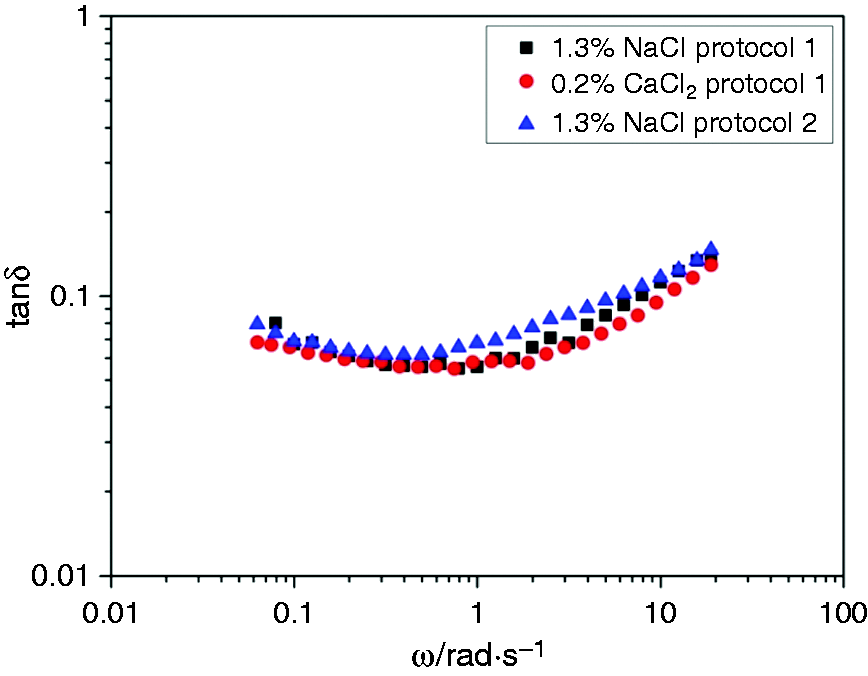
Figure 5 also demonstrates that the mechanical spectra of sheared gels formulated with 1.3 wt% NaCl were not influenced by the different mechanical processes used during their preparation. This indicates that both sheared gels had a similar microstructure as is also supported by CSLM. The excess energy used with protocol 2 was not enough to achieve a different microstructure and linear viscoelastic behaviour.
Interestingly, a smaller concentration of CaCl2 resulted in sheared gels with similar viscoelastic properties. This may be interpreted on the basis of well-established effects of salts on gellan strong gels. Yet, the amount of salt needed to achieve the gelation depends on the ionic strength and type of the cation used (Nijenhuis, 1997). In presence of monovalent cations, such as K+, two LA-gellan double helices need to connect by strong carboxylate –K+–water–K+– carboxylate interaction. However, in the case of divalent ions, such as Ca2+, each –K+–water–K+– bridge is predicted to be substituted by a single Ca2+. The carboxylate–Ca2+– carboxylate interaction is stronger than those formed by carboxylate–K+–water–K+– carboxylate (Chandrasekaran and Radha, 1995). This indicates that divalent ions seem to be much more effective than monovalent ions in forming a gellan-based structural network.
Steady shear flow tests
Figures 7 and 8 show the flow curves of the systems studied. Raw data were corrected to consider the shear rate variation with the plate radius, since it is zero at the center of the plate while it reaches a maximum value at the rim. This correction was carried out as indicated in the section on Materials and methods.
Corrected shear stress dependence of viscosity for sheared gels containing 0.2 wt% LA-gellan gum and different types of gel-promoting ions and obtained by different protocols. Temperature: 20 ℃. Shear rate dependence of corrected shear stress for sheared gels containing 0.2 wt% LA-gellan gum and different types of gel-promoting ions and obtained by different protocols. Temperature: 20 ℃.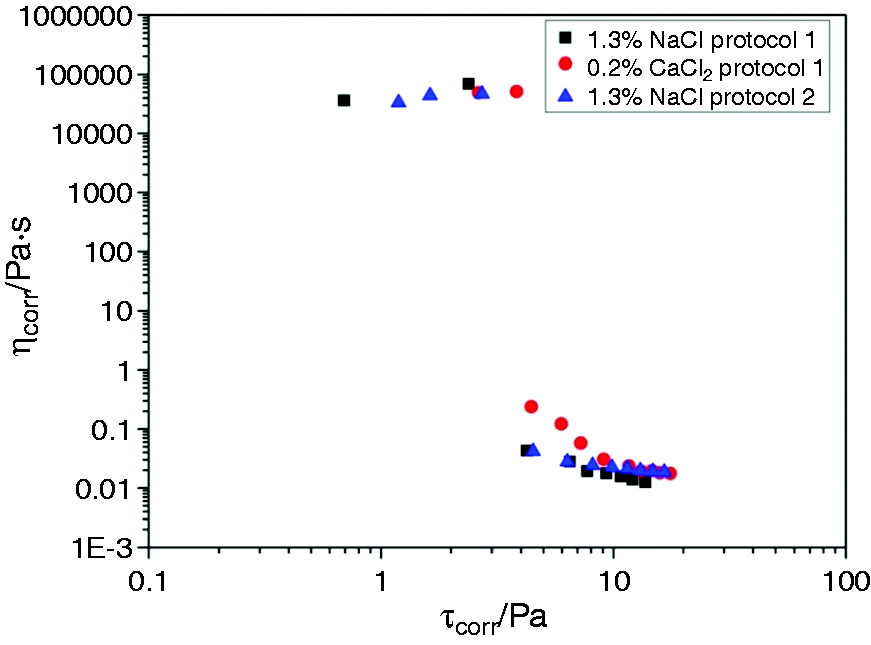
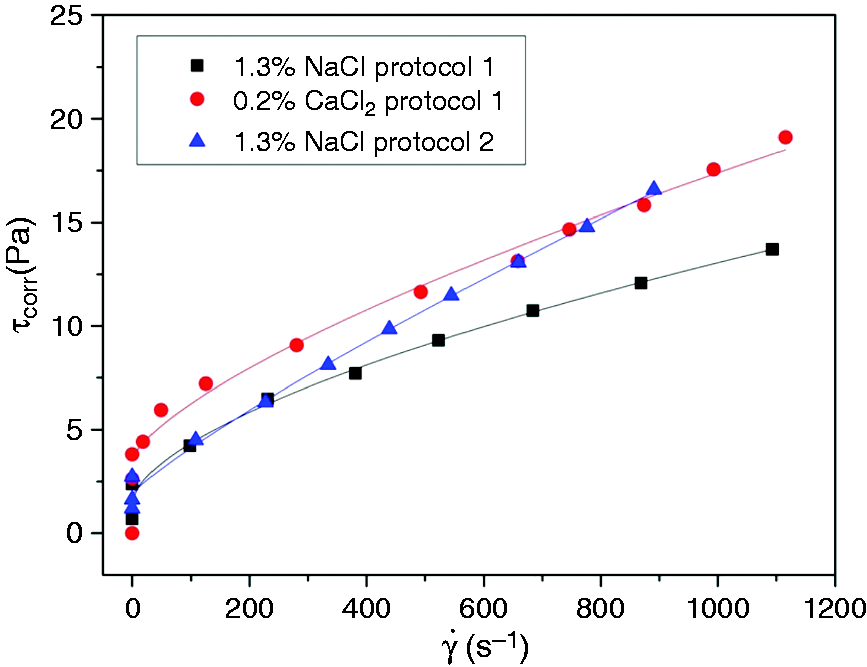
Figure 7 exhibits apparent viscosity values as a function of corrected shear stress. All sheared gels studied exhibited extremely high apparent viscosity at very low shear stress and a very shear thinning behaviour as demonstrated by the five-orders of magnitude fall in the apparent viscosity above a critical shear stress. This is consistent with results reported in a previous work in which series of creep-recovery-creep experiments conducted at several independent shear stresses illustrated how a dramatic drop in viscosity was observed above a practical yield stress. Interestingly, the onset of nonlinear time-dependent viscosity values was also checked at the yield stress (García et al., 2015).
The shear rate dependence of corrected shear stress fitted fairly well the Herschel-Bulkley equation as illustrated in Figure 7.


Fitting parameters of the Herschel-Bulkley equation for sheared gels containing 0.2 wt% LA-gellan gum and different types of gel-promoting ions, prepared by different mechanical protocols

Note: Temperature: 20 C. E stands for standard error of fitting parameters.
Conclusions
CLSM demonstrated that sheared gels prepared with 0.2 wt% low-acyl gellan gum have a heterogeneous microstructure. This consists of a dispersion of gel-like polymer clusters with irregular shapes in an aqueous biopolymer-depleted phase.
Oscillatory stress sweep results revealed that in order to determine the dynamic linear viscoelastic region (DLVR), tests must be performed at different frequencies. The mechanical spectra demonstrated that sheared gels prepared with low-acyl gellan gum exhibited viscoelastic properties, with elastic component greater than the viscous one and a very small frequency dependence of the storage modulus.
Sheared gels containing NaCl showed similar mechanical spectra regardless of the preparation protocol used. We have demonstrated that shear gels exhibiting similar linear viscoelastic properties can be prepared with the same mechanical process by just adjusting the right concentration of either sodium or calcium salts in the formulation. In fact, it has been possible to obtain a similar sample structure using a lower concentration of CaCl2 due to the fact that divalent ions are much more effective than monovalent ions in forming a three-dimensional gellan network. We have checked that the interpretation of the effect of ions on strong gellan gum gels is also valid for sheared gels.
Steady shear flow tests revealed that the sample shows a very shear thinning behaviour. The flow properties at steady shear fit the Herschel-Bulkley equation with small (1.5 Pa–3.6 Pa) values of apparent yield stress and flow indexes which range from 0.6 to 0.8. On the whole we draw the conclusion that these fluid gels exhibit quite similar shear flow properties.
From the point of view of sheared gel applications, we underline that they exhibit clear viscoelastic properties with dominant elastic component, very high apparent viscosity at low shear stresses and a significant practical yield stress. All these properties support their applications as dispersion stabilisers. In addition their very shear thinning flow behaviour is welcome for their handling properties.
Footnotes
Declaration of conflicting interests
The author(s) declared no potential conflicts of interest with respect to the research, authorship, and/or publication of this article.
Funding
The author(s) disclosed receipt of the following financial support for the research, authorship, and/or publication of this article: This paper reports some of the results obtained while working within the framework of research Project CTQ2011-27371 funded by the Spanish Ministerio de Economía y Competitividad (MINECO) and by the European Comission (FEDER Programme). Their financial support is kindly acknowledged.
Acknowledgements
CP Kelco is thanked for providing Kelcogel F samples.