






Abstract
In this work, the effect of the addition of olive leaf extracts on the quality of vacuum-packed salmon burgers stored at 4 ℃ during 16 days has been studied. Olive leaf extract and its hydrolysate were initially characterized and then incorporated to salmon burgers. A shelf life study was conducted in three different batches (control, olive leaf extract, and hydrolyzed olive leaf extract burgers). Among the chemical indices determined, total volatile base nitrogen values were lower in hydrolyzed olive leaf extract and olive leaf extract burgers than in control samples. Lipid oxidation was lower in salmon burger with olive leaf extract. Salmon mince treated with hydrolyzed olive leaf extract showed lower microbial counts during the whole study, which extended the shelf life of the fish product. Therefore, the potential of olive leaf extracts to preserve salmon burgers during cold storage has been demonstrated.
Introduction
Olive leaves are a copious by-product derived from the olive grove and olive oil mills. They can be found in high amounts during pruning of the trees, harvesting and in the olive oil industries. Olive leaves have been used for centuries as a folk remedy for combating fevers and other diseases, such as malaria (Somova et al., 2003). Several reports have shown that olive leaves are rich in high-value bioactive compounds such as oleuropein, verbascoside, luteolin-30-7-di-O-glucoside, 10-hydroxy oleuropein, quercetin rutinoside, ligstroside, oleuropein diglucoside, luteolin-7-O-rutinoside, luteolin-7-O-glucoside, and apigenin 7-O-rutinoside, among many others (Khemakhem et al., 2017a). Indeed, there is compelling scientific evidence that olive leaf polyphenols show antioxidant, anti-inflammatory, hypoglycemic, anti-hypertensive, antimicrobial, anticancer, and anticholesterolemic properties (Nunes et al., 2016). Thus, the use of olive leaves is hence attractive to researchers due to its high content of bioactive components, material availability and price, as olive leaves are considered as a cheap raw material which can be used as useful source of high value-added products, such as phenolic compounds (Khemakhem et al., 2017b).
Due to these benefits, several researchers have previously employed olive leaf extracts (OLE) for the supplementation of refined olive oil, husk olive oil, and other edible vegetable oils (Bouaziz et al., 2008; Chiou et al., 2009; Paiva-Martins et al., 2007; Salta et al., 2007). Paiva-Martins et al. (2007) reported that the enrichment with extract from 1 kg of leaves is sufficient to fortify 50–320 L of refined olive oil to a similar stability as a virgin olive oil. Chiou et al. (2009) reported that supplemented frying oils (sunflower, olive, and refined palm oils) had higher total polyphenols and tocopherols’ content, oxidative stability, and antioxidant capacity than non-supplemented oils. A similar trend was observed by Salta et al. (2007) who found that after adding olive leaf polyphenols to olive, sunflower, palm, and a vegetable shortening oil, both antioxidant capacity and oxidative stability were substantially improved for all the oils studied after supplementation. Bouaziz et al. (2008) studied the enrichment of refined olive and husk oils with both OLE and hydrolyzed olive leaf extract (HOLE), which resulted in an appreciable resistance to oxidative deterioration due to its phenolic antioxidants content. OLEs have been also employed to avoid lipid oxidation and to increase shelf life of meat products such as pork sausages (Hayes et al., 2010, 2011), meatballs (Gok and Bor, 2012), pork meat patties (Botsoglou et al., 2014a, 2014b), and minced beef meat (Aouidi et al., 2017), among others. In fish products, Albertos et al. (2018) included olive leaf powder on mackerel minced in order to evaluate its antioxidant effect, meanwhile Cedola et al. (2017) employed an olive oil industrial by-product to increase the nutritional quality of fish burgers. However, there is little research on the employment of OLEs to prolong shelf life of fish and fish products (Khidhir, 2015).
Fish is considered as a valuable source of proteins in the human diet. Fish and fish products contain high-quality proteins and other necessary nutrients; they are low in saturated fatty acids and contain high content of unsaturated fatty acids (Venugopal and Shahidi, 1995). However, these products are highly perishable due to their biological composition, being the main cause of deterioration the activity of typical spoilage seafood microorganisms. Microbial proliferation provokes the loss of essentially fatty acids, fat-soluble vitamins and protein functionality, production of biogenic amines, and formation of off odors (Gram and Dalgaard, 2002). Moreover, fish products obtained from fatty fish species are also susceptible to oxidation as they contain high amounts of polyunsaturated fatty acids (Olafsdóttir et al., 1997). In an attempt to control the deterioration and lipid oxidation of food, synthetic additives are widely used. However, synthetic antioxidants may have toxic effects and consumers are concerned with safety; thus, the interest in products with natural antioxidants has increased (Mancini et al., 2015). In this sense, Nunes et al. (2016) highlighted the interest of using bioactive compounds derived from olive by-products as natural additives.
The aim of this study was to examine the effect of two different OLEs on the quality and shelf life of salmon burgers stored in vacuum packs. After characterization of OLEs, quality parameters of salmon burgers, such as total volatile bases, lipid oxidation, color, and microbial growth during cold storage, were evaluated.
Material and methods
Preparation of OLEs
Olive leaves (Olea europaea L.) from Chemlali variety were collected in Sfax (Tunisia) on December 2015, dried in a tunnel microwave dryer (1200 W, 70 ℃) for 10 min, grounded (Adasen, JN-100, China), sieved to particle size under 1 mm, and stored in the darkness at 4 ℃ until extraction.
OLE was prepared by mixing olive leaf powder with water (2.5% w/v), and the mixture was kept under constant agitation for 1 h. Subsequently, the solution was filtered using filter paper (Filtres RS, 8-11 µm, Spain), and the solvent was removed with a rotary evaporator at 40 ℃ under vacuum to dryness, freeze dried, and stored at −18 ℃ until use.
On the other hand, OLE was hydrolyzed in order to produce a hydroxytyrosol (HYTY)-rich extract (as HYTY is the main oleuropein derivative). Thus, HOLE was obtained by treating OLE extract with phosphoric acid (85% v/v) up to pH 2. Next, the solution was kept in an autoclave (121 ℃, 20 min), filtered using filter paper, concentrated in rotary evaporator at 40 ℃ under vacuum to dryness, freeze dried, and stored at −18 ℃ until use.
Characterization of OLEs
OLE and HOLE were characterized by determining pH, total phenol content (TPC), 1,1-Diphenyl-2-picryl-hydrazyl (DPPH) radical-scavenging activity, the oxygen radical absorbance capacity (ORAC assay), and the contents of oleuropein and HYTY using high-performance liquid chromatography (HPLC).
TPC of OLE and HOLE was determined according to the method described by Singleton et al. (1998). Briefly, 100 µL of OLE or HOLE was mixed with 500 µL of Folin–Ciocalteu’s phenol reagent. After 5 min, 1 mL of Na2CO3 solution (20% w/v) was added, and the mixture was adjusted to 10 mL with distilled water. The reaction was kept in the darkness for 30 min, and the TPC was determined by measuring the absorbance at 765 nm using a spectrophotometer (Thermo Fisher Scientific, Helios Zeta UV-VIS, UK). Results were expressed as milligram gallic acid equivalent (GAE) per gram of dry extract (DE).
The DPPH radical-scavenging activity of OLE and HOLE was determined by adapting the protocol described by Bersuder et al. (1998) with some modifications. However, 500 µL of extract at different concentrations (10–100 µgmL−1) was added to 375 µL of ethanol (99% v/v) and 125 µL of a DPPH-ethanol solution (0.02% w/v) as free radical source. Then, the mixtures were incubated for 60 min in the darkness at room temperature. The absorbance of the remaining DPPH radical was measured spectrophotometrically at 517 nm and calculated as follows
The ORAC assay was conducted according to the method described by Dávalos et al. (2004) with some modifications. Briefly, 28 µL of OLE or HOLE mixed with 112 µL of sodium phosphate buffer (75 mM, pH 7.4) and 70 µL of fluorescein (FL) solution (200 nM in buffer) were placed in a well of a black 96-well microplate. Next, mixture was preincubated at 37 ℃ for 15 min. Then, 70 µL of 2,2′-azobis (2-methylpropionamidine) dihydrochloride (AAPH) solution (80 mM in buffer) was added rapidly. Finally, the plate was shaken for 30 s, and the fluorescence was recorded every minute for 120 min at 37 ℃. The excitation and emission wavelengths were 485 and 538 nm, respectively. Blank (FL + AAPH) was prepared using phosphate buffer instead of sample, while calibration solutions using trolox as antioxidant were also carried out in each assay. All the reaction mixtures were prepared in duplicate, and at least three independent assays were performed for each sample.
The area under the antioxidant curves (AUCs; fluorescence vs. time) was calculated as
On the other hand, oleuropein content and HYTY content of OLE and HOLE extracts were established by HPLC-UV/Vis. For this purpose, an Agilent 1260 Infinity quaternary LC chromatograph (Agilent Technologies, Waldbronn, Germany) coupled to a Shimadzu SPD-6 A UV detector was used. Separation was carried out with a ZORBAX Eclipse plus C18 analytical column (250 × 4.6 mm i.d., 5 µm) (Agilent) at 40 ℃. A mobile phase composed by (A) 70% acetonitrile (ACN) in water and (B) water containing 0.1% phosphoric acid was used. For analyte elution, the initial composition of mobile phase was set at 10% A and 90% B. Then, the percentage of A was increased to 25% over 25 min, then from 25% to 80% up to 35 min and finally from 80% to 100% up to 50 min. Next, initial conditions were reached in 10 min. UV detection was performed at 280 and 254 nm for HYTY and oleuropein detection, respectively. In all cases, 20 µL was injected, being the flow rate 0.6 mL min−1. The calibration curves were constructed with oleuropein and HYTY standards (Sigma, Saint Louis, MO).
Evaluation of OLEs as natural preservative in salmon burgers
Salmon burger preparation
Aquacultured salmon (Salmo salar) from a land-based farm in Norway (Hallvard Lerøy, Bergen, Norway) of the commercial size 3–4 kg were purchased from a local market in Valencia (Spain) and transported to the laboratory under refrigeration. Upon arrival at the laboratory, fish were manually beheaded, gutted, filleted, trimmed to remove bones, and skinned. Salmon was then minced using a food processor (Thermomix TM-31, Vorwerk & Co, Wuppertal, Germany).
Fish mince was divided in three batches (1500 g each) which were assigned to the following treatments: control group, salmon mince with OLE (S-OLE), and salmon mince with HOLE (S-HOLE).Both S-OLE and S-HOLE batches were prepared by the addition of 200 mg GAE/kg salmon mince (polyphenol equivalent), as it was shown that the addition of this concentration was enough to exhibit antioxidant activity (Botsoglou et al., 2014a). Thus, 1.60 and 5.00 g/kg salmon mince were added for S-OLE and S-HOLE, respectively.
In order to facilitate OLE and HOLE incorporation to salmon mince, extracts were dissolved in 20 mL of distilled water, added to the fish samples (1500 g salmon mince), and mixed thoroughly in the food processor. Accordingly, 20 mL of distilled water was added to prepare control samples. The salmon mince of each batch was shaped and weighted to obtain fish burgers of 40 g each (60 mm diameter and 1.5 cm thickness). Finally, two burgers were introduced in sterile bags of polyamide/polyethylene and vacuum packaged with a vacuum packaging machine (Tecnotrip EV-25-CD, Barcelona, Spain). Samples were stored at 4 ℃ during 16 days analyzing three bags per condition each sampling day. All the analyses were performed in triplicate.
Salmon mince characterization
Moisture, protein, fat, and ash content of the salmon mince preparations were determined according to the methods described by Association of Official Analytical Chemists (1997).
Physicochemical determinations in salmon burgers during storage
At each sampling day, pH, water activity, color, total volatile base nitrogen (TVB-N), trimethylamine nitrogen (TMA-N), and thiobarbituric acid (TBA) index were determined in salmon burgers.
Determination of pH was carried out using a digital pH-meter micropH 2001 (Crison Instruments, S.A., Barcelona, Spain) with a puncture electrode (Crison 5231) at five different locations on the sample. Water activity (aw) was measured with an Aqualab apparatus model CX-2 (Decagon Devices, Inc., Pullman, WA).
Instrumental color analyses were performed with a Minolta Chroma Meter CM-3600d (Minolta, Osaka, Japan®) with a D65 light source and a 10° observer. Data were expressed using the International Commission on Illumination (CIE) L*a*b* system to represent lightness (L*), redness (a*), and yellowness (b*). Measurements were performed in five different locations of each fish burger.
The TVB-N content and TMA-N content were determined by steam distillation according to the method described by Malle and Tao (1987). Results were expressed as mg N/100 g of fish.
Lipid oxidation in fish mince was evaluated by TBA index using a modified version of the methodology of Tarladgis et al. (1960). The modification of this procedure consisted of adding butylated hydroxytoluene before distillation to prevent autoxidation. Results were expressed as mg malondialdehyde/kg fish.
Microbiological analyses in salmon burgers
Mesophilic counts were carried out according to ISO 4833:2003 (2003) method. Enterobacteriaceae were enumerated as reported by Pascual and Calderón (2000). Results were expressed as log Colony-Forming Unit (CFU) CFU/g.
Statistical analysis
All analytical determinations were performed in triplicate, except for color and pH which were measured in quintuplicate. Values of different parameters were expressed as the mean ± standard deviation. Multifactor analyses of variance were carried out using the software SPSS statistics version 17.0 (SPSS Inc., Chicago, IL). Significant differences (p < 0.05) among treatments at each storage time and also among storage times at each treatment were identified using Duncan’s multiple range tests.
Results and discussion
Characterization of OLEs
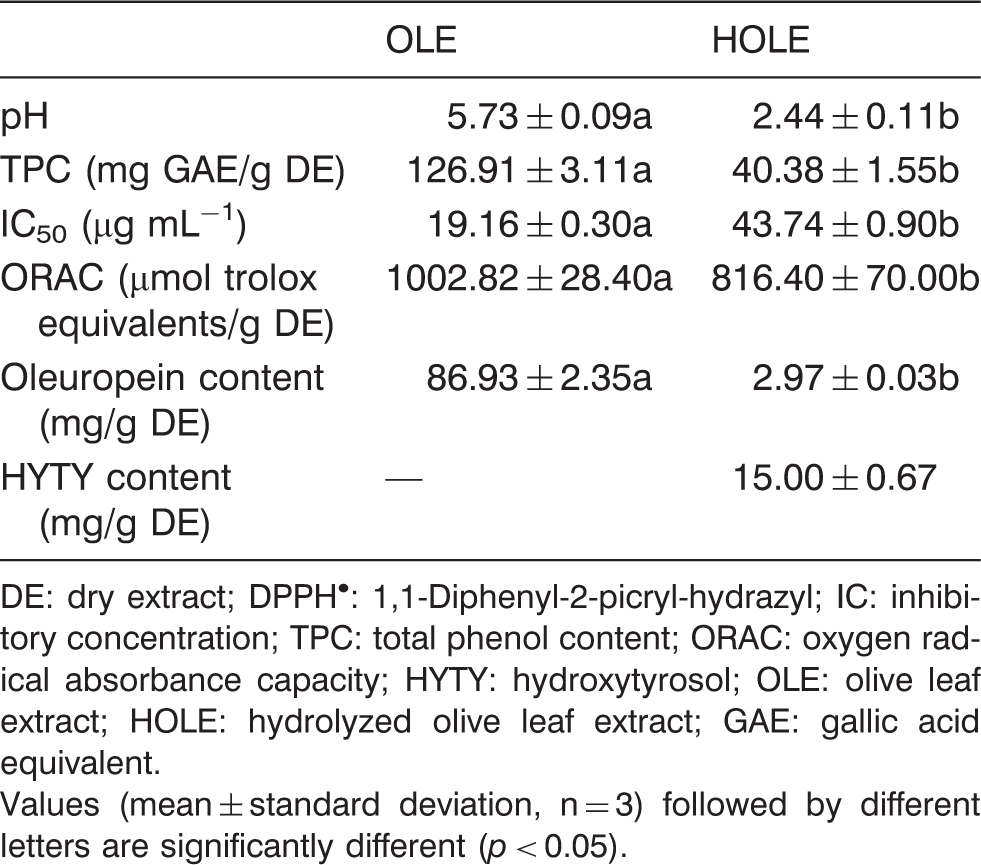
pH, TPC, antioxidant activities (DPPH• expressed as IC50 and ORAC), and oleuropein and HYTY content of OLE and HOLE
DE: dry extract; DPPH•: 1,1-Diphenyl-2-picryl-hydrazyl; IC: inhibitory concentration; TPC: total phenol content; ORAC: oxygen radical absorbance capacity; HYTY: hydroxytyrosol; OLE: olive leaf extract; HOLE: hydrolyzed olive leaf extract; GAE: gallic acid equivalent.
Values (mean ± standard deviation, n = 3) followed by different letters are significantly different (p < 0.05).
Regarding TPC, OLE presented a significantly (p < 0.05) higher value (126.91 ± 3.11 mg GAE/g DE) than HOLE (40.38 ± 1.55 mg GAE/g DE). These results are in the range of those previously reported in the literature (Kontogianni and Gerothanassis, 2012).
Radical-scavenging activity of OLE and HOLE was evaluated with IC50 values, as previously indicated. The IC50 values obtained for the OLE and HOLE are shown in Table 1. Taking into account that the lowest IC50 presents a higher antioxidant activity, it can be concluded that OLE presented a higher antioxidant capacity than HOLE. This result is in agreement with that obtained in TPC determination. Moreover, IC50 of OLE is similar to that obtained for oleuropein standard (20.85 ± 0.23 µgmL−1), which demonstrated the antioxidant activity of OLE. On the other hand, a high correlation was found between radical-scavenging activity and TPC (−0.999), which indicates the synergic effect of olive leaf phenolic compounds.
The ORAC values obtained for OLE and HOLE are also included in Table 1. Also in this case, a stronger protective capacity was observed for OLE (1002.82 ± 28.40 µmol TE/g DE) in comparison to the value obtained for HOLE (816.40 ± 70.00 µmol TE/g DE). This result follows the same tendency found for TPC and DPPH assays. The obtained ORAC values are in the range of those previously reported in the literature (Ciriminna et al., 2016; Albertos et al., 2018).
As it can be observed in Table 1, a high amount of oleuropein was obtained in OLE (86.93 ± 2.35 mg/g DE). This result showed that oleuropein was the major compound of the OLE. The identification of oleuropein was based on comparing the retention time and UV absorbance spectra with those of the standards. On the other hand, and as previously stated, acid treatment of OLE-induced hydrolysis or breakdown of oleuropein, which led to the appearance of HYTY (15.00 ± 0.67 mg/g DE) followed by a concomitant disappearance of oleuropein (2.97 ± 0.03 mg/g DE). This result was in agreement with that found in other studies, where the acid hydrolysis of OLE favored the hydrolysis of oleuropein to produce HYTY (Bouaziz et al., 2008; Kontogianni and Gerothanassis, 2012).
Salmon mince characterization
Moisture, protein, fat, and ash content of the salmon mince samples (control, S-OLE and S-HOLE) were in the range of 71.43%–72.57%, 18.32%–17.12%, 10.57%–11.07%, and 2.68%–3.70%, respectively. These values were similar to those reported by other authors for fresh salmon (Fernández-Segovia et al., 2012), which indicated that the preparation of salmon mince did not alter the nutritional properties of salmon.
Changes in physicochemical quality during storage
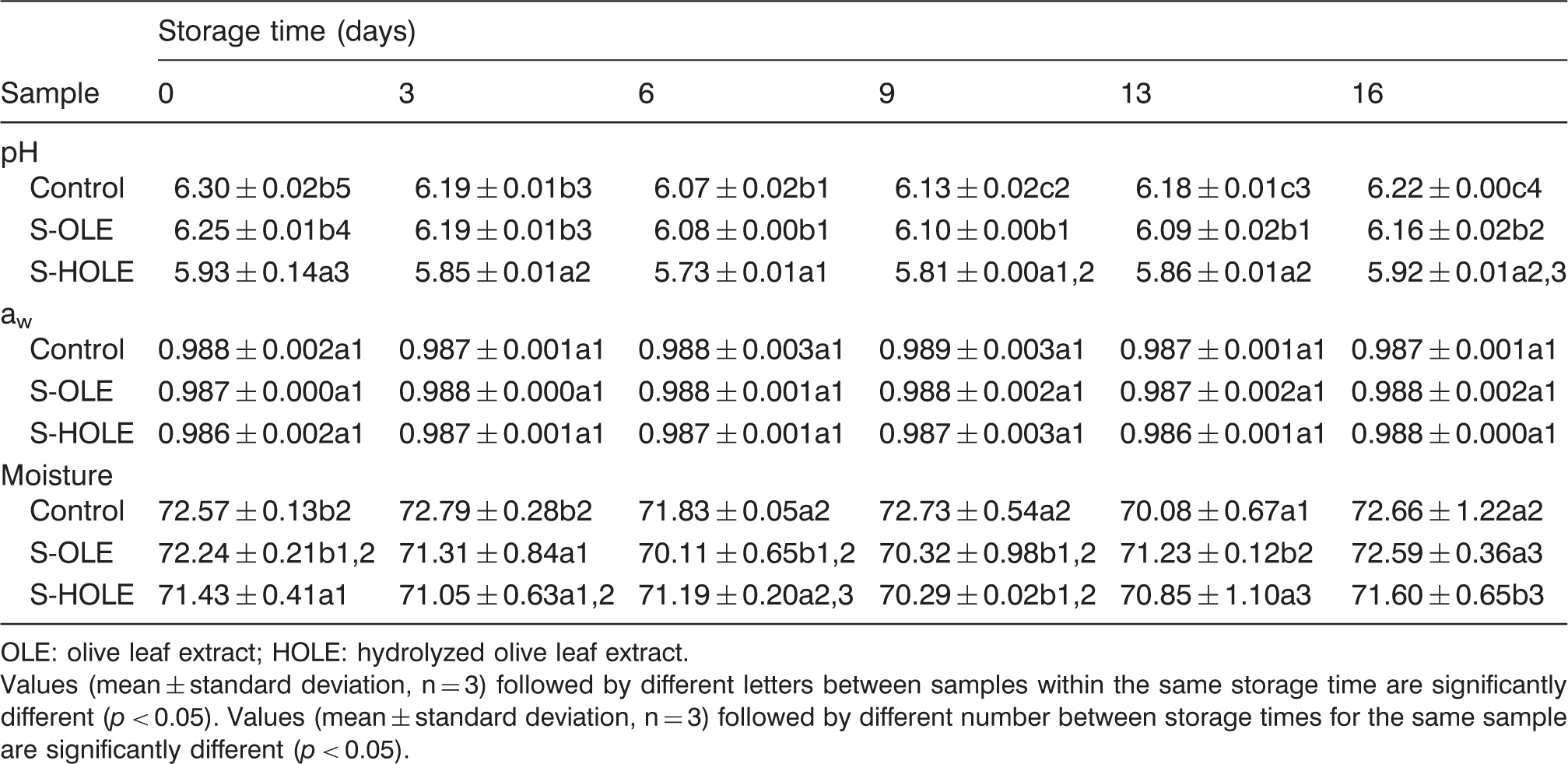
pH, aw, and moisture content (g/100 g) of the minced salmon hamburgers (control, S-OLE, and S-HOLE) during storage
OLE: olive leaf extract; HOLE: hydrolyzed olive leaf extract.
Values (mean ± standard deviation, n = 3) followed by different letters between samples within the same storage time are significantly different (p < 0.05). Values (mean ± standard deviation, n = 3) followed by different number between storage times for the same sample are significantly different (p < 0.05).
Initial values of water activity (aw) of salmon burgers were in the range of 0.986–0.988 (Table 2). The high aw value of salmon burgers indicates the high susceptibility of this type of food products to microbial spoilage, pointing out the importance of adding preservative compounds to maintain the microbial quality of the salmon burgers during the marketed period. Values of aw did not change (p > 0.05) over storage, and no differences (p > 0.05) were found among S-OLE, S-HOLE, and control burgers. These values were similar to those reported by Rizo et al. (2015) on fresh salmon.
Moisture content was slightly lower in S-HOLE samples when compared to control and S-OLE samples immediately after preparation of samples (day 0) (Table 2). During storage, there was not a clear trend of moisture content, and punctual variations could be due to sample variability.
The evolution of TVB-N values in salmon burgers during storage time is presented in Figure 1(a). TVB-N is widely used as an indicator of fish spoilage. Its increase has been related to the activity of spoilage bacteria and endogenous enzymes which results in the formation of compounds including ammonia, monoethylamine, dimethylamine, and TMA (Kykkidou et al., 2009). The concentration of TVB-N in freshly caught fish varies between 5 and 20 mg N/100 g flesh (Huss, 1995) depending on fish species and other environmental factors. Meanwhile, according to European Community regulation n° 2074/2005 (European Commission, 2005), Salmo salar should be regarded as unfit for human consumption when the limit of 35 mg TVB-N/100 g is exceeded. In the present study, the initial values of this parameter ranged between 14.91 and 15.50 mg N/100 g, indicating the adequate hygienic quality of the fish product for human consumption. Similar values have been reported in other studies for fresh salmon (Fernández-Segovia et al., 2012). The concentration of TVB-N in salmon burgers increased gradually throughout the storage period. The production of TVB-N was higher in control burgers than in the S-HOLE and S-OLE from the day 6 until the end of the study. There is no legal limit established for fish burgers neither other fish product; however, considering the limit previously mentioned for fresh salmon, control samples exceeded the acceptability limit at day 9 of storage meanwhile samples with S-HOLE and S-OLE were acceptable until 12 days.
Changes in TVB-N (a) and TMA-N (b) in control, S-OLE and S-HOLE burgers during cold storage. Mean values ± standard deviation (n = 3). OLE: olive leaf extract; HOLE: hydrolyzed olive leaf extract; TVB-N: total volatile base nitrogen; TMA-N: trimethylamine nitrogen.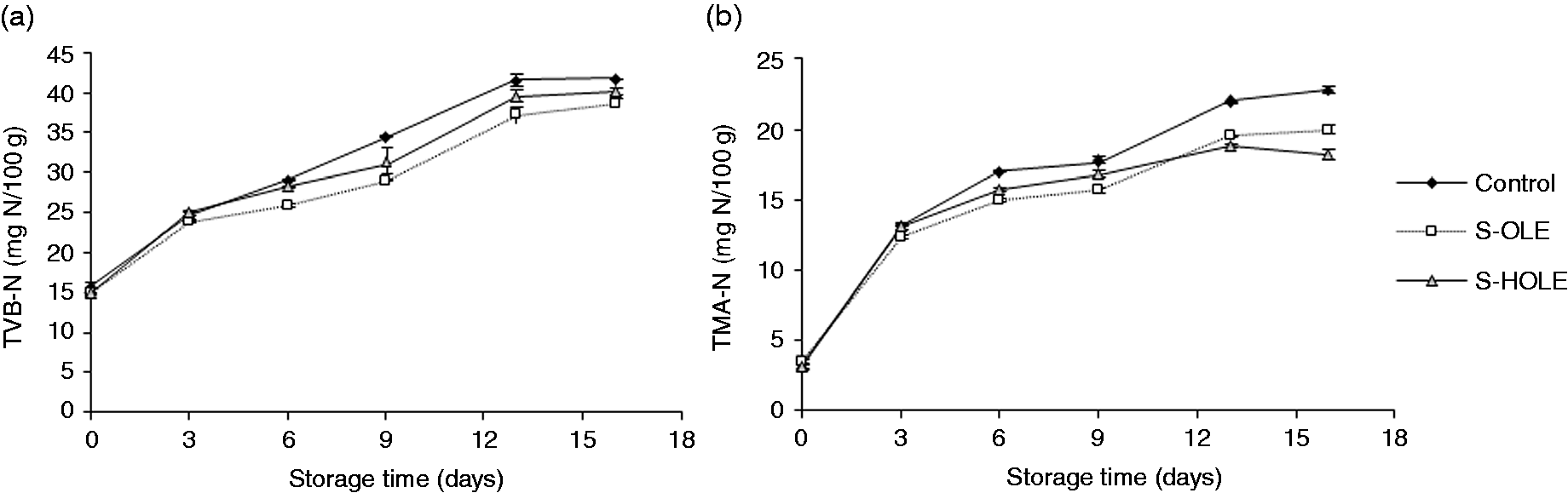
TMA is a pungent volatile amine often associated with the typical “fishy” odor of spoiling seafood. Its presence in spoiling fish is due to the bacterial reduction in trimethylamine oxide (TMAO). The TMAO is naturally present in the living tissue of many marine fish species. TMAO content in fish varies with the season, size, age, and environmental conditions, and the differences in TMAO levels among individual fish of the same species may sometimes be larger than the differences among the species (Shumilina et al., 2016). It has been reported that 10–15 mg TMA-N/100 g is usually regarded as the upper limit of acceptability for human consumption (Huss, 1995). In this sense, although there is no regulation concerning the TMA-N level, beyond 15 mg TMA-N/100 g, the product quality is generally considered as damaged. The evolution of TMA-N values of control and burgers supplemented with S-OLE and S-HOLE is presented in Figure 1(b). The initial concentration of TMA-N in salmon burgers was similar in all the samples (control, S-OLE, and S-HOLE). These results are in agreement with those found for this fish spices in other studies (Rodríguez et al., 2010). During cold storage, TMA-N content increased significantly in all samples, being higher in control samples compared to S-OLE and S-HOLE samples at the end of the study. Hebard et al. (1982) established a correlation between the organoleptic evaluation and the TMA concentration for cod and haddock muscle during cold storage. In that study, fish with TMA levels in the range of 0–4.2 mg/100 g was set to prime quality, fish with TMA between 4.25 and 29.5 mg/100 g was set to acceptable quality, meanwhile TMA content higher than 29.5 mg/100 g was unacceptable for human consumption. However, in other studies carried out with salmon stored in ice under aerobic conditions, it was determined a concentration of 15.8 mg/100 g for TMA-N at the point of spoilage (Hozbor et al., 2006). Considering this conservative limit, control samples would be rejected before day 6 of storage, meanwhile S-OLE and S-HOLE could be accepted until day 9 of storage.
TBA is secondary breakdown product of lipid oxidation and widely used as an indicator of degree of lipid oxidation (Aubourg, 1999). TBA values in the different samples during cold storage are shown in Figure 2. The addition of OLE and HOLE to the fish mince produces a significant reduction in TBA values (p < 0.001) in comparison with the control. S-OLE samples exhibited the lowest TBA values during the whole study, which could be explained by the effect of OLE extract to protect fish fat from the oxidation. Similar results were observed in the literature (Aouidi et al., 2017; Hayes et al., 2010). Hayes et al. (2010) established that oleuropein extract reduced lipid oxidation by 53% and 78%, at concentrations of 100 and 200 µg/g muscle, respectively, under aerobic conditions, and by 76% and 84% under modified atmosphere packs (80% O2:20% CO2) compared with control samples (Hayes et al., 2010). As it has been previously explained, OLE presented a higher antioxidant capacity than HOLE (Table 1).
Changes in TBA values in control, S-OLE, and S-HOLE burgers during cold storage. Mean values ± standard deviation (n = 3). OLE: olive leaf extract; HOLE: hydrolyzed olive leaf extract; TBA: Thiobarbituric acid; MDA: malondialdehyde.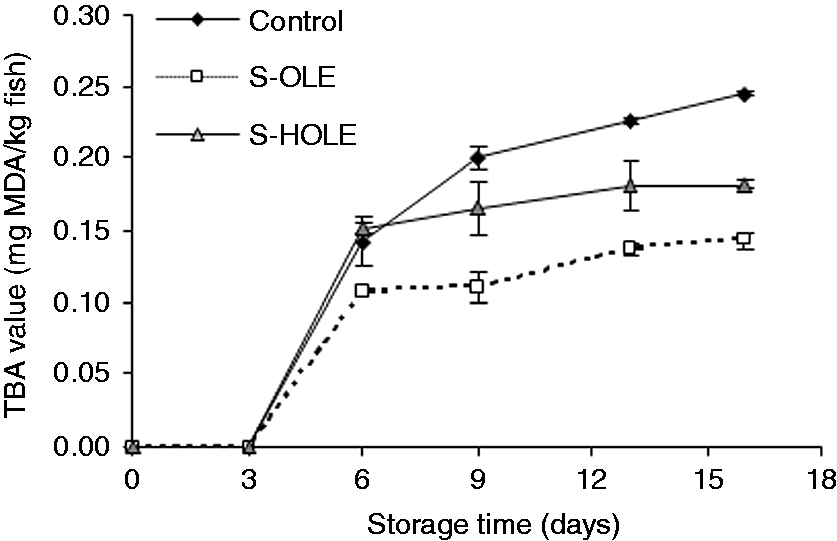
Color expressed as lightness (L*), redness (a*), and yellowness (b*) of salmon burgers is shown in Figure 3. The incorporation of OLE and HOLE to the salmon mince significantly increased (p < 0.05) lightness (L*), being this increase higher in the case of HOLE addition. Storage time had no significant effect (p > 0.05) on lightness (L*) in any type of salmon burger, which could indicate that vacuum packaging and cold storage conditions were able to prevent sample discoloration. There was an initial reduction in redness (a*) as a consequence of HOLE incorporation to salmon mince due to the brown color of this extract; however, this effect was not observed in S-OLE burgers. However, the addition of S-OLE extract increased significantly yellowness (b*) values (p < 0.001). There was no effect (p > 0.05) of storage time on a* and b* values.
Changes in color expressed as lightness (L*), redness (a*), and yellowness (b*) of control, S-OLE, and SHOLE burgers during cold storage. Mean values ± standard deviation (n = 15). OLE: olive leaf extract; HOLE: hydrolyzed olive leaf extract.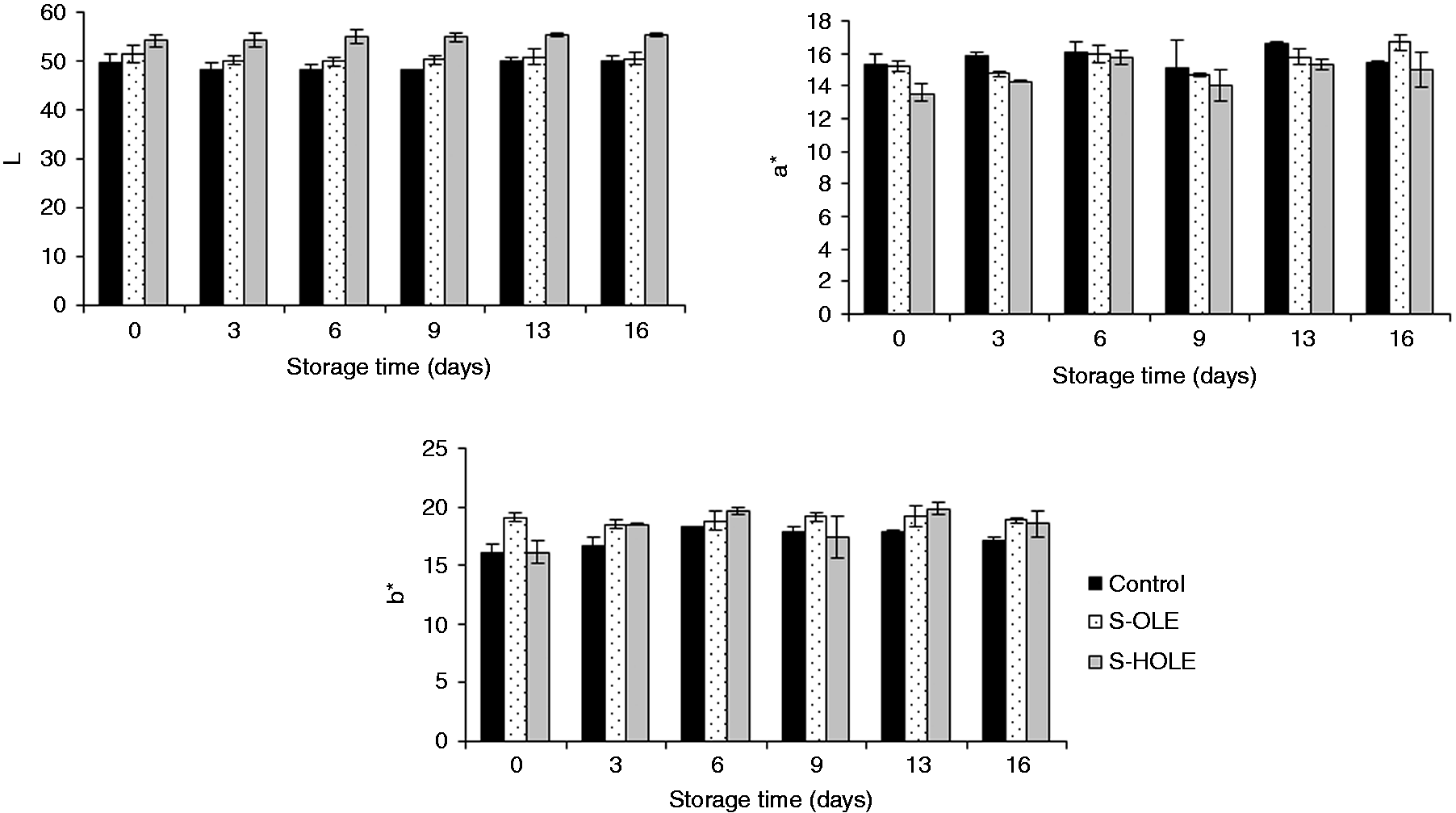
Changes in microbiological quality during storage
In general, a progressive increase in the Total Viable Counts (TVC) was observed in the all the samples (Figure 4(a)). The mean values for mesophilic bacteria of S-HOLE were lower during the whole study, while no significant differences were observed between control and S-OLE samples. For fresh water and marine species, the microbiological limit recommended by the International Commission on Microbiological Specifications for Foods (1986) for TVC at 30 ℃ is 7 log UFC/g, being this limit widely employed in fish shelf life studies (Kykkidou et al., 2009). As salmon burgers prepared with S-HOLE did not exceed this value during the cold storage, this product could be considered as microbiologically acceptable under the tested storage conditions. However, control and S-OLE burgers reach this value at day 9 of analysis, and therefore, the shelf life of these products could be considered as less than nine days.
Changes in mesophilic bacteria (a) and enterobacteria (b) in control, S-OLE, and S-HOLE burgers during cold storage. Mean values ± standard deviation (n = 3). OLE: olive leaf extract; HOLE: hydrolyzed olive leaf extract; CFU: Colony-Forming Unit.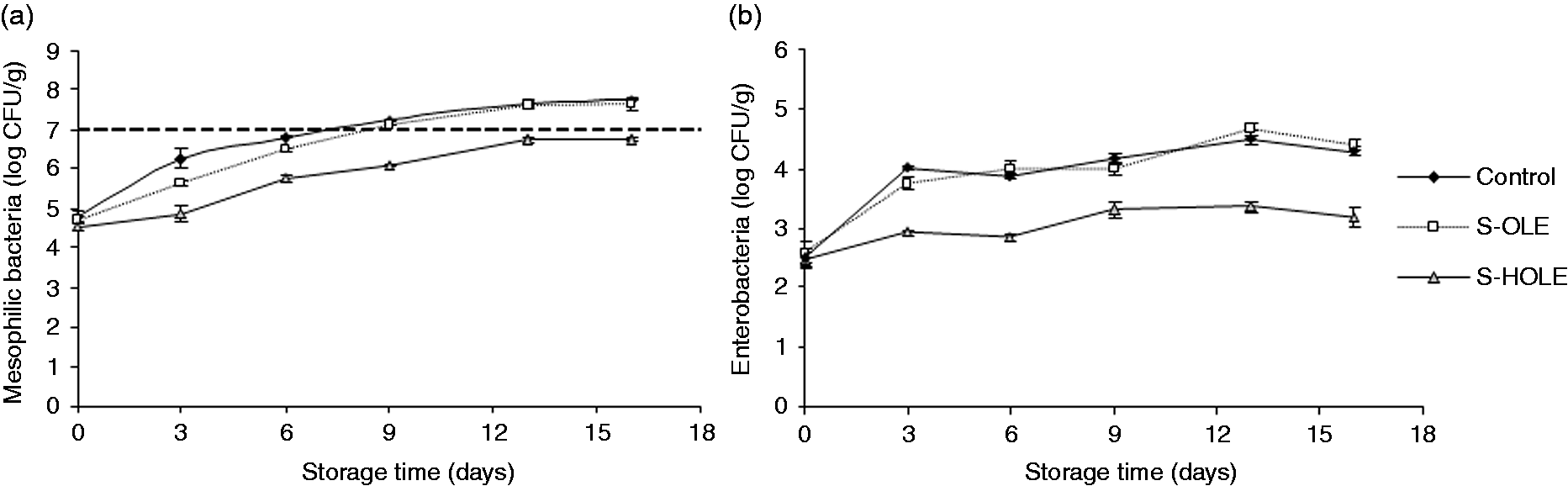
A similar evolution was observed for Enterobacteriaceae counts (Figure 4(b)), where S-HOLE counts were lower than those observed for control and S-OLE burgers during the whole study. According to these results, HOLE could be used as a natural preservative to prolong shelf life and quality of fish products. However, OLE did not show any antimicrobial activity, which is in agreement with other research studies carried out on pork and beef patties containing OLEs (Hayes et al., 2010; Thielmann et al., 2007), where no significant effect in TVCs was recorded. Gok and Bor (2012) on the contrary reported a growth inhibitory effect of OLE on fresh beef preparation. In this study, samples treated with OLE extracts at concentrations of 0.5 and 1.0 g/kg were able to delay microbial growth and furthermore improve all tested sensory attributes (Gok and Bor, 2012).
Conclusions
In the present study, the potential of OLEs to preserve salmon burgers during cold storage has been demonstrated. The high polyphenol content of the OLE and HOLE contributes to their demonstrated antioxidant activity. OLE has been useful to delay lipid oxidation of fish burgers. Salmon mince treated with HOLE showed lower microbial counts during the whole study, which extended the shelf life of the fish product. Therefore, olive leaves could be considered as a reliable source of phenolic compounds which could be used as natural alternative to the synthetic additives usually employed by the food industry.
Footnotes
Declaration of conflicting interests
The author(s) declared no potential conflicts of interest with respect to the research, authorship, and/or publication of this article.
Funding
The author(s) disclosed receipt of the following financial support for the research, authorship, and/or publication of this article: This work was supported by Ministry of Higher Education and Scientific Research of Tunisia (Laboratories LR14ES08 and LR11ES45). MJ Lerma-García thanks the Universitat Politècnica de València for a postdoctoral contract (PAID-10-14).