







Abstract
The effect of Hofmeister salts (NaCl, NaSCN, Na2SO4, KCl, LiCl, CaCl2) on surface iridescence in cooked pork was investigated. Strongest iridescence occurred in samples treated with NaSCN, NaCl and KCl. Control samples and LiCl, CaCl2 and Na2SO4 treatments showed weaker iridescence. However, differences between KCl and LiCl, CaCl2 and Na2SO4 were not statistically significant (p > 0.05). Nevertheless, a tendency of chaotropic salts (NaSCN, NaCl, KCl) to cause stronger iridescence was noted that might be explained with a more effective solubilization of myofibrillar proteins (MPs), reducing incoherent scattering from the myofibrils and thus enhancing multilayer interference.
INTRODUCTION
Meat colour is an important characteristic since it indicates freshness, quality and wholesomeness and thereby strongly influences the consumers’ purchasing decision (Kropf, 1980). Colour deviations such as discolorations can lead to the rejection of these products. A common colour deviation is the occurrence of iridescence, which is the rainbow-colored shine on fresh meat and meat products (e.g. beef pastrami, corned beef, cooked hams) that appears when the muscle fibres are crosscut (Mancini, 2007). Iridescence is a purely physical phenomenon caused by an interaction of the incident light with the meat’s microstructure and it is not attributed to the addition of chemical additives or the growth of microorganisms as often falsely assumed by the consumers (Wang, 1991). This misconception can cause a rejection of iridescent meat products that has both negative economic effects for the meat industry and negative environmental consequences since high-quality, edible food products have to be discarded. For many years, the meat industry has been seeking ways to reduce or inhibit iridescence. However, limited research has been carried out to clarify the underlying mechanisms and structures of meat iridescence that are still widely unknown to the present day. Research in this field is impeded by difficulties in the methodology such as quantification due to strong angular dependency and ultrastructural analysis due to structural changes with sample preparation. An accepted hypothesis of meat iridescence is multilayer interference from stacks of alternating A- and I-bands with different refractive indices in striated muscle fibres (Swatland, 2012a, 2017, 2018). The I-band (isotropic, low refractive index) contains thin filaments that are composed primarily of actin whereas the A-band (anisotropic, high refractive index) contains both thin filaments and thick filaments that are composed of myosin. Light reflected from these refractive index boundaries may constructively interfere and thus produce interference colours (Swatland, 2012a). It is well known that light scattering by the myofilament lattice contributes to meat colour and can explain differences in lightness due to variations in structural attributes such as sarcomere length, lattice spacing and optical properties of the sarcoplasm and the extracellular space (Hughes et al., 2020; Swatland, 2012b; Purslow et al., 2020). Swatland (2012b) suggested a possible relationship between light scattering causing paleness and interference causing iridescence and assumed that iridescence disappears when light scattering is strong. Optical properties of meat can be altered with the addition of salts that cause profound structural changes concerning the micro- and ultrastructure of the muscle tissue (Knight and Parsons, 1988; Böcker et al., 2006). Myofibrillar proteins (MPs) are salt-soluble proteins and can be dissolved with higher salt concentrations. In the sarcomere, sodium chloride has been reported to extract the A- and Z-bands, produce swelling of the I-band and disrupt structures in the M-line (Puolanne and Halonen, 2010; Voyle et al., 1984; Wilding et al., 1986). Salt ions bind to the myofilament proteins and thereby increase the electrostatic repulsion between the myofilaments which widens the lattice spacing, induces the swelling of the myofibrils and reduces the intermyofibrillar spaces (Hamm, 1972). Thus, one would expect that scattering within the myofibrils and from the extracellular spaces decreases as salt is added to meat. Swatland and Barbut (1999) showed that an increase of sodium chloride concentration increased the relative amount of reflected light maintaining its original plane of polarization (Fresnel reflectance) and suggested that light scattering was reduced by the dissolution of MPs. It is assumed that sodium chloride increases the solubility of myosin by the absorption of Cl− ions to the hydrophobic amino acid chains of myosin filament (Puolanne and Halonen, 2010). Cl− is a chaotropic ion that reduces the protein-protein interactions and makes the protein-water interface more hydrophilic (Dér et al., 2007). The ability of ions to stabilize (salting-out) or destabilize (salting-in) a protein was investigated by Hofmeister (Hofmeister, 1888). The Hofmeister series orders the ions according to their effectiveness to stabilize proteins with ions at the beginning of the series called kosmotropes (structure makers) and ions near the end of the series called chaotropes (structure breakers). Kosmotropic and chaotropic ions have different effects on MPs (Puolanne and Halonen, 2010) with chaotropes increasing the hydrophilicity of the protein surface and increasing solubilization while kosmotropes increase the hydrophobicity and reduce solubilization (Dér et al., 2007). With the assumption of light scattering being reduced by dissolution of MPs, one could expect that chaotropic ions could increase meat iridescence by solubilizing myosin, reducing light scattering and thus allowing for a higher amount of light to constructively interfere to produce interference colours. Kosmotropic ions should have the opposite effect and less iridescence should be observed. The objective of this study was to investigate the effect of different sodium and chloride salts on iridescence of cooked pork meat.
MATERIALS AND METHODS
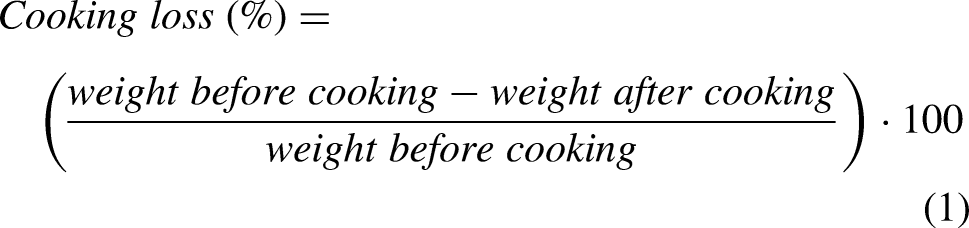
Fresh pork loins (M. thoracis et lumborum, n = 3) were purchased from a local wholesaler (Mega eG, Stuttgart, Germany). Muscle pH was measured with a puncture type pH probe (WTW SenTix Sp, Xylem Analytics Germany Sales GmbH & Co. KG, Weilheim, Germany) connected to a pH-meter (WTW pH 537, Xylem Analytics). The average pH of the fresh meat was 5.44 ± 0.08. Analysis of the raw meat as determined by the official collection of methods of analysis (§64 German Food and Feed Act, LFGB) ((BVL) 2005) was: 74.2 ± 1.2% water, 22.8 ± 0.1% protein and 2.1 ± 0.9% fat. Muscles were cut into cubes with side lengths of 5 cm with a sharp blade. Iridescence was observed on the surfaces with cross-cut muscle fibres of all fresh meat cubes. Six different salt treatments plus a control treatment ( = no salt addition) were performed: NaSCN, NaCl, Na2SO4, CaCl2, LiCl and KCl. All reagents were purchased from Carl Roth GmbH + Co. KG (Karlsruhe, Germany). Sodium chloride is the habitually used salt in meat products. Other salts were chosen by changing the counter ions of Na+ and Cl− with a chaotropic (SCN−, K+) or kosmotropic ion (Li+, Ca2+, SO42−). One meat cube from each loin was randomly assigned to the different treatments. Cubes were dry-salted by the addition of the aforementioned salts at isoionic strength (IS = 0.34, equal to 2.0 wt% NaCl) in separate plastic bags, manually massaging and vacuum-packaging (PA/PE 90 µm, Mega eG, Stuttgart, Germany) to avoid drying. Samples were stored at 2 ± 2 °C for 14 days to completely absorb the salt and allow salt penetration to the samples core. Subsequently, the cubes were cooked (Ness-Smoke GmbH & Co. KG, Remshalden, Deutschland) to a final core temperature of 70 °C and cooled at 2 ± 2 °C. After cooling, pH of the cooked samples was measured with a puncture type pH probe (WTW SenTix Sp, Xylem Analytics). Cooking loss was calculated as the ratio of weight loss during cooking to the initial weight before cooking:
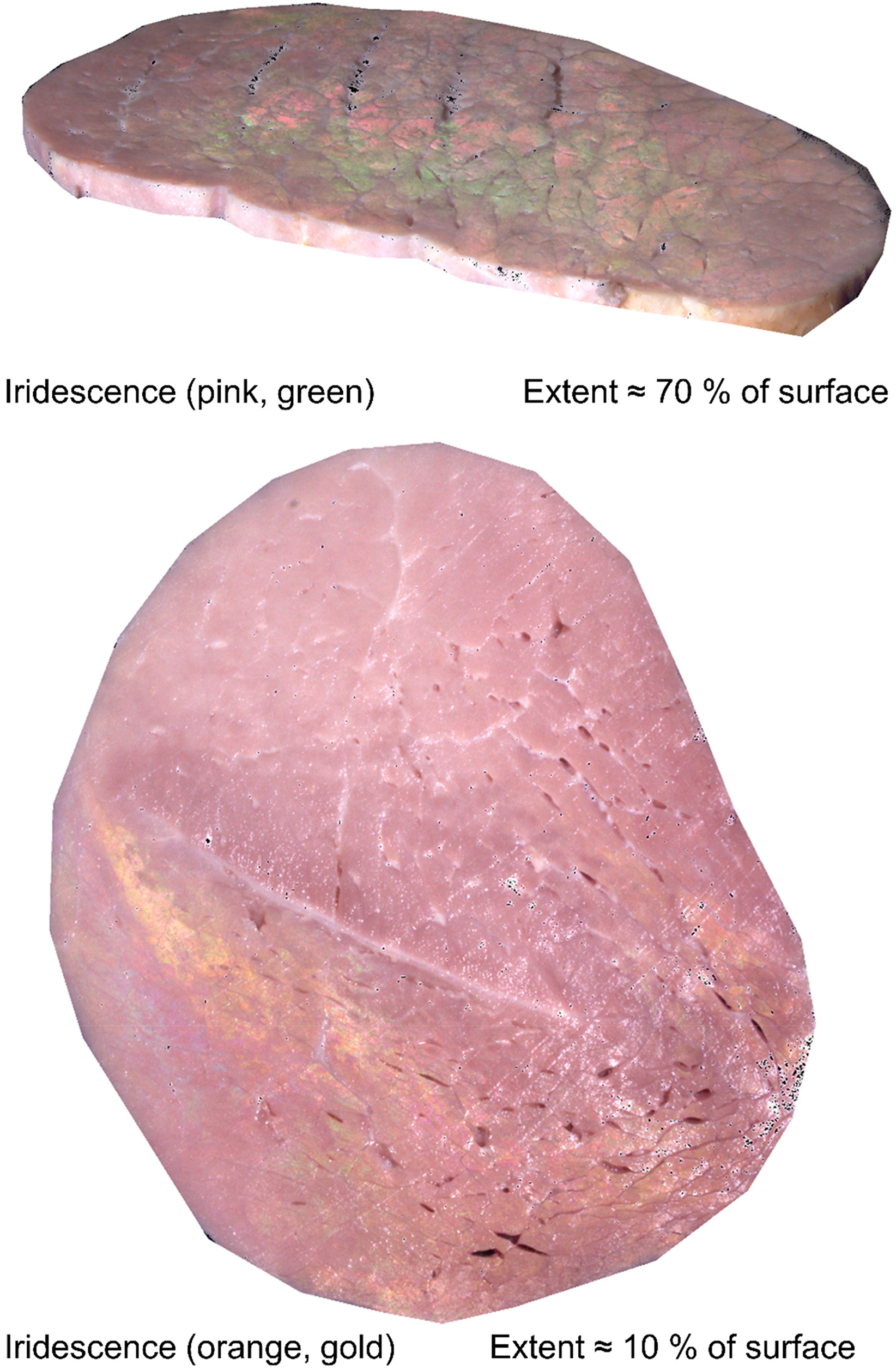
Reference images used for training of the sensory panel.
RESULTS AND DISCUSSION
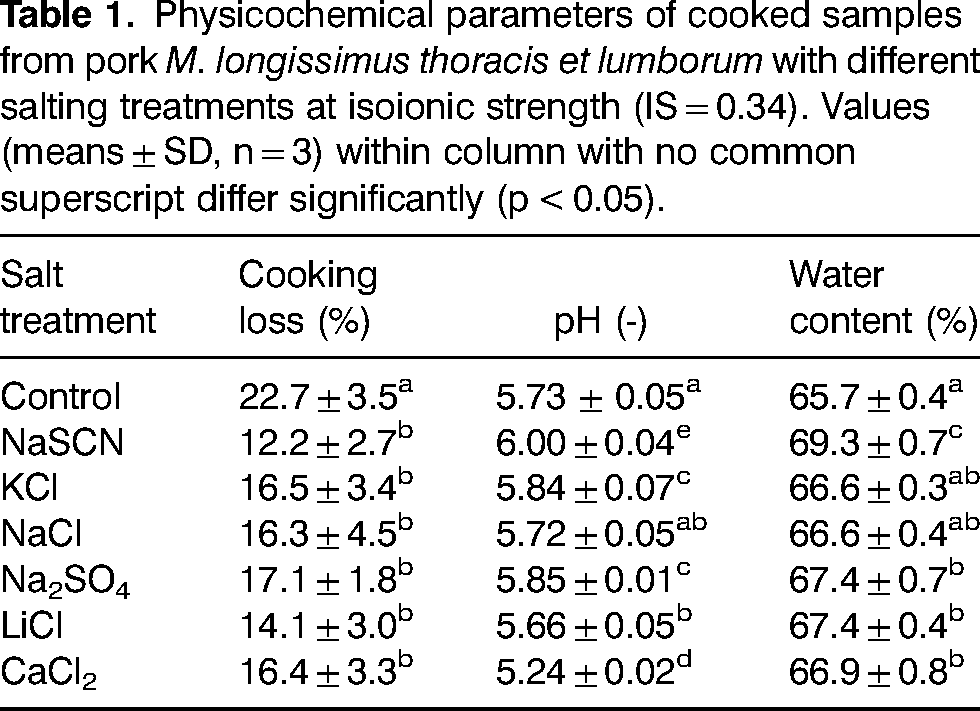
Iridescence (yellow, green, orange) was observed on all slices of cooked samples from all different treatments. The strongest iridescence occurred with NaSCN, NaCl and KCl treatments (Figure 2). Chaotropic counterions (SCN−, K+) showed a tendency towards stronger iridescence. Control samples as well as the kosmotropic counterions (Li+, Ca2+, SO42−) resulted in lower iridescence. However, differences were not statistically significant between the treatments with KCl and LiCl, CaCl2 and Na2SO4. As expected, the highest cooking loss occurred in the control treatment (Table 1) and decreased with the addition of salt. But the type of salt did not influence cooking loss (p > 0.05). Similar results were found for the water content of the cooked samples. Samples treated with NaSCN (lowest cooking loss) had the highest water content whereas the control treatment resulted in the lowest water content (highest cooking loss). The type of salt had an effect on the pH of the cooked samples. No pH changes were found with the addition of NaCl. A pH decrease compared to the control treatment (pH 5.73 ± 0.05) was observed for treatments with LiCl and CaCl2. In contrast, an addition of NaSCN, KCl and Na2SO4 increased the pH. This is accordance with results from Hand et al. (1982) who noted that replacement of NaCl with KCl at equivalent ionic strengths increased the pH value whereas a replacement with LiCl decreased the pH value in cured pork ham. The pH changes can be attributed to differences in binding abilities of ions to different protein groups (Puolanne and Halonen, 2010; Song et al., 2020). Correlations showed that higher iridescence scores were associated with higher water contents (r = 0.524, p < 0.05), lower cooking losses (r = −0,496, p < 0.05) and higher pH values (rS = 0.475, p < 0.05). These findings may support the postulated mechanism that iridescence arises when MPs are dissolved and thus incoherent scattering from the myofilament lattice is reduced. Meat iridescence is assumed to be a multilayer Fresnel reflectance from sarcomere discs (Swatland, 2012a). Swatland and Barbut (1999) noted that more Fresnel reflectance was detected with increasing NaCl concentrations and explained it with the dissolution of MPs that reduced light scattering from myofibrils. Iridescence also has been attributed to the hydration state of meat (Swatland, 1988). Higher water-binding capacity is an indication of an increase in the extraction of salt-soluble proteins (Gordon and Barbut, 1992) and the efficiency of ions to promote water-binding capacity of meat follows the Hofmeister series (Pospiech and Montowska, 2011). Proteins are stabilized by strong chaotropic cations and kosmotropic anions and destabilized by kosmotropic cations and chaotropic anions (e.g NaCl, NaSCN) (Zhao, 2005). Increase of myofibrillar protein solubility with NaCl is assumed to be induced by the formation of ion pairs between Cl− ions (chaotropic anion) and positively charged chaotropic groups of the myosin filament (Puolanne and Halonen, 2010). Chaotropes act as solubilizers since they tend to unfold the three-dimensional structure of proteins. Anionic chaotropes such as Cl− and SCN− accumulate in the protein-water interphase and make them more hydrophilic (Dér et al., 2007). According to the Hofmeister series, SCN− is a stronger chaotrope than Cl− and is thus more effective in solubilizing MPs that could explain the stronger iridescence. In contrast, KCl consists of a chaotropic cation and chaotropic anion and therefore affect the protein structures in a different manner. For example, Song et al. (2020) showed that KCl was less effective in solubilizing total and MPs but the differences in protein solubilities between NaCl and KCl had no impact on cooking loss, as we also noted in our study. With less solubilized myofibrillar protein, incoherent light scattering could be stronger and suppress coherent scattering (multilayer interference). This could explain weaker iridescence in the KCl treatment, as well as with the kosmotropes Na2SO4, LiCl, CaCl2. Kosmotropes make the protein-water interfaces more hydrophobic (Dér et al., 2007) and thereby act as stabilizres (salting-out). Another possible explanation for stronger iridescence could be a higher hydration causing myofibrillar swelling and reduction of extracellular spaces thus reducing scattering from extracellular spaces and allowing more light to enter the myofibrils to constructively interfere. However, these explanations are solely assumptions since the structures and mechanisms engaged in meat iridescence are still poorly understood and complex interactions probably determine the effects of different salts on iridescence.

Iridescence score of cooked samples (n = 3) from pork M. longissimus thoracis et lumborum as influenced by different salting treatments at isoionic strength (IS = 0.34). Bars without a common superscript differ significantly (p < 0.05).
Physicochemical parameters of cooked samples from pork M. longissimus thoracis et lumborum with different salting treatments at isoionic strength (IS = 0.34). Values (means ± SD, n = 3) within column with no common superscript differ significantly (p < 0.05).
CONCLUSION
The purpose of this study was to investigate the effect of Hofmeister salts on meat iridescence in cooked pork. A tendency of chaotropic salts (salting-in) to cause stronger iridescence was observed. Stronger iridescence was correlated with lower cooking losses and higher water contents. This information suggests that myofibrillar protein solubility is of high importance for meat iridescence and that the use of different salts or salt mixtures by the industry could reduce iridescence in meat products. Further research should be conducted to investigate the possibilities of sodium chloride replacement to reduce meat iridescence without negatively impacting product quality, acceptability and shelf-life.
Footnotes
ACKNOWLEDGEMENTS
This research project was financially supported by the German Ministry of Economics and Energy (via AiF) and the FEI (Forschungskreis der Ernährungsindustrie e.V., Bonn), Project AiF 20011N.
DECLARATION OF CONFLICTING INTERESTS
The author(s) declared no potential conflicts of interest with respect to the research, authorship, and/or publication of this article.
FUNDING
The author(s) disclosed receipt of the following financial support for the research, authorship, and/or publication of this article: This work was supported by the Forschungskreis der Ernährungsindustrie e.V. (grant number 20011N).
