







Abstract
This study aimed to improve the physical stability of ultra-high temperature (UHT) oat beverage by adding hydrophilic colloids (guar gum [GG] and xanthan gum [XG]) and a natural emulsifier (soluble soybean polysaccharide [SSPS]). The stability of the oat beverage was characterized by particle size, zeta potential, rheological properties, Fourier-transform infrared (FTIR) spectroscopy, backscattered light intensity (ΔBS), and microstructure. The results indicated that XG reduced the average particle size and size distribution of the beverage, indicating that XG could prevent particle aggregation. GG increases the apparent viscosity of the oat beverage without affecting the zeta potential. When SSPS was added to the oat beverage, it increased the absolute value of the zeta potential and the infrared absorption peak intensity, while the average particle size and backscattered light intensity (ΔBS) decreased, resulting in a more uniform microstructure. The zeta potential reached a maximum value of 32.12 when GG, XG, and SSPS were combined, indicating that the physical stability of the oat beverage was effectively improved when all three were present simultaneously. This study may provide some suggestions for the industrial production of low-viscosity cereal beverages with good stability.
Keywords
INTRODUCTION
Oat beverages, as an alternative to dairy products, contain high amounts of β-glucan, which increases satiety and lowers blood sugar and cholesterol (Sethi et al., 2016). However, it is not inherently stable (Jeske et al., 2017). During the production process, stabilizers such as xanthan gum are usually added to increase the consistency (Patra et al., 2021). There are few studies on improving the stability of oat beverages (Bonke et al., 2020; Martinez-Padilla et al., 2020). This study focused on two aspects: first, the use of naturally derived emulsifiers soluble soybean polysaccharide (SSPS), guar gum (GG), and xanthan gum (XG), and the modification of their stabilizer formulations to improve their stability. Second, by improving the sterilization method, ultra-high temperature (UHT) sterilization was used to prevent the destruction of oat beverage stability by high-temperature sterilization. Oat beverages are colloidal systems composed of macromolecules, including 32 starch granules, proteins, solid particles, and fat globules (Aydar et al., 2020), leading to their inherent instability. Also, oat beverages are subjected to heat treatment, which makes them considerably more unstable (Basinskiene and Cizeikiene, 2020). Although, studies have been conducted to improve the stability of beverages during autoclaving by using stabilizers such as microcrystalline cellulose and gellan gum (Li and Fan, 2020; Ni et al., 2021). However, the autoclaving approach still produces severe heat damage (Liu et al., 2016), resulting in poor stability of beverages. In recent years, ultra-high temperature (UHT) sterilization has been widely used to improve the stability of beverages (Singh et al., 2020), but there are no studies to prove that (UHT) sterilization can reduce the damage to the stability of oat beverages.
Soluble soybean polysaccharide (SSPS) is a natural hydrophilic polysaccharide derived from soybean residues with nutritional properties of dietary fiber (Gao et al., 2021). It has been shown that SSPS can improve emulsification properties and enhance stability (Hao et al., 2020). However, there are few current studies that address the use of SSPS as natural emulsifiers to improve the stability of cereal beverages. Therefore, in order to obtain oat beverages with good stability without the addition of chemical additives, in this study, a combination of different hydrocolloids of (XG or GG) and natural emulsifier SSPS was added in the presence of UHT. Also, the formulation of the most stable oat beverage with different combinations was screened by particle size, zeta potential, rheological properties, Fourier transform infrared (FTIR) spectra, backscattered light intensity (ΔBS), and microstructure. This study is important for the design of oat food products and provides a theoretical basis for the technological modification of cereal beverages.
MATERIALS AND METHODS
Materials
Oats were purchased from October Paddy Agricultural Technology Co., Ltd (Liaoning, China). GG was purchased from Wanbang Chemical Technology Co., Ltd (Henan, China). XG was purchased from Huasheng Food Co., Ltd (Guangdong, China). SSPS was purchased from Juyuan Biotechnology Co., Ltd (Guangdong, China). Medium-temperature α-amylase (26,000 RAU/g), amyloglucosidase (350 GAU/g), and Multifect PR 50G (500,000 HUT/g) protease were supplied by Danisco Co., Ltd (Jiangsu, China).
Preparation of oat beverage
The oat rice was washed and baked at 150–160 °C for 10–15 min, then ground and filtered through a 60-mesh sieve. The solid-liquid ratio was 1:9 (w/v), oat beverages enzymolysis were performed with Medium-temperature α-amylase, amyloglucosidase, and Multifect PR 50G protease. The mixture was centrifuged at 3000 r/min for 15 min to remove precipitation. Hydrophilic colloid (GG、XG) and natural emulsifier (SSPS) were then added to the filtrate and stirred constantly at a speed of 200 rpm for 15 min at 80°C. The resulting beverage sample was homogenized at 60 MPa using a high-pressure homogenizer (TW-Basic, Triowin, China). The final beverage sample was sterilized using UHT (PT-20T, Wadi Automation Equipment Co., Ltd, China): 137°C, 10 min. Beverages were aseptically filled using the special purpose filling device (TF-AS, Triowin, China) provided by UHT, resulting in the oat beverage product. Varying stabilizer formulations were applied as follows: 0.16% SSPS (w/w); 0.1% GG (w/w); 0.14% XG; 0.1% GG (w/w) and 0.14% XG (w/w); 0.1% GG (w/w), 0.14% (w/w) XG and 0.16% SSPS (w/w).
Analytical methods
Particle size and distribution
The particle sizes and distribution of the oat beverage were measured with a. The particle sizes and distribution of the oat beverage were measured with a laser diffraction particle analyzer (Bettersize2600, Bettersize Inc, China) (Liu et al., 2019). A certain amount of sample was taken at room temperature and dispersed them in a stirred tank. With deionized water as the dispersion medium, set the circulating pump speed to 1600 r/min, the shading range was 10%–15%. The refractive index of particles and water was 1.52 and 1.33, separately. Date was collected and analyzed using the special purpose software provided by the instrument.
Zeta potential
The zeta potential of the oat beverage was determined using nano-granularity zeta potential analyzer (Zetasizer Nano ZS, Malvern Panaco Inc, UK). All samples were diluted 100-fold with deionized water and then placed in a sample cell. Samples were maintained for 1 min at 25 °C before measurement (Ni et al., 2019). The instrument parameters used were: water as the dispersant with a viscosity of 0.890 cP, a refractive index of 1.330, and a dielectric constant of 78.54. Date was collected and analyzed using the special purpose software provided by the instrument.
Rheological properties
The rheological property analysis of the oat beverage was carried out at 25 ± 0.1 °C using a rheometer (Mars 60, Haake Inc, Germany). (Chen et al., 2019). Around 2 mL samples were carefully placed on a rheometer bottom plate with a 40 mm parallel plate, and the gap between the two plates was set to 1.0 mm. The shear rate changed from 0.01 to 100 s−1, and the time was 30 s. Each sample were allowed temperature equilibration for 2 min before measurement. The apparent viscosity of the samples versus shear rate was recorded. Rheological data were modeled according to power-law model.
FTIR
All samples were freeze-dried and measured using FT-IR (IS50, Nicolet Inc, US). 1 mg samples and 150 mg KBr were put in a mortar and fully grind. After pressed into thin slice, place it in the infrared spectrometer. The scanning range was 400–4000 cm−1, with a total of 32 scans and a resolution of 4 cm−1. Date was collected and analyzed using EZ OMNIC software v9.2 (Ren et al., 2022).
Physical stability
A Turbiscan stability analyzer (LAB expert, Turbiscan, France) was used to test and evaluate the stability of the oat beverages (Huang et al., 2021). Beverage samples of 20 mL were placed in the cylindrical glass tank, and the samples were scanned periodically from bottom to top with a pulsed near-infrared light source (wavelength: 880 nm). The scanning conditions were as follows: temperature: 25 °C; time: 0–2 h; and interval: 10 min. The device collected the backscatter profile of the beverage samples, comparing the physical stability of the sample with the ΔBS and stability index (TSI).
Microstructure
The microstructure of the fresh beverage was observed by fluorescence inverted microscope (TE2000-U, Nikon Inc, Japan) with 20 × objective lens and 10 × eyepiece at 25 °C (enlarged by 200×) (Ray and Rousseau, 2013). Images were captured with a KMP-Michrome 20 CCD camera and analyzed with Photoshop software v.3.2.
Data analysis
All experiments were performed in triplicate. Data were drawn and analyzed using Origin software v9.0. An analysis of variance was performed using SPSS statistical software v19.0, and there was a significant difference at the P < 0.05 level.
RESULTS AND DISCUSSION
Changes of particle size and size distribution
The stability of the beverage is reflected by the average particle size (Figure 1(a)) and particle size distribution (Figure 1(b)).
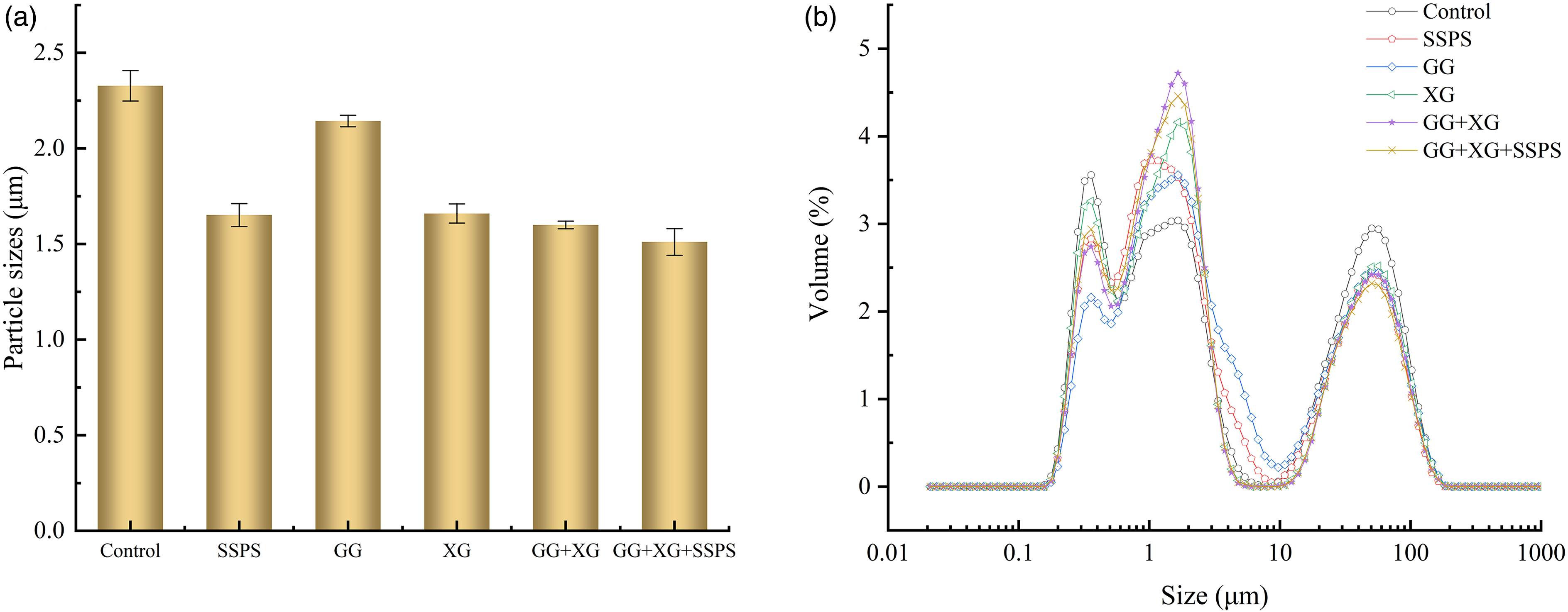
Effect of different hydrocolloids and natural emulsifier on average particle size (a) and particle size distribution curve (b) of oat beverage. SSPS: soluble soybean polysaccharide; GG: guar gum; XG: xanthan gum.
All beverages in this study exhibited a three-peak distribution (Figure 1(b)). The lower peak height at about 60 μm indicates that the addition of XG, GG, and SSPS helps to suppress the aggregation of suspended particles. Also, the values of mean particle size indicate that the addition of XG, GG, and SSPS improves the aggregation of suspended particles. In addition, when XG and GG were mixed, there was no significant difference in average particle size. When SSPS was added, the average particle size reached the minimum. The crosslinking of polysaccharide chains between polysaccharides created entangled network structures, which slowed the movement and collision time of droplets and increased the space resistance between droplets (Heyman et al., 2014). Therefore, the combination of GG, XG, and SSPS reduced the average droplet size and improved the stability of the beverages.
The average particle size of GG was larger than that of XG and SSPS, likely because they are non-adsorbed polysaccharides that form complexes with starch and proteins in beverages through electrostatic adsorption or hydrogen bonding (Rodríguez Patino and Pilosof, 2011). Under neutral conditions, XG and SSPS are negatively charged, GG is not charged, and XG and SSPS absorb some of the positively charged protein molecules to form a neutral carbohydrate surface layer, which reduces the probability of rejection flocculation in the system and suppresses droplet aggregation, thus lowering the average particle size (Rodríguez Patino and Pilosof, 2011).
Zeta potential changes
Zeta potential is one of the indexes that reflects the stability of a beverage. According to the results shown in Figure 2, all samples were negatively charged, indicating that there are more negatively charged particles in oat beverage than positively charged particles. When SSPS and XG were each added alone, the absolute values of the zeta potential increased significantly, to about 19.82 and 24.21, respectively. Compared with SSPS and XG, the addition of GG had little effect on the absolute value of the zeta potential. When GG, XG, and SSPS were combined, the absolute value of the potential reached a maximum of about 32.12. Therefore, in the present study, the electrostatic repulsion between GG, XG, and SSPS was stronger than that between GG and XG. If the absolute value of the zeta potential exceeds 30, the beverage is considered stable (Ma et al., 2017; Mirhosseini et al., 2008). The greater the electrostatic repulsion between droplets, the greater the absolute value of the potential, and the better the stability of the beverage (Dickinson, 2009). Therefore, SSPS showed potential as a natural emulsifier, and oat beverages containing SSPS, GG, and XG showed better emulsifying properties.
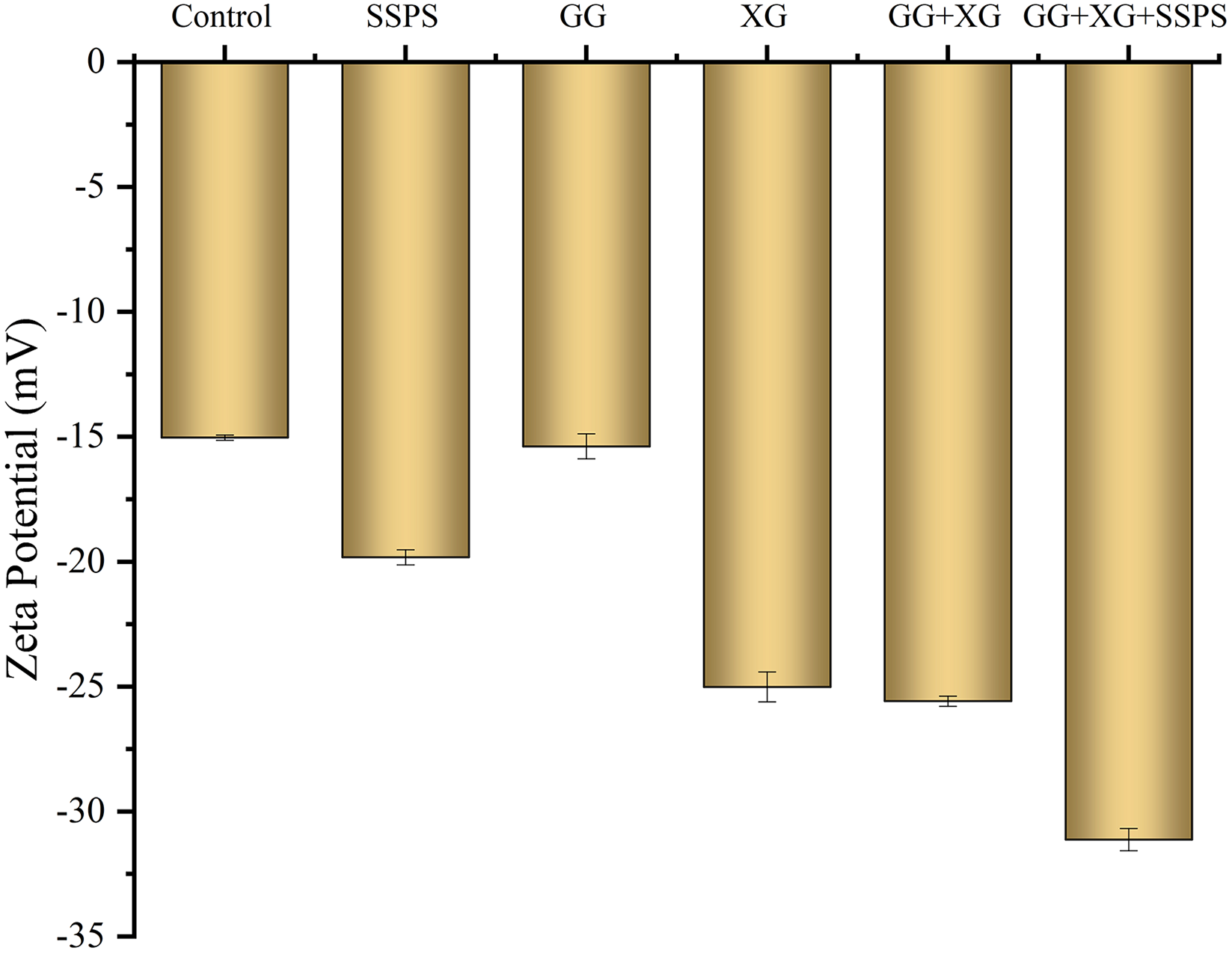
Effect of different hydrocolloids and natural emulsifier on zeta potential of oat beverage. SSPS: soluble soybean polysaccharide; GG: guar gum; XG: xanthan gum.
High electrostatic repulsion is a key factor in improving the stability of beverages (Wei et al., 2020). The potential of the beverage system depends on several factors such as composition, conformation of the polysaccharide, isoelectric point, and acidic or alkaline environment (Ren et al., 2022). All samples were negatively charged probably due to the isoelectric point (pI = 4.4) of oat protein and the nature of the stabilizer added. The absolute value of zeta potential in the control group was about 14.5. Clearly, beverages with low zeta potential are prone to coagulation or flocculation, making it difficult to maintain a stable emulsion system (Guo et al., 2014). The significant increase in zeta potential with the addition of SSPS and XG alone may be because the negative charge group of the polysaccharide molecule is electrostatically attracted to the positive charge fragment on the protein molecule or binds to the protein through hydrophobic interaction and hydrogen bond interaction so that the absolute value of the system potential increases.
Rheology properties
The curve of apparent viscosity and the shear rate of the beverage samples is shown in Figure 3. As the shear rate increased, the apparent viscosity of all beverages decreased. This phenomenon is called shear thinning. Compared with the control, SSPS had no significant effect on the viscosity, while the addition of GG and XG could increase the apparent viscosity, which was related to the thickening effect of the hydrophilic colloid and the hydrogen bonding between the hydrophilic colloid molecules and starch molecules (Russ et al., 2016). The effect of SSPS, GG, and XG on beverage viscosity depends on their molecular flexibility, viscosity, and charge properties (Perez Herrera et al., 2017). SSPS is almost non-sticky, while GG has a strong capacity to combine water molecules, through hydrogen bonding to form a network structure, resulting in a system with high-viscosity characteristics (Martin-Alfonso et al., 2018). XG has been attributed with excellent shear thinning, rigid rod-like molecular conformation, and high molecular weight, as well as other structural characteristics (Chantaro et al., 2013; Yadav et al., 2018). In addition, oat beverage contains high levels of starch, which has a synergistic thickening effect with the hydrophilic colloid. Theoretically, the viscosity of XG should be lower than that of GG at the same concentration (Chaisawang and Suphantharika, 2005); however, the viscosity of XG was higher than that of GG in this study, which could have been caused by the low addition of GG. The combination of SSPS GG, and XG further increased the viscosity of the beverage., which may also contribute to the physical stability of the beverage.
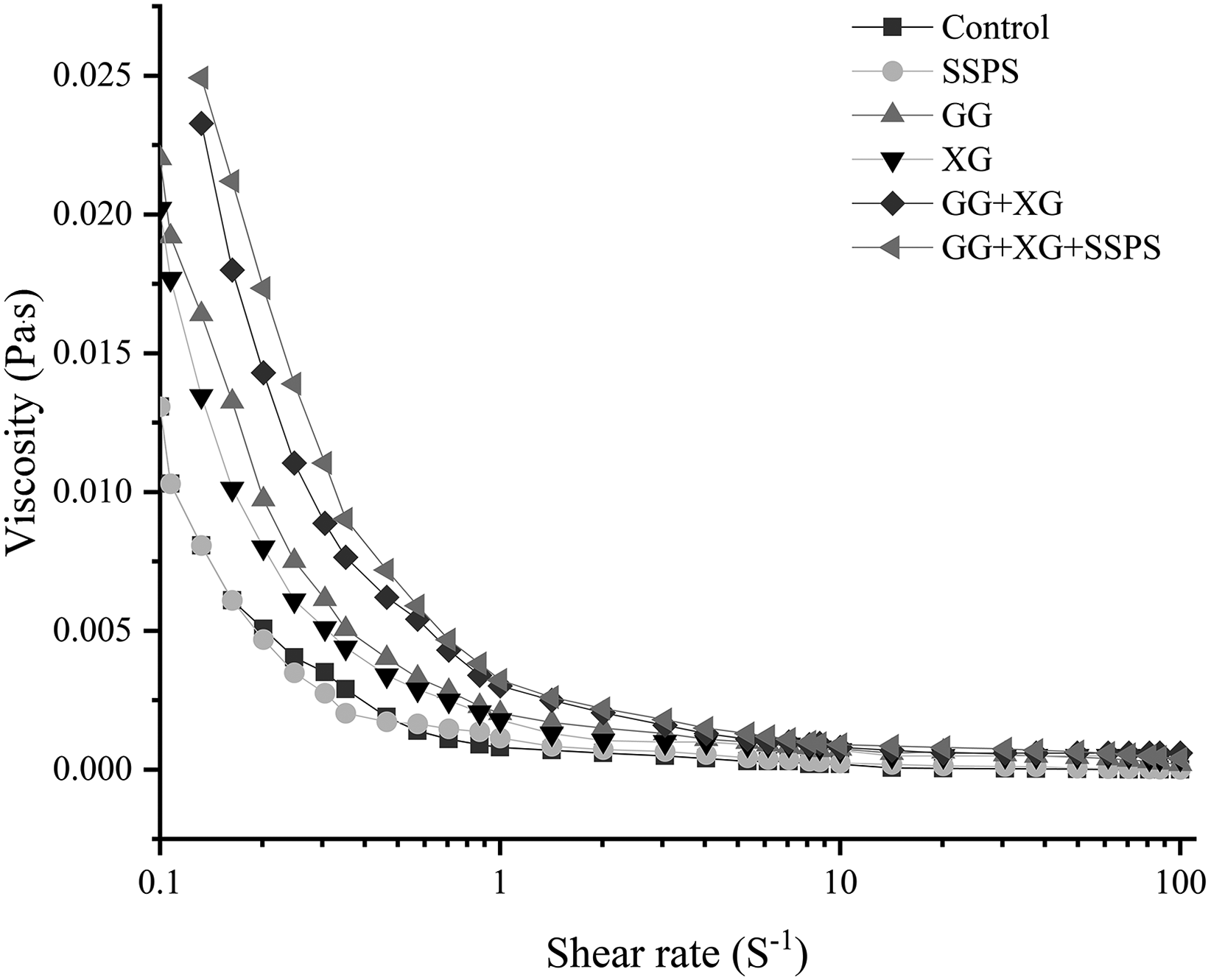
Effects of different hydrocolloids and natural emulsifier on apparent viscosity of oat beverage. SSPS: soluble soybean polysaccharide; GG: guar gum; XG: xanthan gum.
FTIR
Figure 4 shows the FTIR of oat beverages with different hydrocolloids and natural emulsifiers. The effect of this chemical group is enhanced when the intensity of the absorption peak is enhanced in the infrared spectrum. The results showed that the infrared spectrum of all samples was like. Compared with the control, no new absorption peak appeared after the addition of a stabilizer, indicating that the addition of the stabilizer did not introduce new chemical groups. A broad band of 3500–3100 cm−1 be observed in all spectra, where the O-H oscillation peak is at 3405.02 cm−1, which may also represent the N-H bond in the protein (Jiang et al., 2011). The peaks at 2925.87 cm−1 indicate the C-H bond stretching vibration (Andrade-Mahecha et al., 2012), The peaks at 1744.52 cm−1 can be attributed to the ester carbonyl (CH3-CO=) stretching groups (Ito et al., 1979). The peaks at 1643.82 cm−1 can be assigned to the stretching of the carbonyls of the β-turns, in particular, to the internally hydrogen-bonded. The enhanced absorption peak at 1643.82 cm−1 indicates that the protein and dextrin are bound (Secundo and Guerrieri, 2005). The peaks at 1412.82 cm−1 can be attributed to the bending vibration and C-O-O stretching peaks of methylene -CH2. The peaks at 1151.58 cm−1 represent the stretching vibration absorption peak of the C-O-C bond in the glucose ring (Xie et al., 2006). The peaks at 1027.59 cm−1 and 573.14 cm−1 can be attributed to the C-O vibration peak and stretching vibration peak of the pyranose ring skeleton (Kaczmarska et al., 2018). Kizil et al. (2002) showed that the intensity of the absorption peak near 1000 cm−1 depended on the intramolecular hydrogen bonds in -OH. The addition of SSPS, GG, and XG, shown in Figure 4, resulted in an increase in the absorption peak intensity of the beverage at 3430 cm−1, 1744.52 cm−1, 1643.82 cm−1, and 1027.59 cm−1, indicating the hydrogen bond interaction between the starch, protein, fat, and natural emulsifier in the hydrophilic colloid in beverage (Ji et al., 2017; Zheng et al., 2019). These results are consistent with existing rheological studies (Figure 3).
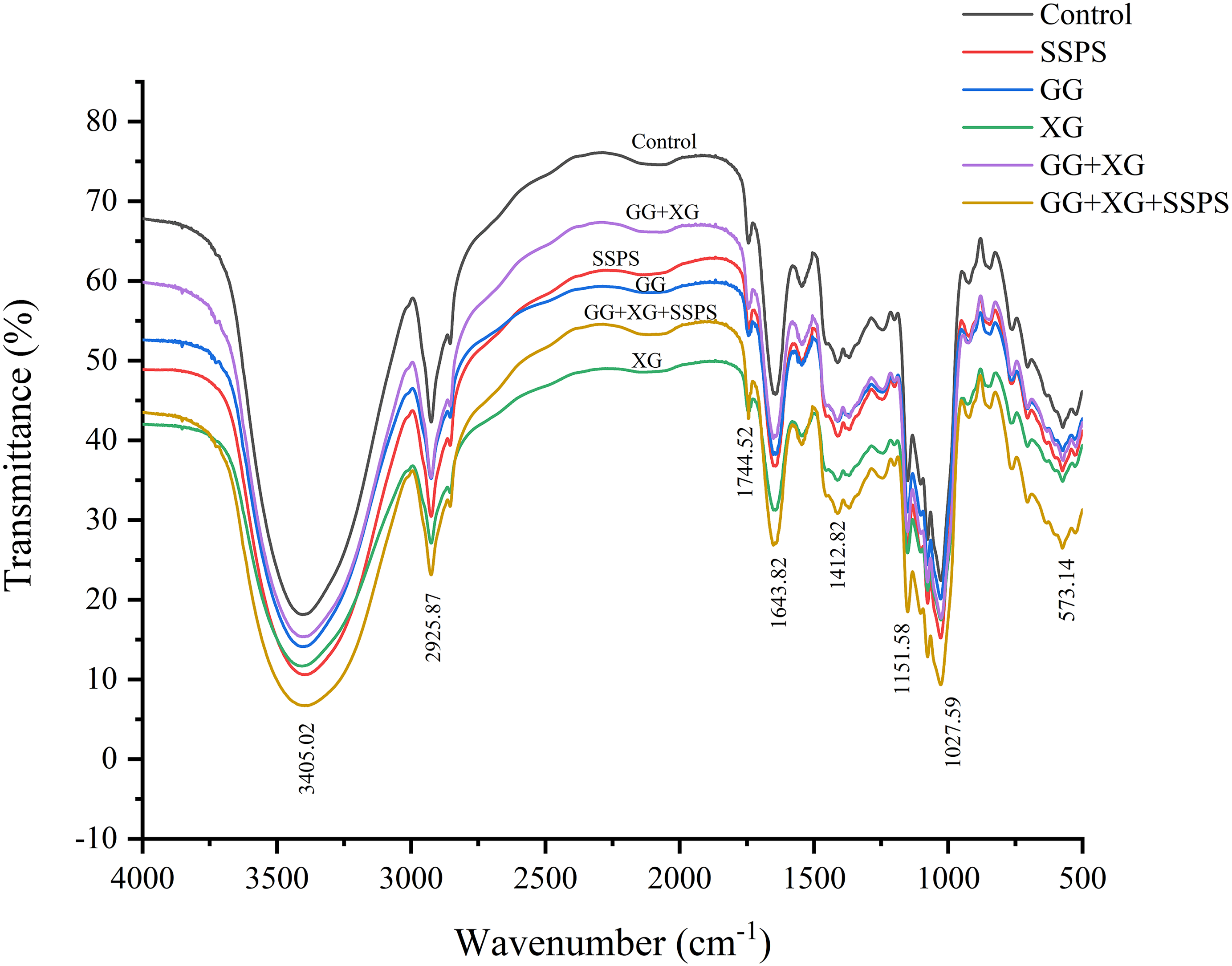
FT-IR of oat beverage with different hydrocolloids and natural emulsifier. SSPS: soluble soybean polysaccharide; GG: guar gum; XG: xanthan gum.
Physical stability
ΔBS was measured using the Turbiscan to analyze the aggregation, layering, or sedimentation of the sample within 2 h (Wang et al., 2020). Figure 5(a) shows the relationship between ΔBS, height, and time. The blue and red lines represent the start and end of the scan, respectively. The decrease of ΔBS at the top of the control sample indicates the decrease of particle concentration and the formation of the clarification layer. This is due to the gravity-driven migration of particles from top to bottom (Guimarães et al., 2018). In the samples with SSPS, the absolute value of ΔBS at the top decreased from 25 to 8, and the sedimentation rate was lower than that of the control group, mainly due to the increase of electrostatic repulsion.
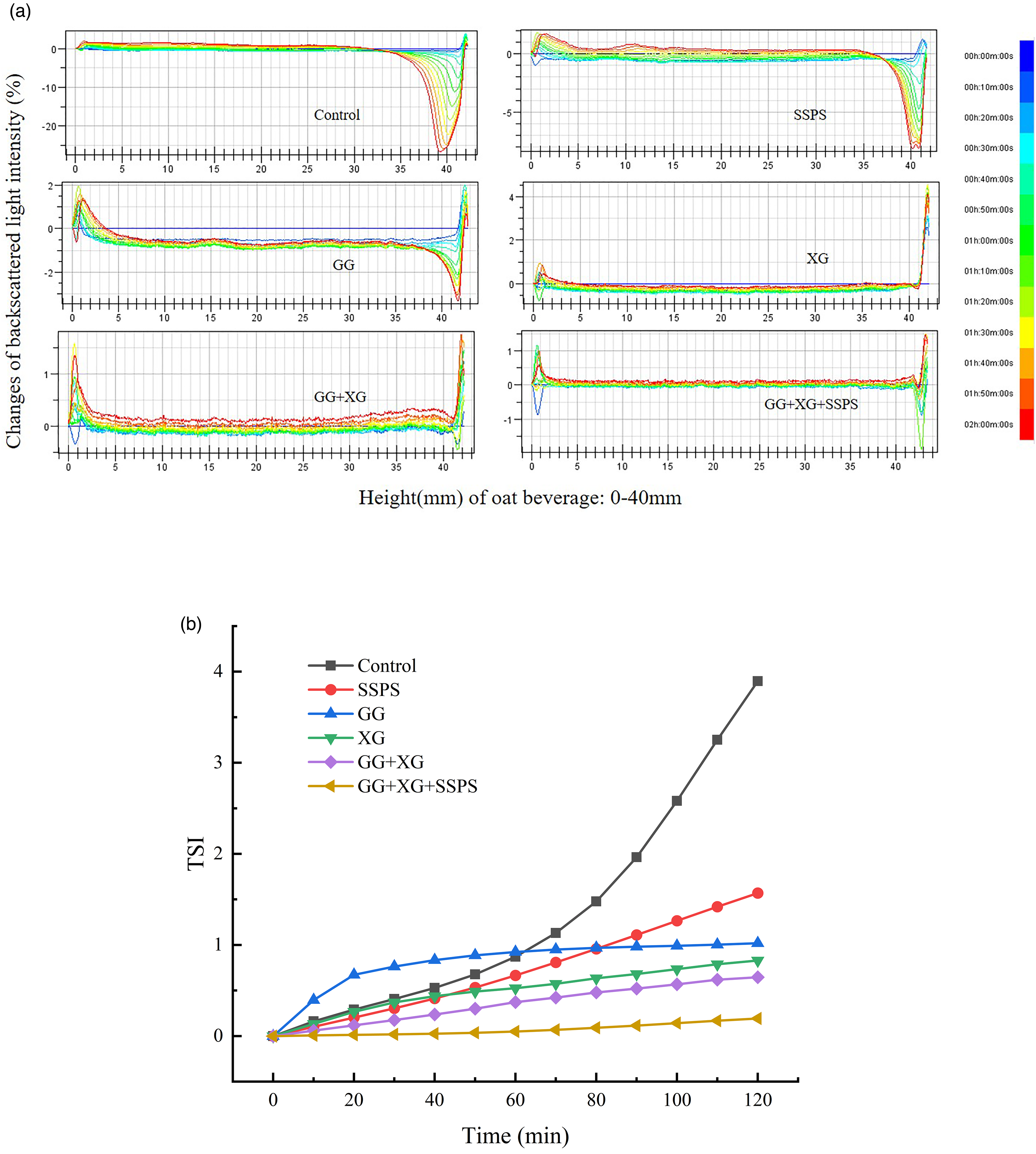
Effects of different hydrocolloids and natural emulsifier on the changes of backscattered light intensity (a) and TSI (b) of oat beverage. SSPS: soluble soybean polysaccharide; GG: guar gum; XG: xanthan gum.
After adding XG, the TSI was significantly reduced (Figure 5(b)), because XG polysaccharide molecules form hydrogen bonds with water molecules to form a gel-like network structure (Hemar et al., 2001), effectively preventing the aggregation of particles. Figure 5(a) shows that as time goes on, the fat globules at the bottom migrate upward, resulting in a decrease in the volume concentration of the particles at the bottom (Blecker et al., 1997) and a decrease in ΔBS and forming a lower convex peak. The fat globules at the bottom migrate to the top, resulting in an increase in the volume concentration of the top particles, thereby undergoing an increase in ΔBS and forming an upper convex peak, indicating emulsion stratification. Since XG has no hydrophobic bond, it cannot bind to oil; thus, XG will cause oil slick. On the contrary, GG is weaker than XG in inhibiting sedimentation but better at inhibiting oil slick. Although they were improved compared with the control group, the formation of precipitation layers and clarification layers indicated that oat beverage shows poor physical stability.
When XG and GG are added at the same time, the TSI of the beverage decreased to 0.8%. This suggests that much of the sample was stable, which can be attributed to the synergistic effect between the galactose moieties in XG and GG (Morris et al., 1977). The ΔBS in the middle of the beverage is not uniform and showed a decreasing concentration gradient from top to bottom during the standing process. In the presence of XG, GG, and SSPS, the sample had the lowest ΔBS (no more than 0.2%), and the beverage system reached greatest stability. The TSI (Figure 5(b)) reflected the same phenomenon. Because SSPS and XG are both negatively charged, the addition of SSPS increased electrostatic repulsion and steric hindrance between droplets (Ren et al., 2022), thereby preventing flocculation. Moreover, SSPS quickly adsorbed to the surface of the oil droplets. The sugar chain of SSPS extends to the water phase to form a thick hydration film around the oil droplets to stabilize the oil droplets through steric hindrance.
Microstructure
Figure 6 shows microscopic photographs of oat beverages with different hydrocolloids and natural emulsifiers. Larger particle clusters were found, as shown in Figure 6(a). This phenomenon may be a solid particle produced by the polymerization of denatured proteins. Although oat beverage with smaller particle size was obtained by homogenization, the protein is easy to aggregate without stabilizer. The large particle clusters in Figure 5(b) were significantly reduced, which may be evidence of the non-covalent binding of SSPS and protein, thereby increasing the solubility of oat protein and preventing its aggregation. As shown in Figure 6(c) and (d), no particle clusters were observed, although larger particles still existed. The size of the suspended particles in Figure 6(e) was significantly reduced compared to Figure 6(c). This phenomenon indicates that combination preparations are more effective than single aqueous colloids in reducing particle aggregation. As shown in Figure 6(f), the lack of larger particles and clusters explains why the oat beverage had a significantly smaller average particle size upon the addition of the emulsifier. Dickinson (2008) indicates that the droplets of the emulsion should be as small as possible to prevent delamination of the emulsion. This study illustrated that the balance of Van der Waals force, electrostatic force, and polymerization force as the main droplet interaction types played key roles in the stability of the oat beverage (Buffo et al., 2001).
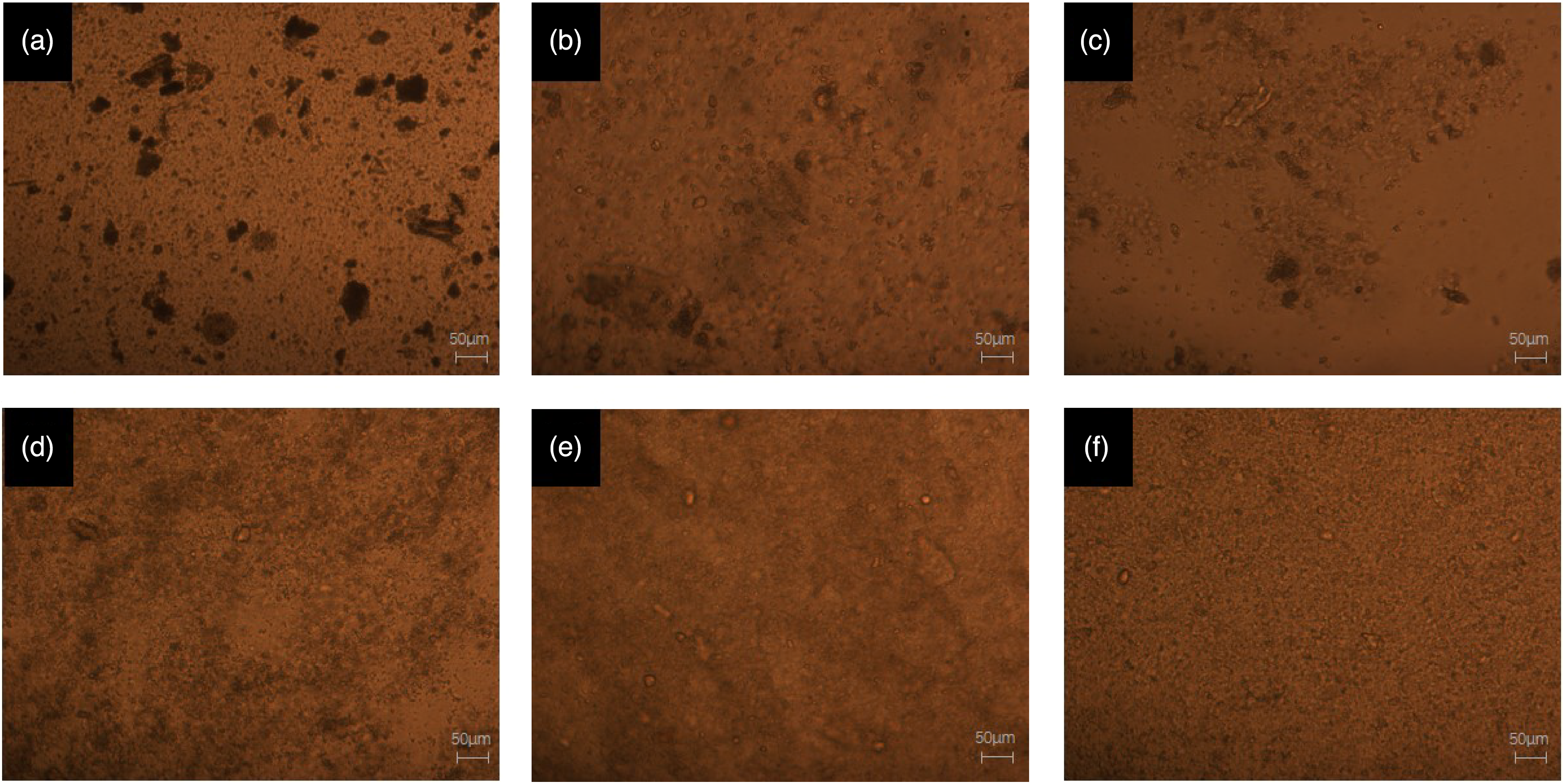
Effect of different hydrocolloids and natural emulsifier on microstructure of oat beverage. (a) Control; (b) SSPS; (c) GG; (d) XG; (e) GG + XG; (f) GG + XG + SSPS. SSPS: soluble soybean polysaccharide; GG: guar gum; XG: xanthan gum.
CONCLUSIONS
The behavior of GG, XG, and natural emulsifier SSPS in the oat beverage was studied. Turbiscan analysis revealed a clear phase separation in the absence of hydrocolloids and natural emulsifier. Notably, the addition of GG, XG, and natural emulsifier SSPS effectively improved the physical stability of the oat beverage. The results showed that XG could reduce the particle size and increase the absolute value of the zeta potential. The addition of GG significantly increased the apparent viscosity, which indicated that viscosity and potential were the main factors of the beverage stability. In addition, FTIR and Turbiscan analysis showed that the addition of SSPS increased the intensity of absorption peaks of protein, starch, and fat, and decreased the ΔBS and TSI. GG, XG, and SSPS could prevent the aggregation of particles such as protein, starch and fat through electrostatic and hydrogen bonding, and the microstructure obtained is more uniform with the superposition of GG, XG, and SSPS. The results showed that SSPS had the potential as a natural emulsifier in cereal beverages. Synergism between SSPS and hydrocolloids can improve apparently the stability of cereal beverages and provide valuable information for the food and the beverage industry.
Supplemental Material
sj-docx-1-fst-10.1177_10820132231176875 - Supplemental material for Influence of hydrocolloids and natural emulsifier in the physical stability of UHT oat beverage
Supplemental material, sj-docx-1-fst-10.1177_10820132231176875 for Influence of hydrocolloids and natural emulsifier in the physical stability of UHT oat beverage by Youhui Zhang, Yu Kong, Yanjun Yan, Feng Gao, He Ma and Changjin Liu in Food Science and Technology International
Footnotes
ACKNOWLEDGEMENTS
We thank doctor Yuntao Zhang from Kansas State University for helping us to check the manuscript. The authors also acknowledge the financial support of Tianjin municipal science and technology support plan program (19YFZCSN00560), which has enabled us to carry out this study.
DECLARATION OF CONFLICTING INTERESTS
The author(s) declared no potential conflicts of interest with respect to the research, authorship, and/or publication of this article.
FUNDING
The author(s) received no financial support for the research, authorship, and/or publication of this article.

SUPPLEMENTAL MATERIAL
Supplemental material for this article is available online.
References
Supplementary Material
Please find the following supplemental material available below.
For Open Access articles published under a Creative Commons License, all supplemental material carries the same license as the article it is associated with.
For non-Open Access articles published, all supplemental material carries a non-exclusive license, and permission requests for re-use of supplemental material or any part of supplemental material shall be sent directly to the copyright owner as specified in the copyright notice associated with the article.
