







Abstract
The objective of the present study was to assess the inactivation kinetics of γ-irradiation of selected foodborne pathogens in instant soup. Escherichia coli O157:H7 (ATCC 25922), Salmonella enterica subsp. enterica serovar Enteritidis (ATCC 13076), Staphylococcus aureus (ATCC 2592), and Bacillus cereus (ATCC 11778) were inoculated into instant soup and irradiated at various doses of 0 (control), 0.5, 1.0, 1.5, 2.0, 2.5, 3.0, 4.0, 5.0, and 10.0 kGy using 60Co source. The radiation response of these four major foodborne disease pathogens in instant soup was tested. As expected, the pathogen population decreased with increasing irradiation dose. By comparing bacterial resistance in instant soups according to D10 values, E coli O157: H7 was the most radio-resistant bacteria (D10 of 1.580 kGy), followed by Salmonella (D10 of 1.160 kGy), S aureus (D10 of 0.775 kGy), B cereus (D10 of 0.462 kGy). For modeling of inactivation kinetics, both, the conventional first-order linear model and Weibull model were compared and the goodness of fit of these models was investigated. Weibull model produced a better fit to the data. This research has shown that γ-irradiation was effective to eliminate pathogens in instant soup and it can be a great way to assure the microbiological safety of the instant soup.
Introduction
Instant soups are widely consumed by people and are available in the market in most countries. They are made from blending many ingredients such as spices, flour, pasta, dehydrated vegetables and meat, milk powder. On the other hand, the fact that the soup consists of a mixture of so many different ingredients increases the risk of illness pathogen contamination (Wang et al., 2010). Poor quality raw material and poor sanitary conditions reduces soup quality and safety. For this reason, food safety has attracted ever-increasing concern. Because soup can be contaminated with pathogens from the raw materials in its composition, at any stage of its production, from workers, from the environment or from contact surfaces. Furthermore, soups might be quite dangerous in terms of food safety and public health unless they are prepared with enough hot water and stored under adequate conditions. Because in this case, harmful bacteria may grow in the soup, and even produce toxins that are quite resistant to heat, pH, and NaCl, and some spore-forming bacteria may become resistant to high temperatures and grow (Balaban and Rasooly, 2000). Researchers have reported that the temperature of the water used in the preparation of instant soups does not exceed 100 °C and this may increase the microbiological risk for consumers (Oomes et al., 2007). In previous studies, foodborne pathogens like Salmonella, Escherichia coli, Staphylococcus aureus were detected in instant soups. While E coli was reported as an important pathogenic bacteria isolated, it was reported that S aureus was isolated in 33% of the soup samples examined in Turkey (Çoksaygılı and Başoglu, 2011; Demirci and Sezer, 1995). The presence of S aureus in instant soup indicates the inadequate processing conditions and risk of production of enterotoxin. These toxins pose a risk to food safety since they cannot be destroyed by thermal treatment, inhibitors, or dehydration (Apaydın and Gumus, 2018).
The emergence of worldwide antibiotic resistance to foodborne pathogens has caused food safety complications (Chouhan et al., 2017). Foodborne pathogens consisting of Salmonella, E coli O157:H, Bacillus cereus and S aureus have been regularly associated with major food safety concerns (Newell et al., 2010). Pathogens are also one of the main reasons for the rejection of many food products exported from different countries outside the EU (European Commission, 2020). Salmonella spp. and E coli species are among the most periodically reported foodborne pathogens in the EU from the point of disease outbreaks (EFSA and European Centre for Disease Prevention and Control 2019). The food industry adds artificial preservatives as a solution to prevent the growth of pathogens, even if some of them are harmful to human health (Khanum Mirza et al., 2017). Because of these reasons, it is necessary to inhibit pathogens that may result in foodborne illness after packaging.
Gamma irradiation, which is accepted as a pathogen-controlling technology, has the power to decrease the prevalence of foodborne infectious diseases and it is usually applied after packaging (Eustice, 2015; Tauxe, 2001). Gamma irradiation up to 10 kGy in foods is usually considered safe and causes no nutritional/microbiological issues, product damage, or toxicological hazards to the human body (World Health Organization, 1981). It is a powerful preservation process to eliminate foodborne pathogens (Gumus et al., 2008). The effect of the sterilization method on ensuring food safety is guessed based on the inactivation data of vegetative microbial cells (Mastwijk et al., 2017).
Inactivation of microorganisms by the irradiation process can be related to the applied radiation dose (Lea, 1955). Finding a mathematical expression that predicts microbial inactivation as affected by gamma irradiation leads to great advantages for the food industry. An appropriate model would provide a better comprehension of the function of pathogen microorganisms found in soup samples under exposure to gamma irradiation. Traditionally, inactivation of vegetative microbial cells subjected to inactivation process is presumed to be ruled by first-order reaction kinetics (D10-values). In the traditional first-order reaction kinetics method, it is assumed that all cells in a population show the same sensitivity to inactivation of vegetative microbial cells exposed to the inactivation process. On the contrary, there are generally survival curves with downward or upward concavity and non-linear distribution in inactivation kinetics and they are determined in semi-logarithmic coordinates. As an alternative approach, the Weibull model has been recommended to describe inactivation kinetics (Peleg and Cole, 1998). The Weibull model has been confirmed as the microbial inactivation model regardless of what lethal treatment is since it has been more succesful option than the conventional alternatives (Buzrul, 2022).
Since drying the ingredients of the soup alone cannot be regarded as an adequate barrier to prevent the growth of foodborne pathogens in soup, additional processes should be considered to ensure food safety. It is requisite to control pathogenic bacteria in soup that can induce food poisoning. Therefore, the overall aim of the present study was to assess the inactivation effects of γ-irradiation at different dose rates against selected foodborne pathogens E coli O157:H7, B cereus, Salmonella and S aureus in soup. Inactivation kinetics were assessed using both, the traditional first-order model (D10-values) and the Weibull approach. For modeling of inactivation kinetics, goodness of fit of these models was investigated.
Materials and methods
Materials
Peptone water, tryptic soy agar (TSA) and tryptic soy broth (TSB) were purchased from Merck (Darmstadt, Germany). All chemicals in the study were purchased from Sigma-Aldrich Canada Ltd (Oakville, ON, Canada). The commercial instant soup was supplied from a local market in Tekirdag, Türkiye. A particular variety of soup manufactured by a specific producer was employed as the material of this study.
Bacterial strains
We obtained E coli O157:H7 (ATCC 25922), B cereus (ATCC 11778), Salmonella enterica subsp. enterica serovar Enteritidis (ATCC 13076) and S aureus (ATCC 2592) from the bacterial culture collection of Tekirdağ Namık Kemal University (Tekirdağ, Turkey).
Preparation of pathogen inoculum and inoculation
The stock cultures of E coli O157:H7 (ATCC 25922), B cereus (ATCC 11778), Salmonella enterica subsp. enterica serovar Enteritidis (ATCC 13076) and S aureus (ATCC 2592) were preserved at −80 °C in TSB containing glycerol (40% v/v). For the microorganism inactivation experiments, the stock cultures of the pathogens were multiplied through 2 serial 24 h growth cycles in TSB at 37 °C to get active cultures of all target microorganisms. Then, 1 ml of each tested diluted bacteria containing 106 CFU/mL was inoculated into a quantity of 10 g instant soup separately and thoroughly mixed.
γ-Irradiation treatment
All inoculated instant soup samples in stomacher bags were irradiated using a Co60 gamma irradiator (Ob-Servo Sanguis, Institute of Isotopes, Hungary), having a dose rate of about 1168 Gy/h at room temperature (∼25 °C). Irradiation of the samples with gamma rays was carried out at Sarayköy Nuclear Research and Training Center (Ankara, Turkey). The different doses of irradiation (0, 0.5, 1.0, 1.5, 2.0, 2.5, 3.0, 4.0, 5.0, and 10.0 kGy) were applied to determine the inactivation kinetics.
Bacterial enumeration
Standart spread plate technique described by Osaili et al. (2018) was used for determinating the populations of bacteria in non-irradiated and irradiated samples. Under aseptic conditions, the stomacher bags were opened and mixed with 90 mL sterile peptone water (0.1%, w/v). After that, soup and aseptic water mix in the stomacher bags were homogenized by stomacher ST400 (Seward, Ltd, London, UK) for 2 min, then serial dilutions (from 10−1 to 10−6) of the irradiated and non-irradiated soup samples were prepared. 0.1 mL of each dilution (from 10−1 to 10−6) prepared was transferred in triplicate onto the surface of TSA. After spreading with a sterile spreader, the inoculated plates were incubated at 37 °C for 48 h. The colonies of the pathogens were counted according to the plate count method described by Hossain et al. (2014).
Modeling the microbial inactivation
Inactivation kinetics were analyzed using both, the log-linear model and the Weibull model. The inactivation rate of pathogens was modeled and analyzed statistically. Data fit of the models and plotting of the results were both performed with Sigma Plot 14.0 (Systat Software Inc., Chicago, IL, USA). The goodness-of-fit of the models was evaluated using the adjusted determination coefficient (R2 adj) and standard error of estimate values.
Log-Linear model
Inactivation of microorganisms resulted from both thermal and non-thermal applications first was described by first-order kinetics traditionally (Peleg and Cole, 1998). The linear model was described by replacing the variable time by irradiation dose (d) in the quation below,

Weibull model
It is well known that the inactivation kinetics of microorganisms mostly does not follow the first-order kinetic (Hakguder Taze et al., 2015). In case there is a non-linear regression between irradiation dose and inactivation rate, Weibull model was fit to data since it is the most flexible one among the non-linear models (Buzrul, 2022). The Weibull model was defined in the below equation,

Statistical analysis
All experiments were conducted three times with duplicate samples. All data were analyzed by analysis of variance (ANOVA) which is a completely randomized design. The statistical analyses were done with the SPSS 18.0 statistical package program. Mean values were analyzed by Duncan's multiple-range test. P < 0.05 showed significant difference among the irradiation applications.
Results
Initial populations of E coli O157:H7 (ATCC 25922), S Enteritidis (ATCC 13076), S aureus (ATCC 2592), and B cereus (ATCC 11778) in instant soups were approximately 104–106 CFU/g. Figure 1 shows the schematic plot of survival curves according to the first-order kinetics and experimental data for E coli O157:H7, S aureus, S Enteritidis, and B cereus in instant soup depending on the irradiation dose. Figure 2 shows the schematic plot of survival curves according to the Weibull model for pathogen bacteria treated by irradiation in the soup mix. As shown in Figure 1 and Figure 2, gamma irradiation significantly reduced levels of E coli O157:H7, S Enteritidis, B cereus and S aureus in instant soups.
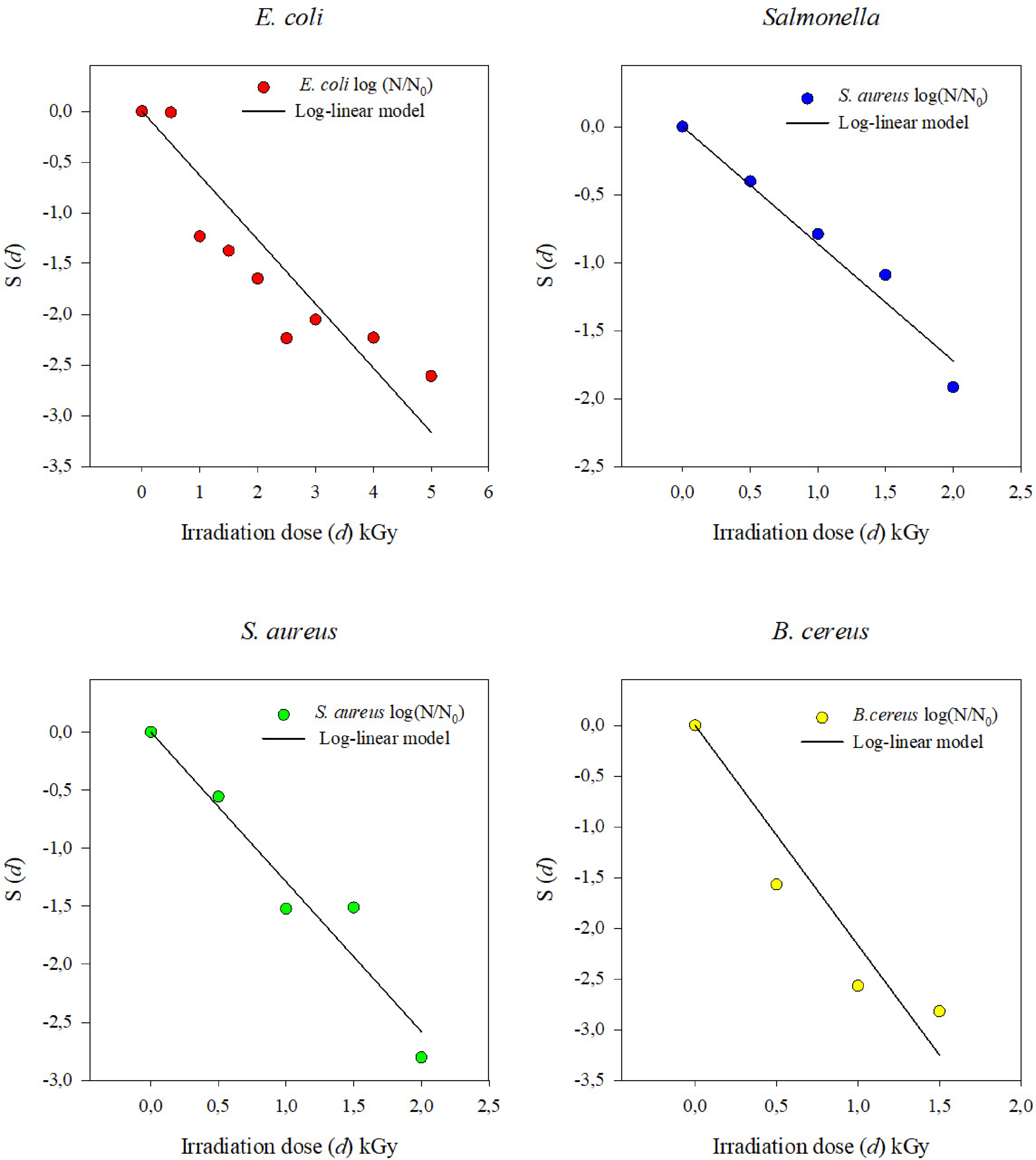
Schematic plot of survival curves according to first order kinetics and experimental data for Escherichia coli, Salmonella, Staphylococcus aureus, and Bacillus cereus treated by irradiation in soup mix.
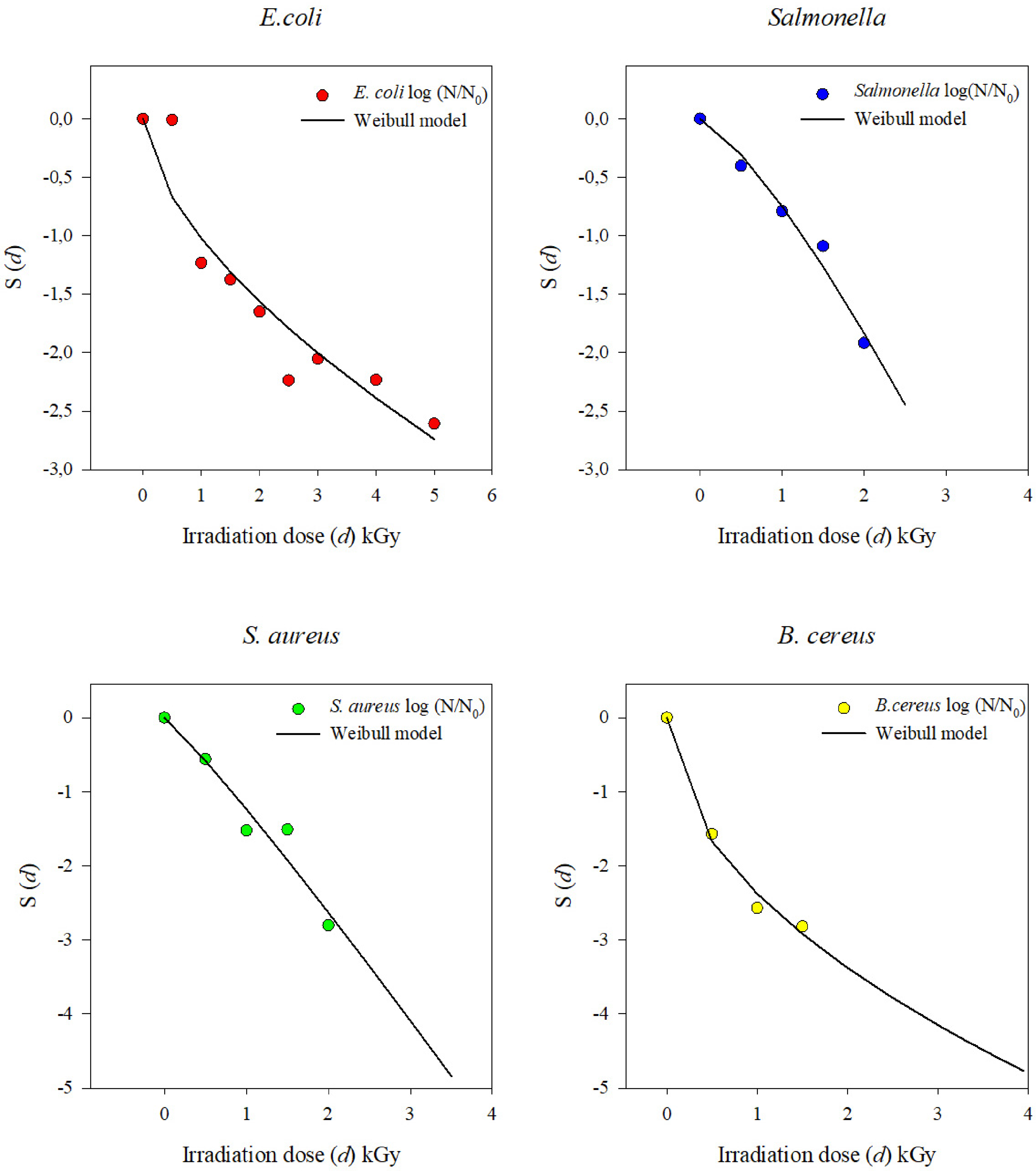
Schematic plot of survival curves according to the Weibull model for Escherichia coli, Salmonella, Staphylococcus aureus, and Bacillus cereus treated by irradiation in soup mix.
A significant decrease was detected in all pathogenic microorganisms in instant soup samples with irradiation application (p < 0.05). Even 0.5 kGy gamma irradiation application caused a statistically significant reduction on pathogens. Increasing the irradiation dose from 0.5 to 10 resulted in a statistically significant increase in pathogen inactivation. Initial populations of E coli O157:H7, S Enteritidis, S aureus and B cereus in the non-irradiated samples were 5.74, 5.20, 5.10, and 4.18 log CFU/g, respectively. Gamma radiation at 0.5 kGy caused 0.37 log CFU/g decrease in E coli O157:H7. The maximum decrease in the population of E coli O157:H7 was determined as 5.74 log CFU/g after 10 kGy irradiation dose exposure. The population of these bacteria in instant soups was not detectable (1 log CFU/g) when 10 kGy irradiation dose was applied.
The highest reduction in the population of Salmonella was determined as 5.20 log CFU/g when 2.5 kGy irradiation dose was applied. The population of Salmonella could not be detected with the treatment of 2.5 kGy.
The maximum decrease in population of B cereus was determined after 2.0 kGy irradiation dose exposure which reduced it by 4.18 log CFU/g. The population of B cereus in instant soup decreased to an undetectable level with the treatment of 2.0 kGy.
Similar to the B cereus population, the count of S aureus in instant soups were not detectable with 2.5 kGy irradiation application. With the application of 2.5 kGy irradiation dose, the population of S aureus in instant soup decreased by 5.10 log CFU/g and became undetectable level.
Table 1 shows the kinetic parameters of first order model for the inactivation of E coli, S Enteritidis, S aureus, and B cereus treated by irradiation in instant soup. The D10-value (decimal reduction dose) was 1.580 kGy for E coli O157:H7, 1.160 kGy for S Enteritidis, 0.775 kGy for S aureus and 0.462 for B cereus in instant soup, respectively. As shown in Table 1, there was a significant (p < 0.05) difference between D10 values and D10 value of E coli O157:H7 was significantly higher than other pathogens. By comparing bacterial resistance in instant soups, E coli O157:H7 was the most radio-tolerant bacteria (D10 of 1.580 kGy), followed by S Enteritidis (D10 of 1.160 kGy), S aureus (D10 of 0.775 kGy), B cereus (D10 of 0.462 kGy) (Table 1).
Kinetic parameters of log-linear model for the inactivation of Escherichia coli, Salmonella, Staphylococcus aureus, and Bacillus cereus treated by irradiation in soup mix.
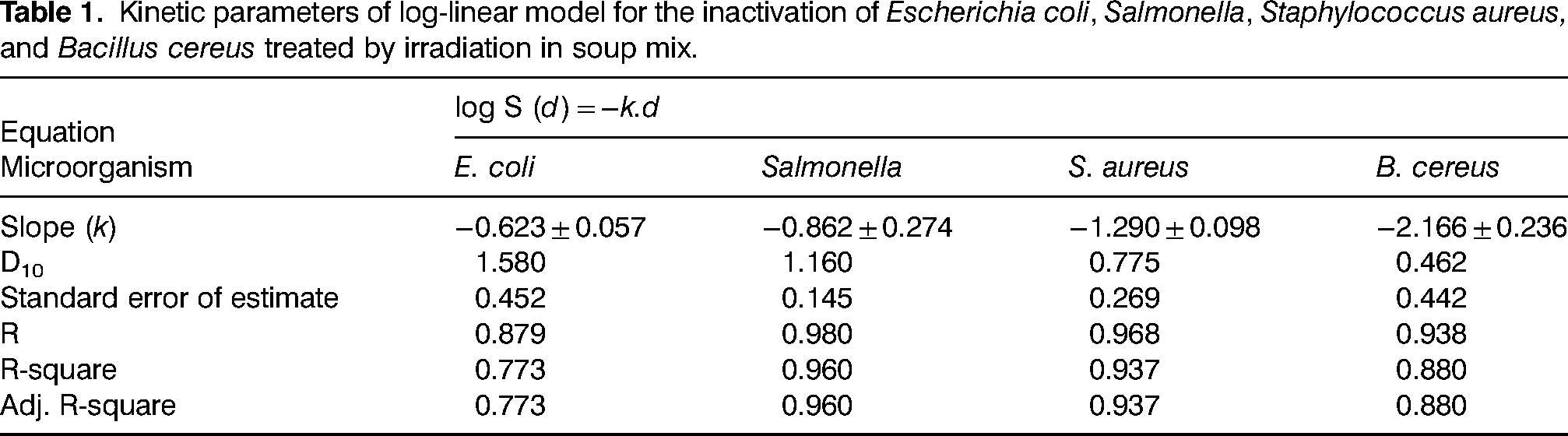
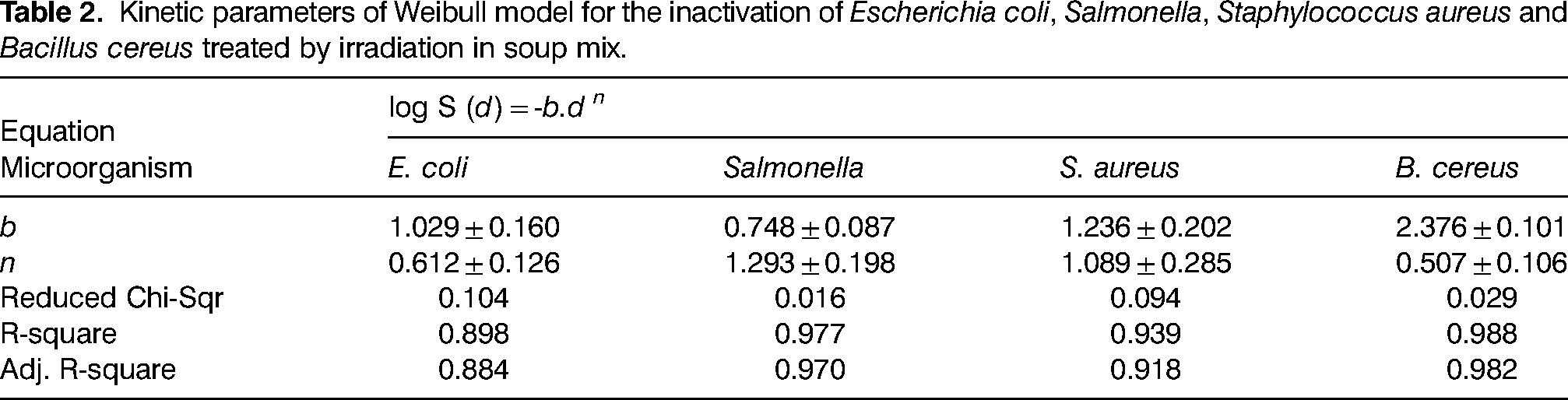
Table 2 shows the kinetic parameters of the Weibull model for the inactivation of E coli, S Enteritidis, S aureus, and B cereus treated by irradiation in soup mix. According to the Weibull model, inactivation rate (b value) was 2.376 for B cereus, 1.236 for S aureus, 1.029 for E coli O157:H7, 0.748 for S Enteritidis in instant soup, respectively. The shape parameter (n value, the constant parameter which determines the shape of the distribution curve) was 1.293 for S Enteritidis 1.089 for S aureus, 0.612 for E coli, 0.507 for B cereus in instant soup, respectively.
Kinetic parameters of Weibull model for the inactivation of Escherichia coli, Salmonella, Staphylococcus aureus and Bacillus cereus treated by irradiation in soup mix.
Discussion
The emergence of worldwide antibiotic resistance to foodborne pathogens has caused food safety complications (Chouhan et al., 2017). Moreover, outbreaks of foodborne pathogens in low-moisture foods like instant soup are emerging concerns about food safety in recent decades (Cheng et al., 2021). The instant soup consists of a mixture of many different components, which increases the risk of foodborne pathogen transmission. Apaydın and Gumus (2018) investigated the microbiological load of 72 instant soup samples sold in Türkiye. Total aerobic mesophilic bacteria counts and S aureus counts were found as 3.51–4.53 log CFU/g and 0.93–1.71 log CFU/g, respectively. Apaydın and Gumus (2018) and Demirci and Sezer (1995) also reported that the presence of S aureus in instant soup indicates the inadequate processing conditions and risk of production of enterotoxin that cannot be inactivated by thermal treatment, dehydration, or inhibitors. Therefore, controlling pathogens that can induce foodborne infectious diseases in instant soup is essential. Food irradiation is a technology to effectively eliminate the microorganisms that cause foodborne illness, such as Salmonella and E coli (U.S. FDA, 2022).
In the present study, the gamma irradiation process was applied to ensure food safety. In this research, the inactivation effects of gamma irradiation at different dose rates were investigated for controlling foodborne pathogen microorganisms in instant soup. The inactivation rate of pathogens was examined in a real food matrix (instant soup). There is no information available in the literature on the inactivation effect of gamma irradiation on pathogens including E coli O157:H7, S Enteritidis, S aureus and B cereus in instant soup. On the other hand, Irawati et al. (2007) applied medium radiation dose to some traditional soups for ensuring the safety, quality and extending their shelf-life. Pathogenic bacteria such as E coli, Staphylococcus spp., Salmonella spp. and Clostridium spp. could not be detected in non-irradiated and also irradiated soups in this reserach. They reported that 5–7 kGy gamma irradiation resulted in a 2–3 log cycle reduction of microbial load in the soup.
In our study, 4.18–5.74 log CFU/g pathogen reductions were achieved when samples were exposed to 10.0 kGy of gamma irradiation. No bacteria were detected after 2.5 kGy gamma irradiation to soup mix cultures except E coli. These results are consistent with those from prior studies which found similar reductions in foodborne pathogens after irradiation. Some studies have been published recently on the inactivation effects of ionizing radiation at different dose rates against pathogens such as Ecoli O157:H7, and Salmonella in various food systems similar to soup (low aw). For example, Song et al. (2014) found that gamma irradiation is effective on reducing Salmonella Typhimurium and E coli O157:H7 in red pepper and black pepper. They found that the population of S Typhimurium and E coli O157:H7 in black pepper decreased by >4.4 to >5.2 log CFU/g and became undetectable level in all cases with the application of 5 kGy irradiation dose. Similarly, Jeon and Ha (2020a) found that 0.15 kGy x-ray irradiation reduced the populations of S Typhimurium and E coli O157:H7 in lettuce samples by 1.36 and 1.69 log CFU/g, respectively. Jeon and Ha (2020b) found that 0.15 kGy x-ray irradiation reduced the populations of S Typhimurium and E coli O157:H7 on spinach leaves by 1.32 and 2.83 log CFU/g, respectively. In addition, Hu et al. (2021) reported that irradiation treatment at 2 kGy resulted in reductions of S aureus and S. Typhimurium by approximately 2.5 log CFU/g and by more than 5 log CFU/g, respectively. Saroj et al. (2007) demonstrated that irradiation at 2 kGy reduced the levels of Salmonella in mung beans and chickpeas by 4.6 and 4.8 log, respectively. Berrios-Rodriguez et al. (2020) found that 0.5 kGy gamma irradiation reduced cell counts of L monocytogenes by 3.2 and 1.6 log CFU/g on carrot and tomato, respectively. In agreement with our results, the cell counts of E coli O157:H7 and S Typhimurium in kimchi seasoning mixture were not detectable at 5 kGy gamma irradiation dose (Jeong et al., 2020). After 10 kGy gamma irradiation exposure, the cell counts could not detected in all situations. Gamma irradiation treatment brings about some biochemical changes and may affect bacterial DNA by breaking chemical bonds within it. So, irradiation may cause cell damage or change membrane permeability (Apaydin et al., 2017; Caillet and Lacroix, 2006; Caillet et al., 2005). For this reason, even low doses of irradiation can be effective in pathogen inactivation.
This research indicates gamma irradiation is effective in inactivating pathogens in instant soup. The results obtained in our study demonstrated that the reduction of S Enteritidis, E coli O157:H7, S aureus and B cereus increased in parallel with the increase of irradiation dose. The gamma irradiation resulted in adversely correlated effects (p < 0.05) on the population of foodborne pathogens in instant soup.
Gamma irradiation shows different efficacy depending on the type of pathogen. Based on the D10 value of pathogens in instant soup, while E coli O157:H7 was the most radio-tolerant bacterium, B cereus was the least radiation tolerance pathogen tested. In this research, the order of radiation sensitivity of the studied pathogens was B cereus > S aureus > S Enteritidis > E. O157:H7 coli O157:H7. The same radiation sensitivity order was reported by Osaili et al. (2018) for Salmonella spp. and E coli O157:H7 in tahini samples. Begum et al. (2020) recorded that E coli was the most radio-tolerant bacterium followed by S Typhimurium and L monocytogenes.
On the other hand, Monk et al. (1995) declared that Salmonella may be the most radiation-tolerance pathogen among gram-negative bacteria. Furthermore, Song et al. (2014) reported that E coli O157:H7 has a lower D-value than S. Typhimurium. Robichaud et al. (2021) found that B cereus (D10 of 2.49 kGy) was the most resistant bacteria againt radiation, followed by S Typhimurium (D10 of 0.97 kGy) and L monocytogenes (D10 of 0.92 kGy), E coli (0.64 kGy), and S aureus (0.46 kGy) in infant formula. The irradiation sensitivity of microorganisms can be affected by various factors. These may be the nature of the food, its temperature during irradiation, sample composition, the physiological state and type of the microorganism, the presence or absence of oxygen, water activity (Radomyski et al., 1994).
It was observed that the survival curve indicated a concavity (Figure 2). Therefore Weibull model was assumed to best describe the survival data. When comparing inactivation rates, Salmonella was the most radio-resistant bacteria (b value of 0.748), followed by E coli (1.029), S aureus (1.236), and B cereus (2.376). Shape parameters (n values) of E coli (0.612) and B cereus (0.507) were less than one. If the shape parameters (n values) of the Weibull model were less than one, the survival curve is concave (as seen in Figure 2). It also indicates that surviving pathogenic microorganisms have the ability to adapt to applied gamma irradiation. (Van Boekel, 2002). Therefore, it can be interpreted as evidence that radio-tolerant pathogens are destroyed at a relatively fast rate and more radio-resistance pathogens survive.
Data obtained from irradiation inactivation of E coli O157:H7 appears to be compatible with survivor curves fitted by Weibull model kinetics (Tables 1 and 2). While Adj. R-Square value of E coli O157:H7 in first-order kinetics was 0.773, this value was 0.884 in Weibull model kinetics. Furthermore, Adj. R-Square values of S Enteritidis ve B cereus in Weibull model were 0.967 and 0.982, respectively. Weibull model explains these two pathogens very well. Weibull model produced a better fit to the data of S Enteritidis and B cereus populations.
Conclusions
The results of this work indicate that gamma irradiation technology has the potential as a non-thermal process to completely eliminate pathogenic bacteria in instant soup that can cause foodborne infectious diseases. Gamma radiation has bactericidal effects against E coli O157:H7 (ATCC 25922), B cereus (ATCC 11778), Salmonella enterica subsp. enterica serovar Enteritidis (ATCC 13076) and S aureus (ATCC 2592) in instant soup. The populations of foodborne pathogens were reduced in instant soup when the irradiation dose increased from 0.5 to 10.0 kGy. In total, 2.5 kGy irradiation dose was sufficient to reduce B cereus and S aureus populations to undetectable level, whereas 10 kGy irradiation dose was necessary for E coli O157:H7 populations to be completely eliminated. The maximum decrease in population of E coli O157:H7 was determined as 5.74 log CFU/g after 10 kGy irradiation dose exposure. Because comparing bacterial resistance in instant soups, E coli O157:H7 was detected as the most radio-tolerant bacteria (D10 of 1.580 kGy), followed by S Enteritidis (D10 of 1.160 kGy), S aureus (D10 of 0.775 kGy), B cereus (D10 of 0.462 kGy). As a result, gamma irradiation improves microbiological safety and it can be recommended to ensure the food safety of instant soups.
Modeling the inactivation kinetics of microorganisms is crucial for food safety, because the safety of food products can be defined and predicted through modeling. Weibull model produced a better fit to the data with a higher adjusted determination coefficient (R2 adj). Adj. R-Square values of S Enteritidisve B cereus in Weibull model were 0.970 and 0.982, respectively. Weibull model explains these two pathogens very well. Weibull model produced a better fit to the data of S Enteritidis ve B cereus populations. In conclusion, Weibull model has been a more successful option than the conventional alternatives and it can be proposed to describe inactivation kinetics of pathogens.
Footnotes
Acknowledgements
Authors have gratefully acknowledged TÜBİTAK BİDEB supported the event with the number of 1129B372100408 and Prof. Dr. Sencer Buzrul who organized this course and did agreat mentorship.
Declaration of conflicting interests
The authors declared no potential conflicts of interest with respect to the research, authorship, and/or publication of this article.
Funding
The authors received no financial support for the research, authorship, and/or publication of this article.
