







Abstract
This study investigated the effects of polishing duration (15–120 s) in a laboratory abrasive rice polisher on milling quality, grain characteristics, and kernel surface microstructure. The results revealed that the degree of polishing (DOP) increased significantly from 2.38% (15 s) to 15.29% (120 s), which was accompanied by a higher broken content (from 6.35% to 18.45%) and a reduced head rice yield (from 93.6% to 80.3%). The complete removal of bran streaks required a DOP >13.05%, but this threshold also coincided with over-milling and yield loss. Scanning electron microscopy (SEM) images revealed the progressive abrasion of the protuberances and bran layers, with uniform polishing achieved only after 90 s. These findings clearly indicate the trade-off between bran removal and grain integrity, underscoring the need to optimize the polishing time for balanced quality, yield, and sustainability in rice processing. Therefore, this study highlights how optimizing rice polishing through abrasive milling can reduce grain breakage, increase head rice yield, and improve grain uniformity, thereby minimizing postharvest losses. By balancing whiteness, transparency, and surface structure, this research supports more efficient use of harvested rice, promoting food security and sustainability in grain processing.
Introduction
Rice (Oryza sativa) is one of the oldest and most important cultivated crop species worldwide; it serves as a staple food and is widely grown in Asian countries (Fukagawa and Ziska, 2019; Tong et al., 2026). In India, rice is consumed by approximately 65% of the population, and the country is the second-largest producer, contributing 25.27% to global production (APEDA, 2023-24; FAO, 2023). The rice milling industry is therefore a major agro-based sector, with approximately 174,296 milling units reported in India (Goyal et al., 2012). Brown rice has damaged and broken grains that are sensitive to damage during storage and have low commercial value (Nath et al., 2024). Milling transforms brown rice into white rice by removing bran and germ, and the efficiency of this process directly affects the yield, quality, nutritional composition of rice, and profitability (Akther et al., 2025). The yield of milled rice depends on several factors, including variety, kernel maturity, moisture content, cracking, storage, and milling technique. Among these, polishing is particularly critical, as it is the most energy-intensive stage of milling (Mohapatra and Bal, 2010). The energy supplied during polishing is consumed through abrasion, heating of the grain, and overcoming machine forces (Mohapatra and Bal, 2004). While polishing improves storage, cooking quality, and digestibility, excessive polishing reduces nutrient retention and increases grain breakage. For example, brown rice cannot be stored long in tropical climates because of its lipase activity (Singh and Sogi, 2016), and its cooking time is more than twice that of white rice (Pletsch and Hamaker, 2018). However, over-milling leads to nutrient loss and reduced head rice yield (Yadav and Jindal, 2008). Thus, optimizing polishing conditions is essential to balance consumer preference for whiteness with the industry goal of maximizing yield. The degree of polishing (DOP) quantifies the extent of bran and germ removal, and the value, stability, and appearance of milled rice depend on the residual bran on the kernel surface (Wood et al., 2012). However, owing to the undulating surface of rice kernels, achieving uniform polishing remains difficult (Mohapatra and Bal, 2007).
Although previous studies have explored individual aspects of rice milling, such as energy consumption, cooking quality, and optical properties, under various milling conditions (Mohapatra and Bal, 2007; Yadav and Jindal, 2008), comprehensive studies that simultaneously correlate polishing duration with both quantitative milling parameters and microstructural changes at the kernel level are lacking. While advanced analysis tools such as the discrete element method (Li et al., 2025) are still in the process of refinement, particularly in capturing complex breakage behavior, their application remains limited for biological materials such as rice. In contrast, analyzing grain–grain and grain–surface interactions and breakage mechanisms by scanning electron microscopy (SEM) provides more direct and reliable insights. SEM-based surface and fracture analysis therefore remains a more practical and effective approach for optimizing rice milling and polishing, as it enables clear observations of damage, crack formation, and surface abrasion, which directly influence milling quality and head rice yield. In particular, the integration of SEM to understand polishing uniformity and surface morphology alongside conventional quality metrics has not been adequately addressed in existing studies. The present study addresses this gap by systematically evaluating the effects of polishing time on both milling performance and grain microstructure, thereby providing a more holistic understanding of the trade-offs involved in rice polishing.
Materials and methods
Raw materials
The Chingure paddy variety used in this study was cultivated during the monsoon season of 2023 under open-field irrigated conditions in Godda district (25°00'45.4“N 87°20'29.4”E), Jharkhand, India. Chingure paddy is an indigenous, non-scented rice landrace traditionally cultivated in eastern India, including Jharkhand. The unpolished kernels have a slightly dark surface, reflecting retained bran layers, and the variety is well adapted to rainfed, low-input conditions with stable performance under local agro-ecologies. The physical properties of the Chingure rice kernel are well characterized by Prakash et al. (2016). The crop was harvested at physiological maturity and stored under ambient conditions prior to the milling experiments. This variety was selected because of its regional importance and suitability for abrasive polishing studies. After hulling, darker brown rice was used to clearly observe the polishing effects. The paddy was dehusked using a laboratory husker (Satake THU35A, Japan), and broken grains were removed with a grader (Burrows Equipment Company, USA). Only whole brown rice kernels were selected for the experiments.
Polishing of rice in an abrasive rice polisher
Experiments were carried out using a laboratory abrasive rice polisher (Model TM 05, Satake Corporation, Japan) equipped with a feeding hopper, an emery roller (30P), a screen (1 mm slot), and collection boxes for bran and polished rice. The machine has a capacity of 0.2 kg and was operated at 1440 rpm. Brown rice samples (200 g, 11.27% moisture, wb) were polished for 15, 30, 45, 60, 75, 90, 105, and 120 s. Bran and polished rice were collected separately, and each experiment was performed in triplicate to determine the mean values of the DOP, broken content, and head rice yield.
Estimation of the degree of milling, broken content, and head rice yield
Degree of polishing
The DOP (%) was determined using the gravimetric method (Rao, 2024). Each weighed sample was polished, and residual bran adhering to the surface was removed with a laboratory aspirator (Bates Aspirator, USA). The weight difference was recorded, and the DOP was calculated using Eq. 1.

Broken content (%)
After each experiment, the broken rice was separated from the milled rice using a laboratory grader (Burrows Equipment Company, Illinois, USA) and weighed. The broken content was determined using Eq. 2 (Wazed et al., 2021).

Head rice yield (%)
The head rice yield is defined as the ratio of the mass of head rice to that of milled rice and was determined using Eq. 3 (Prakash et al., 2014).

Measurement of whiteness and transparency of milled rice
The whiteness and transparency of the milled rice were measured using a Satake milling meter (Model MM-1B, Satake Corporation, Japan) following the procedure of Mardison et al. (2018). The instrument projects light onto the sample and records reflected and transmitted light as whiteness and transparency, respectively. Prior to measurement, calibration was performed with standard white and brown plates. Each rice sample was inserted into the inlet, and three readings were taken; average values were used for analysis.
Study of the uniformity of polishing
Images of rice milled to different DOP were captured using a 20.1 megapixel, 26× optical zoom camera (Model DSC-H200, Sony, Japan). Photographs of milled rice taken at different DOP were compared to study the uniformity of polishing (Prakash et al., 2014).
Microstructure of polished rice
Microstructural changes in rice kernels at different polishing stages were examined using a scanning electron microscope (SEM, EVO 60, ZEISS, Germany). The samples were sputter-coated with a 3–5 nm layer of gold–palladium using a low-vacuum coater (POLARON SC7620, UK) and mounted on sample stubs with conductive carbon tape for stability. The coated grains were analyzed under SEM, and representative images were captured at 60×, 300×, and 500× magnifications.
Statistical analysis
All the experiments were conducted in triplicate, and the results are presented as the means ± standard deviations. The data were analyzed using one-way ANOVA in SPSS (IBM, USA), and Duncan's multiple range test (p < 0.05) was used to evaluate homogeneity and identify significant differences among treatments.
Results and discussions
Effects of milling time on the degree of polishing, broken content, and head yield of rice
The DOP increased consistently with increasing milling duration (Figure 1). A significant increase (p < 0.05) was observed, from 2.38% at 15 s to 15.29% at 120 s, confirming that the polishing time directly governs the extent of bran removal. In addition, the broken grain content also increased significantly (p < 0.05), reaching a maximum of 19.69% at 120 s (Figures 2 and 3). This increase in breakage reflects the greater degree of mechanical abrasion and thermal stresses generated within the polishing chamber during extended milling. Conversely, the head rice yield decreased progressively with increasing polishing time (Table 1), decreasing from 93.6% at 15 s to 80.3% at 120 s. The inverse relationship between the broken content and head rice yield highlights the trade-off between achieving greater DOP and maintaining grain integrity. These results suggest that while prolonged polishing enhances bran removal and kernel whiteness, it simultaneously compromises yield due to stress-induced fracture of kernels. These trends are consistent with earlier findings in pneumatic rice polishing (Prakash et al., 2014), indicating that excessive polishing, regardless of technique, leads to structural weakening of rice kernels. This behavior indicates that polishing time primarily governs kernel mechanical stability, and once surface bran is substantially removed, further abrasion acts directly on the endosperm, accelerating fracture rather than improving milling efficiency. Brown rice after moderate milling can serve as a healthy diet (Mir et al., 2020). Kabir et al. (2024) reported that milling rice at lower degree of milling levels could result in higher nutritional value, ensuring better consumer health. Therefore, optimizing the polishing duration is critical to balance consumer preference for whiteness with the industrial goal of maximizing head rice recovery.
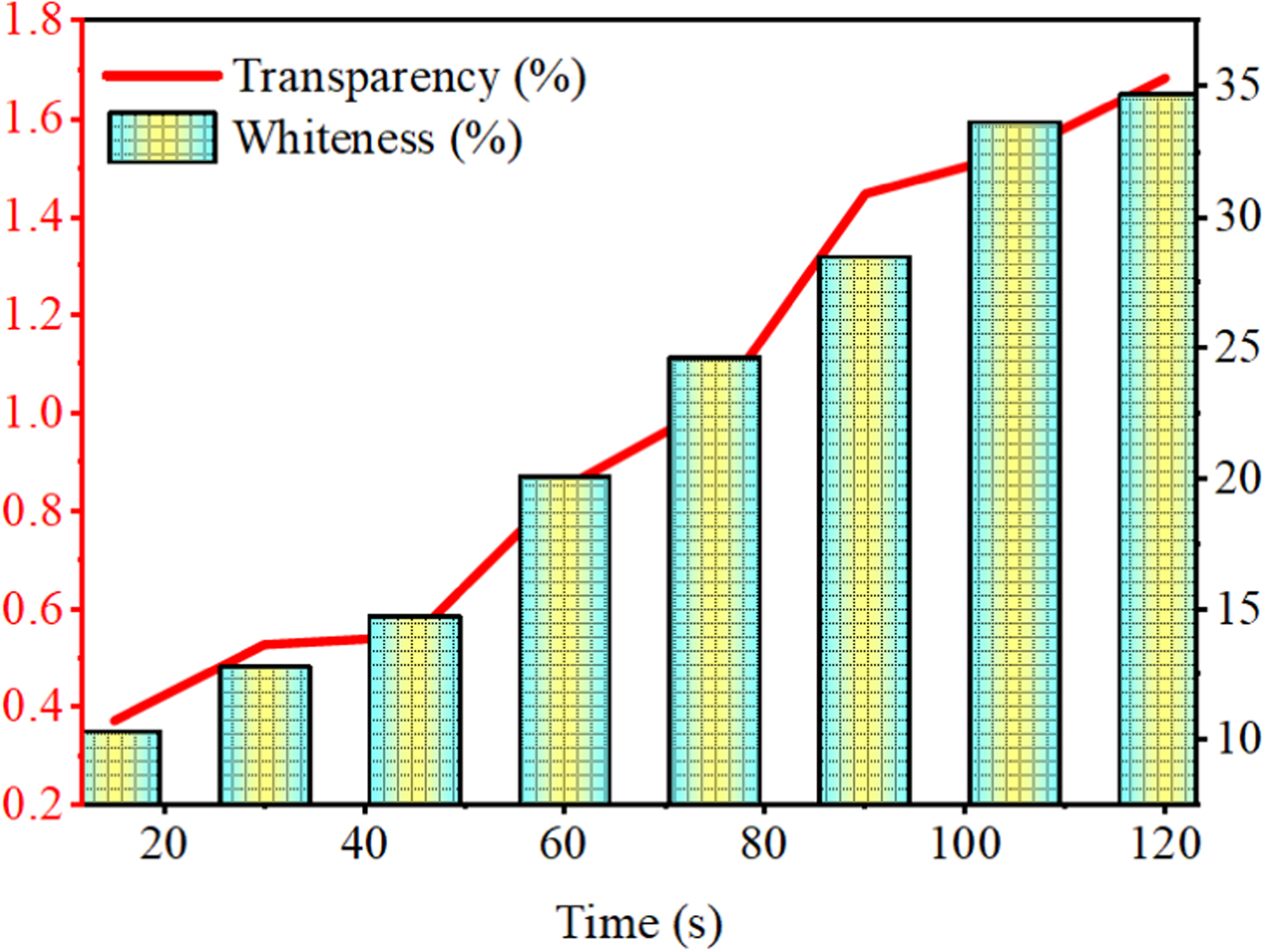
Transparency and whiteness at different times in an abrasive lab polisher.
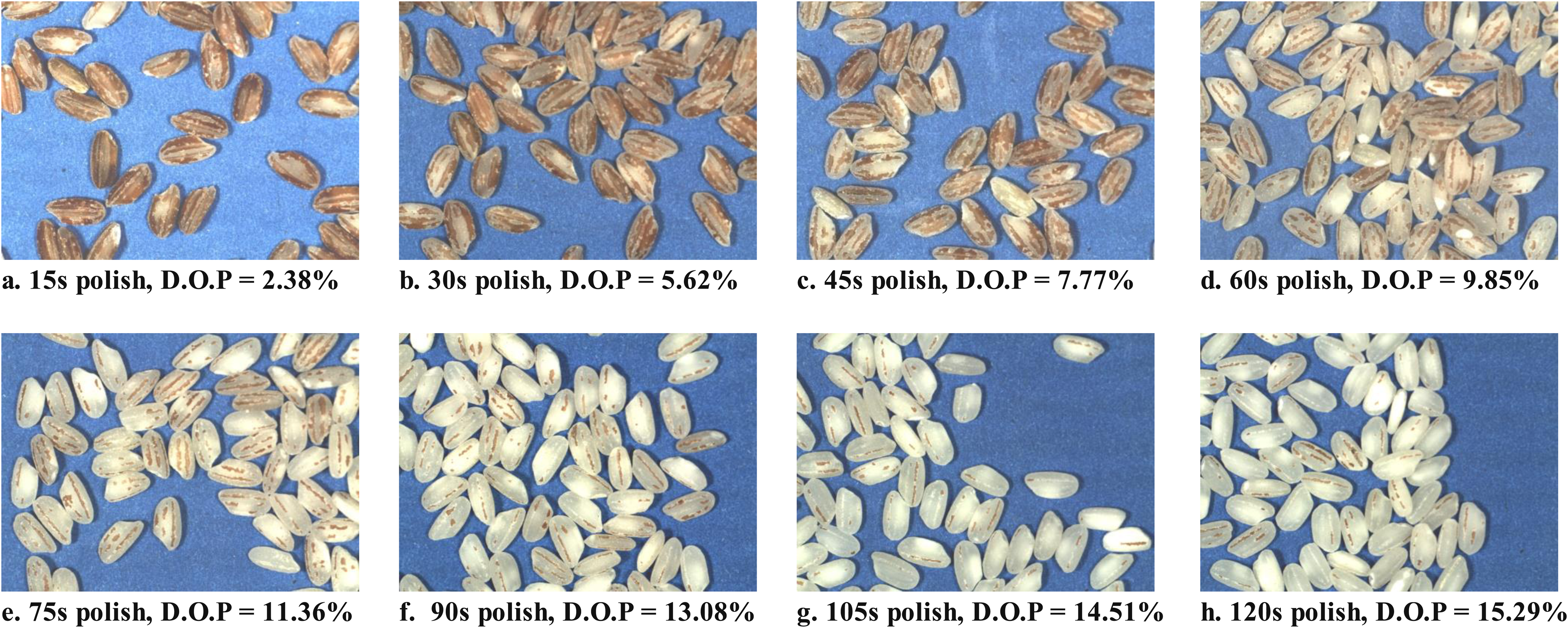
Photographs of polished rice after a specific time of polishing in an abrasive laboratory polisher, where 15 s (a), 30 s (b), 45 s (c), 60 s (d), 75 s (e), 90 s (f), 105 s (g), and 120 s (h).
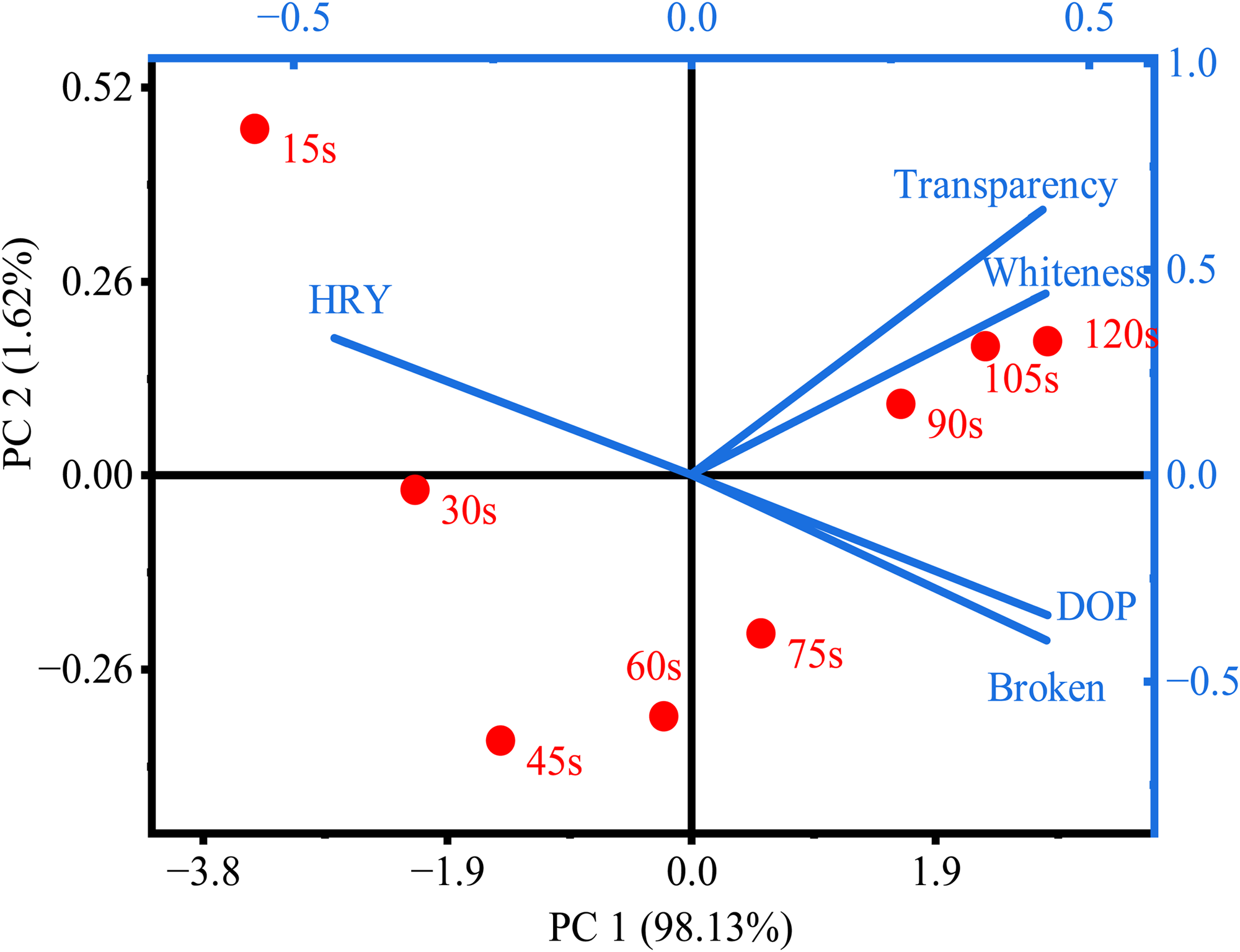
Biplot showing the effects of polishing time on various parameters. (HRY: head rice yield, DOP: degree of polishing).
Degree of polishing, broken, and head rice yield at different times in the abrasive lab polisher.
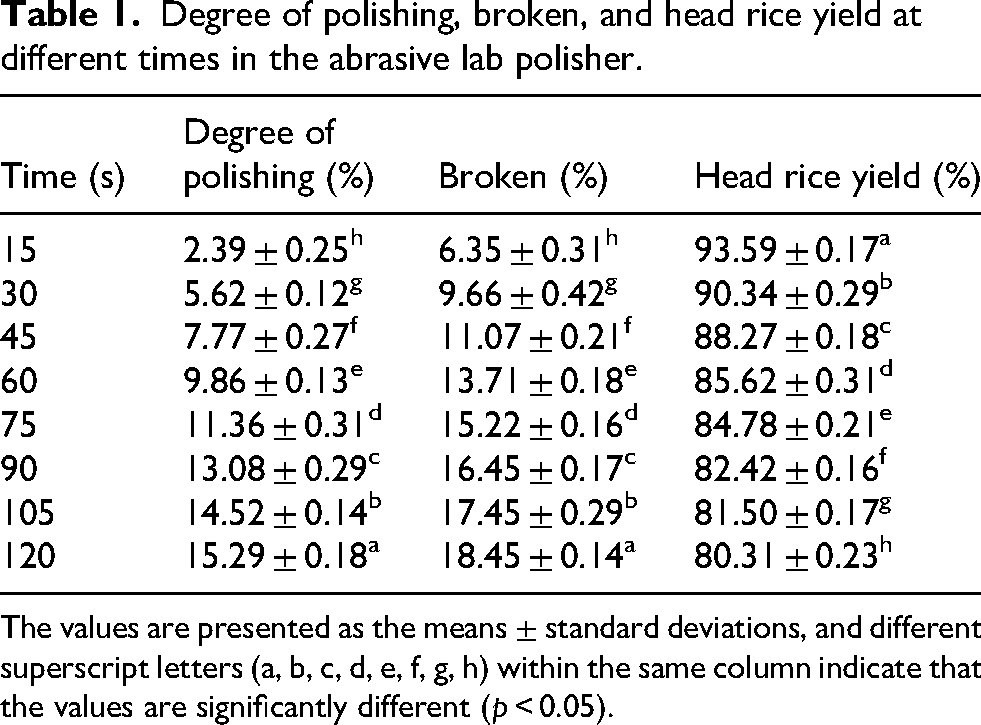
The values are presented as the means ± standard deviations, and different superscript letters (a, b, c, d, e, f, g, h) within the same column indicate that the values are significantly different (p < 0.05).
Effects of milling time on the whiteness and transparency of milled rice
The whiteness and transparency of milled rice increased significantly (p < 0.05) with increasing polishing time (Figure 1). At 120 s, the transparency reached 1.683%, and the whiteness reached 34.7%, representing the highest values. This progressive increase can be attributed to the gradual removal of the bran and germ layers, which exposes the starchy endosperm. The limited improvement observed at longer polishing durations suggests that the optical quality reaches a near-saturation point once most surface-adhering bran is eliminated. Since bran is darker and more opaque, its removal enhances both the reflectance and transmittance of light through the kernel, thereby improving whiteness and transparency. Chen et al. (2022) reported that bran removal directly influences grain brightness and reduces heavy metal bioavailability, underscoring the functional importance of polishing beyond aesthetics. Similarly, Mohapatra and Bal (2007) reported that increased polishing improved whiteness but at the cost of increased energy consumption and reduced yield. The whiteness increased with processing time, with the highest value occurring at longer durations and the lowest value occurring at shorter durations (Elicin et al., 2022). In the present study, the sharp increase in whiteness between 60 and 105 s suggests that this interval corresponds to the most active phase of bran removal, where residual streaks are eliminated, and kernel surfaces become uniformly smooth.
Transparency, although numerically lower than whiteness, complements whiteness as an indicator of grain quality. Higher transparency reflects fewer residual bran particles and a more uniform endosperm, traits that enhance consumer acceptance and cooking performance. The transparency gradually increased with time, but the increase after 90 s was minimal, suggesting that most bran removal was complete. Extended polishing improves optical quality but increases breakage and reduces head rice yield (Table 1). Thus, polishing times of 90–105 s offer a practical balance between consumer preference and milling efficiency. Therefore, further extension of the polishing time beyond this stage contributes marginally to visual quality while disproportionately increasing kernel damage and yield loss.
Effect of polishing time on the uniformity of polishing
Milled rice grains polished in an abrasive laboratory polisher for different time intervals are shown in . DOP increased from 2.38% to 15.29% as the polishing time increased from 30 to 120 s (Figure 2(a) to (h)). The whiteness of polished rice also increased with polishing time and DOP due to the removal of germ and bran layers. During the initial stages of polishing, the bran present in the linear depressions did not come into contact with the emery surface. Bran streaks were observed on the milled rice surface after up to 13.08% DOP, which disappeared with further polishing (DOP >13.08%), as shown in Figure 1(g) and (h). Similar observations were reported by Mohapatra and Bal (2007) for the abrasive polishing of Pusa Basmati rice (DOP >10%). Uniformly polished white rice with complete removal of bran was obtained after polishing for more than 90 s, corresponding to a DOP greater than 13.08%. This confirms that a uniform surface appearance is achieved only when polishing exceeds the natural bran content of brown rice, thereby marking the onset of over-milling. However, it can be concluded that complete removal of the bran layer requires overmilling (DOP >13.08%). The extent of bran adhesion to the rice endosperm can vary widely and is influenced by drying and storage conditions, cultivation and harvesting methods, weather conditions, and rice variety (Huang et al., 2026). Brown rice generally contains approximately 8% bran; polishing above this level produces mostly endospermic material along with a small amount of bran (Das et al., 2025).
To gain insight into how polishing time affects the measured quality parameters, a principal component analysis (PCA) biplot was employed as a multivariate analytical tool (Figure 3). The PCA biplot clearly demonstrated that PC1 accounted for 98.13% of the total variance, indicating that changes in milling time were the dominant factor influencing rice quality attributes, whereas PC2 explained only 1.62%, representing minor residual variation. The whiteness, transparency, DOP, and broken rice contents presented strong positive loadings along PC1, confirming their direct associations with increasing polishing time. In contrast, head rice yield loaded negatively on PC1, highlighting its inverse relationship with polishing intensity. The samples polished for 90–120 s clustered on the positive side of PC1, reflecting higher optical quality and kernel breakage, whereas those polished for shorter durations (15–45 s) were associated with higher head rice yields and better grain integrity. Overall, the PCA biplot effectively summarizes the trade-off between improved appearance and reduced milling yield as the polishing time increases.
Study of the microstructure of the rice kernel surface
SEM images of rice polished in a laboratory abrasive polisher for different durations (30, 45, 60, 75, 90, 105, and 120 s) at magnifications of 60×, 300×, and 500× are presented in Figure 4(a) to (x)). The surface of the whole brown rice kernel appeared relatively smooth and undulated at 60× magnification (Figure 4(a)). At higher magnifications of 300× (Figure 4(b)) and 500× (Figure 4(c)), distinct protuberances and depressions were observed. Figure 4(d) shows that the germ remained intact in brown rice and was removed during the initial stages of polishing, as it did not adhere tightly to the kernel. The protuberances on the rice surface abraded first, as shown in Figure 4(e) and (f), after which they were polished for 30 s. Figure 4(g) to (i) illustrates the partially abraded surface after 45 s, whereas Figure 4(j) to (l) shows larger bran particles remaining after 60 s, which were progressively removed with longer polishing. As milling continued, both the protuberances and bran layers gradually abraded (Figure 4(j) to (x)). Figure 4(s) to (u) and (v) to (x) depicts the microstructure of fully polished rice at 105 and 120 s, where the germ and bran layers were completely removed. However, finer bran particles were still observed adhering to the surface at 120 s (Figure 4(x)). Overall, the SEM image illustrates the progression of bran removal over time.

SEM images of whole and milled rice kernels at 60×, 300×, and 500× magnification. Brown rice kernels (a–c), rice kernel Polish for 30 s (d–f), 45 s (g–i), 60 s (j–l), 75 s (m–o), 90 s (p–r), 105 s (s–u), and 120 s (v–x).
These microstructural changes have important implications for food preparation and cooking quality. The intact bran layers and surface roughness observed in brown rice act as barriers to water penetration, resulting in slower hydration and longer cooking times. Partial removal of bran and surface protuberances during moderate polishing enhances water absorption by increasing the surface area and creating diffusion pathways, thereby improving cooking uniformity. However, continued polishing leads to the development of surface fissures and micro-cracks, which compromise kernel integrity and increase susceptibility to breakage during handling and cooking. Similar observations were reported by Wood et al. (2012), who used microscopy to assess bran removal patterns in milled rice. Halim et al. (2022) reported that, based on the SEM observation, there was more cracking on the ageing tissue structure surface, and this cracking can affect the ability of the kernel to absorb water and elongate during the cooking period. These microstructural observations support the macroscopic milling results, indicating that excessive polishing, while improving the hydration rate, weakens the kernel structure and increases breakage and cooking losses, ultimately affecting the texture and appearance of cooked rice.
Conclusion
This study demonstrated that the polishing duration has a decisive influence on the rice milling quality, grain integrity, and surface microstructure. The DOP increased significantly from 2.38% at 15 s to 15.29% at 120 s, but the broken rice content also increased. The complete removal of bran streaks required a DOP greater than 13.08%, but this threshold also coincided with overmilling and yield loss. SEM analysis confirmed the progressive abrasion of the protuberances and bran layers, with uniform polishing achieved only after 90–105 s. Overall, the findings highlight a clear trade-off: extended polishing enhances whiteness, transparency, and surface uniformity but compromises milling efficiency by increasing breakage and reducing head rice yield. Therefore, for industrial practice, polishing times of approximately 90–105 s appear optimal, balancing consumer preferences for bright, translucent kernels with acceptable yield losses. By linking quantitative milling parameters with microstructural evidence, this work provides valuable insights for optimizing rice polishing, reducing postharvest losses, and supporting more sustainable grain processing.
Footnotes

Ethics considerations
Not applicable
Consent to participate
Not applicable.
Consent for publication
Not applicable.
Funding
The authors received no financial support for the research, authorship, and/or publication of this article.
Declaration of conflicting interests
The authors declared no potential conflicts of interest with respect to the research, authorship, and/or publication of this article.
Data availability
The data will be available from the corresponding author upon reasonable request.
Clinical trial
Not applicable