






Abstract
Transitional care incorporates actions to ensure the coordination and continuity of care between provider settings (ie, hospitals, nursing homes, home health care, patients’ home, and physician offices) occurs to meet the patient’s goals relative to their disease management. The evolution of transitional care over the past decade has facilitated the emergence of several transitional care models. However, there is a dearth of understanding related to the collaboration between nurse transition coaches and home care nurses when implementing transitional care model activities to achieve desired patient outcomes in the home health care setting. This case study describes the enactment of a specific transitional care model’s conceptual framework to derive an in-depth understanding of the collaborations between nurse transition coaches and home health nurses in the unique context of home health care. The case is a specific patient-centered Care Transitions Intervention (CTI) model with 4 embedded subunits: (1) the experiences and actions of the nurse transitions coach, (2) the experiences and actions of the home health nurse, (3) document and artifacts review, and (4) the experiences and observations of key leadership stakeholders involved in transitional care activities in one home health care organization located in Michigan.
Keywords
Introduction
The aging population and correlational rise of individuals with chronic disease conditions have magnified the need for home health services to meet the challenge of managing patients with complex medical needs. By 2050, 1 in 5 adults age 65 years or older will require medical interventions that necessitate home care services posthospitalization. 1 Yet there are few studies to evidence how posthospitalization transitions occur in home health care. In home health, transitional care is viewed as a key element in the advancement of quality care in the geriatric population. 1 Patients with conditions that necessitate complex continuous management frequently receive care from multiple care providers. Patients with diseases like congestive heart failure (CHF) and chronic obstructive pulmonary disease (COPD) may receive care interventions from multiple health care providers during their acute hospitalization and posthospitalization phases of care. 2 Fragmented posthospital transitioning of individuals with complex chronic conditions can lead to costly or poor patient outcome. 3
Moreover, fragmentation in health care systems contributes to the complexities of patient and caregiver engagement in self-care management after discharge from an acute care provider setting. Older adults with multiple chronic conditions or polypharmacy have a higher risk potential for hospitalizations and rehospitalizations due to inadequacies in self-care management. Furthermore, older adults with complex illness trajectories experience multilevel care in multitiered provider settings. 4 Therefore, nurses in the home health industry must seize the opportunity to incorporate clinical interventions that will influence positive evidence-based patient outcomes.
Nurses are expected to advance their professional practice through the adoption of evidence-based clinical strategies. The care coordination process enfolded in transitional care models is one aspect of professional practice through which nurses influence patient care. Implementing evidence-based practice interventions in the clinical setting could provide nurses with teachable moments to expand best practices related to the application of specific transitional interventions for chronic care management in older adults. Furthermore, nurse leaders in health care who consider the benefits, risk, and challenges of implementing a patient-centered transitional care partnership model will have informational intelligence to shape policies and processes that govern practice guidelines. The current exploration into a specific patient-centered transitional care model (Care Transitions Intervention [CTI]) could provide valuable insight into practice applications to narrow the gap in interdisciplinary provider partnerships to effectively interrupt patterns of frequent hospital readmissions and improve the translation of transitional care model interventions into standardized clinical practices across the health care continuum.
Multiple factors contribute to gaps seen in care transitions from one care setting to the next care setting. The most significant factors are poor patient care coordination’s, inadequate education of older adults and their caregivers, and lack of access to external resources. 5 The evolution of transitional care over the past decade has facilitated the emergence of several transitional care models. These models provide the framework for patient engagement in self-care management, the integration of interdisciplinary provider services, and building evidence-based interventions to improve patient health outcomes. 6 Systematic reviews of transitional care studies have highlighted successes in transitional care practice implementation; however, identification of specific interventions to either lower the cost for care or decrease the risk for hospital readmission was difficult to procure. 7
The CTI model also known as the Coleman model is the conceptual model underlying the framework for this qualitative case study.8,9 The model was used to gain an in-depth understanding of the collaborative experiences and actions of nurse transition coaches’ and home health care nurses’ integration of the model interventions in the unique setting of home health care. The model incorporates 4 core pillars (medication self-management, use of a personal health record [PHR], red flags recognition, and adherence to physician follow-up appointments) to engage patients and their caregivers in interactive self-management education to become independent in managing their disease process within 4 weeks post acute/subacute treatment interventions.
This case study describes how collaboration and communication actually occur between nurse transitions coaches and home care nurses when acute/subacute transitions to home health take place using a specific transitional care model (CTI/Coleman) in the home health care setting.
Methods
Design and Sample
This research used a single-embedded qualitative case study design. A single-embedded case design with multiple units of analysis was the design used to investigate care transitions in the unique context of home health care. Empirical investigation of the Care Transition Intervention model allowed the researcher to discover and understand how interdisciplinary partnership collaborations occurred in the unique context of the home health care setting. This study was approved by an institutional review board.
The case is defined as the CTI model used in a single home care organization to facilitate patient care transitions from an acute/subacute facility into home health care. The units of analysis were defined as follows: (1) the experiences and actions of nurse transitions coaches (titled Transition Nurse Liaisons (TNLs) in the study setting, (2) the experiences and actions of home health care nurses in the study setting, (3) the observations and experiences of leadership stakeholders in the study setting, and (4) documents and artifacts review (see Figure 1). The study was driven by a central research question: If at all, within the unique context of the home health care setting, how do the transition coach and home care nurse collaborate in the care transitions intervention program to achieve specific patient outcomes as described in the Four Core Pillars? Figure 2 diagrams the CTI conceptual model, the case study design, and the process for data collection and analysis.

Transitional care embedded design.
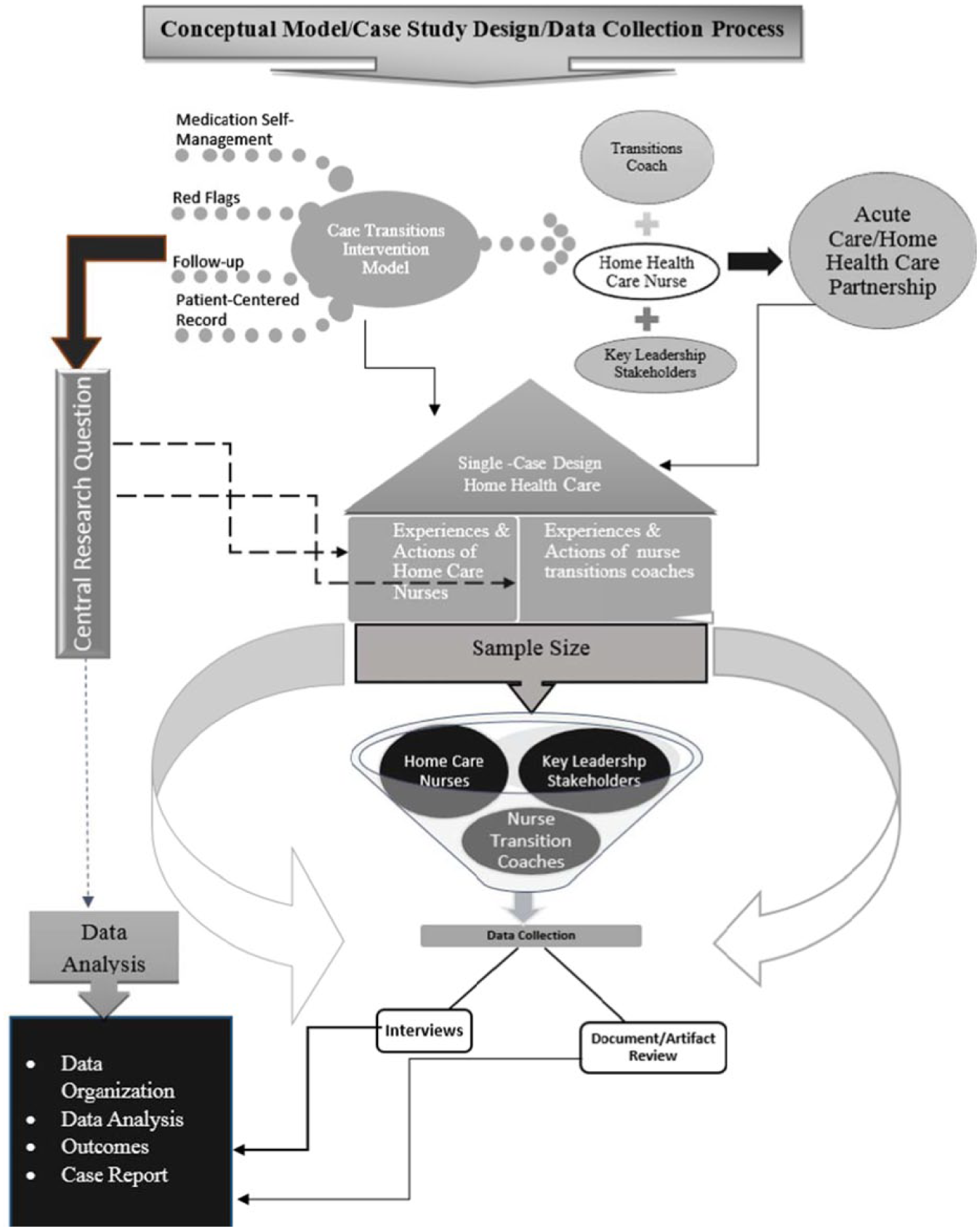
Conceptual model/case study design/data collection process.
Data Collection and Analysis
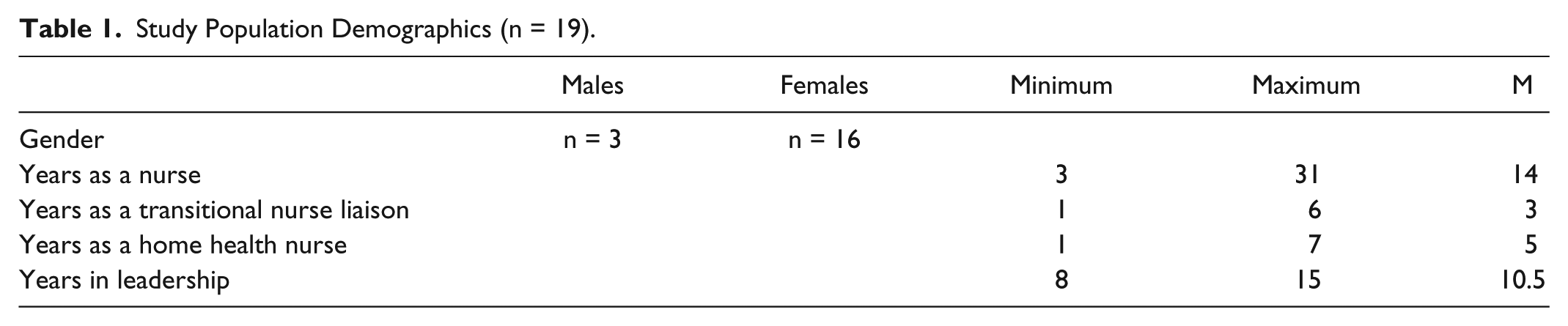
Permission was granted from the study organization to conduct the research at the home health care organization. Because this research was context-bound, the sample size only included participants in the study location meeting the experience criterion bounded by the case (the CTI model). The sample size included 19 participants drawn from the staff (clinical and leadership) in a single home health care organization in Michigan. The sample size takes into account the limited number of leadership personnel (3) and clinical staff (8 nurse transitions coaches and 8 home health nurses) in the study location. Sample population demographics are given in Table 1.
Study Population Demographics (n = 19).
The interview instrument developed for this study was used to answer the central question: If at all, within the unique context of the home health care setting, how does the transition coach and home care nurse collaborate in the care transition intervention program to achieve specific patient outcomes as described in the 4 core pillars of the CTI model? The interview question instrument was distributed to a panel of 5 expert faculty expert members at the University of Phoenix to field test to establish validity and reliability of the instrument. The final Interview Question Tool contained 12 preestablished open-ended interview questions to participants to express their viewpoints on how the conceptual model was implemented in the study organization.
The researcher conducted and transcribed all interviews. Interviews were private, conducted either in-person, telephonic, or by Skype with 8 transition coaches, 8 home health care nurses, and 3 key leadership stakeholders. To protect the identity and anonymity of participants, an alphanumeric coding system was used. The interview sessions lasted from 30 to 90 minutes post a brief descriptive summary discussion of the study, and review and signing of consent forms. With participant permission, audio digital recording of interviews occurred. The data collection process began in January 2016 and continued through March 2016. Each participant was asked 12 identical interview questions using the research/interview tool in the same sequence to investigate the central research question guiding this study.
Data saturation was achieved when the collection of new information no longer shed any further light on the central research question developed to answer how the CTI program contributes to the achievement of specific patient outcomes. In this current study, data saturation was reached with the completed interview of interviewee number 16 (HHN 107). Validation of saturation occurred with the completion of interviews 17, 18, and 19. The researcher incorporated credibility, dependability, confirmability, transferability concepts throughout this research to add to the trustworthiness of research data and results.
The triangulation process involved gathering data from interviews of nurse transition coaches, home care nurses, key leadership stakeholders, and document and artifact reviews used to validate the results of the study findings. In this case study, the triangulation of results from the combined sources helped to produce an in-depth understanding of the challenges of CTI model implementation in the bound home health system. Data obtained from documents (ie, organization brochures, home health blog, Centers for Medicare Medicaid Services [CMS] website, etc) were uploaded into NVivo 11 and coded to the appropriate established node category for further query and analysis. Statistical data for quality outcome indicators to evidence patient outcomes and new admission stats for transitional care patient conversions provided by the organization evidencing outcomes were analyzed using Microsoft Excel software.
The researcher created the transcripts from the audio digital recordings into text using Microsoft Word. Transcripts were sent to participants to validate content by confidential email. All participant transcripts were coded using an alphanumeric coding system. The transition coach participants have the alphanumeric codes TC 200 through TC 207, the home health nurse participants have the alphanumeric codes HHN 100 through HHN 107, and the key leadership stakeholder participants have the alphanumeric codes KLS 300 through KLS 302. Strict confidentiality of participant and organizational information was maintained throughout the study.
Results
Purposeful sampling techniques were used to acquire knowledge from participants to construct a comprehensive analysis of participant perceived experiences relative to the acute or subacute/home health care partnerships in transitional care. Data were collected from 19 participants with home health care background. The transitional coaches (n = 8) have a cumulative average of 14 years in nursing practice and an average of 3 years in their role of transitional nurse liaison. Training for their positions included training certification in Dr. Eric Coleman’s Care Transitions Model, field preceptorship with experienced TNLs, and computerized instructional training. Six (75%) of the transitions coaches previously worked in an acute care hospital setting prior to moving into home health care. In this group, 2 (25%) also received Integrated Care Management (ICM) certification as part of the training for this role.
The home health nurse participants (n = 8) have an average of 11 years (range, 4-30 years) of nursing practice and have functioned in their role of nurse case manager from 1 to 7 years. Six (75%) of participants previously worked in the acute care setting. Training for their home care role included a combination of 2 to 3 weeks’ instructional classroom training and a minimum of 1-week field preceptorship with a veteran home care nurse. The key leadership stakeholders (n = 3) have an average of 10.5 years (range, 8-15 years) of experience as leaders and have held their current positions in the home health organization from 4 to 15 years. The senior vice president of operations has 28 years of nursing experience, received certification through Dr. Eric Coleman’s CTI program, and performed the CTI process within the organization for 3 years prior to becoming the nurse leader in the organization. The non nurse regional directors only provided their years of experience and how long they had been in their leadership roles.
Four themes emerged from the data: (1) Disconnected Communications, (2) Contrary Perceptions of Coordination/Collaborative Partnerships, (3) Challenges in Implementing Model Processes, and (4) The Rehospitalization Rate Is the Most Valuable Indicator. One subtheme emerged from the data analysis: true indicators of positive outcomes. Each theme will be discussed with supportive participant testimonies or statistical data.
Disconnect Communications
Participants collectively reported communication exchange occurs mainly through notes placed in the patient’s medical record. Participants expressed rarely does face-to-face interaction occur between disciplines involved in the care transitions process. The data analysis is derived from interview question 2 specifically related to how communications occur between the transition coach and the home care nurse during the care transitions phase. According to participant TC 200, “coordination notes are the first source of communication with emails and phone calls prior to and after the Start of Care (SOC) between TNLs and Field Nurses.” Review of the coordination note with TC 200 revealed the note included information on the patient’s diagnoses, medications, family dynamics, follow-up physician appointment, information on the patient’s red flags, and any needs or concerns the patient/caregiver had. Similarly, TC 202 expressed referred to the communication interface between the transition coaches and home health nurses as dismal “right now there is not much of that going on. The notes are in the chart.” Other TCs asserted that the majority of the communication between the home health care nurses occurred through there documented coordination notes. This sentiment was evidenced by the home health nurses interviewed. HHN105 stated, “truthfully, there is not much communication between the transition nurse and the home care nurse unless there is a problem.” Another HHN (104) stated, “I don’t have a lot of contact with our TNLs.” The majority of the HHN expressed verbal communication was lacking between the transitions coach and home care nurse. According to HHN 103, “typically, there is not a whole lot of communication beforehand . . . but they [TCs] always right a note that goes into the chart that I can see as soon as I get the chart.”
There was general consensus from all categories of participants that communications occur; however, the data evidence a disconnect in partnership communication exchanges between the transition coaches and the home care nurses. There is a lack of evidence of how they partner together to integrate the CTI model interventions when patients are transitioned into the home health care setting. In the organization’s multilayered patient transitions process, the nurse transitions coach visits the acute/subacute facility to initiate the coordination of services for the patient’s transition to home with home health care services. In some instances, the transitions coach will initiate some of the CTI model’s interventions; however, this process is not consistently operationalized among all coaches.
Discussions with participants revealed that there is not a systems process in place within the electronic medical record (EMR) to force acknowledgment of information receivership by the home health nurse when the nurse transition coach transfers the case to the home health nurse. The results showed fragmented information dissemination between care providers as a critical link to communication failures between the health care team involved in implementing the CTI model interventions with patients in the home health care setting. The findings in this theme were similar to the findings in the literature. In the literature, multiple studies evidenced that when inconsistencies exist in information sharing, it creates service fragmentations within the provider setting which affects smooth patient-centered care transitions. 10
Contrary Perceptions of Coordination/Collaborative Partnerships
The findings in this study evidence that the home health care nurses’ perceptions differ from the nurse transition coaches relative to information exchange when discharges occurred from the acute/subacute setting into home health care. The process for patient transitions involved the nurse transition coaches making visits to the acute/subacute facility to initiate the coordination of services for patients being discharged home with home health services. A meaningful dialogue (verbal or face-to-face) is almost nonexistent between the transition coaches and home health nurses. Verbal exchanges typically only occurred when there were patient problems or concerns during the facility transitions phase, once the patient transitions into the home health setting, information exchange subsides. There is a greater reliance on coordination notes within the patient’s EMR to communicate between disciplines verses warm hand-off verbal or face-to-face reporting.
KLS 301 stated, “Well the relationship I think is vital because when the transitional nurse gets all the information at bedside . . . they’re basically setting up our field nurses for success . . . ” Similarly, KLS 302 asserted, “our transition nurse liaison provide insight into what is really going on with the patient and the patient’s entire complete picture of their situation.” The organization’s leaders, KLS 300, KLS 301, and KLS 302, expressed similar viewpoints relative to partnership collaborative/coordination interface between the transitions nurse and the home health nurse.
Conversely, the nurse transition coaches perceived ineffective partnership engagements with the home care nurses. The transitional coach follows the patient until the home care episode is started. TC 201 stated, “TNLs collaborating in the home with that start of care, I can tell you that it’s only a note. It would be idea to have an interdisciplinary conference of some kind prior to the visit.” The contact between the nurse transition coaches and the home care nurses occurred mainly through coordination notes placed in the EMR of the patient. Though the information collected relative to the medical, socioeconomic, and psychosocial needs of the patients is documented in the patient’s EMR, there is uncertainty if the home health nurse reads the EMR information prior to performing the patient’s admission into home care. TC202 reverberated “transitional nursing is a great tool in preventing rehospitalizations but you have to have training on both sides because right now the field staff really doesn’t know what we do.”
The home health care nurse participants generally identified the nurse transition coaches as discharge coordinators who performed discharge planning activities with the patient to facilitate the transition from the acute or subacute institutions to home with home health care. HHN 100 summed up the home health care nurses’ perspective when she indicated the nurse transition coaches are like “tour guides, they map out everything and help the patient so that things go smoothly and [the home care nurses] have everything that [they need when they get to the patient’s home].” There is consensus across participants that having nurse transitional coaches to interface with the patients prior to facility discharge is beneficial because they can address some of the issues or concerns of the patient/family members that may inhibit a smooth transition into home health care.
The data showed nonroutine collaborative partnership activities between the nurse transition coaches and the home health nurses during the initiation of care and ongoing to support the patient’s application of the 4 core pillar interventions specified in the CTI Model. An integrated partnership relationship between the nurse transition coaches and home care nurses is marginal at best because contact occurs mainly through coordination notes placed in the EMR of the patient. Having standardized discharge planning interventions could improve and advance coordination and communication efforts between disciplines when transitional care is initiated. 11
This researched evidenced a gap in clinician collaborations pre and post transitional activities when patient transitions occur from one care setting to the next care setting. The data did not clearly evidence that care efforts are coordinated to implement the 4 core pillars of the CTI model through a bridged partnership in the bound home health care system. The current process used in this organization to perform patient care transitions mimics findings in the literature that point to communication breakdowns within the patient’s circle of providers as a common contributable factor to poor integration of patient transitions. 12
Challenges in Implementing the Model Processes
The home health care organization in this study launched their transitional care program in 2012 using the CTI model interventions when patients were being transitioned from either an acute care or subacute care facility to home with home health care. The model design uses transitional coaches to engage patients and their caregivers in interactive self-management education to become independent in managing their disease process within 4 weeks post treatment interventions in an acute/subacute setting. In this organization, the CTI model interventions are integrated into patient care as part of the home health nurse’s core assessment responsibilities.
The results in this study evidence modifications to the tenants of the 4 core pillars in the CTI (Coleman) model. The nurse transition coaches and the home health nurses have a hands-on approach to conducting medication reconciliation, ensuring the patient has their follow-up appointment scheduled with their primary care physician (PCP), instructing the patient in red flags recognition, and developing the patient’s PHR. However, the model design promotes active patient engagement in self-care management activities through the model’s pillars.
Across all categories of participants, references were made to challenges in implementing the model processes. A modified version of the model is used with specific emphasis placed on medication reconciliation and scheduling of physician follow-up appointments as part of the organization’s clinical best practices. However, NVivo 11 analysis revealed that the majority of the home health nurses did not have knowledge of the conceptual model. Further analysis evidenced a knowledge gap regarding the model’s core interventions and the integration process among the home health nurses who are case managing patients in the home setting. For example, HHN 104, HHN 105, HHN 106, and HHN 107 made statements in their interviews that they did not have knowledge of the CTI model. Practice integration of the model relative to coaching patients/caregivers in the model’s interventions is stagnated due to the home health nurses’ (case managers’) lack of knowledge surrounding the model design and implementation objectives.
Another challenge identified through interviews is clinicians knowing that a patient is in the transitional care program. HHN 105 shared that “many times we don’t know that the patient has transitional care until the patient says oh, I have this booklet.” Information exchange is disjointed throughout the process from the initial transitional care meeting with the patient predischarge to patient engagement in the transitional care model interventions postdischarge in the patient’s home setting. Collaboration and coordination between the home health nurse and nurse transitions coach is marginal relative to conjointly empowering the patient or caregiver to actively participant in implementing the 4 pillars of the model. The findings in theme 3 suggest the need for leadership support to vertically integrate the transitional care model between care providers within the bound system. The nurse transition coaches received certification training in the CTI model interventions as designed by Dr. Eric Coleman. However, the home care nurses who are charged with implementing the model’s interventions with the patient/caregiver during the home care episode have not received any formalized training to guide the patient through the model’s 4 core pillars. Impediments in cross-disciplinary education on the conceptual model have created fragmented integration of a systematic approach to transitional care delivery in the study organization.
The Rehospitalization Rate Is the Most Valuable Indicator
The main instrument used to collect patient data is the Outcome and Assessment Information Set (OASIS). This instrument contains a standardized group of data elements designed to enable the performance of a systematic comparative measurement of home health care patient outcomes at 2 time points. 13 Though theme 1 shows a disconnect in communications between the nurse transition coaches and the home health nurses, and theme 3 evidence inconsistencies in enacting the CTI model interventions, the organization has realized positive patient outcome achievement. The major elements measuring patient outcomes using the model is the rehospitalization rates and patient unplanned care in the emergency room (ER) without admission. KLS 300 commented, “Rehospitalization rate is the most valuable indicator.” Participants HHN 104, KLS 301, KLS 302, TC 205, and TC 206 also agreed that the core indicator used to evaluate patient outcome achievement was rehospitalization rates during interview discussions. These elements are publically reported through CMS and were used in this organization to measure the quality of patient care and achievement using the CTI model interventions.
The results from the review of documents and archive data relative to the organization’s patient quality outcomes evidenced that the organization realized significant improvements in their rehospitalization admission rates and patient unplanned ER use with the implementation of the CTI model. Prior to the implement of the model’s concepts in 2012, the organization ranked in the 17th and 20th percentiles (years 2010 and 2011, respectively) for unplanned care in the ER without being hospitalized and in the 29th and 25th percentile (years 2010 and 2011, respectively) for patient rehospitalizations. Between 2012 and 2016, the organization realized a steady percentage decline in unplanned care in the ER without being admitted. They are currently at 10.3% which is 2 points below the national average of 12.3 % at this outcome indicator. Similarly, they have realized a 9.5% improvement in their rehospitalization rates for the same period (2012 through 2016). Although their current percentage of 18.3% is 2.3% higher than the national average at this outcome indicator, they had a significant improvement of 11.4% over their pretransitional care program ranking of 29.7% in 2010. Although the organization has evidenced positive outcome scores over time, continual research is needed to solidify the effectiveness of partnership integration of a transitional care model process when multiple providers are involved in the patient’s transition to home with home health care.
Subtheme: True Indicators of Positive Outcomes
The analysis of statistical reports revealed patient quality outcome indicators linked to the implementation of the 4 core pillars in the CTI model. The indicators are (1) “how often the home health team taught patients (or their family/caregiver) about drugs,” (2) “how often patients got better at taken their drugs correctly by mouth,” and (3) “how often the home health team begin their patients’ care in a timely manner.” These indicators are publically reported through CMS.
Data for the medication indicators are collected through elements on the OASIS assessment document. The home health care nurses are involved in the data collection process when they perform the admission and discharge for the patient. The statistical outcomes are derived from the comparison of responses on the OASIS at admission and discharge. Year-over-year comparative data showed patients improved in medication education and administration management. The data show that the organization’s percentage ranking for patient education on medicines went from 87% in 2010 to 99.2% in 2016. Similarly, the percentage ranking for patient medication administration showed an increase from 53.0% in 2010 to 58.2% in 2016.
At the quality indicator provision of care in a timely manner, the organization’s scoring improved 17.4%. There percentage ranking showed an increase from 73.7% in 2011 to 91.1% in 2016. In interview discussion with the key leadership stakeholders, they attributed this improvement to having nurse transition coaches (titled TNLs) interface with the patients/caregivers prior to their discharge from the acute/subacute facility to home with home health care. What remains weak is the interdisciplinary information exchange between the nurse transition coaches and the home health nurses to foster an integrated approach to implementing the model intervention in the unique setting of home health care.
Discussion
Transitions of care have become a recognized area of critical improvement in health care quality and patient safety. 14 Since the passage of the Patient Protection and Affordable Care Act of 2010, health care organizations have initiated transitional care programs to reduce patient rehospitalizations and unplanned use of the emergency room. Transitional care incorporates actions to ensure care coordination between provider settings (ie, hospitals, nursing homes, and home health care) to meet the patient’s goals relative to their disease management. Figure 3 provides a pictorial visual of the case and the emergent themes that evolved from empirical inquire of interdisciplinary partnership collaborations in the unique context of home health care. The CTI model (the case) 4 core pillars (medications self-management, use of PHR, red flags recognition, and adherence to physician follow-up appointments) are pivotal interventions implemented by care providers with patients to achieve the desire patient outcome of reducing rehospitalization within 30 days post an acute episode.

Figurative summary of the embedded case study.
This case study examined the nature of the collaborations between nurse transition coaches and home care nurses and the success of their partnership in implementing the specific interventions of the Care Transitions Intervention (CTI/Coleman) model in a single home health care organization’s system. Study results mimic findings in the literature revealing gaps in interdisciplinary communications and collaborations when patients are transitioned from one care setting to the next care setting. This study illuminated the actions and experiences of 8 nurse transition coaches and 8 home health nurses involved in patient care transitions from an acute/subacute facility into home health care.
The findings in this study are consistent with past research and current literature regarding lack of partnership communications and collaborations when patients are transitioned from one care setting into the next care setting. The findings show that home health care nurses and nurse transitions coaches have differing perceptions about their partnership enactment of the CTI model interventions when patients are transitioned into the home health care setting post an acute/subacute care episode. Moreover, the findings show that the home health care nurses and nurse transitions coaches appear to work in silos within the organization’s structure to implement the transitional care process when patient discharges occur from the acute/subacute care setting. During interview, TC 202 expressed that the organization lacked a collaborative process that fosters interactive partnering with the home health care nurses. Congruency was noted within the participant discussion that partnership integration might be a systemic problem in this organization’s transitional care program.
The majority of home health care nurses were not knowledgeable about the CTI model or the significant role they have in implementing the model interventions when a patient is transitioned into the home health care setting. There was little evidence to support that the home health care nurses received any education on the transitional care process through their orientation or preceptorship upon employment with the organization. Though leadership supports the tenants of the program, the majority of efforts to educate on the model’s interventions occurred with the nurse transition coaches. To enhance potential sustainability of patient outcomes using the model interventions, the home health nurses would need education and training on the conceptual model and the organization’s process for model implementation.
Unique to this organization is their use of nurse transition coaches to introduce a modified version of the model’s interventions and gather information from the patient/caregiver in the facility as outlined in the model prior to their discharge home. They do not follow the patient for 4 weeks of care as designed in the model to support the patient/caregiver with implementing the 4 core pillars (medication self-management, use of a PHR, red flags recognition, and adherence to physician follow-up appointments). When patients are admitted into home care, the home health nurse is charged with engaging the patient/caregivers to actively participate in the model interventions to become self-sufficient in care management and achieve the desired patient outcomes from the transitional care experience.
However, the 8 home health care nurses interviewed in this study confirmed they lacked knowledge regarding the CTI model conceptual framework. Furthermore, the majority indicated they lacked interdisciplinary partnership collaborations during the transitions process to implement the model’s interventions when a patient is transitioned from an acute/subacute setting into home health care. This raises significant concerns regarding the organization’s partnership integration of the CTI model’s concepts to facilitate patient engagement in developing chronic care management skills. Strategic integration of coordinated care between care providers leads to better delivery of health care services. 15 In this organization, changes in the clinical infrastructure are suggested to incorporate a standardized interdisciplinary collaborative partnership approach for engaging patients in the CTI model interventions to improve patient health outcomes. This study suggests that notable improvements in information sharing between nurse transition coaches and home health nurses are essential to ensure patients and their caregiver are engaged in an integrated patient-centered approach to post–acute care transitions.
Though the study results evidence a gap in partnership communication and collaborations between the nurse transition coaches and home health nurses, the organization realized positive quality patient outcomes with the implementation of the CTI model interventions. The organization’s transitional care program initiative began in 2012. Study results revealed year-over-year improvements in quality indicators for reducing patient rehospitalizations, unplanned emergency room use, patient medication education, and patient medication administration. Even with the positive outcomes revealed in this study, this organization needs to execute strategies that will enhance professional-to-professional collaborations to further enhance achievement of patient outcomes using specific patient-centered transitional care model interventions. Using strategic tactics to improve partnership collaborations and communications between the interdisciplinary team and enhancing home health nurses’ knowledge and competence in the conceptual model may lead to a replicable care transitions process that can be shared throughout the home health care industry.
Footnotes
Acknowledgements
The authors thank Dr Eric Coleman for granting permission to include the Care Transitions Intervention Model within the content of this article.
Declaration of Conflicting Interests
The author(s) declared no potential conflicts of interest with respect to the research, authorship, and/or publication of this article.
Funding
The author(s) received no financial support for the research, authorship, and/or publication of this article.
