







Abstract
This article explores women’s pathways to participation in environmental justice advocacy in California’s San Joaquin Valley. Many scholars find that women become environmental justice activists according to a common set of experiences in which apolitical women personally experience an environmental problem that launches them into a life activism to protect the health of their families. Although a small group of the 25 women the author interviewed fit this description, overall the interviews reveal a much more diverse array of paths into environmental justice activism. The author’s data complicate the idea that environmental justice activism is the first political activity for most women environmental justice activists and that they are motivated to become activists primarily in order to protect the health of their families. The author discusses the significance of these findings and concludes with a call for scholars to revisit the question of women’s pathways into environmental justice activism.
Introduction
In this article, I explore women’s pathways into environmental justice activism through the case of advocacy in California’s San Joaquin Valley. The San Joaquin Valley is one of the most productive agricultural regions of the world and yet also one of the poorest regions in the United States (Cowan, 2006; Walker, 2004). The towns that border its vast fields of cotton, fruits, vegetables, grains, and nuts have formed the backdrop to human suffering and struggle for generations. Chinese immigrants living in the labor camps of the late 1800s, Depression-era families fleeing the Dust Bowl of the 1930s, César Chávez and the farmworkers movement, and today’s environmental justice advocates have all called this region both workplace and home. Activists combat pollution from pesticides, fertilizers, toxic waste, diesel exhaust, factories, and mega-dairies (Balazs, Morello-Frosch, Hubbard, & Ray, 2011; Cole & Foster, 2000; Francis & Firestone, 2011; Harrison, 2006, 2011; Kresge & Strochlic, 2007; Moore & Matalon, 2011; Ramos, 2003). Consistent with nationwide patterns of pollution distribution, the toxic load is generally heaviest in poor communities of color (Balazs et al., 2011; Bullard, Mohai, Saha, & Wright, 2007; Harrison, 2011; London, Huang, & Zagofsky, 2011; United Church of Christ, 1987).
Environmental justice advocacy is a fruitful case in which to explore women’s pathways into activism because of the high numbers of women involved (Bullard, 1993; Di Chiro, 1998; Epstein, 1995; Gibbs, 2002; Gottlieb, 1993; Szasz, 1994; Taylor, 1993; Verchick, 2004). Common explanations for their activism center on the idea that women environmental justice activists are pursuing traditional women’s interests (Brown & Ferguson, 1995; Di Chiro, 1998; Gottlieb, 1993; Krauss, 1993a, 1993b; Stein, 2004).
Prior scholarly work on women’s participation in environmental justice activism often supports the following narrative: apolitical women personally experience a specific environmental problem and are motivated to become activists in order to protect the health of their families. I call this the traditional women’s environmental justice narrative. In contrast, my interviews suggest that most women in the San Joaquin Valley have at least some political experience before becoming environmental justice advocates; they respond to environmental problems that they have personally experienced as well as to those experienced by others; and they are motivated by more than the desire to protect their families. Overall, they become environmental justice activists through diverse social processes. These include personal experience of societal problems in differing degrees and concern about the health of their families. However, they also include prior experiences of activism, recruitment efforts from friends and social movement organizations, the precedent of role models, the effect of broad historical upswings in activism, negative interactions with government bodies, and the influence of educators, organizers, family, and friends who help women understand that the personal problems that they and others experience are, indeed, larger social problems.
My research builds on the existing scholarship that indirectly questions the traditional women’s environmental justice narrative. Using empirical data to explore the diversity of women’s pathways into environmental justice activism provides another way to counter the common stereotype that women are politically naive, primarily motivated by concerns based in the home, and less capable of holding and acting on abstract political commitments than men. Although the traditional women’s environmental justice narrative rejects stereotypes that denigrate the political abilities of housewives and mothers, my research pushes back against conceptualizations of women environmental justice activists as housewives and mothers.
Literature Review
In the following section, I describe the prior environmental justice research on women’s pathways into activism, social movement scholarship on entry into social movement participation, and narrative analysis scholarship on political narratives.
Environmental Justice Scholarship
Environmental justice scholars most often report women’s experiences as variations on a common theme: women without political experience personally experience an environmental problem and are motivated to become activists in order to protect their families and communities. Some scholars place these experiences at the center of their work, whereas others assert them in passing in scholarship devoted to other topics. The story of Lois Gibbs, a high-profile activist from Love Canal, New York, is most frequently used to represent this path (see Brown & Ferguson, 1995; Kaplan, 1997; Krauss, 1993a), but numerous scholars use similar narratives for women environmental justice advocates in general.
First, many scholars write about women environmental justice activists who have no prior political experience. It is not always clear whether this representation is part of a claim that most women environmental justice activists (or sometimes men, too) have no prior political experience, or whether the activist with no prior political experience is one type of activist, among many, on whom the author has chosen to focus (see Brown & Ferguson, 1995; Bullard, 1993; Cole & Foster, 2000; Gibbs, 2002; Gottlieb, 1993; Krauss, 1993a, 1993b; Lerner, 2010; Szasz, 1994; Taylor, 1993). Nonetheless, the general impression given by the environmental justice literature is that women were apolitical before becoming environmental justice advocates. Instead of drawing on prior experience in the larger political world, scholars often note that female environmental justice activists draw on their experiences at home to inform their activism. For example, Krauss (1993b, p. 247) describes the identity of motherhood as a “resource of resistance.”
Second, scholars also write that environmental justice advocates personally experience the environmental harms that they seek to remedy (Brown & Ferguson, 1995; Cole & Foster, 2001; Gottlieb, 1993; Peeples & DeLuca, 2006; Verchik, 2004). Krauss (1993b) states, “Unlike the more abstract, issue-oriented focus of national [male-dominated environmental] groups, women’s focus is on environmental issues that grow out of their concrete immediate experiences” (p. 248).
Third, scholars describe the role of a mother who protects her children and home as an important incentive for environmental justice activism (see Bell & Braun, 2010; Brown & Ferguson, 1995; Di Chiro, 1992, 1998; Gottlieb, 1993; Krauss 1993a, 1993b; Peeples & DeLuca, 2006; Stein 2004). For example, Krauss (1993b) writes, “It is the traditional, ‘private’ women’s concerns about home, children and family that provide the initial impetus for blue collar women’s involvement in issues of toxic waste” (p. 253). Gottlieb (1993) makes a similar point by quoting activist Cora Tucker, “I think women bring so much more to an organization because we look at it, most of the time, from the point of view of how it affects our children” (p. 209).
On the other hand, the work of other environmental justice scholars complicates this narrative. For example, scholars frequently describe the various movements that came together to form the environmental justice movement. However, they tend to look at merging movements at an abstract conceptual level rather than addressing the variety of actual political experiences that activists may bring to the environmental justice movement 1 (see, e.g., Cole & Foster, 2000). Di Chiro (1992) describes the role of motherhood as a motivator for women environmental justice activist, but is careful to note, “Their identity as simply ‘mothers’ is by no means always the central focus of their activism” (p. 115). Epstein (1995) qualifies the claim that struggles about toxics are likely to be the first political experience for the activists when she states that this is more likely to hold true for White communities than for communities of color and that women who are already known as leaders in their communities may be more effective environmental justice leaders than women with no such experience or community stature.
In other cases, scholars acknowledge a variety of politicizing experiences, but emphasize those that fit the traditional women’s environmental justice narrative. For example, Szasz (1994) uses several paragraphs to describe how antitoxics protests emerge both from newly formed groups and leaders as well as from preexisting community organizations and leaders. Then he spends six pages analyzing interview excerpts from activists who fit an important piece of the women’s environmental justice narrative: they led apolitical lives that focused on home and family until they became environmental justice activists. 2 In her study of environmental justice activists in New Mexico, Prindeville (2004) also complicates the standard narrative’s focus on activism that is motivated by a desire to protect family health. Instead, she finds that cultural preservation is the dominant motivating force for the women’s political participation.
Other scholars extend the reach of the traditional women’s environmental justice narrative by broadening the concept of mothering to include not only the caretaking of one’s own children but also caring for other people’s children and the general community in which the women live (Bell & Braun, 2010; Krauss, 1993b; Naples, 1998; Peeples & DeLuca, 2006). Krauss (1993b) writes, “Family has a very different meaning for these women than for the middle class nuclear family. It is a less privatized, extended family which is open, permeable and attached to community” (p. 252). Though not specific to environmental justice organizing, Naples (1998) makes a similar claim with the concept of activist mothering, which “draws attention to the caretaking activities of women who do not have children of their own and who conceive of their community work as mothering” (p. 112). This scholarship suggests that even if women are not working to protect the health of their own children (perhaps they do not have any, or their children are grown up and out of the house, or are at home but not at risk), they are still engaging in mothering through their broader community work.
Some scholars also point to motherhood as a legitimizing and strategically effective frame that female environmental justice activists can use to convey their concerns to a broader audience (Bell & Braun, 2010; Brown & Ferguson, 1995; Epstein, 1995; Kaplan, 1997; Krauss, 1993b; Peeples & DeLuca, 2006). This scholarship positions women activists as working within a fundamentally gendered world that often does not take women seriously as political actors unless their activism is built around traditional views of women as mothers and caretakers. However, these scholars do not discuss whether this strategic framing of women’s activism could not only influence how activists portray themselves in public but also skew academic analysis of women’s entry into activism that uses women’s public narrations as data. They also do not discuss whether activists could be presenting themselves in this light, intentionally or not, during their private interviews with scholars. These are important questions to consider.
In spite of the complications described above, studies that focus most explicitly on women’s involvement tend to support the traditional women’s environmental justice narrative. Older studies that support many of the three aspects of the narrative that I describe continue to be referenced in more recent scholarship (see, e.g., Bell & Braun, 2010; Brulle, 2000; Culley & Angelique, 2004; Stein, 2004).
Social Movement Scholarship
In comparison to the work of environmental justice scholars, the work of social movement scholars points to quite different conclusions about the issue of entry into activism. The traditional women’s environmental justice narrative emphasizes the individual experience of seeking out activism in response to particular threats, and Goodwin and Jasper (2003, p. 54) acknowledge that some people do “self-recruit” into advocacy. However, many social movements scholars have critiqued models that rely excessively on individual grievances, attitudes, and motivations for explaining entry into activism. They devote more attention to describing a complex array of other factors that influence pathways into activism, including recruitment efforts made by existing social movement organizations, a prior history of activism, and social networks (Diani, 2004; Diani & Lodi, 1988; Goodwin & Jasper, 2003; Jasper & Poulsen, 1996; McAdam, 1986; Oberschall, 1973; Snow, Zurcher, & Ekland-Olson, 1980; Tilly, 1978; Walsh, 1981). For example, McAdam (1986) wrote that participants in the 1964 Freedom Summer project were pushed into applying for the project by their ideology, but then pulled into actually participating through their social connections with other participants. Environmental justice scholars can benefit from analyzing a broad array of factors that lead people into activism. Social movement scholars give us a sense of what to look for.
Narrative Analysis Scholarship
Other scholars analyze activist narratives to understand how they are shaped and what their political implications are. For example, Herbert Kohl (2005) and Francesca Polletta (2006) explore the story of civil rights activist Rosa Parks. Rosa Parks is commonly depicted as a seamstress who was so tired after work one day in 1955 that she refused to give up her seat on a bus for a White person, as was required by Alabama law. As the story goes, her refusal to relocate led to her arrest, and her arrest led to the beginning of the Montgomery bus boycott and the start of the Civil Rights movement. Many adults and children alike believe she was poor and apolitical, and decided spontaneously not to move out of her seat that day. But Rosa Parks did not spontaneously decide not to give up her seat that day. The famous incident was not the first time she had refused to change seats for a White person, and the Montgomery bus boycott did not materialize out of thin air after her arrest.
Instead, Kohl and Polletta note that Parks was actually a committed activist and the secretary of the local chapter of the National Association for the Advancement of Colored People. She had a history of refusing to play by the rules that segregated Blacks from Whites on buses. Civil rights leaders had earlier considered organizing a boycott after 15-year-old Claudette Colvin was arrested, but decided otherwise after she became pregnant while still unmarried. Parks was a highly respected leader in the Black community who could be counted on to sustain the fight in the face of threats of violence. The larger civil rights community took advantage of her arrest to organize the bus boycott and sustain it for the 381 days it took to win their struggle. Finally, although Rosa Parks played a very important role in the Montgomery bus boycott and in the Civil Rights struggle, this campaign and movement also drew on the skills and contributions of many other leaders who never achieved the same figurehead status.
Kohl (2005) argues, “To call Rosa Parks a poor, tired seamstress and not talk about her role as a community leader and civil rights organizer as well, is to turn an organized struggle for freedom into a personal act of frustration” (p. 20). He suggests teaching children a realistic “Rosa was Ready” version of history instead of the misleading “Rosa was Tired” version. As he writes,
This story of collective decision making, willed risk, and coordinated action is more dramatic than the story of an angry individual who sparked a demonstration; it has more to teach children who themselves may have to organize and act collectively against oppressive forces in the future. (p. 37)
Kohl is careful to note that this more nuanced version of history “does not diminish Rosa Parks in any way” (p. 52). Rather, “It places her, however, in the midst of a consciously planned movement for social change” (p. 52).
However, politically active women face a difficult choice when presenting themselves to the public. Einwohner, Hollander, and Olson (2000) argue that familiar framings in movement stories are more likely to be accepted than new ones. Specifically, they speak of the double-bind that women activists face: “On the one hand, women are expected to present a feminine (i.e., emotional) self; on the other hand, they are judged incompetent and unstable for their emotional appeals” (p. 693). Polletta (2006) also writes that women are expected to tell stories in a particular, more emotive way. If they challenge people’s assumptions about what a woman’s narrative should sound like, they risk being ignored or undermining their own efforts. Because of this, Polletta argues that political stories often are told in ways that reinforce the status quo.
Similarly, Nina Eliasoph (1998) writes that in public settings people speak in individualistic, largely apolitical terms. But in more private settings, they speak in much more political terms about large-scale social problems and how to address them. She writes, “At each step in the broadening of the audience, the ideas shrank” (p. 7). As she elaborates,
They assumed that the public forum was a place for plaintive individuals to expose their side of the story, to “speak for themselves” . . . broad political concerns surfaced and then mysteriously vanished behind very personal-sounding concerns: “my house,” “my children,” “close to home.” (p. 6)
Eliasoph argues that people depoliticize their activism because they know that U.S. social conventions discourage political discourse in many public settings. She describes long-time, seasoned activists who publicly identify themselves only as “moms” and argues that these depoliticized public representations reinforce public political apathy.
My research findings contrast with the bulk of environmental justice scholarship that describes women’s pathways into activism, align with social movement scholarship about pathways into social movement participation, and suggest that narrative analysis should be explored in more depth in future environmental justice scholarship. In the following pages, I describe my research method, give an overview of my findings, and present alternative, real-life narratives to compare to the traditional women’s environmental justice narrative.
Method
To find women to interview, I collected names of women environmental justice leaders living in California’s Central Valley 3 from the executive directors of three key nonprofit organizations that support advocacy in the area. These organizations employ small staffs of organizers and in some cases lawyers, and two of the three maintain an office not just in the San Joaquin Valley but also elsewhere in the state. I then contacted representatives from the smaller regional and town-specific groups that typically did not have any paid staff. Most people I interviewed were involved with more than one of these groups. I also engaged in snowball sampling with my interviewees and checked my list of names against publicly available documents that list environmental justice leaders. I stopped trying to find new people to interview when continued snowball sampling repeatedly provided only the names of women leaders I had already interviewed or planned to interview. This led me to believe that my interview pool was a reasonably complete representation of the entire population of women perceived by their peers to be environmental justice leaders in the region at that time.
I did not define the term environmental justice when asking for recommendations for women whom I should interview, but almost all the recommendations were for women who were active in preventing and resolving pollution problems in poor communities of color. This reflects both the environmental justice movement’s historic initiation around the disproportionate burdens of pollution in poor communities and communities of color and the continuing central role of antitoxics campaigns. The women I interviewed were active in campaigns such as those that focus on air pollution, drinking water pollution, toxic waste landfills, and pesticide poisoning.
Some of the women interviewed grew up in the Valley and spent their entire lives there. Others grew up there, left, and came back. Some are the children of immigrant farmworkers and traveled throughout the San Joaquin Valley as well as into Texas and the Pacific Northwest before finally settling in the Valley. Others grew up in farmworker communities or Native American reservations outside of those in the San Joaquin Valley, or they moved there from other parts of California, the United States, or Latin America at various ages. The majority of the women interviewed spent at least half of their lives living within the San Joaquin Valley. The three who grew up elsewhere and moved as adults to the San Joaquin Valley to work at environmental justice nonprofits have spent the least amount of time in residence (though one of these three grew up in the California’s comparable Salinas Valley). Activists living in the San Joaquin Valley have a strong sense of place and are sensitive to the way in which their region is “othered” within California. They are also sensitive to the problems that can arise when activists living in other parts of the state or country try to assert leadership on issues specific to the San Joaquin Valley. I chose to exclude activists living outside of the Central Valley to capture the experience of these local activists.
Among these San Joaquin Valley residents, I had originally planned to interview only “grassroots” activists and intended to distinguish the “professionals” or “grasstips” activists from the “grassroots” activists by whether or not they were paid for their activism. However, I found this a difficult distinction in practice. Some otherwise “grassroots” activists were hired as local organizers for nonprofits. Other women moved in and out of paid and volunteer advocacy or combined part-time paid advocacy with volunteering. The distinction would also have limited my understanding of the breadth of women who are active in environmental justice advocacy and how they became so. Therefore, the interviewees include both “grassroots” and “grasstips” activists, as long as they actually lived in the Central Valley rather than engaging in its issues from a distance. This composition of interviewees reflects the reality of the environmental justice movement because it is (a) multiracial, though dominated by people of color, and (b) multiclass, though dominated by the poor and working-class.
Interviews were conducted during 2007 and 2008 and therefore provide a snapshot of the lives of the women leaders of San Joaquin Valley environmental justice advocacy at that time. See Table 1 for demographic information about the women interviewed. See also the appendix for a list of my interview questions. I expanded on these questions as necessary to capture as much of the interviewee’s oral history as possible. I conducted 21 interviews in English and four in Spanish, according to the interviewees’ ability and preference. Interviews typically lasted between 1 and 1.5 hours.
Overview of Women Interviewed
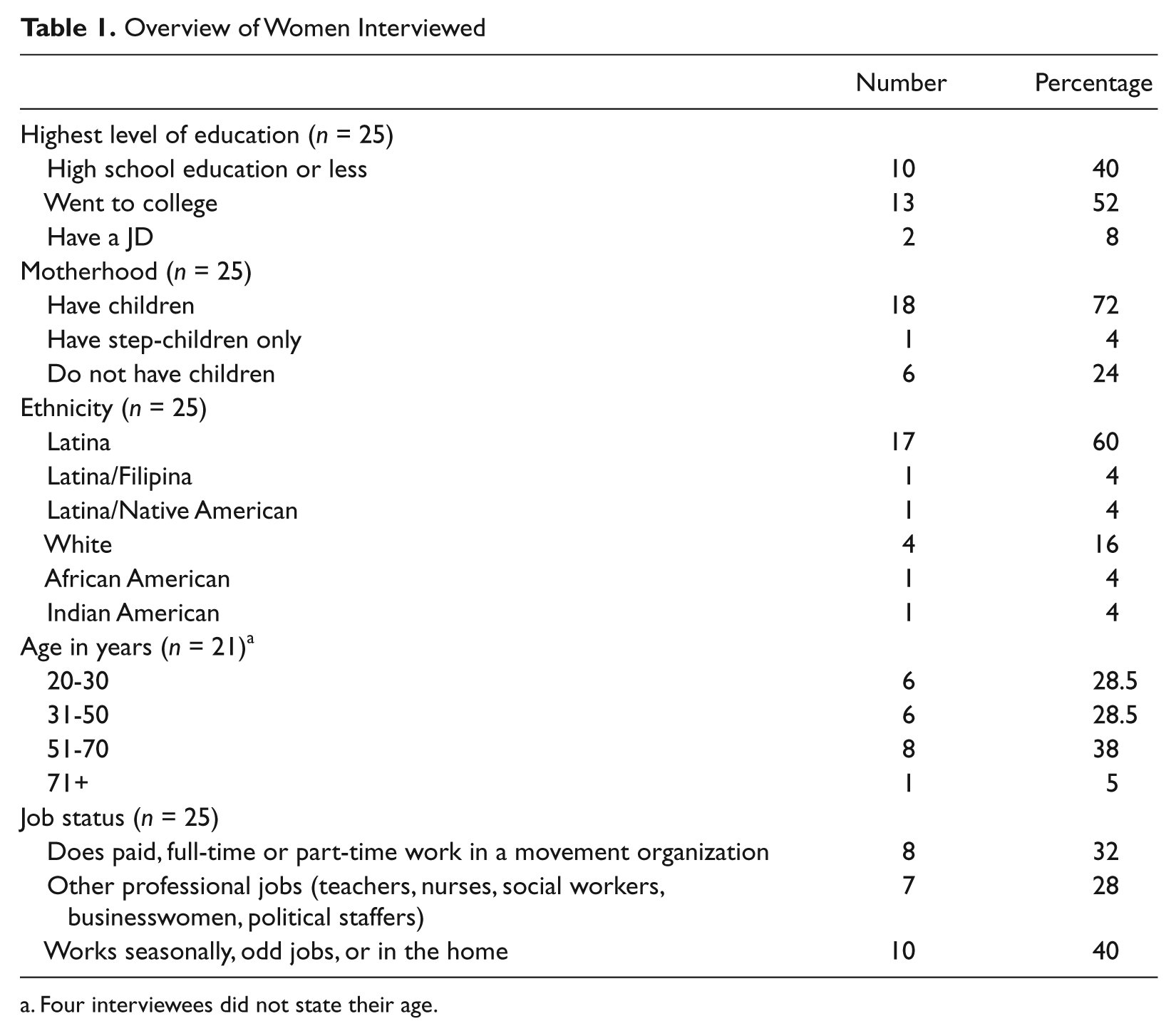
Four interviewees did not state their age.
Findings
Compare the scholarly findings above with the actual story of a San Joaquin Valley environmental justice activist:
Mary’s
4
story begins with her marriage at 15. Her husband was a farm worker who was active in the United Farm Workers of America (UFW). She joined him on the marches and political campaigns that were connected with his work. Mary had always wanted to be a nurse, but from a young age she had epileptic seizures. As she told me, “César Chávez never said, ‘No, you can’t.’ That’s why his slogan was ‘Si, se puede,’ because yes, you can.” Mary’s husband took her to a UFW meeting at 40 Acres in Delano, which had a clinic for farm workers at that time. Mary saw the nurses and said, “Oh, I always wanted to be a nurse.” César heard her and said “Well, why aren’t you?” Mary said, “Because I can’t. I get seizures and everybody’s told me I’d never be able to be a nurse because of my seizures.” César said, “You can be anything you want to,” and helped her go to nurse’s aide training. Mary worked as a nurse’s aide until she finished college and received her nursing degree. She was a nurse for 30 years before retiring. After 1 month of retirement she became tired of not doing anything and went back to work. Now she works at a unionized (UFW) rose farm, taking out the thorns that get stuck in the farm workers hands, face, and eyes and seeing to their other health problems. During her years as a nurse Mary would go on the UFW marches to take care of people who got sick or who had too many blisters on their feet from marching. She remembers one march from Delano to Sacramento in particular. She got upset because the organizers put her in a van to tend to the sick but she wanted to be out marching. She describes the impact of starting with about 20 people in Delano and ending 250 miles later in Sacramento with thousands. She remembers how the Teamsters and just about everyone else worked against them on that march, and how different it was from a march from Merced to Sacramento that they did around 1990 or 2000. This time the Teamsters lent them their hall in Sacramento to sleep in, the police provided an escort, and truckers stopped to get them sodas and water to drink as they marched. Mary and her family moved from a home surrounded by a grape orchard to the small town where she still lives. Her family, and many of the neighbors, had “self-help” houses built for them because of their low-income status. Early on there were problems with the water supply in town, and residents were told not to flush their toilets at certain hours, and to only take showers at other hours. Mary felt this was not right and asked her sister, who worked at a regional nonprofit, to send a legal assistant over to help resolve the problem. Mary began collecting signatures in town to replace the private water company with a community service district that the whole town would co-own. The campaign was successful and very personally meaningful to Mary, who years later ended up on the town water board. For a time the water system worked well and provided them with clean water, albeit sometimes at low pressure. But later the town began having problems with their water again. This time it smelled terrible and in many houses came out looking brown and muddy. Mary had already been introduced to the environmental justice organization nearby and began working on the water problem with one of their organizers. They formed a committee for people in the San Joaquin Valley with water problems, and went to Sacramento, Fresno, and San Francisco to attend various water board meetings in an attempt to resolve their problem. Mary faced strong opposition from her local board when she brought bottles of the smelly brown water collected from neighbors’ homes as examples of what they had to live with. Mary and the other neighbors still had to pay for the poor-quality water that they were receiving. She used bottled water to cook with but bathed in the tap water, although she used bottled water to wash her hair so it would not retain the sewage smell of the tap water. Mary’s grandchildren would come to visit and Mary would bathe them, but her daughter would later find rashes on the children, which they decided must have been caused by the water. During this time several of Mary’s old UFW friends joined another nearby environmental justice group and began inviting her to meetings that they were organizing on pesticide buffer zones and the possibility of receiving a grant to put in sewage lines in her town. Mary’s father died when she was young. Her mother spoke little English, and Mary credits her with very little influence in terms of her own work as an activist. Somehow she and her sister ended up being the only ones in their family who were “a little pushy,” and tried to fix things when they thought something was wrong. She thinks the “female movement” must have had a lot to do with it. Toward the end of our interview I asked Mary if she has any children, and she told me that she has four. Mary’s first child is the healthiest, and she was born before Mary and her husband moved to a home in the middle of a grape orchard. Of the second two children born on the ranch, one was born with only one kidney
i
and one has high blood pressure and diabetes. The fourth child has a serious case of asthma. Mary attributes the child born with one kidney and the other child’s asthma to the pesticides to which they were exposed. Now, at 65 or a little older, Mary is still working as a nurse. She volunteers on local and regional water issues and continues to support political campaigns that are backed by the UFW. Most recently, she went to Los Angeles to support Antonio Villaraigosa’s campaign to be the first Latino mayor. She walked the streets and talked to the voters on Election Day. She also works with Catholic Charities registering people to become citizens. Her husband died 12 years ago of a heart attack and diabetes.
Mary’s story represents several important patterns in my interviews, which are described in the section below. Although her story is gendered in important ways, it contradicts the traditional women’s environmental justice narrative. Mary was politically active before she came to environmental justice advocacy; she did not describe personally experiencing a threat, environmental or otherwise, that led to her initial entry into activism; she was politically active before having children; and she did not describe gender roles or her children as an important force that motivated her activism.
Countering the Traditional Women’s Environmental Justice Narrative
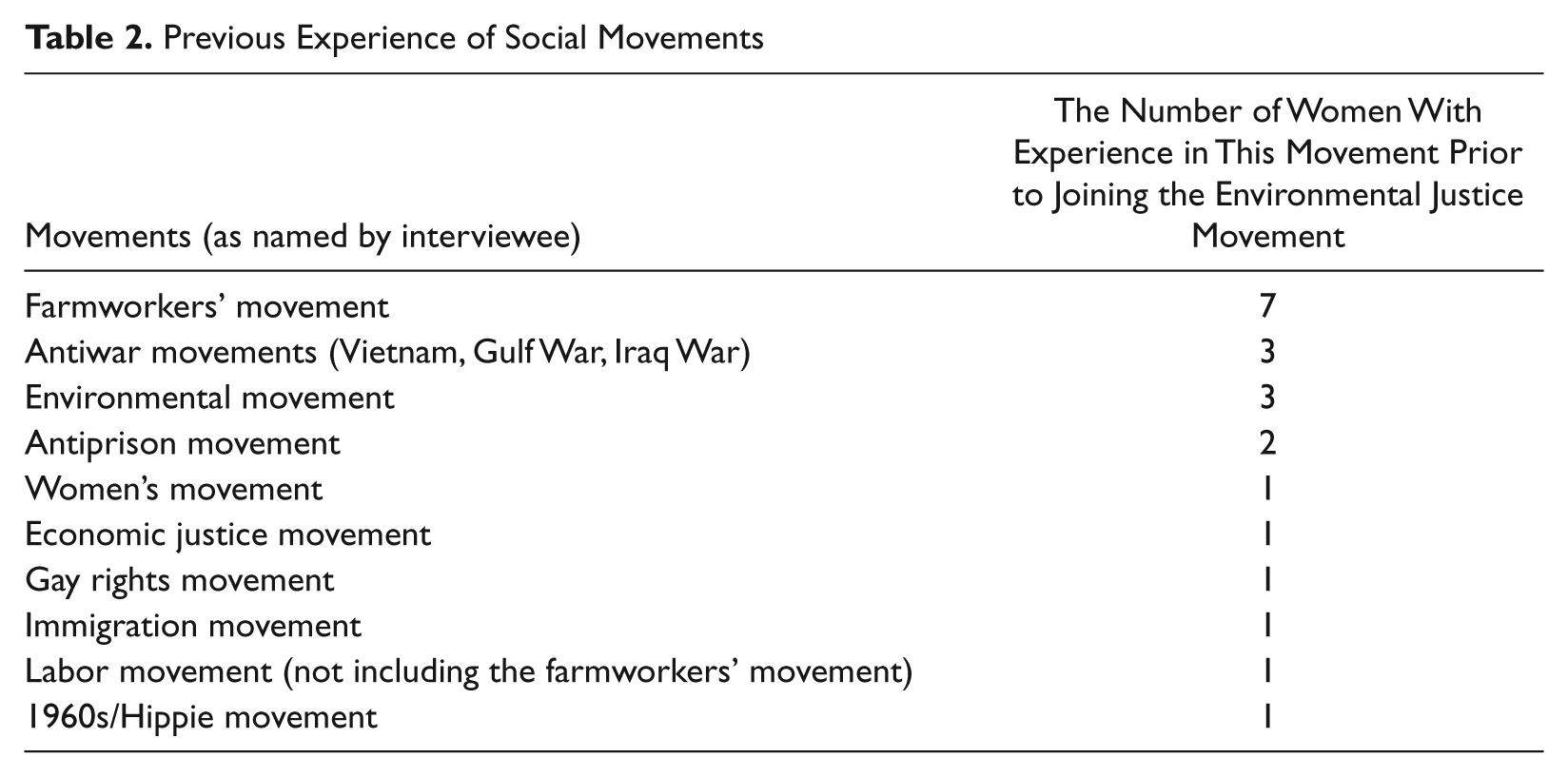
The traditional women’s environmental justice narrative describes women who became involved in politics for the first time through environmental justice advocacy, but 20 of the 25 women I interviewed were politically active before they became involved in the environmental justice movement. This is shown through participation in other social movements (11 out of 25 interviewees), involvement in electoral politics beyond voting (7 out of 25), and/or activism around problems in their children’s schools (5 out of 25). See Table 2 for a complete list of movements that the interviewees participated in prior to becoming environmental justice advocates. Their participation most frequently involved attending meetings, rallies, and marches, but sometimes also involved organizing events, participating in targeted “get out the vote” campaigns, running for local elected office, attending lobbying trips to the state capital, supporting labor strikes, and a variety of other social movement activities.
Previous Experience of Social Movements
The traditional women’s environmental justice narrative also assumes that activists had a very direct, personal experience with environmental injustice, which spurred them into advocacy. Many of the women I interviewed did indeed experience events of the sort described in the traditional women’s environmental justice narrative. For example, one woman discovered the presence of a toxic waste dump just outside of her town when organizers from a social movement organization knocked on her door to describe the company’s plans to add a toxic waste incinerator to the site. Mary described the skin problems her grandchildren developed when bathing in polluted tap water at her house. Another came home one day to find a policeman at her door telling her family to evacuate the area because of a pesticide drift accident. However, experience of these events alone was not enough to catapult most of these women into activism. After all, in these examples many of the people in town were affected by the problem described and only a few took the lead in trying to resolve it. In addition, some women were motivated not so much by problems that they or their families experienced personally, but by other people in the their towns, or by people whom they did not know.
Unlike the traditional women’s environmental justice narrative, the majority of the women I interviewed did not present their environmental justice work as being motivated by a desire to protect their children and families. Rather, most described broader sources of motivation and politicization that were fueled by their moral conviction that what was happening to them, their families, their communities or the world, was simply wrong.
When I asked explicitly whether being a woman had anything to do with their environmental justice activism, six of the women said no, seven said yes, four gave mixed answers, and six responded by speaking about other things. The seven who said that being a woman was part of why they were involved in environmental justice advocacy gave varying reasons. Some spoke of practical factors (women have more flexible schedules than men and often can go to daytime government meetings that men cannot attend; this is what social movement scholars call biographical availability); others spoke of motherhood as a motivator (as the traditional women’s environmental justice narrative describes); and one woman described her awareness of women’s subordinate position in society—and especially in her Mexican American culture—as providing a social justice lens through which she sees the world.
It is also worth noting that about 25% of the women interviewed did not have children and that some of the women who did have children were already politically active before their children were born. In the latter case, children may have deepened their commitment to advocacy but were clearly not its cause. The women also did not typically describe the work they did to protect their communities as a form of extended mothering.
Multiple Pathways Into Activism
If the traditional women’s environmental justice narrative does not adequately describe women’s entry into environmental justice advocacy in the San Joaquin Valley, then what does? In place of the individualized, heavily gendered representation of pathways into environmental justice activism represented by the traditional women’s environmental justice narrative, my findings paint the picture of an array of pathways that, when taken together, are more social and more subtly gendered. Women were motivated to become environmental justice activists not only due to a wide array of grievances experienced by themselves and others but also because other people helped them understand that the specific problems they experienced and witnessed were part of wider social problems. They were also motivated by the recruitment efforts of friends and social movement organizations and by prior political experience.
The grievances that motivated women’s entry into environmental justice varied widely. Some women experienced environmental justice problems themselves or within their families, as is depicted in the traditional women’s environmental justice narrative. Others felt motivated to act based on problems experienced by others in their communities. One woman describes her anger at the botched decontamination process that her neighbors endured after a severe pesticide drift incident.
I couldn’t sleep at night because it bothered me so much that it happened and that still nothing was being done about the people who had gotten sick. The UFW was organizing a press conference and getting more attention drawn to what had happened here. And I just learned a lot about pesticides. And then at press conferences, they would always ask me to speak. Even though I wasn’t one of the victims that got de-conned [decontaminated], I was one of the ones speaking all the time.
This event helped propel her into the role of spokesperson for her town and region.
Other women were motivated by the problems of people who were not part of their day-to-day life at all, at least not before they became activists. The following quotation from my interview with Flora describes her experience doing research in Bolivia on waste management practices prior to her involvement in environmental justice advocacy. Flora was from a middle-class family and did not experience significant environmental injustice in her own life. However, she was able to relate to the problems experienced by others. Here, she describes the importance of the relationships she made with people who scavenge in trash dumps to find things that they can resell to make a living.
It was a very eye-opening experience to see what happens to waste after it leaves our privileged lives and houses and goes different places, and how other people’s reality is. My time in Bolivia had a drastic effect on me. I think before it was much more of an intellectual interest of, like, environmental issues are interesting; like climate change is complex and there’s all these different systems and it’s sort of challenging, interesting, intellectually. But definitely when I was in Bolivia I could see how much this isn’t just some intellectual kind of fun, you know, in a textbook or in a movie or something. It’s people’s lives that are drastically [affected]; not having food or water or an environment that is safe to live in. And it brought it home to a much more urgent, basic kind of human rights need, and how vital that was, and that made it much more real and concrete.
Flora’s experiences in Bolivia enabled her to relate more personally to the problems of the poor. This ability to relate to people who were not part of her everyday life contributed to an interest in social justice work. At the time of our interview she had eschewed the more highly paid work that her professional training makes available to her and was working in the environmental justice movement instead. In an interesting inversion of the traditional women’s environmental justice narrative (in which a woman first lives in a polluted area and then becomes politicized), Flora represents a small group of women I interviewed who first became politicized and then moved to a polluted area to work and build their lives.
Anger about being excluded from government processes that are supposedly open to the public was also a grievance for many of the women. Women who represented working-class communities were angered by the way in which government officials scheduled meetings that excluded people who could not easily get time off from daytime work. They were also angered by the layers of bureaucracy that governed who could speak at public meetings, when they could speak, and in what form they could speak. The meetings seemed designed to keep their voices silent. Technocratic language prevented many community members from fully understanding what was going on. In addition to all the other ways in which they were blocked from participating in government meetings, Spanish-speaking communities faced serious difficulties in getting interpretation provided for them. All but 4 of the 18 Latinas I interviewed speak English fluently, but many of those in their communities did not. This became a lightning rod around which they organized more community members.
Regardless of whether environmental injustices are experienced personally or not, all women have to understand the experience as a problem before they can incorporate it into an activist agenda. Traditional women’s environmental justice narratives are often told about dramatic cases with seemingly obvious consequences, but the experience itself is not always so clear.
For example, some of the women I interviewed did not see their experiences as problems until they became involved in an environmental justice organization or other social movement organization. This inverts the narrative in which people become politicized before joining advocacy groups. Social movement organizations often help people view their own experiences in the framework of social justice and activism. For example, although she herself was a farmworker, Adriana only began to think about the plight of farmworkers after she became active in the UFW. Social movement organizations may also be the first to inform people about political events in their communities. This was the case with a woman who had recently run for and been elected to her city council. An organizer came to one of their meetings and surprised them with the information that they had the worst air quality in the nation, which facilitated her entry into environmental justice advocacy.
High school and college also helped some women understand their personal experiences in the context of larger societal problems. For example, Dora gained a new understanding of her childhood experiences:
All of my uncles are lechugueros, lettuce pickers. At a very young age, I was very much aware of the sulfur in their boots and how they would come home and take everything off before they entered the house because there was an understanding that whatever happened in the field couldn’t go into the house, right? You know, being in school, recess time, there were what we call dusters. There were a lot of aircraft spraying pesticides around the schools. Now I know that pesticide drift must have happened on the playground. But a lot of that knowledge, obviously it didn’t hit me until I went to school. I majored in environmental studies and geography. I took a class in environmental justice where I learned the term environmental justice and also environmental racism. And I was clearly attracted to that because I was learning the principles in school and pretty much applied it back to my life, back home where I grew up. And I kept saying, “Wow, you’re right.” If you are a Latino, by far we’re all—I began to see connections with injustices.
Women were also recruited into advocacy through the efforts of friends and social movement organizations. One young former farmworker describes her initiation into the UFW as follows:
To be honest with you, at the beginning I had no idea who César Chávez was. One time a friend of mine told me, “Hey, you want to go to this march?” I’m like, “No.” I was like any ignorant person. I was kind of embarrassed. I said, “No, I don’t want to be holding no little flag or be out there. What for?” But I got started by an invitation by a friend, and as soon as I saw, and discovered what they were actually fighting for, that was what made it really interesting. To know how people get discriminated [against] and get mistreated and abused.
Some women grew up in political families or married someone politically active. Family and spouses helped women to learn ways of seeing problems in the world that linked them to larger social structures and provided the possibility of change. These people also acted as role models and provided moral support for the women’s activism:
My passion is not really like some people. Now my husband is one of those some people. . . . Up there by himself, challenging police officers, challenging sheriffs, challenging chief of polices, challenging school districts, you know? Just one person. That has been a very good lesson. So really, I got to give it to my husband. He’s really —he’s on it. And it’s kind of hard to live with somebody who’s on it, and just sit back and watch TV [laughs]. You know, when there’s something that’s got to be done, somebody has to do it, so—we just do it.
Prior political experiences also influenced women’s pathways into activism in several ways. In some cases these prior experiences made the women ideologically predisposed to environmental justice advocacy. For example, two women came to environmental justice work through prison activism. One of them describes this process as follows:
This philosophy was what really brought me to environmental justice work, or the overlapping philosophies, if you will. And that was that. A lot of the low income communities that are typically targeted for siting prisons are very similar and in fact sometimes the same as those communities that get targeted for polluting sources, such as incinerators and dairies and what have you. So basically I got involved and introduced to the environmental justice movement through my prison moratorium work.
In other cases, prior political experiences build dense social ties among activists who facilitated their entry into environmental justice advocacy. One woman left her work on a local farm to become an organizer for a labor organization. When her boss quit to take a new organizing job in an environmental justice organization, he told her soon after about a job opening at another environmental justice organization. She applied with his formal recommendation, was hired, and transitioned into a new advocacy arena.
Women also experienced historical moments of upsurges in activism at key moments in their lives. The civil rights and antiwar activism of the 1960s and 1970s and the farmworker organizing of the 1960s through the 1980s all helped inform women about the issues and contributed to the perceived legitimacy of activism.
Discussion
Much scholarship on women’s pathways into environmental justice advocacy draws on feminist theory that seeks to break down the public–private binary by showing ways in which women’s so-called private, concrete concerns about their families can inform political action (see, e.g., Krauss, 1993a, 1993b; Peeples & DeLuca, 2006; Verchik, 2004). Although it is important to show that family concerns and the home are a legitimate basis for political action, it is also important not to overgeneralize women’s political actions and motivations as based in the home. Painting women environmental justice advocates in general as people who spontaneously became advocates after environmental threats to their families discounts women’s capacity for holding abstract political commitments and values, their political experiences, and their capacity for strategic thinking. It also negates women activists who have no children, or reduces them to being valued only for their future reproductive capacity, and obscures the importance of social movement organizations and larger societal structures in drawing women into activism.
The traditional women’s environmental justice narrative generally covers both the primarily White antitoxics movement, such as the experience of Lois Gibbs, and the subsequent and overlapping environmental justice movement, which is more explicitly oriented around people of color. Either way, the narrative is usually used to describe the experience of working-class women. Sometimes this working class focus is made explicit and sometimes it is done indirectly by focusing on women in environmental justice in general, supported by the understanding that the environmental justice movement is generally a movement of poor people and the working class.
The women I interviewed, however, incorporate the experience of working-class and middle-class women environmental justice activists, as both play important roles in San Joaquin Valley activism. This may be unique to my case, or there may be more middle-class involvement in environmental justice advocacy than has previously been discussed in prior scholarship on women’s pathways into activism. The San Joaquin Valley is one of the poorest regions in the country but is also home to wealthy people and a small middle class. Some of the women I interviewed grew up poor or working-class but were able to achieve some of the benefits of a middle-class lifestyle through nonprofit work or a college education. Despite their new status, they retained their commitments to people from communities similar to those in which they grew up.
My research therefore differs from previous scholarship both in the diversity of the class backgrounds of the activists interviewed and in the results. This diversity among the women may account for some of the differences between my findings and those of other scholars, but certainly not all of it. Many of the women I interviewed fit the traditional expectations of an environmental justice activist in terms of their race, class, and advocacy, but their experiences still do not fit the traditional women’s environmental justice narrative. 5
Future Research
The differences between my findings and those of prior scholars who have addressed similar questions call for more research to explain the discrepancy and to continue to build knowledge about women’s entry into environmental justice activism. I suggest several lines of inquiry to explore (a) regional variation in activist history and its influence on women’s pathways into environmental justice activism, (b) changes in women’s pathways into environmental justice activism over time, and (c) the possibility that prior scholars overstated the traditional women’s environmental justice narrative.
More empirical research is needed to determine how applicable my findings from the San Joaquin Valley are to other parts of the country. The Valley’s history as the birthplace of the farmworkers’ movement could mean that women environmental justice activists there have more prior political experience than women in other areas of the country. Comparative research in other regions should shed light on geographic variations in activist history and the extent to which they currently shape women’s entry into environmental justice activism.
Scholars also need to assess the extent to which 1980s and 1990s scholarship on women’s pathways into environmental justice advocacy may be out of date. Pathways to involvement have likely changed as the environmental justice movement has matured. For example, several women I interviewed learned about environmental justice through the books they read and the classes they took in college and then sought out environmental justice jobs after graduation. Others first learned about environmental justice through jobs in supporting social movement organizations. Such feedback loops are less likely to exist in a fledgling movement, as the books would not have been written yet, and there would be fewer environmental justice classes and fewer funded jobs that support it (Bullard et al., 2007; Pellow & Brulle, 2005). Similarly, the experiences of people in the environmental justice movement could have changed over time along with the broader professionalization of social movement organizations and civic life in recent years (Skocpol, 2003), or with the increasing tendency for women to work outside of the home.
Scholars who reported on the traditional women’s environmental justice narrative in the past can also help move this discussion forward by reflecting on whether they may have overstated the traditional women’s environmental justice narrative for the following reasons. First, environmental justice research often focuses on the most highly visible movement spokespeople, but the experiences these spokespeople bring to their roles are not necessarily representative of other activist leaders who do not take such prominent public roles. Research that analyzes pathways into activism according to whether the interviewee frequently does or does not act as a movement spokesperson will add depth to our work.
A second, related question is whether activists may be representing themselves differently in public and in private. Environmental justice research methods often incorporate the public representations of environmental justice activists without discussing this possibility. Scholarly work on the strategic use of motherhood in framing women’s political concerns should prompt us to look at this issue. Also, activists are limited by the format of public speeches, in which multiple people typically each get a short amount of time at the microphone in a public hearing or as a prelude to a protest or some other action. Of necessity, the speakers exclude much of their life story that would be revealed in the longer time frame of a private interview and may gravitate toward those aspects of their experience that they feel are most likely to move their audience. Some scholars have even analyzed the strategic use of motherhood narratives within environmental justice advocacy but have not yet asked whether this strategy could mean that our scholarship has overstated the importance of the motherhood narrative in driving the activism of women environmental justice leaders.
Overall, scholars need to explore not only trends in pathways to environmental justice activism but also do more work on variations and exceptions to those trends. A fuller understanding of these processes will help us recognize and value a wider array of women’s experiences.
Footnotes
Appendix
Acknowledgements
The author thanks the intellectual community that supported this work. In particular, Dave Campbell, Jonathan London, Julie Sze, Natalia Deeb-Sossa, Andy Szasz, Flora Lu, Alison Alkon, Carolina Balazs, Catalina Garzón, Lynette Perkins, Luke Cole, Bradley Angel, Leticia Casanueva Jauregui, Christy McCullen and all of the scholars, anonymous reviewers, activists and friends who commented on drafts, attended presentations, and provided encouragement along the way. The author thanks in particular the women environmental justice advocates of California’s San Joaquin Valley for sharing their stories and insights.
The author(s) declared no potential conflicts of interest with respect to the research, authorship, and/or publication of this article.
The author acknowledges with gratitude the following sources of financial support from the University of California, Davis: The Henry A. Jastro and Peter J. Shields Graduate Research Scholarship, the Orville and Erna Thompson Travel Award and the Consortium for Women and Research Graduate Research Award.
i
This daughter has passed away since the time of this interview.