






Abstract
Commons are resources shared by a group of people, and are studied using the commons dilemma paradigm. Despite Hardin’s prediction that the only sustainable management options are government regulation or private ownership, sustainable commons management has been observed with unregulated groups; however, global commons such as the atmosphere and oceans seem to conform to the prediction of “tragedy” because self-interests among users lead to degradation of the commons through overuse. The present study examined whether the factors of commons type (consumption or waste disposal) and cost (money or time) influence individual self-constraint in harvesting/polluting decisions to prolong the longevity of the shared resource, in the absence of social communication. Results indicate an interaction of the two factors: Individual self-constraint was greatest with the combination of disposal commons and time cost. These findings suggest that creative strategies to manage global commons may be possible, at least for waste-disposal commons.
Introduction
Commons are resources shared by groups of people and include natural resources such as air, water, forests, and fisheries. Both individuals and organizations are dependent on natural commons. For example, organizations and institutions rely on natural commons for resource inputs (e.g., water, forests, fisheries) and as repositories for wastes generated during production (e.g., air, water). Thus, the sustainable management of natural commons is important for our lives and livelihoods.
Many present environmental issues involve commons use, especially global commons shared by all humanity (as well as other species). Scientists have identified a list of boundaries beyond which planetary systems are unreliable and most involve global commons such as atmospheric carbon, ocean acidification, ozone depletion, global freshwater, and chemical pollution (Hoffman & Jennings, 2015). Unfortunately, research on commons management indicates that such global commons are the most difficult to use sustainably (e.g., Berkes, 2009; Brownlee & Kueneman, 2012; Feeny, Berkes, McKay, & Acheson, 1990).
Hardin (1968) suggested that commons are difficult to manage sustainably because of economic rationality: An individual using the commons beyond their share of the resource’s capacity (e.g., overfishing) retains all of the profit from their additional use while the cost (e.g., reduction of breeding capacity below replacement) is shared by all users. Thus, he reasoned that the only sustainable management options were government regulation or private ownership.
However, subsequent research indicates that many commons, of diverse types and global locations, are sustainably managed by unregulated groups (Berkes, 2009; Brownlee & Kueneman, 2012; Feeny et al., 1990; Ostrom et al., 2002; Pretty, 2003). Most of these studies indicate that such management relies strongly on social norms and sanctions among the users of the commons. Both individuals (e.g., Lavergne, Sharp, Pelletier, & Holtby, 2010) and organizations (e.g., Hahn, Reimsbach, & Schiemann, 2015) prefer voluntary systems over external forms of regulation therefore, self-governance seems to be the primary choice. However, for global commons such as the atmosphere and oceans, current experience indicates that self-governance does not work, as Hardin predicted. For instance, CO2 emissions into the atmosphere have continued to increase, despite widespread international agreements such as the Kyoto Protocol. Analysis suggests that this is largely because global commons are managed by “open access,” which is defined by two characteristics: (1) the difficulty of excluding other users and (2) each user’s choices impact the welfare of all other users (Berkes, 2009; Brownlee & Kueneman, 2012; Feeny et al., 1990). Both of these are certainly true for atmospheric carbon emissions despite considerable international efforts to limit global emissions.
Evidence suggests that sustainable commons management requires (1) self-regulation or self-constraint to use shared goods within the limits of the collective use of the commons (e.g., Dewitte & De Cremer, 2001) and (2) social regulation such as social norms, social sanctions, and negotiation (e.g., Pretty, 2003). Self-regulation or self-constraint is the ability to foresee that one’s self-interested actions will affect the longevity of the shared resource and therefore it is observed in one’s lessening of consumption to preserve the resource. Social regulation on the other hand, is the social influence on consumption behavior where social norms and expectations (to utilize self-constraint in consumption) are imposed by the larger group or society. Given the evidence of failure of international social regulation strategies such as the Kyoto Protocol to manage global natural commons, it would be useful to examine whether there are factors that can influence self-regulation of commons use, even in the absence of social collaboration.
Commons Dilemma Paradigm
Resource sharing has been typically investigated using commons dilemma paradigms. Commons dilemmas customarily involve a hypothetical resource, for example, fish (Hine, Gifford, Heath, Cooksey, & Quain, 2009), forests (Brijulin, Smith, & Bell, 2001; Cardenas, 2003; Gifford & Hine, 1997; Rustagi, Engel, & Kosfeld, 2010; Sheldon & McGregor, 2000; Van Hiel, Vanneste, & De Cremer, 2008), or generic pools (Brucks & van Lange, 2008), from which groups of participants withdraw resources (harvest) with the goal to increase their individual gains (personal goal) while maintaining the resource (group goal). This paradigm is used as an analogue of natural commons situations in which conflict arises between personal and group goals, with personal gain served best by large harvests but the group goal of resource maintenance best served by restrained harvesting. Previous research using this paradigm focused mostly on consumption-based commons; however, Gifford and Hine (1997) alluded to a conceptually different type of dilemma. If we were to describe this dilemma, it would be a disposal-based dilemma in which wastes are deposited, thus threatening pollution if wastes are deposited at a rate faster than the absorption capacity of the commons. In this type of dilemma, individuals would make decisions regarding pollution of a desirable commons. Although this conceptualization is similar to the commons dilemma, the framing is different, for example, decisions to destroy a desirable, mutually beneficial space for immediate personal benefit.
Loss Aversion
Economic research indicates that individuals perceive losses and gains differently—a loss is typically weighed more heavily than an equal gain (e.g., Kermer, Driver-Linn, Wilson, & Gilbert, 2006; Rabin & Thaler, 2001; Thaler, Tversky, Kahneman, & Schwartz, 1997; Tversky & Kahneman, 1981, 1991). This is also observed in life, where income losses have a‘ greater impact on subjective well-being than do equivalent gains in annual income (Boyce, Wood, Banks, Clark, & Brown, 2013). Thus, individuals attempt to avoid losses in their decisions, even when there is a chance for greater gains. The effect of gain versus loss perspective has been examined with judgment paradigms (e.g., Dreber, Ellingsen, Johannesson, & Rand, 2012; Kahneman & Tversky, 1984; Mahoney, Buboltz, Levin, Doverspike, & Svyantek, 2011), and loss aversion has been known to influence decisions in areas as diverse as health, politics, and investment. In commons dilemmas, individuals make decisions based on losses and gains of commodities versus loss of life of a resource. It could be reasonable to assume that perhaps loss aversion may also have a role in individual commons dilemma decisions in terms of protection of natural resources.
Evaluation of Money Versus Time
Differences in evaluation of time versus money costs have been observed in several decision tasks including escalation of commitment (Cunha & Calidieraro, 2009; Soman, 2001), risk judgment (Leclerc, Schmitt, & Dube, 1995), temporal discounting (Zauberman & Lynch, 2005), and cheating (Gino & Mogilner, 2014). The latter is particularly relevant for commons use decisions, because choosing to overuse one’s collective share of the resources can be characterized as a form of cheating. Gino and Mogilner (2014) observed that money primes increased cheating (e.g., 88% of participants) relative to time primes (42%) or a no-prime condition (67%).
In contrast to money primes, priming time has been shown to increase generosity (Liu & Aaker, 2008) and social motivation (Mogilner, 2010). For example, in three experiments Liu and Aaker (2008) observed that donations to charity organizations were much greater for participants who were first asked to contribute time to the organization (e.g., $11.50 in Experiment 3) than for those who were first asked to contribute money ($6.65). Consistent with the evidence that time and money evoke different goals, those who were first asked for time donations rated the well-being benefits of their contribution much higher than those who were first asked for money donations, and these ratings mediated the influence of time versus money priming on donation amount.
Referencing money in an experimental context has been observed to decrease social focus (decrease self-restraint; Vohs, Mead, & Goode, 2006, 2008) and increase self-interest (Vohs et al., 2006). In nine experiments, Vohs et al. (2006) observed that reminders of money reduced social actions such as requesting help from others or offering help to them (e.g., volunteering, donation contributions). Similarly, students primed with either money or economic concepts were less willing to volunteer their time (DeVoe & Pfeffer, 2009) and in a commons dilemma context, Brijulin et al. (2001) observed that when monetary rewards were involved, harvesters became more competitive and self-interested. Hence, literature suggests that time and money may be perceived differently by individuals.
Moral Foundations Theory
Moral foundations theory suggests that individuals adhere to both emotions and judgment in moral decisions. Haidt (2001) proposed a dual-process model of moral reasoning, wherein emotion precedes moral judgment (Haidt, 2012). In decision situations that have a potential ethical implication, individuals may automatically have an emotional response to the situation (Greene, Morelli, Lowenberg, Nystrom, & Cohen, 2008). The purity moral foundation is a moral foundation which when evoked, drives individuals toward protecting the sanctity or purity of things against degradation. Seeing that the nature of the tasks, to harvest or pollute, may involve moral decisions, perhaps the purity moral foundation may be important for commons dilemma decisions as well.
Study Design and Choice of Factors
The factors we chose to examine in the present study were commons type (consumption or waste disposal) and the type of cost for individual self-constraint (time or money). There are the two types of commons important to global problems, overconsumption (e.g., fish, forests) and irresponsible waste disposal (e.g., pollution). Different strategies may be required for each, and given the urgency of environmental issues we need to understand these dilemmas so we can design efficient and effective responses. We also wanted to know how individuals self-constrain their interests (try not to overpollute or overconsume a resource) when such effort entails different types of cost. In order to prolong the longevity of the common pool, individuals had to be willing to devote time or money. The devotion of time or money was framed as a cost, because performing ecofriendly behavior often comes at a personal cost. In the absence of regulations and social incentives (e.g., reputation, trust), which is the context we have set ourselves because of the current global situation, nations and international bodies have limited “levers” to influence self-regulatory behaviors, so we believe that it is important to examine which types of incentives are effective. One is the market system (money), about which there is considerable evidence, but which is apparently insufficient to encourage adequate cooperation in global commons. Thus, we were interested in exploring another potential incentive.
Humans are strongly motivated by speed and convenience (e.g., fast-food; rapid service), so time incentives are another area of interest. There are widespread voluntary sector organizations in most countries where active volunteers offer their time, rather than money. Given the current pace of modern life, time may be as scarce as money and some evidence suggests that patience and perseverance, both of which require larger amounts of time, are useful for achieving complex goals (e.g., Levitin, 2014 ). For all these reasons, plus the existence of evidence that time and money incentives have different impacts on decisions, time cost was chosen as a potentially important factor to examine. Before outlining the details of the study, we briefly outline our hypotheses.
Hypotheses
In traditional commons dilemmas, individuals typically withdraw a desirable good from a shared commons, but run the risk of depleting the good if everyone takes too much. In this way, they make critical decisions regarding their consumption. In the reverse commons dilemma, individuals are operating on a similar premise, but instead of withdrawing something desirable they are depositing something into a desirable commons at the risk of destroying the common space. Although similar in many respects, the two dilemmas are conceptually different in that they are framed differently; polluting versus harvesting. In a traditional commons dilemma, individuals benefit by attaining something from a harvest (Parks, Joireman, & Van Lange, 2013) and in the reverse dilemma, individuals risk losing a common good by polluting.
Loss aversion literature suggests that in most decisions, losses are weighed more heavily than gains (Mahoney, Buboltz, Levin, Doverspike, & Svyantek, 2011; Thaler, Tversky, Kahneman, & Schwartz, 1997; Tversky & Kahneman, 1981, 1991). We propose that in the reverse commons dilemma frame, the idea of degrading a common space is more salient in that, individuals are made aware that their competitive selfish goals may destroy a natural space indefinitely whereas, withdrawing something desirable as in a commons dilemma may be perceived as a gain. The saliency of the loss scenario drives our assumption that, in the context of commons dilemmas, individuals will be more likely to perceive the traditional commons dilemma in a frame of a gain and a reverse commons dilemma in a frame of a loss. Due to the gain versus loss perception and loss aversion literature findings (losses being weighed more heavily than gains), we also propose that individuals will weigh the permanent loss of a resource more heavily in a disposal situation than a consumption situation, which should result in individuals polluting less in a reverse commons dilemma.
Presentation of money primes in commons dilemma tasks, have shown to evoke more competitive, self-interested behavior (Brijulin et al., 2001; Vohs et al., 2006, 2008). This means that when money is in question, individuals were more likely to focus on personal gain, trump the common good, and overharvest the resource (Vohs et al., 2006, 2008). However, presentation of a time prime has shown to increase generosity and socially interested behavior (Liu & Aaker, 2008; Mogilner, 2010). This means that individuals who were asked to contribute to a common good by donating their time would be more apt to do so. Time and money are both valuable personal commodities, each carrying a specific set of considerations with respect to decisions. Seeing that the effect of money prime has been observed to cause competitive behavior in commons dilemmas, and effect of time has been shown to increase prosocial behavior (individuals more likely to volunteer time in resource preservation; Brijulin et al., 2001; Vohs et al., 2006), we believed that it would be pertinent to compare valuing of the two concepts within the context of the common dilemma tasks as evidenced in self-constraint.
The association of resource degradation with pollution for disposal commons suggests another potential influence associated with commons use type: moral foundations theory (purity foundation). We propose that due to the ready available frame of the moral dilemma in the pollution scenario, if individuals are asked to monitor their pollution (“To pollute the sanctity of a resource or not to pollute?”), individuals are more likely to perceive the moral aspect of their decision (pollution ends in permanent destruction of resource purity, and the permanent nature of this loss highlights the graveness of their overpollution decision irreversible). If this is so, and degrading the natural environment seems intuitively wrong and thus to be avoided, such concerns would lead to lower commons use for reverse dilemmas (e.g., waste disposal decisions) than for traditional dilemmas (consumption decisions) the same prediction as for gain/loss perspective.
Present Study
The purpose of the present study was to examine the factors that may improve the success of commons self-governance in the absence of social strategies. The factors of interest were dilemma type (traditional/consumption vs. reverse/disposal commons) and the type of cost for self-constraint (money vs. time). Rather than conduct separate studies for each contrast, we decided to investigate both factors using a factorial design. This choice was made because, although experimental methods require isolation of potentially influential factors, such isolation is unlikely in real-world contexts. In actual situations, various influential factors may modify each other’s effects on the behavior of interest. Factorial designs while still artificial, enable the examination of interactions between well-controlled factors, maintaining the benefit of experimental methods while increasing the potential understanding of real-world situations.
The current study created a situation in which social comparison was possible (e.g., three simultaneous users of the commons), but communication between commons users (e.g., social management) was not. This situation was designed as an analogue to open access management of commons (Brownlee & Kueneman, 2012). Both dilemma type (traditional/consumption vs. reverse/disposal) and cost (money vs. time) were manipulated using scripts. Participants read either a waste disposal scenario (reverse dilemma) or a consumption-based scenario (traditional dilemma), and the costs of constraint involved either money or time. Participants were asked to make decisions about use of a common resource over several trials.
Each of the factors (dilemma type; cost type) was chosen for independent reasons, as discussed above. We hypothesized main effects of both dilemma type and cost, with lower use choices in the reverse dilemma condition, and with time cost. However, given the existing evidence reviewed, there was reason to believe that the type of commons and cost-type may interact. Given the importance and urgency of global commons management, we believed that this relationship would be important to understand. We speculatively hypothesized additive effects of dilemma type and cost, with the lowest use for the combination of reverse dilemma and time cost and the highest use for traditional dilemma and money cost.
Method
Participants
One hundred university students participated in the study. The participants’ mean age was 22.00 years (SD = 5.31). Participants were recruited from a participant pool operated by the department of psychology in a small Canadian midwestern university. In exchange for participation, they received a bonus credit in an introductory psychology course. Participants were randomly assigned to complete either a traditional or reverse commons dilemma, under conditions of either time or money cost (25 participants per condition).
Procedure
The study was designed as a 2 (dilemma type: traditional or reverse) × 2 (cost: money or time) factorial experiment, with both factors manipulated between participants. The four conditions created by the 2 × 2 design were presented as scripted scenarios (described below).
Participants independently completed the computerized commons dilemma task in a small room. All participants were asked to imagine that they were the president of a forestry company operating in a shared forest (commons), and made use choices for each of 10 trials. For each trial they could choose to use 0 to 3 units, and indicated their choice by typing it into the computer keyboard. In addition to recording their choice selection, the computer also recorded the time between the presentation of the trial screen and the participant’s decision (response time; RT).
Participants were told that they were sharing the commons with two other companies (participants) who made choices for each trial simultaneously. Unbeknownst to the participants, the two other participants were simulated, with one programmed to exhibit constrained choices (0-1) and the other programmed to exhibit unrestrained choices (2-3) for the first five trials, in order to establish a situation of social comparison. After the three choices were made for each trial, the remaining resource was increased by 1.1% to mimic the “regeneration rate” of a natural commons. At the end of each trial, the participant was provided with a summary that informed them of all three participants’ decisions and the remaining commons resources. Participants were informed that, should the commons be completely depleted before the end of the task, they would be “fined” a penalty consistent with their cost condition (see below).
Finally, after the 10 choice trials, participants were asked to describe their thoughts and expectations about the trials retrospectively. These descriptions were classified based on frequency of utterance, to provide possible clues about participants’ reasoning during the commons dilemma trials.
Scripted Scenarios
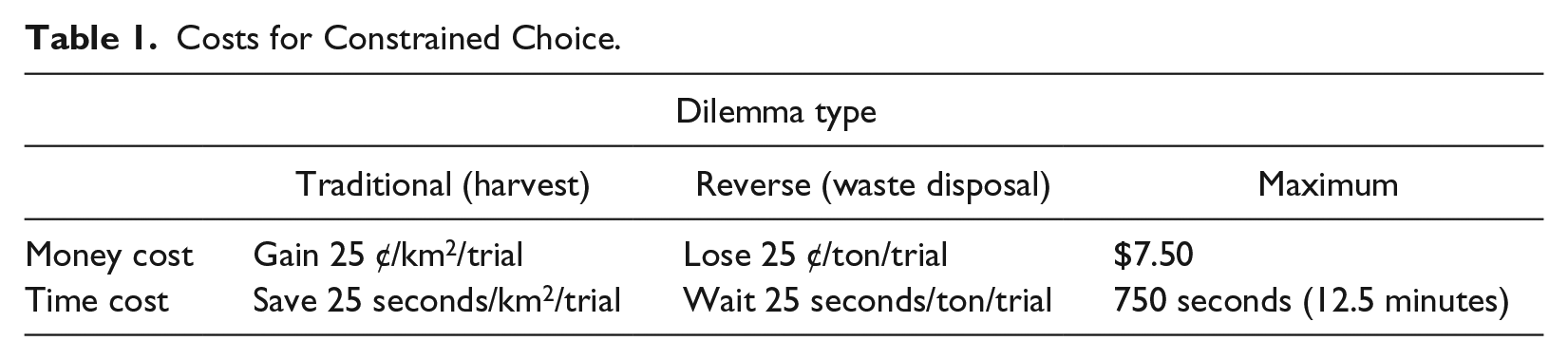
The independent variables were manipulated by varying the details of the commons use participants read before the trials. For the dilemma type manipulation, commons were described as either consumption-based (harvesting lumber; traditional dilemma) or disposal-based (depositing waste in waterway; reverse dilemma). For the cost manipulation, a cost for constraint (choosing less than the maximum 3 units) was described as either monetary (25 cents per unit) or a time delay (25 seconds per unit; see Table 1).
Costs for Constrained Choice.
The script for the traditional dilemma described a forest initially containing 48 km2 of harvestable trees from which participants harvested 0 to 3 km2 on each trial. The script for the reverse dilemma described the shared commons associated with the forestry operation as a waterway through the forest, into which they could dispense treated or untreated waste. In this case, constraint was described as treating waste before disposal, which was associated with a cost for each unit treated. Three metric tons of waste accumulated per trial, and participants were required to dispose of all the waste. They could choose to treat 0 to 3 tons of waste before disposal. The body of water could sustain up to 48 tons of untreated waste before it became entirely polluted.
The script for monetary cost indicated that participants would receive 25 cents for each km2 of trees harvested (traditional dilemma; paid at the end of the study) or pay 25 cents per ton for treating waste before disposing of it in the forest waterway (reverse dilemma). For the reverse dilemma condition, participants were initially allotted $7.50 and told that they could spend it as they saw fit and would be given any unspent money at the end of the study. The $7.50 amount was precalculated to allow participants to progress through the entire task while spending portions of this amount to either treat waste or retain it. However, if they retained the entire amount, they would not reach the completion of the task. The time cost scripts indicated that, for each unit less than the maximum harvested (traditional dilemma) or treated (reverse dilemma), trials would be delayed by 25 seconds for each unit, illustrated by a time loading bar that appeared on the screen. Thus, the cost for constraint was that the participant had to wait to begin the next trial, thus “losing time.”
As an example, the script for the reverse dilemma/time condition asked participants to assume the role of forestry company president who needed to dispose of 3 metric tons of waste into a nearby forest waterway for each day of operation (trial). For each trial, they could either treat all or some of the waste (0-3 tons) before disposing of it. For each ton of waste treated, they would wait 25 seconds before the next trial (see Table 1 for all conditions).
For all conditions, there was a penalty for depleting the commons before the end of the study, which would occur if a participant used the maximum resource on most trials. If that occurred, the commons dilemma task terminated, and the participant was “fined” 30% of their accrued earnings (money cost condition) or completed an extra 20-item quiz, which increased the time required for the study by approximately 10 minutes (time cost condition).
Results
Commons Use Choices
Mean commons use choices were analyzed with a 2 (dilemma type: traditional or reverse) × 2 (cost: money or time) analysis of variance (ANOVA). Contrary to our hypotheses, neither main effect was significant: dilemma type, F(1, 96) = 0.56, p = .455; cost, F(1, 96) = 0.08, p = .779. The null hypotheses that neither dilemma type nor cost influenced harvest choices (i.e., main effects) were theoretically meaningful (Gallistel, 2009) so we conducted a Bayesian t-test (Rouder, Speckman, Sun, Morey, & Iverson, 2009) to assess the odds favoring support of these null hypotheses. This Bayesian factor (B01) expresses the relative likelihood that two groups are drawn from the same source distribution (i.e., the null hypothesis) or different distributions (i.e., the alternative hypothesis; Gallistel, 2009). Using the online calculator provided by Rouder et al. (2009), and the recommended JZS prior, B01 = 3.73 for dilemma type and B01 = 4.48 for cost. These values indicate that the odds supporting the null hypotheses were approximately four times that for the alternative hypotheses. According to Kass and Raftery (1995), odds ratios between 3 and 10 are considered substantial evidence in support of the null hypothesis.
While the main effects for dilemma type and cost were nonsignificant, a significant interaction of the two factors was observed, F(1, 96) = 5.50, p = .02, with a small effect size of ε² =.003 (see Figure 1). A simple effect test revealed a significant difference between dilemma type (p = .03, MSE = 0.22) with time cost. In the two time cost conditions, participants used more of the common resource with a traditional dilemma (M = 2.02) than with a reverse dilemma (M = 1.72). This is consistent with our hypothesis of an interaction between dilemma type and time cost, but the absence of a significant difference between dilemma types with monetary cost (p = .26) suggests that the effects are not completely additive.
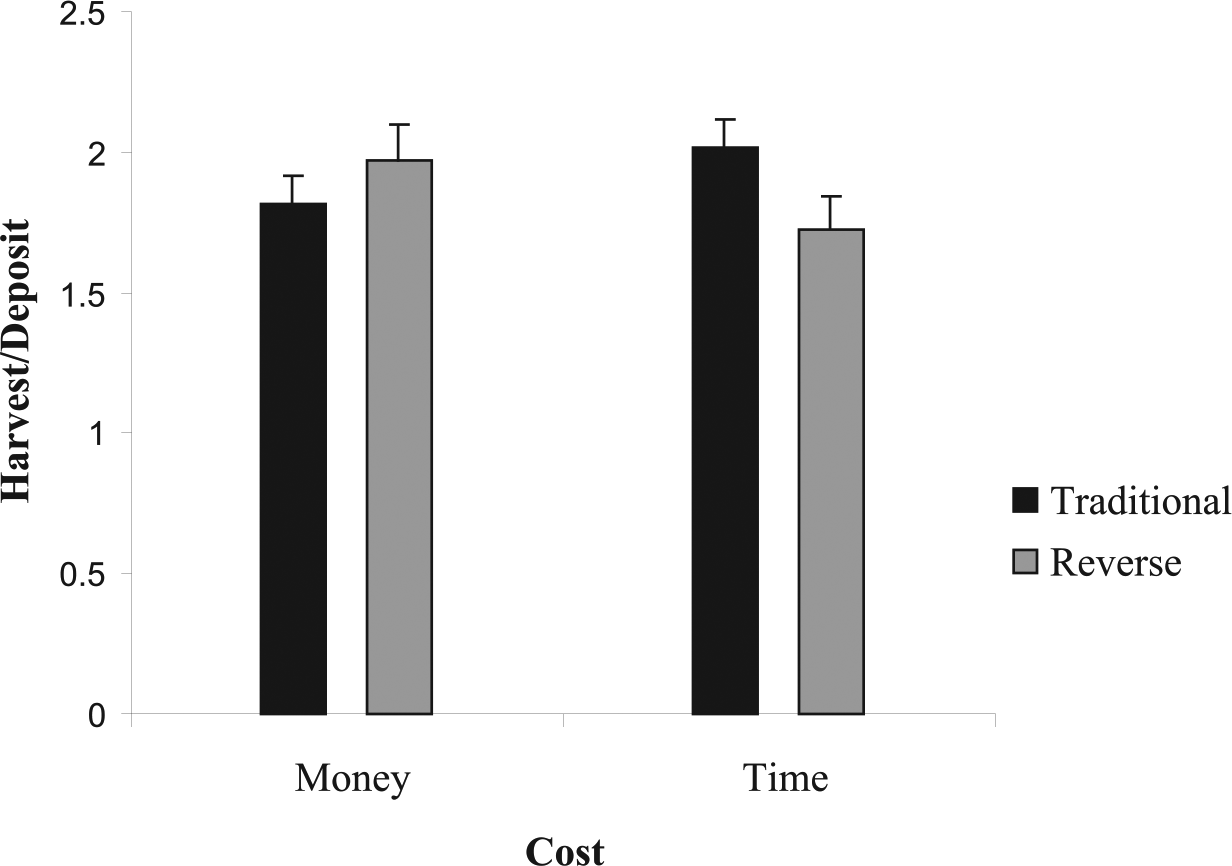
Dilemma type by cost type interaction for harvest choices.
Response Times
Although previous commons dilemma research has not examined RT, time to make use decisions could potentially provide clues to reasoning in this situation. The 2 (dilemma type) × 2 (cost) ANOVA of RTs revealed significant main effects of both cost, F(1, 96) = 63.85, p < .01, MSE = 3.54, with a moderate effect size of ε2 = .050, and dilemma type, F(1, 96) = 4.76, p = .03, with an effect size of ε2 = .004. As can be seen in Figure 2, RT for the reverse dilemma (M = 6.56 seconds) was slower than for the traditional dilemma (M = 5.73 seconds). The cost main effect indicated slower decisions for time cost (M = 7.65 seconds) than money cost (M = 4.64 seconds).
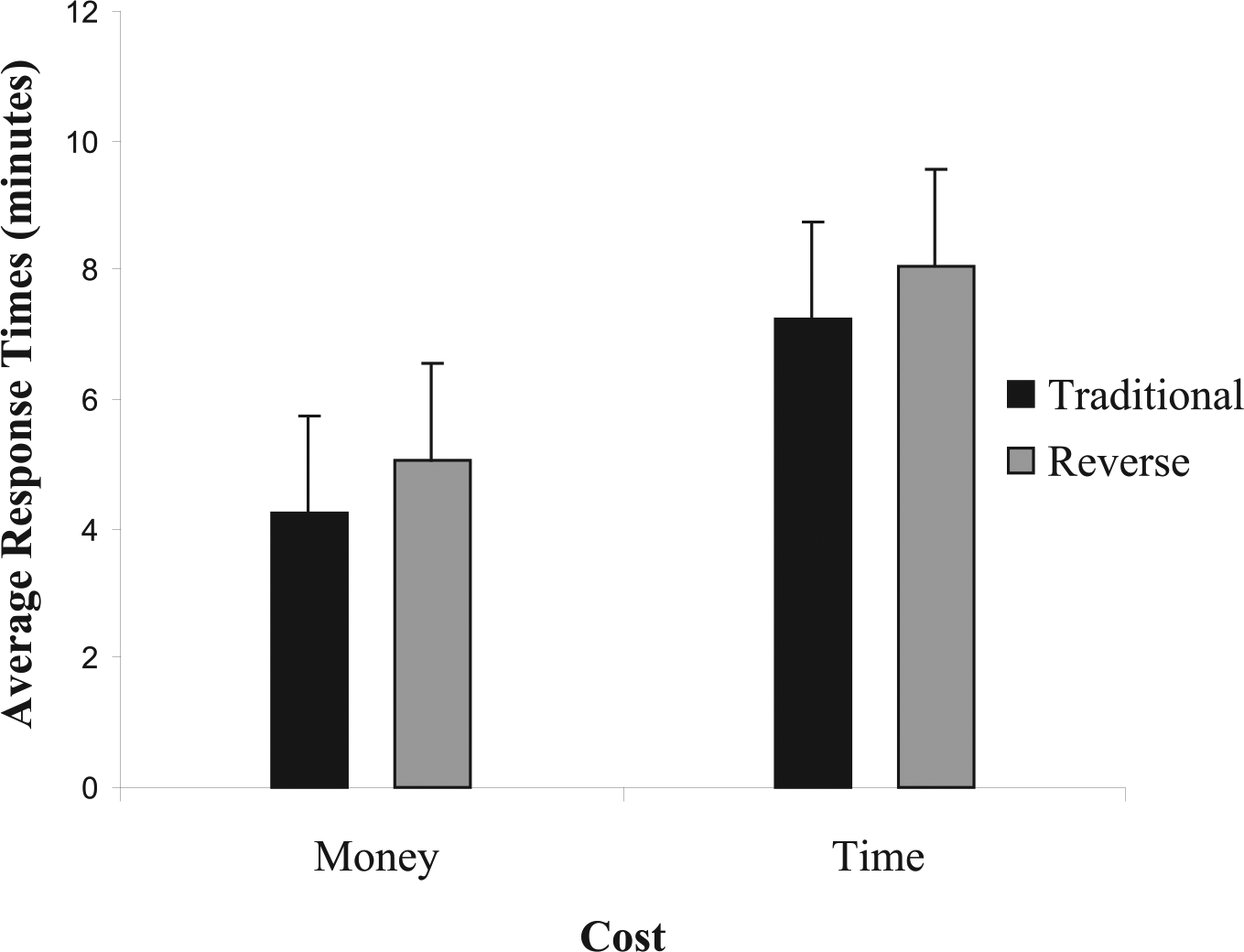
Response times by dilemma type and cost.
Given the significant interaction observed for commons use choices, a correlation analysis was conducted to examine whether these dependent measures were related (see Table 2). This analysis indicated that use choices and RT were associated: Participants who took longer to decide were more likely to make constrained use selections, r(100) = −.38, p < .01.
Correlations Between Commons Use Choices and Reaction Times Across Three-Trial Sets.
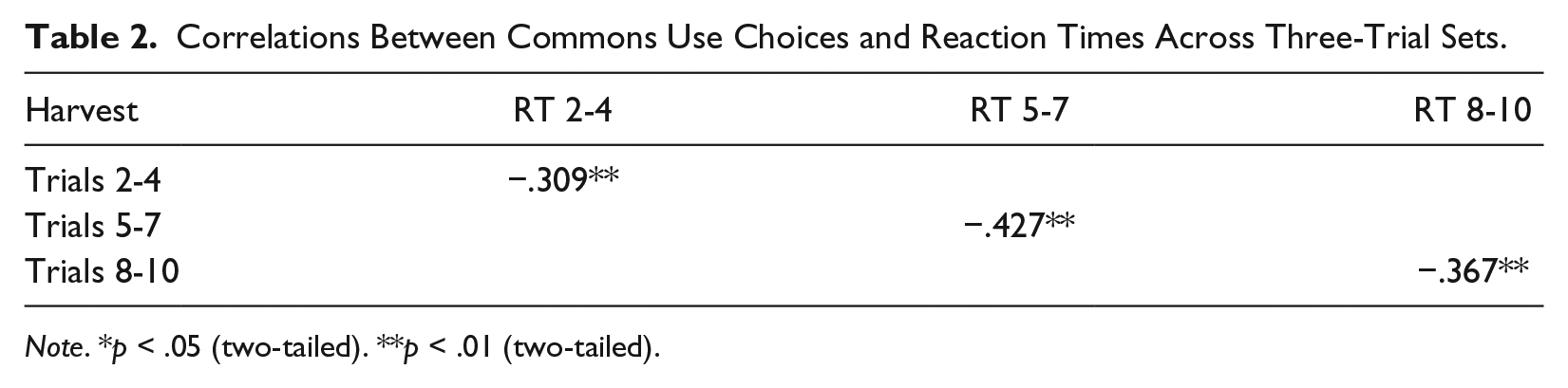
Note. *p < .05 (two-tailed). **p < .01 (two-tailed).
Qualitative Theme Analysis
Participants’ retrospective comments about their decisions were transcribed and coded into theme categories. The descriptions of 25 participants, equally selected from each condition, were initially coded by both authors to determine intercoder reliability. Reliability was .90, so the remaining 75 transcripts were coded by a single researcher, equally divided between both authors.
Theme categories included references to pool or resource, cost, expectations of others, business, and the environment. We conducted chi square tests to determine whether condition (dilemma type × cost) influenced the frequency of reference to each category. The chi test revealed a significant association between condition and reference to cost, χ2(3) = 7.68, p = .05. Based on the odds ratio, the odds of mentioning financial cost were 1.2 times higher for the reverse dilemma/money cost condition (i.e., monetary loss) than any of the other conditions. No other significant differences were observed.
Discussion
The purpose of the present study was to explore factors that may improve the success of commons self-governance in the absence of social communication. This question is important for global commons, which typically involve open access management because exclusion to the commons is very difficult, and each user’s choices can impact the welfare of all users (Berkes, 2009; Brownlee & Kueneman, 2012; Feeny et al., 1990). Thus, factors that influence individual constraint of commons use are necessary to increase the success of managing global commons sustainably. The two factors that we explored in this study were how the commons was used (consumption or disposal) and the cost associated with constrained use of the commons (time or money).
Neither commons type nor cost influenced constraint overall, but the two factors interacted—with monetary costs use was greater for disposal than for consumption commons, whereas the opposite pattern was observed with time costs (statistically significant only for the latter). These findings indicate a more complicated set of influences on constraint behavior than previously considered. In light of the theoretical bases of our hypotheses (loss aversion, moral foundations, and time/money priming), the absence of main effects indicates that none of these factors has a simple influence on constraint in a commons situation. However, the combination of moral foundations theory and loss aversion may explain the observed interaction of dilemma type and cost.
As discussed in the introduction, we expected the purity foundation to influence use choices for disposal commons because of the pollution implications, resulting in more constraint for reverse dilemmas. This was observed for time cost conditions (see Figure 1), but not with monetary costs. Why would this be the case? We speculate that, for money cost conditions, the influence of the purity foundation and loss aversion had contradictory effects in the reverse dilemma. It is likely that participants were influenced more by economic than moral factors in the money cost conditions because previous evidence indicates that money primes decrease social cooperation (e.g., Vohs et al., 2006). In the reverse dilemma condition of the present study, participants were required to spend (e.g., lose) money to preserve the commons (see Table 1), leading to our expectation that the reverse dilemma would decrease constraint. Participants in the reverse dilemma condition were concerned with monetary losses as indicated by their greater mention of costs. However, given the focus on pollution in this condition, purity concerns may have partially counteracted this loss aversion, resulting in the nonsignificant difference between traditional and reverse dilemmas. For the time cost conditions, conversely, purity concerns apparently overshadowed loss aversion in the reverse dilemma condition. It is also possible that gain or loss of time is subject to less loss aversion, allowing the impact of purity concerns to be seen more clearly.
The combination of loss aversion and the moral foundation of purity could explain the absence of main effects for either dilemma type or cost, combined with the presence of a significant interaction between dilemma type and cost. This would suggest that devising time-based strategies to encourage constraint in commons use may only be effective for disposal commons. This post hoc speculation needs to be tested. If the present findings are replicated, however, this would have important implications for sustainable management of global commons, especially as the most problematic global commons situations involve disposal (e.g., atmospheric CO2 emissions, air and water pollution, ocean acidification). For instance, international and national leaders might make creative use of the “slow movements” (e.g., Honoré, 2004, 2013) to design solutions for constraint in large-scale commons involving patience and attention, rather than financial or market solutions.
Cooperation in commons is a complex issue, and increasing global commons cooperation is a “wicked problem.” This means that there are many, sometimes conflicting, influences on actions. Research in behavioral economics and social psychology indicates that many subtle factors influence any single decision (e.g., Ariely, 2008; Kahneman, 2011), and this is likely to be especially true for social dilemmas. We suggest a combination of framing influences (loss aversion and purity values) to explain the finding that for waste-disposal commons, participants were more willing to spend time than money to preserve collective resources. These are both automatic, unconscious influences, evoked by the characterization of the context in which participants find themselves. Previous evidence of each of these effects indicates that such subtle effects are robust in isolation (e.g., Feinberg & Willer, 2012) for purity concerns; Parks et al. (2013) for loss aversion, thus, they are likely to conjointly influence framing in some circumstances. In consumption situations, however, the influence of moral concerns is likely weaker, given the ubiquity of consumption framing in society. Thus, only the single factor of loss aversion influenced decisions for traditional dilemmas.
Although the purpose of this study was theoretical, the study also makes methodological contributions to commons dilemma research. Specifically, the results of this study suggest that extension of the paradigm to include both reverse dilemmas and different types of cost for constraint is valuable. The significant findings related to RT also indicate that inclusion of this measure in the paradigm would provide additional understanding of decision processes in the commons situation. We observed a negative correlation between RT and choices, which suggests that constraint was linked to longer decision time. This may indicate that making less self-interested choices requires more deliberation. A main effect of dilemma type for RTs (see Figure 2) also indicated that choices were made more slowly with reverse dilemmas, consistent with our speculation of the addition of moral purity concerns to the decision (Greene, 2007; Greene et al., 2008).
Limitations and Future Research
This study has attempted to contrast traditional (consumption) and reverse (disposal) commons dilemmas, hence the findings need to be replicated. The sample size in this study was modest, and all participants were undergraduate students. Future research investigating this question should include larger samples of community participants, to ensure generalizability of the findings.
Although the combination of moral foundation and loss aversion theories can provide a post hoc explanation of the present results, moral concerns were not explicitly assessed in this study. In addition to including consumption and disposal commons dilemmas, future studies could also emphasize either harm/care or purity/sanctity foundations (as in Feinberg & Willer, 2012) and observe whether these manipulations influence constraint behavior differently for the two commons types. If we are correct in our hypothesis that the purity/sanctity foundation primarily influenced reverse dilemmas, such a study would indicate results similar to the present study only for purity primes, and care/harm priming would have relatively little impact on either dilemma type.
Conclusion
Given the current and future threats to global natural commons, the importance of understanding constraint in commons use cannot be overstated. Experimental research using the commons dilemma paradigm can be an invaluable tool in this, in that results can be obtained much more rapidly than with field and case studies. The current study was designed to examine whether two specific factors could influence constraint in the absence of social communication, as this is the situation for many globally important commons. The results indicate that this line of investigation is potentially valuable, and may lead to more creative management of difficult-to-sustain commons.
It is possible that the changing state of communications technology may reduce the difficulty of managing global commons using social norms and sanctions. Internet and social network communications allow the creation of more geologically distant social groups, as well as easier transmission of evidence about commons use and overuse. Perhaps this will mean that, in the future, open access commons will become more like identified group commons, especially as social pressures mount for transparent disclosure of organizational resource use and waste disposal (e.g., Brownlee & Kueneman, 2012). However, if this is not the case, finding factors that encourage constrained commons use in the absence of social strategies will greatly benefit humanity.
The evidence that disposal-based commons may be more amenable to constraint given time costs rather than financial costs is potentially heartening, given that sustaining such commons is among the most pressing global concerns. Some evidence suggests that efforts in this direction are already emerging, especially with respect to voluntary CO2 emissions disclosure. Disclosure of use and emission has been deemed important in international contexts. In the United States and in the United Kingdom, voluntary initiatives such as the Carbon Disclosure Project have been created to prompt disclosure of company efforts and performance regarding carbon emissions (U.S. Environmental Protection Agency, 2012; U.K. Government, 2013). Evidence suggests that carbon emission disclosure is the first step toward better management of emissions (Simnett, Nugent, & Huggins, 2009); it can improve company’s image (Sullivan & Gouldson, 2013), lead to improved carbon management (Matisoff, 2013), and can be used to enforce the social contract between society and company (Deegan, 2002). Transparency is largely valued in society, and it can improve a company’s reputation (Deegan, 2012). Nondisclosure on the other hand, has been noted to make no significant impact on decisions (Harvey, Bell, & Birjulin, 1993). The present findings suggest that more targeted focus on expending time and effort on international reporting and monitoring of CO2 would potentially facilitate sustainable management of this commons.
Footnotes
Declaration of Conflicting Interests
The author(s) declared no potential conflicts of interest with respect to the research, authorship, and/or publication of this article.
Funding
The author(s) received no financial support for the research, authorship, and/or publication of this article.