







Abstract
This editorial reviews key themes, trends, and assumptions of organizational research on place and sustainability and introduces the special issue on the “Role of Place in Sustainability.” While recent theorizing has often emphasized global issues such as grand challenges, planetary boundaries, and climate change, this special issue revisits the local by focusing on the role of place in sustainability. We discuss trends and subdomains of research on place and sustainability and identify key assumptions at the interplay between global and local perspectives. Instead of advocating for universal solutions or exclusively context-specific approaches, we highlight the concept of “senses of place,” emphasizing the connections among diverse notions of place and intrinsic links to these locations. We demonstrate how the four insightful articles featured in this special issue provide a broader dialogue on place and sustainability. Finally, we outline a research agenda that identifies underexplored themes in place-based sustainability studies.
Introduction
While the theorizing related to organizations and the natural environment has in recent years emphasized the global level (e.g., grand challenges, planetary boundaries, and climate change), this special issue revisits the local by focusing on the role of place in sustainability. We aim to “think local” and “act local,” thus emphasizing different contextualizations of sustainability.
Place has always had a central role in the study of organizations and the natural environment, from Rachel Carson’s (1962) Silent Spring to Elinor Ostrom’s (1990) grounded work on the commons to calls for appreciation of Indigenous theorizing (see Banerjee & Arjaliès, 2021). In short, sustainability is not “placeless.”
Research on Place: Conceptualization and Trends
Place has a significant impact on how we perceive the world (Mazutis et al., 2021), and scholars have used a variety of terms to denote the notion of place in organization and management studies. As the saying goes, “a beloved child has many names” and we are somewhat inclusive with regard to the specific terminology, opting for a broad conception of the term “place” that incorporates elements related to space, location, and context.
Indeed, Shrivastava and Kennelly (2013, p. 84) argue that place is a multidimensional concept, defining it as “a built or natural landscape, possessing a unique geographical location, invested with meaning.” Place can thus be understood to include the location (i.e., the geographical location), the locale (i.e., the setting of day-to-day activities), the sense of place (i.e., human experiences of the physical place), as well as the broader context (local institutions and ecosystems) (see Agnew, 1987; Cresswell, 2004; Gieryn, 2000; Relph, 1976; Masterson et al., 2017; Mazutis et al., 2021). Guthey et al. (2014) reflected over a decade ago on integrating place and sense of place in organizational studies of sustainability. The authors called for more studies on how organizations socially construct the place in which they operate; how organizations experience spaces and nature; and how organizations value and understand local knowledge and ecology. Our special issue builds upon this research agenda by expanding the notion of sense of place to diverse ways to experience place across multiple places. The articles of the special issue empirically study each of the future research directions proposed by Guthey et al. (2014).
Place has been explored extensively in business and management studies. A recent review of 290 empirical articles by Wright et al. (2023) examines the role of place and space in the organizational and institutional change literature. The authors outline four ways of seeing place and space: a functional perspective, a situated perspective, an experiential perspective, and a mutually constituted perspective. Relatedly, International Business scholars have long evaluated the impact of cultural place and space on multinational firms (Shin et al., 2017) and geographical mobility and immobility of individual employees (Choudhury, 2022). In their examination of place in organization studies, Dacin et al. (2024) describe the trends of moving from a stable notion of place to a more dynamic one (i.e., place as something both stable and constantly actively created), from physical to polymorphic (i.e., both physical and digital), and from neutral to political (i.e., increasingly problematizing the power dynamics around place). The past decade has also seen an increasing interest in the space where work takes place, as we have witnessed broader changes away from traditional physical workspace and the need to account for the spatial dynamics of work (Stephenson et al., 2020). Finally, interstitial spaces, small-scale settings where individuals from different institutional fields interact (such as workshops or meet-ups) connect existing spaces have also received scholarly increasing attention (Furnari, 2014).
Place is particularly important when it comes to sustainability, with the rootedness of sustainability efforts in local environments and stakeholders. In fact, despite the global nature of several sustainability issues (such as climate change), goals (such as the Sustainable Development Goals (SDGs)), or solutions (such as degrowth) that scholars have recently emphasized (Bruijn et al., 2024; Wasieleski et al., 2021; Yu et al., 2023), place is increasingly prominent in management and organization studies of sustainability. Figure 1 indicates a steadily growing trend in the study of place and sustainability in our field over the past two decades.
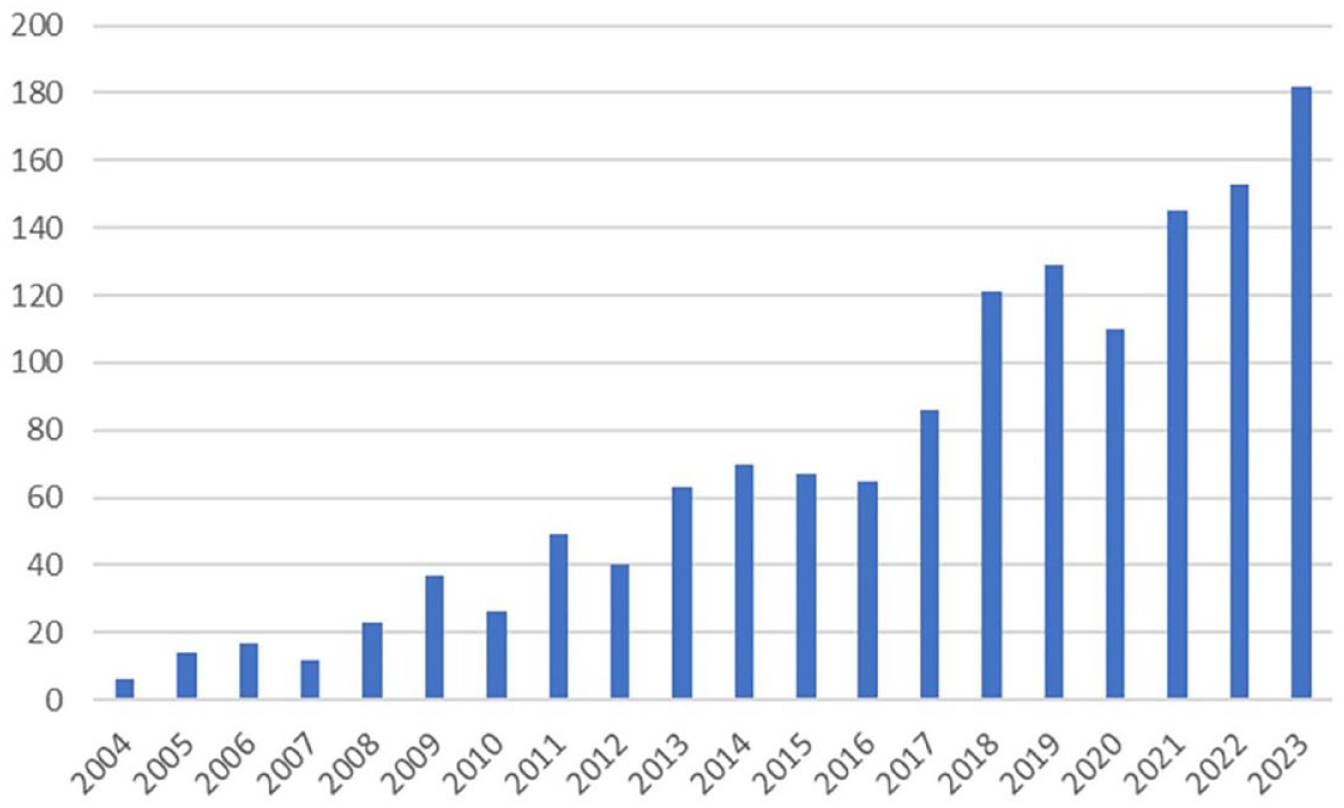
Journal Articles on Place and Sustainability.
The role of place in sustainability has been explored in various ways, such as how firms in specific locations or contexts adapt their practices, comparing institutions across different places, and focusing on themes like smart or sustainable cities. In addition, the study of place and sustainability tends to draw from multiple disciplines. As showcased in Figure 2, management research in this domain has benefited from contributions from various academic fields including social sciences, environmental sciences, engineering, and computer sciences. At the same time, some disciplines that are crucial for sustainability research have not found much application in management and organizations research. For instance, only six management articles from our search in the Scopus database are also classified under earth and planetary sciences, suggesting that recent calls for the much-needed incorporation of earth systems sciences (e.g., Wasieleski et al., 2021) in our work have yet to bear fruit.
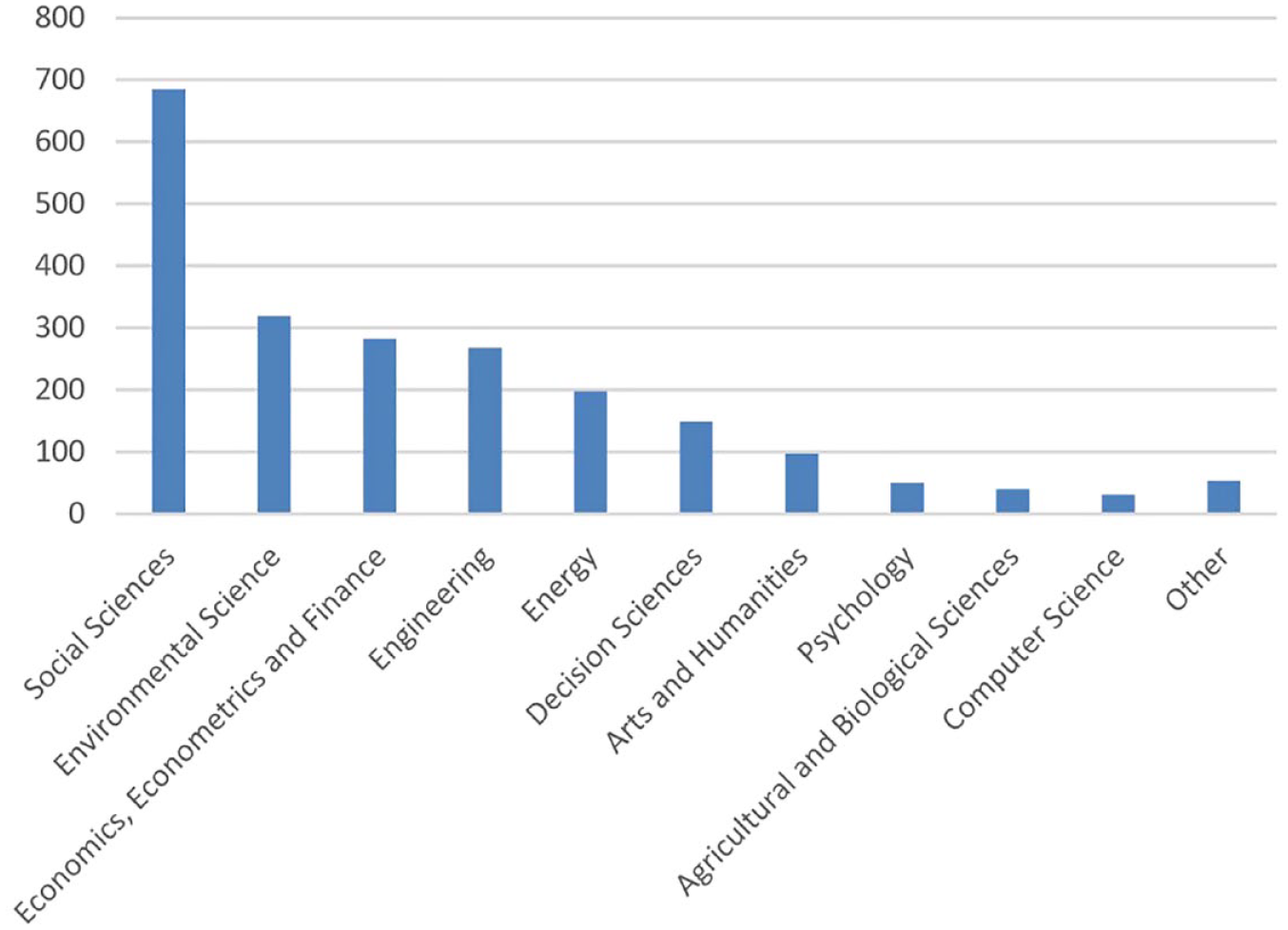
Cross-Disciplinarity of Research on Place and Sustainability.
Based on our reading of existing scholarship on place and sustainability, we identify four domains with which the organizational literature is most often concerned. In contrast to the previously mentioned ontological categorization of place can be perceived (Wright et al., 2023), our domains are more descriptive and empirically driven. A first domain relates to organizations within local environments: research that examines how organizations ground sustainability in a specific local context that determines both sustainability problems and (potential) solutions. The second domain relates to organizations with local environments: research that also tends to focus on specific places, but here scholars do not make the assumption that place is exogenous to the organization but rather that organizations and the places they operate in co-evolve. A third domain of research studies organizations beyond local environments: research that examines how sustainability initiatives and practices developed for one specific place can be scaled beyond that locale. Finally, a fourth domain on organizations across local environments has a comparative focus on how organizations learn and transfer knowledge from one place to another to scale sustainability practices in multiple and often diverse contexts. The articles in this special issue are exemplary contributions to these domains.
Special Issue Articles
Our special issue consists of four articles studying diverse contexts, ranging from textiles in the Tibetan Plateau to urban planning in St. Gallen and from farming practices in Vancouver Island to renewable energy cooperatives in the south of France. We introduce these articles in Table 1 and below, and then place them in the context of prior literature.
Special Issue articles.
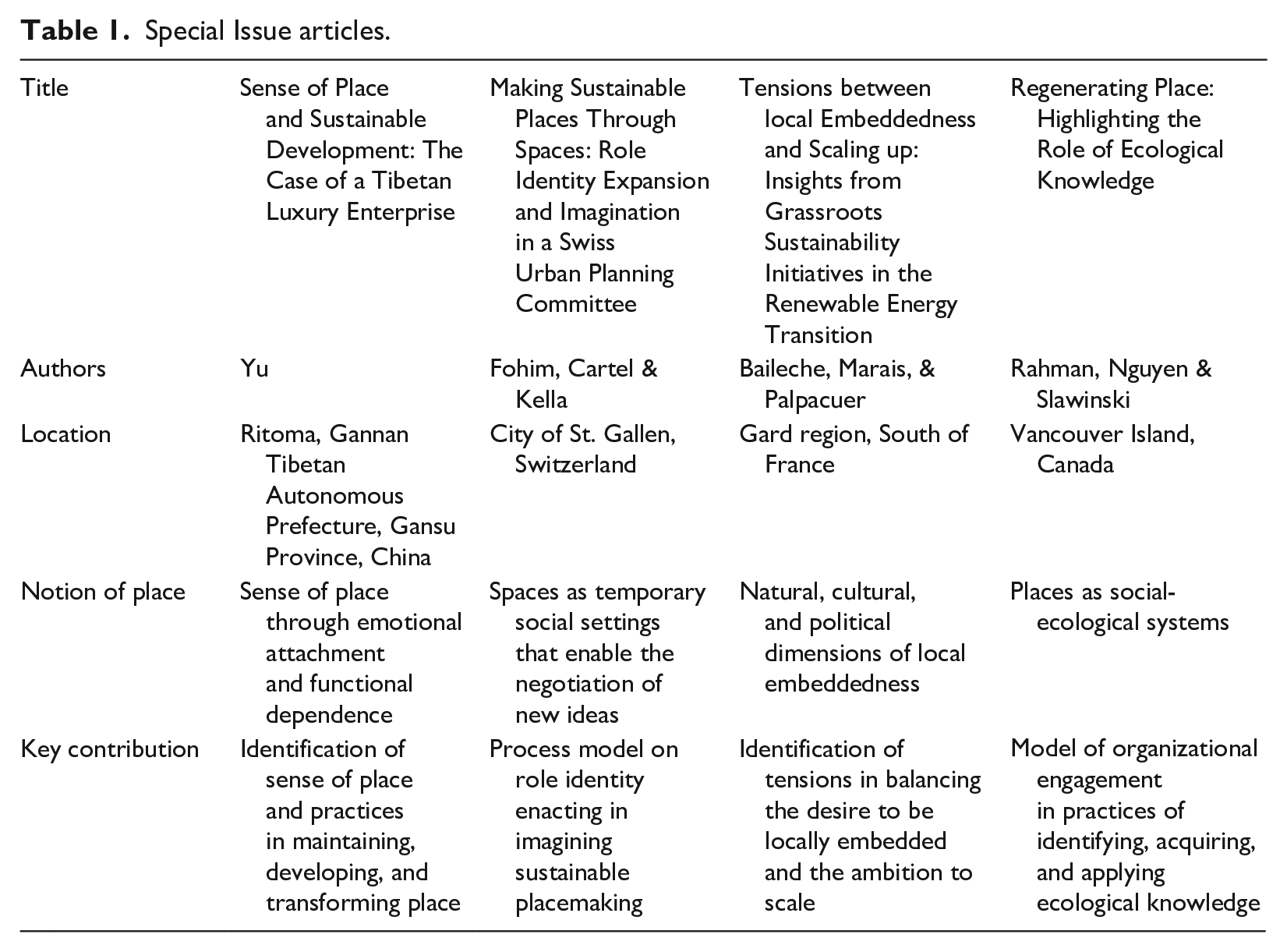
Our special issue begins with “Sense of Place and Sustainable Development: The Case of a Tibetan Luxury Enterprise.” In it, Yu (2024) explores sense of place in a nomadic village in the high altitudes of the Tibetan Plateau. In an ethnographic study of luxury textile firm, the author describes how the company creates local employment and preserves the environment. In doing so, Yu shows how an emotional attachment to place goes hand in hand with a sense of functional dependence. These two forms of sense of place in turn take three pathways toward sustainable development at the local level. Emotional attachment leads to continuity in place, while functional dependency leads to developing the place. The tension between these two forms of sense of place allows the organization to transform the place, while still keeping the place’s core elements intact. Through this in-depth exploration of a case in context, the study contributes to our understanding of the dynamics of the sense of place, and—notably from the perspective of organizations and the natural environment—link these dynamics to sustainable development practices.
The second special issue article is “Making Sustainable Places Through Spaces: Role Identity Expansion and Imagination in a Swiss Urban Planning Committee.” Fohim et al. (2024) examine the transition to sustainable cities. The authors call attention to the importance of spaces—temporary social settings that enable the negotiation of new ideas—as enablers of collaboration around new solutions, but caution about the difficulty of collaboration between actors representing different sustainability dimensions. Drawing on a case study of an urban planning committee in St. Gallen, the authors investigate conditions that catalyze sustainable placemaking, “the process of harmonizing environmental benefits, economic growth, and social inclusion within a place.” This fascinating study reveals that, despite their initially siloed views, committee members were able to develop shared visions of a sustainable St. Gallen. The findings show that this success case can be attributed to a gradual expansion of the committee members’ role identities through a process of stepwise imagination of the future of the city: narrow role identities tied to only one sustainability dimension were gradually augmented, becoming more loosely coupled to existing roles and eventually encompassing a commitment to a holistic and more future-oriented view of sustainability for the city. Given that consensus building is difficult under siloed perspectives linked to narrow job descriptions, a crucial contribution of this study is to underscore the importance of role identity expansion for creating sustainable places. In addition, the paper contributes to the literature on spaces by showing how stepwise “joint imagination” can support the expansion of role identities, the uniting of diverse actors around shared meanings and a common sense of the place, and eventually collaboration for sustainable placemaking.
In the third special issue article, “Tensions between Local Embeddedness and Scaling Up: Insights from Grassroots Sustainability Initiatives in the Renewable Energy Transition.” Baileche et al. (2024) examine the transition to renewable energy driven by grassroots initiatives. The authors focus on a widespread and particularly important conundrum to many initiatives and organizations working on sustainability: the need to balance the desire to be locally embedded and the ambition to scale. Their empirical setting consists of grassroots initiatives that join a federation of citizen renewable energy cooperatives in the South of France. This allows them to analyze the evolution of this federation, specify the tensions between local embeddedness and the logic of scaling up and capture the effect of these tensions on grassroots initiatives. Their careful analysis shows that integrating dimensions such as shared culture, local political emancipation, and the relation to local nature is critical to understanding desired and especially undesired consequences on the paths toward sustainability. Their analysis also includes a temporal dimension to assess the role of the local and place in sustainability efforts, calling for a long-term view. Finally, the manuscript eloquently illustrates how studying transition processes in the making helps generate intermediary conceptual insights, especially in sustainability research.
The special issue closes with “Regenerating Place: Highlighting the Role of Ecological Knowledge,” by Rahman et al. (2024). Here, the authors tackle the critical and increasingly explored theme of regeneration. As we witness widespread ecological decline or degeneration, local communities are calling for regeneration. This study explores certified farming organizations on Vancouver Island in Canada. The key argument of the paper is that the role of ecological knowledge in regeneration has been largely overlooked. Rahman and colleagues demonstrate how three practices—identifying, acquiring, and applying ecological knowledge—simultaneously enhance organizational performance and regenerate local places (in the form of local social-ecological systems). The authors develop a model of regenerating place that integrates elements of environmental stewardship, partnership formation, flexibility, and knowledge management. This model ultimately leads to financial and ecological sustainability, as well as the health of local communities and ecosystems. In this way, the study contributes to the emerging literature on regenerative solutions by outlining specific practices that enable these solutions and highlighting their knowledge-based elements.
All special issue articles reflect place-sensitive research: they acknowledge the crucial role of the place in sustainability initiatives, and all focus on the adoption of sustainability practices in a particular locale. Yet, none assumes that enacting sustainability is straightforward even within one particular place. For example, the article by Fohim et al. (2024) exemplifies that sustainable placemaking is particularly difficult when heterogeneous parties are involved. The other papers echo these challenges and further expand on how organizations co-evolve with the place. For example, Rahman et al. (2024) detail how organizations ground sustainability in the local context and show that by doing so the organizations advance not only organizational goals but also strengthen local places. Similarly, in Yu’s (2024) study of a Tibetan enterprise, the organization copes with and adapts to the place while simultaneously seeking sustainable livelihoods for the local community. Finally, going beyond a single locale, Baileche et al. (2024) discuss how the embeddedness in place that often makes for successful sustainability initiatives presents difficulties when trying to scale out; these difficulties arise precisely because such sustainability projects are grounded in place-based and “closely interlinked cultural, political, and ecological dimensions” (Baileche et al., 2024).
Place and Sustainability: Assumptions and Dichotomies
Based on our reading of the literature, three key assumptions and two dichotomies appear common to organizational research on place and sustainability. We discuss these below and then offer suggestions for future research.
A first common assumption is that place-based sustainability engagement is widely regarded as beneficial. Business and management scholars conducting “place-sensitive” research (see Dacin et al., 2024) naturally highlight the importance of place and related elements. There is a tendency to seek a deeper understanding of local factors, often leading to a “small is beautiful” perspective. Yet, this common outlook among sustainability scholars may result in a selection bias, where positive cases—cases where local sustainability efforts are successful—are predominantly examined.
A second and related assumption is that local and traditional knowledge are necessary and often perceived as superior to other forms of (non-local) knowledge. Place-based practices are rooted in local knowledge, which is considered a prerequisite for developing sustainability programs specific to a particular place. This often implies that non-local knowledge is irrelevant, needs to be adapted, or might generate unintended and even undesired outcomes. Local organizations rooted in a specific place often aim to scale their initiatives by deeply engaging with the needs and problems of the communities and locations they are involved, whereas large or multilateral organizations seek to scale by reaching as many communities and locations as possible (Kim & Kim, 2022).
Finally, another assumption that appears to permeate much of the literature on place and sustainability is that larger international actors, such as multinational enterprises (MNEs) and international nongovernmental organizations (INGOs), often struggle to embed themselves in local contexts due to their mandate and scope of their operations (Bruijn et al., 2024). Top-down sustainability efforts by these organizations that aim for universal solutions can at times be seen as distant. By contrast, local communities, organizations, and movements tend to emphasize the need for locally adaptable sustainability solutions.
The special issue articles—with their emphasis of deep local knowledge and sense of place as critical for sustainability practices—appear to share the assumptions that place-based engagement is beneficial, local knowledge is necessary, and local actors have an advantage in engaging in sustainability in context.
At the root of these assumptions, we argue, are two perceived dichotomies related to place and sustainability. The first is a universalistic versus a pluriversalistic view of the world, a dichotomy that stems from modern and newer discourses and the unequal power or resource distribution between large international organizations and local actors. While a modern ontology assumes the existence of one world—a universe—newer discourses allow for multiple ontologies or multiple worlds—a pluriverse. Such newer relational ontologies move away from strict divisions between culture and nature and individual and community (Escobar, 2011, 2018). The second dichotomy involves scaling deep versus scaling out. The latter refers to scaling of a sustainable enterprise or solution by geographical expansion to other places. Scaling deep, by contrast refers to scaling toward “locally anchored endurance,” whereby solutions stay local and address specific problems in more depth (Kim & Kim, 2022). Figure 3 provides a typology, in the form of a 2-by-2 matrix, exhibiting these dichotomies between universalistic and pluriversalistic views and the options of scaling deep and scaling out.
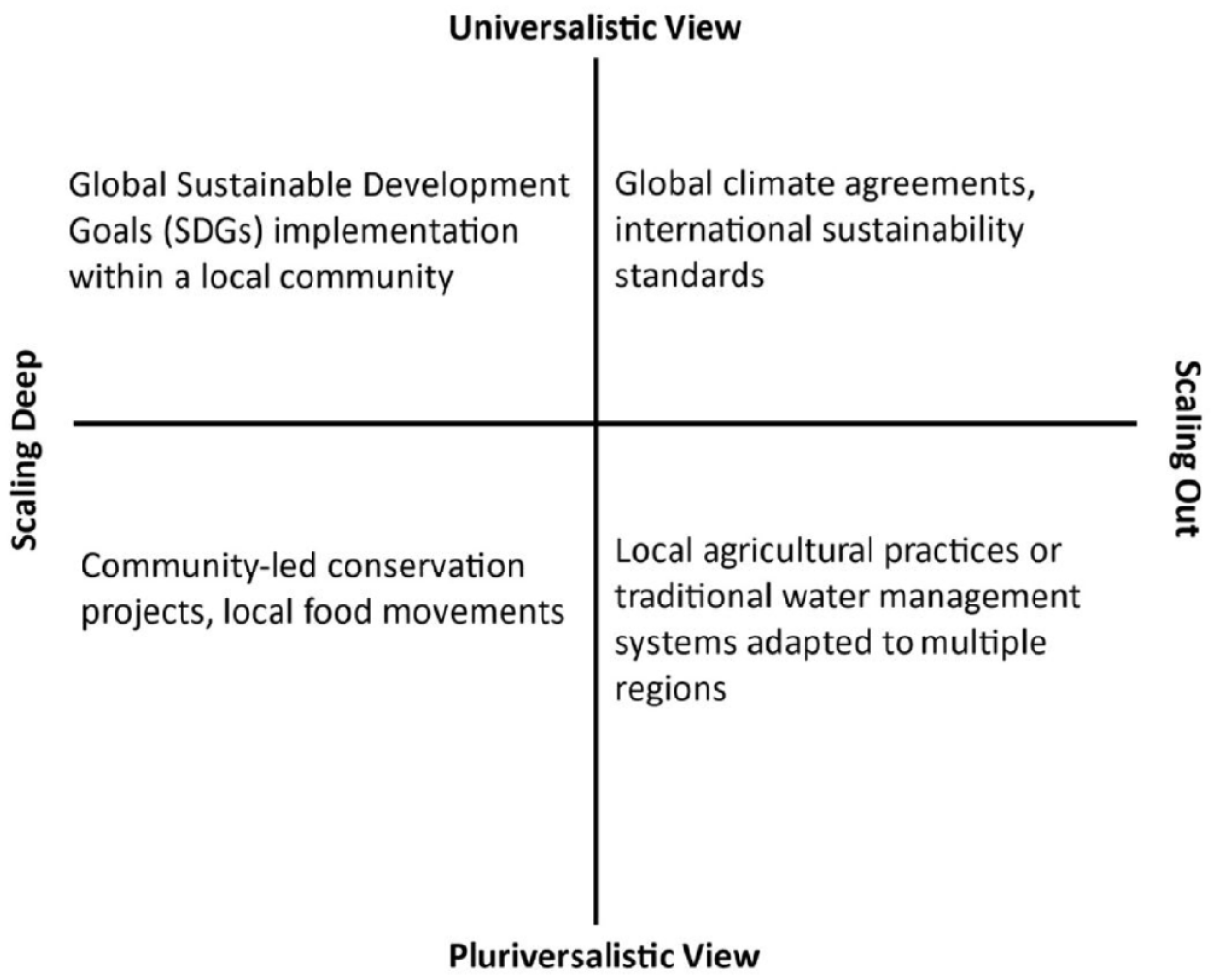
Dichotomies in Research on Place and Sustainability.
Moving Forward: A Research Agenda on Place and Sustainability
The special issue articles reflect the importance of place-based knowledge and a local sense of place for scaling deep (Fohim et al., 2024; Rahman et al., 2024; Yu, 2024) but also the challenges of place-based knowledge in efforts to scale out (Baileche et al., 2024). Furthermore, these papers bridge universal and place-sensitive challenges and solutions by acknowledging that place-based processes are critical—and thus copy-paste approaches are unlikely to work (e.g., Baileche et al., 2024)—while also identifying specific attributes (e.g., role identities—see Fohim et al., 2024) or processes that may “apply to other places with similar theoretical attributes” (Yu, 2024).
More broadly, the articles suggest that there is potential to bridge the dichotomies identified above. We propose that doing so may require a pluriversalistic sense of place and/or sense of places, building on the agenda defined by Guthey et al. (2014). Thus far research has largely looked at sense of place, defined as “the process by which individuals and groups derive meanings, beliefs, symbols, values, and feelings” from a singular physical place (Chapin & Knapp, 2015). The special issue articles also employ sense of place to varying degrees, implicitly or explicitly. For instance, the studies by Rahman et al. (2024) and Baileche et al. (2024) emphasize the ecological dimension of sense of place, particularly natural/ecological dimensions of local embeddedness and knowledge. Fohim and colleagues (2024) highlight the idea that sense of place is not always shared, as different members of the committee started with several “senses” of the place before arriving to a joint sense of place: a common idea of the sustainable city. Finally, Yu (2024) goes one step further to decompose sense of place into constituent parts (emotional attachment and functional dependence), before showing how it is used in practice.
In addition to these important contributions to our understanding of sense of place, we recommend expanding this concept to a plural sense of places, which involves understanding and contextualizing individual places in relation to others. By combining experiences from multiple places, we can better understand sustainability challenges and design solutions. This involves a more “humble” understanding of so-called grand challenges (Böhm et al., 2022) and a focus on the experiential and relational aspects (D’Cruz et al., 2024) of place and sustainability.
Finally, informed by the special issue articles and the broader literature, we present below a series of topics and questions that future research can address to enhance understanding of the link between place and sustainability across the research domains that were discussed earlier.
Organizations Within Local Environments
How do organizations ground sustainability into local contexts? The complex nature and global scale of sustainability issues such as climate change, poverty, and inequality have urged many scholars to move away from studies of the local environment. Yet, while the scale of these problems is global, their manifestations often vary markedly from one place to another (Yu, 2024), rendering “global” solutions maladaptive to specific locations, if not outright destructive. Moreover, the locale is important in sustainable organizing because it shapes opportunities for organizations to engage not only with organizational objectives but also with broader objectives such as the construction of sustainable cities (Fohim et al., 2024) or moral markets (Casasnovas, 2023; Georgallis & Lee, 2020). Recent work has highlighted, for example, that regional logics and values supportive of sustainability enable the founding of organizations that align with these values and logics (Tilleman et al., 2020; Vedula et al., 2019); that local social movements motivate moral market entry by companies with resonant identities (Georgallis & Lee, 2020; Sine & Lee, 2009); and that local institutional mechanisms shape the perceived trade-offs and strategic orientations of dual-purpose organizations (Battilana et al., 2022). Thus, place and sense of place determine both sustainability problems and potential solutions. But how do organizations that address sustainability issues navigate these local institutional environments? How do they acquire resources to support their goals? How do they link their business to local norms and values? The articles of the special issue provide partial answers to these questions, but much remains to be done. For instance, how do organizations tie local issues to global problems to achieve collective market outcomes? And how can multisector sustainability efforts grounded into the local context achieve deep scaling?
Organizations With Local Environments
How do organizations and sustainability coevolve in a local context? Wicked problems are complex, long-term challenges that require collaboration between business, government, NGOs, community and faith leaders, indigenous peoples, and other stakeholders (Barnett et al., 2018). In addition, information regarding society’s social and environmental issues can be overwhelming and paralyze firm behavior (Barnett et al., 2020). As the special issue articles show, focusing on place can potentially help organizations overcome knowledge challenges and resource constraints, and co-create (Torfing et al., 2019) more impactful sustainability practices. Similarly, Russo et al. (2022) explore how hybrid companies are concentrated in places depending on the local community’s collectivism, political orientation, and third-sector munificence. Arguably, the time of seeing business as separate from society and the environment is coming to a close, and recent calls for embedding organizations in their biophysical environment and adopting a systems perspective (see Grewatsch et al., 2023; Howard-Grenville & Lahneman, 2021; Jarzabkowski et al., 2021) offer opportunities to examine how organizations shape their environments (Mair & Seelos, 2021), including their locales.
Ultimately management research and its knowledge sources badly need to be contextualized (Filatotchev et al., 2022) and these developments raise a number of questions which the special issue articles have only began to answer: How do local narratives of place, including traditional knowledge, change an organization’s engagement with place? How do organizations, places, and sustainability co-evolve? What are the roles of organizations in local institutional environments and policy-making processes? And does contextualized knowledge bring new perspectives to sustainability?
Organizations Beyond Local Environments
How do organizations scale their sustainability practices beyond their local context? A central theme in entrepreneurship and strategy research has been to understand what makes some organizations more successful than others at scaling their operations. Successful growth is particularly critical in the realm of sustainable entrepreneurship, given the promise of social impact that awaits the successful transfer or adaptation of such business ventures (Chliova & Ringov, 2017). But insofar as organizations use cultural, political, or ecological knowledge specific to a place (Baileche et al., 2024; Rahman et al., 2024), rely on employees or consumers who espouse resonant values (Russo et al., 2022), and benefit from local government or civil society actors that support sustainable enterprising (Casasnovas, 2023; Georgallis & Lee, 2020), scaling beyond the local context can be challenging. This is particularly the case if one aims to study the transformative impact of organizations on the economic and societal systems they are embedded in (Grewatsch et al., 2023; Mair & Seelos, 2021). Moreover, heterogeneous contexts render the benefits to scaling more uncertain, raising the question of whether, and when, expanding geographically is preferable to “deep” local scaling (Kim & Kim, 2022). Given these challenges and trade-offs, what are some successful “recipes” for growing sustainability practices beyond the local context? What are the actors, institutions, and mechanisms that facilitate or impede such endeavors? How do organizations go about scaling their sustainability practices beyond their local context, and how can a “sense of places” facilitate successful scaling out?
Organizations Across Local Environments
How do organizations learn and develop their sustainability practices in different contexts? Studies on the diffusion of organizational practices, the literature on learning, and research on international business have all been concerned with how organizations learn from others as well as from their own experience (Dahlin et al., 2018; Naumovska et al., 2021). Following others is particularly prevalent in the face of uncertainty (Rao et al., 2001), whereas stable conditions make organizations more likely to rely on their own experience. This poses a challenge for understanding sustainable ventures across contexts: much of the (international business) learning literature has assumed relatively similar experiences across contexts, and experience similarity is indeed conducive to learning; but as also outlined in the Special Issue articles, sustainability problems and solutions are often place-dependent, making experience less directly applicable to new contexts (Bruijn et al., 2024). This raises several questions: Do sustainable ventures rely more on their own experience or on knowledge from local affiliates when scaling to new places? How similar, and in what ways, must the context be for prior learning not to be rendered obsolete? And how should sense of place(s) be used in deciding what should or should not be transferred to other contexts? Moreover, many organizations fail when they attempt to scale, or they experience failure vicariously. Does such adverse experience demotivate further expansion attempts, or are prior failures helpful in the process of expanding sustainable enterprises and markets? Overall, how and under what conditions do organizations learn and improve their sustainability practices across diverse contexts?
Conclusion
This special issue, “The Role of Place in Sustainability,” showcases the increasing interest in the intersection of place and sustainability among management and organization scholars and provides a forum and agenda for research in this area. We discussed key trends and domains that have been common in the literature and how the four special issue articles contribute to this important research area. We identified key assumptions that permeate much of research on place and sustainability: that place-based engagement is beneficial, local knowledge is necessary, and local actors have an advantage. Building on prior work and the special issue articles, we suggest that the concepts of “sense of places” and “senses of place” can help scholars bridge perceived dichotomies related to universalist versus pluriversalistic perspectives and scaling deep versus scaling out. Finally, we end by providing a research agenda that can help ground future efforts to understand the role of place in sustainability. The challenge before us is not merely to understand the role of place in sustainability but to innovate and integrate these insights into every facet of organizational strategy. By doing so, we can transform local knowledge into global wisdom, fostering sustainability that resonates deeply within communities while echoing across the world. Now is the time for scholars and practitioners alike to step up, push boundaries, and turn these insights into impactful actions that drive real change.
Footnotes
Declaration of Conflicting Interests
The author(s) declared no potential conflicts of interest with respect to the research, authorship, and/or publication of this article.
Funding
The author(s) received no financial support for the research, authorship, and/or publication of this article.
