






Abstract
As sustainability reporting has become mainstream, questions remain about whether disclosed stakeholder engagement supports more democratic forms of corporate accountability. This study examines the extent to which stakeholder engagement disclosures in sustainability reports reflect practices associated with stakeholder democracy and how these disclosures have evolved over time. Using a qualitative content analysis of sustainability reports from 50 mining and energy companies, comparing 2015 and 2022 disclosures, we find that engagement remains predominantly indirect, uneven across stakeholder groups, limited in its inclusion of marginalized groups, and weakly specified. While some companies broadened and diversified their disclosures, others stagnated or regressed. The study contributes to sustainability reporting research by showing that breadth, depth, and uptake are complementary dimensions for assessing disclosed stakeholder engagement. We argue that the mainstreaming of sustainability reporting has not systematically translated into broader inclusion, stronger dialogic practices, or greater uptake of stakeholder input into organizational processes.
Keywords
Introduction
In recent decades, accelerating climate change, biodiversity loss, and pollution pressures have heightened demands for greater corporate accountability within an increasingly constrained global system (Whiteman et al., 2013). In response, companies frame sustainability not merely as a corporate responsibility but as essential to survival within an evolving regulatory landscape and mounting pressures from stakeholders 1 (Boiral et al., 2022; Busch et al., 2024). Sustainability reporting has consequently emerged as a mainstream practice for disclosing environmental, social, and governance (ESG) commitments and impacts (Hahn et al., 2023; Jackson et al., 2020; Shabana et al., 2017), with 96% of the world’s largest companies now publishing such reports (KPMG, 2024). Frameworks and regulations, such as the Global Reporting Initiative (GRI), the Sustainability Accounting Standards Board (SASB; now part of the International Financial Reporting Standards, or IFRS), and, more recently, the EU Corporate Sustainability Reporting Directive (CSRD), have structured and standardized these disclosures in response to growing stakeholder expectations (Ardiana, 2023; Esteban-Arrea & Garcia-Torea, 2022). Yet despite this widespread institutionalization, concerns persist regarding report quality, greenwashing, and limited evidence of meaningful impact (Hahn et al., 2023; Pucker, 2021; Zharfpeykan, 2021).
An important element of these debates is stakeholder engagement. Stakeholder engagement, defined as stakeholders’ involvement in organizational activities and sustainability-related processes, including sustainability reporting (Greenwood, 2007; Kujala et al., 2022; Wenzel et al., 2025), is widely discussed as a way for companies to demonstrate accountability and legitimacy. Drawing on stakeholder theory (Freeman, 1984; Parmar et al., 2010), it seeks to integrate diverse stakeholder priorities into organizational strategies, activities, and reporting, thereby fostering legitimacy and trust (Kujala et al., 2022; Kuruppu et al., 2019). Engagement also enables companies to understand stakeholder concerns, respond to them, and enter into dialogue with stakeholders (Kujala et al., 2022). However, despite growing recognition that stakeholder engagement is an important corporate practice, implementation often remains limited (Ardiana, 2023; Gagné et al., 2022; Torelli et al., 2020).
Reporting frameworks present stakeholder engagement as central to sustainability reporting, yet organizations approach it with different intentions. Some pursue engagement strategically to manage dependencies and reduce uncertainty (Herremans et al., 2016; Mitchell et al., 1997). Others frame engagement as a means to enhance legitimacy and demonstrate accountability to a broader range of stakeholders (Greenwood, 2007; O’Dwyer, 2005). Still, engagement is often considered instrumental and serves managerial or reputational objectives rather than facilitating dialogue (Bellucci et al., 2019; Kaur & Lodhia, 2018; Manetti, 2011). Recent work conceptualizes stakeholder engagement into three modes—participation, inclusion, and democracy—reflecting alternative ways for stakeholders to influence organizational processes (Wenzel et al., 2025). Participation refers to opportunities for stakeholders to provide input, inclusion captures their ability to shape issues and deliberations, and democracy involves genuine influence over decisions. Stakeholder democracy entails the dual obligation to hold organizations accountable for decisions impacting stakeholders and for organizations to involve stakeholders in governance (Crane et al., 2004; Moriarty, 2014; O’Dwyer, 2005). Although sustainability reporting could provide stakeholders with information and opportunities for dialogue, critics caution that reporting often privileges managerial perspectives over stakeholder voices, which raises doubts about its capacity to enhance democratic accountability (Cho et al., 2015; Owen et al., 2001).
While sustainability reporting has become mainstream, stakeholder democracy remains underdeveloped, and fully realized examples remain rare. Even purpose-built participatory models can fail: for example, Mountain Equipment Co-op, founded in 1970 as a consumer cooperative, saw its board unilaterally sell its assets to a private equity firm in 2020, stripping over five million members of their governance role and prompting legal challenges (Cecco, 2020; Smart & Pullan, 2020). Likewise, weak stakeholder engagement can have broader societal consequences. The Dieselgate scandal revealed how Volkswagen’s disregard for stakeholder interests—amid poor oversight and fraudulent environmental disclosures—led to severe legal and reputational repercussions (Boiral et al., 2022; Siano et al., 2017; Zhang et al., 2021). Together, these cases illustrate the ways that fragile participatory arrangements can erode accountability. While such high-profile failures expose engagement deficits, sustainability reports offer insight into how firms represent stakeholder engagement and the extent to which these disclosures reflect democratic engagement.
The mainstreaming of sustainability reporting raises an important question: have the stakeholder engagement processes that underpin it similarly become mainstream practice? Sustainability reporting has long been critiqued for prioritizing corporate interests over broader societal concerns (e.g., Boiral, 2013, 2016; Cho et al., 2015, 2018) while stakeholder engagement processes are frequently characterized as discretionary, superficial, and lacking in substantive content (Ardiana, 2023; Bellucci et al., 2019; Gagné et al., 2022). Given that the GRI Sustainability Reporting Guidelines have now been in circulation since 1999, this paper examines whether and to what extent companies have meaningfully transformed their stakeholder engagement disclosures. Specifically, we address the following research question: To what extent do stakeholder engagement disclosures in sustainability reports reflect practices associated with democratic engagement, and how have these disclosures evolved over time?
This study analyzes stakeholder engagement practices disclosed in sustainability reports over time and examines the extent to which these disclosures reflect practices associated with stakeholder democracy. We focus on two high-impact extractive sectors: mining and energy companies. Companies in these two areas include major polluters facing increasing pressure to report on sustainability (Böhling et al., 2019; Talbot & Boiral, 2013). Due to stakeholder pressure (Crane et al., 2004; Fonseca et al., 2014; Moriarty, 2014), extractive firms often produce comprehensive sustainability disclosures to demonstrate accountability (Cho & Patten, 2007; Milne & Patten, 2002) and maintain their social license to operate (Grushina, 2017; Jenkins, 2004). Sustainability reports thus provide a useful lens for examining how companies disclose stakeholder engagement under conditions of heightened scrutiny and the increasing standardization of reporting frameworks.
This article contributes to research on sustainability reporting (e.g., Ardiana, 2023; Cho et al., 2018; Grushina, 2017) and stakeholder democracy (e.g., Crane et al., 2004; O’Dwyer, 2005; Wenzel et al., 2025). By critically assessing the extent to which mainstream sustainability reporting reflects stakeholder democracy, we refine scholarship on stakeholder engagement (Gagné et al., 2022; Kujala et al., 2022) and corporate accountability. We show that stakeholder engagement disclosures vary in breadth (which stakeholders are engaged) and depth (how engagement occurs), and we introduce uptake—the extent to which reported practices are embedded into organizational processes and outcomes—as a complementary evaluative lens. Our longitudinal analysis traces how these practices have evolved and examines whether disclosures signal that engagement has been embedded in organizational processes in a way that is consistent with democratic accountability. Drawing on prior research on stakeholder engagement and democracy (e.g., Bellucci et al., 2019; Brown & Dillard, 2015; Puroila & Mäkelä, 2019), we argue that, despite the mainstreaming of sustainability reporting, progress toward more inclusive and participatory engagement remains limited.
The remainder of the paper proceeds as follows. The first section reviews the literature on stakeholder engagement in sustainability reporting and its relationship to stakeholder democracy. The second section details the methods applied in this study. We then present the main findings, followed by a discussion of the paper’s academic contributions, practical implications, limitations, and suggestions for future research.
Literature Review
Stakeholder Engagement in Sustainability Reporting
Stakeholder engagement refers to “various processes and strategies that firms and other organizations implement in their stakeholder relations” (Kujala et al., 2022, p. 1140). From a company perspective, it involves informing stakeholders about company activities (often to gain trust), understanding their expectations, and securing approval (Galeotti et al., 2025; Kujala et al., 2022). Stakeholder engagement is a mechanism for fostering dialogue, managing risks, and co-creating value (Kaur & Lodhia, 2018; Kujala et al., 2022; Stocker et al., 2020). It is also used to enhance transparency and to integrate diverse perspectives into decision-making (Bellucci et al., 2019; Stocker et al., 2020). Engagement includes strategy implementation, reporting, and accountability processes to enable stakeholder participation in shaping corporate policies and initiatives (Gagné et al., 2022; Galeotti et al., 2025; Stocker et al., 2020).
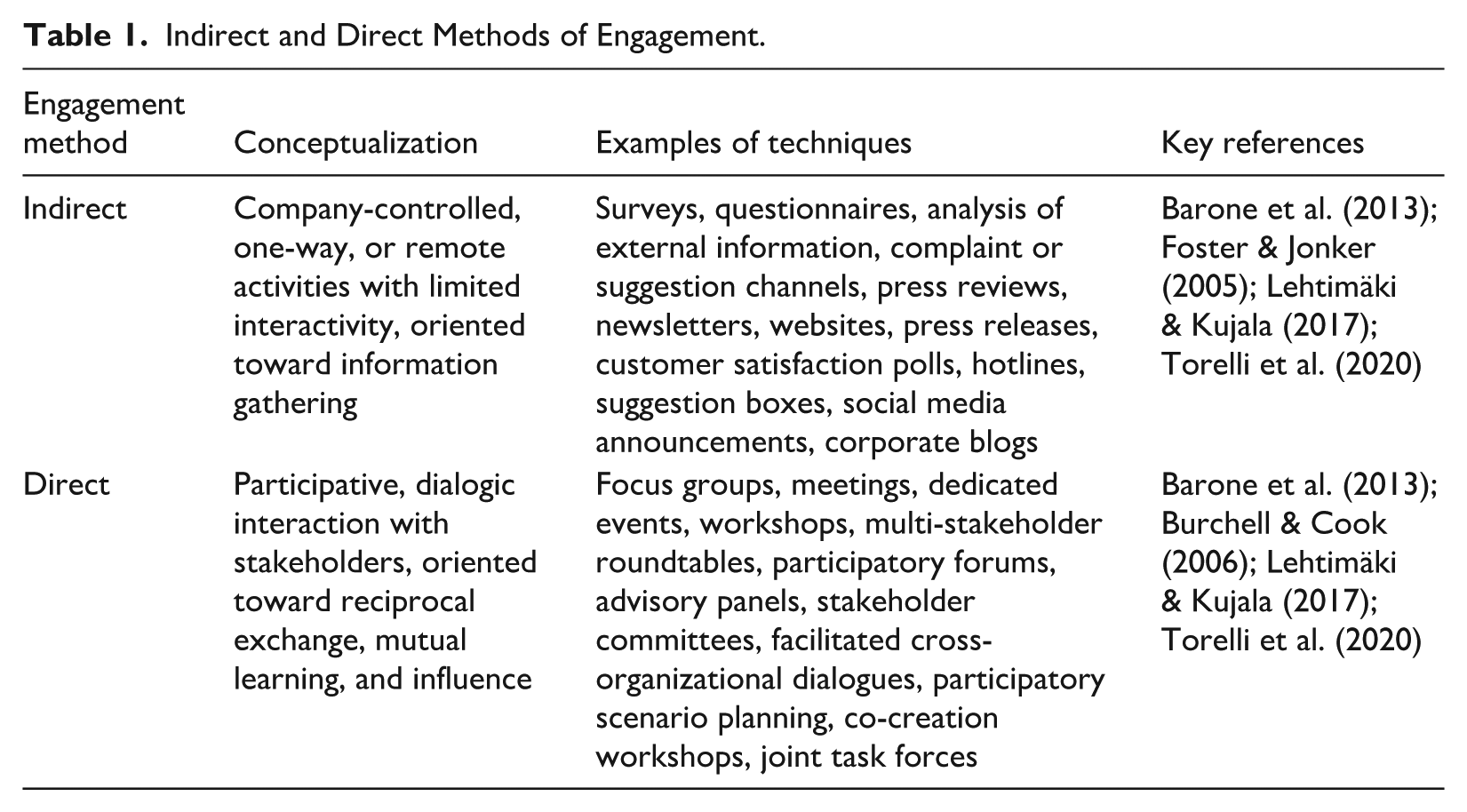
The ways in which organizations execute stakeholder engagement vary considerably, from providing basic information to having stakeholders more deeply involved in organizational processes. Early research identified engagement as informing, responding to, or involving stakeholders, with different implications for the depth and credibility of interaction (Herremans et al., 2016; Morsing & Schultz, 2006). Subsequent work distinguished between indirect engagement methods, characterized by one-way, company-controlled communication flows, and direct engagement methods involving dialogic, iterative interaction oriented toward mutual learning and influence (Kujala et al., 2022; Torelli et al., 2020) (see Table 1). Indirect engagement methods include low-interactivity consultation—for example, one-way provision of information or firm-designed requests for feedback—used to scan expectations and gather inputs (i.e., “information” or “response” strategies) (Barone et al., 2013; Morsing & Schultz, 2006; Torelli et al., 2020). Typical techniques include newsletters, websites, press releases, stakeholder surveys and polls, and calls for comments. Direct engagement methods involve participative and dialogic exchanges aimed at mutual learning and influence, often in facilitated multi-party settings or in ongoing interactions between organizations and stakeholders (Barone et al., 2013; Burchell & Cook, 2006; Lehtimäki & Kujala, 2017). Examples include multi-stakeholder workshops and roundtables, participatory forums, advisory panels, and facilitated cross-organizational dialogues.
Indirect and Direct Methods of Engagement.
Stakeholder engagement plays an important role in sustainability reporting in two interrelated ways. First, an effective reporting process relies on stakeholder engagement to identify and prioritize the most relevant, or material, ESG topics (Grushina, 2017). Actively involving stakeholders helps to ensure that sustainability reports reflect the issues that matter most to both the company and its stakeholders (Machado et al., 2021; Puroila & Mäkelä, 2019). Second, sustainability reports require companies to disclose the stakeholder engagement activities conducted throughout the year, thereby indicating whether and how stakeholder input has been considered in the reporting cycle. Hence, stakeholder engagement in sustainability reporting is often presented as supporting transparency, participation, and accountability (e.g., Bellucci et al., 2019; Kujala et al., 2022; Manetti, 2011). These approaches are intended to enable stakeholders to hold organizations to account and to seek greater transparency in decisions affecting them (Bellucci et al., 2019; Grushina, 2017). Yet to hold the reporting organization accountable, stakeholders need to access reliable and relevant information, implying reciprocal information flows between the reporting organization and a wide range of stakeholders (Dillard & Vinnari, 2019; Gagné et al., 2022; Torelli et al., 2020).
Challenges in Stakeholder Engagement Processes and Disclosures
Although stakeholder engagement is institutionalized in sustainability reporting standards, disclosure does not necessarily yield transparency, as information flows often privilege managerial perspectives over stakeholder empowerment (Cho et al., 2015; Owen et al., 2001). Frameworks such as the GRI Standards, AccountAbility’s AA1000 principles, and the International Sustainability Standards Board (ISSB) Sustainability Disclosure Standards assume that engagement enhances report quality by incorporating diverse perspectives (Fonseca et al., 2014; Leeson & Kuszewski, 2023). However, the informational quality of engagement disclosures frequently falls short of stakeholder expectations and offers limited insight into organizational responsiveness (Ardiana, 2023; Fernandez-Feijoo et al., 2014; Machado et al., 2021). In practice, disclosure is often compliance-oriented: reports foreground alignment with reporting standards and only selectively reflect stakeholder input, reinforcing legitimacy rather than enabling dialogic change (Brown & Dillard, 2015; Manetti, 2011). This dynamic is compounded by impression management practices: reports accentuate favorable initiatives while sidelining contentious issues, thereby offering legitimacy without enhancing transparency or responsiveness (Sandberg & Holmlund, 2015; Talbot & Boiral, 2018). Engagement activities can also be used strategically to manage legitimacy risks, reduce resistance, and co-opt critical voices (Journeault et al., 2021; Kujala et al., 2022), a dynamic described as the engagement-control paradox (Pietilä et al., 2025). As such, sustainability reports offer an indirect and constructed representation of stakeholder engagement, shaped by organizational priorities and disclosure choices, rather than a direct account of how engagement unfolds in practice.
Another challenge is the heterogeneity of stakeholders. Disclosures often present them as coherent and unified, although their interests may diverge and powerful or proximate voices are often privileged (de Villiers et al., 2024; Kaur & Lodhia, 2019). Depending on how they are organized, relational practices used in engagement processes can either bridge differences or deepen exclusion, and reporting commonly masks the range of positions held by different stakeholders and the potential disagreements between them (Bader et al., 2025). Evidence from the extractive industries shows that marginalized groups, such as Indigenous and local communities, may be formally recognized as stakeholders but are often excluded from meaningful participation. Engagement may serve to defuse criticism despite limited adherence to free, prior, and informed consent (FPIC) and the United Nations Declaration on the Rights of Indigenous Peoples (UNDRIP) for Indigenous communities (Jenkins, 2004; Journeault et al., 2021). Although the GRI and the ISSB promote stakeholder inclusiveness, they offer limited guidance on who qualifies as a stakeholder or how to prioritize competing perspectives, allowing disclosures to oversimplify engagement and obscure representation and influence (de Villiers & Dimes, 2023; de Villiers et al., 2024; Gagné et al., 2022).
A related difficulty lies in the form and significance of the engagement methods. Distinctions between indirect and direct engagement highlight ongoing debates about what constitutes “meaningful engagement.” While many engagement activities remain tokenistic or procedural—granting voice without conferring influence (Kaur & Lodhia, 2019)—substantive practices demonstrably shape organizational priorities, commitments, or resource allocations (Wenzel et al., 2025). The literature generally prioritizes direct, dialogic formats, which facilitate joint problem framing and can prompt reciprocal position changes (Barone et al., 2013; Kujala et al., 2022; Lehtimäki & Kujala, 2017). Indirect methods are recognized for their breadth and value in early issue mapping, supporting stakeholder identification and surfacing a wide range of concerns at scale (Foster & Jonker, 2005; Torelli et al., 2020). Engagement thus spans from organization-controlled consultation to participatory practices capable of redistributing influence in decision-making. This wide range complicates assessments of how engagement contributes to accountability and inclusion.
Stakeholder Democracy, Engagement, and Sustainability Reporting
Stakeholder democracy has been advanced as a normative ideal, as it emphasizes organizational accountability to those affected by decisions and grants them a meaningful role in governance (Crane et al., 2004; Moriarty, 2014; O’Dwyer, 2005). It is conceived as redistributing voice and influence so that organizational practices are shaped not only by shareholders but also by those who bear the social and environmental consequences of corporate activity (Greenwood, 2007). For this redistribution to be legitimate, participants in engagement processes must both have a voice and represent their constituencies through clear ties of authorization and accountability. Without such connections, engagement may create the appearance of inclusiveness without fulfilling democratic representativeness (Jastram & Berberyan, 2023).
In the context of sustainability reporting, stakeholder democracy highlights engagement as a legitimate means of accountability and shared governance, provided it reflects meaningful information flows and representative stakeholder voices. Accountability requires organizations to provide stakeholders with information on resource use and the social and environmental consequences of their activities (Harrison & van der Laan Smith, 2015; Puroila & Mäkelä, 2019). Reporting can, in principle, enable such accountability by creating channels to access information, express concerns, and engage in dialogue. This perspective is reflected in the literature on dialogic accounting, which conceives of reporting as a space for interaction and deliberation between organizations and stakeholders (e.g., Bebbington et al., 2007; Brown & Dillard, 2015; Dillard & Vinnari, 2019). Yet scholars have questioned whether these processes constitute meaningful engagement, noting that reporting practices often remain tokenistic (Manetti, 2011) or lack the quality and specificity required to enhance accountability (Gagné et al., 2022). Critical studies further caution that reporting privileges managerial perspectives and constructs narratives that limit stakeholder influence (Cho et al., 2015; Owen et al., 2001). This debate highlights the tension between the aspirational ideals of stakeholder democracy and tokenistic practices observed in corporate reporting.
Illustrative cases highlight the promise and limits of stakeholder democracy in practice. ExxonMobil’s concealment of internal climate science in the 1980s and 1990s, despite pressure from NGOs, scientists, and investors, illustrates how the absence of meaningful accountability mechanisms enabled the marginalization of critical voices (Hall, 2015). At the other extreme, Patagonia’s 2022 transfer of ownership to a trust and an environmental non-profit reflects a far-reaching commitment to stakeholder democracy, positioning the natural environment as the residual beneficiary (McCormick, 2022). Between these extremes lies Ørsted, whose transformation from a fossil fuel utility to a renewable energy leader was shaped by sustained engagement with governments, investors, and civil society (State of Green, 2021). This case shows how more inclusive engagement can inform strategic redirection within conventional governance structures. Together, these examples suggest a continuum—from exclusionary or symbolic engagement to transformative, participatory governance—while underscoring that stakeholder democracy often remains aspirational and difficult to realize in mainstream corporate contexts.
International reporting standards have attempted to formalize democratic aspirations by embedding stakeholder engagement into their principles and guidelines. Both the GRI and the AA1000 standards emphasize that reports should be shaped by input from diverse stakeholder groups to enhance inclusiveness and responsiveness (Fonseca et al., 2014; GRI, 2016; Grushina, 2017). This multi-stakeholder orientation seeks to operationalize stakeholder democracy by institutionalizing processes that give stakeholders a voice in defining material issues and assessing performance (Kujala et al., 2022; Leeson & Kuszewski, 2023). In line with this orientation, the most recent GRI Standards include guidance on “meaningful engagement with stakeholders,” defined as ongoing, two-way, responsive communication that involves relevant stakeholders prior to decision-making (GRI, 2021). Yet, as research has shown, the extent to which these processes move beyond procedural compliance to embody democratic engagement remains uncertain.
Method
This study applies qualitative content analysis to examine the extent to which stakeholder engagement disclosures in sustainability reports reflect democratic engagement practices and how these disclosures have evolved over time. The method is well suited for analyzing narrative disclosure and examining emerging phenomena (e.g., Bowen, 2009; Milne & Adler, 1999). Rather than evaluating the relevance of disclosed topics, our focus is on the reporting practices themselves. The mining and energy sectors were selected as major polluters within the extractive industry facing heightened demands for sustainability reporting and stakeholder scrutiny, which makes their reports particularly apt for this analysis (e.g., Cho & Patten, 2007; Talbot & Boiral, 2013).
Data Collection
The GRI Sustainability Reporting Guidelines were used to select the initial sustainability reports included in this study. We chose the GRI guidelines because they are among the most widely recognized and adopted standards for sustainability reporting (KPMG, 2024). Using reports that follow the same framework enabled a systematic and consistent analysis, as these reports share common indicators and reporting principles.
The study adopts a comparative approach, analyzing sustainability reports from 2015 following the GRI G4 Guidelines, and reports from 2022 following the GRI Standards that replaced the GRI G4 Guidelines in 2016. Sustainability reports from the mining and energy sectors from 2015 were sourced from the GRI Sustainability Disclosure Database. 2 At its closure in 2020, this database, which spanned over 20 years, listed 63,852 reports from 15,398 organizations, including 2,223 reports from 438 mining companies and 4,032 reports from 853 energy companies. Reports were selected based on their adherence to the GRI G4 Guidelines, an A or A+ application level under the earlier G3/G3.1 guidelines, and publication in English or French.
From G4 onward, the GRI framework placed a stronger and more explicit emphasis on stakeholder engagement, requiring organizations to describe how stakeholders are identified and consulted, and how their concerns influence strategy. Given this continued emphasis, the 2015 reports provide a suitable baseline. Reports from 2022, prepared in accordance with the GRI Standards, were added to capture changes in stakeholder engagement over time. By analyzing the 2022 reports alongside the 2015 reports, we offer a comprehensive analysis of stakeholder engagement practices in sustainability reporting in an evolving landscape, where sustainability reporting has become mainstream and stakeholder pressures have intensified.
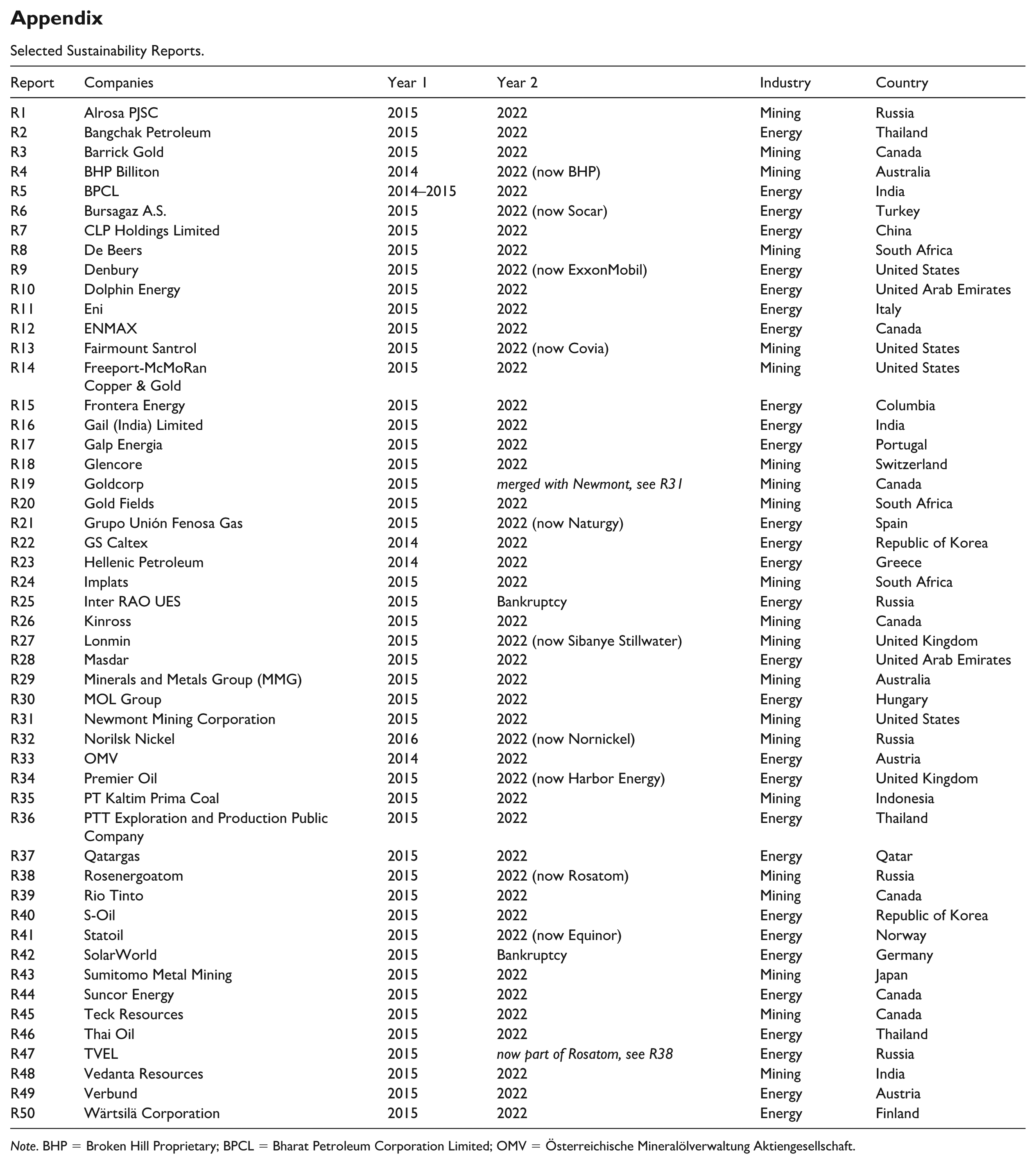
In total, we analyzed 50 sustainability reports from 2015 that met the aforementioned criteria—20 from the mining sector and 30 from the energy sector. We included the same companies’ reports for 2022, except for four companies that either merged (e.g., Goldcorp and Newmont) or declared bankruptcy (e.g., SolarWorld). This resulted in a final dataset of 96 sustainability reports (see Appendix).
Data Analysis
The data analysis focused on the sections of the sustainability reports that explicitly addressed stakeholder engagement. Following the GRI framework, the sampled reports included a general statement on stakeholder engagement and a materiality assessment, for which engagement is a required component. The reports’ GRI content index with page references served as our primary tool for locating the relevant disclosures, complemented by reviewing the full report to capture contextual information on stakeholder engagement. When no such index was provided, we manually searched the report to identify stakeholder engagement sections, ensuring consistent analytical scope.
A qualitative content analysis was conducted, employing a mix of deductive and inductive approaches (Fereday & Muir-Cochrane, 2006). The selected content was coded using NVivo software. We developed a codebook for initial deductive coding. The codebook included basic information related to the reports (e.g., the GRI option chosen for the first selection of reports (Core or Comprehensive), other sustainability guidelines or standards followed, and the presence of external assurance) and stakeholder engagement indicators from the GRI G4 Guidelines (see Online Supplemental Files, Document A). These indicators were maintained in the last version of the GRI Guidelines—the GRI Standards (GRI, 2021)—which most companies followed for their 2022 sustainability reports (except two companies that transitioned away from this framework; their reports were retained for comparative purposes). Our coding, guided by the GRI Guidelines, captured how companies disclosed their stakeholder engagement, such as the stakeholders included, the methods used, the frequency of engagement, or the key topics and concerns raised. In line with prior studies, we distinguished between direct and indirect engagement methods based on classifications from the literature (see Table 1 for corresponding conceptualizations, examples of techniques, and key references). Additional codes were then introduced inductively to examine the extent of disclosure and to identify patterns among the initial codes (Qureshi & Ünlü, 2020). The 2015 and 2022 reports were coded using the same codebook to ensure consistency.
We conducted a comparative analysis of the 2015 and 2022 reports to identify developments in stakeholder engagement disclosures over time. Key trends for both 2015 and 2022 were extracted separately; data from both years were placed side by side in an Excel file for each company, enabling us to identify trends and highlight similarities and differences. The first and second authors conducted the comparative analysis independently, iteratively reviewing the reports, NVivo-coded data, and Excel files, followed by meetings (n = 10) to discuss findings and refine interpretations. This approach allowed us to compare the evolution of engagement methods—distinguishing direct from indirect approaches—and the stakeholder groups reported as engaged. Building on these insights, we developed a typology of reporting companies and classified them into five categories, ranging from front-runners to laggards. This classification was constructed to capture the trajectory of stakeholder engagement practices rather than a static snapshot. Companies were categorized into five groups based on their trajectory and positioning across both periods:
Front-runners demonstrated comprehensive disclosures and a focus on direct stakeholder engagement methods.
Improvers showed progression in the comprehensiveness of disclosures and toward more direct methods of engagement.
Maintainers remained stable mainly with indirect methods or limited stakeholder engagement disclosures.
Decliners reduced the comprehensiveness of their engagement disclosures over time and focused less on direct methods.
Laggards maintained providing general statements and minimal detail about their engagement methods.
During the final phase of data analysis, involving multiple sessions with the research team (four people), three overarching themes emerged that shaped the presentation of our results:
Stakeholders included in the engagement process: Who gets a voice?
Type of stakeholder engagement methods used.
Evolution of stakeholder engagement disclosure practices.
Findings: Stakeholder Engagement in Corporate Sustainability Reporting
Stakeholders Included in the Engagement Process: Who Gets a Voice?
The concept of stakeholder democracy emphasizes engagement processes that involve a broad range of stakeholders, including those most affected by corporate activities. The analysis of stakeholder categories reported over time reveals a relatively stable pattern in how companies disclose their engagement. Most reports mentioned a limited number of stakeholder groups, often without specifying individual actors or clarifying how they were involved. Although the disclosed stakeholders are highly diverse, they can be grouped into six main categories, with a seventh for reports that did not specify any stakeholders. Document B of the Online Supplemental Files provides an overview, including examples, definitions, and representations, across reporting years.
Across both years, financial stakeholders—such as investors, shareholders, and customers—featured most prominently, being mentioned in the majority of reports (94% in 2015 and 92% in 2022). Public and civil society stakeholders, including NGOs, advocacy groups, and media, were also widely represented (82% and 76%, respectively), suggesting that these actors held a recognized, though secondary, position in the engagement practices. Internal stakeholders appeared in 60% (2015) and 58% (2022) of the reports, reflecting a less prominent presence in engagement disclosures. Community stakeholders were identified in 38% and 42% of the reports in 2015 and 2022, respectively, pointing to a more selective inclusion of locally affected groups. Industry stakeholders accounted for 32% in both years, while references to “miscellaneous” stakeholders—such as universities and public organizations—remained comparatively limited (13% and 19%). A small minority of reports made no mention of stakeholders (6% and 8%), indicating that most organizations identify some form of engagement.
In addition, we identified challenges in the level of detail in disclosures of corporate engagement with these stakeholder groups. Reports often lacked detailed information about the nature of the interactions, particularly with Indigenous communities and other critical groups; some also provided very little information about who exactly they were engaging with. Unspecific and ambiguous information makes it difficult to clearly understand who was engaged with, among a broader stakeholder group, such as financial or industry stakeholders. For example, Denbury (2015, p. 5) identified its key stakeholders as the Board of Directors, senior management, employees, investors, and neighbors, yet offered no additional detail regarding these groups, making the scope and nature of their inclusion ambiguous. In their materiality assessment, Statoil (2015, p. 7) wrote that they had a dialogue with “investors and shareholders” and mentioned their majority owner, which is the Norwegian government, but provided no further information about their other investors.
Naming numerous groups at once makes it challenging to distinguish between the various stakeholder groups, and the reports often do not explain how these groups were engaged with. Rio Tinto (2015, p. 11) stated in its materiality assessment: “In 2015, we consulted with investors, suppliers, industry groups, NGOs and peer companies. This combined with media reviews was used to assign an external rating for each issue”. Similarly, while Eni (2022, pp. 16-17), in their materiality analysis, reported having engaged with approximately 3,000 stakeholders to steer their corporate strategy, they failed to disclose the specific actors they consulted or details on the focus of their input specifically for the materiality assessment. Instead, they disclosed “relevant themes” per broad stakeholder group for general engagement activities, as well as an overview of “main engagement activities” without consistently specifying the groups involved.
Certain stakeholder groups, such as Indigenous communities, may have had conflictual relations with reporting companies in the past, yet most firms provided no disclosures on specific communities, the quality of their meetings, or the nature of discussions. This limited disclosure raises concerns regarding stakeholder selection. Most reports referred only in generic terms to “Indigenous communities,” without specifying which Nations they engaged with. Most companies offered little to no explanation of who these rightsholders were, which specific topics were addressed, the rationale for their selection, or the nature of the engagement process. A notable exception is Teck, who outlined the key issues affecting communities of interest within a particular stakeholder group. In both their 2014 (p. 25) and 2022 (p. 63) reports, Teck clearly stated the names of the communities or Nations engaged with. Furthermore, Teck disclosed how issues such as water-related impacts of their operations and holistic approaches to engaging with Indigenous communities (including land use and related concerns) were incorporated into reporting. While such detailed disclosures remained uncommon, these cases demonstrate that specific reporting on Indigenous engagement is feasible within current reporting frameworks.
Overall, our findings highlight that organizations continue to emphasize economically and institutionally proximate stakeholders, while other groups, such as local communities, receive more variable attention. The lack of specificity is particularly consequential for community stakeholders, given their direct exposure to corporate impacts.
Type of Stakeholder Engagement Methods Used
A key dimension of stakeholder democracy concerns the type of engagement, distinguishing dialogic and participatory forms of interaction from more unidirectional approaches focused on gathering stakeholder input. Our analysis shows that indirect engagement methods remain predominant in the reports, with little change over time and generally limited detail in the description of engagement practices (see Table 2).
Stakeholder Engagement Methods: Examples and Occurrence.
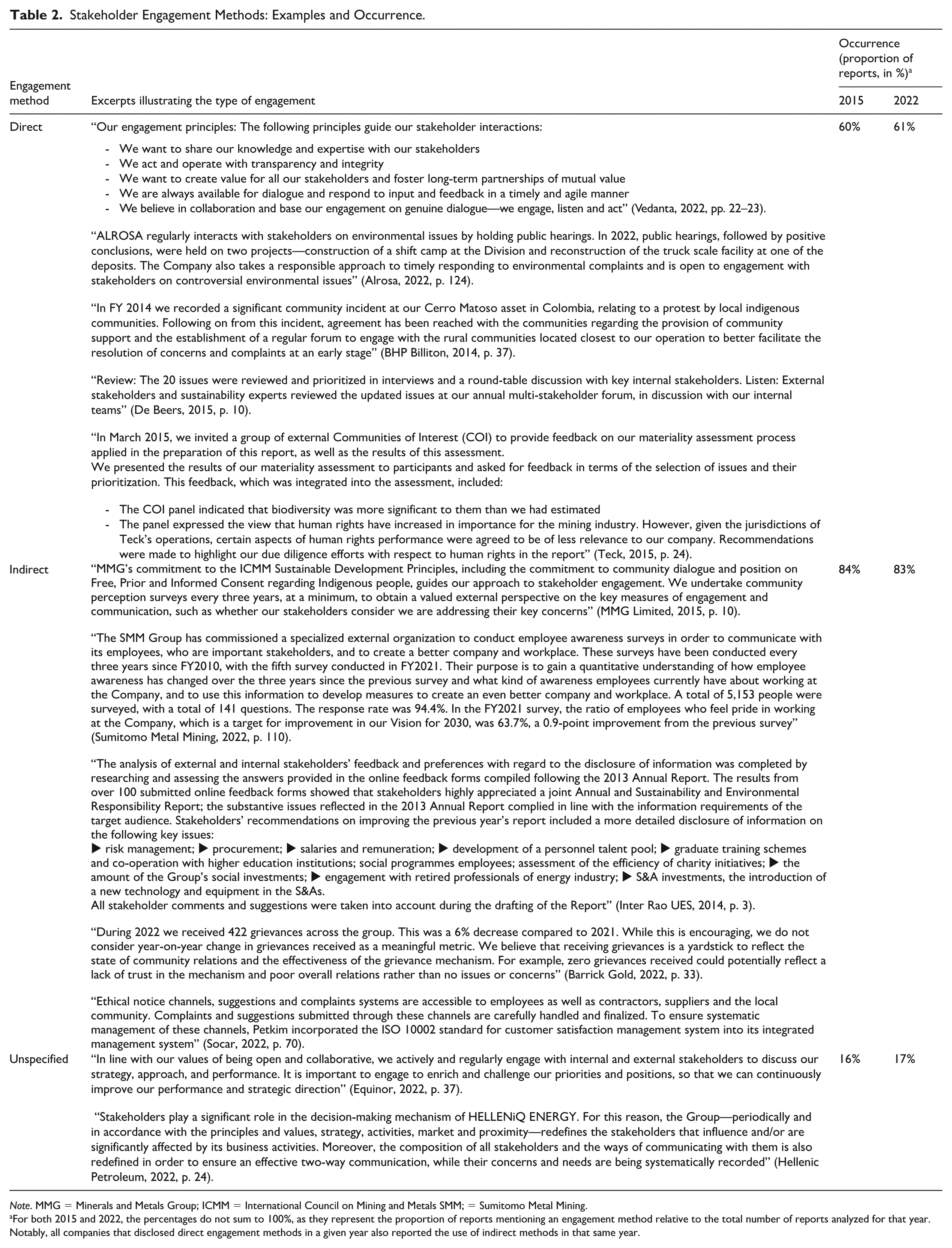
Note. MMG = Minerals and Metals Group; ICMM = International Council on Mining and Metals SMM; = Sumitomo Metal Mining.
For both 2015 and 2022, the percentages do not sum to 100%, as they represent the proportion of reports mentioning an engagement method relative to the total number of reports analyzed for that year. Notably, all companies that disclosed direct engagement methods in a given year also reported the use of indirect methods in that same year.
Direct Engagement
A total of 60% (2015) and 61% (2022) of the sampled companies disclosed the use of direct stakeholder engagement methods. Each of these firms also disclosed indirect engagement methods (see Table 2). Companies reported using direct engagement methods, such as interviews, focus groups, and roundtables, to facilitate interaction with stakeholders. These approaches are intended to facilitate dialogue and collaboration, offering opportunities for diverse perspectives to inform sustainability initiatives.
For example, in 2022, companies such as Vedanta and Bharat Petroleum Corporation Limited (BPCL) disclosed the use of participatory engagement strategies. Vedanta (2022, pp. 22–23) introduced its stakeholder engagement section with a statement in which “dialogue” and “input” were specified as important principles (see Table 2). The following page of the report presented a table listing the company’s stakeholder categories, including key expectations, engagement methods, and initiatives addressing stakeholder concerns. As direct engagement methods, they listed community group meetings, village council meetings, public hearings, and employee feedback sessions. However, no further information was provided on the frequency of these engagements and the uptake of their outcomes in the firm’s decision-making. Similarly, BPCL’s report (2022, pp. 105–107) provided a table listing, for each stakeholder category, the company’s engagement frequency, methods used, key stakeholder topics and concerns, and corporate responses. For example, BPCL (2022, p. 106) indicated that engagement with communities and NGOs was undertaken periodically and on a needs basis, focusing on topics such as “local employment, training and inclusive growth, long-term engagement with NGOs.” The reported company responses included “CSR programs implemented to foster community development, skills training to improve livelihood opportunities, and exit mechanisms to ensure project sustainability.” While BPCL was among the few companies disclosing engagement frequency and the company’s responses to stakeholder engagement, these disclosures remained short and descriptive, offering limited insight into the actual dialogue or outcomes of the engagement.
Furthermore, companies such as Alrosa (2022, see Table 2) or BHP (2022) also disclosed the use of direct engagement methods in their general stakeholder engagement section: Our operated assets are also required to maintain annual stakeholder engagement plans and conduct regular engagement activities, including one-on-one meetings, multi-stakeholder roundtables, issue-based consultations and written communications. These engagements provide a valuable space for more open and in-depth dialogues with stakeholders on issues such as those raised in our community perception research, exploring mutually beneficial solutions and building trust. (BHP, 2022, p. 53)
Direct engagement formats are intended to surface issues and enable stakeholders to contribute to decision-making. However, companies often do not elaborate on the outputs of these methods. BHP was a notable exception (2022, p. 53): the company disclosed that it had received 50 community concerns and 106 complaints, of which five were classified as grievances requiring third-party interventions. It also provided six examples of specific concerns or complaints from different projects worldwide. When accompanied by evidence of uptake of decisions on these specific complaints, these formats align even more closely with democratic practices. While the 2022 report provided a more systematic overview of its approaches, including a quantification of the issues raised and illustrative examples, its 2014 report was distinctive because it offered narrative accounts of specific projects that demonstrated how stakeholder input was taken up in the company’s decision-making (see Table 2).
Some companies, such as De Beers (2015) and Teck (2015), also disclosed the use of direct engagement methods for their materiality assessment process (see Table 2). Yet most companies provided no further details (e.g., De Beers, 2015) or only selected examples (e.g., Teck, 2015) regarding the rationale for issue selection or how deliberation and prioritization processes unfolded.
Indirect Engagement
Indirect engagement methods accounted for 84% of disclosed engagement strategies in 2015 and 83% in 2022. These methods are based on remote activities and rely on one-way, non-interactive communication, including, for example, surveys, questionnaires, or grievance mechanisms. Companies tend to use surveys to gather input or scan expectations. For instance, MMG Limited (2015) conducted a community perception survey, and Sumitomo Metal Mining (2022) carried out an employee awareness survey (see Table 2). These methods often do not specify how survey participants were selected or how the information was processed or used. The examples of MMG Limited (2015) and Socar (2022) showed this, respectively, for a survey and ethical notice channels, where only limited details were provided (see Table 2). By contrast, Sumitomo Metal Mining (2022), Inter Rao UES (2014), and Barrick Gold (2022) provided a greater degree of detail by specifying, for instance, the number of stakeholders surveyed, the results obtained, or the challenges associated with conducting these methods (see Table 2). However, without detailed disclosures on the methods, output, or uptake, it remains uncertain whether these practices reflect responsiveness to stakeholder interests.
Unspecified Engagement Methods
A total of 16% (2015) and 17% (2022) of the reporting companies included only brief or vague stakeholder engagement sections or mentioned engagement sporadically across their reports, without specifying the methods used, thereby limiting the extent to which the democratic character of their engagement practices can be assessed (see Table 2). This category includes, for instance, Equinor’s (2022, p. 37) introductory paragraph in the “External Relations” section, which comprised its stakeholder engagement disclosures. Following this statement, the company described associations and industry initiatives it participated in, as well as partner and supplier relationships. Although it referred to “regular engagement” with broader stakeholder groups, the disclosures lacked methodological detail. Similarly, Hellenic Petroleum (2022, p. 24) noted its aim to “ensure an effective two-way communication,” but no further information on engagement methods was provided (see Table 2). As another example, the 2022 report of PTT Exploration and Production Public Company (pp. 9-10) included a section titled “Stakeholders’ Voices” but did not specify the means through which stakeholder engagement was conducted. Finally, Rosatom (2022) did not include any disclosures on stakeholder engagement.
In sum, stakeholder engagement methods in the sampled reports remain predominantly indirect and minimally detailed, with little change between 2015 and 2022. Although many companies report the use of direct engagement formats, these disclosures are typically superficial, offering limited information on frequency, participant selection, or how stakeholder inputs inform decisions. A few cases provide stronger evidence of follow-up and outcomes, but such examples remain exceptions.
Evolution of Stakeholder Engagement Disclosure Practices
In analyzing the evolution of corporate stakeholder engagement practices between 2015 and 2022, we observed variability in the level of detail of disclosures but limited overall progress. This led us to identify five distinct categories of stakeholder engagement disclosure practices: front-runners, improvers, maintainers, decliners, and laggards (Table 3).
Categorization of Stakeholder Engagement Practices.
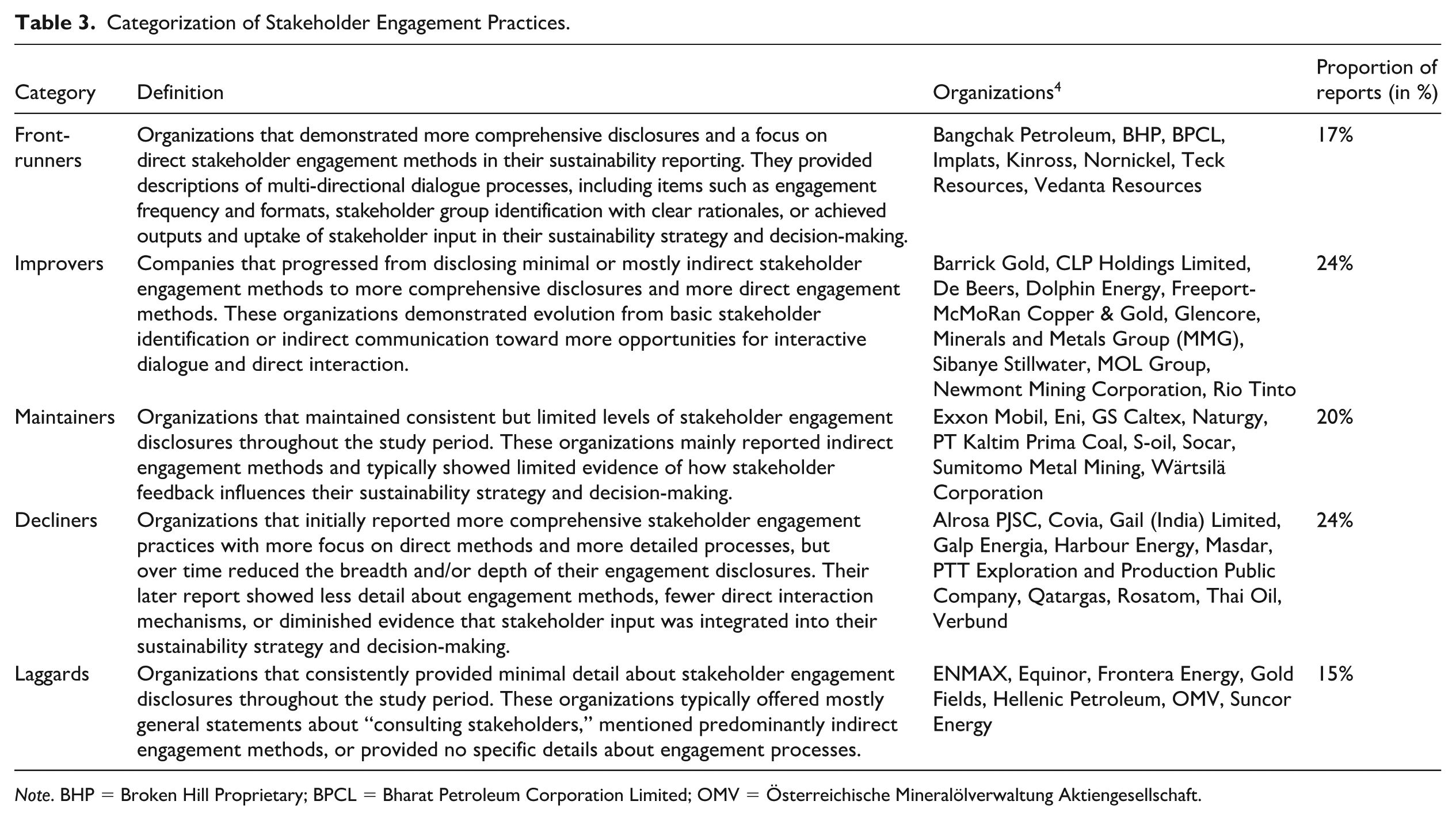
Note. BHP = Broken Hill Proprietary; BPCL = Bharat Petroleum Corporation Limited; OMV = Österreichische Mineralölverwaltung Aktiengesellschaft.
Front-Runners
The first category, front-runners, includes companies that consistently use direct stakeholder engagement methods and provide comprehensive disclosures on stakeholder engagement in their sustainability reports. This group accounts for 17% of the sample, indicating that only a small group of companies maintained such engagement practices over the study period. For example, in its 2015 sustainability report, Kinross included a brief note on stakeholder engagement in its “Message from the President and CEO”: Stakeholder Engagement. We value the input of stakeholders, a fact reflected in the 168,000 interactions we had with stakeholders in 2015. Positive feedback far outweighs negative feedback as we registered 3,800 thank you notes and other expressions of support compared with 132 general complaints and 58 specific grievances. (Kinross, 2015, p. 4)
This was followed by a long and detailed section outlining its engagement practices further along in the report (pp. 63–71). These practices covered “a spectrum of approaches and vary depending on the stakeholders, the needs and nature of the community, and the issues,” including regular meetings with officials and community members, negotiated agreements, formal dialogue tables and stakeholder committees, presentations and partnerships with diverse groups, targeted and public mine tours, participation in cultural and sporting events, and informal conversations. The report highlighted the top concerns by site, the specific stakeholders involved, and how the company responded. By 2022, Kinross had institutionalized these practices more firmly: its sustainability report (pp. 23–27) presented an extensive description of engagement activities, including a detailed table that listed stakeholder groups, key topics raised, methods and engagement frequency, and specific 2022 initiatives. The company also provided an overview of key stakeholder issues (2022, pp. 105–107), including the follow-up of an issue identified in 2015: Trespassers at [mining operations in] Paracatu, [Brazil]: We have implemented comprehensive measures at Paracatu to protect people and assets, operating in a manner consistent with the Voluntary Principles on Security and Human Rights. Trespassing events in 2021 and 2022 were 22 and six respectively, down from a high of 228 in 2017. (Kinross, 2022, p. 105)
The company’s consistent and systematic approach shows how Kinross sustained and further institutionalized their stakeholder engagement practices over time.
Improvers
The second category, improvers, accounts for 24% of the analyzed companies. This group comprises companies progressing from minimal or mostly indirect stakeholder engagement reporting to more comprehensive disclosures and an increased focus on direct engagement methods. They thus evolved from basic stakeholder identification or one-way communication toward more interactive forms of dialogue and participation. For example, in 2015, CLP Holdings (p. 10) noted: “Starting last year, we took the approach of utilizing the stakeholder concerns collected during the year through our existing stakeholder engagement channels, which support our local operational and business strategy needs, to inform the content of our report.” Their “Stakeholder Inclusiveness” statement was followed by a table indicating key stakeholder groups, typical interests and concerns, and activities per region of operation (pp. 11–14). By 2022, the company provided a more detailed account of its practices in a dedicated section on stakeholder engagement (pp. 22–24): Developing a communications and engagement plan: CLP uses a wide range of easily accessible public engagement channels, both formal and informal. Those channels include surveys, focus groups, briefings, visits, events, roadshows and online channels, all of which enable it to receive concerns, interest or feedback at any time during the year. Drawing on past experiences, the channels for each project are selected based on the project’s nature and the most effective means of reaching the identified stakeholders. (CLP Holdings, 2022, p. 22)
In addition, they presented “CLP’s Stakeholder Engagement Framework,” which provided “open and transparent channels for stakeholder input and a review and consideration process where concerns about CLP’s business are responded to in a timely manner” (p. 22). This was followed by a section entitled “CLP’s stakeholder engagement channels,” with a table listing stakeholders, areas of interest in 2022, and key engagement channels. Overall, CLP’s disclosures evolved from relatively little documentation in 2015 to more detailed and systematic reporting in 2022, illustrating an improvement in the company’s stakeholder engagement disclosures.
Maintainers
The third category, maintainers, accounts for 20% of the companies in the sample. They reported consistent but limited levels of stakeholder engagement throughout the study period and mainly engaged indirectly with stakeholders. Their reporting showed neither major improvement nor decline over the period. Maintainers do not show the level of direct engagement required to be considered improvers or front-runners, yet they provide enough information to avoid being classified as decliners or laggards.
For example, in the 2015 report (p. 14–15), Eni included a table outlining their stakeholder engagement practices, though the information provided was limited and offered little detail on the frequency or nature of interactions. Eni also included stakeholder engagement disclosures in their materiality assessment section. They stated that: In order to embrace the top management’s 2014 view, a cycle of interviews with 12 top managers was carried out on the role and meaning of sustainability for Eni. Furthermore, 140 key-position managers were involved in a survey with the aim of finding the issues affecting the value creation. (Eni, p. 13)
By 2022, the table format was replaced with a written description and table conveying similar information but still lacking specificity on engagement type and frequency. In the same section, entitled “Stakeholder Engagement Activities” (p. 16), the company reported that “about 3,000 stakeholders were engaged in the materiality analysis that steers corporate strategy and guides the definition of the Strategic Plan.” While direct engagement with top management was no longer highlighted, the scope of consultation was considerably expanded. However, this broader outreach was accompanied by limited detail on engagement modes and how stakeholder input informed decisions. Thus, while the number of stakeholders increased substantially, limited clarity and detail underscore the persistent tension between disclosures on the breadth of participation and the depth of engagement.
Decliners
The second-to-last category comprises decliners, representing 24% of the companies in the sample. Initially, this group reported stakeholder engagement practices with greater detail, outlining processes with some specificity, and greater emphasis on direct methods. Over time, however, they reduced the depth, frequency, and detail of their stakeholder engagement reporting.
For example, in 2015, in the “Stakeholder Engagement” section, Harbour Energy (then Premium Oil) disclosed information on the purpose of the engagement, stakeholder selection, and the different levels at which engagement took place (i.e., at corporate, business unit, and operational levels). They further stated: Stakeholder engagement also helps us to understand the potential risks that stakeholders could pose to the achievement of our business objectives, thereby enabling us to avoid or mitigate them in a proactive way. Examples of the stakeholders we engaged in 2014 and the issues raised by and with them are set out in Figure 6. The feedback from our engagement activities has helped inform our risk management process. (Premium Oil, 2015, p.23)
They also reported on their first Stakeholder Forum on Corporate Responsibility, presenting it as an initiative intended to expand in the following years. They further included a detailed table (pp. 23–25) identifying six stakeholder categories and 13 subgroups (e.g., business partners subdivided into joint venture partners, contractors and suppliers, and customers). For each subgroup, they specified engagement mechanisms, minimum engagement frequency, key issues raised in 2014, and cross-references for further information.
Although the company continued to affirm the significance of stakeholder engagement in 2022, the level of specificity declined. The 2022 report contained a separate section entitled “Engaging with our stakeholders,” yet it was introduced by only a short statement: “Working together to create shared value: We aim to create value for our stakeholders by engaging with them and understanding and responding to the issues that are important to them,” followed by a quote from the Senior Vice-President, Government and External Affairs (p. 10). The one-page disclosure identified six stakeholder groups, each accompanied by a short narrative and typically a single engagement indicator (e.g., >350 investor meetings during 2022). This marked a clear decline in the disclosure of stakeholder engagement processes compared to 2015.
Another example is Masdar, which stated in their 2015 “Sustainability Policy” that it responds to “the issues, needs and expectations of our internal and external stakeholders through regular consultation, collaboration and on-going dialogue” (p. 14). They then provided a detailed section (pp. 29–36) outlining their approach, stakeholder mapping, detailed stakeholder groups and subgroups, an engagement matrix with frequencies, an overview of activities, and an impact matrix specifying methods, issues raised, and company responses. However, in the 2022 report, there was no dedicated discussion of stakeholder engagement. Instead, stakeholders were mentioned only indirectly in different instances throughout the report, for example, in relation to Masdar’s participation in international platforms (p. 62). This shift illustrates the fragility of progress in embedding stakeholder engagement within sustainability reporting over time.
Laggards
The final category, laggards, accounts for 15% of the companies in the sample. Throughout the study period, these companies consistently provided minimal detail on stakeholder engagement reporting. Their disclosures were typically limited to general statements about “consulting stakeholders,” relied primarily on indirect engagement methods, or provided no specific information about engagement processes.
One example is Equinor (previously Statoil), whose 2015 sustainability report included only brief references to stakeholder engagement. In its strategy section, the company acknowledged the need to adapt to diverse local contexts, stating that “Creating lasting value for communities’, the second strand of our sustainability strategy, implies working within a number of areas simultaneously, while demonstrating inclusive stakeholder engagement” (2015, p. 4). The report’s dedicated stakeholder engagement section consisted of a single paragraph under “Our Approach”: Stakeholder engagement is a central element of our commitment to create lasting local value. We work with communities in the countries in which we have business activities to enhance the benefits and manage the potentially adverse impacts of our activities. We use public consultations, surveys, interviews, town hall meetings and community panels to manage our impact on communities and understand how we can contribute. A corporate reputation tracker that includes sustainability and ethics themes is run regularly. (Statoil, 2015, p. 26)
Although the company briefly mentioned several engagement methods and claimed to use direct approaches, the disclosures remained vague and largely descriptive, providing little information on processes, participants, or outcomes.
In 2022, Equinor’s references to stakeholder engagement were brief and dispersed across different report sections (e.g., protecting nature, human rights, diversity and inclusion, integrity, and performance). The dedicated “External Relations” section (p. 37) provided only a short and vague description of engagement activities, mentioning “consultations with stakeholders” and “the Energy Transition Plan presented at the Annual General Meeting” as examples. Overall, the 2022 disclosures were fragmented and offered minimal insight into the scope or outcomes of stakeholder engagement.
Another example is Gold Fields, whose 2015 disclosures presented stakeholders primarily through a value distribution lens. An early section of the report (entitled “Stakeholder value distribution,” p. 11) outlined how value flows to governments, employees, suppliers, and host communities, but provided little information on engagement processes themselves. Later, in the “Risk and materiality” section (p. 42), the company included a very short paragraph on stakeholder engagement, referencing the AA1000 principles and distinguishing between direct and indirect engagement at operational and corporate levels (e.g., community forums, meetings with regulators, investor outreach). However, this description remained highly generic, with no detail on the participants, frequency of engagement, or how stakeholder input informed decision-making. In 2022, Gold Fields continued to refer to stakeholders, mainly in the context of value creation rather than stakeholder engagement. The report frequently highlighted how the company “creates enduring value for stakeholders,” emphasizing outcomes such as employment, procurement, and social investment, but providing no dedicated section or detailed explanations of stakeholder engagement processes. References to engagement appeared briefly and in passing—for example, in relation to community relations or materiality—without specifying who was involved, how engagement occurred, or how stakeholder input informed decisions.
Discussion and Conclusions
This study examined how stakeholder engagement is disclosed in sustainability reports and the extent to which these disclosures reflect practices associated with stakeholder democracy. Comparing 2015 and 2022 reports across mining and energy companies, we found a mixed landscape marked by continued prioritization of financial stakeholders, ambiguous stakeholder identification, and reliance on indirect engagement. Only a small subset of companies demonstrated sustained, detailed engagement practices; most showed modest improvement, stagnation, or regression. Overall, progress toward more dialogic and participatory engagement in sustainability reporting remains limited.
Contributions
This article advances research on sustainability reporting and stakeholder democracy (e.g., Ardiana, 2023; Crane et al., 2004; Wenzel et al., 2025) by critically examining stakeholder engagement disclosures in sustainability reports from the mining and energy sectors. Despite the mainstreaming of sustainability reporting and increasing institutional pressure, our findings show that these disclosures remain uneven in breadth (who is engaged) and depth (how engagement occurs), and that practices associated with stakeholder democracy remain selective and limited. Indirect engagement methods continue to dominate, and many reports lack methodological specificity—such as stakeholder selection criteria, respondent distribution, or clear explanations of how stakeholder input informed decisions. These patterns reinforce concerns raised in prior research that stakeholder engagement in sustainability reporting often remains discretionary, generic, and procedurally framed rather than substantively participatory (Bellucci et al., 2019; Gagné et al., 2022; Puroila & Mäkelä, 2019; Torelli et al., 2020). While reporting frameworks present engagement as supporting transparency and accountability, our findings suggest that the form of engagement disclosed does not systematically translate into demonstrable influence on organizational decision-making.
Building on research that conceptualizes sustainability reports as mediated arenas in which stakeholder voices are filtered through managerial framing (Cho et al., 2015; Talbot & Boiral, 2018), our analysis illustrates how engagement is represented rather than directly observed. In high-impact extractive sectors, where legitimacy pressures and social license to operate concerns are pronounced (Böhling et al., 2019; Jenkins, 2004), reporting practices may be shaped by incentives to manage how stakeholder expectations are portrayed. Consistent with this reasoning, we observe that financial stakeholders are more prominently represented, while Indigenous and local communities—whose claims may challenge corporate operations or legitimacy—are more frequently described in generic and limited terms. Although we do not assess engagement practices directly, uneven representation in disclosures raises important questions about whose concerns are rendered visible and whose influence is traceable in reported decision-making processes (Jastram & Berberyan, 2023). In doing so, our findings extend critiques of impression management in sustainability reporting by showing how selective representation operates not only for performance metrics but also for stakeholder engagement disclosure (Cho et al., 2015; Gagné et al., 2022; Sandberg & Holmlund, 2015). Taken together, considering financial stakeholder prioritization, continued reliance on indirect techniques, and sparse engagement of marginalized groups, our results suggest that without meaningful reform, sustainability reporting will continue to privilege corporate perspectives over inclusive, dialogic engagement and robust accountability. This is particularly concerning in the mining and energy sectors, where structural obstacles to meaningful engagement with Indigenous communities remain pronounced (Böhling et al., 2019; Jenkins, 2004; Journeault et al., 2021; Zharfpeykan, 2021). As corporate accountability scholarship underscores, insufficient attention to Indigenous communities’ histories, cultures, and political structures—alongside the risks of tokenism—can impede genuine dialogue and further erode trust (Jenkins, 2004; Journeault et al., 2021).
A central conceptual contribution of this study is to refine how engagement disclosures are evaluated. Previous research has primarily assessed engagement through the presence of stakeholder categories, the classification of methods, or dialogic aspirations (Bellucci et al., 2019; Puroila & Mäkelä, 2019; Torelli et al., 2020). We extend this work by introducing uptake—the extent to which reported engagement practices are visibly embedded in organizational processes and outcomes—as a complementary evaluative dimension. Across our sample, many disclosures describe stakeholder groups and interaction formats but provide limited traceability for decisions, strategic adjustments, resource allocation, or other organizational changes. Advancing dialogic accounting scholarship, which emphasizes deliberation, plurality, and the risk of managerial capture in accountability processes (Bebbington et al., 2007; Brown & Dillard, 2015), we argue that democratic potential depends not only on the existence of engagement mechanisms but on disclosure of how stakeholder input is incorporated. Uptake and traceability thus become necessary conditions for assessing whether sustainability reporting supports democratic forms of corporate accountability.
Extending this analysis over time by examining disclosures longitudinally, the study moves beyond static snapshots to reveal divergent trajectories: while some firms broadened or diversified their engagement disclosures between 2015 and 2022, others regressed or stagnated, resulting in limited aggregate progress. This variation within a shared regulatory and institutional environment suggests that institutionalization alone does not guarantee deeper or more democratic engagement practices. In line with research demonstrating that the formal adoption of sustainability standards does not necessarily transform underlying practices (Boiral, 2013; Cho et al., 2018; Hahn et al., 2023), our findings challenge assumptions that the mainstreaming of sustainability reporting yields cumulative progress toward participatory accountability. Rather than converging toward consistent and increasingly dialogic forms of engagement, disclosure trajectories appear fragmented and, in some cases, reversible. This divergence reinforces our earlier finding that engagement disclosure remains mediated by organizational interpretation of reporting requirements.
Finally, our findings highlight a persistent gap between the normative expectations embedded in reporting frameworks and disclosed practices. The GRI standards emphasize materiality, stakeholder inclusiveness, and meaningful engagement, positioning stakeholder participation as integral to identifying priority issues and shaping reporting outcomes. However, many reports in our sample provide insufficient detail to demonstrate how stakeholders are identified, how material topics are prioritized, and how stakeholder input influences decisions. This gap nuances literature that portrays reporting frameworks as mechanisms for enhancing democratic accountability (Kujala et al., 2022; Leeson & Kuszewski, 2023); it also supports critical scholarship documenting implementation gaps between formal adherence and substantive change (Hahn et al., 2023; Talbot & Boiral, 2018). In this sense, our findings suggest that while sustainability reporting has become institutionalized, its democratic potential remains contingent on organizational choices regarding transparency, traceability, and inclusion rather than guaranteed by formal standard adoption.
Taken together, these contributions demonstrate that the mainstreaming and standardization of sustainability reporting have not systematically translated into cumulative progress toward inclusive and dialogic engagement. Instead, engagement disclosures remain uneven and selectively detailed, reflecting ongoing organizational discretion in how stakeholder engagement is represented. By foregrounding breadth, depth, and uptake as complementary dimensions, our study clarifies the conditions under which sustainability reporting may support democratic accountability—and the structural limits that continue to constrain its realization, particularly in high-impact extractive sectors (Böhling et al., 2019; Talbot & Boiral, 2018).
Managerial and Policy Implications
To enhance stakeholder engagement in sustainability reporting, companies could adopt more systematic approaches to both conducting and disclosing engagement processes. In-depth stakeholder engagement is crucial for enabling broader participation and more democratic forms of corporate decision-making. This implies embedding dialogue mechanisms upstream of reporting, rather than treating stakeholders as passive recipients of sustainability reports. Greater stakeholder involvement throughout the reporting cycle may strengthen the credibility and balance of corporate sustainability narratives. For example, multi-stakeholder committees or advisory panels could be involved in key stages of the reporting process, such as identifying material issues, documenting stakeholder expectations, clarifying trade-offs between divergent interests, and reviewing how such considerations are reflected in organizational decisions and disclosed information.
Given the centrality of stakeholder engagement to frameworks like GRI, regulators could strengthen structured guidance to enhance consistency and accountability. This guidance may include clear methodologies for identifying, consulting, and integrating perspectives of underrepresented groups—Indigenous communities, and other marginalized stakeholders. Tailored strategies such as participatory decision-making, culturally appropriate consultation, and long-term relationship-building may help address power asymmetries and support more meaningful incorporation of stakeholder concerns.
At the same time, any such guidance must resist the temptation to prescribe a single universal model of engagement. What constitutes meaningful stakeholder engagement is shaped by cultural context, historical relationships, and industry-specific dynamics. Engagement with Indigenous rightsholders in a Canadian mining context, for instance, carries distinct legal and relational dimensions that differ from engagement with affected communities in a Gulf-region energy company or a South African extractive operation. Regulators and companies alike should therefore treat reporting frameworks as enabling structures rather than compliance checklists; they should provide a common floor of accountability while preserving the flexibility necessary for contextually grounded practices. A one-size-fits-all approach risks reducing engagement to a procedural exercise.
Limitations of the Study and Avenues for Future Research
This study has several limitations. Its focus on extractive industries, namely mining and energy, limits generalizability to other sectors. Future research could extend this analysis across industries and use larger, geographically diverse samples to explore region-specific patterns. Longitudinal studies examining how engagement practices evolve in response to regulatory changes would also be valuable. Each framework—GRI, SASB, IFRS, or CSRD—encourages stakeholder engagement differently, making comparative analysis of their impacts worthwhile. For instance, our 2022 data show several companies outside the European Union now adopting double materiality, a CSRD principle requiring both inside–out (impact/stakeholder) and outside–in (financial) perspectives. This may encourage companies to broaden stakeholder inclusion beyond investor concerns when selecting prioritized ESG topics. In addition, while our study examines what companies report about stakeholder engagement, future research should investigate stakeholder perspectives on these processes—including whether and how stakeholders actually participate in sustainability reporting, whether they find these engagement opportunities meaningful, and what barriers they face in having their voices heard.
Although we categorized stakeholder engagement into direct and indirect forms, we initially intended to conduct a more granular analysis across stakeholder groups (e.g., employees, customers, communities, investors) and trace changes between 2015 and 2022. However, this was constrained by the limited detail provided in most sustainability reports, particularly regarding specific engagement methods and the stakeholder groups to which they were directed. The lack of granularity in the disclosures restricted more nuanced analyses of the patterns of engagement and their evolution. Future research would benefit from accessing richer data sources or alternative research methods, such as interviews, surveys, ethnography, or participant observation, to capture the complexity and variation in stakeholder engagement practices across different groups and periods.
Prior research on impression management suggests that in their sustainability reports, companies tend to highlight what they regard as their most favorable initiatives (Sandberg & Holmlund, 2015; Talbot & Boiral, 2018). As a result, our analysis captures only the practices that companies themselves consider most substantive or exemplary and does not provide a comprehensive picture. Future research could address this limitation by examining the decision-making processes behind stakeholder disclosures and the challenges companies face in engaging stakeholders meaningfully. Such studies could analyze conflicts of interest, political trade-offs, and legitimacy considerations that shape disclosure choices, and explore discrepancies between organizational practices and their representation in reports. This would shed light on the mechanisms of filtering, simplification, and impression management that underlie the disclosure of information on stakeholder engagement.
Finally, in line with Crane and Matten (2021), there is a growing need to revisit stakeholder identification models, which may overlook marginalized or underrepresented groups. Future studies could develop frameworks for stakeholder identification that better reflect evolving societal expectations and emerging stakeholder voices. In addition, future research could also examine sustainability reporting with greater attention to organizations’ social obligations, particularly toward employees and affected communities, including Indigenous communities. By advancing these research directions, scholars can contribute to a more critical and inclusive understanding of stakeholder engagement in sustainability reporting.
Supplemental Material
sj-docx-1-oae-10.1177_10860266261446871 – Supplemental material for From Disclosure to Democracy: A Content Analysis of Stakeholder Engagement Processes in Sustainability Reports
Supplemental material, sj-docx-1-oae-10.1177_10860266261446871 for From Disclosure to Democracy: A Content Analysis of Stakeholder Engagement Processes in Sustainability Reports by Julie Bernard, Kim Ceulemans, Olivier Boiral and Marie-Christine Brotherton in Organization & Environment
Footnotes
Appendix
Selected Sustainability Reports.
| Report | Companies | Year 1 | Year 2 | Industry | Country |
|---|---|---|---|---|---|
| R1 | Alrosa PJSC | 2015 | 2022 | Mining | Russia |
| R2 | Bangchak Petroleum | 2015 | 2022 | Energy | Thailand |
| R3 | Barrick Gold | 2015 | 2022 | Mining | Canada |
| R4 | BHP Billiton | 2014 | 2022 (now BHP) | Mining | Australia |
| R5 | BPCL | 2014–2015 | 2022 | Energy | India |
| R6 | Bursagaz A.S. | 2015 | 2022 (now Socar) | Energy | Turkey |
| R7 | CLP Holdings Limited | 2015 | 2022 | Energy | China |
| R8 | De Beers | 2015 | 2022 | Mining | South Africa |
| R9 | Denbury | 2015 | 2022 (now ExxonMobil) | Energy | United States |
| R10 | Dolphin Energy | 2015 | 2022 | Energy | United Arab Emirates |
| R11 | Eni | 2015 | 2022 | Energy | Italy |
| R12 | ENMAX | 2015 | 2022 | Energy | Canada |
| R13 | Fairmount Santrol | 2015 | 2022 (now Covia) | Mining | United States |
| R14 | Freeport-McMoRan Copper & Gold |
2015 | 2022 | Mining | United States |
| R15 | Frontera Energy | 2015 | 2022 | Energy | Columbia |
| R16 | Gail (India) Limited | 2015 | 2022 | Energy | India |
| R17 | Galp Energia | 2015 | 2022 | Energy | Portugal |
| R18 | Glencore | 2015 | 2022 | Mining | Switzerland |
| R19 | Goldcorp | 2015 | merged with Newmont, see R31 | Mining | Canada |
| R20 | Gold Fields | 2015 | 2022 | Mining | South Africa |
| R21 | Grupo Unión Fenosa Gas | 2015 | 2022 (now Naturgy) |
Energy | Spain |
| R22 | GS Caltex | 2014 | 2022 | Energy | Republic of Korea |
| R23 | Hellenic Petroleum | 2014 | 2022 | Energy | Greece |
| R24 | Implats | 2015 | 2022 | Mining | South Africa |
| R25 | Inter RAO UES | 2015 | Bankruptcy | Energy | Russia |
| R26 | Kinross | 2015 | 2022 | Mining | Canada |
| R27 | Lonmin | 2015 | 2022 (now Sibanye Stillwater) |
Mining | United Kingdom |
| R28 | Masdar | 2015 | 2022 | Energy | United Arab Emirates |
| R29 | Minerals and Metals Group (MMG) | 2015 | 2022 | Mining | Australia |
| R30 | MOL Group | 2015 | 2022 | Energy | Hungary |
| R31 | Newmont Mining Corporation | 2015 | 2022 | Mining | United States |
| R32 | Norilsk Nickel | 2016 | 2022 (now Nornickel) |
Mining | Russia |
| R33 | OMV | 2014 | 2022 | Energy | Austria |
| R34 | Premier Oil | 2015 | 2022 (now Harbor Energy) |
Energy | United Kingdom |
| R35 | PT Kaltim Prima Coal | 2015 | 2022 | Mining | Indonesia |
| R36 | PTT Exploration and Production Public Company | 2015 | 2022 | Energy | Thailand |
| R37 | Qatargas | 2015 | 2022 | Energy | Qatar |
| R38 | Rosenergoatom | 2015 | 2022 (now Rosatom) |
Mining | Russia |
| R39 | Rio Tinto | 2015 | 2022 | Mining | Canada |
| R40 | S-Oil | 2015 | 2022 | Energy | Republic of Korea |
| R41 | Statoil | 2015 | 2022 (now Equinor) | Energy | Norway |
| R42 | SolarWorld | 2015 | Bankruptcy | Energy | Germany |
| R43 | Sumitomo Metal Mining | 2015 | 2022 | Mining | Japan |
| R44 | Suncor Energy | 2015 | 2022 | Energy | Canada |
| R45 | Teck Resources | 2015 | 2022 | Mining | Canada |
| R46 | Thai Oil | 2015 | 2022 | Energy | Thailand |
| R47 | TVEL | 2015 | now part of Rosatom, see R38 | Energy | Russia |
| R48 | Vedanta Resources | 2015 | 2022 | Mining | India |
| R49 | Verbund | 2015 | 2022 | Energy | Austria |
| R50 | Wärtsilä Corporation | 2015 | 2022 | Energy | Finland |
Note. BHP = Broken Hill Proprietary; BPCL = Bharat Petroleum Corporation Limited; OMV = Österreichische Mineralölverwaltung Aktiengesellschaft.
Acknowledgements
The authors would like to thank David Talbot and Michelle Rodrigue for their helpful guidance and comments in developing this paper. They are also grateful for the helpful comments of Diane-Laure Arjaliès, Myriam Michaud, and Ju Young Lee on the earlier version of this paper. They would also like to thank the Social Responsibility (SR) Division at the Administrative Sciences Association of Canada (ASAC) Conference for their comments on an earlier version of this paper. They would also like to thank Lyanne Ahumada, our research assistant, for her assistance in the data collection and Andrea Zanin, for her copyediting of this paper.

Funding
The authors disclosed receipt of the following financial support for the research, authorship, and/or publication of this article: The authors are grateful to the Canada Research Chair in Internalization of Sustainability Practices and Organizational Accountability for providing funding for this project.
Declaration of Conflicting Interests
The authors declared no potential conflicts of interest with respect to the research, authorship, and/or publication of this article.
Supplemental Material
Supplemental material for this article is available online.
Notes
Author Biographies
References
Supplementary Material
Please find the following supplemental material available below.
For Open Access articles published under a Creative Commons License, all supplemental material carries the same license as the article it is associated with.
For non-Open Access articles published, all supplemental material carries a non-exclusive license, and permission requests for re-use of supplemental material or any part of supplemental material shall be sent directly to the copyright owner as specified in the copyright notice associated with the article.
