






Abstract
We introduce this Special Issue on Mainstreaming Sustainability by reviewing insights from organisational research on how sustainability becomes, or fails to become, mainstream practice. Although organisational sustainability research has investigated diverse approaches to addressing sustainability challenges, critical questions about mainstreaming remain underexplored. To advance this field of research, we define sustainability mainstreaming and identify two distinct types: integrating sustainability within business‑as‑usual and transformative change. We offer a novel framework of sustainability mainstreaming that integrates multiple levels of analysis, organises research across these levels, and identifies the mechanisms that explain why the process of mainstreaming reproduces business-as-usual in some contexts while enabling transformative change in others. We position the eight Special Issue articles within this framework, distinguishing business‑as‑usual and transforming modes of mainstreaming at the institutional, interorganisational, organisational, and individual levels. We conclude with a research agenda on four themes: multilevel integration, the impact of mainstreaming, temporal complexity, and political realities.
Introduction
Calls for addressing and accelerating sustainability have been made for well over 30 years (cf. An, 2023; Gladwin et al., 1995; Johnson & Schaltegger, 2016; Mebratu, 1998; Shrivastava, 1995; Starik & Rands, 1995) with scholars and practitioners alike advocating for more rapid organisational transformation. Yet management and organisation studies find that sustainability is often considered an operational or technical issue that should be relegated to specialised departments or compliance functions rather than integrated into core strategic decision-making. Although sustainability has gradually reached corporate boardrooms (Walls & Berrone, 2017; Yuriev & Boiral, 2024) with dedicated roles crafted for sustainability managers (Carollo & Guerci, 2018; Wickert & de Bakker, 2018) and consultants (Gond et al., 2024), considerable uncertainty remains about how to address the challenges of mainstreaming and the associated risks within business organisations. The depth and authenticity of sustainability governance vary considerably across organisations, and its mainstreaming is increasingly contested in the current political climate (Buzogány & Mohamad-Klotzbach, 2021; O’Brien, 2026). Recognition of sustainability’s importance does not automatically translate into effective governance structures, adequate resource allocation, or meaningful strategic integration. The gap between rhetoric and reality remains substantial in many organisations (Lyon & Montgomery, 2015), raising persistent questions about the motivations and effectiveness of sustainability initiatives.
Sustainability concerns such as environment, health, and safety (EHS) issues have long been part of organisations’ operational and supply chain practices, typically managed through risk mitigation and regulatory compliance frameworks (Gemmell & Scott, 2013; Hajmohammad & Vachon, 2016; Han & Um, 2024). However, the climate emergency, biodiversity loss, and a range of social issues including inequality, human rights, and labour conditions have significantly raised the strategic urgency of sustainability for business and have broadened its potential impact. Although sustainability has material implications for long‑term performance, organisations have embraced this insight to varying degrees and have started to mainstream sustainability in markedly different ways.
Multiple drivers have accelerated the shift to mainstreaming: increased regulatory pressures (such as the EU’s Corporate Sustainability Reporting Directive [CSRD] and climate disclosure requirements), insurance company requirements, investors demanding environmental, social, and governance (ESG) integration, employees seeking purposeful work, consumers making values-based purchasing decisions, and a host of supply chain challenges ranging from resource scarcity to reputational risks associated with supplier conduct. Despite all these developments, the mainstreaming of sustainability, that is, the process of treating or regarding sustainability as normal, still faces considerable challenges, not in the least because sustainability is itself such a broad and complex notion. Global sustainability indicators, such as the planetary boundaries, suggest that sustainability remains far from being mainstreamed in practice (Williams et al., 2025).
In this introduction to the Special Issue (SI), 1 we examine the notion of mainstreaming in the context of sustainability. Discussing mainstreaming is important because it considers whether and how sustainability ideas are taken up within organisations, markets, and policy domains, and what happens to these ideas in the process. As Scott et al. (2022, p. 213) note, mainstreaming involves the “interdisciplinary and transdisciplinary process of transmorphing and normalising a concept, objective, policy or plan within the decision-making and routine activities of multiple policy domains necessary for effective delivery and impact.” In our context, mainstreaming engenders processes of structurally, culturally, and practically embedding sustainability into institutional, organisational, and individual actions and behaviours. At the same time, the extent to which mainstreaming simply leads to the internalisation of sustainability consistent with “business-as-usual” approaches or fundamentally disrupts, thus leading to more transformative change, remains unclear.
This SI is motivated by a diversity of questions pertaining to the drivers, mechanisms, and outcomes of mainstreaming sustainability. For instance, little is known about what is being mainstreamed at different levels of analysis, the mechanisms through which sustainability becomes mainstreamed (or not), the tensions and contradictions that emerge during this process, and the consequences of mainstreaming for sustainability agendas. What organisational structures, governance mechanisms, incentive systems, and cultural shifts are required? Does mainstreaming sustainability represent genuine institutional change or does it risk being diluted to fit existing organisational logics? How do temporal dynamics such as the interplay between short-term pressures and long-term commitments shape mainstreaming trajectories? And how do political contestations, at multiple levels, enable or constrain the mainstreaming process?
In the remainder of this article, we first draw on insights from the environmental governance and policy literature to define mainstreaming sustainability. Second, we review the extant organisation studies literature on mainstreaming sustainability and classify it along four levels of analysis, building on prior research that has acknowledged sustainability challenges need to be addressed across multiple, interconnected levels (Johnson & Schaltegger, 2020; Russo et al., 2024; Schaltegger et al., 2022). We develop a novel framework by identifying the opportunities, challenges, and tensions of mainstreaming sustainability at each level and by classifying mainstreaming sustainability as integration within business-as-usual versus transformative change. Third, we position the SI articles within our novel framework on the distinct types of mainstreaming at multiple, interconnected levels of analysis and identify their contributions. Finally, we propose a research agenda focused on multilevel integration, the impact of mainstreaming, temporal complexity, and political realities.
Mainstreaming Sustainability: Four Levels of Analysis
Although important sustainability initiatives have been undertaken, such as the development of sustainability reporting standards, the growth of impact investing, and the emergence of chief sustainability officers, the pace of mainstreaming sustainability in many organisations often remains slow, ineffective, or symbolic, leading to repeated calls for accelerating sustainability and associated transitions (Dahlmann & Brammer, 2011; Markard et al., 2020; Yang et al., 2026). This challenge raises fundamental questions about what is actually being mainstreamed and what mechanisms facilitate or hinder mainstreaming.
The literature on mainstreaming sustainability is quite dispersed, ranging from research on education (Bansal & Boyd, 2026; O’Rafferty et al., 2014) to public administration and governance (Bornemann & Christen, 2025; Scott et al., 2022) and from research on regional development (Wamsler et al., 2014) to environmental law (Bleby & Foerster, 2023). Despite its widespread use across disciplines and empirical contexts, mainstreaming sustainability remains poorly defined with no shared or established definition in organisational studies. To improve our understanding of mainstreaming sustainability for organisations, we here rely on insights from the environmental governance and policy domain, which has defined mainstreaming as “taking a specific objective of one issue domain and declaring that this objective should be integrated into other issue domains where it is not (yet) sufficiently addressed” (Scott et al., 2022, p. 203). The mainstreaming of sustainability generally is inherently more complex than targeted forms of mainstreaming with more narrowly defined objectives, such as the mainstreaming of policy on reducing carbon emissions, which is why some have argued that mainstreaming sustainability requires comprehensive and “transformative change that systemically links environmental, economic, and social concerns” (Bornemann & Christen, 2025, p. 5).
The fragmentation of the mainstreaming literature partly reflects the fact that scholars examine how sustainability becomes embedded at multiple levels of analysis or scales (Goworek et al., 2018), including the institutional, interorganisational, organisational, and individual levels (Bansal & Song, 2017). This emphasis on multiple levels builds on prior research that recognises sustainability exists across interconnected levels and calls for multilevel theorising to capture both top–down and bottom–up dynamics (Russo et al., 2024; Williams et al., 2025). To extend this debate to mainstreaming sustainability, we visualise four levels at which sustainability can be mainstreamed in Figure 1, indicating what is being mainstreamed at each level, and what distinct mechanisms each level encompasses through which sustainability becomes normalised in practice. In doing so, we define mainstreaming sustainability as processes for systemically normalising environmental, social, and economic objectives in interconnected institutional, interorganisational, organisational, and individual practices – via integration in business-as-usual or transformative change.
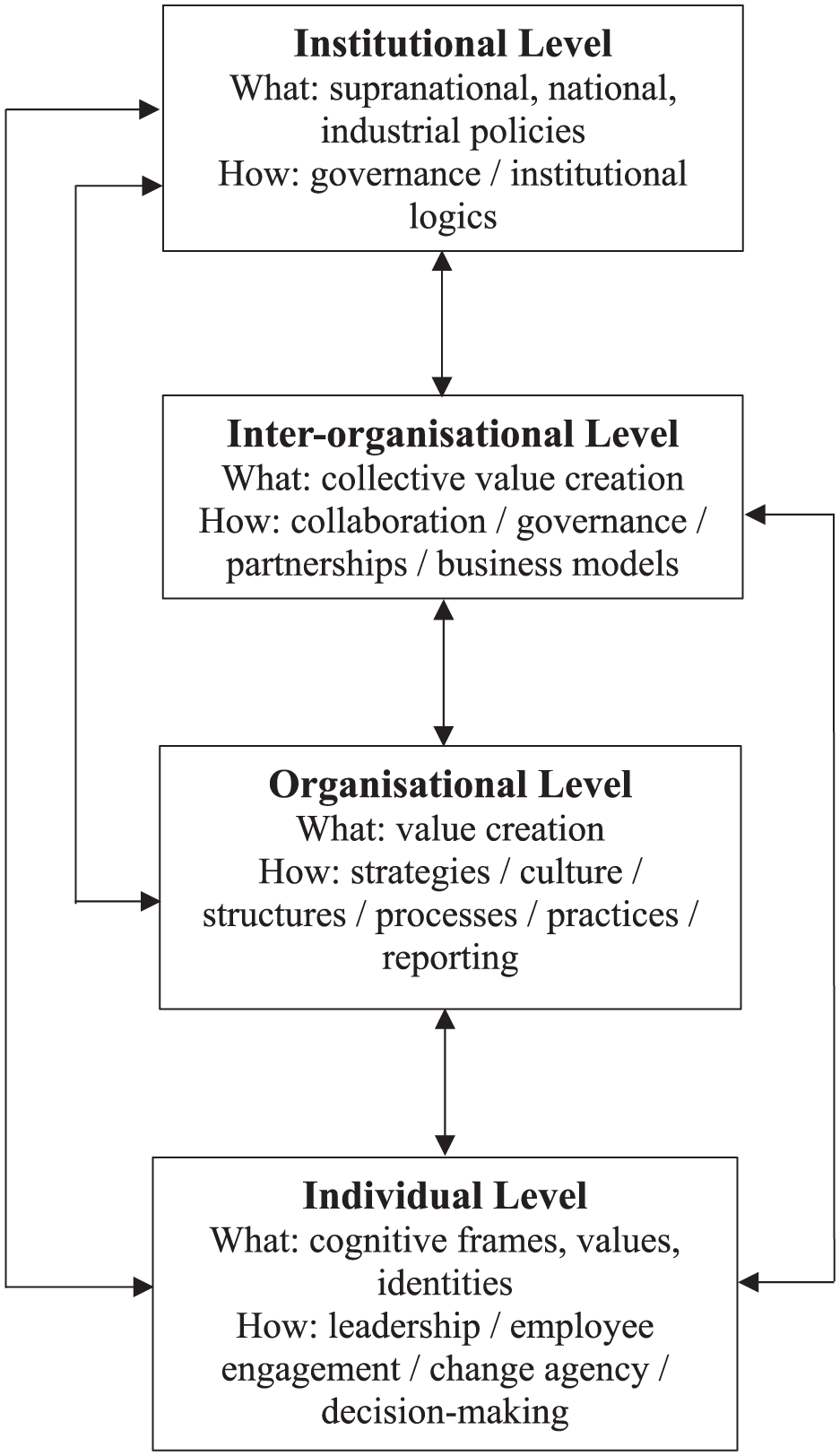
Levels of mainstreaming sustainability.
First, at the institutional level, mainstreaming implies that sustainability concerns are incorporated within supranational, national, or industrial policies that were not originally oriented towards sustainability (Bleby & Foerster, 2023; Bornemann & Christen, 2025; Scott et al., 2022). Mainstreaming at this level requires adapting and expanding existing institutional logics so that sustainability becomes integral to how policies are designed and implemented (Bornemann & Christen, 2025). This process often involves negotiating competing interests, reframing dominant policy paradigms, and building coalitions among actors with divergent priorities, thus making institutional mainstreaming as much a political achievement as a technical one.
Second, at the interorganisational level, mainstreaming implies that partnerships and business models move beyond the collective creation of economic value to pursue sustainable value creation. Scholars examine how collaboration among organisations drives the mainstreaming of sustainability, whether through cross‑sector partnerships, multi‑stakeholder initiatives, or circular‑economy collaborations (Van de Sande et al., 2026; Williams et al., 2026). This stream of research also investigates sustainable business models that rely on boundary‑spanning partnerships connecting organisations with external actors (e.g., Niesten et al., 2024). Entrepreneurs mainstream sustainable business models through their interactions with other organisations and industries, for instance, by borrowing elements from established business models in other industries to enhance the legitimacy of sustainable business models (Vernay et al., 2022).
Third, at the organisational level, mainstreaming is reflected in strategies, structures, processes, and reporting and disclosure practices that pursue the creation of sustainable value beyond a narrow focus on economic value (Mitra & Buzzanell, 2018). Research aims to understand the conditions under which sustainability strategies become effectively embedded into organisations’ mainstream competitive strategy (Hengst et al., 2020). This can occur via tight integration, in which sustainability is substantively implemented across organisational structures and processes, which stands in sharp contrast to the symbolic adoption of sustainability, where organisations articulate commitments without changing their practices (Hengst et al., 2020).
Finally, at the individual level, sustainability is mainstreamed into cognitive frames, values, and identities through leadership, employee engagement, and change agency. Research at this level often focuses on how leaders and employees engage with sustainability or CSR within organisations (e.g., De Roeck & Farooq, 2018; Jones Christensen et al., 2014; Wickert & de Bakker, 2018). The micro-level CSR stream shows how personal attributes and perceptions of organisational support shape employees’ responses to CSR initiatives, and how CSR in turn enhances individual-level outcomes such as job satisfaction and organisational citizenship behaviour (Glavas, 2016).
Figure 1 further illustrates the interactions between levels, where bottom‑up processes (e.g., individual agency influencing organisational practice) and top‑down influences (e.g., policies shaping organisational behaviour) jointly drive the mainstreaming of sustainability. This emphasis on cross-level interactions builds on prior work that recognises sustainability as a multilevel phenomenon shaped by interdependencies across levels (Johnson & Schaltegger, 2020; Schaltegger et al., 2022). For instance, recent work extends micro-CSR research by examining how interactions between individuals shape outcomes at the organisational level. Such interactions, particularly between insider social change agents and senior management, can progress CSR integration (Remmer & Gilbert, 2026). Studies have also shown how sustainable investment managers at the individual level interact with the interorganisational level via intermediaries, such as ESG rating agencies and non-governmental organisations (NGOs), to champion the mainstreaming of sustainable investments (Crifo et al., 2019; Juravle & Lewis, 2009). Entrepreneurs seek to mainstream sustainable business models by aiming for impact at the institutional level, for example, by collaborating with NGOs to weaken the dominant industry logic and reinforce alternative logics by advocating for new regulations (Vernay et al., 2022).
Opportunities, Challenges, and Tensions of Mainstreaming
Mainstreaming sustainability brings both opportunities and challenges, many of which have been widely discussed in academic and practitioner literature (Delmas et al., 2019). Engaging in sustainability may enhance innovation and competitive advantage through the development of green products, services, and business models; reinforce stakeholder collaboration by building trust and legitimacy with diverse constituencies; or contribute to cost-efficiency through resource optimization, waste reduction, and energy savings. Such approaches are portrayed as win-win strategies (Niesten & Jolink, 2020), but the reality is often more complex and contested.
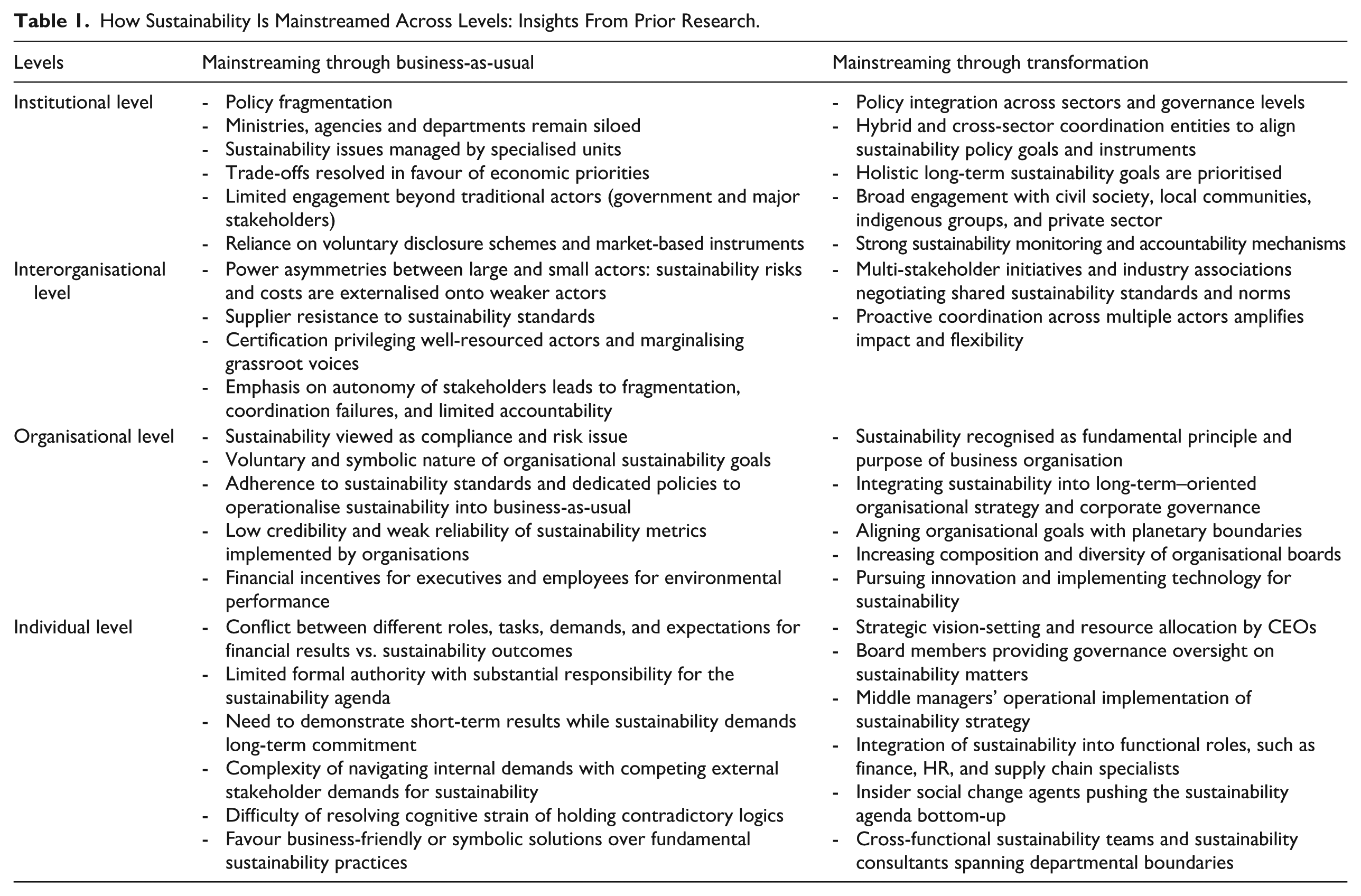
Mainstreaming sustainability may also pit short-term and long-term objectives against one another, create tensions between short-term financial objectives and long-term goals, pose challenges in terms of measuring impact, and require navigating intricate integration challenges across various functions (Hahn et al., 2010; Kok et al., 2019; Slawinski & Bansal, 2015). Furthermore, mainstreaming may surface difficult trade-offs between competing sustainability goals (such as renewable energy expansion vs biodiversity protection) and raise questions about who bears the costs and who reaps the benefits of sustainability transitions. Here, we discuss these opportunities, challenges, and tensions in greater detail for the different levels at which mainstreaming sustainability may take place (see Table 1 for a summary).
How Sustainability Is Mainstreamed Across Levels: Insights From Prior Research.
Institutional Level
Mainstreaming sustainability at the institutional level refers to the systemic embedding of environmental, social, and economic considerations into governance structures and processes. This includes policy integration across sectors, institutional coordination, regulatory frameworks, green budgeting and procurement, financial instruments, and monitoring systems to ensure accountability and transparency (Candel & Biesbroek, 2016; Gölgeci et al., 2026). While these approaches are now widely embedded in governance discourse, their implementation remains uneven and often limited in transformative impact due to political, institutional, and economic constraints.
Policy integration is central to mainstreaming efforts, particularly for cross-cutting challenges such as climate change, social inequality, and public health. Rather than addressing these issues in isolation, integration seeks to align policy goals, instruments, and actors across governance domains. However, as Candel and Biesbroek (2016) contend, policy integration is not a fixed outcome but a multidimensional and dynamic process involving policy frames, subsystem involvement, goals, and instruments that may evolve unevenly or even contradict one another. Furthermore, integration can generate institutional complexity, coordination costs, and implementation challenges, making it neither universally feasible nor inherently desirable (Candel, 2021). Brandl (2026) also emphasises that eco-social policy integration must account for both environmental and social objectives while recognising the symbolic, material, and multilevel nature of governance processes. Together, these perspectives highlight that sustainability mainstreaming is inherently contested and shaped by uneven institutional capacities and political priorities.
While policy integration focuses on governance structures, transition frameworks introduce a temporal dimension to how systemic change unfolds. Meadowcroft and Rosenbloom (2023) conceptualise sustainability transitions as progressing through three phases: emergence (experimentation and learning), acceleration (scaling and adoption), and stabilisation (institutionalisation of new systems). This perspective underscores that mainstreaming sustainability is not a linear process but one that evolves over time and requires continuous, adaptive policy support.
These theoretical insights are reflected in the evolution of global sustainability governance. Since the 1992 Rio Earth Summit, international frameworks have increasingly sought to integrate environmental, social, and economic objectives. Agreements such as the Rio Declaration, Agenda 21, the UNFCCC, and the Convention on Biological Diversity established key principles for sustainable development and international cooperation. Subsequent initiatives, including the Kyoto Protocol, the Millennium Development Goals, the Paris Agreement, and the Sustainable Development Goals (SDGs), have expanded this agenda by promoting coordinated action across sectors and governance levels.
The SDGs, adopted in 2015, represent the most comprehensive attempt to mainstream sustainability globally through 17 goals and 169 targets spanning environmental protection, social equity, and economic development (United Nations, 2015). However, progress towards the 2030 targets has been limited and uneven; as of 2025, only 18% of targets were on track or met, while many show stagnation or regression (United Nations, 2025). These shortcomings are linked to weak accountability mechanisms, institutional fragmentation, data gaps, and selective implementation (Allen et al., 2018; Biermann et al., 2022; Panda & Dash, 2025). Empirical studies confirm these challenges. Breuer et al. (2023) find that SDG implementation is typically led by environment and exterior ministries, with limited engagement from other sectors and societal actors. Birner et al. (2024) show that although horizontal policy integration has increased in Germany, direct cross-sectoral engagement with the SDGs remains limited. Nägele and Thiemann (2025) demonstrate that World Bank lending continues to prioritise economic growth and poverty reduction over environmental objectives. Collectively, this evidence suggests that global frameworks are effective in agenda-setting and coordination but have been less successful in driving structural transformation.
The European Green Deal is often presented as a leading example of integrating sustainability into economic governance by aligning climate objectives with growth strategies. However, Hereu-Morales et al. (2024) argue that it maintains a strong emphasis on economic growth, lacks sufficiently robust environmental targets, and prioritises carbon reduction over broader ecological and social concerns. This reflects a deeper structural tension as many mainstreaming efforts operate within growth-oriented paradigms that may be incompatible with ecological limits (Hickel & Kallis, 2020). As a result, sustainability is often accommodated within existing systems rather than driving transformation. More broadly, climate governance research highlights increasing institutional complexity, fragmentation, and the rise of hybrid governance arrangements involving both public and private actors, which not only can expand participation but also dilute accountability and coherence (Pattberg et al., 2022).
These limitations are reinforced by broader structural constraints. Short-term political cycles and shifting priorities can undermine international commitments as well as national sustainability policies and programmes (Knox et al., 2025). In addition, sustainability strategies in one region can generate adverse impacts elsewhere, such as resource extraction pressures and toxic waste burdens associated with low-carbon technologies in the Global South (Sovacool et al., 2020). Armed conflict represents another significant barrier to sustainability, disrupting ecological, social, and economic systems. The global military carbon footprint is estimated at approximately 5.5% of total emissions, yet remains poorly accounted for in international frameworks (Neimark et al., 2025; Parkinson & Cottrell, 2022).
In sum, while sustainability mainstreaming has become a central principle of institutional governance, its transformative potential remains constrained by fragmented implementation, institutional complexity, and persistent political-economic tensions. Bridging the gap between ambition and transformative results will require: stronger coordination mechanisms across policy sectors and governance levels; enhanced accountability of governments to meet sustainability objectives; greater financial commitment to long-term sustainability transitions; and a fundamental reorientation towards eco-social wellbeing as the central policy priority rather than modifying growth-oriented development models. Without addressing these underlying challenges, mainstreaming efforts are unlikely to achieve systemic change.
Interorganisational Level
To consider mainstreaming sustainability at the interorganisational level means examining how sustainability becomes normalised within and across networks, partnerships, supply chains, and collaborative arrangements that span organisational boundaries (Wieland, 2021). This shifts attention from what happens within single organisations to the relational processes, power asymmetries, and coordination mechanisms that shape sustainability diffusion across organisational fields and value chains. Interorganisational mainstreaming encompasses both horizontal collaborations among peer organisations (such as industry associations, multi-stakeholder initiatives, and collective action platforms) and vertical relationships along supply chains (such as buyer-supplier dynamics, certification schemes, and value chain governance structures). Research has examined supply chain relationships and how lead organisations impose sustainability standards while suppliers respond to or resist these demands (Soundararajan et al., 2018); multi-stakeholder initiatives and how diverse actors negotiate shared standards and governance frameworks (de Bakker et al., 2019); industry associations and how peer organisations collectively construct sustainability norms (Marques, 2017); and cross-sector partnerships investigating conditions under which business–NGO collaborations contribute to transformative change (Stadtler et al., 2024).
What emerges across such studies is that interorganisational mainstreaming is fundamentally shaped by power dynamics and resource dependencies. Power asymmetries between larger and smaller organisations, or between suppliers and large buyers, can lead to uneven mainstreaming outcomes: sustainability requirements imposed downwards through supply chains while costs and risks are externalised onto weaker actors (Lang et al., 2023), certification schemes creating barriers that exclude certain stakeholders (McDermott, 2013), and collaborative governance structures privileging well-resourced participants while marginalising grassroots voices (Boon & Wolf, 2025). Furthermore, interorganisational mainstreaming confronts distinctive coordination and governance challenges. Unlike intra-organisational change directed through hierarchical authority, interorganisational sustainability mainstreaming requires negotiating among autonomous entities with divergent interests and capabilities, creating dilemmas around standard harmonisation, monitoring and enforcement, and knowledge sharing. The proliferation of competing sustainability initiatives can undermine their credibility and effectiveness (Reinecke et al., 2012).
Critically, interorganisational mainstreaming raises questions about the scale and scope of transformation. While collaborative initiatives can amplify impact by coordinating action across multiple organisations, they may also gravitate towards compromises that accommodate the least committed participants, thereby hindering transformative change. The emphasis on voluntary, market-based mechanisms may enable flexibility but also limit accountability and allow persistent free-riding. Moreover, the focus on technical standards and operational improvements within existing value chain structures may leave deeper questions unaddressed: about sustainability and consumption (Schaefer & Crane, 2005) or the distribution of value and risk across global supply chains (Bapuji et al., 2018).
Organisational Level
Research on mainstreaming sustainability at the organisational level has been growing strongly ever since scholars attempted to understand drivers and barriers for greater environmental protection and social and ethical considerations in business. The emerging conceptual divergence into streams of corporate social responsibility (CSR), business ethics, and corporate sustainability remains a challenge for researchers, practitioners, and policymakers to this day (Bansal & Song, 2017; Elkington, 2018). Witness, for instance, critiques of efforts to measure and manage the diversity of issues and challenges subsumed under the framework of ESG (Edmans, 2023). Much of this has been driven by a focus on mainstreaming nonfinancial performance or impact measurement as a means to link companies’ efforts to broader sustainability ambitions such as the UN SDGs (Van Zanten, 2025) as well as organisations’ financial performance (Stroehle et al., 2026). Yet the credibility of such metrics remains scarce due to significant uncertainties involved (Delmas et al., 2026).
Mainstreaming sustainability in business entails various considerations on aspects relating to organisations’ strategic approaches, organisational structures, and managerial practices. In terms of acknowledging the different issues and interpreting them as matters of strategic concern, boards and executives, including their composition and diversity, are critical for setting the overall speed and direction of travel (Villalba-Ríos et al., 2023). Increasingly, the discourse is also shifting towards approaching sustainability as a central business consideration for determining organisational purpose (Almandoz, 2023; Dahlmann & Stubbs, 2023). In doing so, scholars examine the ways in which organisations depart from instrumental orientations of viewing sustainability as means to a financial end and instead treat sustainability as an organisational end in its own right (Dyllick & Muff, 2016). This has implications for corporate governance and organisational leadership (but also financial markets) by shifting the role of values and norms away from a short-term, shareholder value and profit orientation towards the deeper integration of wider stakeholder concerns into organisational decision-making focused on creating long-term positive societal impact (Aguilera, 2023; Mayer, 2021; Sajjad et al., 2024).
Strategically, businesses embed sustainability by allocating responsibility and resources to different functions. In this context, organisational goals and targets such as Net Zero, Nature Positive or Water Stewardship are seen as central steering mechanisms for directing sustainability towards a desirable future outcome (Zu Ermgassen et al., 2022). Yet research finds these can be problematic given their voluntary nature and numerous incentives to present a more positive picture than is true (Callery & Kim, 2025). Many organisations also seek to align investor, stakeholder, and organisational goals by providing financial incentives to their executives (Haque & Ntim, 2020), with research suggesting incentives provided to all employees are more likely to result in measurable environmental performance improvements (Dahlmann et al., 2017). At the same time, concerns remain that such incentives merely send tokenistic signals rather than lead to wholesale changes in organisational cultures as required, given the scale and urgency of many sustainability challenges.
Beyond these high-level choices, mainstreaming sustainability arguably relates most directly to the degree to which such concerns are normalised in the day-to-day running of the business. Dedicated policies and procedures (e.g., environmental management systems such as ISO14001), adherence to industry and product standards (Tampe, 2021), and obtaining relevant certifications (e.g., Forest Stewardship Council (FSC), B Corp, etc.; Moroz et al., 2018) all form part of an integrated approach that prioritises operationalisation into business-as-usual. Yet the complex and uncertain nature of many sustainability issues demands new managerial practices and tasks, including broader risk management approaches and the development of transition plans that incorporate scenario analysis. Management research in this space, however, is still in its infancy (Huiskamp et al., 2022; Nicolajsen et al., 2025).
Moreover, innovation in terms of technology and business models clearly plays another fundamental role in helping organisations to address the major sustainability issues (Roome & Louche, 2016). Research here highlights the need for developing new organisational capabilities to address the significant tensions involved (Arranz et al., 2026). Particularly in combination with emerging digital technologies, organisations have to navigate a multitude of multilevel challenges, meaning that innovation on its own cannot provide the solutions needed (Höllerer et al., 2026). In sum, while organisations are experimenting with a variety of novel organisational approaches on sustainability, effective mainstreaming remains fraught with complexity that can act as barriers to good intentions and efforts.
Individual Level
At the individual level, mainstreaming sustainability means looking at the role and activities of individual organisational actors in mainstreaming efforts, as well as at the effects of mainstreaming on these individuals. The first entails examining how individuals act as change agents, champions, or boundary spanners who translate, negotiate, and embed sustainability principles into organisational routines, decision-making processes, and cultural norms. In contrast, the second focuses on how mainstreaming processes shape individual identities, roles, competencies, and experiences. This includes potential tensions between personal values and organisational expectations, shifts in professional identity, and the cognitive and emotional labour involved in navigating sustainability’s integration into everyday work. In both directions, a growing body of work is being developed.
As to the individuals who drive, stimulate, or enact sustainability mainstreaming, studies have considered the role of particular actors across organisational hierarchies and functional domains. At the executive level, research has examined chief executive officers (CEOs) and their influence on corporate sustainability agendas through strategic vision-setting and resource allocation (Mahran & Elamer, 2024; Walls & Berrone, 2017). Other research has focused on middle management such as sustainability managers who navigate the complex terrain between strategic commitments and operational implementation (Augustine, 2021; Wickert & de Bakker, 2018) by developing new environmental values and beliefs and testing and refining these in practice (Halme, 2002). Beyond designated sustainability roles, research has explored the contributions of functional specialists such as supply chain managers who embed environmental and social criteria into procurement decisions (Preuss & Fearne, 2022), human resources professionals who integrate sustainability into talent management and organisational culture initiatives (Guerci & Pedrini, 2014), and finance professionals who champion ESG integration into investment and reporting frameworks (Schaltegger & Zvezdov, 2015). In addition, research has highlighted the role of employee activists and intrapreneurs who push sustainability agendas from below, often operating outside formal mandates and acting as insider social change agents (Halme et al., 2012; Heucher et al., 2024), as well as board members who exercise governance oversight and strategic guidance on sustainability matters. More recently, attention has turned to those in hybrid roles such as sustainability consultants who bridge organisational boundaries (Gond et al., 2024) and cross-functional sustainability teams that coordinate mainstreaming efforts across organisational silos. What is clear in many of these accounts is that many of these individuals often experience conflict between different roles, tasks, and expectations, which restricts their options to contribute to sustainability mainstreaming in meaningful ways. These conflicting demands can manifest across multiple dimensions. Structurally, sustainability champions frequently occupy ambiguous positions with limited formal authority yet substantial responsibility for driving change (Wright & Nyberg, 2017). Temporally, they face pressures to demonstrate short-term results even as genuine transformation requires long-term commitment (Slawinski & Bansal, 2015). Politically, they must navigate competing stakeholder demands, balancing external advocates pushing for radical change against internal resistance from colleagues focused on traditional “core” business objectives (Wickert & de Bakker, 2018). Cognitively and emotionally, they experience the strain of holding contradictory logics simultaneously (Dahlmann & Grosvold, 2017; Wright et al., 2012). To gain legitimacy and secure resources, these actors often engage in strategic compromises: framing initiatives in business-friendly language, focusing on “safe” sustainability issues that align with existing priorities while avoiding contentious topics, or implementing visible programmes that signal commitment while leaving fundamental practices unchanged, leading to a “mainstream” interpretation of sustainability.
Mainstreaming as Business-as-Usual or Transformative Change?
In the above sections, we reviewed and classified existing research on sustainability mainstreaming across four levels of analysis: institutional, interorganisational, organisational, and individual. This has led us to uncover two distinct approaches to embedding sustainability in business: first, mainstreaming sustainability through integration within business-as-usual; and second, mainstreaming sustainability through transformative change (Krull-Kuper et al., 2026). Table 1 summarises this classification, illustrating how prior research across the four levels reflects these two modes of mainstreaming sustainability.
In mainstreaming through integration within business-as-usual, organisations approach sustainability as a constraint, requirement, or as compliance with regulation. They integrate sustainability in existing strategies, structures, and resources without making any fundamental changes to these organisational practices. Here, sustainability is seen as a means to a financial end and always serves a business case. Mainstreaming represents the absorption of sustainability into existing organisational and market logics without substantive transformation – a process also characterised by decoupling. Consequently, sustainability becomes normalised within the existing paradigm rather than serving as a vehicle for a paradigm shift and being normalised in a new paradigm.
In contrast, by mainstreaming through transformative change, organisations move beyond compliance and incremental integration. Sustainability changes an organisation’s purpose, strategy, structure, and resources and becomes an organisational end in itself. This alternative approach positions mainstreaming as the necessary condition for systemic transformation, arguing that radical ideas remain marginal until they achieve institutional embeddedness and scale. Yet, it remains unclear when sustainability is pursued through business-as-usual or transformation, as this choice is shaped by interdependent dynamics across the different levels of mainstreaming. The tension between these two approaches is not resolved by choosing one over the other but by recognising mainstreaming as a contested political process.
A Multilevel Framework of Sustainability Mainstreaming: Positioning the SI Articles
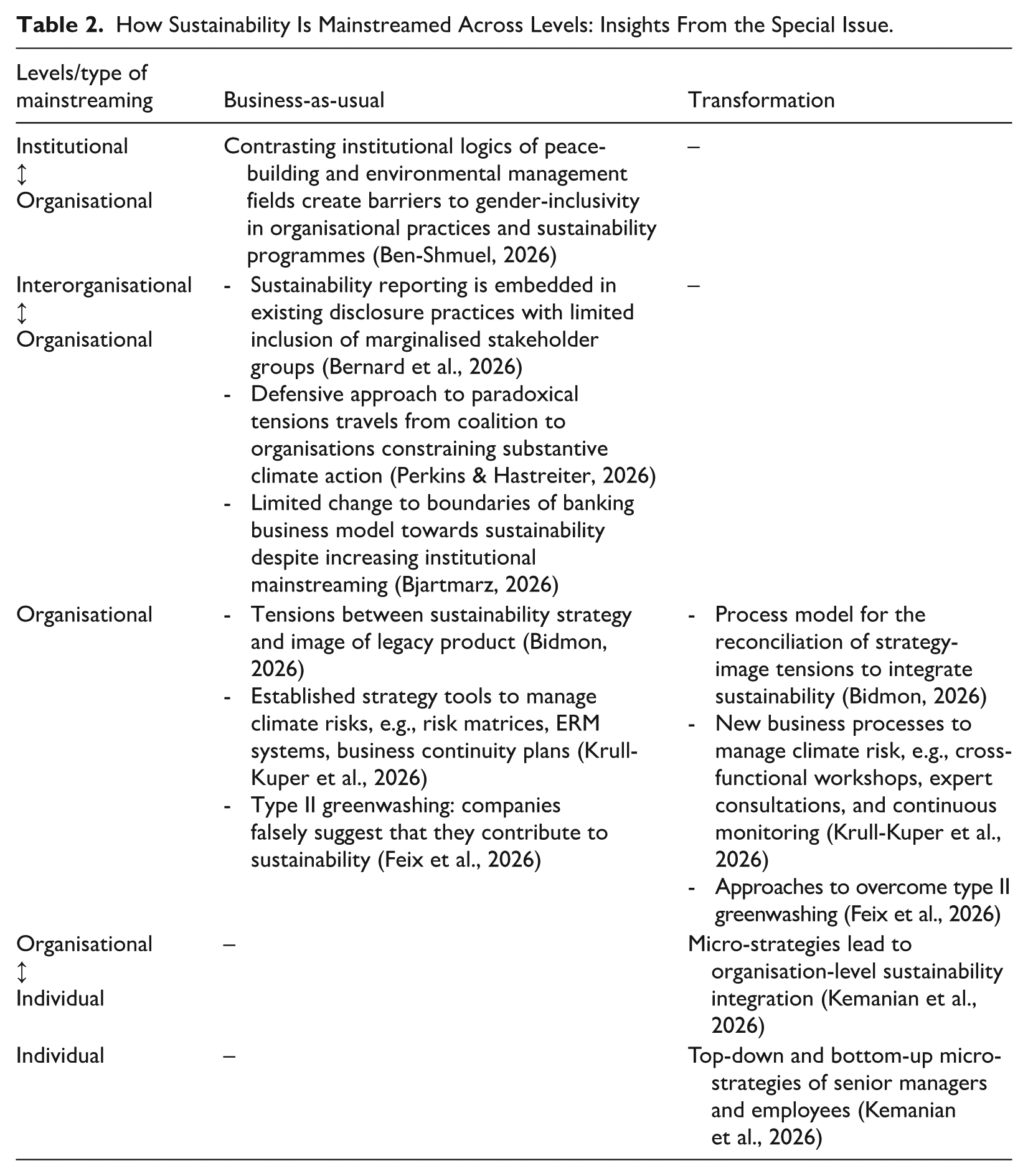
In this section, we discuss the SI articles using our framework of two forms of sustainability mainstreaming across four levels of analysis. Most studies in the SI focus on business‑as‑usual forms of mainstreaming, analysing how sustainability becomes integrated in existing practices, structures, and governance arrangements. At the same time, several contributions explicitly examine the conditions, tensions, and processes through which organisations seek to move beyond business‑as‑usual and transition towards more transformative forms of sustainability mainstreaming (see Table 2 for a summary).
How Sustainability Is Mainstreamed Across Levels: Insights From the Special Issue.
Focusing on the intersection between institutional and organisational levels, Ben-Shmuel (2026) examines how institutionalised professional logics manifest and influence organisational practices. The setting of Ben-Shmuel’s ethnographic study is a nonprofit organisation with an overarching goal of advancing cross-border (Israel, Gaza, the West Bank) and cross-communal (Jewish-Israeli and Palestinian) cooperation to address environmental issues. The organisation operates in both the peace-building and environmental management domains, organisational fields with contrasting professional logics and gender-inclusive institutionalisation. The peace-building field where gender inclusion is comprehensively institutionalised recognises multiple forms of knowledge and values relational and community‑based work. In contrast, the environmental field where gender inclusion is minimally institutionalised, privileges technical-scientific expertise and marginalises social and participatory approaches. Ben-Shmuel’s in-depth analysis demonstrates how these field-level institutional differences influence organisational processes such as problem recognition and prioritisation, decision-making, and organisational discourse. She also shows how field‑level gender dynamics create epistemic and structural barriers to integrating more gender-inclusive sustainability practices. As such, dominant business‑as‑usual institutional and organisational arrangements constrain the transformative integration of social and technical approaches to mainstreaming sustainability.
At the interorganisational and organisational levels, Bernard et al. (2026) examine the extent to which stakeholder democracy is reflected in the stakeholder engagement disclosures within sustainability reports. Drawing on a qualitative content analysis of sustainability reports issued by mining and energy companies over time, the authors show that stakeholder engagement disclosures remain largely selective, prioritise financial stakeholders, and reveal predominantly indirect stakeholder engagement practices (company-controlled, one-way, limited consultation). Although certain organisations had more comprehensive disclosures including direct engagement processes such as participative dialogues with often marginalised stakeholder groups (e.g., Indigenous and local communities), these were counterbalanced by organisations with minimal disclosures or reductions in stakeholder engagement. These findings challenge the assumption that mainstreaming sustainability reporting necessarily leads to more transformative forms of stakeholder involvement in organisational governance and decision-making. For the majority of extractive sector organisations, reporting about stakeholder engagement appears to be a case of business‑as‑usual mainstreaming without substantively transforming the nature of stakeholder relationships.
Focusing on the interaction between interorganisational and organisational levels, Perkins and Hastreiter (2026) examine mainstreaming dynamics within the world’s largest climate-focused investor coalition, Climate Action 100+ (CA100+). CA100+ is a membership-based initiative of asset owners and asset managers that seek to improve climate-related disclosure, governance, and mitigation among carbon-intensive organisations. The authors show that a defensive approach to paradoxical tensions (goal, temporal, participation, and coopetition tensions) emerges upstream within the coalition and subsequently travels downstream along the governance chain to the carbon-intensive organisations, where it reinforces similarly defensive practices. This transfer of tensions down the governance chain constrains the coalition’s capacity to prioritise substantive climate governance and mitigation over disclosure-based responses. Overall, the study illustrates a business‑as‑usual approach to sustainability mainstreaming, in which dominant organisational and interorganisational arrangements reproduce short‑term, finance‑oriented priorities. Invoking the fallacy of scale, the authors explain why mainstreaming fails: even though the initiative incorporates a large number of actors with significant reach and impact, investors prioritising short-term financial performance outnumber those seeking to advance more ambitious climate objectives.
At the interorganisational and organisational level, Bjartmarz (2026) examines business models in the Danish banking sector. Drawing on in-depth case studies, this article examines whether banks preserve, adjust, or transform their models in response to growing regulatory and societal pressures (but also scandals and political uncertainty) for mainstreaming sustainability. By employing a conceptual focus on boundary work, her findings suggest that despite significant new demands from regulators and customers, banks’ business models remain essentially unchanged. Specifically, the three cases studied primarily preserve the current or familiar boundaries or only make incremental adjustments. In part, this lack of transformation is explained by the substantial complexity and ambiguity involved in translating coercive pressures into business model changes. The conclusion is that without addressing wider societal norms, banks are struggling to integrate complex sustainability logics in a context where strong financial logics prevail.
At the organisational level, Bidmon (2026) considers an important obstacle to mainstreaming sustainability, examining what happens when strategic actions to integrate sustainability create tensions between a firm’s established identity and its projected image. Through a qualitative, longitudinal study of luxury sports car manufacturer Porsche during the introduction of electric cars, she examines how such strategy–image tensions were managed, and how attempts at transformative mainstreaming were impacted by business-as-usual considerations on the continuity of the firm’s legacy. In her analysis, she highlights the discursive process of implementing strategic actions that challenge the legacy product, in this case, the “traditional” luxury sports car with an internal combustion engine that was commonly associated with brand attributes such as speeding, racing, and high fuel consumption. In her analysis, she develops a three-stage process model for the reconciliation of strategy-image tensions and thereby sheds light on the complex dynamics that arise when established firms attempt to make sustainability “fit” their legacy.
Krull-Kuper et al. (2026) also focus their attention on the organisational level, asking how organisations respond to growing calls for mainstreaming climate risks into their strategies. Their longitudinal analysis of secondary data from the global food and drinks sector reveals that most organisations rely on established strategy tools such as business continuity plans, risk matrices, enterprise risk management (ERM) systems, materiality templates, and target dashboards for the decision-making. While such approaches offer the benefits of familiarity and seamless operational integration, paradoxically, they also reinforce priorities aligned with a business-as-usual mind-set. As a consequence, the process of mainstreaming climate risk into existing practices here further deepens a commitment towards business models and operations that are arguably leading to the climate crisis in the first place. In doing so, they run the risk of entrenching current routines that may be ill-suited for many sustainability challenges. By contrast, some organisations are found to have recognised the broader complexity and salience of different types of climate risks, leading them to deviate from established business processes. By employing materiality assessments, cross-functional workshops, expert consultations, continuous monitoring, and scenario planning, these organisations are beginning to initiate more transformative change that recognises the growing uncertainty involved in responding to climate change. This article therefore contributes towards our understanding of the paradoxical role of strategic tools in either enabling or hindering the mainstreaming of sustainability in business, depending on how the underlying risks are being interpreted.
At the organisational level, Feix et al. (2026) apply a different perspective and examine how greenwashing can be a barrier to sustainability mainstreaming. In particular, they distinguish between Type I and Type II greenwashing, with the first describing a situation where companies exaggerate the extent to which they engage in actions described as socially or environmentally desirable, and the second referring to practices by which companies falsely suggest that their actions contribute to the macro-level goal of sustainability. The authors argue that this Type II greenwashing remains insufficiently conceptualised and countered and is particularly problematic because it enables a business-as-usual approach to mainstreaming. After examining the characteristics of this type of greenwashing, they propose three discursive devices through which it operates and outline ways to counter it to open space for more transformative approaches.
Focusing on the interaction between individual and organisational levels, Kemanian et al. (2026) take a micro-foundations perspective on the mainstreaming of sustainability and aim to understand how individuals impact sustainability in an organisation. They identify four top-down micro-strategies of insider-change agents (elevating sustainability as a pillar of strategy, building organisational capacity and accountability, establishing thought and action leadership, and aligning global direction with local reality) and argue that these serve as corporate opportunity structures that facilitate the normalisation of sustainability over time. In addition, they show that middle managers enact four types of bottom-up micro-strategies (harnessing collective action, bridging roles and knowledge, establishing proficiency and credibility, and focusing local action on impact). Their comparative case study of a pharmaceutical, coffee, and mobility company focuses on the enablers of mainstreaming sustainability by illustrating how the top-down and bottom-up micro-strategies interact at different stages of maturity of transforming towards sustainability. In moving from early to intermediate and advanced stages, the corporate opportunity structure widened, creating more space for bottom-up micro-strategies. Via multiple mechanisms, the micro-level work of senior and middle managers and employees gets translated into organisational-level sustainability: by finding common ground, setting spatial and temporal boundaries to fast-track sustainability work, establishing a sense of ownership, and enabling self-efficacy of individuals’ sustainability work, the micro-strategies of insider-change agents shape collective outcomes.
A Way Forward
Our review of the challenges facing the mainstreaming of sustainability leads us to identify several directions for further research. Based on our framework and the insights derived from the SI contributions, these directions relate to the common themes of multilevel integration, the impact of mainstreaming, temporal complexity, and different political realities.
Multilevel Integration
Taken together, the papers in this SI reveal a notable asymmetry in how sustainability mainstreaming is currently studied across levels of analysis. Contributions focusing on the individual and organisational levels largely conceptualise mainstreaming as transformative change (e.g., Kemanian et al., 2026), whereas papers at the interorganisational and institutional levels tend to examine mainstreaming as the integration within business-as-usual (e.g., Perkins & Hastreiter, 2026). While this distribution is not surprising, given that transformative ambitions at lower levels are often constrained by the rigidity and stabilising forces operating at higher levels, it points to important gaps in the literature. First, more research is needed at interorganisational and institutional levels to examine how sustainability mainstreaming can take a genuinely transformational form and how these higher‑level arrangements can enable, rather than constrain, transformational efforts at individual and organisational levels. While prior research has acknowledged the transformational potential of individual-level action on macro-level institutions as a bottom-up process (Johnson & Schaltegger, 2020), we argue that more research is needed on how top-down processes can enable the transformative potential of insider social change agents. One important question is how to give voice to sustainable start-ups that lack the industry associations and lobbying power of incumbents, and hence, how institutions can alter the playing field in favour of sustainable entrants.
Second, we lack sufficient understanding of why sustainability continues to be reproduced as the integration within business-as-usual at the individual and organisational levels. While such dynamics are often shaped and constrained by interorganisational and institutional conditions, existing research tends to focus predominantly on change agents and progressive actors, rather than on the barriers, inertial forces, and everyday practices that compel individuals and organisations to sustain business‑as‑usual arrangements. Comparative research is therefore needed to examine why some actors contribute to reproducing the status quo, while others engage in transformative change.
Impact of Mainstreaming
In our call for papers, we invited contributions that examined the impacts of sustainability mainstreaming, including how effective mainstreaming is and how its effects on organisations, nature, and society can be measured (de Bakker et al., 2024). While the papers in this SI advance important conceptual and qualitative insights, none directly assess sustainability impacts as an outcome variable, nor do we include quantitative studies that systematically measure the effects of mainstreaming. This absence reflects a broader pattern identified within Organization & Environment and the field more generally. As Russo et al. (2024, p. 127) note, “we believe that a clear path out of the mainstream lies in shifting the dependent variables we study to authentic environmental impacts.” Future research would therefore benefit from developing quantitative or mixed‑method approaches that treat environmental and social impact as dependent variables, while remaining attentive to the complexities of measurement and the risk that impact metrics themselves may reinforce narrow or business‑as‑usual forms of sustainability. This will often call for interdisciplinary research among organisation scholars and biologists, ecologists, or other natural scientists to examine environmental impact. In particular, the wealth of new data available from satellite observations, forensic genetics, hydrological maps, and other sources opens innovative avenues for studying firms’ sustainability impacts beyond their self-disclosed corporate data (Etzion et al., 2026). Better understanding whether and how mainstreaming of sustainability truly creates beneficial outcomes in relation to the planetary boundaries is essential if significant progress is to be achieved.
Temporal Complexity
In our framework, we conceptualise mainstreaming sustainability as either integration within business-as-usual or transformative change. While this distinction clarifies how sustainability becomes mainstreamed in practice, future research could further examine the temporal dynamics through which these approaches unfold, particularly whether and how managers, organisations, or policymakers transition from business-as-usual integration to transformative change over time. In addition, research may explore how actors across levels juxtapose these two approaches, rather than privileging one over the other. Similar to prior work showing that juxtaposing short- and long-term considerations enables organisations to engage more effectively with sustainability challenges (Slawinski & Bansal, 2015), positioning business-as-usual integration and transformative change in tension may foster more integrative responses, thereby increasing the likelihood of substantive sustainability outcomes (Carmine & De Marchi, 2023).
Political Realities
Any discussion on mainstreaming sustainability today cannot neglect the significant and growing backlash the concept is facing. What, at least in parts of the world, was once a relatively uncontested development towards greater corporate responsibility and environmental accountability has become deeply politicised terrain. Internally, organisations face competing pressures as sustainability champions confront resistance from those prioritising short-term financial performance (Kok et al., 2019), creating a divide between internal advocates and sceptics that shape what gets implemented, scaled, or abandoned. Externally, political and ideological opposition has intensified, with sustainability agendas increasingly framed as ideologically driven or economically counterproductive. In contexts where political and ideological opposition to sustainability agendas has intensified, an emergent challenge for sustainability mainstreaming is defending the legitimacy of sustainability itself.
Beyond these tensions, disruptive geopolitical events such as wars, armed conflicts, and the broader reconfiguration of the global order are likely to affect sustainability mainstreaming at multiple levels. Energy security policies may work against decarbonisation initiatives, while supply chain distribution problems may refocus corporate attention to cost and resilience rather than sustainability. Such developments underscore the scaling challenges identified by Goworek et al. (2018), raising questions about how organisations can maintain and deepen sustainability initiatives under unfavourable conditions. This requires more research on the political (Wamsler & Osberg, 2022) and systemic (Dentoni et al., 2026) dimensions of mainstreaming. Future work therefore should integrate insights from institutional theory, political science, systems theory, and organisational studies to develop more robust accounts of how sustainability can be embedded in ways that are resilient to backlash, capable of navigating internal resistance, and sensitive to the volatile external environments in which contemporary organisations operate. Different pathways ranging from incremental business-as-usual to transformative ones are needed, working in tandem, to fully mainstream sustainability.
Footnotes
Acknowledgements
The authors sincerely thank the editors-in-chief for their insightful and constructive feedback, which significantly improved the quality and clarity of this article.

Funding
The authors received no financial support for the research, authorship, and/or publication of this article.
Declaration of Conflicting Interests
The authors declared no potential conflicts of interest with respect to the research, authorship, and/or publication of this article.