







Abstract
Literacy scholarship captures immigrant youth of color ethnoracial identity constructions through their digital literacy practices. Still, few studies examine how immigrant youth of African origin use digital literacy to navigate ethnoracial tensions and craft racialized identities. Drawing on raciolinguistic and postcolonial theory, this study extends and nuances existing scholarship by examining the digital literacy practices and ethnoracial identity formations of a 13-year-old Nigerian girl who migrated to the United States. Positioning my analysis within the intersection of race, language, and identity, I inquire: How does Isioma leverage digital literacies to navigate U.S. racialization and negotiate U.S. racial identity categories? Furthermore, how does Isioma employ digital literacies to construct and negotiate her ethnoracial identities? I employ a narrative analysis of home observations, semistructured interviews, and literacy artifacts. Findings illustrate how digital tools disrupt raciolinguistic perspectives against minoritized languages. Digital literacies also enable the preservation of ethnic identities and languages while influencing racialized and hybrid identity formation and narration in the physical world.
Social media platforms are integral to the lives of youth all around the globe, shaping their worldview and influencing their self-expression, relational connections, and creative outlets. In the United States in particular—a place that is relatively free from government censorship—youth of color have used and continue to use TikTok, Instagram, YouTube, and other social media apps to advocate for racial and social justice (Hurley, 2023; Vogels et al., 2022). The social media advocacy of youth became especially prominent in 2020, as the global COVID-19 pandemic more fully revealed both new and long-standing racial, economic, and educational injustices, such as hate crimes, blatant discriminatory acts, and murders that particularly impacted Black and Asian communities. As literacy scholarship has illustrated, Black American youth remain at the forefront of racial advocacy. Through the use of social media and digital literacies, they have highlighted school-based racial discrimination (Price-Dennis & Carrion, 2017), called out police brutality (Garcia et al., 2020; Janfaza, 2022), and advocated for Black racial identity development and enactment; they have also criticized digitally mediated cultural appropriation and mobilized a #BlackTikTokStrike to assure Black creators’ credibility through their innovative digital literacies across social media and school settings (Greene et al., 2021; Sims, 2022; Pruitt-Young, 2021).
Over the past three decades, literacy and language scholars have also explored the digital practices of immigrant youth of color. These studies have found that engagement in digital literacy supports immigrant youth of color in their transition to new countries (Lam & Warriner, 2012; Liu et al., 2012). The digital literacy practices of this group have also helped them to navigate cross-cultural tensions (Campano et al., 2016; Lam, 2013; McLean, 2010), develop transnational relationships (Dávila, 2015; Kwon, 2022; Skerrett, 2015), and preserve their multilingual practices (Bigelow, 2011; Kinkead-Clark, 2014; Kim, 2016a, 2016b). These engagements are particularly crucial in racially stratified, Eurowestern countries, where immigrant youth of color often face identity homogenization and discrimination based on their ethnic, cultural, and linguistic identities (Bauer & Sánchez, 2020; Kim, 2018; Watson & Knight-Manuel, 2017). Although the physical and digital worlds overlap and mutually co-construct each other (Jandric et al., 2018; Smalls, 2020), studies have found that digital worlds also offer unique opportunities to disrupt these hierarchies and address the damaging psychological effects associated with them (Smith, 2022; Steele, 2021).
Most recently, in regard to immigrant youth of color, scholars have emphasized the significance of centering race in language and literacy research. This emphasis has shed light on the intricate ways that Black immigrant 1 youth navigate institutional racial identity classifications and racism through their literacy and language practices (Skerrett & Omogun, 2020; Mahiri, 2017; McLean, 2010). This body of scholarship, which has predominantly focused on Black immigrant youth of Caribbean origin, has also demonstrated that Black immigrant youth actively construct ethnoracial 2 identities through their digital literacy engagements. As noted above, Black American youths engage in digital literacies to enact their identity (Ellison, 2014). However, a need remains for critical examinations into how immigrant youth of African origin navigate ethnoracial tensions and craft racialized identities for themselves, particularly through digital literacy. Given the limited research into diversity within the identities of Black youth, there is a clear need for a deeper understanding of the digital literacy practices of immigrant youth of African descent. The focus on African immigrant youths’ digital literacies is especially salient given that the ancestors of many African immigrant youths, unlike their Black American and Caribbean youths’ ancestors, were not subjected to enslavement through the Transatlantic slave trade, an experience that often forms the basis for the Black identity category in the United States. It is also worth noting that by 2050, one in four individuals globally will be of African descent (Walsh & Morales, 2023). Therefore, comprehending the digital literacy practices of African immigrant youth is crucial due to the differing historical and colonial lineages among African, African American, and Caribbean youths. These historically divergent lineages, combined with the significant role of technology amid heightened African migration, provide a foundational rationale for expanding the exploration of digital literacies to include immigrant youth of African origin.
In response to this need, I have extended and added nuance to existing literacy and language scholarship by applying racial and postcolonial lenses to my study of the digital literacies of African immigrant youth, particularly Nigerian youth. My study centered on the experiences of one 13-year-old Nigerian girl, Isioma, 3 as she navigated the process of U.S. racialization and U.S. racial identity categories through her digital literacy practices. My study thus contributes to and expands the evolving discussion on how immigrant youth of color experience and respond to the racialization of their identities, languages, and literacies.
The purpose of this study was twofold: to emphasize the agency and strategies required to navigate racialization and the construction of ethnoracial identities in the new homelands of immigrant youth; and to present the theoretical and pedagogical implications of these insights to enhance language and literacy learning opportunities for youth worldwide. The two questions of this study were
How does Isioma use digital literacy practices to navigate the process of U.S racialization and U.S. racial identity categories? How does Isioma use digital literacy practices to construct, negotiate, and narrate her ethnoracial identities?
Review of the Literature
Immigrant Youth or Color Digital Literacy Practices
Previous studies have contributed to a rich discussion about framing immigrant and transitional youth (Lam & Christiansen, 2022; Skerrett, 2015). In my research, I used the term immigrant to refer to youth whose feet are firmly planted in their new homeland, and the term transnational to refer to youth who “maintain significant ties to two or more nation-states” (Skerrett, 2015, p. 2). I considered the shared experiences of both groups in their migration to new countries. While I drew on literature that focused on both immigrant and transnational immigrant youth of color, I framed all the youth in this review as “immigrants” based on their shared experience.
Immigrant youth of color have employed digital literacies—“multiple and interactive [literacy] practices that are mediated by technological tools that involve reading, writing, language, and exchanging information in online environments” (Lewis-Ellison, 2023, p. 594) (2013, p.1)—for varied purposes. Unlike traditional literacies such as reading and writing, digital literacies have enabled immigrant youth to forge friendships across national borders (Kim, 2018; Lam & Christiansen, 2022) and sustain familial bonds through texts, video calls, and music (Becker, 2021; Braden, 2020; McLean, 2010). Digital platforms have also facilitated immigrant youth of color in seamlessly and simultaneously recruiting multiple languages and literacies (Skerrett, 2012), often without fear of criticism (Bigelow, 2011; Yi & Hirvela, 2010). This research has demonstrated that digital spaces are essential for immigrant youth of color to engage with community.
Immigrant Youth of Color: Identity Constructions and Negotiations Through Digital Literacy Practices
Scholars who have approached literacy from a sociocultural perspective argued that language, literacy, and identity are closely interconnected (Doucet, 2014; Kim, 2016b; Gee, 1991). In this view, digital environments have provided immigrant youth of color opportunities to move beyond fixed-identity categories in order to construct flexible identities (Kim, 2018; Lam, 2000). These digital platforms also have demonstrated the potential to challenge and deconstruct identity hierarchies and power dynamics present in the physical world (Mahiri, 2017; Smith, 2022).
For immigrant youth of color, digital literacies have been crucial in mediating cultural, linguistic, and ethnoracial identity tensions. For instance, Lam's study (2000) showed how by adopting various discourses, a Chinese immigrant high school senior, Almon, was able to enter a digital multicultural Japanese pop culture world that allowed him to construct an identity not readily available to him in his adopted country. Similarly, a study by McLean (2010) demonstrated how a Trinidadian and Tobagonian tenth-grader, Zeek, utilized various languages on Facebook to construct and perform multiple digital identities as a “female learner, individual, and Caribbean immigrant” (p. 19). These studies have emphasized how digital environments enable immigrant youth of color to construct identities through adopted discourses and strategic multilingual practices.
While identity construction implies the development of a stable identity, identity negotiation emphasizes the multidimensional, continual, and ever-evolving nature of becoming (Hall & Gay, 1996; Moje & Luke, 2009). For example, a study by Compton-Lily et al. (2017) illustrated how a seven-year-old Mexican American boy, Carlos, engaged in intersectional identity negotiations through gaming, cell phone use, and other digital literacies—all of which facilitated his negotiations of his American and Mexican identities. Lam and Rosario-Ramos (2009) also demonstrated how high school immigrant youth from Latin American, South Asian, and East Asian countries have engaged in identity negotiations on digital platforms through their use of their heritage language.
Digital spaces are unique in that they offer immigrant youth of color a variety of semiotic and multimodal choices to deconstruct singular notions of heritage, language, and identity. In Kim's study (2016b), immigrant youth of color revised their self-representations by constantly changing their avatars and signatures, and by frequently posting animations, videos, and written texts about themselves. Through these representations, they revealed hybrid identity affiliations that extended beyond geographical space. Furthermore, the online identity formations of immigrant youth of color have also helped them comprehend who they are in the real, offline world (Lam & Christiansen, 2022; Nelson et al., 2020).
The existing literature has also underscored the importance of digital literacies in shaping the immigration experiences of Black immigrant youth, particularly those of Caribbean origin (Bigelow, 2011; Braden, 2020; McLean, 2020; Omogun & Skerrett, 2021; Smalls, 2020; Smith, 2022). However, while African youth, like their Caribbean counterparts, are often racialized as Black upon migrating to countries such as the United States, the historical lineage of many African youths does not include enslavement through the Transatlantic slave trade. For that reason, I focused on the diverse historical lineages, ethnoracial complexities within the Black identity category, and the burgeoning global wave of African migration (Tamir, 2022) for my study of the intersections of immigration, race, racialization, and digital literacies in the life of the focal Nigerian immigrant, Isioma. This inquiry was crucial to advance the understanding of immigrant youth of color navigation of racialization and identity formations in literacy research and education, both in the United States and beyond.
Theoretical Frames
In this section, I discuss the theoretical frameworks that guided this study: (1) racial formation and associated concepts of racialization, anti-Black linguistic discrimination, and raciolinguistics, and (2) a postcolonial perspective of digital identity formation.
The Interrelations of Race and Language
Educational and social science scholars have argued that race is not only a social construct but also a fundamental axis of societal organization that is maintained by social, economic, and political structures. Omi and Winant (2014) coined the term “racial formation” to describe this organization, which they defined as “the sociohistorical process by which racial categories are created, inhabited, transformed, and destroyed” (p. 55). Racial categories reinforce hierarchies and power structures because of the different ideological values assigned to racialized labels (Fanon, 1967; Hall and Gay, 1996; McLean, 2020). These labels, once embodied in the social fabric of the United States, also resulted in anti-Blackness (Dumas & Ross, 2016). Anti-Blackness, as shown in resistant and antagonistic behaviors toward Black people, Black values, and Black languages, created adversarial relationships between Blackness and the possibility of being considered human.
Also relevant to my analysis is the racialization process that immigrants experience upon their migration to new countries. Ninety percent of immigrants of color to the United States have come from African and Caribbean nations (Camarota & Zieglar, 2017). Although African and Caribbean immigrants are diverse, they “may feel renewed urgency in understanding why and how they are assigned to a monolithic category of Black when their ethnoracial identities include unique mosaics of geography, history, culture, language, and literacy practices” (Skerrett & Omogun, 2020, p. 4). Critical race theory (Bell, 1992; Crenshaw, 1991; Delgado & Stefancic, 2023) has argued, correctly, that race and racism are ingrained within U.S. laws, policies, practices, and institutions that perpetuate societal power dynamics; this fact explains the racialization process that African and Caribbean immigrants encounter upon their arrival in the United States. Given this social reality, it can be argued that when Isioma, the Nigerian immigrant youth highlighted in this study, migrated to the United States, she entered a socially constructed imaginative place in which she was already racialized as Black (Anderson, 2017; Ibrahim, 1999). In other words, her inherited racial identity differed from her ethnic Nigerian identity and culture. Consequently, she also became susceptible to American anti-Blackness.
In Eurowestern countries like the United States, the intersection of literacy and language with race affects access, equity, and freedom (Ball, 1992; Freison, 2022; Smitherman, 1986; Willis, 2015), which is further amplified through a lens of anti-Black linguistic racism (Baker-Bell, 2020). The relationship between anti-Blackness and linguistic oppression has resulted in the “linguistic violence, persecution, dehumanization, and marginalization that Black language speakers experience in school and everyday life” (Baker-Bell, 2020, p. 7). Literacy scholars have also illustrated how anti-Blackness and linguistic oppression have harmed Black immigrants in Eurowestern settings (Bauer & Sanchez, 2020; Doucet, 2014; Nalubega-Booker & Willis, 2020; Smith, 2019). Smalls (2020), whose scholarship has focused on the racialization of adult Liberian immigrants, contended that language is deeply connected to the racialized body, and “ . . . the more Black-identified people produce Black signs [Black language or move in ways that have been registered as relating to a Black social type, for example], the Blacker they may intersubjectively become” (p. 21). In becoming more Black, therefore, the languages and literacies of Black immigrants have also become subjected to raciolinguistic perspectives (Flores & Rosa, 2015; Rosa & Flores, 2017). Flores and Rosa (2015) have asserted that raciolinguistic ideologies have inaccurately linked racialized individuals with linguistic inadequacy, regardless of their actual linguistic competencies. According to this perspective, their languages, including standard languages, are interpreted through the lens of white listening. Flores and Rosa (2015) have also demonstrated the impact of raciolinguistic ideologies on Asian and Latinx immigrant youth, while Baker-Bell (2020) has shown the impact of anti-Black linguistic racism on Black youth. Drawing on these intersectional racial linguistic lenses, I looked at how racialization, along with linguistic ideologies, has influenced the multilingual practices of immigrant youth such as Isioma, the focal participant in this study.
A Postcolonial Perspective: Identity Formations Through Digital Literacies
While racialization theories have predominantly focused on the historical process of racialization and the “othering” of non-Europeans since the European discovery of the Americas (Omi & Winant, 2014), a postcolonial perspective expands this focus by examining the global racialization and “othering” of African peoples through varied discourse and representation (Agyepong, 2013).
Although the Eurowest uses colonial discourse to “other” Africans, postcolonial scholars have reconceptualized subaltern identities to showcase the complex and diverse nature of the African continent (Eze, 2014). Through this reconceptualization, “the colonized is no longer at the periphery” nor “understood exclusively as the victim” (Eze, 2014, p. 245). Eze (2014) also argued that globalization has played a critical role in the reinventions of African identity, because African identities are “no longer shaped exclusively by geography or blood,” with “many African families . . . now increasingly multi-ethnic, multi-racial, transcultural” (p. 235). Eze (2014) further contended that “how we construct and interpret our identities influences how we relate to others” (p. 244). Appiah (2017) extended this identity concept, arguing that a pristine culture or identity does not exist because both are affected by modern culture. Instead, a postcolonial perspective understands identities, particularly African identities, as delocalized, relational, and part of a larger global community. My approach has thus drawn on a postcolonial perspective to situate the African identity as delocalized and relational. This perspective allowed for the analysis of fluid and hybrid ethnoracial identity formations that oppose colonial and white supremacy-imposed categories.
Because a sociocultural perspective on literacy and language includes multiliteracies (Hull & Nelson, 2005; New London Group, 1996) and new literacies (Gee & Hayes, 2011; Cope & Kalantzis, 2013), it has emphasized the role that discourse, social, and discursive practices play in identity formations (Bhabha, 1994; Gee & Hayes, 2011; Hall & Gay, 1996; Kim 2016a). In line with this perspective, Mahiri (2017) highlighted the power of digital texts and tools concerning identity and asserted that they enhance the possibilities to construct complex and fluid identities that exist beyond prescribed racial identities. Coupling a sociocultural perspective of literacy and language with a postcolonial perspective of identity allowed me to situate Isioma's digital literacy practices within historical, racial, social, and cultural contexts and further aided the examination of her digital literacy influences and purposes. It also facilitated the exploration of potential connections between Isioma's language and literacy practices and her online identity formations.
Methodology
This study drew from a larger 11-month critical ethnographic research project in which I partnered with six Nigerian immigrant youths in Central Texas; my purpose was to understand how U.S. racial identity categories and racialization processes influenced their language and literacy practices, including digital literacy practices, as well as their identity formations and negotiations across contexts.
Setting
This multi-sited research project occurred in Central Texas. In 2019, 20,000 (15%) of the region's 300,000 Black residents were Black immigrants (Cobler, 2022). Although Black immigrants comprised a small percentage of the city's immigrant population, their population doubled between 2010 and 2019. Caribbean immigrants made up 10% of the city's Black immigrant population. Africans, particularly West Africans, made up the largest percentage of the Black immigrant population. Most African immigrants in the city had come from Nigeria. There are limited data on the residential locations of the city's African immigrants. However, two African community centers and two African food markets are in the northern part of the city. All the youths’ families attended the same church and frequently shopped at the local African food markets.
Focal Participant
While Africans migrate to the United States from all over the African continent, data have shown that most have come from West Africa (Anderson, 2017; Reed & Andrezewski, 2010). I focused on the largest group of West Africans—Nigerians—who have migrated to the United States. Great ethnic, cultural, and linguistic diversity exist within the Nigerian population; I was thus able to explore the novel understandings of the varied languages, literacies, and identity formations of Nigerian immigrant youth.
My study developed from my mentoring relationship with Sarai Oki, a member of this Nigerian youth group, following an elementary school-university partnership. Following an undergraduate literacy practicum teaching that I taught, which took place in Sarai's elementary school, her school principal and literacy coordinator asked me to mentor her. They described Sarai as a smart but shy student who had recently moved from Edo State, Nigeria to Central Texas. Considering my Nigerian American identity and their awareness of my interest in working with Black immigrant youth, they invited me to mentor her to support her in becoming more social. After I concluded my mentoring sessions with Sarai, I developed a relationship with her parents, Mr. and Mrs. Oki. This relationship facilitated introductions to other Nigerian families in their church and local community. These connections in turn led to the inclusion of Sarai's older sister, Isioma, and four more Nigerian youths in my larger 11-month critical ethnographic research project, in which I employed purposive sampling (Marshall & Rossman, 2014). I chose to focus on Isioma because of her substantiative use of digital literacies in developing her racialized identity and multilingual practices.
Isioma
At the time of this study, Isioma was 13-years-old and in the ninth grade; she had relocated from Delta State, Nigeria, to Central Texas in 2018 with her parents and three younger siblings. Shortly after her arrival to the United States, she identified racially as “African” and ethnically as “Ukwani Delta-Igbo”; her racial and ethnic identities anchored her in her birthplace, her father's ethnicity, and his cultural traditions. Isioma often said that she experienced “racism” and, since moving to the United States, she realized that “Black people were treated differently . . . in bad ways because of their skin color.”
Isioma spoke multiple languages: Nigerian English (also known as Standard Nigerian English), Nigerian Pidgin, and French. Nigerian English derives from Britain's colonial rule of Nigeria from the mid-nineteenth century through 1960 and is mostly used in political, educational, media, and formal settings. Nigerian Pidgin, an English-based Creole, functions as a lingua franca in Nigeria and other West African regions and takes various forms; its roots date back to seventeenth-century trade interactions between Nigerians and Portuguese merchants, and it continues to foster connections across West Africa today (Abgo & Plag, 2020; Elugbe, 2008). Additionally, Isioma learned French during her primary and junior secondary schooling in Nigeria, which corresponds to elementary and middle school in the United States. While many in the United States may perceive Isioma as linguistically privileged, Isioma's parents advocated strongly for her to receive additional academic and social support to further enhance her academic success in the United States—an ambition that can be interpreted as aspirational and navigational privilege (Yosso, 2005).
During the academic year in Nigeria, Isioma attended a Christian boarding school and returned home for holidays. After moving to Central Texas, she enrolled in a public high school (where she excelled in honors classes) as well as a dual-enrollment program at a local community college. Her favorite subject was science. Isioma observed stark differences in student–teacher interactions between Nigerian and U.S. schooling; she found some students “kind of ungrateful” for their education, describing them as “not caring about school” and “dropping out.” She reported how she often questioned them, pointing out the contrast between the United States and Africa: “If you go to Africa, there are people who wanna go to school.” After the end of the school day, Isioma used her cell phone for digital activities at home, accessing apps such as WhatsApp, iMessage, YouTube, Instagram, Snapchat, and TikTok.
Positionality
I came to this research as the daughter of an Edo Nigerian father who migrated to New York City, and an African American mother who was born and raised in Detroit, Michigan. Growing up, I experienced competing cultural values, beliefs, and expectations from both identities; each implicitly and explicitly pressured me to choose one of them. I grew up and was schooled in Detroit—a predominantly African American city. My schoolbooks and popular media portrayed Africans as primitive and less-than-human. In turn, colonial, socialization, and cultural processes led me to hide my Nigerian identity and solely align with dominant forms of U.S. Blackness. When I became a middle school literacy teacher in New York City, I incorporated West-African-focused literature and multimedia into my classroom. However, like me, my West African students also hid their African identities at school. Consequently, my lived and professional experiences have informed how I have attended to the identities of African youth in both physical and digital spaces.
Notwithstanding this approach, my Nigerian identity did not permit Nigerian young people and their families to position me as a cultural “insider” (Urrieta, 2015). As a result, I intentionally built relationships with them beyond the scope of the research project to diminish what I perceived to be a researcher–participant wall. I shared photos of my Nigerian family, accepted their invitations to eat various Nigerian dishes during my home visits, and answered their questions about the authenticity of my Nigerian identity. Over time, the youth and families welcomed me as a “fellow Nigerian.” Becoming a cultural insider influenced my interpretation of the study's data, not just as a researcher, but especially as a fellow community member. It is through this lens that I have intimately understood the need to make visible the diverse identities, languages, and literacies of African immigrant youths.
Data Collection
Because Isioma was the focal participant of this study, I chose various data sources from the larger, 11-month, three-phased critical ethnographic study in which she participated. These data sources captured events in which Isioma engaged with language and literacy. These sources included digital and multiliterate practices as mediums to navigate U.S. racialization; U.S. racial identity constructs; and to construct negotiate, and narrate her identity in her physical worlds and digital platforms (see Table 1). In phase 1, I provided Isioma and her parents with a joint youth–parent questionnaire to understand her self-reported identity, languages, and literacies. Because the study was designed to focus on out-of-school settings, phase 2 consisted of 12 biweekly out-of-school visits, each lasting 1.5–2 h, that served as ethnographic observations. My visits spanned six months and included trips to Isioma's home as well as places she requested to visit outside of her home, such as the mall, Starbucks, and the nail salon.
Data Related to Isioma's Literacy, Including Digital Literacy and Multiliterate, Practices.
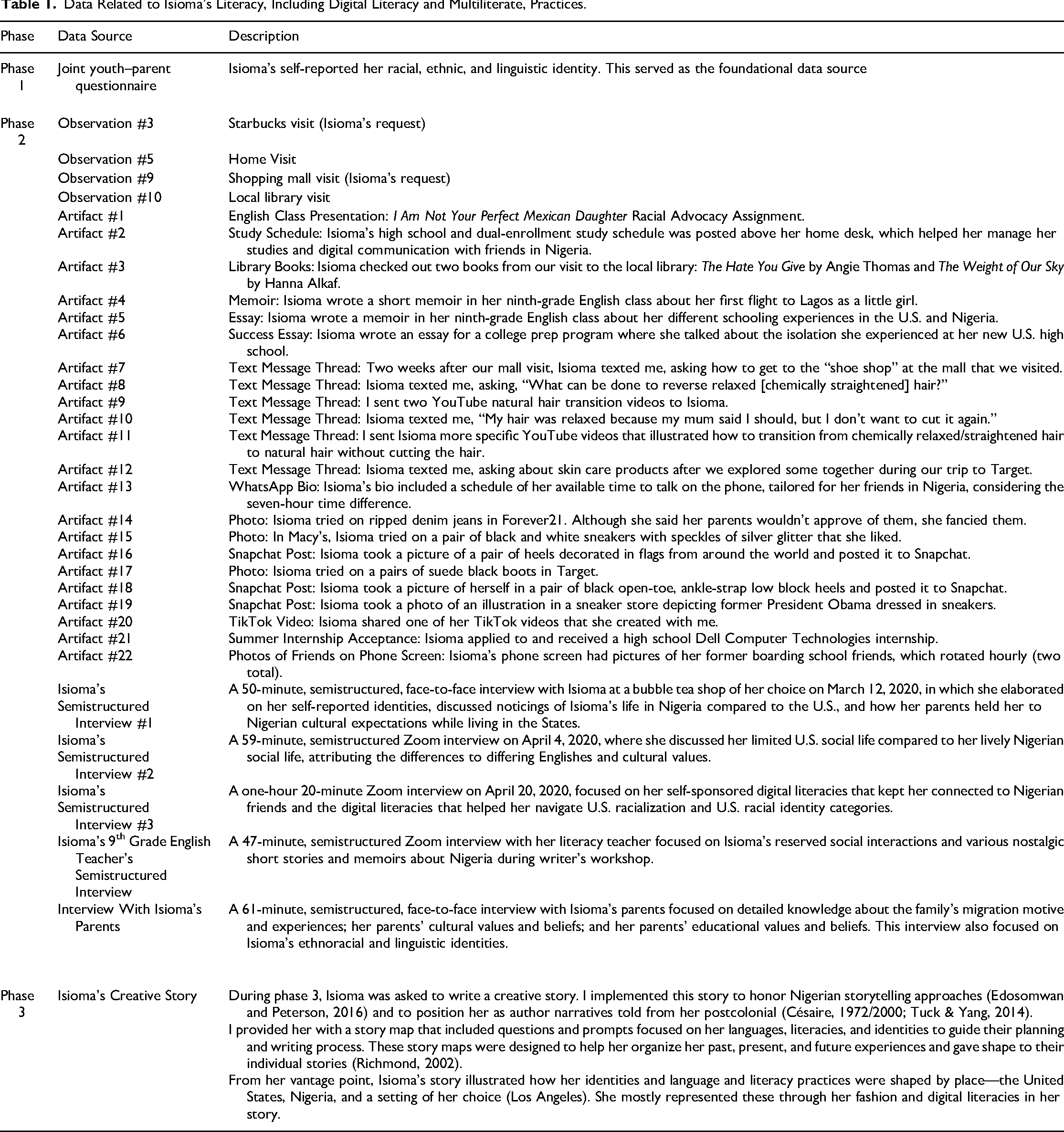
During each visit, I either jotted quick notes into a small notebook or audio-recorded my observations. In settings where our interactions required full attention (e.g., trying on sneakers), I handwrote my observations into a small notebook or made a voice note on my phone after the observation (Emerson et al., 2011). After completing all observations, I typed them into individual Google Docs and annotated notes related to the core concepts of this study. The digital format of these notes allowed me to identify and annotate instances related to Isioma's digital identity formation during data analysis. These notes also informed our informal discussions and the semistructured interviews I conducted with Isioma (n = 3), her parents (n = 1), and her literacy teacher (n = 1). Additionally, Isioma shared a total of 23 literacy artifacts during phase 2, some of which I requested to include in the study. Finally, I asked Isioma to write a creative story along with a story map to self-narrate how her identity, languages, and literacies have been shaped by various places—specifically the United States, Nigeria, and a setting of her choice.
Data Analysis
I employed narrative analysis (Kiramba & Oloo, 2020; Riessman, 2008) because it values individual stories as crucial sources of understanding (Connelly & Clandinin, 1990). I also integrated constant comparative analysis (Strauss & Corbin, 1998) across all three phases. This method facilitated theme identification by guiding the selection of narratives for further examination. Because our identities are narratives that convey who we are (Yuval-Davis, 2006), this approach was suitable for exploring Isioma's identity narratives through her digital literacies. As a critical ethnographer, I also centered Isioma's perspective in the data analysis.
In phase 1, I used narrative thematic methods to make sense of the data related to Isioma's digital literacy practices. First, I created a descriptive matrix (Miles & Huberman, 1994) in a Google Doc; I aligned Isioma's digital literacies vertically and the study's research questions horizontally. This matrix facilitated connections between her practices and the research inquiries, which I wrote as brief descriptions in each cell to illustrate Isioma's digital literacy practices in relation to each question. Next, I analyzed the blurbs to identify “similarities, differences, and trends” across Isioma's digital literacies (Averill, 2002, p. 855). My analysis guided the development of three-pages of single-spaced thick descriptions (Geertz, 1988) which outlined Isioma's digital literacy practices. I annotated these descriptions to “generate inductively a set of stable concepts that can be used [to] theorize” Isioma's digital literacy practices and to ground the emergent findings (Reissman, 2008, p. 74). After annotations, I created four codes: (1) race, (2) community, (3) identity, and (4) language/multilingualism. Examples of these codes are detailed in Table 2. I read through the descriptions three more times alongside the codes to make comparisons (Strauss & Corbin, 1998). This analysis phase culminated in initial analytical insights about Isioma's digital literacy employments, which I wrote up as a preliminary findings report.
Data Analysis Phases, Codes, Examples, and Definitions.
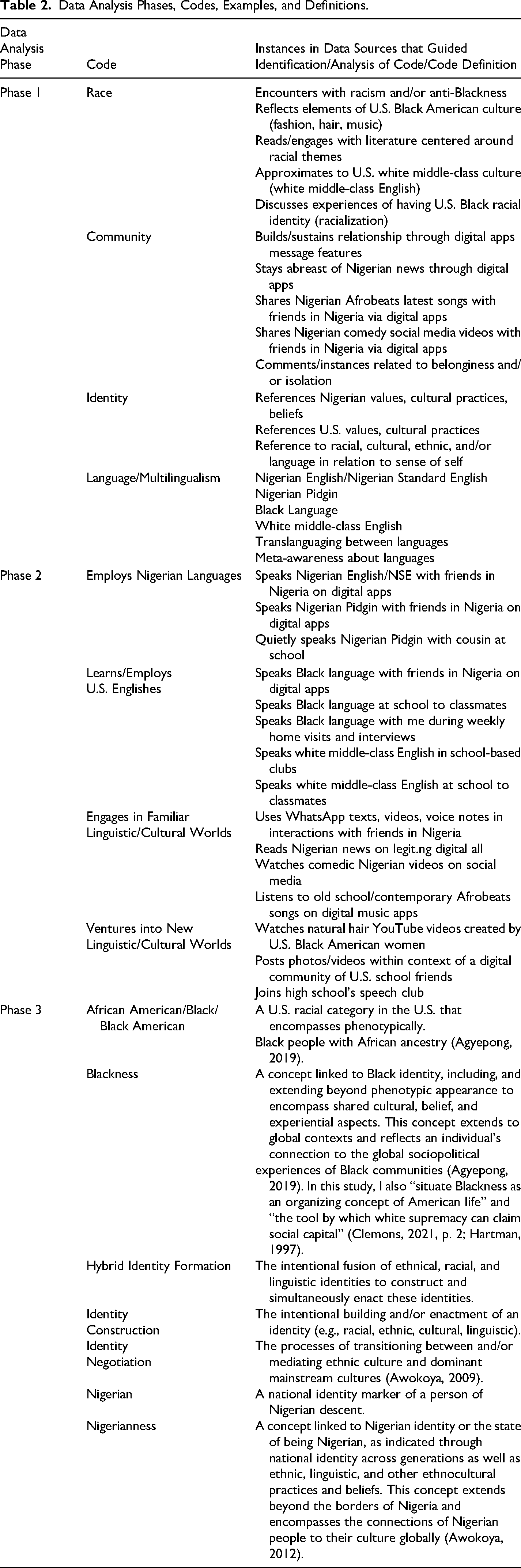
In phase 2, I shifted my attention to the ideological perspectives that undergirded Isioma's digital literacy employments in order to answer the first research question: How does Isioma use her digital literacy practices to navigate U.S. racialization processes and U.S. racial identity categories? Unlike the initial phase in which I separated Isioma's digital literacy practices into individual categories, in this phase I interpreted her digital literacy employments holistically so as to “move toward broader commentary” about each of them (Reissman, 2008, p. 6). Critical to this phase, in which I coded the preliminary findings, was my utilization of background literature on immigrant youth of color and anti-Black linguistic and raciolinguistic theories (Baker-Bell, 2020; Omi & Winant, 2014; Rosa & Flores, 2017). In my study, these theories meant any instance in which Isioma's digital literacies were influenced by race and/or language: for instance, using WhatsApp to speak Nigerian Pidgin with friends in Nigeria and watching a YouTube video to learn about Black American girls’ natural hair styling techniques. From this phase, the following themes emerged: Isioma (1) employs Nigerian languages; (2) learns/employs U.S. Englishes; (3) engages in familiar linguistic/cultural worlds; and (4) ventures into new linguistic/social worlds. Examples of these themes are provided in Table 2. Finally, I used these themes to construct a narrative response to the first research question in a Google Doc.
During phase 3, I focused on the ideological perspectives that undergirded Isioma's digital literacy employments concerning the second research question: How does Isioma use digital literacy practices to construct, negotiate, and narrate her ethnoracial identities? Drawing heavily from phases 1 and 2, I deductively coded the preliminary report from phase 1 as well as the narrative from phase 2 to generate two other codes: (1) identity construction and (2) identity negotiation. While Isioma's identity constructions were influenced by anti-Black linguistic and postcolonial theories, to understand them I also utilized literature on the identities of immigrant youth of color and their digital literacies. For example, I analyzed instances where Isioma used Nigerian flag emojis in her WhatsApp bio to challenge fixed U.S. racial identifications. Additionally, I created a conceptual matrix in a Google Spreadsheet to explore how Isioma's digitally mediated identities emerged from her digital literacies and language use on digital platforms. In this phase, the following themes emerged from my analysis of Isioma's digital literacies: (1) African American/Black/Black American; (2) Nigerian; (3) Nigerianness; (4) Blackness; and (5) hybrid/fluid identity. Operational definitions of these themes are also provided in Table 2.
After deeply examining all the data elements separately in the previous phases, I worked closely with Isioma (via text messages, phone calls, and Zoom conversations) to co-construct a narrative in which she saw herself authentically reflected.
Findings
In the section that follows, I present a narrative of Isioma's digital literacy practices as well as her identity constructions and negotiations through her digital literacies across digital platforms and in physical worlds.
Ethnoracial Identity Negotiations Through Digital Literacies and Multilingualism
As noted in the methods section, Isioma racially identified as “African” and ethnically identified as “Ukwani Delta-Igbo.” She explained her identity as follows: “I mean [it's] where I was born. I know my like . . . ethnicity and my traditions. I’m Delta Igbo and kind of . . . I’m Ukwaani. Yeah, so like, I narrowed it down to my dad's ethnicity ‘cause that's what most people do.”
Although her study and extracurricular schedules were intense, Isioma carved out intentional online time to socialize and learn about current events so that she could remain digitally anchored in Nigeria. Isioma professed much pride in her Nigerian identities, Nigerian languages, and what she referred to as her “Nigerian accent.” Despite her Nigerian pride, she shared that at school she often experienced racism and pressures to perform dominant forms of Blackness.
Shortly after Isioma's migration to Central Texas, her multilingual practices expanded to include American languages. As noted above, before her migration, she spoke Nigerian English, Nigerian Pidgin, and French. During a visit to a local boba tea shop, she told me about the challenges of learning what she referred to as “American English”: two new languages she was adding to her linguistic repertoire. She described her “American Englishes” as comprising both Black language and white middle-class English. Although both were American Englishes, both languages also pragmatically and semantically differed from the language that her parents declared as her first language: Nigerian English. Isioma especially enjoyed speaking Nigerian English, in particular enunciating her words with her “Nigerian accent.” She explained the differences in English styles in an interview excerpt here: I feel like I like my Nigerian accent more. When I’m tryna talk American, it's kinda hard [laughs]. But I’m still learning because I feel like now, I’m way more better than when I just came because it was way worse than this [laughs] . . . I remember in Nigeria we used to watch Nickelodeon to like practice [American English] and stuff, and getting here [United States], you have to watch people . . . watch how they talk. It's like you’re adapting to them . . . but I don’t want to adapt fully. There are some parts that I want to keep from my Nigerian parts. I want to keep my accent. I also want to keep what I [culturally] value.
Although Isioma embraced her Nigerian languages and accent, she quickly learned that Black language and white middle-class English were more highly regarded and more socially acceptable than her Nigerian languages. According to Isioma, this linguistic hierarchy led her to quietly communicate in Nigerian Pidgin through whispered tones with her Nigerian cousin who also attended her high school (Interview #1). This hierarchy, as she often shared, also compelled her to meticulously listen to and learn Black language and white middle-class English, which she strategically acquired by listening to her peers speak and by joining her high school's speech club—a space where she aimed to master both languages through speech and debate engagements with her peers. Learning these two U.S. languages was critical for Isioma because they helped her navigate racialized structures, discourses, and constructs at school. Considering that identity among multilingual individuals is formed by moving fluidly between languages (Dávila, 2019), Isioma also constructed and narrated Blackness through her Black language and white middle-class linguistic employments.
Isioma represented herself quite differently online as she engaged in individual and group-based digital literacies. She felt less burdened by the U.S. racialization that she experienced at school, which compelled her to racially position herself through Black language and white middle-class English. Instead, she streamed old-school and contemporary Afrobeats music on YouTube, read the latest Nigerian news on Legit.ng (a digital Nigerian news app), and texted her former boarding school friends in Nigeria via WhatsApp. Through these digital literacy practices, she remained connected to Nigerian culture and society and sustained deep emotional connections to her friends across safe digital platforms. Isioma's WhatsApp interactions were particularly significant to her daily life. Sometimes, because her friends in Nigeria texted and video-called her while she was at school, she frequently drew on a range of images, emojis, and written text to create and revise her WhatsApp bio. Because of the seven-hour time difference between Nigeria and her study schedule (see Figure 1), her bio informed her friends of her availability. When asked about the logic behind her detailed WhatsApp bio, Isioma said, I mean . . . I really miss them [my friends]. I really wanna go back and talk to them and stuff because I feel like I really connect to them more than I connect to most of my friends right here [in the United States].

Isioma's WhatsApp status for friends in Nigeria.
Over time, as Isioma maintained communication with her friends in Nigeria across national borders through their WhatsApp group chat, they began to question her Nigerianness. As we sat side by side on her living room couch, she laughed when she shared that her friends had once said that she “sounded different” after she sent them a WhatsApp voice note: “They be like, ‘Omo, you don change ooo’ [laughs].” Isioma's use of Black language syntax (“be like”) alongside Nigerian Pidgin reflected her knowledge that I, as a Nigerian American and African American researcher, would understand multilingual meaning-making. It also showed how her American Englishes became integral to her daily communication, which is what her friends in Nigeria noticed.
To understand the significance of Isioma's insight, it is helpful to examine the linguistic components of what Isioma said. In Yoruba, a language from southern Nigeria, “Omo” literally means child. When used in the context of Nigerian Pidgin, it can be used to relate to a friend of any gender to denote shock, disbelief, or to emphasize a point. In the case of Isioma's friends, they used the term “Omo” coupled with “ooo”—which is often used as an expression of emphasis—to express their deep shock at how differently she sounded. Her friend's statement can be translated to mean, “Sister, you have changed in America. You sound different.” To challenge her friends’ shock, Isioma sent back a response voice note in Nigerian Pidgin: “Abeg, I’m nooot. I’m still the same ooo” [laughs].” By using the Nigerian Pidgin word “abeg,” which means “please,” coupled with “ooo,” Isioma was pleading with her friends by emphasizing that she not only sounded the same but was also still Nigerian. I asked her why she emphasized her accent in her voice notes, and she told me, “It's just sort of like . . . having not changed.” Speaking Nigerian Pidgin, Isioma later told me, made her feel freer: “Like we can talk . . . We’re more free with more people who understand you, who know you better. Yeah.” By strategically speaking Nigerian English and Nigerian Pidgin while emphasizing her Nigerian accent through voice notes, streaming Afrobeats songs, and recruiting multiple digital images, emojis, and written texts across these digital platforms, Isioma held onto and defended her Nigerianness. She also narrated an identity that was less bound by U.S. racialization, racial identity categories, and racial discourse in these digital spaces; she was able to be a carefree, Nigerian teenage girl who desired to express herself in the languages and accents of her choice.
Constructing and Embodying Blackness Through Natural Hair and an Anti-Black Advocacy Stance
When Isioma lived in Nigeria, she chemically straightened her hair. Shortly after migrating to the United States, she found herself in the middle of the U.S. Black American natural hair movement. 4 While she told me that some women in Nigeria often wore their hair in its natural, nonchemically straightened state and that a former classmate's natural hair reached the middle of her back, she also noticed that almost all the Black American girls at her high school wore their hair in its natural state. The natural hair textures and hairstyles of Black American girls practice inspired Isioma to join the natural hair movement, too. Since my hair was also in its natural state, Isioma frequently texted me—thereby positioning me as a cultural broker—to learn about the natural hair transition and sustenance process. As we texted, I learned that Isioma's chemically straightened hair was her mother's decision, and although Isioma desired to transition her hair to its natural state, she was unsure how to do so without cutting off the relaxed parts of her hair (Observation #5). To assist her, I sent her YouTube videos created by adolescent African, Black American, and Caribbean girls that documented their natural hair transition process, the products they used, along with hairstyle tutorials. I intentionally chose videos created by girls across the Diaspora to serve as visual inspirations and examples of what was possible for her. As Isioma watched the videos amid her intense school and study schedule, she further immersed herself into the Black natural hair world—a digital space where Black women across the globe have unapologetically opposed Eurocentric perceptions of beauty.
Midway through her natural hair transition, Isioma's younger sister called her natural hair “ugly.” Her older Nigerian cousin, who had also recently moved from Nigeria to the United States, and attended the same high school, also questioned Isioma's choice, asking “Why did you cut your hair?” Their responses did not discourage Isioma. Instead, she continued to watch and learn from the adolescent girls’ natural hair videos, defying her family's internalized Eurocentric beauty standards and deepening her knowledge of the interconnections between hair and race in the United States. She explained her view: “It's like . . . when you wear natural here [in the United States], it tells people that you are really . . . really proud of your skin color . . . to be Black” (Interview #3).
On her joint youth–parent survey, conducted 11 months after she migrated to the United States, Isioma initially identified racially as “African.” However, as she spent more time in the United States, she became racialized, which was evidenced by her unfortunate encounters with school- and society-based anti-Blackness and her explicit statements about race; she explained this transition with statements like the following: “It seems like the rich [neighborhood] areas are for white people in America.” These encounters influenced Isioma's intentional decision to transition from chemically straightened to her natural 4b hair—a coily Z-shaped, densely packed curl pattern that bends in a way that makes a zigzag pattern. The knowledge she gathered about natural hair processes in the racialized YouTube digital space extended into and overlapped with her physical worlds, where she engaged in multiliterate and racio-semiotic offline natural hair practices as significations of Blackness. Isioma's hair became a symbol, a form of interpersonal meaning-making, and a medium through which she communicated a Black racial identity amid the racial discourses within her U.S. school setting. Thus, by drawing on these digital and multiliteracies, Isioma constructed and embodied Blackness.
Isioma further embodied Blackness through her stance and advocacy against U.S. anti-Black racism, especially through her assignments in her English class, where her teacher allowed students to choose independent reading texts through a reader's workshop model. Throughout her ninth-grade year, Isioma read young adult books with Black American and Latinx girl protagonist characters, such as On the Come Up by Angie Thomas, which she read independently, and I Am Not Your Perfect American Daughter by Erika Sánchez, which she read as part of a diverse young adult book club in class. She responded to both books through respective multiliterate and digital presentations and focused on themes in which young girls charted their life paths as they overcame obstacles such as their intersectional racial and gender identities. Isioma intentionally sought out more books with racial themes. During one of my weekly home visits, Isioma and I visited the library per her mother's, Mrs. Oki's, request. While perusing the books in the library, Isioma turned to me and asked, “They don’t have any racial stuff?” I asked her, “Is that what you would like to check out today?” She responded, “Yes. Dear Martin.” I pulled out my phone to google the book's title, and when she saw the image of the cover, she confirmed that that was the book. When she took my phone to the librarian to show them the book, she unfortunately learned that Nic Stone's Dear Martin book was not on the shelf.
While Isioma was able to assert her stance against anti-Blackness at school, there was little space for her to do so at home. Instead, her mother, Mrs. Oki, believed that engaging in racial matters was a distraction from attaining educational success—one of the core reasons that she and her husband, Mr. Oki, migrated to the United States with their four children. Race, as Mrs. Oki often discussed it, did not impede Black success in America. She shared her view in this interview excerpt: Isioma complains about racism here in America. I tell her to be diligent and to stand her ground. She can be anything that she wants to be. My children tell me, “Oh, but the history of this country.” I tell them, “But look at this [pointing to the television] . . . forget history.” I want them to be great. I call them to the living room to watch movies and shows that are inspirational. I once showed them the Michelle Obama movie. Michelle Obama is not a pushover. Michelle's [college] roommate left because she didn’t feel safe being around young, Black Michelle Obama . . . but that didn’t stop her. I also had them watch Gifted Hands in Nigeria and again here in America. They’ve watched Gifted Hands about two to three times. They don’t waste time on video games. I speak over them, “You will be great.” I keep saying it. I teach them not to be a pushover. I will keep speaking. I will keep talking. I will never stop.
Mrs. Oki's sentiments aligned with social science and educational scholarship that has argued that Black immigrant parents conceptualize educational attainment in countries like the United States as a medium to overcome racial discrimination (Awokoya, 2012; Doucet, 2014; Kinkead-Clark, 2014). Mrs. Oki also strongly relied on her faith as a medium to protect her children from the harms of racism. Like the oppositional comments that Isioma received from her younger sister and cousin about her natural hair transition, Isioma was also not deterred by her mother's opposing stance on U.S. anti-Blackness. Isioma continued to honor, construct, and embody Blackness as well as advocate against anti-Blackness through her YA book reading and multiliterate practices.
Racial Identity Positioning via Social Media and Fashion
In an essay for a summer internship application, Isioma once stated that she experienced “the inevitable culture shock of being in a different school system” upon her arrival in the United States. In an interview, she elaborated on this statement, sharing that unlike her U.S. high school experience where she could wear “regular clothes,” in Nigeria she “dressed in school uniforms.” This clothing difference, according to Isioma, made her U.S. schooling experience feel “overwhelming.” This feeling in turn led her to use a nonverbal, multiliterate medium—fashion—to construct a fashion-forward identity at her U.S. school. Isioma always loved fashion, but the dress code of her Nigerian boarding school did not permit her to showcase it at school. However, in the United States, she was able to draw on a range of multiliteracies, as she explained here: I really like fashion. It's like good to dress yourself . . . the way you dress, it tells people who you are…kind of. You can always show off with your dressing and tell people how you want to be presented and look like in a lot of different places.
Isioma's intentional use of fashion to communicate a fashion-centric identity exemplified her reliance on multiliteracies to navigate raciolinguistic ideologies that silenced and accented her Nigerian languages; this then led her to expand her multilingual repertoire by learning and speaking Black language and white middle-class English. Her use of fashion multiliteracies also highlighted the intersections of immigration, race, communication, and belongingness. Like her natural hair practices, her fashion interests overlapped with her digital worlds where she spent significant time exploring and trying on outfit combinations across digital platforms such as Pinterest and Instagram.
As we developed a closer relationship, Isioma asked me to exchange my weekly home observation visits for trips to local malls and stores to window shop and try on clothes—most of which she posted to Snapchat. During one visit to the mall, she quickly walked inside of a sneaker store. Standing closely beside me, she bashfully asked if she could try on some of the sneakers. I encouraged her to ask the salesman, and in a low tone, she asked him, “Can I try on these Vans sneakers?” Minutes later, he came out carrying four boxes of Vans sneakers in different colors. As she tried on each pair of shoes, she handed me her cell phone so that I could take photos of her. She later went to another store to try on a pair of black Nike Air Force One sneakers. She posted the photos to Snapchat shortly after. During another weekly observation, she saw an illustration of President Obama dressed in sneakers inside a sneaker store and immediately took a picture of it. She laughed while posting the photo to her Snapchat and said, “It doesn’t look like he would wear those type of sneakers.” Her laughter revealed her cognitive dissonance, and arguably, a fixed understanding of what it means to “look” professional.
I was curious to know more about Isioma's Snapchat fashion posts and asked her to tell me more. She said that while she had befriended some former Nigerian school friends on the app, they rarely used it. As a result, she mostly used Snapchat to communicate with her U.S. classmates in her dual-enrollment college program. They all used Snapchat's group direct message feature to plan and prepare for their upcoming speeches and speaker roles. Isioma, however, strategically used this digital space to post pictures of herself dressed in U.S. Black American popular cultural clothing items at popular U.S. spaces. As she put it here: “Like, if I go somewhere like the mall, I can just post it there . . . I just like post photos of places I go that I feel like it's beautiful or something like that.” She went on to say that these images emphasized “the American side of her.” While Isioma told me that her “American identity” construction was not intentional, and that she intentionally held on to her Nigerian identity through her Nigerian English and Nigerian Pidgin languages, she eagerly requested visits to Starbucks, Target, and other stores that symbolized U.S. popular culture. However, her requests to engage in these digital and multiliterate practices often conflicted with her parents’ more traditional Nigerian cultural values and educational expectations. Nonetheless, Isioma asked to visit these symbolic U.S. places to take pictures of herself stylishly dressed, which she would then post.
The desires and expectations of Isioma's classmates, which were also embedded in U.S. racial identity categories and associated expectations, took precedence over her parents’ traditional Nigerian cultural and educational expectations. Thus, Snapchat served as a digital space that allowed Isioma to racially position herself and socially align with her U.S. classmates and peers in a way that her physical world did not. Using this and other digital spaces better equipped her to navigate the overwhelming pressure to respond to U.S. racialization and fit inside U.S. racial identity configurations in her physical world.
Discussion
This study explored the digital literacy practices and ethnoracial identity constructions and negotiations of one 13-year-old girl, Isioma. While previous studies have examined the digital literacies of Asian, Caribbean, and Latinx immigrant youths (Compton-Lilly et al., 2017; McLean, 2010; 2020; Kim, 2016; Lam, 2013; Lam & Christiansen, 2022), this study contributes uniquely to the field by focusing on the digital literacies of an underexamined immigrant youth group—Nigerians. In doing this study, I have extended the existing literacy knowledge base by shedding further light on ethnoracial diversity, not only within identities of immigrant youth of color but also within Black youth identities.
In my examination of Isioma's digital literacy practices, I highlighted how she recruited multilingualism, digital tools, images, and written text to maintain connections with Nigeria; to sustain social and emotional bonds with friends in Nigeria; and to defend and narrate her Nigerian identity. I also showed how Isioma's encounters with U.S. racialization and anti-Blackness cultivated her stance against anti-Black racial discrimination, which she demonstrated by crafting and embodying Blackness. Central to her Black racial identity formation was her participation in the YouTube Black natural hair community that facilitated her transition from chemically straightened to natural hair. Furthermore, her reading of young adult books, which featured Black and Latinx adolescent protagonists who explored intersectional themes of racial justice and young adulthood, played a significant role in shaping her identity. Moreover, I illustrated how Isioma employed social media and fashion multiliterate practices, particularly within her U.S. school and social media environments, to position herself racially and, consequently, socially, in response to the racial discourse and expectations prevalent in her Central Texas school. In alignment with literacy scholarship that has emphasized the interconnectedness of digital and physical realms (Jandrić et al., 2018; Kim, 2016; Nelson et al., 2020), I illustrated the reciprocal nature of Isioma's digital literacies in shaping her ethnoracial identity constructions and negotiations. While existing scholarship has documented immigrant youths’ identity formations and ethnic identity denouncements resulting from immigration (Doucet, 2014, Smith, 2019), I showcased how Isioma strategically engaged in digital literacy to preserve her Nigerian ethnic identity and to craft a U.S. Black racial identity. I also highlighted how Isioma dismantled rigid U.S. identity categories. Given the recent science of reading school mandates and attacks on racial diversity in U.S. school settings, this depiction of identity negotiation has underscored the use of digital platforms as spaces for facilitating fluid ethnoracial negotiations. It also has underscored the significance of digital, multilingual, and multiliterate literacy practices in support of student identities and well-being in ways that traditional literacy curricula often cannot.
By documenting Isioma's multilingualism, which included Nigerian English, Nigerian Pidgin, and Black language, both on digital platforms and at school, I revealed how her proficiency in multiple languages facilitated her navigation of U.S. racialization and linguistic hierarchies. Through her Black language employments, which facilitated her Black racial identity constructions, she disrupted raciolinguistic ideologies (Rosa & Flores, 2017) and countered anti-Black linguistic racism (Baker-Bell, 2020) by agentively using language for racial and social positioning. Distinct from linguistic appropriation, the incorporation of features of West African languages into Black language, alongside Isioma's West African identity and her anti-Black stance, precluded her from being categorized as a linguistic appropriator of Black language. Instead, Isioma's acquisition of Black language exposed the need for deeper investigations and linguistic projects that foster the linguistic solidarity of Black American and Black immigrant youth. Although Nigerian English and Nigerian Pidgin were deemed socially inappropriate compared to the Black language and white middle-class English that Isioma spoke at school, her friends in Nigeria preferred Nigerian language usage during their WhatsApp communication. In doing so, they delinked their Nigerian languages and accents from the raciolinguistic (Flores & Rosa, 2015; Rosa & Flores, 2017) discourses that often discriminate against Nigerian languages and accents. Critical to Isioma and her friends’ disruption of raciolinguistic perspectives against Nigerian English, Nigerian Pidgin, and their Nigerian accents were their postcolonial perspectives of their identities and languages, which refused to position both as the Other (Appiah, 2017; Eze, 2014). Based on this finding, language and literacy researchers and practitioners should also adopt and apply postcolonial perspectives of African language to literacy and language curricula to enhance the multilingual learning experiences of youth.
Finally, this study was unique in its multisited methodological design. Because I followed Isioma's requests to visit places of her desire across her home, community, and digital spaces, I intimately traced the interrelations between race, language, literacy, and identity from her perspective. Thus, this study offers methodological implications for literacy researchers to design further flexible and responsive studies that are inclusive of spaces beyond literacy classrooms to explore language and literacy as well as identity formations that may not be visible in schools. As my findings showed, raciolinguistic (Rosa & Flores, 2017) and other damaging ideologies silenced Isioma's Nigerian English and Nigerian Pidgin at school. Considering that few studies have documented the agency and strengths of African immigrant youths (Kiramba et al., 2022), my study should encourage researchers to continue to examine spaces where youth can engage in agentive and preferred language and literacy practices, such as in digital spaces, community centers, and (if given permission), the homes of youth to gain more authentic portrayals of their identity constructions and negotiations through their languages and literacies.
Supplemental Material
sj-docx-1-jlr-10.1177_1086296X241273989 - Supplemental material I’m Still Nigerian: Navigating Race Through Digital Literacies
Supplemental material, sj-docx-1-jlr-10.1177_1086296X241273989 I’m Still Nigerian: Navigating Race Through Digital Literacies by Lakeya Afolalu in Journal of Literacy Research
Supplemental Material
sj-docx-2-jlr-10.1177_1086296X241273989 - Supplemental material I’m Still Nigerian: Navigating Race Through Digital Literacies
Supplemental material, sj-docx-2-jlr-10.1177_1086296X241273989 I’m Still Nigerian: Navigating Race Through Digital Literacies by Lakeya Afolalu in Journal of Literacy Research
Supplemental Material
sj-docx-3-jlr-10.1177_1086296X241273989 - Supplemental material I’m Still Nigerian: Navigating Race Through Digital Literacies
Supplemental material, sj-docx-3-jlr-10.1177_1086296X241273989 I’m Still Nigerian: Navigating Race Through Digital Literacies by Lakeya Afolalu in Journal of Literacy Research
Supplemental Material
sj-docx-4-jlr-10.1177_1086296X241273989 - Supplemental material I’m Still Nigerian: Navigating Race Through Digital Literacies
Supplemental material, sj-docx-4-jlr-10.1177_1086296X241273989 I’m Still Nigerian: Navigating Race Through Digital Literacies by Lakeya Afolalu in Journal of Literacy Research
Supplemental Material
sj-docx-5-jlr-10.1177_1086296X241273989 - Supplemental material I’m Still Nigerian: Navigating Race Through Digital Literacies
Supplemental material, sj-docx-5-jlr-10.1177_1086296X241273989 I’m Still Nigerian: Navigating Race Through Digital Literacies by Lakeya Afolalu in Journal of Literacy Research
Footnotes
Declaration of Conflicting Interests
The author declared no potential conflicts of interest with respect to the research, authorship, and/or publication of this article.
Funding
The author received no financial support for the research, authorship, and/or publication of this article.

Notes
References
Supplementary Material
Please find the following supplemental material available below.
For Open Access articles published under a Creative Commons License, all supplemental material carries the same license as the article it is associated with.
For non-Open Access articles published, all supplemental material carries a non-exclusive license, and permission requests for re-use of supplemental material or any part of supplemental material shall be sent directly to the copyright owner as specified in the copyright notice associated with the article.
